![]() |
||||||||
|
« October 2005 | Main | December 2005 » November 30, 2005The Market Today After rising 0.0016% yesterday, the S&P 500 fell 0.64% today while our Buy List gave back 0.43%. For the month of November, the Buy List was up 5.88% and the S&P 500 was up 3.52%. For monthly tracking purposing, I’m going to rebalance the entire Buy List based on today’s closing pricing. I’m going to equally weight all 25 stocks. Then on January 1, we’ll start tracking the 2006 Buy List (which I'll have for you in about two weeks). Our worst performer today was the best performer for the month. Quality Systems (QSII) gained 21.3% during November despite giving back 8% today. The best stock today was Donaldson (DCI) which jumped nearly 6% to a new 52-week high. Looking over today's GDP, here are some thoughts about interest rates and the economy. Over the last 10 quarters, the U.S. economy has grown by 17.6% (including inflation). That’s about 6.7% on an annualized basis. That’s very good. At the beginning of that period, a 10-year Treasury bond yielded about 4%—so you can see that borrowing has really paid off (for now). My concern is that the Treasury market will soon start demanding a larger piece of the action, and rates will rise. If you were loaning money and saw your borrower making such nice returns, wouldn’t you want some of it? I would. Here’s your odd stat for the day, along with a small lesson. There are only eight stocks that have beaten the S&P 500 for the last seven straight calendar years. That’s a lot lower than what I would have guessed. If we assume that every stock has a 50-50 chance of beating the market each year, then seven straight victories would be 1-in-128 (one over two to the seventh). Given that a few thousand stocks have traded continuously over that time, I would have guessed that a few dozen stocks had seven-year win streaks. Over 500 stocks have beaten the market the last five years. What happened? 1999. The S&P 500 was up a lot that year, but most stocks weren’t. The reason is that the index is weighted by market value. The bigger you are, the more say you have. And the big boys were soaring that year. For everyone else, 1999 wasn’t much fun. The median return was 0%. The eight stocks that beat the S&P 500 from 1998 through 2004 are Canterbury Park (ECP), Chico’s FAS (CHS), Cohesant Technologies (COHT), Electronic Arts (ERTS), FactSet Research Systems (FDS), K-Swiss (KSWS), Oshkosh Truck (OSK) and Rare Hospitality (RARE). Here’s how the eight are doing so far this year: Chico's FAS 93.76% Beating the market one year isn’t so hard. Doing so consistently is very tough. Today's Link: John Mugarian. Posted by edelfenbein at 7:11 PM The Dual Market We basically have two stock markets right now, energy stocks and everything else. All the other industries are highly correlated to each other. The big outlier is energy stocks. Also, the daily volatility of the other sectors is still very low. Energy is the only place that’s showing any action. The most popular way of investing in energy stocks is through the S&P 500 Energy Spyders (XLE). This is almost akin to what the Nasdaq 100 ETF (QQQQ) was during the tech bubble. Look at this chart of the Financial Spyders (XLF) compared with the S&P 500 ETF (SPY):
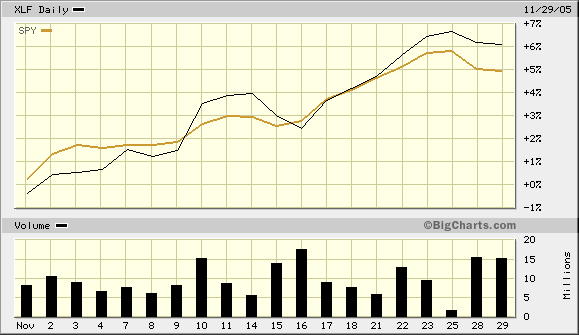
They move together like waltzing partners. I just used the finacials as an example, but several other sectors are moving just like that. Now look at the Energy Spyders:
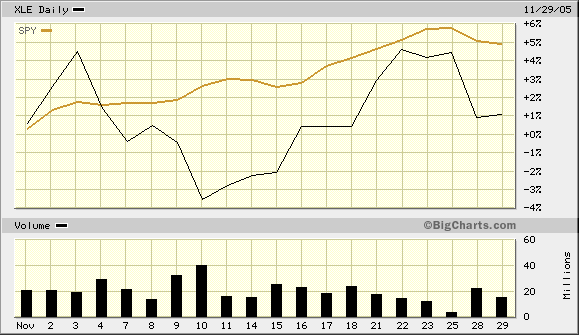
Talk about following your own drummer! The overall market has almost no bearing on energy stocks (and vice versa). Posted by edelfenbein at 3:40 PM Credit Suisse First Boston: Dell Undervalued From Forbes: Credit Suisse First Boston maintained an "outperform" rating on Dell and advised investors to buy shares of the PC giant at current levels. Posted by edelfenbein at 2:22 PM Private Equity Strikes Again The 80's are back! Today's buyout is of TDC, the Danish phone company. The private equity group includes Apax Partners, the Blackstone Group, Kohlberg Kravis Roberts, Permira Advisers and Providence Equity Partners. They're looking to pay $12 billion for TDC. This isn't over. I expect to see many more. Posted by edelfenbein at 1:16 PM Today’s GDP Report As many of you know, I’ve been saying that the economy is much stronger than a lot of experts think. When the first report on third-quarter GDP came out last month, I wrote: “According to surveys, Wall Street’s estimate for third-quarter GDP growth is 3.6%. That’s way too low. I expect to see a number over 4%. In fact, I wouldn’t be surprised to see a number over 5%.” It turned out to be 3.8%. I still thought that was too low. Today I found out that I was right. The government revised GDP growth higher to 4.3%. Today’s report suggests that economic growth is accelerating—the rate of growth is itself increasing. Also, inflation continues to be benign. This is excellent news for investors. The market is down a bit today. Quality Systems (QSII) is taking a hit due to an analyst downgrade. Our Buy List is holding up well so far. All told, November has been a great month for the Buy List. I’ll have final numbers later today, but we should be up around 6%, and the S&P 500 is up about 4% (that doesn’t include dividends). Also, Donaldson (DCI) is rallying on its strong earnings announcement from yesterday. Posted by edelfenbein at 1:08 PM November 29, 2005Big Value in Small-Caps For the last 10 years, small-cap stocks have been the leading sector. Looking at 10-year returns of major fund categories, it's clear that the leading category, small-cap value, got a big leg up during the bull market that began in 2003. Posted by edelfenbein at 5:56 PM Gold at $500 Gold finally broke $500 an ounce. "People are looking for an alternative investment to U.S. dollar-based instruments. The expectations of inflation in the coming year are very high," said Albert Cheng, Far East managing director for the industry-backed World Gold Council. Posted by edelfenbein at 3:52 PM Consumer Confidence Rises More good news. Consumer confidence had its biggest gain since 2003. Consumer confidence rose in November by the most in more than two years as falling gasoline prices encouraged shoppers before the start of the holiday season. Posted by edelfenbein at 12:49 PM The Morning Market Don’t worry. Brown & Brown’s (BRO) stock hasn’t been cut in half. The stock split 2-for-1 this morning. So if you own, you now have twice as many shares. Brown & Brown even got a shout-out from Cramer last night. The bad news is that Frontier (FRNT) didn’t split, it’s just down today. The company announced a debt offering and the stock is currently down about 10%. The market is regaining some lost ground from yesterday. Energy and small-caps are leading the charge. Dell (DELL) is also looking good. Posted by edelfenbein at 10:32 AM Southwest Goes to Denver The Wall Street Journal has a front page story this morning about Southwest Airlines (LUV) entering the Denver market. Whenever Southwest enters a new market, its competitors cut and run. Not this time. Frontier Chief Executive Jeffery Potter caught wind of Southwest's move the night before the announcement, he recalls. Mr. Potter knew that other airlines, including Alaska Airlines, had successfully competed against Southwest in some cities, and felt reassured that Frontier compared favorably to those airlines, he says. The article includes an interesting table. Including fuel costs, Southwest is a bit cheaper than Frontier. Excluding fuel costs, Frontier is cheaper. Posted by edelfenbein at 5:07 AM The Undefeated Colts
OK, I’m officially on the Colts’ bandwagon. This team is incredible. I just watched them dismantle the Steelers. Every part of their game is top notch. They even have the league’s best kicker. Jeez, just give them the trophy right now. The Colts are 11-0 and I’m rooting for them to finish the season undefeated. I’m getting tired of the 1972 Dolphins. If you’re not a football fan, the ’72 Dolphins were the last team to go undefeated. Every year the team reunites and celebrates when the last undefeated team goes under. It used to be cute but not anymore. The time has come for another team to finish off a perfect season. Apparently, Don Shula thinks the Colts can do it. Since Miami’s annus mirabilis, eight teams have started 10-0. In 1975, the Vikings lost their 11th game to the Redskins 31-30. The 1984 Dolphins made it to 11-0 before losing to San Diego. Miami then went on to lose the Super Bowl to the 49ers—a team which had only lost one game. The 1985 Chicago Bears were just scary. They went 12-0 before being losing to the Dolphins in a legendary Monday night game. That was the most-watched game in the history of Monday Night Football. The hype for that game was incredible. It was as big as any Super Bowl. Dear lord, Marino was amazing in his prime. Miami ran rings around the Bears. It’s hard for me to believe that this Friday will mark the 20th anniversary of that game. Yikes! I remember how the whole world was waiting for the rematch in the Super Bowl but Miami had to go and lose to New England in the AFC Championship game. I actually felt sorry for the Super Bowl’s promoters. What could have been Ali-Frazier IV turned into football’s equivalent of Grenada. The Bears destroyed the Patriots 46-10. In 1990, the Giants and the 49ers made it to 10-0 but both teams got tripped up in Week 11. They met in the NFC Championship game which the Giants won 15-13. And thanks to Scott Norwood’s missed field goal, New York won the Super Bowl. The next year, the Redskins started 11-0 before losing to their archrivals, the Cowboys. Washington also went on to win the Super Bowl. In 1998, the Broncos made it all the way to 13-0. Strangely, they lost two straight games before recovering and winning the Super Bowl. So I guess history is on the Colts' side of winning the Super Bowl. I see that in the second-to-last game of the season, the Colts play the Seahawks in Seattle which could be trouble. Shaun Alexander is having a great season, but if the Colts keep playing like this, they’re going 16-0. Posted by edelfenbein at 12:17 AM November 28, 2005The Market Today The winning streak was finally snapped! The S&P 500 had gone up for seven straight sessions, and 14 of the last 17. But another rally was not to be. The S&P 500 gave back 0.85%, and the Buy List lost 0.70%. Let’s thank Thor Industries (THO) for saving us today. This was clearly our big winner. In fact, it was one of the top performers on the entire NYSE. The rest of our Buy List must have been busy shopping online. Only five of our stocks were up, and 20 stocks closed lower. Frontier Airlines (FRNT) is now down to $8.89 a share. As I’ve said before, this is an unusually risky stock for our Buy List. Nevertheless, I think it’s a compelling bargain. In my opinion, it’s very likely that Frontier can make 80 cents a share next fiscal year. Considering that sales jumped 22% last quarter, you can see that Frontier has a lot of potential. But the stock is very volatile. It’s worth a shot only if you’re already well-diversified. The big news today was Merck’s (MRK) restructuring. This is sad to see from a once-dominant company, but there is a lesson here. Do you ever notice that some companies never announce a “bold, new restructuring plan”? I couldn’t imagine Expeditors (EXPD) announcing “a major cost-cutting initiative.” The reason is that they’re always looking to cut costs. That’s what great companies do. It’s in their blood. They don’t have to announce it. Hershey (HSY) also recently announced a reorganization. The Wall Street Journal began an article today with this: “Bank of America Corp. shares are up 9.2% since Sept. 8 -- the day Alvaro G. de Molina took over as chief financial officer of the nation's second-largest bank. A coincidence? Maybe not.” Actually, it is. My apologies to Mr. de Moline, but corporations don’t turn on a dime. Not even several thousand dimes. (Isn’t every bank up 9.2% since September 8?) Reorgs and restructurings and new business plans and new CFOs always start out optimistically. The stocks often respond. I wish them all well. And yes, some do work out, but most never do. I’m sorry, but it’s true. On that cheery note, here’s today’s link o’the day: groovystocks.com. Check it out. Posted by edelfenbein at 8:11 PM Broker Haggle Guide Forbes presents the "Broker Haggle Guide." My advice: It never hurts to ask. Posted by edelfenbein at 2:19 PM Today’s Make-Believe Issue: We Have Too Much Cash Here’s a great example of one of my pet peeves about the financial media. No matter how good the news is, we can always find a negative angle. The writer's goal is what paragraph do we drop the crucial "but" line in. Here’s how you start: Great news! Corporations are making record profits. This year, the companies in the Standard & Poor's 500-stock index are on track to pay out more than $500 billion to shareholders in the form of dividends and share repurchases, or buybacks, according to S&P. That's up more than 30% from last year's record -- and equivalent to nearly $1,700 for every person in the U.S. Sounds good. In every episode of “Behind the Music,” you always get the line that goes something like: “Just when it seemed like nothing could go wrong for Styx, everything went wrong.” But there could be an economic downside to the cash glut. Uh oh. The fact that companies have been sitting on so much cash is, in some respects, a vote of no-confidence in U.S. economic prospects: At least some companies may be signaling they can't find enough profitable ways to reinvest their earnings, so they are simply returning it to shareholders. Attack of the indefinite pronouns! In some respects, some journalists may use a few of them as a vote of no-confidence in a threadbare theme. By the way, what might some investors being doing with some of their dividends? Burn them or invest in the economy? It doesn’t say so we’ll simply never know. Through dividends, a company, in effect, distributes part of its profits directly to shareholders. Share buybacks, in which a company buys some of its own shares outstanding, can benefit shareholders in other ways: They can boost the company's share price, and they can also be a smart corporate investment if the company correctly judges that its stock is undervalued. Or it can be a complete waste of money. Just ask shareholders of Cisco. Some economists call the payouts this year an ominous development that may be stealing from future economic growth, since they suggest companies are having trouble spotting new products, projects or services they think will boost their growth. "These payments keep the economy growing more slowly because that money isn't flowing into capital spending," says Milton Ezrati, chief economist at Lord Abbett Funds in Jersey City, N.J. "If businesses are giving up on innovation, we have problems." Giving up on innovation? Was that what TheGlobe.com was? No one told me. And now for our final paragraph. The good news for dividend fans is that it looks like there's ample room for these checks to grow from here. Today, 385 companies in the S&P 500 pay dividends, down from a peak of 469 in 1980. And even though billions are going out the door, dividends only comprise about 32% of payers' profits. Historically, companies have paid out about 54% of their profits as dividends. So it turns out there’s no issue at all. Dividends are rising and they’re still far below their historic level. Yet somehow the economy was able to grow and innovate in the past. Why can’t the media? Posted by edelfenbein at 11:41 AM Thor’s Earnings Today’s trading is fairly quiet but Thor Industries (THO) is soaring on a strong earnings report. Thor Industries Inc., a maker of motor homes, travel trailers and other recreational vehicles, said Monday its fiscal first-quarter profit rose 24 percent, driven by higher recreational vehicle sales and increases in retail market share. The stock is up over 7% today. It looks like we’ll have to wait another day for Dow 11000. Posted by edelfenbein at 11:10 AM What's Buffett Buying After sitting on the sidelines for much of 2004, Warren Buffett is buying stocks again. What’s he buying? The Oracle of Omaha has been snapping up shares of Wal-Mart (WMT) and Anheuser-Busch (BUD). Don’t worry—he hasn’t gone completely Bubba on us. Buffett has also bought shares in Diageo (DEO), which is a European liquor company (Johnnie Walker, Captain Morgan, Smirnoff). Plus, he’s been increasing his stake in Wells Fargo (WFC). Remember, sometimes the best stock to buy is one you already own. Posted by edelfenbein at 6:37 AM The Unsinkable Dollar A widening trade gap is supposed to sink a currency. But our trade deficit keeps growing and the dollar is rallying. What’s going on? The Wall Street Journal opines: At the end of the day, a currency isn't a true commodity, like gold or wheat. It is a store of value. Its supply is determined by a central bank, which has a monopoly on its creation. Foreign-exchange markets are dominated by a cartel of central banks, and currency rates are a function of those central banks' monetary policies. Posted by edelfenbein at 5:45 AM November 27, 2005A Rebound for Airlines One of my golden rules is never, never, never, never invest in an airline stock. Airlines stocks are nothing but trouble. They’ll lie to you. They’ll cheat. They’ll steal. They’ll say they love you, but they stay out late drinking. Airline stocks can never be trusted. Even Warren Buffett got burnt in an airline investment. Just don’t do it. So...have I told you about our airline stock? Yes, I admit it. Frontier Airlines (FRNT) is on our Buy List. I wish I could say that I have some highly technical reason for liking Frontier. I don't. I simply think the stock is undervalued. As long as your portfolio is well-balanced, I think it’s acceptable to add a reasonably risky stock. But it should be a small portion of your portfolio. Also, for the first time since Kitty Hawk, things are looking up for the airline sector: After five years of steep losses, the U.S. airline industry appears to be on the verge of a recovery, as fuel prices come off their peaks, labor costs decline and excess capacity finally begins to shrink. Posted by edelfenbein at 2:30 PM Cyber Monday The Friday after Thanksgiving is traditionally known as Black Friday, which is the beginning of the holiday shopping season. Now we have a new phenomenon, Cyber Monday. This is supposedly when the online shopping season starts. Why Monday? That’s when everyone is back in the office and they can use faster Internet connections. Posted by edelfenbein at 2:07 PM The $74 Million Research That No One Wants As part of the famous global research settlement, Wall Street brokerage firms are supposed to give their clients free, independent research. The problem is, nobody wants it. Reports by outside consultants, the first since the 2003 settlement, show that 10 Wall Street firms collectively spent nearly $74 million to provide clients with "independent" research -- reports generated from outside analysts -- through mid-2005. Yet the reports suggest the research isn't a hit. Wait a minute! Eight million clams for 408 unique visitors a month! Did everyone else’s head explode or was that just me? You guys hit me more than that in a day (way more), and I’m willing to be paid...say...$6 million? I really am a bargain. At $500 an hour, independent consultants don't come cheap. UBS's consultant was paid $1.6 million for about 3,700 hours over two years and Morgan Stanley's consultant made $1.2 million in 18 months. Merrill's consultant logged almost 2,000 hours over two years and made nearly $1 million. Please excuse me while I go light myself on fire. Folks, the best independent research is already free and it’s on the Web. Which reminds me; please check out some of my links. There are lots of great stock bloggers out there. Also, keep those e-mails a-coming. You guys totally rock. The feedback (and stock tips) I get is invaluable. P.S. OK, $5 million. That’s as low as I go. Posted by edelfenbein at 1:26 AM Bed, Bath & Beyond Okay, it’s time for me to start thinking about the new Buy List for next year. As it stands now, my plan is unveil the 2006 Buy List sometime in the middle of December. Just to show you what a fair guy I am, I’ll let the entire world know what the stocks are two weeks ahead of time. I’ll start tracking it on January 1. The Buy List will stay locked in place for the entire year. I won’t make any changes until next December. Here at the world headquarters of Crossing Wall Street Dot Com, our research department is working round the clock to find you the best stocks on the Wall Street. Nothing is too good for my readers. I’ll let you know right now that the 2006 Buy List will look a lot like the 2005 list. Although I haven’t finalized the list, you can be sure that stocks like Dell (DELL), Expeditors (EXPD), Brown & Brown (BRO) and Fair Isaac (FIC) will most likely be there. Although I like Quality Systems (QSII), it may have to go. The stock is just getting too pricey (…sniff). What are the new stocks? I still don’t know, but one stock that’s definitely catching my eye is Bed, Bath and Beyond (BBBY). I admit the name is horrible by the financials are amazing (52 straight quarters of meeting or beating estimates). In fact, I can’t think of a better argument than by offering you the following chart.
Notice how the earnings line (rolling EPS) keeps rising and the P/E ratio keeps falling. This situation is an excellent example of what I’ve talked about before. Good investing is NOT about seizing great opportunities. It’s the exact opposite. Good investing is all about not doing the negatives. Do not take risks you don’t need. Looking at BBBY, we ask ourselves two questions. First, will BBBY’s earnings keep growing? The answer is, I don’t know. On January 1, everything could go horribly wrong. But what are the facts we do know? We do know that the stock has a long history of high returns-on-equity (usually around 25%). We do know that the stock has a long history of consistently growing its earnings. Will 12 straight record years lead to a 13th? I won’t say yes, but I will say that the risk is in our favor. The second question is about the P/E ratio. Will it continue to fall? It certainly could. Even though the company’s earnings have soared over the last four years, that lower earnings multiple has held the stock back. A higher E hasn’t helped the P. Predicting expanding or contracting P/E multiples is a fool’s game. Future earnings you can kinda make a guess at (sorta). Not so for P/E ratios. Earnings can grow indefinitely, earnings multiples can’t. (Don’t tell anyone at Google.) Once again, I can’t predict that BBBY’s P/E ratio will grow again. But I do know that it’s low. It’s about as low as it’s ever been. It could go lower. It absolutely could happen. That risk is there, but look at what we’ve done. We see it. We know it’s there and we’ve minimized it. That’s what good investing is all about. For comparison, in the last year Quality Systems’ earnings have grown by roughly 50%. The P/E ratio has doubled. In other words, the stock has tripled. Once again, we're not going to take risks we don't need. Stocks aren’t lottery tickets. It may seem that way each day, but stocks move for a reason. Those reasons may be quiet, but they’re persistent. Posted by edelfenbein at 12:39 AM November 25, 2005Q&A: Zimmer Holdings I truly enjoy your blog! I started reading it after the article in Barron's and find it very informative. I am a holder of ZMH and have been for about 2 years (I have added along the way with my highest cost position just over $81.00). I would love to get your thoughts on the name as it has been trading horribly (as you are well aware). I do not see a real material fundamental change in the business (obviously some pricing pressure but their margins are still very, VERY strong and pressure from the headline risk for the industry). What am I missing? Thanks! I’m glad you like the blog. As far as Zimmer Holdings (ZMH) goes first let me say, “I feel your pain.” I have to agree with you. I have no idea what everyone’s complaining about. The stock is such a little drama queen. There’s been some questions about pricing, but there’s always been that. If I’m missing something, I have no idea what it is. The financials are as good as ever. This summer, the company raised guidance for the year. Recently, Zimmer slightly lowered its sales guidance for the fourth quarter but it was fairly minor. In my book, the most important thing is the company gave good guidance for next year ($3.58 to $3.65 a share). That comes to a P/E ratio of 17, which is pretty darn good. On top of that, the company announced a major expansion earlier this month. Hurting companies don’t do that. But here’s the thing. It’s not just Zimmer that’s down. I think the whole industry is getting punished for the sins of Stryker (SYK) and Wright Medical (WMGI). That’s just my theory. I don’t get why Biomet is down either. In fact, the reason for my optimism on Zimmer is that the stock has tracked Biomet so closely. That leads to think that this selling is not a company specific thing, but an industry-wide concern. The government is looking into industry pricing. Also, compared to the rest Zimmer has more exposure to knee and hip joints. To be fair, Zimmer was too expensive at $90 a share. But $62! I’m as puzzled as you! Posted by edelfenbein at 3:56 PM The Market Today The stock market had a half-day today. Trading was very quiet. Some holiday oriented stocks had a nice day. Apple Computer (AAPL) and Best Buy (BBY) were both up about 3.3%. I noticed that there are already some complaints about Microsoft’s (MSFT) new xBox. You can test your product for months and months and think you’ve found all the bugs. But give American teenagers 48 hours, and they’ll find every problem. Our Buy List had another market-trailing day today. The S&P 500 was up 0.21% and the Buy List lost 0.08%. Of our 25 stocks, 13 went up and 12 closed lower. Frontier Airlines (FRNT) really hurt us as it fell nearly 3%. I’m not too concerned; only 100,000 shares were traded which is about 25% of normal. Since today was so quite, I’m not sure if we can read anything into today’s trading. However, I’ve been impressed with the rally at the long-end of the bond market. The 10-year bond is not far from going below 4.4%. Gold hit another 18-year high and it’s on the verge of cracking $500 an ounce. Next week should have a bit more action as we’ll get the GDP and employment reports. Posted by edelfenbein at 2:43 PM Gazprom Will Be Opened Up for Foreign Ownership My lifelong dream of owning shares in a state-controlled autocratic natural gas monopoly just took one step closer to becoming reality. The Russian “parliament” “voted” to allow foreign ownership in shares of Gazprom. The Das beat the Nyets 338 to 226. Much shoe-banging and vodka drinking followed. The reform will probably take effect before the end of the year. During the last commodity bubble, the Russians reinvested their profits in a strategic merger—Afghanistan. So I consider this to be progress. Posted by edelfenbein at 2:22 PM Venezuela's Oil Industry The Los Angeles Times has an interesting article on the Venezuelan oil industry. Three years ago, Hugo Chavez fired 20,000 workers from the state-owned oil company. Now those employees are finding work in oil-producing countries all over the world. An estimated 1,000 former PDVSA workers, many of them with graduate degrees from U.S. and European universities, have left Venezuela for Mexico, the United States, Russia, Kuwait, Saudi Arabia — wherever oil is being sought, produced or refined. Posted by edelfenbein at 11:42 AM Black Friday Begins I love the smell of commerce in the morning: Target Corp. offered wake-up calls this morning from Kermit the Frog to entice shoppers to its stores. Sears, Roebuck & Co. gave $10 gift cards to the first 200 customers at each of its more than 2,400 locations. Posted by edelfenbein at 10:50 AM Taser to Be Delisted The Nasdaq doesn't like it when you stop reporting financial results. Posted by edelfenbein at 10:45 AM November 24, 2005Google at $125 Billion Google (GOOG) closed yesterday at $422.86 giving the company a total market value of $125 billion. To put it in perspective, ExxonMobil’s (XOM) market value is almost exactly three times larger than Google’s, yet its free cash flow is roughly 25 times larger. Google now has $7 billion in the bank, plus a highly-valued stock that can be used as currency in many transactions. In Silicon Valley, tech start-ups are no longer trying to make it on the Nasdaq, they want to be bought out by Google. The Google effect is already changing the delicate balance in Silicon Valley between venture capitalists and startup companies. Instead of nurturing the most promising startups with an eye toward taking the fledgling businesses public, a growing number of VCs now scour the landscape for anyone with a technology or service that might fill a gap in Google's portfolio. Google itself and not the larger market has become the exit strategy as VCs plan for the day they can take their money out of their startups. Business founders have felt the tug as well. "You're hearing about a lot of entrepreneurs pitching VCs with their end goal to be acquired by Google," says Daniel Primack, editor of PE Week Wire, a dealmaking digest popular in VC circles. "It's a complete 180 [degree turn] from the IPO craze of five years ago; now Google is looked at like NASDAQ was then." Other entrepreneurs, meanwhile, are skipping the VC stage altogether, hoping to sell directly to Google. Right now, Google and Microsoft (MSFT) are squaring off in a battle to buy AOL, which could be worth $20 billion. My guess is that Microsoft will win in the end. Still, it will be interesting to see what Google does with all its resources. Posted by edelfenbein at 2:39 PM Happy Turkey The Presidential Proclamation. Thanksgiving Day is a time to remember our many blessings and to celebrate the opportunities that freedom affords. Explorers and settlers arriving in this land often gave thanks for the extraordinary plenty they found. And today, we remain grateful to live in a country of liberty and abundance. We give thanks for the love of family and friends, and we ask God to continue to watch over America. Gooble Gooble! Posted by edelfenbein at 11:52 AM Frontier Airlines Files Shelf Registration Yesterday, Frontier Airlines (FRNT) filed a $250 million shelf registration. This means that the company is looking to sell $250 million of bonds or stock within the next two years. The company isn’t doing it now, but the plans are “on the shelf,” and they’ll file updates periodically. Denver-based Frontier said the shelf registration would allow it to offer and sell debt securities, preferred stock, common stock and securities warrants from time to time. Yesterday was another up day for us and the market, although the Buy List trailed the S&P 500. The S&P 500 gained 0.35% and the Buy List added 0.25%. Quality Systems (QSII) and Brown & Brown (BRO) both reached new highs. If you own shares of Brown & Brown, the stock will split 2-for-1 next week. This means that you’ll have twice as many shares and the share price will fall in half. Here are a few items to pass along. There might be a dreaded cranberry shortage. Also, the Xbox 360 has already made it to eBay (EBAY). You might be able to win an auction for about $5,000. Or you can wait a few days; the console retails for $399. Microsoft (MSFT) actually takes an estimated $126 loss on each one sold. Finally, the stock market is closed today, and tomorrow is a shortened session. Posted by edelfenbein at 11:29 AM November 23, 2005Dubai: Do Sell
I’ve been thinking about what's the biggest investment bubble in the world right now. After careful consideration, I decided that Baidu (BIDU) comes in a close second. In fact, it’s so close that it has the syllables right, just in the wrong order. Not even Baidu can match what’s going on now in Dubai. Dubai is one of the emirates of the United Arab Emirates. This city is being built up so quickly it’s almost like science fiction. The Burj Al Arab (pictured above) is the largest hotel in the world. It’s over 1,000 feet tall and sits on an artificial island just off the beach. Each room comes with its own butler. The hotel is so big, the Statue of Liberty can fit in the atrium. Pedestal too. (If you're interested in staying there, here are some details.) The world largest building is also being built here. Oh, did I mention the new airport? It will be the size of Heathrow and O'Hare combined. It doesn’t end there. There’s the Dubai Waterfront. I don't even know how to describe this one. It's basically a giant artificial city being built on the water. Imagine the Tower of Babel, but with WiFi. The development will be larger than the island of Manhattan. Nearly one of every four construction cranes in the world is currently in Dubai. This is just absurd. As you might expect, Dubai has a stock market and it’s doing rather well. I believe this is the entire listing. Their market is making our Nasdaq bubble look like a wimp. In the last 12 months, the Dubai market is up 162%. In the 12 months before that, it was up 181%. Going back three years, the Dubai market is up over 1,000%. One observer said that Dubai is "like Singapore on steroids." There's also an indoor ski slope, and an underwater hotel is being planned. The city is being flooded with workers from all parts of the world. According to a survey, Dubai will need 150,000 new housing units a year. This is a good time to remember that there’s an interesting correlation between market crashes and the largest buildings in the world. The Empire State Building went up just as our market crashed. The Petronas Towers were built as the Asian Tigers fell apart. The World Trade Center and Sears Tower accompanied the crash of the early 1970s. Even the Nasdaq’s shiny new office was opened just before its bubble burst. The price of oil is already well below its high price. What's good for consumers here isn't good news for Dubai. I think Dubai is ready for a fall. Posted by edelfenbein at 3:20 PM FactSet Research Systems FactSet Research Systems (FDS) is starting to impress me. As you can tell from my Buy List, I like to find companies that are key suppliers to an industry. As I watch the broker/dealer stocks soar, I know FactSet has a good client base. Here’s a corporate description from the latest 10-Q filing: FactSet Research Systems Inc. (the "Company" or "FactSet") supplies financial intelligence to the global investment community. FactSet applications support and make more efficient an array of workflows for buy and sell side professionals. These professionals include portfolio managers, research analysts, performance analysts, marketing professionals, sell-side equity research professionals and investment bankers. FactSet applications provide users access to company analysis, multicompany comparisons, industry analysis, company screening, portfolio analysis, predictive risk measurements, alpha and backtesting, portfolio optimization and real-time news and quotes.
Posted by edelfenbein at 1:49 PM The Elliott Wave On Wall Street, there’s a cult of technical analysts who follow the Elliott Wave. If you’re not familiar with it, here’s Wikipedia’s description: The Elliott wave theory is the basis of a technical analysis technique for predicting the behavior of the stock market, invented by R. N. Elliott in 1939. It is based on the belief that markets exhibit well-defined wave patterns that can be used to predict market direction. Personally, I think this is Wall Street’s version of Nostradamus, but there are lots of folks who take it seriously. Very seriously. So if you’re a believer, you’ll be happy to know that we’re at two Fibonacci numbers. Yesterday was the 987th day from the March 2003 low, and the Dow is closing in on 10,946. I have no idea what it means, but I thought I’d pass it along. After that, you’re on your own. Posted by edelfenbein at 1:11 PM Krispy Kreme'd Stocks are up again today. It looks like we’re headed to our sixth straight rally. I noticed an article in Business Week on the turnaround of Krispy Kreme Doughnuts (KKD), or more accurately, the lack of a turnaround. This is a theme I’ve talked about before: Companies don’t turn around so easily. There was a time when Krispy Kreme was one of the most popular stocks around. Quarter after quarter the doughnut shop reported fantastic results. Wall Street loved them and everyone wanted to what was the secret of their success? Lying! The company overstated earnings by $22 million (at first, they blamed the Atkins Diet). Once the glaze it the fan, the stock plunged from $50 to $5. So Krispy brought in Stephen F. Cooper, a well-known turnaround specialist, as their new CEO. Things aren’t go so well. The company hasn’t filed a quarterly earnings report since last October. That’s really not a good thing. In fact, it can get you delisted. What's more, two franchisees have filed bankruptcy, and three others have sued. Worst of all, sales remain in a downward spiral. In an Aug. 10 filing, Krispy Kreme said that, for the fiscal quarters ended in April and July, average store sales fell 21% and 18%, respectively. Meanwhile, Krispy Kreme keeps closing stores. The chain, which earlier this year boasted 440 outlets, has shrunk to 349. Small wonder that its shares, which closed on Nov. 22 at $5.45 -- 89% below its 2003 peak -- remain among the more heavily shorted stocks on the Big Board. Shhh...don't tell Starbucks (SBUX). So what's the future for KKD? More broadly, Harlan Platt, a professor at Northeastern University who studies corporate turnarounds, notes that most highfliers find it difficult to recreate their old growth rate after crashing back to earth. "I give it a 10% chance that Krispy Kreme will ever regain the luster it once had," says Platt. "I put them in the same category as Hard Rock Cafe. They had their moment, but the lines are no longer out the door." Posted by edelfenbein at 12:31 PM The Morning Market Today should be a very quiet day on Wall Street. Appropriately, Hormel Foods (HRL) announced strong earnings on increased turkey sales. Keeping with the subject of turkeys, Patterson (PDCO) reported earnings of 32 cents a share, only a penny more than last year. Recently I wrote about how Patterson’s long history of 15%-20% earnings growth has come to an end. The company has forecast earnings of 38 to 40 cents a share this quarter. Last year, Patterson earned 36 cents a share. That’s not a confident outlook so I’m still weary of Patterson's stock. The market has been up 14 of the last 18 days, and yesterday was another good day. The S&P 500 was up 0.51% and the Buy List was up 0.18%. Unfortunately, health care stocks were the laggards and that weighed us down. Nevertheless, November has been an outstanding month for us. For the month, we’re up 7.13% and the S&P 500 is 4.49%. I’ve had a lot of questions about how often I update the Buy List. I’m going to update the Buy List in the middle of December, and I’ll start tracking the new list on January 1. I won’t make any changes for the entire year. The updated Buy List will be significantly similar to this year’s Buy List. This morning, Placer Dome (PDG) rejected the buyout offer from Barrick Gold (ABX). Research in Motion (RIMM) lowered its subscriber forecast for the quarter. The company said that this revision isn’t related to its recent legal troubles. The Federal Reserve released the minutes from its last meeting. Although the minutes didn’t signal a major change of policy, futures traders have started to alter their forecast. The market is convinced that two more rate increases are coming, one in December and another in January. But now the futures contracts indicate that there’s a 30% chance of a rate hike in March, down from 58% on Monday. The yield curve is basically flat after about six months. That means that investors are not being rewarded for taking any time risk. That’s the key driving force of capitalism. Lenders are soon going to wonder: "why go long?" Once Wall Street is convinced that the rate hikes are behind them, a major rally could get underway. Posted by edelfenbein at 9:57 AM November 22, 2005The Baghdad Stock Exchange
Despite constant threats of violence, the Baghdad Stock Exchange has big plans: Bomb blasts around Baghdad routinely shake the trading room and it takes 10 days for an investor to receive proof of a stock order, but Iraq's fledgling stock exchange is thinking big. Posted by edelfenbein at 2:26 PM Is Walgreen's Too Expensive? I've always believed that it's better to pay extra for the dominant company in a sector than to go hunting for an undervalued second-tier stock. But how much is too much? Nobody doubts that Walgreen's (WAG) is a great stock. The company has increased its sales and earnings for 31 straight years. But it trades at 27 times earnings while CVS (CVS) trades at just 18 times earnings. CVS has been working to close the gap. "There's a case for Walgreen's to be at a premium," says Neil Currie, an analyst who covers both stocks at UBS Investment Research. "But CVS is closing the gap in terms of execution, so there's also a strong case for the [valuation] gap between the two to be closer than it is." Walgreen's stock has a better long-term record, but the two stocks have tracked each other pretty closely for the past four years.
Posted by edelfenbein at 1:35 PM November 21, 2005The Market Today Now this is a market I like! The day started off pretty slow for the market in general, and our Buy List in particular. But then after 3 p.m., things got moving. The S&P 500 closed up 0.61% and the Buy List was just behind at 0.57%. This was another day were a diversified Buy List really helped us out. Energy was the star, and although we don’t have any energy stocks, we were able to keep pace with everyone else. Investors are beginning to focus on quality. I thought it was interesting that both eBay (EBAY) and Donaldson (DCI) jumped over 3% today, although some of our medical stocks like Biomet (BMET) and Stryker (SYK) were weak. Dell (DELL) closed above $30 a share for the first time this month. Varian Medical just issued a big stock buyback. As I’ve said, I’d prefer to just get the dividend. Today was an impressive day all around. The energy sector was particularly strong. I think energy’s run is over, and I expect to see a big pullback in energy shares. Almost everything has been working this month except energy. Since we don’t have any energy stocks on the Buy List, we’re nearly doubling the market this month. I think today’s energy move was a classic “bear market rally.” This is just a snap-back inside a large downtrend. Benjamin Schachter of UBS is the first analyst to give Google (GOOG) a $500 price target. The stock closed at $409.36 a share today. It went public 15 months ago at $85. I was happy to see the Dow close over 10800 and the S&P 500 finished over 1250. The Dow is now positive for the year. Gold is now about to hit $500. However, gold is still not appreciating as fast as corporate profit growth. Posted by edelfenbein at 7:09 PM Investing in Micro-Caps The best-performing size category of all stocks is the smallest of the small—micro-caps. I love finding cheap and unknown micro-caps. However, one of the big problems of investing in micro-caps is liquidity. Thankfully, there are now some exchange-traded funds that specialize in micro-caps. Business Week highlights three new micro-cap ETFs: iShares Russell Microcap Index Fund (IWC), First Trust Dow Jones Select MicroCap Fund (FDM) and PowerShares ETF-Zacks MicroCap Fund (PZI). According to data collected by Professor Ken French, micro-caps have returned over 10,000,000% since middle of 1932. Posted by edelfenbein at 11:24 AM The Market This Morning The Buy List is having a fairly weak morning today. The market is digesting the news of General Motors’ (GM) big restructuring. Personally, I think this is too little, too late. The company is laying off 30,000 people and shutting nine plants. Share of Commerce Bancorp (CBH) are lower due to a downgrade from Merrill Lynch. They’re worried about the flattening yield curve. I try not to get too worried about this. Commerce is a solid bank and the stock has been rallying for the past few weeks, despite the yield curve. On the plus side, eBay (EBAY) looks strong, and Quality Systems (QSII) continues to do well. Dell (DELL) peaked above $30, but it looks like it won’t hold. Business Week and the Wall Street Journal take a look at credit scores and how companies like Fair Isaac (FIC) determine how reliable borrowers are. There’s news from Russia that the government may finally let foreigners invest in Gazprom, the Kremlin-controlled natural gas monopoly. Currently, foreigners have to pay a heavy premium for shares of Gazprom. Just to let you know, the ticker symbol KGB is currently open. This should be a quiet week on the market. The stock exchange is open on Friday which is traditionally the slowest day of the year. Posted by edelfenbein at 11:03 AM No Work and No Play Milton Friedman famously said that there’s no such thing as a free lunch. While Europeans get much more vacation time than Americans, James Surowiecki says that it comes with a hidden cost. Posted by edelfenbein at 8:13 AM Sector Rotation The times they are a-changin. For two years, energy and utility stocks led the market. Recently, they’ve been the worst sectors. What’s taking the lead? Financials. The S&P 500 Financial Index (^SPSY) hit an all-time high on Friday. Here’s how the S&P 500 sectors have done since September 28. Financials 8.63% If the consumer discretionary and staples sectors show some more strength, then I think this rally can last. Posted by edelfenbein at 6:42 AM Let's See Some Dividends Profits are up but stocks aren’t. Now companies are loaded up with cash. My hope is that they’ll avoid bad mergers and show us some dividends. Many companies have heeded the call. In a conference call Thursday, Tyco International Ltd. Chief Executive Edward Breen told investors that the company has spent $4.2 billion on a share-repurchase program begun last year. On Friday, General Electric Co. said that it would sell most of its insurance unit to Swiss Reinsurance Co. in a deal valued at $6.8 billion and that the proceeds would help it boost share repurchases and dividends. I also think Cisco (CSCO) will start paying a dividend soon. I’ve had a change of mind about share repurchases. Now I’d prefer to get a dividend. Let shareholders decide for themselves. By the estimate of Standard & Poor's market strategist Howard Silverblatt, companies in the S&P 500 spent about $245 billion on share repurchases in the first three quarters of this year, topping the record $197 billion they spent in all of 2004. Because share repurchases are outstripping share issuance, there have been meaningful reductions in total shares outstanding at some companies. The WSJ quotes hedge fund manager (and blogger!) Jeff Matthews on how Lexmark (LXK) wasted shareholder money on buying an overpriced stock. Jeff Matthews of Greenwich, Conn., hedge fund Ram Partners LLC says investors' demands for stock buybacks and the like are prompting some companies to do the wrong thing. He points to Lexmark International Inc., a printer maker whose shares fell sharply early last month when it cut its earnings estimate for the third quarter. Posted by edelfenbein at 5:52 AM November 20, 2005Betting on Zarqawi’s Demise Tradesports is a Web site where you can buy futures contracts on real world events. As you may have heard, there are several unconfirmed reports that Mr. Zarqawi just got his ass blown up. Here’s how the contract for "captured or neutralized by December 31” has been trading.
Something’s definitely up. I’m rooting for neutralized. What I find fascinating is that even when we don’t have a lot of hard news, the market is an excellent mechanism for analyzing and prioritizing information very quickly. Update: It looks like it's not true. Posted by edelfenbein at 5:39 PM California Real Estate I was reading an article about the California real estate market, and this line stopped me cold: Nearly 2 percent of adults in California hold a license to sell residential property in the state, where $30,000 commissions on million-dollar homes have become commonplace. Posted by edelfenbein at 5:14 PM Who Owns an Idea? Here's an interesting article on "conceptual plagiarism." Posted by edelfenbein at 4:03 AM Stan the Man
Happy Birthday to two of the greatest players of all-time. Tomorrow Ken Griffey Jr. turns 36, and Stan Musial turns 85! Not only do they share the same birthday, but they’re both from the same town—Donora, PA. In fact, Musial and Griffey’s grandfather were high school teammates! Stan the Man hit over .300 for 16 straight seasons. He was an all-star 20 times, and MVP three times (plus runner-up four times). Bob Costas said: “He didn't hit a homer in his last at-bat (like Ted Williams); he hit a single. He didn't hit in 56 straight games. He married his high school sweetheart and stayed married to her, never married a Marilyn Monroe (like Joe DiMaggio). He didn't play with the sheer joy and style that goes alongside Willie Mays' name. None of those easy things are there to associate with Stan Musial. All Musial represents is more than two decades of sustained excellence and complete decency as a human being.” Here’s Musial’s famous corkscrew stance (never worked for me!). I was happy to see Griffey have his best season in a long time this year (.301/35/92). Griffey and Musial have a combined 1,011 home runs. Of course, Griffey Sr. was another great Donoran, a three-time all-star and a key member of the Big Red Machine. Posted by edelfenbein at 3:11 AM Santa Claus Is Coming to Town Smile. This is the best time of year for stocks. Why year's end is so good for stocks has long been a subject of debate. Some trace it to days when farmers withdrew money to finance a harvest in late summer, then deposited profits afterward. Others point out that many companies, not just retailers, do the bulk of their business and make their largest profits at year's end, as clients buy for the new year. Markets tend to rise ahead of expected January investment of retirement money in stocks. And crude-oil prices have a way of falling at year's end, after the summer driving season, easing inflation fears. That is happening now -- with crude oil down to a five-month low of $56.14 a barrel last week -- and also happened last year. I think it’s mainly due to a surge of new money coming into the market. That probably explains the famous January Effect, when small-caps do much better than the rest of the market. My reasoning is that small-caps benefit the most from greater liquidity. In fact, small-caps do so well in January that they’re basically flat for the rest of the year. The market also had a strong four-year cycle, where stocks peak the summer after a presidential election and bottom out just before the mid-term election. Bear in mind, this is an average of several decades worth of data. Most of these “calendar rules” are so fleeting that they don’t provide any practical trading guidance. Here’s a much more useful stat: The market’s average return over five months is almost exactly equal to the average best day every five months. There are about 100 trading sessions in five months so that means that the market is flat for 99% of the time;100% of your profits come on just one day in 100. Maybe you can pick the 1-in-100. I can’t, and that’s why I’m always fully invested. Posted by edelfenbein at 2:31 AM Don’t Give Up on Actively-Managed Funds Just Yet Mark Hulbert writes about a research paper that found that some fund managers are consistently able to beat certain types of markets. Posted by edelfenbein at 2:09 AM November 19, 2005Corporate Crime Watch Whole Foods Market (WFMI) backs down on its threat to break the law—staying open on Thanksgiving in Massachusetts. The turkeys could not be reached for comment. Posted by edelfenbein at 4:40 PM Gold to $1,000? This week's Barron's includes an interview with John Hathaway, a manager who thinks gold can go to $1,000 an ounce: Haven't some gold stocks been hurt by strength in local currencies? All gold rallies start differently, but they all end the same way. Posted by edelfenbein at 4:18 PM The SarBox Fight If you want to try something really fun, just mention the words “Sarbanes-Oxley” to a CFO. Be sure to stand back from a safe distance. If you’re not familiar with “SarBox,” this is the law that was designed to improve corporate disclosers. I won’t say that the law is a complete disaster, but let’s put it this way—it passed the Senate 99-0. Now many companies, smaller firm in particular, are complaining about unnecessary accounting costs. This is probably a reason why we’ve seen more public companies decide to go private. So a law designed for more transparency leads to less. In fact, Georgia-Pacific’s CEO said that Sarbanes-Oxley was a factor that led to him sell the company to Koch Industries. Earlier this week, Alan Murray wrote in the Wall Street Journal that the SarBox bashing was getting out of hand, and deserved some perspective: A recent study by Foley & Lardner LLP found that all the costs associated with being a big public company averaged $14.3 million last year. That was up 45% from the year before, due largely to the requirements of Sarbanes-Oxley. But for a company like Georgia-Pacific, it's still not that big a number. Murray follows up in today’s WSJ: The strong response to this week's column on Georgia-Pacific's planned merger with privately held Koch Industries has made me feel sorry for Paul Sarbanes and Michael Oxley. The Democratic senator and the Republican congressman have given their names to legislation that provokes amazingly strong emotions in the corporate world. My advice to the two gentlemen: Stay out of the for-profit sector. Here's a more in depth critique of Sarbanes-Oxley. Posted by edelfenbein at 4:00 PM November 18, 2005The Market Today We did it. The S&P 500 jumped 0.44% today to close at a four-year high. Our Buy List rose 0.56%. For November, we’re up 6.33% to the S&P 500’s 3.42%. Let's look at our biggest winners for the month: Quality Systems (+24.2), Expeditors (16.8%) and Fair Isaac (12.9%). The biggest dogs have been Dell (-6.4%), Donaldson (-3.6%), Medtronic (-0.7%) and Frontier Airlines (-0.1%). Frontier had a weird day today. It opened much higher but lost ground to close just five cents higher. More good news for Frontier may be coming. Oil briefly fell below $56 a barrel today. Oil is now down about 20% from its high. I'd like to thank Congress for being a perfect contrarian indicator. The VIX (^VIX), the volatility index, dipped below 11 today. That's a very low reading. I've been paying more attention to the IPO market recently. Except for Baidu.com, some of the best IPOs this year have been stocks you wouldn’t expect: The best performer of the year was also one of the most talked about, Chinese Web search engine Baidu.com Inc., which has gained 171 percent since its IPO. But the stock remains well below its first day gain of 353.9 percent, illustrating the risk of chasing high-profile IPOs. Lastly, I wanted to comment on gold. The gold bugs have been very excited about gold’s rise, but I’m not impressed. Over the last 22 months, the price of gold is up 13.9%, which works out to around 7.3% annualized. If a company had grown its earnings by that amount, people would be complaining. Posted by edelfenbein at 5:13 PM Cisco Buys Scientific Atlanta So Cisco (CSCO) is grabbing Scientific Atlanta (SFA) for $5.3 billion. In cash! I’m sorry. I know I should care but I just don’t. Normally when I hear about a major merger, I usually get angry or excited, usually angry. But this one is one big yawn. Cisco has tons of cash. They just got slammed by Alcatel (ALA) so they pick up SFA. Yawn. The price is probably a good one, but it could have been a whole lot better last year. I expect more deals from Cisco. If I were a Cisco shareholder, I’d still want a dividend which tells you what I think of Cisco. Posted by edelfenbein at 3:58 PM Patterson Lowers Estimate Last week, I had a rambling post on Patterson Companies (PDCO). I was concerned that the company’s long run of consistent earnings growth had come to an end. Today, the company lowered guidance for this quarter and the entire year. The stock is currently down about 17%. So I guess we have an answer. Few companies truly have a short-term earnings glitch. One earnings miss tends to give birth to several more. This is why I don’t consider myself to be a value investor. It’s also why I’m skeptical of turnaround stocks like Hewlett-Packard (HPQ). I’m definitely on the side of Hewlett-Packard, but too often what appears to be a turnaround is really a company displacing its problems instead of fixing them. I get annoyed when the financial media falls for easy story lines (i.e., everything is wrong at Dell, HP is back). It’s much harder to get a company to change its way and truly become more efficient. Another issue is that the power of management is overrated. Despite the proliferation of management studies, and the recent passing of Peter Drucker, management isn’t always the key to a turnaround. The market environment usually has a much greater influence. It’s very difficult to admit that time and chance happens to us all. It’s easier for the media to focus on the personalities on the stage. From what I’ve seen of Mark Hurd, he seems to be doing a fine job so far, but HP isn’t back just yet. Last week, I predicted that Hewlett-Packard would top Wall Street’s estimates, and that was one of the easiest calls of the year. (I have to say that I was impressed by Richard Chu, the analyst at SG Cowen. He was quoted in Reuters, the New York Times and Bloomberg. That’s an analyst triple play, plus it exceeded consensus expectations.) Let’s put the HP story in perspective. The company had a “restructuring charge” of over $1 billion. They’re also increasing the job cuts. As he Hurd it: “On July 19, we had a model. As we discussed then, we had to operationalize the model, and 14,500 moved to 15,300.” By “operationalize the model,” he means to say that it’s call Carly’s fault. And let’s fact it—it is. But how long can he keep that up? The only good part of the layoffs is the high comedy coming out of Europe, by which I mean France. About 5,900 of the job cuts are happening in Europe and 1,240 are in France. Jacques Chirac blamed the unpopularity of the European Union and the defeat of the constitution on its inability to stop Hewlett-Packard from cutting jobs in Europe. Wow, this "operationalize the model" excuse really has legs. Chirac said that he can’t understand why a "large company that makes considerable profits" is firing people. The truth is that they don’t make a considerable profit. At least, not anymore. A few years ago, the media fell in love with the turnaround story of Rite Aid (RAD). They got the best management team in the business. The rearranged their debt and soon the stock jumped from $2 to $10. But it hasn’t done anything since. The best managers in the world can’t change the fact that it’s in one of the most competitive industries around. You can’t sweep in, make some bold moves and expect a turnaround to happen. This brings me back to Patterson. Today, the company lowered its earnings guidance to $1.44 to $1.46 a share, down from $1.54 to 1.58 a share. If that forecast holds, the stock is a good buy. But the game now is forecasting the forecast, and I don’t have much faith in the forecast. Before you know it, the model gets operationalized again, and that’s never good. For now, I’ll watch these turnarounds as a friend, but not as an investor. Posted by edelfenbein at 11:01 AM WSJ: Dell Tops HP in Printer Satisfaction Study From the Wall Street Journal: Though Hewlett-Packard still dominates the market for printers, Dell, a relative upstart in that category, seems to have won more hearts -- at least among business users. Dell, which entered the printer market just two years ago, scored highest among business owners in a recent customer satisfaction survey from J.D. Power and Associates. The PC giant has benefited from its direct-sales tactics -- where customers buy directly from the company, rather than through a dealer. Furthermore, the study said 65% of printer owners did at least some research online before buying. "This is a real strength of Dell, which efficiently leverages its Web site to reach its customers," said J.D. Power analyst George Owens. The study also found that while cost plays a factor, basic features like reliability, color capacity, speed and quality greatly influenced users' satisfaction. Posted by edelfenbein at 6:19 AM November 17, 2005The Market Today Well, that was nice. The S&P 500 closed at 1242.80 today. We’re just 2.24 points from breaking the August 3 high and reaching a 41-month high. Everybody joined in the fun today. The Nasdaq made a four-year high. Google (GOOG) broke through $400 a share. Believe it or not, Yahoo (YHOO) still has a higher P/E ratio. Oil made a five-month low, bonds rallied and the small-caps were up huge. The S&P Mid-Cap Index (^MID) closed at an all-time high. On a side note, that’s a little bit strange. When small stocks do better than large stocks, it’s typically rank-ordered, meaning the smallest do the best, the second smallest do the second best, all the way up to the biggest doing the worst. But now, the middies are leading the way. The S&P 500 gained 0.94% and our Buy List was up 1.48%. Five of our stocks hit new highs, and two more are very close. But today wasn’t perfect. The Buy List is overweighted in medical supplies, one of the few sectors that got hit. Medtronic (MDT), Zimmer (ZMH) and Stryker (SYK) all closed lower. This is probably due to Medtronic’s earnings; Forbes has more. Progressive (PGR) said that its earnings in October fell 46% due to Katrina and Wilma. Also, Commerce Bancorp (CBH) rallied as the CEO said that the bank looks to double the number branches in New York City. Gold continued to rally and it’s close to $500 an ounce. Platinum hit $1,000 an ounce. Earlier this week, I predicted that Hewlett-Packard (HPQ) would report earnings of 49 cents a share, three cents more than expectations. I was wrong. H-P earned 51 cents a share. Posted by edelfenbein at 5:45 PM Below Wall Street’s Radar I don’t think many investors realize how dramatically Wall Street’s research has been pared back over the past few years. This could be one of the biggest changes for professional investors. It seems like a different world but it wasn’t that long ago that star analysts held sway over entire sectors of the market. An upgrade could make instant fortunes. Then came the crash, Eliot Sptizer and the global research settlement. After that, the budgets for research department were slashed. Several major houses laid off analysts. Both Citicorp and Prudential ditched their entire technical analysis departments. Bear that in mind as now I want you to consider the case of Arden Group (ARDNA). To say that the stock keeps a low profile is an understatement. This company might as well be invisible. Arden is based in Compton, CA which isn’t exactly well-known for its corporate HQs. Arden is the parent company of Gelson’s Markets which “operates 18 full-service supermarkets in Southern California carrying both perishable and grocery products.” I’ll be honest with you. I don’t know much at all about Arden Group or Gelson’s. But here are some basics. It’s a very small company. The market cap is about $280 million—a mere spec to Wall Street. The CEO is Bernard Briskin and he owns a huge amount of shares. Outside of its quarterly reports, the company releases almost no information. This is about as boring as you can get. Now let’s look at the earnings: 1996 $0.89 Now do I have your attention? That’s exactly what you want to see from a company, consistently rising earnings. I haven’t dissected the numbers so there could be more to it, but on the surface, Arden looks to be very profitable. The company is having an off-year this year. Sales and earnings are lower, but they’re still making money. Thirty years ago, you could have bought one share of Arden for 56.25 cents ($2.25 after a 4-for-1 split). You would have made close to 15,000% on your money. The S&P 500 is up about 1,250% over the same time. So I think we can say that Arden is a profitable company that has served its shareholders very well over a long time. Now here’s the payoff. Arden Group isn’t followed by a single analyst. There are no earnings estimates. There’s no guidance. No upgrades. No downgrades. No buys. No holds. No sells. Nothing. Think about that. A huge market winner for three decades and no one can be bothered to follow. Not even a hold! By contrast, there’s this one company that’s an internet “search engine.” You may have heard of it. It’s followed by 30 analysts (the company’s market value just passed Cisco, a company that used to be the most valuable company in history of the world). On all of Wall Street, there isn’t one analyst who thought: “Hey, let me check this one supermarket out.” I can’t imagine Arden bringing anyone a lot of investing banking business. Ignoring Arden is simply not serving the interests of investors. I’m not recommending Arden, but I want to show you that there are gobs and gobs of great companies out there that no one knows about. There are masses of people looking for “the next Apple,” but what’s wrong with the current Arden? I’ll give you a few examples. One of the secrets of investing is that there are hundreds of tiny banks on the exchanges. Many are very well run and almost completely ignored. Some have been around for decades. Here’s Northern Empire Bancshares (NREB), a small bank in California. Just 127 employees. Here are the earnings: 1996 $0.26 Higher earnings like clockwork. For the first three quarters of this year, NREB has already made $1.17 a share. If you’re willing to do a little homework, you can become the leading expert on a stock. You already know my Buy List, but here are two stocks for you to explore, both S&Ls: Coastal Financial (CFCP) and NewMil Bancorp (NMIL). Read the 10-Q reports. You learned the math in third grade. Call the company. Most people never even think of doing that. It’s your money. Ask to speak to the CEO. They’ll probably be flattered. This is a new world for investors. The institutions have been dethroned. If individual investors are willing to do a little homework, there are other 15,000% winner out there that no one is looking at. Posted by edelfenbein at 3:00 PM Stocks Are Flat, Wall Street Soars Despite a lackluster stock market, this is a banner year for Wall Street: The Standard & Poor's 500 index is up 1.6% this year, and the Nasdaq composite index is up less than 1%. Yet, Nasdaq's own stock, along with shares of Archipelago (which plans to merge with the New York Stock Exchange), Ameritrade and E-Trade have all been rocketing this year, gaining 250%, 140%, 56% and 22%, respectively. Posted by edelfenbein at 5:58 AM November 16, 2005The Market Today General Motors (GM) fell to an 18-year low today. Poor Kirk Kerkorian. He might be down to his last $1 billion. A few months ago he bought a 10% stake in GM at $30 a share. The stock is now down to $21.29. For reasons I’ll never understand, the company has clung to its 50-cent quarterly dividend. At today’s closing price, that works out to a yield of 9.4%. We’ll see how much longer that lasts. Not all is bad in the housing sector. D.R. Horton (DHI) reported very strong earnings today. A few days ago, the entire sector was hurt by Toll Brothers’ (TOL) weak outlook. Horton is more focused on first-time homebuyers, while Toll Brothers is geared toward the high-end. Still, I’m concerned that the housing market is beginning to come undone. But today was all about commodities. The Dow Platinum & Precious Metals Index (^DJUSPT) was up over 10% today. The odd thing is that the inflation report was pretty good, plus bonds and the dollar rallied. The 10-year bond (^TNX) dipped below 4.5%. Maybe gold doesn’t matter anymore. Honestly, I will never understand the gold market. There’s an old joke that there are only two people in the world who understand the price of gold. They both work for the Bank of England, and they disagree. The Buy List has another poor day today. All told, we were down 0.33% today and the S&P 500 was up 0.18%. Only Expeditors (EXPD) showed any real strength. Frontier Airlines (FRNT) briefly fell below $9 a share. Despite yesterday and today’s pain, the Buy List is up 4.2% for the month and the S&P 500 is up 2.0%. Medtronic (MDT) reported earnings after the close today. For the quarter, the company earned 54 cents a share; I saw estimates for 54 cents and for 55 cents. I never know which consensus to believe, which is another reason why I don’t pay too much attention to them. But Medtronic did something I do pay a lot of attention to: The company gave an earnings estimate for this year, next year and the year after that. If you’re scoring at home, three estimates is three more than Google (GOOG). For this fiscal year, which ends in April, Medtronic is looking to earn between $2.18 and $2.23 a share. The year after that, the company forecasts earnings of $2.45 to $2.55; and for the year after that, $2.78 to $2.98. For comparison, Medtronic earned $1.86 a share last year. That’s pretty amazing. The company has publicly said that they’re going to grow by about 15% a year for the next three years. That’s very good. What else can I say but this is a great stock hidden in plain sight. The longer I’ve been at this game, the more I’m convinced that superior investing isn’t about seizing the next Big Thing—it’s about not taking unnecessary risks. I don’t try to predict the future. My starting point is that I can’t predict the future. I can’t say for sure if Medtronic’s forecast is accurate, but I do know that they’ve had strong growth for a long time, and they’re putting their reputation on the line by saying that it will last at least three more years. Even if they deliver the growth, the earnings multiple could plummet and the stock could go nowhere. Maybe this could happen, maybe that could happen. My strategy is to whittle out the junk from my portfolio and concentrate on quality. That way I bend risk in my favor. As long as you’re patient and diversified, the profits will follow. Posted by edelfenbein at 9:08 PM The Copper Boom The government reported that consumer inflation was pretty tame last month. The core and non-core rates both rose just 0.2%. Despite the good inflation news, the gold bugs are very happy today. The yellow metal is up about $8 an ounce and it’s close to an 18-year high. South Africa said that its gold production this year will likely hit an 80-year low. Platinum is doing even better—it’s at a 26-year high and closing in on $1,000 an ounce. But that’s nothing compared to what’s happening in the copper pits. Copper is at its highest price ever. Don’t worry, gold is still about 4,000 times more expensive than copper. Recently, a Chinese trader shorted $800 million worth of copper. Since he got slammed in this trade, he may have to soon deliver 200,000 tons of copper. The problem is that the trader has now...disappeared. Now we’re seeing a classic short squeeze. The rumor is that the Chinese government will step in and cover the short, which has pushed prices even higher. These are truly the golden days for copper. And to show you that we live in a global economy, the Chilean peso has rallied to a five-year high because Chile is the world’s largest producer of copper. The Chilean peso is one of the few currencies in the world that’s actually gaining against the dollar. The big American copper play is Phelps Dodge (PD), which is up 60% since mid-May. There’s also Southern Peru Copper (PCU) and Freeport-McMoRan Copper & Gold (FCX) which have done even better. Phelps Dodge owns about 11% of Southern Peru. Freeport McMoRan is doing so well that it just announced a special dividend and raised its regular dividend. During the heyday of inflation in the 1970s, the price of copper rose so much that a penny was nearly worth more than a penny. That can’t happen. Printing money is a big money-maker for the government. By the way, seigniorage is a major no-no for individuals. I don’t mean counterfeiting. I mean seigniorage—printing money for a profit. Not only is it a government-enforced monopoly, it's actually illegal for you to play the game yourself. I believe it’s a felony. So if you already have two strikes on your record, do not act like your government. They really don’t like that. About 20 years ago, the mint worked to correct the problem of having our money actually worth something. (You see, the U.S. dollar is the original faith-based initiative.) The mint changed the penny’s formula from 95% copper/5% zinc, to 97.5% zinc and 2.5% copper. Here’s an odd tidbit for you. In 1943, pennies were made from steel due to the war. But a very small number of pennies were accidentally made from copper. Today, these pennies are the Superman Volume #1 of coin collectors (Best. Penny. Ever.) So go quickly and look at all your pennies and see if you have any 1943s. If a magnet sticks to it, then it’s steel. If not, that penny is probably worth a couple million zinc pennies. Posted by edelfenbein at 1:03 PM The Sub-Prime Market is Getting Squeezed Here’s something I haven’t heard too much about. Normally, conventional mortgage rates are about 15%-25% higher than the 30-year Treasury bond yield. (I’m referring to the rate, so when the long-bond is at 10%, you can expect mortgage rates to be about 11.5%-12.5%.) Recently, however, the spread has started to widen. Average mortgage rates are now about 35% higher than the 30-year T-bond—this is a level we haven’t seen in four years. In fact, in the last five months mortgage rates have climbed nearly 100 basis points. What appears to be happening is that the marginal borrower is getting squeezed from the market. One of the major growth sectors of the last few years has been the market for "sub-prime" loans. This is how Buttonwood describes the sector in the latest Economist: “Subprime lending” to people who would not normally be able to make the grade is running at about $500 billion a year. Much of it takes the form of variable-rate, interest-only and negative-amortisation loans. Both debtors and creditors are now more exposed to interest-rate changes. Several sub-prime lenders have reached boo-yah stock star status. But in the last few months, their stocks have been severely punished. Consider New Century Financial (NEW). The stock was up 87% in 2002, 134% in 2003 and 61% last year. But since August, the stock is down by one-third. American Home Mortgage (AHM) is off by 30%. Annaly Mortgage (NLY) has nearly been cut in half. And one of the biggest stars of all, Impact Mortgage (IMH), is over 60% below its 52-week high. Easy credit has been one of the scapegoats for the housing bubble. The Wall Street Journal has an article on C1 this morning about the growth of mortgage loans with less than full documentation. Fully documented loans have dropped from 72% of all mortgages five years ago to just 54% today. As always, bubbles are never the fault of the participants. The participants are merely victims. Who vote. I think this is one of the first signs that the Fed’s rate hikes are being felt outside the world of high finance. Before, the fear was that foreign investors, especially from Asia, would pop the housing bubble by pulling out of our debt market. But them foreigners is still there, begging us to borrow their money. If last week’s Treasury auction is any indication, our government debt is as popular as ever. Plus, the greenback keeps soaring and euro is burning (literally). Also, I haven’t seen much evidence that the corporate junk bond market is feeling the pain. I think we may be surprised next earnings season to learn about major banks that were overly exposed to the sub-prime market. Or it may even could from areas you wouldn’t expect. Di-Tech, the guys who advertise heavily on CNBC, is owned by General Motors (GM). It’s one of the most profitable areas of the company, which is ironic considering the company is heading towards a negative FICO score. Speaking of which, I don’t expect Fair Isaac (FIC), from our Buy List, to suffer. If anything, it might benefit from a more credit-conscious market. Two weeks ago, the company beat expectations by four cents a share. The company is looking for 50 cents this quarter, and $2.15 for this fiscal year (ending in September). Posted by edelfenbein at 6:02 AM November 15, 2005The Market Today I have to admit that I feel asleep about midway through Dr. Bernanke’s hearing today. That’s, of course, far longer than I ever made though a Greenspan performance. Let me get to the market first since this was once of the worst days for the Buy List we’ve had in a few days. The S&P dropped 0.39% and the Buy List was down 0.73%. We obviously can’t beat the market everyday, but that’s our objective. Seven of our stocks were up, 18 were down and one was unchanged. Our biggest loser was Thor Industries (THO). The stock gave back about 3.8% today, although it had a big day yesterday when it rose 6% on an upgrade. Frontier Airlines (FRNT) took a big hit late this afternoon. Around 1:30, the stock started to sell off. This was surprising since oil continues to fall. The price for oil dropped just below $57 a barrel (fuel costs make up a very large part of airlines costs). Still, the little airline tends to be volatile. Our financial stocks were also weak, which could have been due to Bernanke’s “hawkish” testimony. Brown & Brown (BRO) was down 1.7% and Commerce Bancorp (CBH) closed 2.2% lower. St. Jude (STJ) lost a little ground as a result of the J&J/Guidant merger. Some people on the Street thought St. Jude would be next if the Guidant deal fell through. Dell (DELL) was a bit higher today. Don’t tell anyone, but the stock came within a nickel of $30 a share. The Dow got as high as 10740, but lost ground in the afternoon. If it held over 10705, it would have been the Dow’s highest close in eight months. The overall market was weighted down by a weak outlook from Target (TGT). As far the dreaded inflation report, wholesale core prices fell 0.3% last month. Posted by edelfenbein at 4:55 PM Dell's CFO: Our Demise Is "Overworked" Maybe Dell (DELL) isn't dead just yet. Dell CFO Jim Schneider on Tuesday dismissed talk of the computer giant’s demise as "overworked" and predicted the company will continue to grow, albeit more slowly than in the past. Posted by edelfenbein at 2:45 PM Pressure from Hedge Funds You know hedge funds aren’t popular when they get blamed for things they didn’t even do. Consider this passage from Forbes on Cendant (CD): Spinoffs these days are being driven by the growing influence of hedge funds, where impatient managers buy up shares of a company and pressure managers to sell off parts of a business to spur quick market gains, many experts say. Why wait to grow profit when management can sell to make a quick buck? To quote Hoover from Animal House: "They confiscated everything, even the stuff we didn't steal!" Wasn't it also Silverman's approach to be part of a lousy merger to begin with? That wasn’t the fault of any hedge fund. The reason Cendant failed was because the business model didn’t make any sense. They tossed a bunch of mediocre businesses together and figured it would make one really good business. It didn’t work. The stock went down and now they’re breaking it up. I’m sorry but I just don’t see a sinister plot at work here. The article’s implication, of course, is that these hedge funds are really Gordon Gekko for the new millennium. I’m not quite sure how Cendant is Bluestar, but it’s not my analogy. For the record, Cendant is being broken up to create shareholder value. This isn’t an 80s style LBO deal. They’re undoing a deal that never should have been done. It’s hard to ignore the fact that Cendant’s spin-offs have been doing quite well. But hedge fund pressure doesn’t end with "no indication" at Cendant, there’s real live actual indication at OfficeMax (OMX). Hedge fund K Capital Partners, the largest shareholder in OfficeMax Inc., put more pressure on the office-supplies retailer to consider selling itself and called for corporate-governance changes that would make a takeover of the company easier. Think of it! They’re actually demanding accountability from the company they own. If you’re keeping score, Staples and Office Depot are doing very well, while OfficeMax has had three straight lousy quarters. There was also the small matter of the accounting fraud, the financial restatements and the CEO getting canned. So now, Mr. Steck is demanding to see a strategy from the management. I think he’s being very generous. I would have sold out a long time ago. Don’t look now. They’re at it again. Even the mighty McDonald’s (MCD) is getting pressure from a hedge fund. A New York hedge fund wants McDonald's to spin off its company-owned restaurants, but analysts said the company was unlikely to be persuaded and could be headed for a standoff with investors. McDonald's management has already rejected the call from Pershing Square Capital Management, which will present its plan to the investment community at the Value Investing Congress in New York on Tuesday. The fund holds a 4.9 percent stake in the fast-food company. OK, this one probably isn’t a good idea, but at least it’s something. There’s also the story of the frenetic market for credit derivatives. This is a fascinating development on Wall Street. I hope to write more on this later. If you’re not familiar with credit derivatives, I’ll skip the details by saying that it’s basically a way to buy insurance on a loan. This market isn’t just growing, it’s exploding. If a company is about to go under, this is a quick way to make (or lose) a lot of money. In other words, the hedge funds are all over it. This past week, the betting on GM filing for bankruptcy has soared. Personally, I think the market is getting a bit ahead of itself, but Wall Street may soon face a crisis. How will the fairly-new credit derivatives market, and their hedge fund accomplishes, respond to its first major test? No one really knows. We had a dry run with Delphi that seemed to go well. Although Enron, or what’s left of Enron, is still being fought over in the courts. Lastly, I see that when it comes to Eddie Lampert and Sears, all the hedge funds are on the same team. Some of the biggest stars in the hedge-fund and money-management worlds are pulling hard for Sears Chairman Edward Lampert -- who also runs ESL Investments Inc., a hedge fund with about $10 billion in assets -- to turn around the retail chain. They have been betting on Sears shares, and some funds have added to their positions or established new ones in recent months, even as the stock has tumbled in value. Ironically, after yesterday’s close, the big story was that Amazon.com (AMZN) is being added to the S&P 500. This is Wall Street’s equivalent of becoming a "made man." Salute! This is especially impressive when you remember that Amazon doesn’t make that much money. Maybe they’ll start getting more pressure form hedge funds. Oh wait, isn’t that what Jeff Bezos used to do? Posted by edelfenbein at 11:26 AM Johnson & Johnson to Acquire Guidant for $63/Share Johnson & Johnson (JNJ) has finally agreed to buy Guidant (GDT) for $21.5 billion. This works about to about $63.08 a share, which is far less than the original offer of $25.4 billion, or $76 a share. Honestly, this is a rotten deal for J&J and I was hoping they could walk away from it. My guess is that the legal troubles would simply have been too much. The merger was nearly sunk as Guidant had to recall thousands of pacemakers. According to Eliot Spitzer, Guidant’s strategy was to not tell anyone about the defective pacemakers and maybe no one would notice. Once Plan A didn’t work out, Guidant settled on Plan B—beg for a lower price. J&J wanted to lower the price to $60 a share, Guidant wanted $69 a share. Plan C was to sue so they settled on $63 which will be about half in cash and half in stock. I’m very nervous for Johnson & Johnson. This is one of the great companies on Wall Street. The company has raised its dividend for the last 43 straight years. Sales have increased for 72 straight years. Now they’re going to merge with a company that they just had a very public fight with. This is not good. Posted by edelfenbein at 9:18 AM Expeditors International’s 8-K Expeditors (EXPD) just released its latest 8-K report. If you’re not familiar with Expeditors—or for that matter, 8-K reports—I encourage you to give it a read. The company uses these public disclosure reports to answer questions from analysts and shareholders. Their answers are anything but your standard corporate boilerplate. I look at boring reports all day long and trust me—nobody does anything quite like this. Here are some examples: While we're on this topic, it is our observation that some seem to believe that if there are no backlogs at the ports and/or airports, we must not be experiencing a very strong peak season. It may just be us, but having a fair number of "peak season" scars on our back, we think that this perception is incorrect. The logic behind this assertion makes about as much sense as the postman only facing a challenging canine situation as they are being bitten. And later, the company takes a shot at the “Street high” forecast. You did not comment on the fourth quarter 2005 outlook this time; sometimes you do and I am aware that normally the third and fourth quarter are fairly similar. Anything different with this trend? I think you can see why I feel more confident about investing in a company like this. Posted by edelfenbein at 6:03 AM November 14, 2005NY Post: A Hedge Fund for the Unwashed Masses Oh dear lord.... Middle-class investors who dream of the fat returns corporate titans and institutions earn from hedge funds can now wake up to such an opportunity. Posted by edelfenbein at 6:23 PM The Market Today Until today, Abbott Labs (ABT) was the one large drug maker than hadn’t been completely body slammed by the market. Well, today was the day. The company said that one of its drugs designed to prevent heart attacks...doesn’t. The stock dropped about 7.3% today. This is getting sad. I can’t find any survivors in this group. Today was another ho-hum day on Wall Street. Only nine of our 25 Buy List stocks were up today, but thanks to big gains from Quality Systems (QSII) and Thor Industries (THO), the Buy List was up 0.13%, and the S&P 500 was down 0.08%. On Thursday, Friday and the early part of today, the volatility index (^VIX) fell below 12, which is an extremely low reading. The index climbed a bit higher today. The VIX is basically Wall Street’s version of Punxsutawney Phil. If the VIX doesn’t see his shadow, that’s six more weeks of a dull market. The Dow is now just 3 widdle points from 10700. Twice today, we crossed 10700, but it was not to hold. Tomorrow might be more interesting as Ben Bernanke begins his confirmation hearings. I’m not expecting anything interesting but it will be refreshing to hear a Fed chair who speaks in English. Posted by edelfenbein at 3:52 PM Hewlett-Packard Will Earn 49 Cents a Share Since this market is boring me to tears, I’ve decided to make a completely worthless prediction. Nothing is too good for my readers, so here you go. On Thursday, Hewlett-Packard (HPQ) will report earnings of 49 cents a share. Exactly Four Nine. Write it down. The current estimate is for 46 cents a share, so I’m really being brave here. Look at me. I’ve just bucked the trend. OK, this isn’t any special insight on my part. The reason for my brave stand has nothing to do with financial analysis or industry trends, or stuff like that, but I think the media needs it. Let’s just give it to them. It’s basically along the lines of Linus and the Great Pumpkin. You can’t beat up Dell for so long without having something...anything...to fall back on. I don’t want to brush off what Hurd & Crew have done, but H-P still has a long way to go to becoming a competitive player again. Don’t underestimate how much Carly smashed up this company. When you’re in survival mode, it’s not so hard to get a jump out of your financials. Sure, you can improve your margins if you lay off 15,000 people. Hell, we do that all the time as CrossingWallStreet. But at the same time, you just laid off 15,000 people! Come to think of, isn’t canning people right and left what got so many folks angry at Carly? Oh right, plus that whole Compaq thing. Nearly forgot. (By the way, Carly is working on her book. My advance preview: Three hundred pages of someone else's fault.) I see Market Watch tells us, "New H-P chief Hurd already winning turnaround praises." These stories just write themselves. String a few things together, add some quotes and call it a theme. I wish Hurd success, but please. Things hardly could have gotten worse around there. By turn around, we mean that the stock has now doubled. Doubled, I tells ya! It’s now only 2/3 off its high instead of 5/6. So mark my words: 49 cents a share. (Or maybe 48.) Posted by edelfenbein at 1:31 PM Buffett Unplugged The Wall Street Journal looks at Warren Buffett. From this article, I’m surprised by how much Buffett leaves his managers alone. As he puts it, "we delegate almost to the point of abdication." Here are some Buffett tips for individual investors:
Posted by edelfenbein at 10:25 AM Has the Santa Rally Started? Thanks to a nice rally over the past two weeks, the market is right at the upper bound of a frustrating trading range. Every time the index has reached this level, it’s fallen back. We’re now about 1% away from a four-year high. I’m curious if we’ll finally be able to break out. The market is set to open slightly lower today. I’m inclined to think we won’t break out just yet since the volatility index is still so low, but that’s just a hunch. I’m still rooting for this market. There’s yet another company going private and this time, it’s a big one. Koch Industries is buying out Georgia Pacific (GP) for $13 billion. Sheesh...no one wants to be on the market anymore! This deal will make Koch the largest private company. Koch is run by Charles and David Koch, the sons of the founder. The brothers have been very active in libertarian circles. In fact, David was the Libertarian Party’s veep nominee in 1980 when the ticket got nearly 1 million votes. The good news is that the consumer is still happy. Lowe’s (LOW) reported very good earnings this morning. The company topped expectations by four cents a share. Wal-Mart (WMT) reported earnings inline with expectations. The company averaged over $800 million in sales a day for the quarter. This week is also the time for inflation reports. Wholesale prices come out tomorrow, and consumer prices follow on Wednesday. Thanks to plunging oil, we’ll probably see the biggest drop in inflation in decades. The market, however, will be more focused on "core inflation," which is inflation minus volatile food and energy prices. As usual, I don’t expect much news here. Also, AIG (AIG) is set to report earnings. The stock has been rebounding, but given its earnings restatement, and restatement of the restatement, I have no idea what to expect. Posted by edelfenbein at 9:53 AM November 13, 2005The Airline Boom? According to The Economist: "After losing $43 billion in five years, airlines are at the beginning of a massive boom." (T)he airline industry is poised for an almost unprecedented boom, as a new generation of planes is combining with better business models and huge volume growth in new markets. This year an industry with revenues of about $400 billion will end up paying $97 billion for its fuel. According to IATA (the International Air Transport Association), had the price of oil stayed where it was in 2003, at $30, instead of rising to the average $57 expected for the whole of this year, the world's airlines would have made more profit ($45.6 billion) than they have lost in the past five years. (This, says IATA, is also partly a result of a 34% improvement in labour productivity.) Posted by edelfenbein at 5:56 PM November 12, 2005Peter F. Drucker 1909-2005
He was born in Vienna during the reign of Emperor Franz Joseph (his middle initial F. stood for Ferdinand). Keynes and Schumpeter were his economics professors. His first book was reviewed by Winston Churchill in the Times Literary Supplement in 1939. The 29-year-old proved to be more prescient than the Great Man. Mr. Drucker is one of those writers to whom almost anything can be forgiven because he not only has a mind of his own, but has the gift of starting other minds along a stimulating line of thought. There is not much that needs forgiveness in this book, but Mr. Drucker tends to be carried away by his own enthusiasm, so that the pieces of the puzzle fit together rather too neatly. It is indeed curious that a man so alive to the dangers of mechanical conceptions should himself be caught up in the subordinate machinery of his own argument. His proof, for example, that Russia and Germany must come together forgets the nationalism which has developed in Russia during the last twenty years and which would react very strongly against any new German domination of Russian life. But such excesses of logic are pardonable enough in a book that successfully links the dictatorships which are outstanding in contemporary life with that absence of a working philosophy which is equally outstanding in contemporary thought. Within three months, Poland’s fate was sealed. When looking at Drucker’s work, the most arresting fact isn’t how much he got right, but how much he's still misuderstood. Mr. Drucker thought of himself, first and foremost, as a writer and teacher, though he eventually settled on the term "social ecologist." He became internationally renowned for urging corporate leaders to agree with subordinates on objectives and goals and then get out of the way of decisions about how to achieve them. As for me, I’m a bit weary of the Cult of Drucker, which is often quite different from the man. I often hear his disciples pontificate his “ideas,” which wind up being little more than Benjamin Franklin-style truisms—only covered in jargon and masquerading as ideology. “An apple a day keeps the doctor away” becomes “pro-active management encourages and facilitates preventative-based strategies in order to ensure long-run objectives without negative and unforeseen downside effects.” So much Latin, and so little English. Such are the dangers in thinking outside one’s box. But how far can the study of management go? For all of management’s influence, the most difficult question is: Why is this enterprise worth managing? My fear is that Drucker’s legacy is so liquid that his mantle can be claimed by most anyone. The race has been on for quite some time. Right now, the yellow-jersey belongs to Newt Gingrich. The former Speaker of the House, who’s an admirer of Alvin Toffler and other future babble, has clearly adopted Drucker as a political ally. Too many of our business schools, academic centers, media moguls, and government leaders still rely on the Keynesian command-and-control bureaucratic model. They rely on almost nothing of Drucker and even less of the Austrian school and, as a result, routinely apply the wrong principles to structuring education, training, health care, and our role in international trade. Again and again they reject the marketplace. They reject the principles of management. They reject the essence of entrepreneurship. They reject the heart of Drucker and apply instead patterns and behaviors that simply don't work. To be sure, Gingrich’s ideas can stand or fall on their own—with or without the support of Drucker. But we ought to be cleat that Drucker’s ideas have little to do with what Gingrich says. In fact, Drucker was never particularly interested in economics. Too much theory, not enough people. Drucker’s concern was studying institutions as institutions. That’s what he saw in 1939. The Nazis and Soviets had to come together. It was simply what they were. The institutions demanded it. For Drucker, it didn’t matter which institutions he looked at; governments, unions, corporations. He really didn’t find much use in analyzing the government. Drucker preferred the non-profit sector. He even looked at the girl scouts. To Drucker, an institution had an internal agenda simply because it is an institution. Drucker saw the driver of an institution as its management. His goal was to isolate management as a separate concept and study what made some managers good, and others bad. While it sounds a bit platitudinal now, it was quite new then. Still, when reading Drucker I can’t help feeling undernourished. Consider this from Forbes a few years ago: In 1989 C. William Pollard, chairman of the ServiceMaster Co., took his board of directors from Chicago to meet Drucker. In a back room of Drucker's utterly unpretentious home, the sage of Claremont opened the meeting by asking the group, "Can you tell me what your business is?" Groan. This is only the beginning of an exposure to Drucker. Soon, the "ideas" begin to flow freely. We’re now "knowledge workers." And we’re moving to a "knowledge-based society." But...what of it? Before we know it we’re "managing change," yet I’m only interested in “making money.” Again, here’s Drucker: One of the most important jobs ahead for the top management of the big company of tomorrow, and especially of the multinational, will be to balance the conflicting demands on business being made by the need for both short-term and long-term results, and by the corporation's various constituencies: customers, shareholders (especially institutional investors and pension funds), knowledge employees and communities. Call me unimpressed. I can’t say that I disagree with anything Drucker says, which is part of the problem. Truthfully, I think the study of management can only go so far. It’s important, but it’s easily overanalyzed. Just as the diplomat urges diplomacy and the general favors war, the management guru sees only the primacy of managers. To the Drucker’s fans, it’s seems hard to conceive the fact that Grant crossed the James without the aid of a flow chart. Here’s a large section of Druckerama. Apparently, everything is transformational. Everyone is empowered. It all sounds so epic, yet at the same time so...bland. The themes have taken over the building and they’ve smothered the plot. What’s left is Drucker’s true legacy, his boundless enthusiasm. If only all managers had it. To Churchill, Russia may have been riddle wrapped in a mystery inside an enigma, but he saw Drucker clearly. Posted by edelfenbein at 12:04 PM November 11, 2005The Market Today Well, heck. November’s turning out to be a pretty good month. The Buy List is already up 5.18% for the month while the S&P 500 is up 2.30%. Today, the Buy List added another 0.45% and the S&P was up 0.31%. I knew we could outsmart the robots. The bond market was closed for Veteran’s Day, and the stock market was very quiet. One surprise is that Commerce Bancorp (CBH) was out top performer. CBH added 4.0% today even though the stock was downgraded yesterday by A.G. Edwards. Here are a few links that I found interesting. One of my favorite bloggers, Michelle Leder of Footnoted.org, found this gem: How often do top executives agree to forgo their bonuses? About as frequently as pigs fly. Which is why this 8-K filed by The Banc Corporation (TBNC) this week is particularly amusing. In a press release, the company notes that the three top executives "will not accept any performance bonus for which they might have been eligible for" which works out to about $450K for the three. But here’s the clincher: the board has agreed to accelerate the vesting of 625,942 options held by the three — options that are worth about $2 million. There’s a growing business for corporate sleuths. (Via: The Kirk Report.) Dell’s CEO talks to Business Week. Value investing is still winning. And Zimbabwe’s inflation is running at 411%. A month. Posted by edelfenbein at 4:25 PM Program Trading Accounts For 56.7% of NYSE Volume I find this a little unnerving. Odds are, the last stock I bought was from C3PO: Program trading in the week ended Nov. 4 accounted for 56.7%, or an average of 1.08 billion shares daily, of New York Stock Exchange volume. Brokerage firms executed an additional 742.7 million daily shares of program trading away from the NYSE, with 1.4% of the overall total on foreign markets. Program trading is the simultaneous purchase or sale of at least 15 different stocks with a total value of $1 million or more. Today’s a pretty quiet day on Wall Street. The bond market is closed for Veteran’s Day. The stock market’s volume is very low. There’s not much news from our Buy List. Dell (DELL) is trading up about 1%. St. Jude Medical (STJ) just got approval to buy Advanced Neuromodulation Systems (ANSI). For the record, this is not a mega-merger. St. Jude is more than 10 times as large as ANSI. The Dow is within striking distance of 10700. The index has closed between 10200 and 10700 for 125 of the last 126 sessions. Posted by edelfenbein at 3:20 PM Thoughts on Dell Yesterday was D-Day—Dell reported earnings. At this point, Dell’s image among the financial media is somewhere between Kim Jong-il and thyroid cancer. If you recall, on Halloween Dell said it was going to report earnings of 39 cents a share, which was at the "low-end of expectations." The media went into gleeful outrage and fell beneath the low-end of my expectations, which—let’s face it—is already pretty darn low. As for Dell’s stock, it promptly dropped 8% on volume of 105 million shares. Apparently, the low-end of expectations was...well, not expected. Speaking of low-end, that’s the rap against Dell. The company can’t compete in the market for cheap PCs. Plus, their sales growth is slowing, their customer service is horrible and they’re pursuing nuclear weapons. No wait, that last one I think is Kim Jong-il. But you get the idea. Over the last few days, I’ve gotten about 20 gabillion e-mails asking me why I’m not panicking over Dell. The easy answer is that panicking won’t make me any money. (I've tried it.) The other reason I’m not panicking is that there’s no reason to panic. The Major Concern right now is Dell’s slowing sales growth. For the last several quarters Dell’s sales growth has slowed down (or “decelerated” if you’re an analyst, or maybe a Vulcan). But slowing sales growth is not necessarily a problem. Here’s your investing lesson for today. When you’re looking at a company, the single-most important number is return-on-equity. Forget head-and-shoulders, forget bear traps and double bottoms, forget volume, forget stochastics. Return-on-equity tells you more than anything else about how well a company is performing. It’s the best measure of efficiency, bar none. In short, ROE tells us how much we get for how much we got. ROE can be deconstucted down into three parts (warning, math ahead). Profits margins, asset turnover and leverage. Think of it this way: Profit margin is profits divided by sales. Asset turnover is sales divided by assets. Leverage is assets (stuff you have) divided by equity (stuff you own). If we multiply them it will look like this: (Profits) (Sales) (Assets) I pass the graphics savings on to you. The mathematically inclined will see that the two "sales" and two "assets" cancel each other out. And we’re left with profits divided by equity, or return-on-equity. See, easy. The beauty of ROE is that it works for every company. You can compare General Electric to a lemonade stand. A company like Wal-Mart may have a teeny profit margin (around 3%), but incredible asset turnover. Wal-Mart is really just one big inventory control machine. A financial company like Citigroup might have 15 or 20 times more assets than equity, but it generates only a few pennies of revenue for each dollar of assets. Everything here balances out. If you want to borrow more to increase your leverage, your interest costs will hurt your profit margin. Or, you can increase your asset turnover by lowering your margins. Doesn’t this just scream for its own School House Rock? (R-O-E for you and me!) Return-on-equity doesn’t lie, and it can’t be tricked. Earlier this year, General Motors generated huge sales growth with its employee discount. But it sacrificed its profit margins. The ROE never changed. GM just rearranged the equation. It turns out, GM still sucks. The other great thing about ROE is that it’s stable. Almost all financial stats can bounce around, but the ROE of a company tends not to change much from year-to-year. The only true way to improve your ROE is to become more efficient. The ROE of your average company is about 10%. The good ones are around 15%. Really good is 18%-20%. Yesterday, I talked about Patterson Companies. Patterson has had nine straight years of over 20% ROE. It could be longer—that’s as far back as my records go. For the last six years, Dell has averaged 40% return-on-equity. Now do you see why I give Dell the benefit of the doubt? For the third quarter, Dell increased its revenues by 11.3%. But thanks to a shift to higher-margin products, the company was able to increase its net margins. Dell isn't getting beaten on the low-end. It's changing its strategy so it's not so reliant on the low-end. The ROE for was over 18% for last quarter alone. (I haven’t dug through the details, but it looks like Dell’s equity was hurt by a bad investment, which lowers the equity base.) So let’s look at the scoreboard. Dell’s stock is $13 off its high. Yet, if it hard earned two more pennies a share this quarter, no one would be complaining. Two pennies versus $13? So those marginal pennies had a P/E ratio of 650! Yes, I have no problem taking the other side of that bet. By the way, Dell grew its earnings-per-share by nearly 17% last quarter. This is the disaster we’re looking at? Now look at any old story from the last two weeks. We have "It’s Bad to Worse at Dell" from, where else, Business Week. This comes a few weeks after the magazine ran two anti-Dell pieces simultaneously. Every blackheart’s favorite story is: The King Is Dead. Maybe Dell is done for, but they have a funny way of showing it. My theory is that bad news sticks to them. And for now, I’m sticking with 'em too. Posted by edelfenbein at 6:15 AM November 10, 2005The Market Today Finally, a strong day for the market! The S&P 500 is at its highest level in two months. Our Buy List had a solid day across the board. While the S&P 500 gained 0.84%, the Buy List was up 1.82%. Twenty-three stocks were up and only two were down. Today’s big winner was Golden West Financial (GDW) which jumped 5.2%. We also got nice returns from Progressive (PGR) and Quality Systems (QSII). We got new highs from AFLAC (AFL), Fair Isaac (FIC) and St. Jude (STJ). Varian Medical (VAR) is oh-so-close to a new high. Commerce Bancorp (CBH) was downgraded by A.G. Edwards, but it still managed to close higher. Outside our Buy List, Intel (INTC) announced a huge $25 billion share buyback, plus a dividend increase. I’d prefer to see companies pay out dividends rather than buy its own shares. If investors want to buy more shares, that should be their choice. Companies should be in charge of operations; investors should be in charge of profits. Several companies are loaded up with cash. Cisco (CSCO) has $14 billion and Microsoft (MSFT) has nearly $50 billion. In fact, Wall Street was expecting a dividend from Cisco yesterday but the company balked. Today was also D-Day. Dell’s (DELL) earnings came out after the close. The Street hated its last earnings report, plus the company guided lower a few days ago. Every financial media outlet has pounded on the company, and the shares fell below $29. The company just reported earnings of 39 cents a share which was in line with its reduced estimate. Sales were $13.9 billion, slightly below expectations. For next quarter, Dell said it will earn between 40 and 42 cents a share, and revenue will be between $14.6 billion and $15 billion. The company is also buying back $1.7 billion worth of stock. The knock on Dell has been that it’s focusing on the high-end, while its competitors are hurting it on the low-end. I think these criticisms are very much over-rated. Kevin Rollins, the CEO, has said that Dell has to have a balance between the high- and low-end. Plus, margins are much better on the high-end. Lemme see...a record trade deficit is announced, the dollar rallied and 10-year bond had one its best auctions in years. Pardon me while I burn all my economics books. The bond market actually dragged the entire stock market higher. General Motors (GM) plunged to a 23-year low. The stock is lower than where it was when Ralph Nader took on the Corvair 40 years ago. Two other things to mention: Seeking Alpha has a great collection of conference call transcripts. Also, Booyahboy Audit is tracking Jim Cramer. Also, please feel free to e-mail me at eddy@crossingwallstreet.com. I'm going to start a regular Q&A feature on the Web site. Posted by edelfenbein at 4:37 PM A Loophole for Hedge Funds Next year, hedge funds have to register with the SEC. Funds will also have to provide more information, plus they’re subjected to periodic audits. However, there's one loophole that many funds are using. But the SEC's rule only applies to advisors that permit investors to redeem their interests in a hedge fund within two years of purchasing their stakes. The agency concluded that the average "lockup" period for hedge funds is 12 months, so the 12-month period is the time frame covered by the rule. It’s difficult to regulate an industry that was created specifically to avoid regulation. The hedge funds will play every angle. "We have seen a rise in the number of firms asking for two-year lockups and the driver of that is probably the SEC requirements," says Thomas Schneeweis, director of the Center for International Securities and Derivatives Markets at the University of Massachusetts. "If you can pull it off, let's face it, you'd do it." Posted by edelfenbein at 3:31 PM Industry Groups Over the Long Term Professor Ken French is a well-known finance professor at Dartmouth. At his Web site, he keeps an impressive data library. One of the items that I like to look at every few months is the how certain industry groups have performed over the long run. Here’s the annualized return for several industry groups for the past eight decades. Smoke 13.69% I guess vice is far more profitable than virtue, which I kinda suspected. Posted by edelfenbein at 2:52 PM Broker Ad Click here to see the worst broker ad ever (via Michael Covel). Posted by edelfenbein at 11:39 AM Patterson Companies One of the things I like about this blog is that it let’s me think out loud. For example, there’s one stock I’ve been following that I’m truly undecided about. The company is Patterson Companies (PDCO). It’s exactly the kind of stock I like. Steady earnings growth, high returns-on-equity and consistent operating history. The company makes supplies for the dental industry, and it’s a major supplier for the veterinary industry (don’t laugh, it’s very profitable). For several years now the company has grown its earnings by 20% a year like clockwork. To come up with an estimate for next quarter, all you had to do was add 20% to last year’s quarter, plus or minus a penny, then sit back and watch. The stock acted like a bond with a 20% coupon. Here’s the company’s earnings-per-share for the last 10 fiscal years: 1996 $0.22 Not too shabby. There aren’t many companies like that. But then the bombshell came. In May the company totally and completely missed earnings. Wall Street was expecting 39 cents a share, Patterson made only 36 cents. That’s like Tiger Woods missing a three-foot putt. What the hell happened? The year before, Patterson had earned 33 cents a share. This was so...unexpected. The market freaked out and Patterson’s stock fell 14% in one day. Wall Street started to bring down its earnings estimates, and in August Patterson missed again! This time, the Street was expecting 32 cents a share compared with 30 cents the year before, but Patterson reported 31 cents. This couldn’t be happening! How could this happen for two straight quarters? I was baffled—plus, I could never understand the company’s explanation. It seemed that business was quite simply slower. Was this just a blip, or was there something bigger at work? I’m very suspicious of "blips." I just don’t like them. I don’t consider myself a bottom-fisher, and I stay away from turnaround plays. Some companies do turn around, it's just very, very, very hard. For every one Harley Davidson (HDI), there are ten Rite Aids (RAD). Patterson's stock has continued to drift lower, and it’s now over 22% off its pre-bombshell high. But I’m still too afraid to go in. Yes, I know. Bock. Bock. But I just can't pull the trigger. Earnings are due again on November 23 and I'm already sweating. Should I be this emotional about a stock I don't even own? Last year, Patterson made 31 cents a share and said it's expecting earnings of 35 cent to 37 cents a share for this quarter. I'm almost as afraid of a good quarter as I am of a bad one. If Patterson delivers great results, should I go back in? I just can’t ignore two lousy quarters. If the results are rotten, then the story is easy. The company just ain’t no good no more. But what if it's a screaming buy and I'm not listening? Posted by edelfenbein at 11:20 AM General Motors to Restate Earnings Yesterday, it was AIG (AIG). Now General Motors (GM) is restating earnings from 2001. When it rains, it pours: General Motors said it would restate its financial results for 2001 by up to $400m because of accounting errors while losses for the second quarter of 2005 quadrupled after a revision of its holding in Fuji Heavy Industries. It once was a giant. Here's a chart showing the decline of GM's credit rating over the past 25 years. Posted by edelfenbein at 10:05 AM Expect Three More Fed Rate Hikes William Poole, the President of the St. Louis Federal Reserve Bank, said yesterday that the Fed’s interest-rate policy ought to be "risk-averse." That may not seem like a big deal, but in the carefully-worded world of central bankers, that's considered to be going ape shit. I'm surprised Poole wasn't taken down with a Taser. In English it means, or the market is taking it to mean, that the Fed is going to raise rates three more times. Until now, the market was expecting two more rate hikes—one on December 13, and another on January 31, which is also Greenspan’s last day. Now the market is also expecting another rate increase at the Fed’s March 28th meeting. That will bring the Fed funds rate up to 4.75%. Here’s a graph of the futures contract for the Fed funds rate for next May. You can see the spike around the time of Katrina when the market thought the Fed might put off its rate hikes. Even though that was just over two months ago, the market’s perception has since changed quite dramatically.
The 10-year Treasury bond is currently yielding 4.64%, so the yield curve could be slightly inverted in just a few months. The 30-year Treasury is yielding 4.82%. Actually, it’s a 26-year bond; the U.S. Treasury hasn’t issued a 30-year in four years. But thanks to budget deficits, they’ll be returning in February. The interest rate gap between the U.S. and Europe has been getting steadily wider, which has helped the dollar rally this year. Two straight weeks of rioting has also helped the greenback. On the other hand, the trade deficit surged to a new record in September. The trade deficit jumped 11.2% to $66.1 billion. The deficit with China was over $20 billion. Posted by edelfenbein at 9:59 AM November 9, 2005The Market Today The market closed its fifth straight boring-as-hell day. Not that I’m looking for excitement, but this is getting ridiculous. Let at these numbers: the Dow, +6.49 points, the Naz +3.74 and the S&P 500 +2.06. Of the 100 stocks in the S&P 100, 74 moved less than 1% today. This is like watching the WNBA. The VIX (^VIX) is now back below 13. Here’s something a little bit interesting. After an accounting scandal earlier this year, American International Group (AIG) restated its profits for the last five years. It turns out that the company had overstated its profits by $3.9 billion. Hey, those pesky decimals can be kinda confusing. Millions, billions, kilometers, it’s all one big blur. Well, now the company is correcting the correction. AIG says that it understated the previous correction by $500 million. That's nice to know but something tells me this story isn’t quite over. Here’s a little tidbit from the Wall Street Journal on Hank Greenberg, AIG’s former Grand Poobah. When AIG executives traveled with him on business, they were required to use the small pilots' bathroom in the front of a corporate plane. A large, fancy bathroom in the back of the plane could be used only by Mr. Greenberg, his wife and their Maltese dog, Snowball, according to a former AIG executive. A dog named Snowball? Wasn’t that Trotsky in Animal Farm? Or wait, that was a pig. But still, Snowball? The bathroom?? Moving on, the Buy List had a decent day. We beat the market again. The S&P 500 was up 0.17%, and the Buy List was up 0.44%. Both Fair Isaac (FIC) and Expeditors (EXPD) hit new 52-week highs. Danaher (DHR), the tool company, reiterated its fourth-quarter forecast. I like to see companies do that around the middle of a quarter. Outside our Buy List, Cisco (CSCO) reported earnings after the close. I’m enjoying this because this is the first time Cisco is required to expense its stock options. Several tech stocks fought this regulation hard. Cisco regularly had its earnings inflated by about 20%. Just two months ago, Cisco was trying to get the SEC’s approval on a shady option-expensing scheme. Fortunately, the SEC shot them down. I always enjoyed hearing people on CNBC say that Cisco has a P/E ratio of around 16. Yes, by their accounting. For the quarter, Cisco earned 25 cents a share, 20 cents without options. Including options, the Street was looking for 24 cents a share. Starbucks (SBUX) just said that options-expensing will cost them about 9%. And finally, General Motors (GM) fell to another 52-week low as Delphi reported that its loss widened by seven-fold. Posted by edelfenbein at 5:45 PM Investing Tips The worst investor in the world is the investor who's down a little, and thinks he or she can make it back by doing something dramatic. This usually involves "doubling-down," or using a lot of margin, but it usually winds up turning a small loss into a major problem. They delude themselves into thinking that a quick fix—just this one time—can correct the shortfall. When you're down in an investment, you can't let your emotions get the best of you. The first lesson is that the stock doesn't know you own it or what price you paid. I often hear from investors who own horrible stocks but they refuse to sell because they "don’t want to book a loss." The stock isn’t aware of your entry point. If it's a good stock, then keep owning it. If it's bad, then sell. It really is that simple. Here’s a chart of Expeditors (EXPD) going back 20 years. You can see that there's never been a time that was “too late to buy.” And with many lousy stocks, it’s never too early to sell.
Value is a relative. If Google's (GOOG) stock were to fall by $100 over the next few months, you’d hear people say that it’s cheap. No, it would be cheaper than it was, but it’d still be wildly overpriced. We all have different yardsticks, but good investors don't toss theirs aside when it tells them something they don't want to hear. The Wall Street Journal reported that a judge has frozen the assets of a hedge fund. The manager "admitted that he had lost a large amount of money in the fund and had deviated from its original investment strategy in order to make up for losses, the SEC said." Even pros make this mistake. Just a few weeks ago, we saw Frontier Airlines (FRNT) plunge. I didn't panic. I didn't sell. I didn’t "double-down." Instead, I waited. The storm passed, and we’re back where we were. This is why I love investing. As long as have a good strategy and high-quality stocks, sometimes the best thing to do is nothing at all. Posted by edelfenbein at 2:40 PM Oil Exes on Capitol Hill Calling these hearings a circus would be an insult to America’s fine carnival-based economic sector. James Mulla, chairman of ConocoPhillips, said "we are ready open our records" to dispute allegations of price gouging. The committee's #1 target is Lee Raymond, the CEO of ExxonMobil (XOM). Raymond said Exxon Mobil's exploratory and capital spending plans are based on how long it takes to bring new wells, plants or other developments into production. The company's planners pay no heed to daily or quarterly fluctuations in crude-oil or gasoline prices in deciding when to fund a project, he said. Posted by edelfenbein at 12:06 PM A Dull Market Dear Lord, this is a boring market. This is the S&P 500 for the last four days; up 0.43%, up 0.02%, up 0.22%, down 0.35%, and today we’re up 0.08%. The Buy List is up 0.32% today. Wake me when something happens. Posted by edelfenbein at 10:56 AM Hedge Funds Lost Money in October October was a rotten month for hedge funds: Hedge funds lost money overall in October, while strategies that trade equities fared the worst as stock prices fell, French business school Edhec said. Posted by edelfenbein at 10:34 AM Two Stocks Go Private In Peter Lynch’s “One Up On Wall Street,” he said that he first heard about La Quinta (LQI), when has asked someone at rival Holiday Inn who their best competitor was. Lynch, who was then the manager of Fidelity Magellan, later found out that La Quinta was covered by just three analysts. His point is that some of his best investment ideas didn’t come from highly paid research analysts. He wrote: If IBM goes bad and you bought it, the clients and bosses will ask: “What’s wrong with that damn IBM lately?” But if La Quinta Motor Inns goes bad, they’ll ask: “What’s wrong with you?” That’s very true. Later, Lynch spent a few nights at La Quinta; he liked what he saw and bought the stock. It became a huge winner for the fund. Today, La Quinta announced that it’s going private. The Blackstone Group is buying it out for $3.4 billion. What’s strange is that this is the second private equity deal in the last two days. Yesterday, Linens N Things (LIN) said it’s being bought out for $1.3 billion. Doesn’t anybody like the stock market anymore? Yes, I know there have been some dubious IPOs in the past, but I’m curious if going private is a trend. Posted by edelfenbein at 9:59 AM Electronic Paper Behold the future, "electronic paper." "Electronic paper" is a display technology that makes possible flexible or even rollable displays which, unlike current computer screens, can be read in bright sunlight. I think Xerox PARC invented everything. Posted by edelfenbein at 6:25 AM November 8, 2005The Market Today Except for the homebuilders, it was another quiet day on Wall Street. Here’s how the 20 top homebuilders did today:
The S&P 500 lost 0.35% today and our Buy List fell 0.20%. We’re still ahead for November; 2.39% for us compared with 0.96% for the S&P 500. There’s not much to say about today’s market. This marks four straight days of little movement. The S&P 500 has bounced between 1215 and 1225. Dell (DELL) came within a penny of matching a 52-week low. I’m curious at to what Dell will have to say on Thursday. I’m particularly interested in its guidance for next year (Dell’s fiscal year ends at the end of January). If the low end of Dell’s forecast is $1.82 a share or more, then it would give the stock a P/E ratio of less than 16. Posted by edelfenbein at 4:46 PM TO & Guidant & JNJ On Sunday, I watched the Redskins beat the Eagles 17-10. The Eagles didn’t have their star receiver Terrell Owens, and I don’t think his presence would have made a difference. I don’t see how Owens can continue to a part of the Eagles anymore. In fact, I doubt he’ll play for an NFL team ever again. Seriously, who wants that headache? "TO" is an immature, selfish, greedy brat. That’s not what you want from a football player. A hedge fund manager? Sure. But not a football player. He poisons whatever touches. Frankly, I think the Eagles deserve some blame simply for tolerating his antics for far too long. You’re probably wondering where I’m going with this. After giving it some thought, I think the TO story has its parallel with some corporate mergers, or would-be mergers. As I’ve said before, I hate mega-deal mergers. They rarely work out. Executives love to declare them. They get to use business school words like “synergy” and “cross-promotion.” The stock market usually rewards the stocks, at first. But after awhile, the big deal is seen to be one big headache. Mega-mergers are the TO’s of Wall Street. The problem is that these ”synergies” never work out. I’ll give you a great example. Fifth Third Bank (FITB) used to be an all-pro bank. (That name? The Fifth National Bank merged with the Third National. So they called it, Fifth Third. Yep, and it’s still better than Verizon.) This was a stock that creamed the market for years. They dominated banking in Ohio. From 1975 to 2002, the stock went up about 250-fold. Then they had to blow it all away. Fifth Third announced its mega-merger with Old Kent, a Michigan bank. Suddenly, there were accounting problems. Followed by regulatory issues. Followed by a loss of market share. Now the share price has been cut in half, despite a rising market. That’s how dangerous a bad merger is. A bank goes up 250-fold, and then falls in half. Now the word on the Street is that Fifth Third would make a great acquisition target. I mean, it’s so cheap it can’t possibly go any lower. Right? Plus, there’s synergy. It can't miss! The latest is the Wells Fargo (WFC), or maybe US Bancorp (USB) are interested. Do these people ever learn? We also have the story of Time Warner (TWX) desperately trying to ditch AOL. I rank this as the worst merger since the Hitler-Stalin Pact. This is The Onion from five years ago: In the largest merger of imaginary assets in corporate history, Internet giant America Online last week acquired media megacorp Time-Warner for an unprecedented $161 billion in pretend money. "This merger will revolutionize the way invisible amounts of non-existent cash are transferred," said Steve Case of AOL, a company whose actual revenues are a tiny fraction of its make-believe valuation. In an effort to keep pace with AOL, website blairwitchproject.com is expected to acquire General Motors sometime later this week. The merger was going to revolutionize media. Cross-promotion! Leverage assets! Synergy! Then the bubble burst, and Time Warner was left carrying a dog. Is anyone really surprised? Microsoft (MSFT) and Google (GOOG) are now ready to square off in a fight for AOL. Actually, I’m not expecting much of a fight. I think Microsoft will win out simply because they need it more. I don’t have anything against small mergers, or “fold ins.” Large companies are always buying up smaller companies. The problem is the “mega-merger” that’s based on concept not real business. Look at what happened to Citigroup (C). They had the idea to make a “financial supermarket.” Hey, let’s take a mediocre bank, a mediocre insurance company, a mediocre investment bank and a mediocre retail brokerage, and smash them all together. It will make one great super-huge company! Actually, you get one gigantic mediocre mess. Notice how Lehman Brothers’ (LEH) stock keeps soaring, but Citigroup’s doesn’t. And now it’s Citi that’s selling off its insurance assets. My bet is that Citi will spin off Smith Barney and/or Salomon Brothers before the end of 2006. Here's a hint: You always know a merger isn’t going well when the name gets changed back. The "AOL" just disappeared from AOL Time Warner like some out-of-favor Kremlin official. Or Morgan Stanley/Dean Witter is now Morgan Stanley (MWD) again? Morgan Stanley was the epitome of the Wall Street establishment. It was originally cut loose from J.P. Morgan back in the 1930’s when banks and brokers had to part ways. Dean Witter was the scruffy young upstart that brought Wall Street to the middle class. But together...they had Synergy!! This merger always reminded me of what Bette Davis said of Fred Astaire and Ginger Rogers: “He give her class, and she gave him sex.” How much longer does the “Chase” have in JPMorgan Chase (JPM)? Or Mobil in ExxonMobil (XOM)? Those aren’t spelling mistakes, by the way. Squished together names usually signify squished together companies. CEOs even try to synergize the alphabet. It’s what I like to call a “dumbassidea.” Now we have to watch the sorry spectacle of Guidant (GDT) suing Johnson & Johnson (JNJ), demanding to be bought out! What are they thinking? Guidant, they’re just not that into you. Move on! Guidant did everything it could to screw up the merger, and now they’re angry that J&J has cold feet. There’s so much bad blood, how do they expect the merger to work out? Instead of $76 a share, Guidant now just wants $69. Please. Both companies should forget about it, and pretend this whole episode never happened. It will be better for both. J&J, Guidant, TO and the Eagles never should have gotten together in the first place. Posted by edelfenbein at 4:04 PM Sluggish Day So Far A sluggish day so far. Not awful, just sluggish. The S&P 500 is down 0.39%, while our Buy List is down 0.21%. eBay (EBAY) is our leader today, up about 2.77%. Commerce Bancorp (CBH) is also having a nice day thanks to a New Jersey court dismissing a lawsuit against the company. Late yesterday, Frontier Airlines (FRNT) said that its passenger count rose in October. The stock is unchanged today, after a rotten day yesterday. Fiserv (FISV) said that its CEO will be retiring, and the new CEO will be the COO of H&R Block (HRB). Also, Dell (DELL) will report its earnings after the Thursday’s close. The stock is down today. On a side note, I track 20 homebuilders—every single one is down today. Bonds are having a very strong day, which I find a bit surprising. The 10-year yield is down to 4.65%. Posted by edelfenbein at 1:39 PM Riots Are Hurting the Euro After 12 straight nights of rioting in France, the euro is beginning to feel the squeeze: "The riots in France will have impacted confidence over Europe and we're also seeing key technical levels being broken, pushing the euro lower," said Paul Mackel, a currency strategist at ABN Amro Holding NV in London.
Posted by edelfenbein at 11:32 AM Toll Brothers Warns Toll Brothers (TOL), the largest builder of luxury homes, cut its forecast for next year. The company said that it will build 9,500 to 10,200 homes, lower than its previous guidance of 10,200 to 10,600 homes. Plus, it sees “softening in demand” in some markets. The entire homebuilding sector is taking a hit this morning. Toll Brothers is down about 13%, DR Horton (DHI) is down 11% and Pulte (PHM) is down 9%. Incidentally, Toll Brothers posted great earnings for the quarter, but no one seems to care. Here’s a chart of the homebuilding sector. At one point, the sector was up nearly ten-fold for this decade, but since July the stocks have been retreating.
Posted by edelfenbein at 10:04 AM How Much Would You Pay For a studio apartment in midtown Manhattan? $1,000,000? Higher. Higher?? River View. $1,500,000? Dishwasher. Of course, $1,502,000? Hardwood Floors. Um, $1,700,000? **Foot Tapping** No way...$2,000,000? Look, I bet you’d love Jersey. Yep, this is a studio. Is it worth it? Posted by edelfenbein at 7:28 AM The Earnings Scorecard According to Zacks, 80% of the S&P 500 has reported earnings so far; 279 companies have beaten expectations, 89 have missed and 50 have nailed it on the head. For 2005, profits are expected to rise by 12.1%, and 12.5% for next year. Profit growth is now expected to be 11.7% for the fourth quarter. Every sector but tech is expecting to have slower growth this quarter compared with the third quarter. Here’s what Zacks has to say about revisions: Positive estimate revisions are widespread, eight of the sectors had more positive than negative revisions over the past four weeks. Energy loses the lead for 2005. While the estimates are still rising, it falls to third place in terms of average estimate change up (1.04%) and eighth place in terms of the revisions ratio (1.15). Energy still firmly in the lead for 2006. Its average estimate has increased 4.27% on a revisions ratio of 2.84. Technology has the highest 2005 increase in average estimate, rising 2.71% on a revisions ratio of 1.35. Telecom has the highest 2005 revisions ratio at 3.39, which powered a 1.85% increase in the average estimate. Eight of the ten sectors have more positive revisions than estimate cuts for 2005, five of ten for 2006. The Consumer Discretionary sector suffered an average decline of 5.47% for this year and 3.48% for next year. Posted by edelfenbein at 7:15 AM Dividends and the S&P 500 Standard & Poor’s reports that cash dividends in the S&P 500 will set another record in 2005. For the year, dividend payments have increased by 12.4%. The indicated dividend is now $22.70. Currently, 386 of the 500 stocks pay dividends, and 256 stocks have increased their dividend this year. What’s interesting is that 63 of those stocks are financial stocks. Through November 7, dividend-paying stocks have gained 5.29% while non-dividend-payers are up 3.81%. Posted by edelfenbein at 6:46 AM November 7, 2005Slow and Steady Wins the Race If you invested $600 in the S&P 500 every month for the past 25 years and reinvested the dividends, today you'd have $1,011,700.47. Pretty cool, huh? Posted by edelfenbein at 6:42 PM The Market Today Today was another teeny rally. The S&P 500 gained 0.22%, which is about eleven times what it did on Friday. I still don’t feel much richer, but our Buy List was up 0.20%. Except for Frontier Airlines (FRNT), the Buy List had a pretty decent day. The little airliner dropped $0.34 a share, or 3.53%. Way back when, the original reason why Johnson & Johnson (JNJ) wanted to buy Guidant (GDT) was to get its foot in the lucrative defibrillator market. But now that Guidant has been knocked down, two of our Buy List stocks, St. Jude Medical (STJ) and Medtronic (MDT), are gobbling up its market share. Stephen D. Simpson at the Motley Fool has some interesting comparisons: (Guidant’s) sales dropped 14% in the quarter, led by a 26% drop in defibrillator sales to $331 million. By way of comparison, St. Jude recently posted sales of $277 million, with growth of 68%. Medtronic is a more difficult comparison because it reports an out-of-sync quarter, but sales of ICD products for the last reported quarter were up 30% to about $718 million. Those are two excellent stocks. Here’s something not a lot of folks are talking about: The Dow Jones Transportation Average (^DJT) closed at an all-time high today at 3,979.44. Not bad, especially when you consider that the Industrials are still about 1,000 points off their high. The DJT index includes Expeditors (yay!) and Southwest Airlines (boo!). The index has shot up only in the past two weeks. Also, the Dow Jones Energy Index (^DJUSEN) got hit again today. It finished down -1.62%. The government reported that gas prices fell for the fifth straight week. Posted by edelfenbein at 5:40 PM Another Hedge Fund Cop If hedge funds were blues singers, Connecticut would be Mississippi, and Greenwich would be the Delta. Now that more regulations are coming from the Feds, Connecticut’s Attorney General, Richard Blumenthal, wants even more. It’s not just Eliot Spitzer that Wall Street has to worry about. Mr. Blumenthal is putting together a task force of regulators and hedge-fund executives to jump-start changes. He says he will move to impose his recommendations on any hedge fund with operations in Connecticut or pursue necessary legislation to allow him to put the new rules in place. Posted by edelfenbein at 3:58 PM Energy Stocks Continue to Fall The market and the Buy List are basically flat today. Frontier Airlines (FRNT) is off 30 cents which is weighing us down. I’m not sure why it’s down so much today. Independence Air filed for bankruptcy, but I wouldn’t think that would hurt Frontier. Continuing my theme from last week, the energy sector continues to fall. The Dow Energy Index (^DJUSEN) is off about 2% today. One energy analyst said that prices at the pump could be at $2.15 in another month. Ironically, the CEO’s of oil companies are going to testify before Congress on Wednesday. It might make for bad economics, but it will be good television. To show you how dramatic the decline has been, here’s a chart of prices at the pump from GasBuddy.com.
Posted by edelfenbein at 1:19 PM Mixed Market The AP at 11:22:
The AP at 12:22:
Posted by edelfenbein at 12:34 PM Are Low-Priced Stocks Better? I’m often asked why the Buy List doesn’t have more lower-priced stocks. I’ve never understood this. It seems that investors would much rather buy a lot of shares in a low-quality, low-priced stock that a small amount of shares in a high-quality, high-priced stock. My advice it to completely ignore the price range of a stock (though, don't ignore its value). I’d much rather buy a small number of shares in a high-quality $80 stock, than many shares of poor $10 stock. With the advent of discount brokers, commission costs are pretty reasonable. IBD has more to say: Cheap stocks often end up at fire-sale prices for a reason. They may keep missing profit or sales views. They might be the target of a lawsuit or probe. Or they could hail from an ailing industry. I think people see a low-priced stock and think, "gosh, it's so cheap--it just can't go any lower." Well, it can. I remember my finance professor said that "zero is a long way down." A $100 stock can drop 99% and it's still at $1. It can drop another 99% and it’s still at a penny. It can keep dropping 99% many more times and still not be at zero. Zero is a long, long, long way. That’s how low it can go. Posted by edelfenbein at 11:59 AM Morning Market Report The earnings season is just about over. We still have a few more earnings reports to go. On Thursday, we’ll get Dell’s (DELL) earnings report. The company’s quarter ended on October 31, so they’re actually pretty quick to report. Dell recently warned Wall Street that its earnings won’t be as strong as previously thought. Dell was already the subject of a negative article in Barron’s this weekend, plus one in Business Week this morning. Apple Computer (AAPL) had another downgrade this morning. This is the second downgrade recently due to valuation. I also see that Google (GOOG) is poised to open higher, and it will probably make a run on $400 a share. The stock went public last August at $85. The Wall Street Journal quoted Michael Panzner, head of sales trading at Rabo Securities USA, as saying, "It’s almost like things haven't cratered, so let’s be optimistic." As odd as that sounds, I think he’s got it. Oil looks to fall again today, and we’re headed to a higher open. U.S. News & World Report has an article on Frontier Airlines (FRNT). If you're not familiar with the airline, the article does a nice job of explaining what Frontier is about. Here's a sample: Frontier and similar airlines have benefited from the overall growth in travel and customers' increasing frugality. One of Frontier's assets is geography, says Denver-based Mike Shonstrom, a senior vice president of research with Emerging Growth Equities of King of Prussia, Pa. Denver is the nation's fifth-busiest airport, and Shonstrom says the city's location near the country's midsection means most flights reach 1,000 miles, which creates efficiencies not found in short hops. With ski season boosting winter flights, and vacation jaunts to Mexico and Florida padding spring and fall, the year-round business is solid. "We still hear a lot of people getting on the planes say, 'What a great airline. We've never heard of you before,'" Potter says. Then he adds: "They're finding us." Frontier also has its sights set on Canada. The least-surprising story this morning is that Guidant (GDT) is suing Johnson & Johnson (JNJ) to complete their $25.4 billion merger. Guidant also reported today that its earnings plunged by 60%, which of course will be Exhibit A in J&J’s defense. Posted by edelfenbein at 9:48 AM November 6, 2005Barron’s on Dell Jay Palmer looks at Dell (DELL). The problem for Dell is that, in the U.S. market, Dell's not the problem. Corporate PC sales, which account for maybe 85% of demand, continue to grow, at an unexciting pace. On the consumer side, Dell's unit sales continue to grow at a slightly faster clip than the market as a whole, which according to both IDC and Gartner is rising at around 11% a year. But for over a year now, the biggest and fastest growing sector has been basic PCs that list at $300 to $400. Though Dell's super-efficient direct-sales business model allows it to make money where many others can't, at ever-decreasing prices, revenue growth is slow and the profit can be measured in pennies. In short, while Dell may be selling more, it is earning less revenue and less profit from each one. Posted by edelfenbein at 11:56 AM Sorry Charlie
Posted by edelfenbein at 8:31 AM The New York Times on Energy Stocks If we only knew the author’s opinion: Shareholders may wish to take their profits before the prices erode further, but many investment advisers make a persuasive case for holding firm. In this view, cyclical ups and downs will continue, but they are mere blips that do not fundamentally alter a very long-term upward trend in prices for energy commodities and stocks. Posted by edelfenbein at 6:20 AM November 5, 2005The Medallion Fund Perhaps the biggest enigma on Wall Street is the Medallion Hedge Fund. This is the super-secret, super-successful hedge fund run by Jim Simons, a former math professor. The fund is currently around $5 billion in size and it’s creamed the market over the last seventeen years. The fund has made over 30% a year net of fees. Those fees? Think 44% of profits and 5% of assets. But what’s really odd is that almost nothing is known about the fund. It’s a black box. Simons goes out of his way to hire people not from Wall Street. About one-third of the fund’s staff has Ph.Ds. It’s all quant-based, and whatever those algorithms are, they work. This is from Simons' Wikipedia page: Simons is said to be superstitious and slightly eccentric. His favorite number is 13. He is known to wear the same necktie throughout an entire year, as long as his hedge fund does not have a losing streak of any length. He has been known to show up at formal business meetings without socks. (He’s a blogger at heart!) Simons now wants to create a mega-fund that will manage $100 billion. If you’re interested, there are still open slots. The minimum is $20 million. There’s an important question at hand: Can a fund be that large as still be successful? The academic research says no. In fact, open-end mutual funds haven’t been that large and successful. Fidelity Magellan started running into trouble when it reached that size. It’s now down to a wee $50 billion. No hedge has ever gotten larger than about $22 billion. That’s the point where both Julian Robertson and George Soros started to get hit with losses. If any can be successful at $100 billion, Simons can. Posted by edelfenbein at 4:25 PM JPM to Sell Its Insurance Unit One of the great secrets of Wall Street is that insurance is a highly profitable industry. Warren Buffett built his empire on insurance. Sure, the industry is boring as heck but this is an area where I don't need any more excitement in my life. We have three insurance stocks on our Buy List; AFLAC (AFL), Brown & Brown (BRO) and Progressive (PGR). All three are doing very well. A few years ago, the financial services industry underwent a massive consolidation. Everybody bought everybody else. In fact, no one is just a bank anymore. To be really hip, you have to be a "comprehensive financial services organization." All the cool kids are doing it. Or call yourself a "supermarket." That's hot. Thankfully, we're seeing some of that reverse. A number of financial megaliths are selling off their insurance units. Citigroup (C) sold Travelers Life insurance business to MetLife Inc. for $11.8 billion. Now, JPMorgan Chase (JPM) is selling off its insurance business. Last year, JPM completed (ugh) a huge merger with Bank One. Speaking of insurance, Berkshire Hathaway (BRKA) reported that its profits fell in half last quarter due to Katrina. The company earned $381 a share, down from $739 a share last year. Buffett has also been placing huge bets against the dollar. Between 2002 and 2004, he made a cool $3 billion by going against the greenback. But not lately. This year, Buffett's dollar gambit has cost him over $900 million as the dollar has rallied. Posted by edelfenbein at 3:45 PM Q&A: Inflation Hello Eddy, Thanks for your e-mail. I absolutely agree with you about inflation. I’m happy the days of inflation are long gone. Just thinking about the music and clothing is enough to scare me. Inflation is nothing but bad news for an economy. The U.S. economy suffered years of uncontrolled inflation. One of the worst aspects of inflation is that it builds upon itself. A little inflation begets more which begets still more. By January 1980, inflation was beginning to spiral out of control. The price of gold spiked to over $800 an ounce. I’ve always felt that there’s another criticism of inflation that economists miss. Inflation is cruel. It rewards debt and punishes people who save. People who live on fixed-income watch helplessly as a lifetime of savings is melted away. It’s a stealth tax on capital, and it’s never voted on. Inflation rewards people who speculate in gold and silver, while stocks and bonds fall far behind. Look at what the Dow did over 17 years. December 31, 1964 close: 874.13 Twenty-five years ago, two Texas brothers tried to buy all the silver in the world. They would have gotten away with it too, if it weren’t for a bunch of meddling kids (i.e., the CFTC). But stocks are claims on real assets. It’s part ownership in a corporation that grows and thrives; creates jobs and builds wealth. But 25 years ago, people were buying rocks. Inflation also does damage to a society. In Weimar Germany, deutschmark were printed in notes of 50 trillion and 100 trillion. Inflation also hit France in the years before 1789. A debased currency breaks the bond been the government and the governed. What creates inflation? That’s easy. It’s simply excessive M2 growth based on a three-month moving average against the implicit price deflator...eyes getting heavy...can’t stay awake. I don’t worry about any of that, and I hope I can assuage your fears of inflation coming back. I always hear that inflation in on the “verge of coming back.” But it never does and I don’t think it will. The reason is that EVERYONE is worried about inflation. Inflation is now broadly recognized as a Very Bad Thing. In the 1950’s and 1960’s, central bankers weren’t concerned about inflation. They were New Dealers. They lived and breathed the idea of preventing a repeat of the 1930’s. It never occurred to them that monetary policy could cause inflation. That was actually a very controversial idea. Even in the 1970’s many economists still thought that inflation was a necessary evil. It was merely the by product of affluence. Now we know that it’s all the Fed’s fault. Even the most clueless American has probably heard the name Alan Greenspan. But how many Americans know his predecessors? You don’t often hear the name Marriner Eccles? William McChesney Martin? Back in the day, nobody knew who they were. No one parsed their speeches. Here’s an example: After the stock market crashed in 1929, the Federal Reserve actually raised interest rates. Dear lord! We now know that that’s the biggest, dumbest, wrongest thing you could possibly do. We’ve learned that mistake, and now we have a new conventional wisdom. That’s why I’m not worried about inflation. Over the last 20 years, I’ve consistently heard that inflation is about to come back. But it never does. Oh sure, Hurricane Omicron Delta will wreck some oil rigs, and that will cause a price spike here and there. But general price inflation? Naw, ain’t gonna happen. While you salute Alan Greenspan, don’t forget Paul Volcker too. During the 1981-82 recession, he had to have Secret Service protection. That was the Fed's glory days. But nowadays, the Federal Reserve is overrated. It’s important, but it’s not all important. The best advantage we have is that the Fed realizes its own limits. This Bernanke fellow seems like a perfectly nice chap, and I have no reason to think he’ll do a bad job. Today, if the Fed makes a misstep, there’s a gigantic international currency market ready to pounce. That’s the Big Story today, not inflation. The volume of currency transactions is nearly $2 trillion. Every day. The Fed is just another player in that game. I hope you don’t mind if I put this in Baby Boomers term. If the economy is the Beatles, the Fed is the drummer. Sure, it’s nice to have a Ringo. But even without him, the band plays on.
Posted by edelfenbein at 1:57 PM November 4, 2005The Market Today A late afternoon rally pushed us in the black for the day. Well...barely, but I’ll take it. This was a nice end to a good week. The S&P 500 rose 0.20 points (yes points, not percent) for a total gain of 0.02%. On an annualized rate, that’s less than 5% a year. I’ll still take it. The Buy List pulled back slightly; we lost 0.13% today, but November is treating well so far. This month, the Buy List is up 2.39% and the S&P 500 is up 1.09%. Our problem child today was Quality Systems (QSII). This I just don’t get. The company reported very good earnings yesterday. The stock rose at the open, and promptly fell to a 3.34% loss. I have no idea what caused the sell-off. The important news is that QSII had a great quarter. I’ll take that too. Frontier Airlines (FRNT) had a hectic day. When I saw the stock open, and nearly run to $10, I felt like a baseball player on a team whose pitchers had a no-hitter going through six or seven innings. Everyone is thinking the same thing, but no one wants to mention it. You don’t even want to sit near the guy. But I had to go and blog it around noon today. What was I thinking? I’m sorry, it’s all my fault. Our no-hitter got broken up by back-to-back home runs. Frontier plunged to $9.44, then closed at $9.63. For the day, we lost 9 cents. Once again, I’m sorry. Did anyone notice that AFLAC (AFL) is almost at a new high? Good, me too. The major action lately is definitely going on in the energy sector. We’re at one of those important “tipping points” in a bull market. This can happen for any sector, or even the entire market. So far, energy stocks have mauled every bear’s growl. They’ve flattened all non-believers. No prisoners. No mercy. Every sell-off has been fought back with another rally. Then in October, the sector started to break down again. But the selling was much harder than anything we’ve seen before. Was this the end? The Dow Jones Energy Index (^DJUSEN) finally found a bottom on October 20. That was a 15.8% "correction" in just 11 days. So now the question is: Was this just another pullback in the long-term trend, or was this a signal that the long-term trend had trended out? Normally, the bulls love to buy on any pullback. And predictably, we’ve now had the reversal. The index rallied about 10% off its low through yesterday. But then today came. The index got nailed for a 2.51% loss. That’s a tough loss on a day like this. The signs are all around us. Add in the productivity report. Add in the inflation report. Add in oil prices. The message is clear: Energy is out of power. Here’s a chart YTD:
Posted by edelfenbein at 7:01 PM Q&A: Stop-Losses I’m fairly new to trading, what do you typically put a stop lost at and do you use trailing stops. I don’t use stops at all. Truthfully, I think they’re a diversion. I understand some people like the psychological comfort of a stop-loss. IBD’s Bill O’Neil has long advocated using a 7% stop-loss point. If that’s what you’d like, then go right ahead, but I don’t think there’s a need to. You either own a stock or you don’t. A good example of how stops can come back to haunt you is what happened to the market after 9/11. Gobs of great stocks got pummeled in the panic-selling when there was no reason to sell. I would hate to have been stopped out then. Also, different stocks have different volatilities. It may be perfectly natural for a stock like Google (GOOG) to swing 10% a day, but a stock like Brown & Brown (BRO) is very stable. Also, volatility is itself volatile, so these hard “7%” rules can box you in. Too many investors get emotionally involved in the day-to-day volatility of their stocks. The great thing about investing is that it rewards not paying attention! What’s not to like? - Eddy If you have any stock questions, feel free to e-mail me at eddy@crossingwallstreet.com. I’m happy to give you my opinion on any stock or investing in general; however per SEC rules, I’m not allowed to give personal portfolio advice. Posted by edelfenbein at 2:15 PM The Midday Market Outside of a few tech stocks, the market is fairly weak today. The Dow is down 37 points. The S&P 500 is off about 0.40%, and our Buy List is down 0.26% Stock like Oracle (ORCL), Cisco (CSCO) and Symantec (SYMC) are higher today, as is Starbucks (SBUX). The caffeine company reported October sales jumped by 21% last month. The yield on the 10-year T-Bond broke out to a 16-month high today. The dollar is at a high this year against the euro, and a two-year high against the yen.
Also, Business Week takes a look at Ikea. Posted by edelfenbein at 12:01 PM Fortune: Englander May Settle With Spitzer Fortune reported that hedge fund legend Izzy Englander may cough up $100 million to settle securities fraud charged with Eliot Spitzer. According to the government, Englander’s Millennium used a series of unusual trading tactics. People close to the case say Millennium devoted some $1 billion to its trading strategy, opening up thousands of mutual fund accounts to disguise what the firm was doing. Allegedly the firm even deployed a byzantine trading tactic that involved creating subsidiaries with peculiar names such as Osaykanu LLC (Oh-Say-Can-You LLC, apparently) to hide its trading. Englander has amassed an enviable record on Wall Street. He reportedly manages money for established clientele like Duke Univeristy. But the Millennium fund isn’t your typical money management operation. Millennium, with around $5 billion in assets, is an “odd duck compared to other hedge funds we’ve looked at,: says a private detective who specializes in hedge fund reconnaissance.There are private detectives who specialize in hedge fund recon! What would Sam Spade think? For one thing, it consists of a labyrinth of entities with different names. Millennium, which has upwards of 100 traders, has tended to be more of a sophisticated day-trading shop, say experts. "Englander takes traders off the street, gives them a pile of money, and says, 'Here's a chair and computer -- go trade'," says someone familiar with the firm. Posted by edelfenbein at 11:28 AM What's the Hottest Market in the World? It’s Brazil. The Brazil iShares (EWZ) are about 500% in the last three years. According to S&P, Brazil’s market trades at just 10.7 times trailing earnings. Brazil's Fed recently lowered short-term interest rates to 19%. President Bush is currently in South America at the Summit of the Americas. He's trying to revive the hemisphere-wide free trade agreement. Here's a three-year chart of EWZ.
Posted by edelfenbein at 11:08 AM Jobs Report The government reported that nonfarm payrolls increased by 56,000 in October. This was about half of what Wall Street was expecting. The unemployment rate fell from 5.1% to 5%. Also, the jobs growth number was revised lower for August (148,000 instead of 211,000) and higher for September (a loss of 8,000 instead of a loss of 35,000). The EU reported that unemployment in Europe fell to 8.4% from 8.5%. Poland has the highest jobless rate of 17.7%. Over a third of young people are out of work. The lowest unemployment goes to...Ireland! Just 4.3%. The bond market is currently selling off. Long-term yields are headed to another six-month high. Also this morning, Prudential downgraded Apple Computer (AAPL) due to valuation. This might weigh on the morning's trading. Frontier Airlines (FRNT) said that it will resume flights to Cancun, which had been suspended due to Hurricane Wilma. The company has also received approval to expand its Cancun service to Indianapolis. Posted by edelfenbein at 8:58 AM November 3, 2005Brown & Brown's Downgrade Here’s Sandler O'Neill’s downgrade of Brown & Brown (BRO). We are lowering our rating to Hold from Buy based on valuation. Brown & Brown is currently trading at 18.9x our forward twelve month earnings per share (EPS) estimate and at a 16% premium to next year's EPS growth rate. They’re right. The stock has rallied lately, but what I’m afraid they’re missing is how strong BRO’s earnings growth has been. For proof, you can see that BRO (black line) has consistently outperformed its peer group (gold line) over the past few years, and its P/E ratio (lower graph) is still pretty cheap compared with recent history. The earnings multiple is about where it was in 2002, and the stock is much, much higher.
Posted by edelfenbein at 5:19 PM The Market Today The market rallied for the second day in a row, and for the fourth time in the last five days. The S&P 500 gained 0.43%, and our Buy List gained 0.32%. The bond market was weak again as long-term yields made new highs. The 10-year yield is up to 4.64%. The broader market was helped by Merck (MRK). It seems that Merck was simply unprepared for the first Vioxx trial. By all reports, the company’s defense at this recent trial was overwhelming. The stock rallied today. Qualcomm (QCOM) and CVS (CVS) also had great days. Just a few weeks ago, Apple Computer (AAPL) fell below $48 after its earnings. The stock broke through to another new high today at $61.85. Four months ago, Oracle (ORCL) hired Microsoft’s former CFO Greg Maffei as CFO. But then, no one seemed to know his status. The company wouldn’t discuss it and an analyst conference was canceled last week. The stock sold off sharply this morning on very heavy volume. The company just confirmed that Maffei has resigned. Guidant (GDT) has been sued by Eliot Spitzer. Now that it seems like Johnson & Johnson will walk away from its proposed merger. There’s been some speculation that St. Jude Medical (STJ), one of our Buy List stocks, might be J&J’ next target. St. Jude was up over $2 yesterday. The big winner today on our Buy List was Fair Isaac (FIC). The stock gained 5.5% in the wake of its great earnings. Lincare (LNCR) was up 4.7%. Congrats to Frontier Airlines (FRNT)! It was named #1 for on time performance. Quality Systems (QSII) just reported earnings of 43 cents a share, three cents more than estimates. Revenues were up 39%. The stock closed up 2.9%. Our laggards included Brown & Brown (BRO) which had two downgrades. Also, Thor Industries (THO) dropped 4.5% due to Fleetwood’s (FLE) poor sales report. Remember how Sarbanes-Oxley was going to increase transparency? Well, the compliance costs are weighing down lots of small companies. One publicly-traded stock has had enough, and they’re going private. Net effect: less transparency. (Via Luskin.) And finally, Random Roger has some thoughts on Pfizer (PFE). Posted by edelfenbein at 4:44 PM Quotes From Chariman Alan
Here are some quotes from Greenspan's testimony today. On the yield curve: That used to be one of the, I guess, most accurate measures we used to have to indicate when a recession was about to occur and when a recovery was about to occur. On low long-term bond yields: Disinflationary pressures, the excess savings pressures, have more than offset the expectational concerns that rising supplies of U.S. Treasury debt have out there. I think that's going to change. On energy prices: We have been able to absorb that to a large extent because we have an extraordinarily more flexible economy than we had back in the mid-1970s. Posted by edelfenbein at 2:41 PM Fair Isaac’s Earnings I wanted to say more about Fair Isaac’s (FIC) earnings report. I was very impressed. The company holds a near-monopoly position in the industry. Last quarter, gross margins expanded from 64% to nearly 67%. Operating margins jumped to 26% from 21%. The company also raised guidance for next year to $2.15 a share. Here’s a report from Reuters, but catch what’s at the bottom. --The company said shares used in computing earnings per share for the latest third quarter were about 67.2 million, compared with about 80.4 million in the year-ago period. Posted by edelfenbein at 1:05 PM The Alito Portfolio Forget his opinion on the Commerce Clause, why the hell does Judge Alito own Bristol-Myers (BMY)? Did he see their earnings report? WTF? Bush wants this man on the Supreme Court! I hope the senators grill him on this. Bristol-Effing-Myers?? Well, let's just burn the Constitution while we're at it. He also owns Disney (DIS), Intel (INTC), McDonald’s and ExxonMobil (XOM), plus a ton of Vanguard funds. Wow, how 1972. Here’s his financial disclosure form. If you ask me, Roberts has a much better portfolio. (1/8 interest in a cottage in Koncklong, Limerick, Ireland??) Posted by edelfenbein at 12:10 PM SEC Investigating Place Dome Trades Here’s some helpful advice. If you ever know about a major merger announcement coming up, do not buy up a ton of calls. People will notice. On October 25 and 26, a client of a Swiss brokerage loaded up on calls of Placer Dome. On October, Barrick Gold made a bid for Placer Dome. The stock shot up 20%, and the calls were sold for $1.9 million. The SEC is now investigating. Posted by edelfenbein at 11:52 AM Merck Wins Merck (MRK) just won its big Vioxx trial. Four years ago, Mike Humeston had a heart attack that came just two months after he started taking Vioxx. The jury said that Merck is not responsible. In August, a Texas jury held Merck liable for the death of Robert Ernst. His widow was awarded $254 million. Merck is appealing that case. Merck’s stock is up about 6% today. Expeditors (EXPD) is up 4.7% today. Lincare (LNCR) is up 3.2%. Quality Systems (QSII) is up 3.6%. The company is due to report earnings after the close. Fair Isaac (FIC) is up about 3% after its great earnings yesterday. Brown & Brown (BRO) got two downgrades today. The company has been on an acquisition binge lately. The stock is off about 3%. Posted by edelfenbein at 11:41 AM Airlines & the PBGC Guess who’s become a large owner of airline stocks? You, the taxpayer. The Pension Benefit Guarantee Corp., the federal agency that partially guarantees traditional pensions, recently was awarded 7% of US Airways Group Inc. by a federal bankruptcy court handling the company's Chapter 11 reorganization, according to the PBGC's recent filing with the Securities and Exchange Commission. The agency got the shares as compensation for the underfunded pension plans it assumed when the company filed for bankruptcy. By going under, the companies can finally get ditch of their pension liabilities. But then there’s the question of what the government should do as a shareholder. When companies seek to shift pension plans to the PBGC in bankruptcy, the agency typically becomes a member of the unsecured-creditors committee that tries to recover assets to cover unfunded liabilities. As a member of the committee, the agency can object to parts of a proposed reorganization plan, including mergers or acquisitions. Its primary role as a committee member is to get as big a share of the assets recovered as possible. Remember, the Feds actually made a nice little profit with its loan to Chrysler 25 years ago. Normally, I’m a bit wary of government ownership of industries. The usual side effects are huge operating losses, poor quality and endless union troubles. With the airlines, we already have that. As usual, the Simpsons has something to say on this subject. When Krusty the Clown is indicted on tax fraud, the IRS seizes all of his assets. Krusty Burger becomes IRS Burger. Homer: Lesse, I'll have four tax burgers, one IRS-wich, withhold the lettuce, four dependent-sized sodas, and a FICA-ccino. Posted by edelfenbein at 10:24 AM Productivity Surges Business productivity surged 4.1% during the third quarter, and productivity growth for the second quarter was revised higher to 2.1%. This was the best number in a long time and well above Wall Street’s forecast. Productivity is an important number to watch because it tells us worker output per hour. Growing productivity changes the entire economic landscape. It basically means that the economy is making less go further. Growing productivity also holds down inflation and takes pressure off the Federal Reserve. Today, Alan Greenspan will make his final appearance before Congress as Fed chairman. Tomorrow we’ll get the employment report for October. Posted by edelfenbein at 9:42 AM November 2, 2005Soccer Affects the Stock Market A Dartmouth study finds that a country's stock market is affected by its national soccer team. Match results may "have an important effect" on share prices, Professor Diego Garcia said, commenting on a report released by Tuck School of Business at Dartmouth this week. "There are forces influencing our economies that have little to do with rational thought." You can download the paper here. Posted by edelfenbein at 10:05 PM The Market Today This was a terrific day for our Buy List. Every stock was up except for Medtronic (MDT). The S&P 500 was up 1.00% while the Buy List was up 1.87%. Brown & Brown (BRO), Expeditors (EXPD), Progressive (PGR), St. Jude (STJ) and Varian (VAR) made new highs. Fair Isaac (FIC) just reported earnings of 53 cents a share, four cents more than Wall Street’s estimate. Sales were up 13.1%. The company also guided higher for this quarter. Posted by edelfenbein at 4:33 PM NYT: Wal-Mart Movie Opens With Fracas in Manhattan Funny: A filmmaker makes an anti-Wal-Mart film. Funnier: Wal-Mart reps buy tickets to see the premier. Hysterical: The filmmaker throws them out. Wal-Mart Stores came to Manhattan last night for a peek at a movie about itself. But before it got the chance, a Wal-Mart consultant was told to leave the theater after the director accused him of trying to secretly record the film. One thing that many of Wal-Mart’s critics forget is that the stock hasn’t done very well recently. Since the market low three years ago, Wal-Mart’s stock is down while the S&P 500 is up over 50%. If the stock had merely kept pace with the overall market, Wal-Mart would be worth over $100 billion more than it is today.
Posted by edelfenbein at 4:02 PM Mercury Interactive Plunges Of all the ways to commit financial fraud, this has to be one of the lamest. In a report filed with the Securities and Exchange Commission, Mercury said an internal investigation -- launched after the SEC began an inquiry into the company in Nov. 2004 -- found at least 49 cases in which the company misreported the dates on which it issued stock options. The practice, which applied to "the overwhelming majority" of grants issued between January 1996 and April 2002, the report said, likely allowed executives and employees to make more money on their options because it set a lower "strike price" at which the options could be exercised. The CEO and CFO have resigned. The stock could be delisted. Shares of Mercury Interactive (MERQE) are down 30% today. Posted by edelfenbein at 3:06 PM Midday Market Update All 25 stocks on the Buy List are up, even Dell (DELL). We’re currently ahead of the S&P 500, 1.33% to 0.70%. Progressive (PGR), St. Jude (STJ) and Varian (VAR) are all at new highs. Both Lehman and Bear Stearns upgraded the entire airline sector which helped shares of Frontier Airlines (FRNT). Right now, oil is down 40 cents to $59.45 a barrel. The VIX is also lower at 13.87. Here's some good news: Johnson & Johnson (JNJ) said that it may cancel its $25 billion acquisition of Guidant (GDT). Ever since the deal was announced, everything has gone wrong for Guidant. If the deal falls through, it will be good for J&J. Finally, Fair Isaac (FIC) is due to report after the close. Posted by edelfenbein at 12:08 PM Symantec’s Earnings Here’s yet another reason why I hate mergers. Symantec’s (SYMC) earnings got creamed last quarter due to “acquisition costs” related to its buyout of Veritas. The company reported a loss of $251 million compared with a gain of $235 million last year. These used to be two great stocks. Symantec was one of the best tech stocks to own after the bubble burst. The Veritas merger was supposed to be this great marriage of storage and security software. At $13 billion, the deal was even larger than Oracle’s (ORCL) bid for PeopleSoft. Also today, Symantec also guided lower for this quarter. The stock is down about 20% today. Posted by edelfenbein at 11:33 AM Time Is Out of Joint What’s going on with the VIX? The CBOE’s volatility index, which measures the implied volatility of the S&P 500, has suddenly become aligned with the underlying index. On Monday, both the VIX and the market rose. Yesterday, both lost ground. That ain’t right. The two indexes disagree with each other more than 80% of the time. Two-day agreements are rare, three straight days is peculiar, and we’ve only had one stretch of four days in a row of alignment in the last three years. The WSJ looks at some theories: There are differing views about what is going on here, but the consensus seems to be that it is best to assume that yesterday's move was really just a correction of Monday's move, and that by now, things are where they belong. The VIX has indeed been climbing lately, although at around 15, it’s still pretty tame stuff. The Era of High Volatility (i.e., the first four seasons of Sex and the City), routinely gave us VIXens in 30’s and 40’s. Since the market finally turned, volatility has melted away. For a brief shining, and disvolatiled moment on July 20, the VIX dipped into the single digits. Even a month ago, the VIX was still around 12. In The Economist, Buttonwood notes that the more volatile environment has been accompanied by changing events. But low inflation, low interest rates and untroubled confidence in safe hands at the helm are fast becoming things of the past. Oil-price hikes have helped to push up inflation around the world. The Fed was expected to raise short-term rates again on Tuesday, to 4%, and looks likely to do so at least once more in the next three months. The European Central Bank may soon follow its tough talk on inflation with some tough action. Japan is more likely to raise rates than to cut them. Alex Ypsilanti, a strategist at Merrill Lynch, points out that over the past ten years the troughs in volatility have come one-and-a-half to two years after the low points in three-month dollar LIBOR (interbank) rates. The Fed started raising rates 16 months ago. What does it all mean? Perhaps the era of high oil, trading ranges, low volatility and low long-term interest rates is coming to an end. As is often with financial markets, important turning points don’t announce themselves. At least not until they’ve made themselves quite comfortable. I get the feeling that the times they are a-changing. Even the Japanese market made a new high yesterday. Although they had a little trouble when a computer glitch shut the market down. Apparently volume has exploded and no one saw it coming. Posted by edelfenbein at 6:08 AM November 1, 2005The Market Today OK class, today’s lesson is on diversification. Even though Dell (DELL) is on our Buy List, we not only beat the market today, but we were up while the market was down. That’s di-ver-si-fi-ca-tion. Even if one of your stocks gets a super-atomic wedgie, you can still make money. It really works. The Fed’s rate hike put a slight damper on Wall Street today. Our two-day rally came to an end as the S&P 500 dropped 0.35%, but the Buy List gained 0.32%. Our big winner was Expeditors International (EXPD) which surged to a new high on great earnings. Fair Isaac (FIC), the credit scorer, reports tomorrow. The current estimate for FIC is 49 cents a share. Dell (DELL) closed down 8.3% on 105 million shares. It was the most active stock today. Did you see that Frontier Airlines (FRNT) got to $9.60 today? The stock is up over $2 from its lows of two weeks ago. Dell didn’t drag down the entire tech sector like I thought it would. The Nasdaq was down 0.29%. The Nasdaq 100, which is the 100 largest nonfinancial stocks on the Nasdaq, fell 0.17%. That index is traded under the QQQQ symbol. Outside our Buy List, Procter & Gamble (PG) reported earnings of 77 cents a share, one penny ahead of estimates. P&G is a great company, but I’m very nervous of the merger with Gillette. I like Gillette too, but I hate mergers. I judge all mergers guilty until proven innocent. I’m rooting for them, but I’ll pass on the shares. Electronic Arts (ERTS) earned 16 cents a share, which is about half of what it made last year. The stock got absolutely trashed earlier this year. Wall Street was expecting earnings of 5 cents a share so this is good news. TXU Corp. (TXU), which had been a juggernaut for a few years, missed expectations today and fell 10.2%. The company raised guidance for next year. Interestingly, even though their profits plunged, their earnings-per-share increased due to heavy share buybacks. Also, Ford (F) and General Motors (GM) reported dramatically lower sales for October. This is a reflection of the end of employee pricing. Here's a chart of Dell today.
Posted by edelfenbein at 5:23 PM Found Deep Within a 10-Q Report From Fieldpoint Petroleum's (FPP) 10-Q report: Administration Take that, Wal-Mart. Posted by edelfenbein at 3:34 PM The Fed Raised Rates The Federal Reserve just raised interest rates for the 12th straight time. The Fed funds rate now stands at 4%. The Fed will probably raise rates on December 13 and January 31, which will be Alan Greenspan’s last meeting. After that, Ben Bernanke takes over. The market has barely budged since mid-morning. Here's the full statement: The Federal Open Market Committee decided today to raise its target for the federal funds rate by 25 basis points to 4 percent. Posted by edelfenbein at 2:19 PM All Eyes on the Fed We’re about two-and-a-half hours from the Fed announcement. It’s mostly a soggy day so far. Financial stocks are lagging, although I’ve been surprised by how well they’ve done over the past few weeks. Bill Cara thinks the Financial Spyders (XLF) are “headed for a tumble soon.” Energy stocks are positive even oil is slightly lower today. Utility stocks are down the most. The Dow Utility Index is now down pretty sharply off its early October high. The index is still up about 17% this year, and over 130% in the last three years. If you recall, the Dow Utility Index plunged in late-2002. At one point, it was less than 20% above its September high. Its September 1929 high. Dell (DELL) is getting squashed this morning. It seems to have found some stability around $29.30 a share. Keith Bachman at Banc of America Securities reiterated his “buy” although he trimmed his forecasts and lowered his price target. Expeditors (EXPD) is up to a new high, as is Progressive (PGR). It’s a good day for dull stocks! Despite Dell’s news, the Buy List is ahead of the market today. At least, so far. Posted by edelfenbein at 11:47 AM Milton Friedman on the Social Responsibility of Business In 1970, Milton Friedman wrote an article in The New York Times saying that corporations have no social responsibility whatsoever, except to make profits. Thirty-five years later, here he is in Reason magazine debating the same point with Whole Foods’ (WFMI) CEO John Mackey. I believe Mackey’s flat statement that “corporate philanthropy is a good thing” is flatly wrong. Consider the decision by the founders of Whole Foods to donate 5 percent of net profits to philanthropy. They were clearly within their rights in doing so. They were spending their own money, using 5 percent of one part of their wealth to establish, thanks to corporate tax provisions, the equivalent of a 501c(3) charitable foundation, though with no mission statement, no separate by-laws, and no provision for deciding on the beneficiaries. But what reason is there to suppose that the stream of profit distributed in this way would do more good for society than investing that stream of profit in the enterprise itself or paying it out as dividends and letting the stockholders dispose of it? The practice makes sense only because of our obscene tax laws, whereby a stockholder can make a larger gift for a given after-tax cost if the corporation makes the gift on his behalf than if he makes the gift directly. That is a good reason for eliminating the corporate tax or for eliminating the deductibility of corporate charity, but it is not a justification for corporate charity. Posted by edelfenbein at 10:32 AM Expeditors International’s Earnings Here’s a nice break from Dell’s news. Expeditors (EXPD) had another great quarter. This is one of those companies that always seems to come through. The company earned 50 cents a share for the third quarter versus 39 cents last year. Expectations were for 46 cents a share. For the first three quarters, EXPD has made $1.24 a share compared with $1.02 last year. They just grow and grow and grow. Here’s CEO Peter Rose on the third quarter: "Execution and efficiency were the tale of this record quarter," said Peter J. Rose, Chairman and Chief Executive Officer. "While we continued to experience significant volume increases in air and ocean freight during the third quarter of 2005, our real profitability increases came from our ongoing efforts to increase productivity in the delivery of our services," Rose continued. This is the only stock on Wall Street whose 8-K reports are actually fun to read. For more, here's a good article on Rose and EXPD. Posted by edelfenbein at 10:18 AM More on Dell I’m still pretty rattled by the news from Dell (DELL). Already, at least two firms have downgraded the stock this morning. In the pre-market, the stock fell below $30. There’s still a lot we don’t know, and won’t know until next week’s earnings report. Some of my questions are: Were the forecasts overly aggressive? How much of this is due to pricing? Is it just PCs? Is this mostly at the low-end? I was impressed by the company's frankness last quarter. Let's see what they have to say now. I’m still holding on. The shares are too cheap here to let go. The New York Times has more: Dell, which is known for driving down PC prices, has decided to sacrifice market share for profit growth, said Brent Bracelin, senior research analyst at Pacific Crest Securities in Portland, Ore. "Dell's been less aggressive in the entry level," he said, noting that the lowest-price Dell system has moved up to $399 from $299. The company announced in September that it would also market a line of desktop and laptop computers as luxury models. For more, you can read this, this and this. And this. Posted by edelfenbein at 9:22 AM |
||||||||||||||||||||||||||||||||||||||||||||||