Crossing Wall Street: Your Guide to Financial Success, Hosted by Eddy Elfenbein
spacer About Buy List FAQ Contact Links Home
spacer

« February 2007 | Main | April 2007 »

March 31, 2007

Slower Earnings Growth

I think I’ve been too optimistic regarding earnings growth for this year. I thought there was a chance that profit growth could come in lower-than-expected, but now we’re seeing the proof.

Jacqueline Doherty notes in Barron’s that on January 1, first-quarter earnings growth for the S&P 500 was estimated to be 8.7%. Today, it’s down to 3.8%. Since analysts tend to low-ball their forecasts, the results will probably be a bit better, perhaps around 7% or 8%.

After that, however, things get hazy. For the second quarter, analysts see earnings growing by 4%, then 6.8% for the third quarter and 12.5% for the fourth quarter. I expect that the forecasts for third and fourth quarters will soon be pared back.

The reason for the slower earnings growth can be blamed largely on just two sectors—the homebuilders and the autos:

James Paulsen, chief investment strategist at Wells Capital Management, notes that 91% of real gross domestic product is growing by 4.3%. Only 9% of the economic is contracting by 10%--the part that is attracting all the attention.

The good news is that even with lower earnings growth, the S&P 500 is still going for just 15.2 times 2007’s earnings.

Posted by edelfenbein at 11:49 PM

Biomet's CFO Resigns

More backdating:

Biomet Inc. said Friday its chief financial officer and another executive resigned after an internal inquiry found accounting errors related to stock option grants over the past 11 years.

The company said it will have to restate its most recent annual report to reflect the disparity in the recorded expenses for stock option grants and the actual expenses for the grants, which totals about $50 million over 11 years, according to preliminary findings.


Posted by edelfenbein at 8:29 PM

March 30, 2007

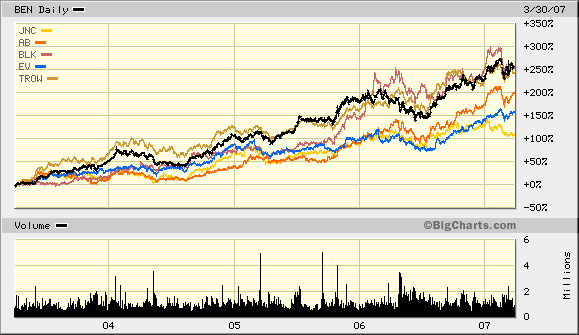
Asset Managers

The old saying is true, it's better to buy the stocks of asset managers than their funds.
ams.gif

Posted by edelfenbein at 3:37 PM

University May IPO

No, really. In India:

When finance minister P Chidambaram said he wanted to make Mumbai Asia's financial hub, he certainly wouldn't have imagined the folks at Mumbai University latching on to every word of his.

But quite obviously, they did. Why else would a proposal come up to convert the university into a company and get itself listed on the stock exchange?

Posted by edelfenbein at 1:45 PM

Highlights from Yesterday's Demonstration

In case you missed it, there was a demonstration on Wall Street yesterday. Don't worry, PinkNews was on the scene:

The crowd swelled at the New York Stock Exchange, as call-and-response chants condemned health care profiteering by insurance and health care companies.

The protest concluded at the "Wall Street Bull" statue, as the fervent group observed those engaging in civil disobedience.

The bull was left with a pair of condoms adorning its horns.

I think that's supposed to be a metaphor.

Posted by edelfenbein at 12:11 PM

The Great Corn Boom

Fortune looks at the dramatic rise in the price of corn:

Four-dollar corn. The price probably doesn't mean much to many Fortune readers, certainly not the city slickers who wouldn't know a combine from a planter. But in farm country, $4 corn is more than a big deal. It's a phenomenon. "It's the center of conversation in the center of the country," says Elizabeth Hund, head of agricultural lending for U.S. Bancorp.

In the span of just eight months, the price of the U.S.'s most important crop - our biggest agricultural export as well as the staple feed for our livestock - has doubled from $2, about where it had been stuck since the late 1990s, to $4 a bushel. The cause is soaring demand from ethanol plants, which bought 2.2 billion bushels last year, 34% more than in 2005. Previous price spikes were short-lived and usually caused by drought, but the futures market thinks this rally has legs.

May 2008 corn recently traded at $4.20 a bushel, while December 2010 futures were at $3.74. This means farmers can lock in terrific prices not just for the 2007 crop but for the three after that as well.

Problem is, what's good for farmers - and even better for the companies selling them tractors, seeds, and fertilizer - has started to roil other parts of the economy. The feed costs of cattlemen and hog farmers have skyrocketed. Ethanol producers have seen their profits slashed. Food companies are being squeezed and are starting to pass along higher costs to consumers. (This isn't just a U.S. problem: Mexico is in an uproar over soaring tortilla costs.)

The market is responding. The Department of Agriculture reports that corn plantings will reach the highest level since 1944.

Posted by edelfenbein at 11:33 AM

Take-Two Shareholders Win

Good for them.

A group of Take-Two Interactive Software Inc. shareholders owning 46.1% of the videogame maker's stock succeeded in removing the board and replacing it with six new directors.

The newly elected board already nominated as chairman Strauss Zelnick, founder of media management and investment firm ZelnickMedia. The board also named Benjamin Feder as acting chief executive, succeeding former CEO Paul Eibeler, and increased the number of board seats to seven from six in order to reappoint the just-ousted Grover Brown as the seventh director.

The board coup is the handiwork of four institutional shareholders, a class of investors not known for activist investing, or agitating for change at companies to boost the stock price. The group consists of mutual-fund firm OppenheimerFunds Inc., D.E. Shaw Valence Portfolios LLC, Tudor Investment Corp. and hedge fund S.A.C. Capital.

The upheaval comes as the maker of "Grand Theft Auto" videogames struggles to rebound from a stock-options scandal and return its operations to profitability. Earlier this year, former Chairman and Chief Executive Ryan Brant pleaded guilty to charges in connection with an options-backdating scheme.

Despite the victory, Take-Two (TTWO) is still an unimpressive stock. But I'm happy to see shareholders beat management. Ideally, this should happen much more often than it does. Shareholders are owners, and should be treated as such. It's unfortunate that it took such a dismal performance to bring this about.

Posted by edelfenbein at 10:26 AM

March 29, 2007

Solengo Capital Takes on Internets

Yesterday, DealBreaker and Naked Shorts posted the marketing brochure for Solengo Capital, the new hedge fund started by Brian Hunter, who happens to have the same name as the energy trader who ruined Amaranth. Turns out, it’s the same guy.

One would think that a marketing brochure’s purpose is to market the company. One is, apparently, wrong. Solengo asked both blogs to take down the brochure. I guess they don’t want the word to get out. Anyway, Naked Shorts complied, but DB is holding its ground.

Reuters reports:

"We think it is valuable information to our readers and they haven't given us persuasive arguments for taking it down," said Beth Levin, associated editor of the site, which focuses on Wall Street matters.

(Note to Reuters: That's Bess Levin.)

I can’t believe that Solengo really thinks it can come out this looking good. I find it ironic that energy traders are wasting their energy on this.

Posted by edelfenbein at 12:27 PM

Q4 GDP Revised to 2.5%

The economy grew by 2.5% for the fourth quarter (technically, it was 2.452%).

Three percent is the Magic Line in GDP growth. Once the economy starts growing less than 3%, it will tend (though not always) to keep doing that for several quarters. The fourth quarter was the third straight quarter of below-trend growth.
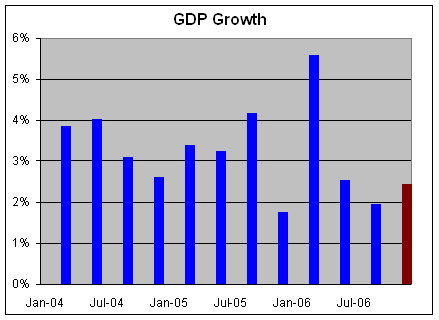
image451.png

Corporate profits had been growing faster than the economy, but that has probably come to an end. For the third quarter of 2006, corporate profits comprised 12.41% of the overall economy, which was the largest share in over 50 years. In the fourth quarter, it dropped to 12.25%.
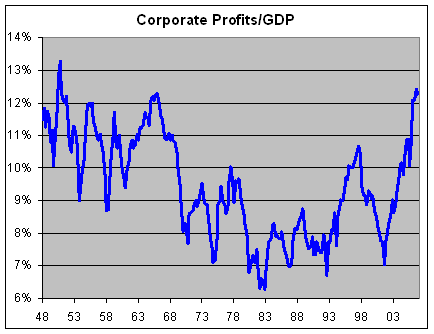
image452.png

Posted by edelfenbein at 8:52 AM

Wall Street and the Subprime Market

In today's Wall Street Journal, Gregory Zuckerman has a great article on the decline and fall of New Century Financial:

In February, New Century mortgages that had been worth $8 billion fell by more than $300 million within days, someone familiar with the matter says. The result: More lenders demanded additional collateral, also called margin, from New Century, including Goldman and Credit Suisse, people familiar with the matter say. Banks also invoked terms allowing them to demand that the company buy back loans if borrowers failed to make payments.

The company's cash was dwindling quickly. Adding to the company's woes were revelations about accounting problems, plans to restate 2006 earnings and post a fourth-quarter loss, and a Securities and Exchange Commission inquiry.

New Century was running out of options. It was unable to get new financing and in violation of its existing lending agreements, in part because it was low on cash. So the company convened the March 6 conference call with its 11 lenders. Mr. Morrice, the CEO, was joined on the call by New Century board member David Einhorn, who runs Greenlight Capital, a New York hedge fund that owned 6% of the company's stock, which by then had fallen 70% in two weeks.

Mr. Morrice informed the bankers that New Century's available cash had dropped to $40 million, down from the $100 million he had reported to some of the bankers a day earlier and from $350 million at year end, a participant on the call said.


Posted by edelfenbein at 8:34 AM

March 28, 2007

Bernanke's Testimony

This is from Bernanke's statement today:

Thus far, the weakness in housing and in some parts of manufacturing does not appear to have spilled over to any significant extent to other sectors of the economy. Employment has continued to expand as job losses in manufacturing and residential construction have been more than offset by gains in other sectors, notably health care, leisure and hospitality, and professional and technical services, and unemployment remains low by historical standards. The continuing increases in employment, together with some pickup in real wages, have helped sustain consumer spending, which increased at a brisk pace during the second half of last year and has continued to be well maintained so far this year. Growth in consumer spending should continue to support the economic expansion in coming quarters. In addition, fiscal policy at both the federal and the state and local levels should impart a small stimulus to economic activity this year.

Outside the United States, economic activity in our major trading partners has continued to grow briskly. The strength of demand abroad has helped to spur strong growth in U.S. real exports, which rose about 9 percent last year, and a robust world economy should continue to provide opportunities for U.S. exporters this year. Growth in U.S. real imports slowed to about 3 percent in 2006, in part reflecting a drop in real terms in imports of crude oil and petroleum products. Despite the improvements in trade performance, the U.S. current account deficit remains large, averaging 6-1/2 percent of nominal GDP during 2006.

Overall, the economy appears likely to continue to expand at a moderate pace over coming quarters. As the inventory of unsold new homes is worked off, the drag from residential investment should wane. Consumer spending appears solid, and business investment seems likely to post moderate gains.


Posted by edelfenbein at 4:13 PM

City to Wal-Mart: Drop Dead

The New York Times reports that Wal-Mart's (WMT) CEO Lee Scott told the paper that expanding into the Big Apple isn't "worth the effort." He referred to all of New York, but a company spokesperson said that he only meant Manhattan.

In other Wal-Mart/New York relations, Jeffrey Goldberg reveals in the New Yorker how Wal-Mart uses facts and evidence to "spin" public relations in ways that could be considered financially advantageous.

Posted by edelfenbein at 11:24 AM

80,000%

Charts don't get much better than Stryker's (SYK):

SYK.gif

The stock hit a new all-time high last week. The company's goal has been to grow by 20% a year. What's amazing is how often they've done it!

Posted by edelfenbein at 7:01 AM

March 27, 2007

Blankfein: "We happen to have as a firm a terrific relationship with Blackstone"

We're just going to start another gigantic buyout fund of our own, that's all.

Goldman Sachs Group Inc.'s sixth buyout fund may top $20 billion, Chief Executive Officer Lloyd Blankfein told shareholders at today's annual meeting.

The fund, which is still raising money, will manage "about $19 to $20 billion of assets, maybe a little bit less, maybe a little more," Blankfein, 52, said at Goldman's Old Slip offices in New York today. That would be more than twice the $8.5 billion fund closed by Goldman Sachs Capital Partners in 2005, which was a record at the time.

Goldman, the most profitable firm in Wall Street history, is raising the fund as Blackstone Group LP also aims to collect $20 billion for the biggest-ever buyout fund. Blackstone, which last week disclosed plans to sell shares worth as much as $4 billion in an initial public offering, didn't include Goldman among the six underwriters selected to manage the sale.

"We happen to have as a firm a terrific relationship with Blackstone," Blankfein said, in answer to a question about why Goldman wasn't included as an underwriter. "It's impossible for us to be in every piece of business."


Posted by edelfenbein at 2:48 PM

Blackstone Will Trade Under BX

It's official, the Blackstone ticker symbol will be BX. Deal Journal considered some others:

No-gos:

BLK. Logical as it sounds, it isn’t available. BlackRock, the former Blackstone unit run by Schwarzman pal Larry Fink, already took it.

B. Big, important companies like Citigroup or AT&T often take a one-letter ticker, but alas, precision metal component maker Barnes Group beat Blackstone to the punch. Then again, if they really wanted it, they could just buy the company.

STON. This one doesn’t work either, because of StoneMor Partners, the Pennsylvania cemetery operator. Plus, there’s the drug connotation, which a Republican like Schwarzman probably wouldn’t be too keen on.

TOP. Probably not a good idea to tip off all those potential investors that this could be a sign of where we are in the private-equity cycle.

Of course, BS is right out.

Here are a few that might work:

MINT. Isn’t this basically what they are now? But then they’d have to move to the Nasdaq, and Schwarzman seems more like an NYSE kind of guy. (Of course we’re assuming here that they’ll list on a U.S. exchange. Who knows — given his aversion to Sarbanes-Oxley, maybe they’ll go to London.)

KKR. What better way to get the best of Henry Kravis of Kohlberg Kravis Roberts, Schwarzman’s rival for the King-of-Private-Equity title?

PE. As in private equity. Someone’s going to take it, so why not the first one to market?

LBO. See previous.


Posted by edelfenbein at 2:23 PM

Home Prices Show Year-Over-Year Decline

From Bloomberg:

U.S. home prices fell in January for the first time in at least six years, a private report showed today.

A measure of home values in 20 metropolitan areas dropped 0.2 percent from the same month last year, according to the S&P/Case-Shiller home-price index. The decrease was the first since the group started keeping year-over-year records in January 2001.

The numbers follow a report yesterday that showed new-home sales at the lowest level in almost seven years as builders struggled with a glut of unsold dwellings. Falling prices make it harder for owners to borrow against home equity and may make lenders even more wary as delinquencies climb.

Today's data "are a good indicator of the dire state of the U.S. residential real estate market," said Robert Shiller, chief economist at MacroMarkets LLC and a professor at Yale University.

I got the data off S&P's Web site. Here's what the index looks like:

image450.png


Posted by edelfenbein at 2:10 PM

The Nasdaq 100 Seven Years On

The Nasdaq Composite (^IXIC) peaked on March 10, 2000 at 5,048.62, but the Nasdaq 100 (^NDX) reached its peak seven years ago today, March 27, 2000, at 4,704.73. That index, and its ETF (QQQQ), probably best represented the new age of limitless technology profits.

In those seven years, the Nasdaq 100 has lost 61.7%. But that's not the worst of it. At one point, in October 2002, the index was 82.9% below its 2000 high. As odd as it may sound, going from an 82.9% loss to a 61.7% loss is a great move--a 124% profit. (Woo!)

The index has been largely dominated by five stocks, Microsoft (MSFT), Intel (INTC), Cisco (CSCO), Dell (DELL) and Oracle (ORCL). There are bigger stocks in the index, like Amgen, but these five were the meat that tech investing was all about. Even today, these five stocks still comprise over 30% of the Nasdaq 100's total market value. However, they make up just 5.4% of the S&P 500.

So how have they done? Since the Nasdaq 100 peaked seven years ago, Microsoft is down 45.8%, Intel is down 73%, Cisco is down 67.1%, Dell is off 59.2% and Oracle is down 58.4%.

Posted by edelfenbein at 8:36 AM

March 26, 2007

Coke Punk'd Its Own Lawyers

Coca-Cola (KO) hired two actors to portray brand managers who ask Coke's real lawyers if they could sue the company because Coke Zero is too similar to regular Coke. Everyone is in on it but the lawyers.

Here are two more ads. They're cute. Ironically, I wonder if The Office could sue Coke for humor style infringement.

Posted by edelfenbein at 3:27 PM

Citigroup to 15,000 Jobs

Chuck Prince is in India, and the New York Times tagged along:

Mr. Prince’s stop in India comes just weeks before Citigroup will announce a broad restructuring plan that could involve the elimination or relocation of as many as 15,000 high-cost jobs from areas including New York, London and Hong Kong, several executives briefed on the matter say. The net job loss could be 10,000 to 12,000, some through attrition.

Citi’s consumer operations will be hardest hit, with front line and back office operations affected, they say. The corporate and investment banking businesses may be hard hit, with several thousand jobs lost, they say.

Managers in these units have been asked to review highly paid employees and look for places to cut fat, particularly just below managing director level.

Shouldn't managers always be looking for places to cut the fat? Over the last three years, Citi's stock is basically flat while the market is up around 30%.

I wonder if there's any message to read BREAK in between IT the lines UP.

Posted by edelfenbein at 12:02 PM

Warren Watches His Buddy LeBron

WBcavaden.jpg

LeBron James invited a buddy who has even more money than he does to watch him play. Billions and billions more.

Philanthropist and businessman Warren Buffett, wearing a black T-shirt with "Witness" glittering on the front, sat courtside as a guest of James on Sunday night for the Cleveland Cavaliers' game against the Denver Nuggets.

Though an unlikely pair, Cleveland's All-Star forward and Buffett are friends and mutual admirers. They first met a few months ago over a lunch of cheeseburgers in Omaha, Neb.

"He wanted a few tips on basketball and I wanted a little advice on money," joked Buffett, estimated by Forbes Magazine to be worth $52 billion. "We switch. He tells me what socks to buy and I tell him what stocks to pick."


Posted by edelfenbein at 7:12 AM

March 24, 2007

A Stock, a Plan, a Short: Yahoo

Now that Yahoo’s Panama is showing early signs of success, Valleywag asks if it’s time to stop bashing the company:

It's surely the best news for Yahoo in a while, and we'd love, in principle, to find another big company to prod. But it doesn't change the basics: Yahoo makes less than half what Google produces in revenue for every search query; it needs much more than a one-off 10% lift in clickthroughs if it is to challenge Google's strengthening grip on the search market.

The narrative remains the same. Yahoo wasted time schmoozing in Hollywood while allowing two Stanford students to build a better search engine. Google has eclipsed Yahoo. Terry Semel's failure is not absolute: Yahoo is growing much more strongly than most media companies. But it is relative. Yahoo, not Google, should have owned the internet.

Ouch. But it’s true. I don’t get how Yahoo is a $31 stock. I wouldn’t touch it for half that. Yahoo is going for 43 times 2008’s earnings; Google, just 25.

Posted by edelfenbein at 7:46 PM

Myths About the Developing World

Fascinating presentation by Hans Rosling.

Posted by edelfenbein at 9:14 AM

March 23, 2007

The Buy List So Far

With a week to go in the first quarter, the Buy List is up 2.39% compared with 1.26% for the S&P 500 (this doesn't include dividends). The Buy List is a tiny bit less volatile than the S&P 500 (average daily swing of 0.781% compared with 0.785%).

Here's the chart:

image449.png

Here's the stock-by-stock breakdown:

Jos. A Bank Clothiers (JOSB)..............................................21.12%
FactSet Research Systems (FDS)......................................16.22%
Respironics (RESP).............................................................10.94%
Bed Bath & Beyond (BBBY).................................................8.14%
Amphenol (APH)..................................................................6.68%
UnitedHealth Group (UNH).................................................5.17%
Donaldson (DCI).................................................................4.18%
AFLAC (AFL)........................................................................3.57%
Graco (GGG) .......................................................................2.88%
Biomet (BMET).....................................................................2.74%
Fiserv (FISV).......................................................................2.04%
Nicholas Financial (NICK)..................................................1.78%
Varian Medical Systems (VAR)..........................................1.26%
SEI Investments (SEIC).....................................................1.23%
Danaher (DHR)..................................................................-0.23%
WR Berkley (BER).............................................................-4.38%
Fair Isaac (FIC)..................................................................-5.31%
Medtronic (MDT).................................................................-6.71%
Sysco (SYY) ......................................................................-10.34%
Harley-Davidson (HOG)....................................................-13.15%

Posted by edelfenbein at 4:43 PM

Bon Voyonage

Last year I wrote about Vonage's (VG) impending IPO:

The offering is oversubscribed. But the price of voice-over-Internet protocol (VoIP) is plunging. And so will Vonage’s share price.

I was right. In ten months, the shares are down about 80%. As an experienced market professional, I know how to judge a company's future profit potential. For example, if the company says that it may never be profitable, that's usually a good sign. Meaning, a bad sign. Either way, that's about the only thing Vonage has gotten right.

Now the company has been slapped with an injuction. It's barred from using a patented technology from Verizon (VZ). One Wall Street firm just put a $1 target price on the shares. Why so optimistic?

image448.png

Posted by edelfenbein at 2:11 PM

Blogroll

If you haven't had a chance, please check out my blogroll. I've added some new names in the past few weeks like Bill Rempel, Matthew Ash, Brett Steenbarger, Yaser Anwar and Maoxian.

Posted by edelfenbein at 10:22 AM

Wallstrip Promo'd on Fast Money

Here's the show with DR himself.

Posted by edelfenbein at 8:30 AM

March 22, 2007

The Blackstone Group's Prospectus

From the SEC's Web site. Here's a sample:

Our Growth Strategy

We intend to create value for our common unitholders by:

•generating superior investment performance across our asset management platform;

•growing the assets under management in our existing investment fund operations;

•expanding our asset management base by raising new investment funds;

•increasing our investment of our own capital in our funds;

•expanding our advisory business; and

•entering into complementary new businesses.

Why We Are Going Public

We have decided to become a public company:

•to access new sources of permanent capital that we can use to invest in our existing businesses, to expand into complementary new businesses and to further strengthen our development as an enduring institution;

•to enhance our firm's valuable brand;

•to provide us with a publicly-traded equity currency and to enhance our flexibility in pursuing future strategic acquisitions;

•to expand the range of financial and retention incentives that we can provide to our existing and future employees through the issuance of equity-related securities representing an interest in the value and performance of our firm as a whole; and

•to permit the realization over time of the value of our equity held by our existing owners.

Blastonechart.jpg

Posted by edelfenbein at 4:13 PM

This Just In...

Human Beings Still Important at Citigroup

Posted by edelfenbein at 11:09 AM

Applying Warren Buffett's Investing Philosophy to Basketball

Courtesy of Heat coach Pat Riley:

Coach Pat Riley said he would be surprised if his players weren't keeping an eye on the standings.

"I think there's no doubt that this week or the next two weeks are going to determine a lot of positioning," he said. "So, it's like looking at the stock market every day.

"We can't get preoccupied with it, because sometimes that gets in the way of playing games."


Posted by edelfenbein at 10:54 AM

The Impact of Interest Rates on Equities

Now that the Federal Reserve has lifted its tightening bias, I wanted to take a look at the impact of lower interest rates on the stock market.

Since 1962, there have been 11,250 days when stocks and bonds have traded on the same day. The yield on the 90-day Treasury rose on 4,845 days, fell on 4,925 days and stayed the same on 1480 days.

On all the days when the T-Bill yield rose, the S&P 500 lost a combined 61.9%. Annualized, that works out to a rate of -4.9% (just capital gains, not dividends).

On the days when the T-Bill yield fell, the S&P gained a combined 1,739.1%, or 16.1% a year.

Interestingly, the market did the best when rates stayed the same. The S&P gained 182.3%, or 19.4% a year.

With long-term rates (10-year T-Bond), the impact is much more dramatic.

The 10-year yield rose on 4,885 days for a combined S&P loss of 98.8%, or -20.5% a year. That's basically a bear market.

The yield stayed the same on 1529 days for a combined S&P gain of 89.4%, or 11.1% a year.

But here’s the kicker: When the 10-year yield fell (4,836 days), and long-term bonds rallied, the S&P 500 gained an amazing 86,631%, or 42.5% a year.

Probably the most fascinating stat is that all of the stock market’s net capital gains have come when the 10-year yield is 65 or more basis points above the 90-day yield (that happens about 70% of the time). The yield curve hasn’t been that positive in 15 months.

Anything less than 65 basis points, including a negative yield curve, works out to a net equity return of a Blutarsky. Zero Point Zero.

Posted by edelfenbein at 8:32 AM

Looking at the Sell-Off

The S&P 500 is now down 0.99% since February 26, the day before the big plunge. Here's how the ten S&P industry groups have fared:

Telecom.................1.04%
Utilities..................0.59%
Industrials............-0.40%
Staples.................-0.58%
Energy..................-0.61%
Healthcare............-1.12%
Tech......................-1.24%
Materials...............-1.31%
Financials..............-1.52%
Discretionary.........-1.82%

Posted by edelfenbein at 8:21 AM

European Central Bank Uses Cartoons to Indoctrinate English-Speaking Youths

edu_en.jpg

Before CNBC moved into animation, the European Central Bank had its own cartoon. Those fun-loving bankers in Frankfort gave us Alex, Anna and the adorable Inflation Monster in the teen-oriented Price stability: why is it important for you? What else could any euroteen want? (Besides actual price stability, a job, etc.).

I wonder if our Fed would ever make a cartoon. Something tells me Bernanke is seriously into Anime. Just a hunch.

(Hat Tip: The Mess That Greenspan Made and Is Apparently Continuing to Make.)

Posted by edelfenbein at 7:58 AM

Michelle Williams' Father Beats Extradition

Michelle Williams, the actress who got an Oscar nomination for Brokeback Mountain, and also played Jen Lindley in Dawson's Creek (and most importantly, is Heath Ledger's girlfriend), is also the daughter of Larry Williams. Papa Williams is a famous stock market trader-slash-guru. (You can check out his Web site at www.ireallytrade.com.) He's sort of a legend in the world or commodity traders -- Larry even has his own eponymous indicator, the Williams %R.

Well, Larry Williams found himself in a bit of hot water with the IRS. They say he owes $1.9 million in taxes. He was arrested last month in Australia, fought extradition. And won.


Williams last year challenged the validity of a notice issued by then federal Justice Minister Chris Ellison authorising a magistrate to rule on the US extradition request.

He argued that Senator Ellison acted on advice from the US which did not identify precisely enough the alleged conduct for which his extradition was sought.

A Federal Court judge dismissed that challenge, but Williams has successfully appealed the decision to the court's full bench.

Justices Roger Gyles, Jim Allsop and Robert Buchanan today overturned the earlier Federal Court order, declaring Senator Ellison's notice invalid.

“In the present case, the material before the minister did not even include a statement of the elements of the United States offences,” the judges said.

Ironically, my indicator, the Elfenbein Quotient, is a ratings system for episodes of Dawson's Creek. Small world.

Posted by edelfenbein at 7:42 AM

Heyday

0375504737.01._AA240_SCLZZZZZZZ_

I went to see Kurt Andersen last night at Politics and Prose. He’s the host of Studio 360 and one of the founders of Spy.

I’m about halfway through Heyday his latest book which is a rollicking historical novel set in 1848. I highly recommend it. Even if you’re not a history nut like me, I think you might enjoy it.

The year 1848 is one of those years where it seems like history went into overdrive, and everything changed so quickly. I don’t think we’ve had a year like that since 1968. I particularly like how Andersen makes you feel like you’re in an age where anything is possible. You can't help feeling that you want to go back in time.

Posted by edelfenbein at 7:15 AM

WallStrip on Starbucks

Today, Lindsay goes on a Starbucks (SBUX) run.

If someone came up to me a few years ago with the business plan of selling overpriced coffee, I would have thought they were crazy: “Sir, I assure you that the American people are far too intelligent to fall for something as transparently phony as a triple latte!” Sadly, this is why I’m not a bazillionaire.

What else can be said about Starbucks? It’s a great American success story. Fifteen years ago, the stock went for about $21 a share. After five 2-for-1 splits, that works out to a split-adjusted price of 67 cents a share. SBUX’s 52-week high is $40.01 a share. That’s about a 60-fold gain.

But trouble could be brewing (BA!). The stock has fallen 25% twice in the past year. Howard Schultz, however, isn't giving in easily:

Schultz, who lamented a nearly 10 percent slide in the company's stock in the past year, asked shareholders not to lose confidence in the world's largest specialty coffee retailer.

"I'm here to tell you that I believe that there's never been a better time to be a Starbucks shareholder," Schultz said. "We are building Starbucks for the long term, and I would hope that after 15 years...you would give us the same trust that you have in the past."

Here's the long-term chart:

image447.png

Posted by edelfenbein at 6:58 AM

March 21, 2007

Financial Stocks Heart Bernanke

It all started at 2:15 in the afternoon. The red line is the S&P Financial Index (^SPSY). The blue line is the S&P 500 (^GSPC).

SPSY.png

The financial stocks gained 2.41% while the entire S&P 500 was up 1.71%. Financial stocks comprise 21.7% of the S&P 500.

Posted by edelfenbein at 9:56 PM

Chinese Market Makes All-Time High

It seems like it was only a few weeks ago that the Chinese stock market was ready to take down the world with it. Come to think of it, it was just a few weeks ago. On February 27, the Shanghai Composite Index fell 8.8%, which would be like the Dow losing over 1,000 points. The Dow responded by dropping 416 points.

Well, now the Shanghai Composite has regained all its lost ground and is at a new all-time high. Last year, the Chinese stock market was up 130%.

image446.png

Posted by edelfenbein at 2:46 PM

The Fed Stays Put

As expected, the Federal Reserve left interest rates unchanged. This is the sixth straight time the Fed has held its powder. Here's the statement:

The Federal Open Market Committee decided today to keep its target for the federal funds rate at 5-1/4 percent.

Recent indicators have been mixed and the adjustment in the housing sector is ongoing (old statement: "suggested somewhat firmer economic growth, and some tentative signs of stabilization have appeared in the housing market"). Nevertheless, the economy seems likely to continue to expand at a moderate pace over coming quarters.

Recent readings on core inflation have been somewhat elevated (old statement: "have improved modestly in recent months"). Although inflation pressures seem likely to moderate over time, the high level of resource utilization has the potential to sustain those pressures.

In these circumstances, the Committee's predominant policy concern remains the risk that inflation will fail to moderate as expected (this is new, despite the word "remains"). Future policy adjustments will depend on the evolution of the outlook for both inflation and economic growth, as implied by incoming information.

Voting for the FOMC monetary policy action were: Ben S. Bernanke, Chairman; Timothy F. Geithner, Vice Chairman; Thomas M. Hoenig; Donald L. Kohn; Randall S. Kroszner; Cathy E. Minehan; Frederic S. Mishkin; Michael H. Moskow; William Poole; and Kevin M. Warsh.

Barry Ritholtz provides his own reality-based Fed statement:

The Federal Open Market Committee decided today to keep its target for the federal funds rate at 5-1/4 percent.

Recent indicators have been much worse than what we were hoping for: Housing is a bigger mess than we anticipated; Business Capex is heading south, as are durable goods. Retail sales have been punk for 3 months running, (and what's with those excuses from the retailers? Too hot! Too cold! Lunar eclipse!) Don't even ask about the Automakers. We expect the economy is likely to continue to soften until it slips to about a 1.5% GDP.

Even worse, recent readings on inflation have been elevated. We were hoping that inflation pressures would moderate as the economy stabilized, but no such luck. In these circumstances, the Committee's predominant policy concern is that we have painted ourselves into a corner, and we are running out of options. On the one hand, Inflation remains an ongoing concern, as medical costs, food, and energy remain problematic. On the other hand, its is apparent that growth is cooling rapidly. Housing has flipped from a net positive for consumers and job seekers to a net negative.

All told, we are running out of options until one or the other of these gets much much worse. Future policy adjustments, therefire, will depend on the evolution of the outlook for both inflation and economic growth, as implied by incoming information. As noted above, if GDP slips below 1.5%, we will be shifting our bias towards easing. Appreciably worse that 1.5%, and we will have to act on rates to prevent a recession -- inflation be damned.

On a final note, the FOMC has taken up a collection, and as a retirement present, we are sending former Chairman Alan Greenspan to a lovely spa on Fiji Island for the foreseeable future. Since there are no satellite feeds, internet connections or any off island communications at all -- preferably, around December 2008.


Posted by edelfenbein at 2:15 PM

CNBC Cartoon Show

char_frank.gif

CNBC is looking to start a cartoon show based on the comic strip CEO Dad. They're going to start with one-minute shorts that could evolve into a half-hour show.

"CEO Dad" centers on Frank Pitt, chief executive of a Styrofoam peanut manufacturer in Pennsylvania, who tries to balance work life and home life with his wife, Chloe, 10-year-old son J.D., 7-year-old daughter Grace and dog Taylor. His family believes he's more focused on work than home life.

"'CEO Dad' is the kind of man whose prenup has a noncompete clause," Stern said. "The irony of the situation is that his family is everything he hopes and dreams it would be if he weren't in it."

Stern said he was a workaholic CEO dad himself until a home break-in nearly took his wife's life and he was held at gunpoint -- an act witnessed by his 5-year-old daughter. After that, he became a "comedic evangelist" and set out to bring humor to others' lives.

"When you lose balance (in your life), the first thing to go is your sense of humor," he said. "I'm trying to reach all the people who are working too hard to get them to laugh at themselves and find a little bit of healing."

Posted by edelfenbein at 11:16 AM

Good Name for a Band

Ladies and gentlemen, put your hands together for Funkwerk!

Posted by edelfenbein at 11:08 AM

Millions of wrinkles, billions of dollars

Here's an interesting article from the Arizona Republic on the growing anti-aging business:

The face of middle age increasingly is smooth and wrinkle-free.

More and more Americans are using an arsenal of cosmetic procedures - eyelid lifts, lasers and skin fillers - to turn back the clock.

This is more than just a vanity play.

The $12 billion-a-year industry is big business for companies such as Medicis Pharmaceutical Corp., which has hitched its growth to selling skin products that make people look and feel younger.

Medicis sells the nation's most widely used "dermal filler," Restylane, and has two more anti-wrinkle products on the way.

While the Scottsdale-based maker of skin and acne products sees a lot more room for growth, so does its chief rival, Irvine, Calif.-based Allergan Inc., which makes Botox and recently launched Juvederm, a skin filler that competes with Restylane.

Both companies see dollars in demographics. Fewer than 1 million people now pay for these dermal filler injections that plump up wrinkles to help skin retain its youthful appearance, but more than 25 million American women age 30 and older earn enough money to afford such treatments.

Posted by edelfenbein at 11:01 AM

Two More Private Equity Buyouts

Two more companies are going the private equity route, Affiliated Computers (ACS) and Claire's Stores (CLE). Both have been very good long-term investments.

Here's a look at ACS:

acs.gif

This is how Claire's Stores has done:

cle.gif

Posted by edelfenbein at 10:08 AM

March 20, 2007

Jim Cramer the Manipulator?

There's a recent video of Jim Cramer talking about how he used to manipulate the stock market. Personally, I think he's just showing off for his audience, but The New York Post hints that he might have said too much.

John Carney adds: "One added thing to watch for: Jim Cramer takes a swipe at easily manipulated financial reporters, who he calls 'the Bob Pisani's of the world.' We're sure his CNBC colleague appreciates it."

Jon C. Ogg at 24/7 Wall Street doesn't think it's a big deal. He points out that the NYP is owned by Murdoch who will soon be launching a competitor to CNBC. Naturally, they want to take JJC down a peg or two.

Bess Levin adds:

A few people also seem to believe that the SEC can make Cramer “give back ill-gotten gains,” especially since they apparently “hate him.” But Cramer seems to rest assured that his relationship with Eliot Spitzer, forged at Harvard, will protect him. At a lecture at the 92nd Street Y a few months back, Cramer told the audience that a reporter had called him to get dirt on the couple, and his response was “I’m never going to say anything bad about the Spitzers.” When pressed further for comment, Cramer asked him, “What do you need to know?” the answer apparently being “Something no one’s ever said about Shiva (Eliot’s wife).” Cramer offered, “She’s a knock-out.” That kind of street cred has got to count for something.

My issue is that the video contradicts Cramer's earlier stand. From The Fortune Tellers: Inside Wall Street's Game of Money, Media and Manipulation:

For all his bravado, Cramer could be hypersensitive to criticism. He called up some of his detractors after the SmartMoney fiasco and yelled at them. When he felt himself under assault, his rapid-fire cadence turned faster, his high-pitched voice a little squeakier. Cramer had no ability to hide his constant swirl of emotions. Once, after Lisa Napoli of The New York Times wrote a mixed profile about his activities and potential conflicts, Cramer declared: "I wish I had been a vicious spinmeister and just beaten the shit out of her and gotten her exactly where I wanted her...Give me a fucking break. Come on, I'm not this huge manipulator of stocks."

When in doubt, I always refer to Jim's 25 Rules of Investing. Specifically, Rule #21: "Just because someone says it on TV doesn't make it so."

Exactly. That's why I use the Internet.

Posted by edelfenbein at 3:22 PM

The Cyclicals Keep Going

To follow up on my earlier post, the Morgan Stanley Cyclical Index (^CYC) finally cracked its 13-year high yesterday. The CYC/S&P 500 ratio is now inches away from a 29-year high:

image445.png

Posted by edelfenbein at 2:50 PM

Hedge Funds Loading Up on Cocoa

Jim Cramer likes to say that there's always a bull market somewhere. I think he's right. There's now a surging market in the cocoa pits. Yes, cocoa is hot! As always, we can blame hedge funds who have been making majors moves there. Check out this chart:

cocoa.png

The Financial Times reports:

Investor interest in cocoa has overwhelmed the traditional trade buyers and sellers, such as the confectionary and cocoa processing companies, in the cocoa futures market.

Weekly data from the Commodity Futures Trading Commission, the US regulator, shows that hedge funds and commodity index funds with long positions, a bet on rising prices, accounted for about a third of all New York cocoa contracts held.

Cocoa markets are subject to wild price swings, which has made some veteran traders wary of predicting further price gains.


Posted by edelfenbein at 2:39 PM

Take-Two Takes Five on Their Annual Meeting

The soap opera at Take-Two Interactive (TTWO) may finally be reaching a conclusion. The company which makes Grand Theft Auto is in a load of trouble. Outside of the fact they don’t make money, is that TTWO is under a slew of lawsuits and investigations. In one of the dumbest moves of the year, they’ve just launched a lawsuit against one of their biggest critics.

A group of shareholders has had enough and is aiming to take over the company and ditch the current management. I so hope they win. It looks like they have the votes to do it. The management team has delayed its annual meeting to explore their options, including a sale. Please, no one is going to buy Take-Two. I hear people say Electronic Arts (ERTS). No way.

If Take-Two is lucky, the dissident shareholders will win and turn the company around.

Posted by edelfenbein at 1:54 PM

Louie the Stockbroker

Posted by edelfenbein at 12:50 PM

Credit Spreads

Here's an interesting look at credit spreads over the past few years:

image444.png

Notice how much closer the lines are today compared with five years ago. That's a big reason for the private equity boom.

Posted by edelfenbein at 11:42 AM

FactSet Beats the Street and Doubles Its Dividend

FactSet Research Systems (FDS) just reported another great quarter. The company earned 52 cents a share, compared with 38 cents last year. Excluding a three cent a share gain, the company earned 49 cents a share which was a penny ahead of analysts' expectations. Sales rose 24% to $116.3 million.

The company also announced that it's going to double its quarterly dividend to 12 cents a share, plus it's expanding the stock repurchase program by $100 million.

FactSet also guided its sales forecast for this quarter slightly higher. It now sees revenues coming in between $118 million and $121 million. That will probably translate to earnings of about 52 cents a share.

The market doesn't seem to know what to do. The stock had been our top-performing stock of the year. Then it fell yesterday, and Joe Bank (JOSB) rallied to take the #1 spot. FDS opened much higher today, but has given back a lot of the gain.

FDS.png


Posted by edelfenbein at 11:02 AM

March 19, 2007

JOSB Hits Nine-Month High

When Jos. A Bank's (JOSB) stock collapsed last June, I immediately put it on my radar. The catalyst for the drop was a horrible earnings report. But as more evidence comes out, it looks like the company is still doing well.

The stock finally broke out above $34 a share today.

JOSB1.png

It's now the top-performing stock on the Buy List for the year.

Posted by edelfenbein at 1:54 PM

The Change to Penny Spreads

Here's a fascinating article from Bloomberg on the effects of changing option spreads to a penny:

Kevin Fischer spent 17 years as a floor trader at the Philadelphia Stock Exchange until Interactive Brokers Group Inc. moved him to its headquarters in Greenwich, Connecticut.

Now he sits in front of a computer screen, creating a trading system to help investors use algorithms, sets of rules calculating the best time and price to buy or sell securities. Fischer is caught in the middle of a regulatory change that's throwing about $1 billion of commissions up for grabs annually and putting Interactive, the world's largest options broker, on the defensive.


Posted by edelfenbein at 12:37 PM

The Fed's Game Plan

The Federal Reserve meets again this week in Washington. A survey of 73 economists showed unanimous agreement that the Fed will leave rates unchanged at 5.25%. But the Fed could soon make a move. The futures market now indicates that there's a 24% chance that the Fed will lower rates three times before the end of the year.

Here's a look at the Fed Funds rate (blue line) and core inflation rate (black line) going back a few years. The red line is the difference. Basically, in a recession the blue line should be equal to the black line. In an expansion, the blue line should be about 2.5 to 3 points higher than the black line.

image443.png

Posted by edelfenbein at 8:18 AM

March 16, 2007

Dept. of Irony: Blackrock to IPO?

Today's big news is that private equity firm, Blackstone Group, may be going public. Strange that the company taking everyone private might be going public. Here's an interview Maria Bartiromo did earlier this week with Steve Schwarzman, the head of Blackstone, and Laurence Fink, the head of Blackrock. (Stone. Rock. I'm not sure what the significance is.) (By the way, when Rock Hudson was on the Flintstones, they still changed his name to "Rock Hudstone." Talk about redundancy! Stoney Curtis, I get. But Hudstone?)

Anywho, at the very end of the clip, Maria asks Schwarzman is he's going to go public. He knew what was in the works, but dodges the question very deftly.

By the way, both Bartiromo and Schwarzman are on the board of the New York City Ballet. It doesn't mean anything, I'm just mentioning it.

Posted by edelfenbein at 1:26 PM

The BusinessWeek 50

BusinessWeek has unveiled its BusinessWeek 50.

Varian Medical Systems (VAR) comes in at #14, followed by Bed Bath & Beyond (BBBY) at #15.

Two more of our stocks appear in the Extra 25: Sysco (SYY) at #58 and Harley-Davidson (HOG) at #60.


Posted by edelfenbein at 10:47 AM

Today's CPI Report

Today's report on consumer inflation showed that prices rose 0.4% last month, which was 0.1% more than what economists were expecting. The core rate, which excludes food and energy, rose 0.2%, which was in line with forecasts.

Here's a look at the core rate going back a few years:

image442.png

Posted by edelfenbein at 10:04 AM

Indiana, We’re All for You!

You gotta hand it to those never-say-die kids at IU. The Mad Money Club at Indiana did everything in their power to get Jim Cramer to do a show from Bloomington. They even made a video based off 24, which is JJC’s favorite show.

It worked! Jimmy C. is going to IU. Here’s more on the Mad Money Club's efforts. It’s a heart-warming pull-for-underdog kinda thing.

It’s almost like some dramatic come-from-behind upset in a bicycle race. Or something.

Posted by edelfenbein at 8:30 AM

But Then Again....

Forbes:

Greenspan Warns Of Subprime Infection

AP:

Greenspan: Subprime Spillover Unlikely

Posted by edelfenbein at 7:24 AM

March 15, 2007

Amgen Continues to Plunge

Shares of Amgen (AMGN) used to trade at a nice premium to the market. Not anymore.

The stock has plunged this year, and it’s on the verge of making a 21-month low today. Still, the earnings appear to be fine. The company missed Street estimates by five cents a share last quarter, but it was still a big increase over last year’s fourth-quarter.

Here’s a look at Amgen’s stock with the earnings-per-share line in gold. The two lines are scaled at 25-to-1 (when the lines cross, the P/E ratio is exactly 25).

image441.png

You can really see how far the valuation has fallen. Going by the same earnings multiple of just a few years ago, the stock could easily be worth $100 today.

At the beginning of the year, Amgen said it expects earnings of $4.30 to $4.50 a share for 2007. The company recently stood by that forecast.

Posted by edelfenbein at 1:41 PM

Yikes!

From the Denver Post:

Whoever sent a package with a disabled explosive device to Denver- based Janus Capital Group in late January could next send working bombs to financial-industry executives at home, a leading security expert has warned.

"There is no doubt in my mind that the next time we hear from him, we will see real devices. That is the frightening part," said Fred Burton, vice president of counterterrorism for Stratfor in Austin, Texas.

Stratfor, also called Strategic Forecasting, is a corporate intelligence and risk-management company that has advised corporate clients targeted by the threatening letters.

The mailer, who identifies himself as "the Bishop," has made escalating threats in a series of 15 known mailings sent over 18 months to financial- service firms, primarily in the Midwest, said Wanda Shipp, a postal inspector in Chicago.


They have a profile of him.

Burton has created a profile of the Bishop suspect, who he believes has only a high school education and spends a lot of time online.

Although the Bishop may be angry about losing money in the stock market, Burton thinks he may be playing out a game.

"It is also very feasible he is living in a virtual world. He is playing out a fantasy or PC game into reality," Burton said.

Great. That describes about 84% of my readers.

Burton cited some possible sources of the Bishop's name:

Lucas Bishop is a character introduced in the 1990s in the X-Men comic-book series who also can be played in a computer game. He is part of a mutant police force that returns from the future. His power involves absorbing energy and releasing it in concussive blasts.

In the 1972 movie "The Mechanic," Charles Bronson played assassin Arthur Bishop. A line used in the movie, "Bang you're dead," has shown up in at least one letter under investigation by authorities.

"The Bishop" is the name of a book in the Stainless Steel Rat fiction series by author Harry Harrison.

Burton suspects the Bishop surveys his targets before mailing them. Although his letters contain primarily Illinois- based postmarks, some have been mailed from Florida and Iowa as well.

Unlike the mailings from the Unabomber and "green" terrorist groups, the letters aren't overtly ideological or political, Burton said.

Some contain requests that the price of certain stocks be brought to $6.66, perhaps an allusion to the mark of the Antichrist mentioned in the Bible's Book of Revelation.

Shipp said the Bishop has also referenced a quote first written by English poet John Milton: "It is better to reign in Hell, than to serve in Heaven."

Posted by edelfenbein at 12:48 PM

Cylical to S&P 500 Near 13-Year High

I know I've become a bore on this topic, but I think it's big news. The Morgan Stanley Cyclical Index (^CYC) is still outperforming the overall stock market. If today's activity holds up, then the CYC-to-S&P 500 ratio will surpass the peak from last May, and touch the highest point in 13 years.

image%20440.png


Posted by edelfenbein at 11:17 AM

Kvetchin' Gretchen

Did anyone see Lost last night? Wouldn't there be tons of dead animals around that sonic wall thing? Also, am I the only person who thinks about these things?

ANYWAY

Larry Ribstein rips into Gretchen Morgenson:

All of this highlights what I’ve been saying about Morgenson for many months. It’s not about her views, or about whether her targets are behaving well or badly. It’s about the journalism: shoddy, hysterical, unsophisticated, misleading, and often just simply poor. More importantly, it’s about the standards of her employer, which persists not only in highlighting her opinions, but in putting them on the front page as “news.”

Dealbreaker has more.

Posted by edelfenbein at 9:26 AM

Harley and the Subprime Market

From Forbes:

Americans not only bought homes they couldn't afford, they also spent money they didn't have on Harleys.

In a note on Wednesday, Edward Aaron, an analyst for RBC Capital Market, said that Harley-Davidson's financial unit has seen increased delinquencies and losses on loans given out over the past few years.

One reason for that phenomenon, he said, is the same reason that the subprime lenders are in financial turmoil -- that is -- they lent money to risky borrowers.

"While we don't know which borrowers are accounting for the acceleration of loss rates in Harley's loan securitizations, it's stands to reason that the lower credit quality customer's would be accounting for most of that change," he said.

That doesn't mean Harley is on the verge of implosion, Aaron said in an interview. But it may cause the motorcycle company's earnings to sputter over the next few years.

This is old news. Herb Greenberg wrote about Harley's finance unit years ago.

Posted by edelfenbein at 8:26 AM

March 14, 2007

Finally....

The book I've been waiting my whole life for.

Posted by edelfenbein at 9:11 PM

What If the Stock Market Was a Bond?

Here’s an unusual post. But it’s my blog, so deal.

I was curious what the historical stock market performance would look like if the stock market was a bond.

Strange? Let me take a step back and explain.

I have the monthly total return figures (including dividends) for the stock market going back to the 1920s. I wanted to take those same monthly changes, apply them to an imaginary bond and see what the yield would have been through the years.

I assumed that it’s a bond of infinite maturity and pays a fixed coupon each month. Actually, the amount of the coupon doesn’t matter, as long as it’s the same each month.

I have to think that many investors would be better served if there were such an investment vehicle. If they knew that the market’s current yield was something like 7% or 8%, they might treat their investments very differently.

What’s interesting is that investing in the 19th century wasn’t too far from this. Many stocks traded at or near “par” which was often $100 a share. Every year, the company would pay out an annual dividend, say $5 or $8 a share, sometimes none, sometimes $10 or $15. They dividend was the game, and there wasn’t nearly as much emphasis on long-term capital gains.

There’s one hitch though. I have to choose a starting yield-to-maturity for December 1925. So this isn’t a completely kosher experiment because the starting point is based on my guess. If I choose a number that’s too high, then the historical performance won’t be able to keep up, and the yield-to-maturity would grow higher and higher and soon leave orbit. Conversely, if my starting YTM is too low, the yield would gradually get pushed down to microscopic levels.

Fortunately, the data makes my job easy. If I start with 6.6%, the market’s yield gets
out of control by the 1970s
. If I start with 6.5%, the yield goes to rock bottom levels by today. By my judgment, the best looking line starts with 6.538%.

Here’s what it looks like:

image439.png

I have to stress that even though this “bond” is complete make believe, this reflects what the actual stock market really did for the past eighty-two years.

Over the last eight decades, the yield has averaged about 10.2%, which is right in line with the market’s long-term total return. Through February 2007, it stood at 8.3%. Seven years ago, it got down to 5% (by comparison, long-term Treasuries were going for 6.5%).

Posted by edelfenbein at 2:55 PM

Reader Quiz

OK class, here’s a short quiz. Let’s say the stock market sells off. We’re told it’s because investors have grown complacent about risk and bid up prices to irrational levels.

If that’s true, which stocks should do better—growth or value?

SVXSGX.gif

Despite the selling, growth is outperforming value.

Posted by edelfenbein at 1:37 PM

It's Not Over Over There

More selling in Asia. Once again, the Indian market bore the brunt of the selling:

sensex2.png

Here's a roundup of the Asian markets.

Posted by edelfenbein at 10:07 AM

Cranky Octogenarian Opens Mouth

IMG_050311.jpg

From the AP:

Two weeks ago, Greenspan's comments about the possibility of a recession occurring at the end of this year contributed to a 416-point fall in the Dow Jones industrial average.

The Dow had another big losing day on Tuesday, falling by 242.66 points, the second biggest drop of the year. But this decline was not driven by anything Greenspan said but rather investors worries about the subprime mortgage market.

During his appearance Tuesday, Greenspan talked about past market crises but not the most recent turmoil and he made no forecasts about the possibility of a recession.
Greenspan did put forward a proposal on how to reduce the growing inequality of incomes in the United States - admit more skilled immigrants into the country.


Posted by edelfenbein at 8:33 AM

March 13, 2007

From the Goldman Sachs Conference Call

I thought this was an interesting answer from CFO David Viniar:


Michael Hecht - Banc of America

I just wanted to follow up on FICC. You guys noted the record results in credit and mortgages. I was just wondering if you could talk a little bit more about the traction there in terms of it being more environmental versus share gains? Particularly in mortgages, are you seeing the best traction in sub-prime versus prime versus commercial or non-U.S.?

David A. Viniar

I think we have handled the turmoil in the market pretty well. Again, in mortgages, you have to remember to size it, and I've talked about this, so with sub-prime first. Sub-prime is part of mortgages, which is part of FICC, which is part of trading, which is part of Goldman Sachs. So the size of mortgages in all of Goldman Sachs is modest, while the business is important, like all of our businesses. Credit businesses are a little bit bigger than the mortgage business, but we really haven't seen any contagion to the credit markets. The credit markets continue to be quite robust. Credit spreads continue to be tight. There continues to be a lot of liquidity in those markets.

Courtesy of Seeking Alpha.

Posted by edelfenbein at 10:09 PM

100 Years Ago Today

Think your portfolio is having a tough time. Well, buck up. Today marks the 100th anniversary of the beginning of the Panic of 1907.

On March 13, 1907, the Dow CRASHED from 86.53 to 83.12. That may not sound like a lot, but it was a fall of 3.94%, which beats our wimpy 3.29% drop from two weeks ago. The next day, March 14, saw the really big action. The Dow plunged to 76.23, a drop of 8.29%. That's a two-day drop of 11.9%. Today, that would be like the Dow losing 1,500 points in 48 hours. The drop of March 14 still ranks as the seventh-worst day in the Dow's history.

The index shot up 6.69% on March 15, but all was not safe. The Dow fell 6.23% on March 25. Here’s a look at Dow during March 1907:

image435.png

That was only part of it. In 22 months, the Dow fell by half. Here's how the market did in 1906 and 1907:

image436.png

J.P. Morgan helped end the panic by providing a loan to the U.S. government. This led people to think that it really might not be a good idea to have the government dependent on one guy's terms. Soooo, in 1913 Congress passed the Federal Reserve Act.

And we haven't had any trouble since.

Posted by edelfenbein at 11:34 AM

Goldman’s Earnings

Goldman Sachs (GS) was supposed to report lower earnings today. This was supposed to be the quarter when the party ended for the big Wall Street houses. Well, it didn’t happen. Or at least, it hasn’t happened yet.

Goldman's earnings blew away the Street’s estimates. The company earned $6.67 a share compared with $5.08 a share last year. That’s just amazing. Let me put that into context for you. Wall Street was looking for a decline to $4.89 a share. In fact, the highest estimate of any analyst was for $5.60 a share. Goldman still beat that by more than a dollar. This is the seventh straight quarter that Goldman has beaten earnings.

After the company reported earnings two quarters ago, the stock rose for 12 straight days. On the 13th day, it fell by a penny a share. Then it continued to rise for 12 of the next fourteen days.

Here's a look at how the Big Five firms on Wall Street have done over the past four years:

Brokers2.gif

Notice how all the stocks started to take a hit recently. Investors were clearly bracing themselves for bad news. Also, Guy Moszkowski, a high-profile analyst at Merrill Lynch, recently downgraded several stocks in the sector.

(You can also see why investors were so unhappy with Phil Purcell at Morgan.)

Goldman is now going for about 10 times next year’s earnings. Lehman (LEH) reports tomorrow.

Posted by edelfenbein at 10:00 AM

March 12, 2007

UnitedHealth to buy Sierra Health

UnitedHealth (UNH) is making a move:

Health insurer UnitedHealth Group Inc. said on Monday it will acquire Sierra Health Services Inc. for more than $2.4 billion to expand in the fast-growing Las Vegas area and boost its Medicare business.

The deal shows UnitedHealth, the largest U.S. health insurer by market value, is continuing to broaden its reach by gobbling up rivals -- and could signal a renewed round of consolidation throughout the sector.

Piper Jaffray analyst Melissa Mullikin said Sierra would help UnitedHealth fill a gap in Nevada.

"We definitely think it's a positive for (UnitedHealth)," Mullikin said. "That's a really desirable geography."

The $43.50 per share deal represents a 21 percent premium over Sierra's closing price of $35.90 on Friday. As of Feb. 23, Sierra had 55.76 million shares outstanding, giving the deal a value of about $2.43 billion.

Best of all, the deal is all cash.

Posted by edelfenbein at 3:11 PM

Dollar General Goes Private Equity

Yet another company is leaving the stock. Kohlberg Kravis Roberts said it’s going to buy Dollar General (DG) for $6.9 billion.

Up until a few years ago, the stock had been a terrific long-term winner. Thirty-two years ago, the stock was going for about three cents a share (adjusted for many, many splits). In 1999, DG got to $26 a share but had a rough go of it after that. Last year, the shares got down to $12. KKR’s offer is for $22 a share.

DG.gif

Posted by edelfenbein at 1:51 PM

FactSet Research Systems Hits New High

Please don't tell FactSet Research Systems (FDS) that we're in a bear market. The stock just hit a new 52-week high. I'm not sure if it's a "healthy" new high though.

image434.png

Posted by edelfenbein at 10:19 AM

WWTDRWD

As soon as the stock market started to break, the first question on my mind was "what would the Detroit Red Wings Do"? Fortunately, we have the Detroit Free:


Chris Osgood

What's your approach to investing? Pretty passive. I don't take too many risks. So (the market) going down 400 wouldn't affect me as much as someone else. I don't really take that many risks.

Why are you so conservative? I don't want to lose my money unnecessarily. Not do anything I would jeopardize losing money for a stupid reason when I don't need to.

Is anyone in the locker room a big Wall Street Journal kind of guy? Not really. We used to have Brent Gilchrist. Mike Vernon was, Steve Yzerman knew quite a bit about it. There used to be a lot of guys in the '90s that knew quite a bit. I haven't seen the Wall Street Journal all year.


Posted by edelfenbein at 7:26 AM

March 11, 2007

Surowiecki on the Correction

In the New Yorker, James Surowiecki looks at the stock market’s recent unpleasantness. He agrees that faulting China is a weak excuse. But he raises an interesting point in that investors aren’t very good at assessing the impact of new information:

In one famous experiment by the psychologist Paul Andreassen, investors who selected a portfolio of stocks and then saw nothing but the stocks’ changing prices managed their portfolios significantly better than investors who were also given a stream of news about the companies they’d invested in. The reason, Andreassen suggested, was that the media’s tendency to overplay stories led investors to place too much weight on news that turned out to be of only transient importance.

Sometimes asking why the market falls is a fruitless task. It’s not a comforting thought, but the stock market can fall suddenly for little or no reason.

Posted by edelfenbein at 7:17 PM

March 9, 2007

Buy List Year to Date

We're holding up well. Through Friday, the Buy List is down 0.63% for the year, while the S&P 500 is down 1.09% (not including dividends).

image433.png

Posted by edelfenbein at 5:23 PM

Today's Jobs Report

The unemployment rate fell to 4.5% for February, although it's still above the 4.4% it reached in October. In the last 50 years, the current jobless rate is the 102nd lowest of 600 months.

image431.png

The economy added 97,000 jobs last month, and the job growth numbers for December and January were both revised higher. Here's a look at non-farm payrolls:

image432.png


Posted by edelfenbein at 10:20 AM

March 8, 2007

Think Our Market Is Volatile

Check out the Indian Sensex (the blue line):

Sensex.png

Posted by edelfenbein at 4:09 PM

Fedipus Rex

Bloomberg writes on the growing rift between the current Fed and the former chariman:

Former Federal Reserve Vice Chairman Alan Blinder said Alan Greenspan may be distracting investors from the Fed's forecast that growth will strengthen this year.

Greenspan, who was Fed chairman for almost two decades until Ben S. Bernanke took over 13 months ago, said at least three times in the past two weeks that a recession is possible. He didn't say one was likely.

"It is a little bit of a problem," Blinder, now a professor at Princeton University in New Jersey, said in an interview. "He is sort of stepping on the message. The Fed's message is things look pretty good and in particular we are not at all worried about a recession."

Current Fed officials are stressing that they don't predict a recession, even after last week's global equities plunge and a run of weaker-than-forecast economic data. Chicago Fed President Michael Moskow said in a speech today that he's not prepared to significantly alter his forecast for a pickup.


Posted by edelfenbein at 1:09 PM

JOSB Rises on Same-Store-Sales Report

Good news for Joe Bank (JOSB) today. The company reported that same-store-sales grew by 2.8% in February, higher than the 1.7% predicted by analysts. The stock is doing very well this morning.

Two other things to note. Donald Tomitz, the CEO of DR Horton (DHI), said that 2007 is going to be so bad for his company, it will be homosexual: "I don't want to be too sophisticated here, but ‘07 is going to suck, all 12 months of the calendar year."

Also, in the Radio Shack (RSH) conference call, someone said something. And they probably shouldn’t have. That’s pretty much all I can say. Radio Shack, if you recall, was the only stock in the S&P 500 to do well last Tuesday.

Posted by edelfenbein at 10:45 AM

March 7, 2007

Buy List News Today

Here are a few bits of news today regarding the Buy List.

Erin Burnett talked with Dave Roberts, the CEO of Graco (GGG). He says he doesn’t see an immediate recession.

Nicholas Financial (NICK) had a very good day today. The stock jumped 66 cents, which is an increase of over 6.1%. As far as I could tell, there was no news on the stock.

WR Berkley (BER) announced that it's increasing its dividend by 20% to five cents a share. Unless I have something wrong, the old dividend was four cents a share, so the increase is by 25%. Here's the press release. Things must be busy there.

Finally, Danaher (DHR) raised the lower end of its guidance today. The company now sees first-quarter profits of 75 cents to 77 cents a share. The previous forecast was for 72 cents to 77 cents a share.

Posted by edelfenbein at 5:16 PM

John F. Baugh 1916-2007

John F. Baugh, the founder of Sysco (SYY), has died.

The company's press release said:

John F. Baugh, the founder of SYSCO Corporation, the $33 billion Fortune 100 global foodservice marketer and distributor, passed away March 5, 2007. His passing was 37 years, almost to the date, of the corporation's initial public offering on March 3, 1970. Richard J. Schnieders, SYSCO's chairman, CEO and president, said, "His passing is indeed a profound loss. First and foremost, John Baugh was a man of commitment -- to his wife, his daughter, his grandchildren and great-grandchildren, to his faith, his community and to the company he founded that touches so many lives today. A true visionary, a legendary entrepreneur, an inspiration to friends and colleagues and a generous philanthropist, his impeccable integrity and generosity of spirit have imprinted indelibly the character of our organization."

John F. Baugh was born February 29, 1916 in Waco, TX. Growing up in the Depression era, Baugh began his lifelong passion with the food industry at an A&P grocery store as a stock boy at the age of 13. Eventually, he became a store manager and in 1946, he and his wife Eula Mae founded a new company, Zero Foods, and began selling and distributing frozen foods to restaurants, hotels, hospitals, schools, fast-food stores and grocery chains.

In 1969, Americans were eating out more than ever and industry studies predicted that half of all meals would be eaten away from home by 2000. Women who had entered the workforce during World War II were continuing to work; with less time to cook they wanted more food prepared by others. Baugh envisioned a national foodservice distribution organization and shared ideas with industry friends across the country.

His dream became a reality when Zero Foods and eight other companies joined together to form SYSCO (an acronym for SYstems and Services COmpany). At the initial public offering on March 3, 1970, the nine companies had aggregate sales of $115 million and served a $35 billion market. In 1977 SYSCO became the leading foodservice supplier in North America and has since maintained this position. In 1988, an acquisition of its next largest competitor gave the company national coverage. SYSCO's network of 172 locations and approximately 50,000 employees now serves an industry in excess of $200 billion. Mr. Baugh published a book about the company, "The SYSCO Story...Thus Far!" in 2003.

Ulrich Boser of Slate recently profiled Sysco and its products.

Posted by edelfenbein at 2:00 PM

Does Media Alarmism Pose a Threat to Your Children?

The Wall Street Journal is at it again. The newspaper ran an article today about possible back-dating of stock options after 9/11:

Amid the stock-market swoon that followed the Sept. 11, 2001, terrorist attacks, dozens of companies granted stock options to top executives or other employees. Now, some of those companies are saying the grants were in fact made weeks later -- and backdated.

The disclosures are the latest wrinkle in a backdating scandal that involves more than 140 companies and has resulted in more than 70 firings or resignations of corporate officials. The new information suggests some executives profited from the market's plunge following Sept. 11 by manipulating options grant dates.

Larry Ribstein writes:

Let's put this in perspective. The fact that the backdaters picked a date that has been depressed by tragedy has nothing whatsoever to do with what the backdaters did or didn't do wrong.

I usually don’t pass along quotes like this without comment, but Ribstein says all that needs to be said.

This isn’t the first time the WSJ has tried to attach 9/11 to back-dating. Last summer, the same three authors of today’s story wrote:

On Sept. 21, 2001, rescuers dug through the smoldering remains of the World Trade Center. Across town, families buried two firefighters found a week earlier. At Fort Drum, on the edge of New York's Adirondacks, soldiers readied for deployment halfway across the world.

Boards of directors of scores of American companies were also busy that day. They handed out millions of bargain-priced stock options to their top executives.

At the time, I wrote:

Not very subtle is it? The soldiers readying for deployment was nice touch. Those evil corporate plutocrats just couldn’t wait to profit off 9/11.

But hold up, how exactly did those boards know that the options grants were, as the Journal points out, “bargain-priced”? The answer is, they didn’t (assuming the options were at-the-money). More importantly, they couldn’t have known. The grants were based on nothing more than faith in the future, which was hardly in overabundance at the time.

It’s true that stocks nosedived when the markets reopened, but that doesn’t by itself mean the options were a bargain. After all, the market had already been falling and it continued to fall for more than a year. In fact, the S&P 500 was still below its pre-9/11 level nearly three years after the attacks (and, of course, those soldiers readying themselves).

John Carney sums it up nicely:

Yelling “9/11” in an argument is usually a sure sign you’ve already lost it. It’s a desperate, pathetic move. So maybe there is something hopeful about the resort to it on the front page of the Journal. Maybe it means that the official backdating storyline is becoming less plausible.

Exactly.

Posted by edelfenbein at 1:37 PM

1987 Redux Redux

The New York Times ran an article saying that the bulls retreat was turning into a "rout." Not to be outdone, Barclays Capital put out a report which compared the current market to the one in 1987. Yikes! And the Financial Times piled on saying that the sell-off "appear to have been exacerbated by an unusual wave of derivatives activity on the part of hedge funds and big banks."

Heavens! Scary stuff. The good news is that all these articles came out during last spring's correction.

You say you forgot about that one? Well, I don't blame you -- it only lasted a month, but no matter. The media can easily recycle these stories. Just use the "find/replace" function. Take out May, add March and...Presto!...you're on your way.

On the bullish front, the FT's Alphaville Blog notes some recent comments by Abby Joseph Cohen:


No changes to Goldman’s baseline forecasts."These already reflect a notable deceleration in economic and profit growth in 2007, but there is no recession on the horizon."
Valuation support is intact for US equities. "Our estimated fair value for year-end 2007 remains 1550, suggesting that the S&P 500 is now about 11% under priced…The strength of US corporate balance sheets, especially among the companies in the S&P 500, and strong ROEs, should also offer some ballast in a rocky market environment. We assume that margins will move lower in many industries this year, but from record-high levels to still-high levels."
GS forecast has long presumed a deceleration in economic growth this year. "Importantly, core inflation is not expected to rise dramatically."

Posted by edelfenbein at 11:45 AM

The Obama Portfolio

obama.bmp

Check out the senator's portfolio.

Posted by edelfenbein at 9:52 AM

Suze Sits in for Cramer

Courtesy of WallStrip.

Posted by edelfenbein at 9:10 AM

March 6, 2007

UnitedHealth Restates Earnings

UnitedHealth Group (UNH) finally restated its earnings to account for all the stock options charges. Bear in mind, this has no impact on the company’s future direction, it’s merely restating what has already happened.

Health insurer UnitedHealth Group Inc. said Tuesday charges to correct accounting for backdated stock option grants reduced profit by $1.55 billion. The company has filed restated financial results for 2006 and prior years, bringing it up to date in its filings with the Securities and Exchange Commission.

UnitedHealth reported 2006 earnings grew 35 percent to $4.16 billion, or $2.97 per share, from $3.08 billion, or $2.31 per share in 2005. Revenue rose 54 percent to $71.54 billion from $46.43 billion.

Results were helped by the acquisition of PacifiCare in late 2005, pricing of risk-based medical coverages and cost cutting.

UnitedHealth said it will make cash payments for additional corporate income taxes of about $100 million, and will record a charge of $55 million, or 4 cents per share, in the first quarter of 2007 for a settlement relating to some employees who exercised options in 2006.

Under the company's current accounting method, corrections to stock option granting methods lowered profit by $414 million, including $57 million for 2005, $44 million in 2004 and $313 million for the 10-year period ended Dec. 31, 2003.

Under its historic accounting method, the company said charges reduced previously reported profit by $1.13 billion, including $238 million in 2005, $158 million in 2004, and $738 million for all prior years through Dec. 31, 2003.

UnitedHealth has already forecast 2007 earnings between $4.7 billion and $4.75 billion. The problem was that we didn’t know exactly what that worked out to on an earnings-per-share basis. Now we can say that it will be about $3.47 to $3.51 a share.

So now we have a clearer picture. EPS was up 29% last year. It should be up around 17%-18% this year, and the shares are going for about 16 times earnings. Sounds like a bargain to me.

Posted by edelfenbein at 10:35 AM

Topps Goes Private Equity

Topps Co. Inc. (TOPP), the company known for baseball cards and Bazooka bubble gum, is going the private equity route. Topps agreed to be bought out for $385 million by a group that includes Michael Eisner's firm, The Tornante Co. LLC.

Most people didn't know this company was publicly traded. I remember how popular the shares were in the late-1990s, but Topps hasn't done much over the long haul.

Topp.gif

Posted by edelfenbein at 10:01 AM

I Told You Sell-Offs Aren't Healthy

From the Telegraph:

Goldman Sachs warns of 'dead bodies' after market turmoil

I’m confused. If they’re already dead, what do we have to worry about?

Posted by edelfenbein at 7:28 AM

March 5, 2007

Conan on the Sell-Off

Posted by edelfenbein at 4:19 PM

WallSt.Net Podcast

Here's a podcast I did recently with Kristin Friedersdorf of WallSt.net.

Posted by edelfenbein at 3:49 PM

Red Robin Reports Great Earnings, But On Closer Inspection, Maybe Not So Great

Last week, Red Robin Gourmet Burgers (RRGB) reported great earnings. The company beat earnings expectations by 16 cents a share, and the stock jumped 7.6%. But David Phillips at 10-Q Detective has read the fine print:

1. 2006 was a 53-week fiscal year. In fiscal 2006, the fifty-third week added $14.4 million to restaurant sales and $0.11 to diluted earnings per share.

2. Earnings benefited, too, from a 3.0% drop in its effective tax rate to 30.6% for 2006. The decrease was primarily due to more favorable tax credits and state apportionment factors resulting from a shift in income to states with lower tax rates—aggregate state income tax rate fell 1.9% to 2.6% in fiscal 2006. This creative accounting boosted income about 6 cents per share. Management anticipates that its 2007 effective tax rate will be approximately 32 percent.

3. In 2006, Red Robin reduced the expected life of its outstanding option grants more than 50% to 2.6 years! By cutting the time it thinks its ‘team members’ will hold options, the burger maker was able to trim compensation costs.

We estimate that the three aforementioned factors added at least 22 cents to Red Robin’s bottom line in 2007.

Oh.

To quote Emily Litella, "nevermind."

Posted by edelfenbein at 3:12 PM

The Fall in India

Stock markets in Asia were slammed again today. The market in India was particularly hard hit. The major index there, the Sensex (^BSESN), dropped 471 points, which is a fall of 3.66%. The index has now lost 2,400 points in the last two weeks.

This came as a shock to many, but not to observers of CNBC’s "On the Money." Last week, one sharp-eyed commentator said that the problems in India are in many respects, worse than China's.

Over the last four years, the Sensex has risen 400%. But now the economy is overheating, and government is starting to lose control of inflation. Are you ready for the latest plan to fight rising wheat and rice prices? The government has banned futures trading for wheat and rice. Oh dear lord.

India is the second-largest producer of wheat and rice, so if you see the price of naan go up, you’ll know who to blame. It’s as if the government read a history of the Nixon Administration, got to the part about their economic policies and said, “Hey, let’s try that!” The government has raised taxes. The central bank has raised interest rates. The current accounts situation is bad and getting worse. As a proportion of the economy, India’s deficit is twice that of the United States. Plus, the country carries a huge debt. There’s an old phrase that the market “climbs a wall of worry,” but in India, the market has charged up a wall of ignorance.

I admire many things about the Indian economy. I recently profiled Cognizant Technology Solutions (CTSH), which is a New Jersey-based company, but a leading outsourcer to India. The company has had stunning results over the past few years. Coincidentally, Cognizant rang the opening bell today from India.

But as far as the Indian stock market goes, I think things will soon get much worse.

Posted by edelfenbein at 11:09 AM

Cramer on Biotech

In New York magazine, Jim Cramer looks at four biotech stocks; Genentech, Celgene, Gilead and Genzyme. I'd also throw in Amgen. I really wish JJC would do more articles like this. He's good at it, and I think he's right.

Posted by edelfenbein at 7:51 AM

March 4, 2007

Economists as Forecasters

Don't get too worried about Greenspan’s forecast for the economy (whatever it is he said). In today’s NYT, Daniel Gross reminds us that economists have been awful predictors:

The Economist reported that in March 2001 — the month the last recession began — 95 percent of American economists believed that there wouldn’t be a recession. In February 2001, the 35 professional forecasters surveyed by the Federal Reserve Bank of Philadelphia collectively predicted growth at an annual rate of 2.2 percent for the second quarter of 2001 and 3.3 percent for the third quarter. It’s as if meteorologists stood outside as the storm clouds approached and informed television viewers that endless sunshine was ahead.

Maybe it’s not the economists’ fault. Perhaps predicting recessions is inherently impossible. To do it, you have to expect the unexpected:

Christina Romer, professor of economics at the University of California, Berkeley, says economists can’t predict recessions for the same reason stock market analysts can’t accurately predict market crashes. “Both kinds of events, by their nature, are not predictable events,” she said. Almost all the postwar recessions were preceded by a shock, like a spike in short-term interest rates, or a sharp rise in oil prices. “It’s impossible to see the shocks coming,” Ms. Romer said.

Posted by edelfenbein at 7:02 AM

March 3, 2007

Dear March

Dear March, come in!
How glad I am!
I looked for you before.
Put down your hat—
You must have walked—
How out of breath you are!
Dear March, how are you?
And the rest?
Did you leave Nature well?
Oh, March, come right upstairs with me,
I have so much to tell!

- Emily Dickinson

Posted by edelfenbein at 11:43 PM

It's Been a Long Week, I Figured You'd Enjoy This

Posted by edelfenbein at 7:38 AM

March 2, 2007

How Are Sell-Offs Healthy?

Yesterday, the AP ran a story, "Market plunge seen as healthy."

As difficult as it might be to explain to investors who lost a total of $632-billion in Tuesday's market carnage, a correction isn't necessarily a bad thing. It may have reacquainted investors with the concept of risk.

"Corrections like this are the financial equivalent of castor oil," said Hans Olsen, chief investment officer at Bingham Legg Advisers in Boston. "It's good for you, you don't like it, but you have to take it."

This is one of my pet peeves. People often want to make capital markets into something they’re not. They get carried away with sloppy metaphors.

For the record, markets are not at all like human beings. Going to the dentist may be very unpleasant, but ultimately good for you. Markets do not work that way. A sell-off is a sell-off. A rally is a rally. There’s no such thing as a good, or “healthy” sell-off, or a bad rally.

I have to stop and think, what exactly does a healthy sell-off mean? I honestly don’t understand the phrase. I think it’s one of those phrases people repeat often enough without considering what it means. When you say it, you sound intelligent--even a bit clinical. But is a “healthy” sell-off one that will immediately turnaround? If it is, why isn’t the market doing right now, instead of...well, selling off?

I absolutely agree that sell-offs are natural. That’s capitalism. This is what markets look like. But the healthy part I don’t get—the idea that implicit in the sell-off is reason for it not to sell-off. Does that make sense to you?

Here are quotes from the past week:

International Herald Tribune

Tuesday was a "a healthy reminder, especially to individual investors, that markets don't go straight up," Sonders said.

Bloomberg

"The correction was a healthy shake-out for those who had become complacent," said Piers Hillier, head of European equities at WestLB Mellon Asset Management in London. "I don't think we're out of the woods."

Even Larry Kudlow!

The plunge follows a 20% run-up that began last summer, and some analysts believe it was overdue. Indeed, 3% corrections are normal and healthy.

MarketWatch:

Large stock market declines can be a healthy cleansing for the industry. Declines purge the products, people and practices that plague the industry -- those things that in a rising market suffer little or no consequence for the bad things they do.

York Dispatch:

"Frankly, it's expected and it's overdue," said Crooks, a 34-year veteran of the industry. "I think it may indeed turn into a 5 to 10 percent correction (drop in price). And I think that would be very healthy."

Reuters:

"I think risk has been underpriced in the market and frankly I'm glad to see this happening because it's a healthy phenomenon." said Ed Walczak, portfolio manager at Vontobel Asset Management in New York.

Posted by edelfenbein at 3:50 PM

Merrill Lynch Called It

They didn't get it right in the clown's mouth, but one month ago, Merrill had an inkling of what was to come.

The bank said 2007 would be the "year of the dividend", with fear returning as the VIX and VDAX volatility indexes - widely used in option trading - rise from record lows.

"We think global interest rates are going to rise a lot more than investors are discounting, and this is a worrisome outlook for profits," said Khuram Chaudhry, chief European strategist.

"We've seen liquidity everywhere, in equities, property, bonds. It's been a one-way bet for investors, and they've taken on a lot of risk. But they're not looking beyond the news to the slow drip-drip effect of interest rates. It matters when central banks tighten monetary policy," he said.

(H/T: B-Riz.)

Posted by edelfenbein at 12:50 PM

Keeping the Y-Axis Real

DealBreaker looks at Tuesday's "plunge" with some perspective. Here's how the market has done YTD:

image430.png

Posted by edelfenbein at 12:42 PM

Buffett's Letter to Shareholders

Here's this year's letter to Berkshire shareholders from Warren Buffett.

You can see all of the letters for the last 30 years here.

Four years ago, Buffett warned that "derivatives are financial weapons of mass destruction." But he may be changing his tune. In this year's letter, he writes: "Why, you may wonder, are we fooling around with such potentially toxic material? The answer is that derivatives, just like stocks and bonds, are sometimes wildly mispriced."

Posted by edelfenbein at 7:53 AM

The Newest Scapegoat: the Stars

From Reuters:

Think Wall Street has seen the worst of the sell-off? Not if the stars are right.

That is the latest prognostication from financial astrologer Arch Crawford, who predicts the direction of financial markets using a mix of technical and fundamental analysis paired with close examination of planetary cycles.

His current assessment: A lunar eclipse and an opposition of Saturn and Neptune are in the cosmic cards this week. Combined with some bearish market fundamentals, that should keep the world's biggest stock market under a cloud, the stargazer wrote to clients.

I'd also like to add that when the moon is in the Seventh House, and Jupiter aligns with Mars, peace will guide the planets, and love will steer the stars.*

Naturally, I don't see this happening anytime soon. But if it does happen, you'll know what to expect.

*Past performance is not a guarantee of future results.

Posted by edelfenbein at 7:02 AM

March 1, 2007

Dell. Still Sucking.

Dell (DELL) just reported after the close. The company earned 30 cents a share, one-third less than last year's fourth quarter. That was a penny ahead of Wall Street's forecast, but six cents a share came from not paying employee bonuses.

Just look at Dell's trailing earnings-per-share. This is all you need to know.

image427.png

If you're new to investing, do you see how the blue line goes down at the end? That's not good. Try and avoid those.

The New York Times notes:

Historically, Dell has had operating margins that were higher than any computer maker except Apple because Dell sells computers directly to its customers and does not have to share profit with retailers. But over the last year, those margins have slipped to 5.5 percent from more than 8.2 percent.

Here's a look at Dell's operating marging:

image428.png

Think of it this way: Dell used to be able to sell $100 worth of effort for around $113. Today, it goes for $106.

The NYT:

Revenue fell 5.1 percent, to $14.4 billion, from $15.18 billion a year earlier. The last time revenue declined at Dell was in 2001, in the recession that followed the technology boom.

Here's a look at trailing four-quarter sales:

image429.png

I wish I could give you more details but I can't. The company hasn't filed a quarterly statement in nine months. (That's also not good.) No blance sheet. No comparisons with last quarter. Nothing. Oh, did I mention the SEC investigation? (That's really not good.)

I'm sure some of this will be revised soon, but here are the results for the last ten years:

Quarter.....Sales....Oper. Income.....EPS
1-97.........$2,588.........$198...........$0.0675
2-97.........$2,814.........$296...........$0.0725
3-97.........$3,188.........$346...........$0.085
4-97.........$3,737.........$397...........$0.10
1-98.........$3,920.........$429...........$0.11
2-98.........$4,331.........$483...........$0.12
3-98.........$4,818.........$539...........$0.14
4-98.........$5,173.........$595...........$0.15
1-99.........$5,537.........$600...........$0.16
2-99.........$6,142.........$694...........$0.19
3-99.........$6,784.........$650...........$0.18
4-99.........$6,801.........$513...........$0.16
1-00.........$7,280.........$625...........$0.19
2-00.........$7,670.........$736...........$0.22
3-00.........$8,264.........$818...........$0.25
4-00.........$8,674.........$589...........$0.18
1-01.........$8,028.........$588...........$0.17
2-01.........$7,611.........$545...........$0.16
3-01.........$7,468.........$544...........$0.16
4-01.........$8,061.........$594...........$0.17
1-02.........$8,066.........$590...........$0.17
2-02.........$8,459.........$677...........$0.19
3-02.........$9,144.........$758...........$0.21
4-02.........$9,735.........$809...........$0.23
1-03.........$9,532.........$811...........$0.23
2-03.........$9,778.........$840...........$0.24
3-03.........$10,622.......$912...........$0.26
4-03.........$11,512.......$981...........$0.29
1-04.........$11,540.......$966...........$0.28
2-04.........$11,706.......$1,006........$0.31
3-04.........$12,502.......$1,089........$0.33
4-04.........$13,457.......$1,187........$0.37
1-05.........$13,386.......$1,174........$0.37
2-05.........$13,428.......$1,173........$0.38
3-05.........$13,911.......$944...........$0.39
4-05.........$15,183.......$1,246........$0.43
1-06.........$14,216.......$949...........$0.33
2-06.........$14,094.......$605...........$0.22
3-06.........$14,383.......$824...........$0.30
4-06.........$14,402.......$801...........$0.30

Posted by edelfenbein at 9:52 PM

Media Star

I'll be on CNBC's On the Money tonight. I'll be joining fellow bloggers John Carney of Deal Breaker and Jon C. Ogg of 24/7 Wall Street. The show starts at 7 pm. We'll be on near the end.

If anyone needs me, I'll be in my trailer.

Ta!

Update: Here's the vid.

Posted by edelfenbein at 5:00 PM

Doubling Down at Dearborn

Mulally is betting the house:

Ford said its restructuring plan would likely cost $11.18 billion, with more than half of the expenses devoted to programs for laid-off workers.

In a filing with the Securities and Exchange Commission on Wednesday, the No.2 U.S. automaker estimated that it would spend $5.96 billion on a jobs bank and other "personnel-reduction programs," $2.74 billion to scale back its pensions, $2.2 billion for fixed asset impairment charges and $281 million to idle plants.

The company also disclosed that it had pledged all its buildings, trademarks, intellectual property, shares in the main company, and shares in Volvo, Jaguar, Aston Martin, Ford Motor Credit and other operations as collateral for a $23.4 billion line of credit to fund its restructuring plan and cover losses expected until 2009.


Posted by edelfenbein at 1:17 PM

Eek!

That wasn't a fun opening. Things are better now.

image%20425.png

Posted by edelfenbein at 11:53 AM

The Carry Trade

One of the key drivers of the market lately has been the “yen carry trade.” A carry trade is when you can borrow money in a currency with low interest rates and turnaround and invest the proceeds in a currency with higher rates. You “carry” the proceeds from one asset to another. It’s like free money. That is, as long as the interest rates don’t move against you.

The popular carry trade has been to use the Japanese yen. The Bank of Japan used to have interest rates set at 0%, but it’s gradually raised rates to 0.5%. Switzerland has also been a popular currency of choice.

For example, a 10-year government bond in Japan goes for about 1.6%. In the U.S., 10-year Treasuries yield 4.5%, and in the U.K., Her Majesty’s 10-year bonds yield about 4.7%. The fear is that the carry trade will suddenly unwind—investors will close out of their carry trades all at once. So how much money is in the carry trade?

Japan's top financial diplomat Hiroshi Watanabe said he was closely monitoring yen carry trades and the impact from their possible reversal. He estimated the size of the carry trade at between 10-20 trillion yen but said there were no statistics available.

10-20 trillion? So he’s closely monitoring it, but he had no frickin idea.

Posted by edelfenbein at 10:24 AM

Who Got Rich Off the Glitch?

Roger Ehrenberg at Information Arbitrage points out that some traders were doing quite well, thank you, from the NYSE's computer glitch.

picture_1.png


See the black line - that's the spot DJIA. See the blue line - that's the March DJH07 futures contract traded on the CBOT. So, let's walk through this together. In the morning the spot and futures markets pretty much tracked each other. Then look what happened - uh oh, the spot market is falling behind, while the futures market is reflecting the true market sentiment. They are starting to diverge, then wider, wider still, FOR ABOUT TWO HOURS, until BANG - the alternative cash system kicks in and the flood of sell orders drops the spot index like a stone. So this technical "glitch" was really, at its core, a timing delay. Then the futures market, as if it knew what was going to happen, ran up, after which the spot market followed with a significant lag. After a little sputtering and some continued dislocation late in the day yesterday, they tracking each other once again today. Whew.

So what does this mean? A savvy futures trader that saw the divergence could have positioned themselves to profit from the inevitable meltdown in the spot market, and the subsequent run-up after the futures rallied ahead of the spot market. AND HAD ABOUT TWO HOURS TO DO IT.


Posted by edelfenbein at 9:55 AM

Greenspan Clarifies

ahhhh.jpg

I thought this is what he said all along, but now Greenspan wants to be perfectly clear. Or, at least, as clear as he ever is:

"By the end of the year, there is the possibility, but not the probability of the U.S. moving into recession," Greenspan said, according to notes taken by Bernard Key, a former economics professor at Tama University in Tokyo, who attended the event.

Greenspan's comments may be an attempt to clarify remarks he made on Feb. 26 that some traders say contributed to a global plunge in stocks the following day. He told an audience in Hong Kong three days ago that he couldn't rule out a recession this year in part because slowing growth in profit margins suggests the expansion might be winding down, the Associated Press reported.

His earlier statement was "probably misinterpreted, that's why we see a clarification today," said Glenn Maguire, chief Asia economist for Societe Generale SA in Hong Kong. "To hint at the possibility of a recession won't make Bernanke's life any easier," he added, referring to Greenspan's successor.


Posted by edelfenbein at 9:25 AM

We Finally Found the Culprit Behind the Market's Sell-Off. You!

No, it wasn't Greenspan. Or the computers. Or the carried away carry trades.

Nope, it was none of the things.

The Wall Street Journal has determined that Tuesday's crack-up was all your fault. By you, of course, I mean the investing public. Yep, it turns out that you (they) are insuffiently virtuous (who knew?):

This week's plunge in stocks and the prices of risky debt raises the possibility that investors, who had been displaying an unusual appetite for risk, are becoming risk-averse. Such a development could have big consequences for the U.S. and world economies.

In recent years, investors have poured money into risky investments from subprime mortgages and emerging-market debt to Chinese stocks. In the process, they have accepted ever-narrower returns, or "risk premiums." That has helped distressed companies avoid bankruptcy, financed a record leveraged-buyout spree, fueled surging profits on Wall Street, enabled poor countries to finance domestic spending and even made insurance easier for consumers to obtain.

Self-interest may somehow be playing a role here.

Posted by edelfenbein at 7:34 AM

spacer
bottom of page image