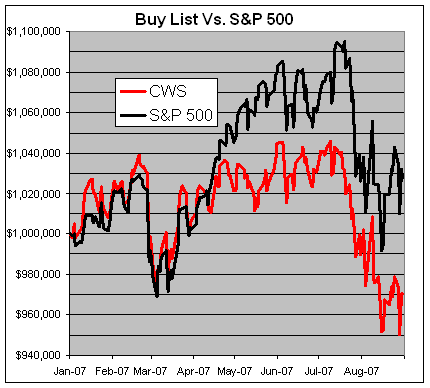
Now that 2007 is nearly two-thirds over, let's have a look at how our Buy List is doing.
So far, the 20 stocks on the Buy List are down 2.95% (not including dividends) while the S&P 500 is up 2.78%. The Buy List has been 8.7% less than volatile than the S&P 500.
Dell (DELL) just reported surprisingly good earnings of 32 cents a share.
Dell, like competitors Hewlett-Packard and Apple, profited from lower costs for computer components amid a supply glut. But profit was reduced by payments to its former CEO and 400 employees for stock options that could not be exercised during the company's internal audit, which found that executives adjusted accounts to meet financial targets.
The big problem is that these aren't official results. Dell hasn't filed with the SEC for over a year. Here are the numbers, but bear in mind that they'll be changed.
The first area of focus is that open interest on September 700 S&P puts is 116,000 contracts, an unusually high number for such a low-probability trade. A put is a defensive bet that gives the holder the right to sell a security at a specified price, in this case more than 50% below the S&P 500's current level of 1463 as of Wednesday's close.
For comparison's sake, according to the Option Clearing Corp., the open interest in the July 700 strike some three weeks prior to expiration on July 20 was 790 calls and 7,300 puts, and the August 700 strike showed 1,250 calls and 14,800 puts prior to Aug. 17 expiration.
And the volume completely outstrips anything seen last September, when the S&P was around 1300, some 20% below current levels. In September 2006, the 700 strike had 600 calls and 7,500 puts, and no strike below 1000 had open interest surpassing 42,000 contracts, and that was the 900 puts.
The bulk of the September SPX trades in question have been put on since June 1. Similar bets have also been placed on the DJ Eurostoxx 50 index, which won't pay off unless the index tumbles nearly 25% to 2800, or below, by expiration on the third Friday of September.
Second-quarter GDP growth was revised higher this morning from 3.38% to 3.96%. The WSJruns through some of the numbers.
Trade gave the economy a bigger push than first estimated -- because U.S. exports were revised up, rising by a rate of 7.6% instead of the originally reported 6.4%. Imports fell 3.2%; originally, the decrease was seen at 2.6%.
The revised data showed trade added 1.42 percentage points to GDP in the second quarter. Originally, trade was seen contributing just 1.18 percentage points to GDP.
Businesses elevated spending more than previously thought. Outlays rose by 11.1% in April through June; originally, spending was estimated rising 8.1%. Business spending climbed 2.1% in the first quarter. Second-quarter investment in structures by business surged by 27.7%. Equipment and software increased 4.3%.
Consumer spending advanced by 1.4%, up from a previously reported 1.3% increase but below the first quarter's 3.7% climb. Consumer spending accounts for about 70% of economic activity. It contributed 1.03 percentage points to GDP in the second quarter; the original estimate was a contribution of 0.89 percentage point.
Durable-goods purchases increased 1.7% in April through June, above the previously reported 1.6% increase but below an 8.8% climb in the first quarter. Durable goods are expensive items designed to last at least three years, such as refrigerators.
Second-quarter nondurables spending fell by 0.3%. Services spending went 2.3% higher.
Residential fixed investment, which includes spending on housing, tumbled by 11.6% in the second quarter, a drop bigger than the previously reported 9.3% plunge. Housing fell 16.3% in the first quarter.
Yesterday was the 14th time in the last 19 Wednesdays that the S&P has rallied.
The numbers here are truly remarkable. The market is up for 35 of the last 50 Wednesdays. That's better a better winning percentage than both the Red Sox and Yankees.
Going back to September 28, 2005--that's an even 100 Wednesdays, the S&P rose 68 times including a run of 13 straight in early 2006. Combined, the other four days of the week are slightly negative.
"It felt like 'Apocalypse Now,'" East Hampton resident Kathi Goldman said at a recent public hearing, describing choppers over her house in the northwest woods. Goldman, a retired science teacher at Grace H. Dodge High School in the Bronx, said choppers were so noisy on July 3 that she fled to her apartment on Manhattan's Upper West Side.
Let’s say some kids in your neighborhood have a lemonade stand. You’re impressed by their entrepreneurial spirit so you order a glass and ask them how business is going.
“Great! We sold $20 worth of lemonade.”
“Wow! That’s really good. How much profit did you make?”
“Well, our costs were $17 so we made a $3 profit.”
You come back in a year (let’s suspend reality for a bit) and you want to see how the biz is going.
“We had a great year! We sold $55 worth of lemonade and our cost was just $35, so we made $20.”
This impresses you a lot. After a lengthy discussion of just-in-time inventory, first-mover advantage and Nassim Taleb’s latest, you decide to make the kids an offer for the lemonade stand.
How much would you pay? Say, $400?
Remember, it’s growing fast. How about $700? Maybe $1,000??
Well, it turns out, the kids have hired Goldman and they inform you that the price of the stand is $3,500 and not one penny less.
The subprime mess has ushered in a new level of clueless political grandstanding. Naturally, Chuck Schumer is around to take first prize.
The chairman of Congress's Joint Economic Committee then called on the firms to "assist this country's mortgage crisis" and "urge your clients to do their part to keep our housing markets afloat, by modifying subprime loans that are at risk of default."
In so doing, Subprime Chuck made a blithering fool of himself, though he probably doesn't realize why. So far, none of the four firms -- PricewaterhouseCoopers, Deloitte & Touche, Ernst & Young, and KPMG -- has responded publicly to his plea for lobbying help.
You see, management's job is to manage, and the auditor's job is to audit. There's also the decades-old requirement under U.S. securities laws that accounting firms must be independent of the companies they audit, both in appearance and in fact.
Under the Securities and Exchange Commission's rules, that means the auditors, among other things, "must act in an unbiased and objective manner." Lobbying audit clients to change their business practices is the mark of a biased auditor, not a disinterested one.
Baldanza (Spirit's CEO) supposedly told one of his staff in an email to handle the complaint and said, "we owe him nothing as far as I'm concerned. Let him tell the world how bad we are. He's never flown us before anyway and will be back when we save him a penny."
He then hit "reply to all" which included the couple's email address as well.
The Dow lost 280 points today. There's something odd about the 280-point level. This is the sixth time in the past seven weeks that the Dow has moved by 280 or more. That includes gains of 283 and 286 and a loss of 281 and today's loss of 280.28. Before February's drop of 416 points, the previous +/-280 day came in March 2003.
Although T-Bills are kinda back to normal, the yield on the 10-year T-Bond got down to a five-month low today.
Here's a new one. Knight Capital (NITE) may return $68 million in fees of its hedge funds due to lousy returns.
The Jersey City, N.J.-based said in a regulatory filing that it would return all or a portion of the fees related to managing its Deephaven Funds. All three major funds in the Deephaven group, which have $4.2 billion under management, have suffered losses during the first six months of the year, according to a report by Sandler O’Neill & Partners. The Deephaven Event fund is down 12.6%, while the Market Neutral fund is down 5.6%. The small Credit Opportunities fund is down 0.7%.
If these funds continue to loss as much during the rest of the year, Knight could suffer a hit of 16-cents per share. Based on “clawback” clause, Knight could return at least a portion of the incentive fees if the Deephaven Funds suffer a loss in the second half of the year.
Here's a video of Jim Cramer (with hair!), Gail Dudack and the Motley Fool brothers on the Charlie Rose show from October 1996. The market segment is for the first 17 minutes. Cramer was correctly bullish.
Gonzales is out, the NYT lists some possible successors:
Among the candidates, they said, were Michael Chertoff, the secretary of homeland security and a former federal appeals court judge and top Justice Department official; Christopher Cox, the chairman of the Securities and Exchange Commission; George J. Terwilliger III, a deputy attorney general under the first President Bush; Laurence H. Silberman, a court of appeals judge in Washington; and Larry D. Thompson, a former deputy attorney general who is now senior vice president and general counsel of PepsiCo.
Long, long time ago... I can still remember
How that yield spread made me smile.
And I knew if I had my chance
Those mofos I could finance
And I could pay my bills for a while.
But February made me shiver
With every good faith I'd deliver.
Bad news on my e-mail;
I just lost one more deal.
I can't remember if I cried
When I saw the Fremont slide
But something touched me deep inside
The day the Subprime died.
So bye-bye, B\C money supply.
Sent my package to four lenders
But they all asked me why.
And good old boys were on a crack induced high Singin', "This'll be the
day the loans die, This'll be the day the loans die."
For the last three weeks, the most interesting investment to watch was the rate on the 90-day T-Bill. I've never seen it so erratic. But now, it looks like short-term Treasuries are almost back to normal.
One ordinary afternoon in a bright, marble-floored lobby downtown here, the following conversation took place between two women, a government worker and a self-employed soapmaker.
"I bought KenGen at 9.90 shillings," said the government worker, Josephine Nduta, referring to her stake in the initial public offering of Kenya's power company last year. "I sold them at 28 -- I made a lot of money!"
"I also made money on that," said Mary Kariuki, the soapmaker, recalling how she used the $1,000 to pay her children's school fees. "I bought 3,300 shares."
The two women carried on about liquidity and profit margins, and recalled with pride attending the first shareholder meeting of KenGen this year, an event so huge that it had to be held in the city's largest soccer stadium. About 200,000 people from all corners of the country came like so many newly minted executives.
"I felt so good," Kariuki recalled. "It was just normal, common people. People dressed well. What impressed me was the number of old women -- they were coming in their traditional clothes. They were telling me, 'Yes, we bought!' "
Hmm, I wonder how this story will end. Wait, don't tell me! I want to see.
Renaissance Technologies, one of the world's biggest hedge fund groups, has shrugged off concerns about volatile global markets and is considering a partial float.
The $30bn (£15bn) group run by billionaire mathematician James Simons had held discussions about selling shares to sophisticated investors through a private trading network set up recently by a group of investment banks.
The move suggests that Renaissance believes that the recent crisis in the US credit markets and the global flight to safety among investors will be short-lived and that there will be ample opportunity for the hedge fund to continue to earn its historically high returns.
Renaissance believes that there will be strong demand for its shares from big US institutions and foreign investors such as governments in Asia and the Middle East.
The bullishness shown by Renaissance comes as hedge fund groups such as AQR and private equity firms including KKR are proceeding cautiously with planned initial public offerings.
However, those groups are contemplating full listings available to all investors that must be registered with the Securities and Exchange Commission. Renaissance is considering a so-called 144A listing that would not be registered and would be available only to institutional and other sophisticated investors.
The highly secretive Long Island-based group is considering this route because it would not be forced to publicly reveal significant information about its trading strategies and it believes it would be more likely to attract more long-term investors.
The shares would trade on a system called Opus 5, launched this month by Morgan Stanley, Lehman Brothers, Citigroup, Merrill Lynch and the Bank of New York Mellon.
The consortium platform is intended to compete with existing markets for private placements set up by Bear Stearns, Goldman Sachs and JPMorgan. Friedman, Billings, Ramsey has also been a big user of the 144A market. A Renaissance official could not be reached for comment. Talks about a sale are at a sensitive stage and could still stall, however the shares could be sold as early as next month.
It is not yet clear what size of stake Renaissance would sell in the offering but it is assumed that current management will retain control of the group.
Fortress Investment Group, the hedge fund and private equity firm that went public this year, manages about $43bn and has a market value of about $7.3bn.
Who knew the baseball card biz could be filled with such high drama? Topps (TOPP) has now delayed the vote on the $385 million takeover offer from Michael Eisner's Tornante. Last week, Upper Deck pulled out of the bidding.
The move is to allow Topps stockholders to "evaluate recent developments when deciding how to vote their shares," Topps said. It said that had the vote taken place as scheduled, the Tornante deal likely would have failed to win a majority of the shares needed for its approval.
Topps urged shareholders in a letter to support the $9.75-a-share cash deal with Tornante, which is owned by former Walt Disney Co. Chief Executive Michael Eisner and Madison Dearborn Partners LLC.
However, two proxy advisory firms, Institutional Shareholder Services and Glass Lewis, have urged Topps holders to reject the Eisner-Madison deal, which also was opposed by Crescendo Advisors LLC.
Upper Deck had offered $10.75 a share but Topps said that offer was "a sham." Considering that shares of TOPP haven't done much for about 15 years, I'd want them to take any offer, sham or not.
Erin Burnett, aka the Street Sweetie, gets a 2,000-word love letter from Howie Kurtz in today's Washington Post:
Less than two years after joining the business channel, Burnett is everywhere, from "NBC Nightly News" to "Hardball." She's been praised by Rush Limbaugh, mocked by Jon Stewart and ogled by Chris Matthews.
The 31-year-old is razor sharp, works crazy hours, is comfortable discussing liquidity or collateralized debt obligations -- and everyone keeps talking about her looks. Under the lights, in a smoky blue dress that matches her eyes as well as her shoes, her flowing dark hair perfectly teased, she is not exactly hard on the eyes.
For the first time on record, home prices are expected to show a decline:
The already rough real estate market may be about to get bumpier.
Economists predict a government report due out Thursday will show a national drop in the median price of single family homes since last year. If economists are right, it will be the first time that's ever happened.
"Cumulatively, prices should fall somewhere between five and 10 percent nationwide," said economist Mark Zandi.
The median price for a single-family home is currently $223,800. The median price is the number midway between the least expensive and most expensive houses sold in a given period.
Zandi says too much inventory, weak demand and tighter credit have been problems in some markets for two years.
"Well over half the country is now experiencing price declines and will experience further price declines through this time next year into 2009," Zandi said. "That's unprecedented."
In Reno, home prices are down more than 6 percent from a year ago and are expected to drop close to 11 percent in the next year.
Minneapolis prices are down 2.6 percent from last year.
And in Hartford, home prices are down more than 5 percent from a year ago and are expected to fall further.
But the price slump hasn't spread everywhere. Home prices are up in places like Charlotte and Austin.
With home prices dropping in so many areas, many families could lose a big financial cushion—their home equity.
"For those homeowners who bought in over the last couple of years, that piggybank is broke," Zandi said. "There is no cash the to pull out because house prices have been declining and they have no equity in their home."
I'm not sure if this is for or against the credit crunch story, but it now tops a poll of economists' fears about the economy:
The combined risk of mortgage defaults and heavy debt loads has overtaken terrorism as the biggest short-term threat to the U.S. economy, according to a survey of economists being released today.
The National Association for Business Economics says almost a third of its survey respondents listed debt-related problems as their top worry: About 18% cited the effects of subprime-loan defaults and 14% listed excessive household or corporate debt.
About 20% of the 258 members responding put defense concerns and the possible economic disruption of a terror attack at the top of their list, down from 35% in the group's March survey. Energy prices were the top-cited risk among 13% of the group, which largely includes economists working at U.S. corporations or with think tanks and universities.
The poll results, collected from July 24 to Aug. 14, reflect early worries about the turmoil spreading through equity and debt markets in recent weeks. Defaults tied to riskier home loans soared this year, devaluing mortgage-backed securities and spurring a pullback from many lenders. The ensuing crisis has spurred worries of cutbacks in business and consumer spending.
The second-quarter GDP report will be revised later this week. It will be interesting to see how well the economy did. The initial report said the economy grew by 3.4%. I wouldn't be surprised to see that number adjusted higher.
Question: Name the worst kind of shoe to run a marathon in. #1 Answer: High heels Worst Answer: Scuba flippers Louie Anderson's Response: If it's up there... I'll be surprised.
There’s something fascinating about the game show the Family Feud. You don’t have to give the best answer, or the funniest answer. You don’t even need to give a correct answer. All you need to do is give the answer everyone else gives. The show rewards people for being exactly like the largest amount of other people. Anything exceptional is not only discouraged, it’s actively punished.
I couldn’t help but think of the show as I read this WSJarticle on why so many quant funds are having trouble:
A number of quant funds, which use statistical models to find winning trading strategies, reported heavy losses this month. In many cases, the managers pointed their fingers at other quantitative hedge funds, essentially saying they all owned many of the same stocks and their models told them all to sell at the same time, driving down the share prices, hurting everyone in the process.
In a letter to investors, Jim Simons of the hedge fund Renaissance Technologies wrote the quantitative funds behind the selling "undoubtedly share some signals in common with our own, and the result has been losses." It didn't help that quant funds are among the fastest expanding categories of hedge funds.
In other words, a lot of folks are running down Wall Street in scuba slippers.
Filings with the Securities and Exchange Commission show that as of the end of June, quantitative hedge funds often shared large positions in the same stocks. Renaissance held 1.1% of the shares outstanding of NVR Inc., a Virginia construction and home-building company. AQR Capital Management, another quant fund, held 0.9% of the company's shares and quant fund Numeric Investors had a 1.6% stake.
NVR stock, which closed yesterday at $571 a share, trades less than most companies of its size. The shares have bounced higher since the selloff, but they are off 8.4% over the past month.
The overlap in quant funds' positions wasn't limited to NVR. Satya Pradhuman, director of research at Cirrus Research, which analyzes small and midsize stocks, found 148 other companies with market capitalizations between $2 billion and $10 billion where large quant funds owned 5% or more of the shares outstanding.
As a whole, those companies' shares underperformed the shares of other midcap stocks during the selloff. Mr. Pradhuman found 473 small-cap stocks, with market capitalizations of $250 million to $2 billion, where the quant funds owned 5% or more of the shares outstanding. These stocks also performed worse than other similar stocks.
The midcap companies where quant funds held big stakes included packaging company Pactiv Corp., toy maker Hasbro Inc. and managed care provider WellCare Health Plans Inc. Small caps included printer Deluxe Corp., consumer-products company Russ Berrie & Co. and health-care equipment maker Zoll Medical Corp.
Brian: Please, please, please listen! I've got one or two things to say. The Crowd: Tell us! Tell us both of them! Brian: Look, you've got it all wrong! You don't NEED to follow ME, You don't NEED to follow ANYBODY! You've got to think for your selves! You're ALL individuals! The Crowd: Yes! We're all individuals! Brian: You're all different! The Crowd: Yes, we ARE all different! Man in crowd: I'm not...
Reason has a fascinating interview with Kirk Hamilton on what really makes a country wealthy, its intangible wealth. This is from the intro:
Oil, soil, copper, and forests are forms of wealth. So are factories, houses, and roads. But according to a 2005 study by the World Bank, such solid goods amount to only about 20 percent of the wealth of rich nations and 40 percent of the wealth of poor countries.
So what accounts for the majority? World Bank environmental economist Kirk Hamilton and his team in the bank's environment department have found that most of humanity's wealth isn't made of physical stuff. It is intangible. In their extraordinary but vastly underappreciated report, Where Is The Wealth Of Nations?: Measuring Capital for the 21st Century, Hamilton's team found that "human capital and the value of institutions (as measured by rule of law) constitute the largest share of wealth in virtually all countries."
The second issue of Condé Nast's big-budget business mag, Portfolio, arrived on newsstands last week and I plucked one from atop an enormous stack of them at the Union Square Barnes & Noble in New York. Between the weeks of media coverage citing long weekends, staff disagreements, reports of fewer ad pages in the second issue and more recently, the public firing of deputy editor Jim Impoco, the magazine has created enough internal melodrama to stoke curiosity--mine, anyway--about how well the second effort stacks up to the first. The temptation to speculate about the skyscraper stack of Portfolios being indicative of oversupply (the money and resources the company is pouring into the publication) or lack of demand (the target audience isn't interested in reading it) lingers, but one retail outlet isn't a legitimate sample size.
And neither is one reader. But if Portfolio were a high-end business magazine, I'd be an enthusiastic subscriber. The problem is that it's not. Press coverage has referred to it as a "Vanity Fair for business." It's not that, either.
The unfortunate thing is that it could be both. Portfolio should be a magazine about power, specifically in the private sector: who has it, how they got it, what they do with it, and whether they're using it for good or evil. (If you're going to write about Cerberus, for example, I have less interest in how secretive Steve Feinberg claims the firm is than what sort of deals John Snow is cutting in China, with whom, and to what extent the Chinese government is involved--something that has wider-ranging implications than the notion that some hedge-fund managers play against stereotypes and drive pickup trucks.) The magazine should exploit the biggest major advantage that print has over the web and that monthlies can generally do better than weeklies--long-form narrative journalism. There are huge swaths of the private sector that aren't materially covered right now. These are stories that existing mass-market business publications mostly bypass: They tend to cover large public companies; which are most relevant to the average investor. But that's a very narrow view of the business world. It's fine for The Wall Street Journal, which purposefully and usefully focuses on investors, but limiting for a general-interest business magazine.
That Portfolio hasn't taken advantage of its opportunity is probably a reflection of editor-in-chief Joanne Lipman's background, which most famously consists of launching The Wall Street Journal's "Weekend Journal," a lifestyle-oriented section that had little to do with covering hard business stories. And Portfolio's flaws seem to be rooted in its editor's entrenched habits from doing a very different sort of journalism.
FactSet Research Systems (FDS) is a company whose products most professional money manager are familiar with, but it’s the stock that’s been catching my eye lately.
The story here is pretty simple: Wall Street is addicted to data and FDS is their dealer. The fundamentals are solid; fat margins, zero debt and nice history of churning out 20% EPS increases.
I’ll warn you, FDS is expensive although it recently got a little less expense. The shares are off about 20% from their high. I think the market is concerned that many of FDS’ clients are these dearly departed hedge funds. I doubt that’s the case. FDS has a large diversified client base (2,000 clients and 33,000 users). This is a well-entrenched business.
Not everyone is on the rate-cut bandwagon. The Financial Times opines against one:
Credit fuels the modern economy, and if the dislocation in the money markets lasts another month or two, investment, consumption and growth in the real economy will suffer. Central banks must restore confidence, but rather than cut interest rates they should extend liquidity operations to longer maturities, more collateral and possibly even different counterparties.
Liquidity injections by the Federal Reserve and European Central Bank have brought down overnight interest rates, but longer-term borrowing is still unusually expensive, while US Treasury bills have been trading at panic levels of below 3 per cent. It is hard to borrow using collateral not issued or guaranteed by a government. Central bank intervention has not worked so far.
This is not a recession panic, as in 1998, when the Long-Term Capital Management crisis coincided with weak economic data.
Nor is it a panic caused by serious credit losses. Defaults on US subprime mortgages are miles off a level at which triple-A bonds backed by them would suffer losses. When they do trade, the prices can be reasonable: as part of its acquisition by Kaupthing last week, the Dutch bank NIBC sold its subprime portfolio for 78 cents on the dollar.
The problem is that the bonds do not trade – the crisis is one of liquidity – and that has spread to short-term debt sold by investment vehicles that may be exposed.
The futures market expects the Fed to cut interest rates aggressively, but unless the Fed expects harm to the real economy, that policy makes little sense. It is indiscriminate and so creates moral hazard in the markets, but there is also a good chance it would not work.
The Fed has already pushed its main funds rate down well below its 5.25 per cent target, but the problem is not overnight liquidity at banks, it is perceived credit risk on three-month commercial paper. Giving cheaper money to banks might or might not change that perception.
The lenders of last resort need to find ways to get money through the traditional banking system to the markets where the trouble is. They can do so by agreeing to lend against more securities (the Bank of Canada is already accepting commercial paper); by lending for a few months rather than overnight; and possibly by dealing with off-balance-sheet vehicles directly.
There should be no handouts – lending should be at penalty interest rates – but what is needed to jump-start the credit markets is more targeted liquidity. Central banks should not crack and cut their policy rates while they have more suitable tools in the box.
Federal Reserve officials are cautiously optimistic that the series of steps they have taken to stabilize markets have started to work.
Ugh! "Cautiously optimistic" is one of the great all-purpose bullshit media phrases of all-time. It means nothing. It sounds thoughtful and sober, but it really communicates nothing. You can see why central bankers love using it.
What a great all-purpose, meaningless qualifier to keep from looking stupid. It's much better than just saying "I don't know." It implies that that the person really does know something important, but is being conservative and careful in the distribution of information, holding back the unverifiable facts for the good of the republic.
Or covering their behinds.
"Cautiously optimistic." If the economy goes into the dumper again, we can say our earlier caution was warranted. If things pick up, we were right to be optimistic and "knew it all along."
The Journal continues:
Officials acknowledge conditions are far from calm, and markets could easily take a turn for the worse. But they cite stable stock prices, a pickup in issuance of jumbo mortgages and other factors as evidence that in recent days conditions have improved, though gradually, instead of worsened.
Many on Wall Street are more pessimistic, and believe the Fed will still have to cut interest rates sharply, perhaps starting in the next week or two. But as long as Fed officials think things are getting better, they are less likely to feel pressured to cut interest rates immediately and more likely to wait until their scheduled meeting Sept. 18 to decide.
Going by the futures market, I’d say the Federal Reserve will cut in September and again in October. I don’t think the Fed wants to break out of its pattern of only cutting rates at meetings. It could, but I don’t think it sees the current situation as being that drastic.
One of my long-standing criticisms of mainstream market analysis is the centrality placed on the Federal Reserve. This is classic over-agency bias. Sure, the Fed is important, but it’s not that important. The Fed really can’t fight what the market wants. If the market demands a rate cut, well...sooner or later, it will get one.
Another issue that I’ve noticed is that some observers are treating the market’s recent activity as some major come-uppance for speculators. The market’s decline is not very steep and the most severe pain is confined to a small number of stocks. Yet, people will use any decline as an excuse for public moralizing.
Let’s keep in mind that equity valuations are still quite modest. Also, growth stocks have outperformed value stocks since the market broke. That’s hardly a come-uppance to irrational exuberance. Viewed from the long-term, this summer is barely a hiccup.
I still think the risk/reward tradeoff greatly favors equity investors. You could even say that I’m cautiously optimistic.
Medical device maker Medtronic Inc.'s profits grew 12.6 percent in the first quarter, but it will be looking to some of its new products to keep that momentum going for the rest of the year.
The maker of pacemakers, spinal implants and insulin pumps has hit a few speedbumps recently, especially in the important market for implantable defibrillators and pacemakers. Recalls at rival Guidant Corp. as well as Medtronic have hampered the market.
New products, including its Endeavor drug-coated stent and its BRYAN Cervical Disc implant, should help, said President and incoming CEO Bill Hawkins.
"It's really the breadth of our whole portfolio that is going to drive growth in the back half of this year," he said in an interview.
Medtronic could also get a boost from recovery at its Physio-Control subsidiary for external defibrillators. Plans to spin it off were put on hold after shipments were suspended in January because of unspecified quality problems.
Hawkins told analysts that the company has been working with the FDA on corrective action, and that it has resumed limited shipments, and plans to resume full U.S. shipments in the second half of the current fiscal year. Hawkins said Medtronic would still look to spin off Physio-Control "at the appropriate time."
Fridley-based Medtronic had launched a direct-to-consumer advertising campign for its implantable heart devices, but Hawkins said on Tuesday that campaign has wrapped up.
Medtronic said it earned $675 million, or 59 cents per share, up from $599 million, or 51 cents per share, during the same period last year. Revenue rose almost 8 percent to $3.13 billion, from $2.9 billion a year ago.
Not counting certain items, Medtronic said it earned 62 cents per share. That matched the expectation of analysts surveyed by Thomson Financial.
Non-U.S. revenue of $1.18 billion was up 16 percent. For the quarter, 38 percent of Medtronic's revenue came from outside the U.S.
Medtronic (MDT) will release its earnings after the close today. The earnings are still humming along even though the stock hasn’t done much. Here’s a look at MDT’s stock (blue line, left scale) and earnings-per-share (gold line, right scale).
Medical device maker Medtronic Inc. reports earnings for the fiscal 2008 first-quarter on Tuesday. The following is a summary of key developments and analyst opinion related to the period.
OVERVIEW: Concerns about lagging sales of its implantable heart devices followed the company into the quarter as Chief Executive Arthur Collins moved closer to his August retirement date.
In June, the company received Food and Drug Administration approval for an implantable pain reliever, aimed at treating chronic lower back pain. It also raised its quarterly dividend 14 percent to 12.5 cents per share and elected two independent board members, raising the total number of board members to 14.
In July, the company said its drug-coated stent Endeavor showed positive results in a late-stage study comparing it with rival Boston Scientific's Taxus. Also in July, the company was issued a warning letter from the FDA saying the company did not properly report problems with some of its medical devices. The problems stem from the company's Minneapolis plant where drug infusion pumps are made. The FDA noted that the company had already fixed the problems, but had failed to report them within the required 30-day period.
During the quarter the FDA also approved Medtronic's Prestige Cervical Disk System, which the company said is an alternative to surgery for people suffering from degenerative disc disease. Medtronic also said it would buy Kyphon, a spinal implant maker, for $3.9 billion.
BY THE NUMBERS: Analysts surveyed by Thomson Financial expect profit of 62 cents per share for the quarter on revenue of just under $3.17 billion. During the first quarter of fiscal 2007, the company earned 51 cents per share on revenue of $2.9 billion. In May, Medtronic said it would no longer provide guidance more than a year ahead and would stop providing quarterly guidance.
ANALYST TAKE: Leerink Swann & Co. analyst Jason Wittes said he expects the company to meet Wall Street expectations. Sales of implantable cardiac devices are expected to rise 9 percent to $732 million, with a large surge in sales figures from outside the U.S., he said.
BMO Capital Markets analyst Joanne Wuensch also said she expects first-quarter results to meet Wall Street expectations and said implantable cardiac device sales will be a key focus.
WHAT'S AHEAD: Wall Street and the company are waiting for the FDA's decision on Endeavor. The company previously said it expects approval by the end of the year. Analysts are also waiting for more information on the Kyphon buyout, for which there is no set closing date.
STOCK PERFORMANCE: Medtronic shares fell 5 percent during the first quarter to close at $50.81 on July 27. The company's fiscal year ends April 27.
Date...............................................Change
December 19, 1980........................-1.27
January 5, 1981.............................-1.13
February 22, 1982.........................-0.94
September 16, 1974......................-0.85
March 27, 1980..............................-0.81
April 28, 1980................................-0.81
August 2, 1982..............................-0.81
June 15, 1981................................-0.81
February 18, 1982..........................-0.77
November 15, 1973........................-0.77
May 26, 1981..................................-0.75
September 27, 1974........................-0.72
September 19, 1974........................-0.71
April 22, 1980..................................-0.68
August 20, 2007..............................-0.67
Wall Street traders don't mind committing the crime - it's doing the time that gives them the willies.
More than half of traders questioned in a recent survey said they would trade on illegal insider information if the deal allowed them to pocket a $10 million profit - provided there was zero chance they would be caught.
If there was a 10 percent chance of getting cuffed by the Feds and perp-walked, then the percentage of traders willing to break the law drops from 58 percent to 28 percent. Only 7 percent of an obviously prison-averse trader community said they would do the crime if there were a 50 percent chance of an indictment. (Yep, traders know how to play odds - Eddy)
The survey, which polled 2,500 traders, was taken by Trader Monthly magazine.
Ty Wenger, the editor of the magazine, attributed the high number of traders willing to commit a felony to the huge premium placed on their having an edge. "That edge is the difference between being highly successful or going belly up; there is no guaranteed money," Wenger said. "Morality can't be a big part of the job."
Perhaps it is no surprise then that the do-the-crime-but-do-no-time traders said that the public figure they despise the most is Governor Eliot Spitzer.
Spitzer is the former state Attorney General who made his mark during eight years in office by cracking down on Wall Street - specifically investment banks, mutual funds and insurance companies.
Sixty-two percent of traders in the survey cited Spitzer as being the most hated, far ahead of ex-New York Stock Exchange boss Dick Grasso, who finished second at 20 percent. John Thain, Grasso's successor, garnered 11 percent with Chris Cox, chairman of the Securities and Exchange Commission, getting 7 percent.
And speaking of Grasso, traders are just about evenly split over whether or not he got a bad rap with the Spitzer suit, claiming he was overpaid - 52 percent think he earned every penny.
"Grasso got a bad rap," one trader, Andre Duncan of Mercer Capital, told the magazine. "People that short deserve all the money they can get." Duncan trades short-term equities.
While we're talking about money, 21 percent of traders questioned said they didn't donate any of their salary to charity.
Other topics addressed by the survey, which will appear in the monthly's next issue, to hit the stands Aug. 29:
* If you could swap lives for a year with one of the following traders, he would be . . .? Stevie Cohen, 42 percent; T. Boone Pickens, 27 percent; Paul Tudor Jones, 25 percent; and James Simons, 6 percent.
* If you could have one super power that you could use to trade, it would be . . .? Mind reading, so I could out-think everyone on the trading floor, 68 percent; Invisibility, so I could go around screwing other traders, like Patrick Swayze did in "Ghost," 19 percent; and superhuman speed, so I could click my mouse faster, 13 percent.
According to the futures market, there's a 380% chance of a Fed rate cut in September. Today could be the first 60-point decline in short-term T-bills in 25 years.
It didn't take Murdoch long. Barron's went after Cramer this past weekend:
Cramer is unapologetic about his self-promotion, but he acknowledges his bad calls, too. What he hasn't done is tell his viewers the overall score for his two-plus years of Mad Money picks. When he hits his "Buy Buy Buy" sound-effect button, can viewers expect market-walloping results?
In trying to figure that out, we came across YourMoneyWatch.com, a Website started by Michael McGown, a retired securities analyst who worked for several major brokerage firms. McGown started the site not long after the show started, and says Cramer sent a complimentary e-mail after noticing it. McGown counts only Cramer's clear and unconditional Buy recommendations, following a sensible set of rules. McGown tracks the stock until Cramer says sell. "As a person watching the show," says McGown, "I think it's a fair way to rate him."
Over two years, YourMoneyWatch has tracked 1,300 Mad Money picks. It's this tally that shows Cramer's stocks lagging behind the Dow and the S&P 500. This year, Cramer's done better. McGown's data show his picks up 3.2%, while the S&P is up 2%; the Dow, 4.9%; and the Nasdaq, 3.7%. CNBC says the YourMoneyWatch data, as well that of Cramer's Mad Money Website, are "not authoritative."
Hoping to get Cramer's advice on how to measure his Mad Money picks, I called him a few weeks ago. He tore into me. "I've never read a single article that I thought wasn't a massive distortion of what the show's all about," he said. When I said I just wanted to see Mad Money's record, he replied: "I've never seen an analysis that I've regarded as honest, and I doubt yours is any different."
Living in DC, I often seen famous politicos roaming the streets. Or at least, famous for DC. Once I came close to running over a senator (by accident). But in the Hamptons this weekend, Barry Ritholtz (not a Guiliani fan) found himself sitting next to the former mayor.
"Mr. Mayor! Good luck in the presidential race. Unfortunately, its going to be an uphill battle, thanks to the current occupant of the White House. But we're New Yorkers, and we wish you the best."
Consider the Great Depression, which, we were taught, was the ultimate morality play. The 1920s markets were bubbly madness. Little true growth underlay the price increases. Then came 1929. The decade of splurge required a decade of penance.
This cuts out a lot of reality. While the stock market of the late '20s was probably too high, it was not high enough to cause "The Grapes of Wrath." A few years ago, Edward Prescott, a Nobel Prize winner, and Ellen McGrattan looked at the Dow in a paper for the Minneapolis Fed. Stock prices relative to fundamental values of corporations were underrated, even in August 1929, they concluded.
Could have fooled me. (And the entire market.) I'll look over the paper later.
Where was your money on the morning of Aug. 19, 2004?
In case you don't recognize the date, that's the day three years ago when Google (GOOG) became a public company after selling 22.5 million shares of stock at the now laughable price of $85.
The Federal Reserve cut the discount the rate by 50 basis points.
This isn’t the regular Fed funds rate we often talk about, instead it’s the rarely used discount rate. Still, this has a huge psychological impact. I think this means that the Fed will almost certainly cut the Fed funds rate at its next meeting on September 18.
The market is already up 200 points. Jim Cramer said this will be the biggest point move in history. For the record, the #1 day was 499.19 points on March 16, 2000.
This is interesting time for the Fed to step in because August options contracts expire today. Days like today are often more volatile than regular trading days. In short, the Fed isn’t afraid to take on the shorts.
Berkshire Hathaway Inc., the investment firm run by Warren Buffett, bought stakes in Dow Jones & Co. and Bank of America Corp. and more than quadrupled its holdings of health insurers UnitedHealth Group and WellPoint Inc.
Berkshire hadn't previously disclosed the stakes in Dow Jones, owner of the Wall Street Journal, and Bank of America, the second-largest U.S. bank, though it's unclear when the company acquired the positions. As of June 30, Berkshire held 2.78 million shares of Dow Jones and 8.7 million shares of Bank of America, the Omaha, Nebraska-based firm said in a filing with the U.S. Securities and Exchange Commission today.
The selling in Bed Bath & Beyond (BBBY) is getting a bit beyond reasonable.
Let’s run the history. In early June, the stock’s at $40.50 when the company says Q1 EPS (May) will be 36 to 38 cents. Not good since the Street was looking for 39 cents.
Naturally, the market freaks because BBBY never warns. They’ve nailed their number for something like 15 straight years. Having them miss is like watching the Orioles two-hit the Yankees. How often is that gonna happen?
Three weeks later, BBBY reports 38 cents a share. So they were off by a penny and the stock drops to $36. If you’re scoring at home, that’s 450 pennies in missing price for one penny in missing profit. That lost value has a P/E ratio of…many.
On the call, the company said that Q2 EPS (August) will either be flat or up in the low single-digits. Since last year’s Q2 came in at 51 cents, I take that to mean 51 to 53 cents a share. (I used math on that.)
There’s been zero news since then and the stock is now below $34 a share. Yes, I know—housing’s a mess, but that’s not all of BBBY’s biz. They’re not Mortgage Mortgage & Beyond.
The stock is about where it was six years ago when the housing boom was just starting. This is one those companies that regularly churns out top-notch returns-on-equity. No debt, solid ratios—and now, a good price.
I notice this post by Bruce Bartlett on Andrew Sullivan's site. I apologize for the length, but I feel I need to post the whole to make my point. Take it away Bruce.
Two years ago, I first saw problems arising in financial markets. The problem was that the Federal Reserve had been easy for a long time in order help get the economy moving after the recession of 2001. This led to overexpansion of certain sectors of the economy that could not be sustained without a continuation of the easy money policy. In 2005, the Fed began reversing its easy money policy. This inevitably meant that those sectors--in this case, housing--that were dependent on easy money would likely crash. As I wrote in an August 2005 column:
"The problem here is that just because the Fed is raising rates gradually, the impact will not necessarily be gradual. It could come quite abruptly. Think of a balloon. Whether you blow it up slowly or fast, at some point it is still going to burst. The same thing oftentimes occurs with monetary policy. It may appear that nothing is going on for a long time and then, suddenly, something dramatic happens to show that monetary policy is working as expected."
I became very concerned by my analysis, even to the point of shorting the market in anticipation that my view would soon become widespread and lead to a market correction. And then nothing happened. The market sloughed off problems in the housing market and among subprime lenders. When I would talk to Wall Street-types, I was assured that things were under control. Everything was carefully hedged. The balloon wasn't going to explode, I was told. It would hiss a little air and everything would be fine.
Contrary to my expectations, the market went up. I closed my short positions, swallowed my losses, and concluded that my analysis was incorrect. Well, I should have had more confidence in myself, because the chickens have been coming home to roost this week exactly as I predicted two years ago.
One point I am trying to make is that to be successful in the stock market, it is not enough to understand fundamental trends and be correct in your forecast. There's also the critical problem of timing. If you are too far ahead of the pack, as I was in 2005, the information is essentially valueless. In fact, it can be counterproductive, as it was in my case. Even if I had held my short position all this time, I still would have lost money because even after the steep decline this week, the S&P 500 index is still more than 1,500 points above where it was two years ago. I still would have lost money.
Over the years, I have observed lots of investors and forecasters making similar mistakes, so I know I am in good company. The trick, as best I can tell, is not to be too much smarter than the market, but just a little smarter. If you are too smart, you move too soon and you end up losing money even though you were basically correct in your analysis. If you are only a little bit smarter, you figure out what's going on just before everyone else does. There's a great deal of money to be made with that kind of knowledge.
As I read this, Bartlett is saying that his mistake was that he was too intelligent. I'm not trying to make fun of Bartlett, indeed, he's a very sharp guy. But the bottom line is that he lost money on a trade that wasn't very intelligent. Sometimes smart people do things that aren't so smart.
The key is to evaluate information correctly and within its proper context. Sure, there were lots of problems in the mortgage markets, but that doesn't mean it will wreck the whole system. Even when disaster comes, it's usually not disaster. He writes that "chickens are coming home to roost." Not exactly. As I write this, the Dow is down about 900 points from its high, or about 6.4%.
The trick isn't to be just a little bit smarter, but it's what kind of intelligence. It's not just the facts you know, it's being able to think critically about those facts. Bartlett's comments remind of Gilbert & Sullivan's Modern Major General who knows "many cheerful facts about the square of the hypotenuse."
When people analyze the market, they tend to have a bias towards drama, which usually flatters the analyst.
Food distributor Sysco Corp. on Monday reported better-than-expected quarterly earnings, helped by increased sales despite food cost inflation, sending shares up as much as 5 percent.
The company, which supplies food and other products to restaurants, cafeterias and other food sellers, reported net earnings of $303.4 million, or 49 cents per share, for the fiscal fourth quarter ended June 30, up from $254.1 million, or 41 cents per share, a year earlier.
Analysts were expecting the company to earn 46 cents per share, according to Reuters Estimates.
Sysco said quarterly sales rose 8.5 percent $9.23 billion, above analysts' expectation of $9.137 billion.
Food cost inflation, measured by the change in Sysco's cost of goods, was 6.1 percent.
The company is targeting long-term annual sales growth of 7 to 9 percent, excluding the impact of major acquisitions, and expects low-to mid-double digit annualized earnings per share growth.
Analysts expected Sysco's 2008 profits to grow about 13 percent to $1.78 per share, and revenues to grow 8 percent to $37.83 billion, according to Reuters Estimates.
James Simons's $29 billion Renaissance Institutional Equities Fund, which uses computer models to pick stocks, has fallen 8.7 percent so far in August.
The hedge fund, started two years ago, has declined 7.4 percent for the year.
"We have been caught in what appears to be a large wave of de-leveraging on the part of quantitative long/short hedge funds," Simons wrote in a note to investors yesterday.
Simons has one of the best records in the hedge-fund industry. His Medallion fund, which manages money only for Simons and his employees, has climbed at an average annual rate of more than 30 percent since 1988. The East Setauket, New York- based firm manages a total of $36.8 billion.
On July 25, the company reported earnings and were decent--not amazing, but decent (20% ahead of expectations). The stock gapped up a bit but eventually closed lower by two cents a share.
Now fast forward to this week. The 10-Q came out on Wednesday and the shares suddenly plunged 13% in two days. I'm not for or against this stock. I just find it interesting that a big sell-off comes, apparently, out of nowhere. Ashland even had to issue a press release after yesterday's close saying they "know of no company-specific issues" causing the decline.
I've gone through the 10-Q and nothing looks out of the ordinary. My guess is that some logarithm spotted some metric or ratio or whatever (no taxes?) and he told another logarithm to sell everything immediately.
I can't imagine his endorsement will sway many people, but it will mean money:
Goldman Sachs Group Inc. Chairman Lloyd Blankfein endorsed Democratic New York Senator Hillary Clinton's presidential bid, a day after her opponents sought to portray her business support as more of a burden than a blessing.
Blankfein's backing follows an endorsement in April from Morgan Stanley CEO John Mack, who was one of President George W. Bush's biggest fund-raisers. Clinton has increased her donations from Wall Street constituents during her time in the Senate, and took in at least $424,545 from the top 10 investment banks in the second quarter for her presidential campaign.
Here’s a simplified version of what’s been happening in the market. This is the sector returns of the S&P 500 for the last three weeks and the three weeks before that.
Sector...............June 28 to July 19..........July 19 to August 9
Energy.......................8.79%........................-9.49%
Staples......................1.61%........................-1.34%
Healthcare.................0.46%........................-4.32%
Industrials..................6.41%........................-6.59%
Tech...........................5.74%........................-6.13%
Materials....................7.58%........................-9.98%
Telecom.....................-0.24%........................-3.59%
Utilities.......................5.02%........................-4.72%
Discretionary..............1.60%........................-8.85%
Financials..................-0.81%........................-7.43%
This Monday is the 25th anniversary of one of the greatest moments in Wall Street history, the release of Fast Times at Ridgemont High. This movie created a cultural reference point for an entire generation of Wall Street traders. In earlier generations, things like the Bible and Shakespeare performed a similar role.
This Sunday will also be important. It’s the 25th anniversary of the beginning of the Bull Market. On Thursday, August 12, 1982, the Dow bottomed out at 776.92.
To add some perspective, the market’s P/E ratio was less than half of today’s P/E ratio. The dividend yield was about four times that of today’s yield.
The following Tuesday, August 17, the market skyrocketed a phenomenal (get this) 38 points. That was the most points ever and percentage-wise, it was the second-best day since the Depression.
Over the last 25 years, the S&P 500 has returned 2,700% (dividends and capital gains) while gold and inflation have both roughly doubled (sorry gold bugs).
Leucadia National (LUK) seems to be weathering the subprime crisis quite well. If you’ve never heard of Leucadia, well…that’s pretty much how the company wants it. They own a hodgepodge of businesses; some real estate here, some timber there. Nothing terribly exciting.
The only interesting thing about Leucadia is that it’s about as close as you can get to owning a private company that just so happens to have a ticker symbol. The company might as well have “no comment” as its slogan. They have no earnings calls, no guidance, no investor conferences, no analyst coverage, nothing.
Despite this, they somehow make money! In the last 25 years, shares of LUK are up 34,000%. That’s more than almost every other stock—Intel, Apple, GE, even Berkshire Hathaway—you name it and LUK probably beats it.
But here’s the interesting part: Leucadia’s last 22% has come this week. I have no idea why. (More buyers than sellers?) Make no mistake; this is a rough market but there are still a lot of good stocks out there.
Brian Hunter, whose bad bets triggered the collapse of hedge fund Amaranth Advisors LLC, says a federal investigation into his possible involvement in an alleged multibillion-dollar manipulation of the natural-gas markets is hurting the start-up of his new fund venture.
Mr. Hunter said Solengo Capital Advisors has been pushed to "the brink of complete disintegration" by a probe by the Federal Energy Regulatory Commission and resulting civil charges against him and his previous employer, Amaranth. The statement was made in documents filed late last week in the federal District of Columbia court as part of a suit against FERC that Mr. Hunter filed in late July.
I wonder if the fact that he lost $6 billion in one week is hurting him as well.
I added Graco (GGG) to the Buy List at the start of this year. So far, it hasn’t been that impressive a stock. The earnings have been blah, and the stock has mostly been stuck in a trading range.
Until today. The shares vaulted past $43 and nearly hit $45. I honestly have no idea what the catalyst was. The next earnings report won’t come for another two months.
Sometimes on Wall Street, you just don’t know what moves a stock.
The great thing about reading the Wall Street Journal is you never know on what page you’ll find the front page story.
Today’s edition contains an excellent article by Greg Ip and Jon Hilsenrath on the birth and untimely death of the credit boom. Most impressively, the pair got Alan Greenspan to go on the record. This question for any discerning reader (or investor) is, “what’s Mr. Greenspan motive for doing so?“
Well, let’s take a look at what he has to say. Here the maestro defends himself against the charge of bring interest rates too low:
Mr. Greenspan raised vague fears with colleagues over the possibility this policy could create distortions in the economy, but he says today that such risks were an acceptable price for insuring against deflation. “Central banks cannot avoid taking risks. Such trade-offs are an integral part of policy. We were always confronted with choices.”
Oh dear lord. This is a completely meaningless answer. We know you face choices, Alan, so does everybody else. The question is, “were those choices correct?” As usual, he refuses to acknowledge his mistake.
But that’s not all—and this is the most maddening part. Greenspan now admits that he was the one who was really concerned about a real estate bubble all along. Honest he was.
Looking back, he says today: “We tried in 2004 to move long-term rates higher in order to get mortgage interest rates up and take some of the fizz out of the housing market. But we failed.”
This is a stunning statement. Did it ever occur to him that he failed in large measure to his initial non-mistake? His answer is equal parts disingenuous and disgraceful. First, the Fed has no business managing mortgage interest rates. Yet in 2004, it was Greenspan who urged investors to get adjustable-rate mortgages.
The Federal Open Market Committee decided today to keep its target for the federal funds rate at 5-1/4 percent.
Economic growth was moderate during the first half of the year. Financial markets have been volatile in recent weeks, credit conditions have become tighter for some households and businesses, and the housing correction is ongoing. Nevertheless, the economy seems likely to continue to expand at a moderate pace over coming quarters, supported by solid growth in employment and incomes and a robust global economy.
Readings on core inflation have improved modestly in recent months. However, a sustained moderation in inflation pressures has yet to be convincingly demonstrated. Moreover, the high level of resource utilization has the potential to sustain those pressures.
Although the downside risks to growth have increased somewhat, the Committee's predominant policy concern remains the risk that inflation will fail to moderate as expected. Future policy adjustments will depend on the outlook for both inflation and economic growth, as implied by incoming information.
A stockbroker from Louisiana has been charged with threatening to kill Finance Minister Jim Flaherty and his family.
The U.S. Attorney's Office alleges that 59-year-old Lloyd Dewitt Tiller, Jr., of Shreveport, La., sent threatening e-mails to the Canadian official late last year and early this year.
Mr. Tiller allegedly claimed he and his clients lost almost $6-million after Mr. Flaherty's decision to tax income trusts last fall.
In the first e-mail, sent on Nov. 13, he threatened to hurt Mr. Flaherty.
In the second, sent Jan. 18, he "threatened to injure both Mr. Flaherty and members of his family," the U.S. Attorney for the Western District of Louisiana, Donald Washington, wrote in a statement.
In February, a plainclothes guard was assigned to Mr. Flaherty after investor anger over the Conservatives' income-trust tax. The minister's office at the time refused to discuss whether a death threat prompted the extra security measures.
Global News reported Monday night that Mr. Tiller allegedly wrote that “I am going to cut your ... throat ... you can't hide, I will find you,” and “You have killed my business as a stockbroker ... you have ruined my life and many of my clients life (sic) and I hear you think it is funny.”
You realize that sending a death threat by email would make the shortest Law & Order episode ever.
This is an interesting article from Business Week on the unusual math that surrounds corporate mergers:
For six years private equity firm Thomas H. Lee Partners tapped the credit markets to buy one consumer-products brand after another and roll them all up into United Industries Corp. But even though United's total debt jumped from $375 million to $860 million by 2005, its leverage—one measure of a deal's riskiness—didn't move much.
How could that be? Part of it was the magic of merger math, a naturally occurring phenomenon that has helped drive $1 trillion in buyouts since the boom began in 2004. It's a pretty simple illusion that happens when a company with a lot of leverage buys one with less. That combined debt load is then spread across all the assets of the new corporate entity. So some key measures of leverage often remain the same or even drop, making it appear from one angle as though there were no additional risk. That can be true even if the acquirer pays the seller a premium, which is usually the case.
A leader in the industrial sector, Danaher Corp. (NYSE:DHR) designs, makes and markets brand name products, services and tech across three categories: Professional Instrumentation (electronic testing, environmental, and medical technologies); Industrial Technologies (motion and product Identification; aerospace and defense, power quality, and sensors and controls); and Tools & Components (which include mechanics' tools and general tools under brand names such as Craftsman.)
It is a leader in many of its classes, with names like Fluke (handheld electronic and network test equipment), Gilbarco Veeder-Root (retail petroleum dispenser market), and Hach/Lange (water analytics). A huge company in the industrial sector can sometimes seem overwhelming (what ARE all of these things, after all? you might ask...), but the thing to know first is that Danaher is solid as they get, with great margins, good management, and is well positioned for continuing growth, particularly through acquisitions.
On July 19, after DHR's excellent second quarter earnings report, Goldman Sachs wrote that Danaher was "well-positioned" for the 2H2007 upside. Time to get in now, its report suggested, and I agree. It set a nice price target of $90. With low operating risk, and consistent growth of revenue, Danaher is a safer pick. Plus, as the Goldman report points out, it is "a leader in defensive growth markets like water, electronic test, and medical," making its price less susceptible to the recent jitters in the market.
Type of Stock: An industrial designer, manufacturer, and marketer, Danaher is a leader in its class in many areas, and has demonstrated solid growth in areas less likely to suffer by market instability.
Price Target: Trading now at $75.80, I agree with the Goldman target of $90 and feel Danaher is well positioned to even exceed this.
Here's an interesting chart. This shows the performance of the S&P 500 Spyders (black line, left scale) compared with the Financial Spyders (blue line, right scale). These include dividends.
This is an interesting chart because it shows two things. First, you can see how closely the financial sector tracked the overall market for the last five years. It never really overperformed or underperformed.
The second part is that you can see how much that relationship has broken down in the past few weeks. Financial stocks have been getting clobbered far worse than the market.
At the start of July, Tunisia hired Daiwa Securities SMBC Co. and Nikko Citigroup Ltd. to help its central bank sell yen- denominated bonds. By the time the fund raising finished this week, Tunisia's borrowing costs had risen by almost a quarter of a percentage point.
So the taxpayers of an African nation suffer because Joe Blow in Detroit can't pay his mortgage.
I need to catch up on some of our earnings reports from last week. There was a bunch, so here’s a quick rundown:
W.R. Berkley (BER) reported earnings of 92 cents a share, inline with estimates. This was a nice improvement over last year, but the stock is right at its 52-week low.
AFLAC’s (AFL) operating earnings came in at 82 cents per share compared with 75 cents a year ago. Analysts were looking for 81 cents per share. The stock soared more than 8% last Wednesday but has since pulled back. Even though they’re both insurance stocks, AFL and BER have been radically different performers this year. AFL is up 13% while BER is down 15%.
Graco (GGG) had a rotten first quarter but it made up for it last quarter. The company earned 66 cents a share, five cents more than estimates. The stock got a nice bump last Thursday and has, so far, held on to it.
Fiserv (FISV) has been a good stock for us, but not lately. The shares got taken down after the company missed earnings by three cents a share (68 vs. 71). FISV lowered its full-year guidance to $2.74 to $2.82 per share, down from $2.86 to $2.94 per share.
Respironics (RESP) had a very good earnings report. This stock is finally getting back on track and is now our top-performer this year. RESP earned 50 cents a share, two cents more than estimates and ten cents more than last year.
SEI Investments (SEIC) was our top-performer last year, rising 61%, but the shares haven’t done well this year. Earnings, however, ain’t so bad. First-quarter earnings were inline, but Q2 came in at 35 cents a share, three cents more than Wall Street’s estimate. Last year, FISV made 29 cents a share.
Varian Medical (VAR) earned 44 cents a share, which was two cents less than last year, but two cents more than expectations. The stock has pulled back some more and it’s turning into one of our big losers for the year. Varian also said that earnings will come in at the low end of expectations. Ugh.
Fair Isaac (FIC) beat consensus, but I’m getting very frustrated with this stock. The previous two earnings reports were terrible.
Nicholas Financial (NICK), our micro-cap car-loan stock, is starting to plunge in a serious way. I think it’s getting caught up in the subprime mess. Revenues were up, but EPS came in at 29 cents, two pennies below last year. The stock has dipped below $9 a share. Delinquencies are up, but the stock still seems very inexpensive to me.
Donaldson (DCI) won’t report for another month, but the company raised its dividend 11% from nine to 10 cents a share.
Fiserv Agrees to Acquire CheckFree for $4.4 Billion
Big news from Fiserv (FISV), one of our Buy List stocks.
Fiserv Inc., the manager of check- processing and cash machines for 17,000 companies, agreed to buy CheckFree Corp. for about $4.4 billion, adding software that runs Internet-banking services.
CheckFree shareholders will receive $48 a share, 30 percent more than yesterday's close, Brookfield, Wisconsin-based Fiserv said today in a statement.
Fiserv's biggest acquisition gives it CheckFree's electronic systems for online bill-paying and technology that processes more than 1 billion transactions a year. Fiserv was outbid by Fidelity National Information Services Inc. earlier this year when it tried to buy rival EFunds Corp. for $1.5 billion.
"Electronic banking is increasing at a significant pace," said Benton Gup, a professor of finance at the University of Alabama. "More financial-services companies are going to offer online banking if they don't already."
Shares of Norcross, Georgia-based CheckFree rose $8.73, or 24 percent, to $45.56 at 12:17 p.m. in Nasdaq Stock Market composite trading. Shares of Fiserv gained 7 cents to $49.26.
The combination will allow the company to eliminate about $100 million a year in expenses, Fiserv said in the statement. The sale, which the companies expect to close by the end of the year, will add more than $125 million to revenue. The purchase should add to earnings per share in 2008, Fiserv said.
Sorry, we had some technical difficulties earlier today. I'd explain it to you, but you probably wouldn't understand. Let's just say it's related to the subprime fallout.
Here's a look at how our Buy List has done going back to the beginning of last year:
We were fairly even with the market until this spring, but we missed the big surge in cyclical stocks. However, we’ve held up a lot better during the recent sell-off. We were over 10% behind the S&P, now we’re 7% behind.
Our relative volatility has plunged in the past few months. Since February, the Buy List is about 12% less volatile than the S&P 500.
Harvard University's endowment fund has graduated some of the most sought-after money managers in the hedge-fund world.
Now one of those stars is teaching Harvard a lesson of its own.
In the past month, the university lost about $350 million through an investment in Sowood Capital Management, a hedge-fund firm founded by Jeffrey Larson. Mr. Larson managed Harvard's foreign-stock holdings until 2004, when he left to set up Sowood, which recently lost more than 50% of its value amid bad bond investments.
Mr. Larson isn't the only high-profile former Harvard-endowment manager with a mixed record since leaving the ivory tower. Jack Meyer, Harvard's former top investment manager, last year raised a $6 billion hedge fund, Convexity Capital, including an initial $500 million investment from Harvard. While Convexity's returns were subpar early on, its performance has improved lately, according to people familiar with the figures.
It's over. Murdoch won his bid for Dow Jones (DJ). This was a silly spectacle and after a lot of drama the only thing Bancroft family did was embarrass themselves.
Here's all you need to know:
DJ's stock has barely moved in a generation. That last uptick is from Murdoch's $60 a share offer.
Mondays are different in Thailand. It's the day of the week on which the world's longest-reigning monarch, Bhumibol Adulyadej, was born.
And in this Southeast Asian nation, the sidewalks, trains, ferries and food stalls selling fiery curries take on a canary- colored glow as Thais -- from chief executive officers to street sweepers -- pay respect to their king by dressing in the royal color of yellow.
Investors are finding reasons to be enthusiastic about Bhumibol too: The $5 billion of shares that the 79-year-old king controls through the Crown Property Bureau, the asset management company established by Thailand's government, are weathering the nation's vicissitudes better than most.