![]() |
||||||||
|
« November 2007 | Main | January 2008 » December 31, 2007The 2008 Buy List Here’s my 2008 Buy List. For tracking purposes, I assume it’s a $1,000,000 portfolio and each position is worth $50,000. Here’s each stock, ticker, starting price and number of shares. This is what I'm referring to when I discuss how well the Buy List is doing.
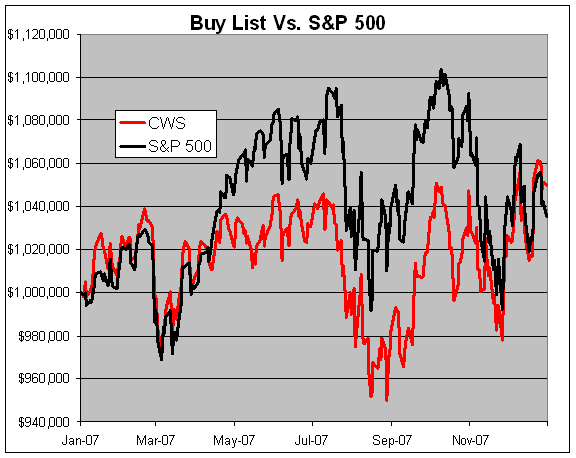
Fifteen stocks return from 2007. The five new stocks are Clarcor, Leucadia National, Lincare, Moog and Stryker. The sells are Fair Isaac, Graco, Respironics and Varian Medical Systems. Biomet was bought out for cash in September. The total market cap of all the companies is $303 billion. UnitedHealth is the largest at $74 billion. Nicholas Financial is by far the smallest at $71 million. The average dividend yield is 0.63%. That's it. The list is now "lock and sealed," and I can't touch it until next year. Posted by edelfenbein at 9:56 PM The 2007 Buy List The 2007 trading year is over. For the year, our Buy List gained 4.99% compared with 3.53% for the S&P 500. Including dividends, the Buy List was up 5.58%, which just barely beat the S&P 500 at 5.49%. This is impressive if you consider that our Buy List was more stable than the overall market. Our daily volatility was 8.92% less than the S&P 500. In 2006, the Buy List gained 10.68%, while the S&P 500 was up 13.62%. Including dividends, the 2006 Buy List was up 11.43%, and the S&P 500 was up 15.80%. For 2007, the best-performing stock was Respironics (RESP) which soared 73.46% followed by Amphenol (APH) which gained 49.39%. The worst stock was Nicholas Financial (NICK) which lost 38.73% followed by Harley-Davidson (HOG) which dropped 33.72%. I track the Buy List as if it’s a $1 million portfolio. In September, Biomet was bought out at $46 a share. The proceeds were divided up into the remaining 19 stocks. This spreadsheet has more details on how well the Buy List did in 2007. Here's how the Buy List did throughout the year:
Posted by edelfenbein at 5:35 PM Relative Performance and the Yield Curve Here’s an interesting graph, but it needs a bit of explanation. It’s the relative strength of each S&P 500 industry group relative to the yield spread. The horizontal axis shows the difference between the three-month and 10-year Treasury yield. The far left of the graph shows an inverted yield curve of 1%. As the graphs moves to the far right, the yield curve steepens to 4%. Two items to mention. First, I used data going back to 1989. Also, I wanted a clean logarithmic graph so I adjusted the starting relative strength number to three. That doesn’t change the scale of the results but I wanted to make that point clear. If you don’t mind me patting myself on the back, I think this is a fascinating chart. For example, you can see that tech stocks (the green line) do well as the yield curve becomes steeper, however, they run out of breath at the very steepest part. Materials stocks (royal blue), on the other hand, do their best at the steepest part of the yield curve.
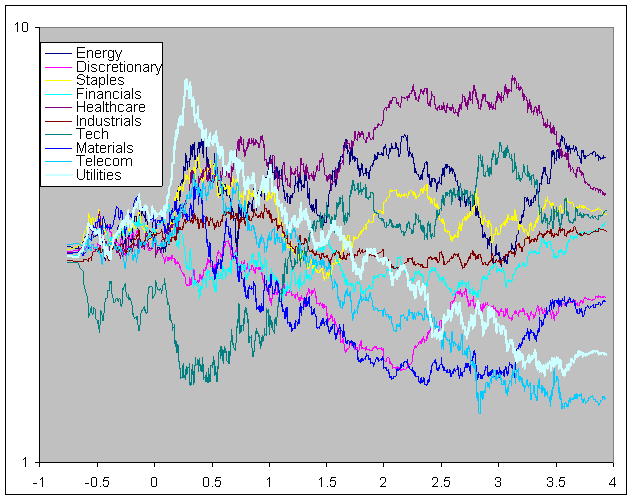
You can also see that Utilities (white) do the best when the yield curve flattens out. This is obviously due to their high dividend yields. What I find most surprising is that financial stocks seem to be of the least impacted by movements in the yield curve. So what does it mean? In 2007, the yield curve started off negative. When the market broke in late February, the spread stood at -0.50. The spread has gradually gotten wider ever since, meaning we’ve moved from left to right. By May, the spread finally turned positive. There was a retrenchment over the summer before the spread shot to over 1.6 in August. The spread currently stands at about 0.9. Here's a look at the yield spread over the last three years:
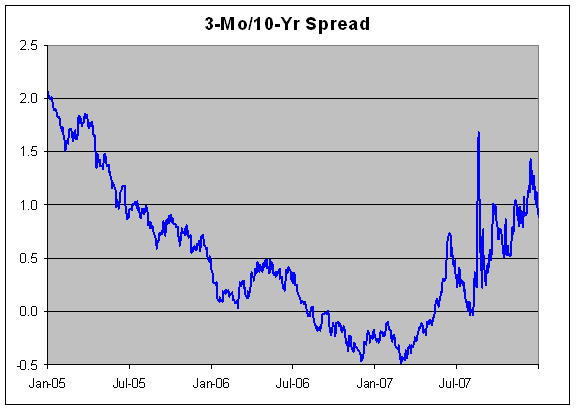
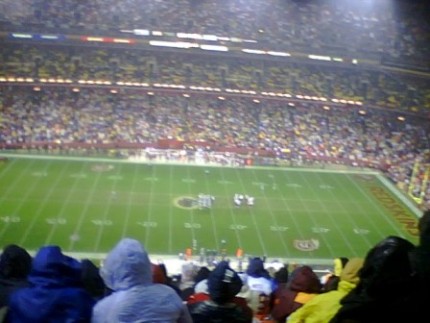
Since September, the Fed has cut short-term rates by 1%. If the Fed keeps cutting rates, the spread could reach 2.0 next year. From the first graph, that bodes well for health care (purple) and staples (yellow)—and the 2008 Buy List. Posted by edelfenbein at 3:58 PM Top 10 Pieces of Happy Economic News At Bloomberg, Kevin Hassett lists the good stories about the economy: 1) Equity markets posted solid gains and price multiples are still low. As of last Friday morning, the Dow Jones Industrial Average had gained about 7 percent for the year, while yielding about 2.25 percent, providing investors with a total return of more than 9 percent. The Nasdaq Composite Index had climbed more than 10 percent, while the Standard & Poor's 500 Index had provided a total return in the 5.5 percent range. There are no signs of irrational exuberance. The price-to- earnings ratio for the S&P 500, for example, finished the year at less than 19, safely nestled in the historical comfort range. Posted by edelfenbein at 1:39 PM The Fall of Blackstone Poor Stephen Schwarzman. Just six months ago, the Blackstone Group (BX) started trading at $36.45, a 17% premium to its IPO price. Today, the stock is down to $21.70. Posted by edelfenbein at 1:23 PM Earnings Preview: Bed Bath & Beyond Today's the last day of trading for 2007. The market is closed tomorrow. On Thursday, Bed Beth & Beyond will report its Q3 earnings. Here's a preview from the AP: OVERVIEW: Home furnishing retailers have suffered as a downturn in the housing market and softer consumer spending take a toll on sales and growth. Posted by edelfenbein at 11:18 AM The View from the Top I went to yesterday's Redskin's game. I was in the second-to-the-last row which, at FedEx Field, is really, REALLY high up. As least I can say I had a seat on the 50-yard line. Yesterday's attendance was an all-time FedEx record of 90,910. Here's a blurry view:
Those little dots on the field are the players. It was cold, wet and miserable. I had a blast and best of all, we're going to the playoffs. Posted by edelfenbein at 9:08 AM December 29, 2007Moog (MOG-A) I’m pleased to announce that Moog (MOG-A) will be final stock on the 2008 Buy List. This late addition is to replace Respironics (RESP) which recently announced that it’s being bought out. I’ll start tracking the 20 stocks of the 2008 Buy List on Wednesday, January 2 which will be the first day of trading of the new year. Once trading begins, I can’t make any changes for the rest of the year. Here’s a description of Moog from Hoovers: Moog (rhymes with "rogue") rules with its precision-control components and systems used in aerospace products, industrial machinery, and medical equipment. Servoactuators, Moog's core product, receive electrical signals from computers and then perform specific actions. Using its servoactuators, Moog builds flight and control systems for commercial and military aircraft, hydraulic and electrical controls for plastic-injection and blow-molding machines, and control systems for satellites and spacecraft. The company also makes electric motors for sleep apnea equipment. Employees hold about 60% of Moog through stock ownership and retirement plans. Here’s a look at the growth of Moog’s earnings-per-share: Year………..EPS Pretty solid. Here once again is the 2008 Buy List: AFLAC (AFL) Posted by edelfenbein at 7:02 AM December 28, 2007Dividends Continue to Rise I often hear market bears describe the current market as “a bubble.” What I find interesting is that if this is a bubble, it’s got to be one of the few bubbles where stock prices have generally lagged growth in both earnings and dividends. S&P just reported that dividends for the S&P 500 grew by 11.5% over last year. They’re also projecting a 9.3% growth for next year. This means that in the last four years, dividends have grown by 60%. The overall dividend rate is still very low—less than 2%. But don’t overestimate how quickly these payments can add up. Over the last five-and-a-half years, dividends have contributed about 10% to the overall return of the S&P 500. That’s around 1,300 Dow points. S&P also added five new stocks to its list of Dividend Aristocrats. These are companies that have increased their dividend every year for the last 25 years. The stocks are Avery Dennison, Exxon Mobil, Integrys Energy, Pitney Bowes and our very own AFLAC (AFL). Here’s a complete list of Dividend Aristocrats. There's also an ETF for the Dividend Aristocrats, symbol SDY. Posted by edelfenbein at 8:27 PM December 27, 2007Projected Earnings Growth The lads at Bespoke Investment Group have tracked projected earnings growth for the S&P 500. Or I should say, lack of growth. For Q4, analysts now expect a decline of 6.3%. In August, analysts were expecting 12.3% growth. Q1 has been pared back to 5% growth and Q2 is now at 3.6%.
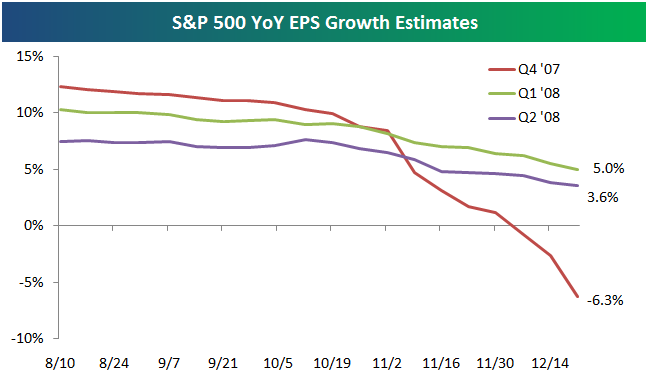
Posted by edelfenbein at 3:46 PM NICK Under $7 a Share I hope to have more about this sometime soon, but gosh darn it—Nicholas Financial (NICK) is cheap. The stock is priced as if it’s going out of business. NICK is currently priced well below book value which is $7.30 a share. Last quarter, NICK made 25 cents a share, and it made 27 cents in the quarter before that. We’ll find out more when the company reports its third-quarter earnings next month. I think it’s very reasonable to assume that NICK will make $1 a share for this fiscal year. That means the P/E ratio is under 7. Posted by edelfenbein at 1:43 PM December 26, 200710-Year-Old Cramer Watch out, Jim. He's got your game. Posted by edelfenbein at 9:06 PM Apocalypse When? As long-time readers of this site know, one of my pet peeves is the lack of balance in accountability between overly bearish and overly bullish predictions. Simply put: You can say that the sky is about to fall until your blue in the face, and be completely wrong, and few people will hold you accountable. As long as you’re vague about time and stress the “about to” part. On the other hand, if you’re bullish and wrong, you’ll be mocked until the cows come home. Or the bears, whichever comes first. Nouriel Roubini is probably the most prominent bear on Wall Street. I like his analysis even if I don’t always agree with it. Of course, I don’t read people to have my views confirmed. I want them challenged. I do want to point out that Roubini’s predictions haven’t exactly been spot on. In June 2006, he wrote: So, this Q2 GDP report is as bad as it could be. I thus stick with my prediction that, by Q4, the growth rate will be close to zero and by early 2007 the U.S. will be in a recession. Panglossian optimists have been proven wrong again. They'd better start adjusting their wishful-thinking forecasts of H2 growth (still close to a 3% consensus) to a reality of an economy rapidly slipping into an nasty recession. A wee bit off, no? To be fair, his views are more complicated than this bit suggests. I’m not trying to pick on him. Instead, my point is to show that it’s easy to get carried away with your hypothesis, and suffer from confirmation bias. One of the problems is that even if you’re right, you still can be wrong. The U.S. economy is titanically complex. There are millions of consumers making several economic decisions every day. Still, the real economic growth rate for the past 40 years has been about 3%. To be a bit more refined, it’s about 3.07%. What’s truly surprising it how little it varies. Here's a look at GDP growth (blue) compared with a 3.07% trend line (red). I apologize that the table is lame but that's my point.
So even when these “crisis” do come along, the overall economy is incredibly resilient. My prediction is that at some point, a recession will come along. It will be short and unpleasant, but after it, a recovery will follow. Posted by edelfenbein at 8:42 PM Amazon's Best Holiday Ever Amazon.com just celebrated its best Holiday EVER. Jeff Mathews isn't impressed. He finds that today's press release kinda looks familiar: 12/26/2007 “Amazon Wraps Up Its 13th Holiday With Best Season Ever” Posted by edelfenbein at 10:39 AM December 25, 2007Merry Everything!
I want to wish everyone a Happy Holiday, and a healthy and profitable New Year. I also want to thank all my readers for their support. Everyday, I get e-mail from readers all over the world. I try to respond to as much as I can, but unfortunately, I can’t get to it all. But I assure you that every e-mail is read and the correspondence helps me with my posts. I don’t charge a dime to use Crossing Wall Street and I don’t run any ads. It’s all a labor of love. In fact, not only is this site free, but I give away market-beating advice. Through Monday, the Buy List is up 6.12%, and there were zero transaction costs throughout the year. So if you started with, say, $100 million to invest, then I made you $6.12 million. If you started with $100 billion, then I made you $6.12 billion. Since I'm so generous, I'll give you one more thing. This. Posted by edelfenbein at 12:08 PM December 23, 2007Inefficient Markets Posted by edelfenbein at 2:16 PM Pats-Dolphins The New England Patriots are set to play the Miami Dolphins, which is a match-up between the best team in the league and the worst. How do you set a point spread for such an extreme event? Vegas has decided on 21-1/2 points. Just like the stock market, this is the collective judgment of many, many um...investors. The New York Times notes that the Pats have failed to cover in four of their last six games. The possibility of the Patriots’ becoming the N.F.L.’s second unbeaten champion has captured the nation’s fascination. At the same time, they seem to have rewritten the rule book when it comes to sports gambling. Not only are the Patriots close to setting several N.F.L. records, including most points and touchdowns, but their march to perfection has also set bank-breaking numbers that have astounded the sports-gambling culture. Out of whack? So the Pats are a market dislocation. Posted by edelfenbein at 8:23 AM December 22, 2007Abbey Road Webcam See what's happening live at the spot where the Beatles walked across the street. Strangely, I kept watching for something to happen but it never did. Although, two double-decker buses passed by. Posted by edelfenbein at 11:01 PM Anti-Anti-Contrarian James Altucher coins a new word: Antidisestablishmentcontrarianism. Don't try to disassemble it with the prefixes and suffixes. I'll tell you what it means because I coined it. It means the people against the people against the markets. In other words, I hate people who consider themselves contrarian investors. I wholeheartedly agree. I can’t stand to hear contrarians congratulate themselves for their “bravery.” The more I look at momentum stocks, the more it appears that running with the crowd is a better strategy. We need a better word, though. Momentumtarians? Posted by edelfenbein at 11:54 AM December 21, 2007The Way You Look Tonight Nope, Sinatra wasn’t the first. It was Fred Astaire who was the first to sing “The Way You Look Tonight.” This clip is from the 1936 movie Swing Time. It always sounds a bit strange to here an early version of a song that's so identified with another singer. The song was between collaboration of Jerome Kern and Dorothy Fields (he music, she lyrics). Personally, I think Fields is one of the great underrated lyricists. Consider how touching, yet simple, these words are. Read them as if you’ve never read them before: Some day, when I'm awfully low, Perfect. Just perfect. The “awfully” is especially brilliant. I can’t imagine how Fields thought of that, yet I can’t imagine the song without it. He’s an odd bit of trivia: Before working with Fields one of Kerns’ earliest collaborators was the great P.G. Wodehouse. (More trivia. That shampoo in Ginger Rogers’ hair? Whipped cream.) The thing about writing lyrics is that it's hard, and writing timeless lyrics is damn near impossible. It seems like every thought has been captured, every feeling has been expressed and every rhyme has been made. But then, suddenly, you come across words that make the world young again:
Posted by edelfenbein at 9:25 PM We're Winning! Thanks to the big 23% surge from Respironics (RESP), our Buy List has finally surpassed the market this year. For the year, we're up 5.38% to the market's 4.66%. Over the next few days, I'll choose a replacement for Respironics for next year's Buy List. Posted by edelfenbein at 4:32 PM CNBC Threatens Fox Guests From Douglas A. McIntyre at Wall Street 24/7: Perhaps GE (GE) unit CNBC should let Fox Business succeed or fail on its own merits. Threatening guests who appear on Fox with banning them from CNBC seems a bit thuggish. Posted by edelfenbein at 9:53 AM Holy Crap! Royal Philips Electronics Is Buying Respironics This is great news for the Buy List. I love Respironics (RESP) and the stock has been very good to us. The deal is for $66 a share, which is a 24.3% premium. Here’s more from the WSJ: Royal Philips Electronics of The Netherlands Friday said it would acquire U.S.-based health care firm Respironics Inc. for €3.6 billion ($5.1 billion) in cash. Here's an old post I did on RESP from a year ago. Posted by edelfenbein at 9:19 AM The Santa Claus Rally Today marks the beginning of the Santa Claus Rally. Earlier this year, I crunched all the numbers of the Dow’s daily return from 1896 to present. The best time of year is a 17-day period from December 21 to January 7. Over the last 111 years, the Dow has gained an average of 3.39% during that 17-day period. To put that in some perspective, the Dow’s annual gain is 8.32%. This means that more than 40% of the Dow’s yearly gain has come during this brief stretch which is less than 1/20 of the entire year.
Posted by edelfenbein at 8:27 AM December 20, 2007The Buy List So Far What was once unthinkable, now could happen. The 2007 Buy List might catch up to the market before the year ends. As of today's close, the Buy List is up 2.76% just 19 basis points behind the S&P 500's 2.95%. That doesn't include dividends. On October 18, the Buy List was up just 1.77% compared with the S&P's 8.59%. That's a gap of 682 basis points. Here's a look at how we've done:
Note: Our total on the bottom of the Buy List page doesn't exactly match our returns because I had to adjust for the Biomet buyout. I'll have complete details in our year-end post. Posted by edelfenbein at 4:40 PM Avoid Turnaround Stocks One of my repeated warnings to investors is to avoid turnaround stocks. Companies rarely turnaround smoothly. Poor-performing companies do indeed turn around, but it’s much rarer than people think. Hewlett-Packard (HPQ), under Mark Hurd, is an excellent example of a good turnaround story. The difficulty in spotting a true turnaround is that the problems that initially hurt the company are often too complex to solve by changing a few items, like the person at the top. Vikram Pandit was just named the new CEO of Citigroup (C) and I wish him all the success in the world. Unfortunately, I think an organization with $2 trillion in assets in the middle of a credit crisis won’t be easily managed. (Note to Vikran: Break it up). I think investors are easily tempted by possible turnaround stories. They see a cheap stock price and think there’s a bargain. Investors also like to personify a company, but this too can be a mistake. A professional athlete can have an “off night.” A large-scale public company usually doesn’t have an “off quarter.” The problem isn’t just execution. It’s also a host of variables from environment, competition, legal problems and a fickle public. One stock that looks very tempting right now is Home Depot (HD). The shares have been plunging and it’s currently going for about 11 times next year’s earnings. So is it a turnaround? Maybe. Bob Nardelli is gone. Year-over-year earnings have been falling (although still positive) for the past four quarters. In February, we’ll find out if it’s five. If the company does show that it has pulled out of its tailspin, then I think the shares could be worth it. Still, I’m hesitant. All turnarounds should be assumed failures until proven innocent. Posted by edelfenbein at 9:52 AM The 2008 Buy List I apologize for being a little late with this, but without further ado...here’s the Crossing Wall Street Buy List for 2008. (Woo!) AFLAC (AFL) Looks familiar? It should, I’m only making a few changes. Once again, I have 20 stocks. Out are Biomet (BMET), Fair Isaac (FIC), Graco (GGG) and Varian Medical Systems (VAR). Biomet was bought out earlier this year. The four new stocks are: Clarcor (CLC) I’ll begin tracking the new list on January 2, 2008, the first day of trading of the new year. The rules state that I'm not allowed to make any changes to the Buy List throughout the year. My purpose is to show investors that by buying and holding a well-diversified portfolio of high-quality stocks, you can do well in the market. For the Buy List, my self-imposed rule is to make changes just once a year. You'll also notice that I don't make many changes. Last year, I added five new stocks. This year, I added just four. Last year, the Buy List made 10.68%. Including dividends, it was 11.43%. Through yesterday's close, this year's Buy List is up just 1.68%. So even though I lost to the market slightly last year, and I'm barely behind this year, I still like most of stocks on my list. As usual, you can assume that I own any of the stocks on the Buy List. I won't buy any of the new names until the new year. Posted by edelfenbein at 6:51 AM December 19, 2007The Fed and Britney's Sister's Boyfriend The Federal Reserve has announced new rules to curb risky lending. Bess Levin sees a perfect analogy. Is the Fed's announcement that it's going to start to try and prevent questionable lending practice NOW kind of like Jamie Lynn Spears's boyfriend saying, "Hey, I'm going to run out to the Duane Reade for condoms, you need anything? Gatorade? Q-tips? (Oh, and by the way, do you have any money I can borrow?...I'm good for it...)" THIS MORNING? Exactly. (But would that make Greenspan kinda like K-Fed?) Posted by edelfenbein at 11:38 AM Best Subprime Story You'll Read Today From Bloomberg: One week in 2002, Daniel Sadek was $6,000 short of covering the payroll for his new subprime mortgage company, Quick Loan Funding Corp. So he flew to Las Vegas and put a $5,000 chip on the blackjack table. Posted by edelfenbein at 7:49 AM My Solution to the Subprime Mess Posted by edelfenbein at 6:44 AM December 18, 2007Goldman’s Earnings Goldman Sachs (GS) just wrapped up another phenomenal year. I honestly don’t know how they do it. The numbers really boggle the mind. For their fourth quarter, Goldman earned $7.01 a share, 40 cents ahead of the Street. For FY 2007, the company earned $24.73 a share. Last year, they made $19.69 a share and the year before that, they made $11.21 a share. By comparison, Morgan, Merrill and Bear are all expected to post losses this quarter. The stock is going for just seven times earnings. Next year, however, could be more difficult for Goldman. By the way, what’s the point in having elections if someone from Goldman Sachs is always appointed to run the economy? (And it's not just us). Posted by edelfenbein at 10:44 AM FactSet’s Earnings Another Buy List stock reported earnings today. For its fiscal first quarter, which ended in November, FactSet Research Systems (FDS) earned 58 cents a share. That’s a 24.7% increase over last year. Strangely, the stock plunged over 3% at the open, but it seems to have recovered some. Revenues came in at $134.1 million which was just slightly ahead of the Street. The numbers for this company are very solid—operating margins at 31%. For the second quarter, FDS expects: Revenues are expected to range between $137 million and $141 million. Operating margins are expected to range between 30.5% and 32.5%. This operating margin guidance holds currencies constant and assumes no change in the expected outcome of performance based stock options. The effective tax rate is expected to range between 34.0% and 35.0%. This is a very impressive company. Posted by edelfenbein at 10:23 AM December 17, 2007Burton Malkiel on CNBC Here's Burton Malkiel discussing the global economy. Posted by edelfenbein at 7:31 PM Malthus Strikes Back Today is an historic day. For the first time ever, a bushel of wheat is going for more than $10. But in real terms, wheat is very cheap. This is from a great article in The Economist on the amazing story of wheat (no, really): In 1815 a gigantic volcanic eruption at Tambora in Indonesia led to the famous “year without a summer”. New England had frosts in July. France had bitter cold in August. Wheat prices reached a level that would never be seen again in real terms, nearly $3 a bushel. Thomas Robert Malthus was then at the height of his fame and the harvest failure seemed to bear out his pessimism. In 1798 he had forecast a population crash, based on the calculation that it was impossible to improve wheat yields as fast as people made babies (each new baby can make more babies; each new field of grain leaves less new land to cultivate). Posted by edelfenbein at 2:10 PM Jeremy Siegel's Outlook for 2008 Jeremy Siegel is always worth listening to. Here's part of his outlook for next year: Economic Growth Posted by edelfenbein at 1:48 PM Why the Dollar Might Rally From today's WSJ: The belief that the Fed would be forced to sharply reduce interest rates to stimulate economic growth has weighed heavily on the dollar. That is because lower interest rates reduce returns on fixed-income holdings in the currency, making the dollar less attractive to investors. Posted by edelfenbein at 11:44 AM Wall Strip Visits Facebook
Posted by edelfenbein at 11:02 AM December 16, 2007Eugene Fama on Momentum Stock From The Region: Region: Let me ask you about momentum. You’ve said that it’s the strongest challenge to the hypothesis of market efficiency. Can you elaborate on that? Posted by edelfenbein at 9:41 PM December 14, 2007Bernice Johnson Reagon It's Friday and the market is closed. I am so outta here. Let's start the weekend with the great Bernice Johnson Reagon. Posted by edelfenbein at 4:25 PM Why Bears Always Have the Best Arguments Paul Kedrosky wonders why bears always have the best (or at least, most compeling) arguments: Even though the stock market has rightly been called the triumph of the optimists, with bulls stomping bears over and over for one hundred years, stock market bears not only haven't gone away, but they generally have the most compelling arguments. Their points seem so damn plausible, level-headed, empirical, and reasonable, while bulls come across as starry-eyed idealists. I agree, especially with points three and four. I've also noticed that a wildly bullish forecast that's wrong will be mocked far more than a wildly bearish forecast. I call this the Elfenbein Asymmetrical Railing of a Lousy Forecast Syndrome. Just a few days ago, Paul Krugman made fun of James Glassman being appointed head of our public diplomacy efforts. However, Krugman was wildly wrong about the market being a bubble in 2003. That call hasn't seemed to tarnish his reputation. Robert Shiller's reputation as a market sage is, in my opinion, completely unwarranted. Bearish arguments are usually more interesting because they focus on the causes and the effect is left to each person's imagination. It's like in a horror movie where you rarely see the scary guy. One day I hope to write a book called, "Alarmism and How It Threatens Your Children." Posted by edelfenbein at 10:59 AM Inflation’s Impact on the Stock Market So how does inflation affect the market? Well, it’s not good. Inflation is a tax on capital. It’s a way for the government to get your money without asking. In fact, the only thing worse than inflation is deflation. I took 80 years of monthly stock market return and ranked them by inflation (lowest to highest). Then I wanted to see the cumulative return as the rate of inflation increased. Here are the results.
At the far left are the most deflationary months, and the far right are the most inflationary. The blue line shows the after-inflation cumulative return of the market. As you can see, deflation has a negative impact on equity prices. The market falls until about the 70th data point which corresponds with an annualized deflation rate of 5.5%. The vast majority of those months were in the 1930s. Stocks rise very steadily until it hits a brick wall around data point 660. That corresponds with an inflation rate of 5.1%. Posted by edelfenbein at 10:26 AM CPI Surge The government just reported that consumer inflation surged 0.8% last month. That’s the fastest rate in more than two years. The year-over-year rate is now 4.31%, which is slightly more than where the Fed is. Still, I’m an inflation skeptic. The government’s numbers most certainly understate the rate of inflation, but I’m only concerned if inflation seems to be getting out of hand. The core rate was just 0.3% last month. Yes, yes, I know the core rate comes in for a lot of criticism, but I think it’s important to watch. For nearly twelve straight years, the year-over-year core rate has never been greater than 3% or less than 1%. Also, long-term interest rates are still quite low.
In fact, more Fed rate cuts could be on the way. The rate on short-term Treasury bills are still far below the Fed Funds rate. Yesterday, the T-bill rate closed at 2.78%, the lowest since the August panic. The Fed is about 140 basis points above the market.
Posted by edelfenbein at 9:25 AM December 13, 2007Bill Miller on Risk Via B-Ritz: You also know that rising stock prices mean lower future rates of return and falling stock prices mean higher rates of return. So I was much happier in the summer of '02 when you buy everything on sale than I was in the Spring of 2000 when a lot of things were super-expensive. Posted by edelfenbein at 3:03 PM Buy List Update Good news from Jos. A Bank Clothiers (JOSB). The company just reported earnings of 38 cents a share, which is a big jump from the 30 cents it made in the same quarter a year ago. The Street was looking for earnings of 33 cents a share. Sales rose 10% to $131.3 million. This stock has had a bizarre year. For the first half of the year, it charged out of the gate and gave us a quick 57% profit. It then took it all back and we’re now in the red. But I still like JOSB and the numbers look good. Late yesterday, Danaher (DHR) reaffirmed its Q4 outlook for EPS of $1.09 to $1.14. Sometimes investors ignore these “reaffirm” stories. I don’t. It’s one thing to say earnings will be good, but it’s nice to see a company follow-up on their forecast, even if it’s just reaffirming. DHR expects 2008 EPS to range between $4.30 to $4.40. Posted by edelfenbein at 12:34 PM Advice from Harry Schultz Peter Brimelow finds some interesting advice from legendary newsletter publisher, Harry Schultz, outside the usual that the world is going to hell: Amid the apocalyptic advice, Schultz finds time to dispense some other helpful hints. Avoid fluoride. Cell phones may cause cancer. Sauerkraut makes for a healthier prostate. Use faxes for all financial transactions. Give money to Republican presidential candidate Ron Paul on his Dec. 16 Boston Tea Party anniversary fundathon. Posted by edelfenbein at 11:52 AM Team Spirit A-Rod Signs Record $275 Million Deal With Yankees "The real question was, did he really care about being a Yankee or is he just about the money," Steinbrenner said in a Nov. 14 interview. "It's apparent he wants to be a Yankee and it's not about the money." In other news: Goldman chief's pay set to hit $70m. Posted by edelfenbein at 11:38 AM December 12, 2007The Back-Dating Bubble Bursts Larry Ribstein of Ideoblog deserves some sort of blog award. Early on, he correctly called the back-dating brouhaha of 2006 what is was, a media-driven pseudo scandal. Now here we are in 2007 and the scandal bubble has burst. The one big fish the authorities got was Greg Reyes, the former head of Brocade. In August he was convicted of conspiracy and fraud. Ribstein said that Reyes was “trying to maximize shareholder value by recruiting the best people, not line his pockets, and where it's unlikely any misstatements hurt investors.” Now it looks like they’re going to lose this case as well. Andrew Ross Sorkin reports in today’s NYT: A principal witness in the stock-options backdating trial that ended in a conviction of Gregory L. Reyes, the chief executive of Brocade Communications Systems Inc., has told associates her testimony may have been untrue, according to court documents. For uncovering the back-dating scandal, The Wall Street Journal won a Pulitzer Prize. Posted by edelfenbein at 1:12 PM If the Market Is So Darn Efficient, Then Why Is this Blog Free? Wait, Don’t Answer That! Megan McArdle, my favorite libertarian blogstress, has some thoughts about Michael Lewis’ Portfolio article and Efficient Market Hypothesis (see also here and here). Megan is a great blogger and I read her every day. I don’t want to get too deep in the weeds on this topic but I’m an EMH skeptic and I want to explain why. My main beef with it is that EMH suffers from theoretical overreach. OK class, let’s remember our scientific method. A theory is a logical explanation for natural phenomena. Well, EMH explains a whole lot, but there are still some holes. The wholes aren’t big, mind you, but they're definitely there and can’t be ignored. Maybe some day, someone will come along with a better explanation for the market and those holes. I hope that day comes soon, but until then, EMH is the best we got. To me, the most significant hole is that value stocks have consistently outperformed the market and they've done it with less volatility. The data here is unambiguous. It goes back 80 years and it’s clear as a bell. Again, we're not talking about a huge difference, but it’s there. There are others (Yahoo at $25?), but that’s the cleanest. Let me be clear: I think the market is very efficient, but the market can be consistently beaten. It’s not luck. It’s just very, very, very, very hard. As a practical matter, there’s a lot to be said for index funds. From my experience of investor behavior, more people ought to own them. It’s interesting that EMH defenders always say that the market can’t be beaten. They rarely defend the other half—the market can’t beat you. What can I say? I know people who have done a great amount of empirical research on this front and their results are, sadly, quite compelling. One final note: Please feel free to ignore the fact that this is a discussion of efficient markets taking place on free blog sites. Update: Megan has more today: I am being assailed by people pointing out that Berkshire Hathaway has done spectacularly, and therefore this EMH stuff is a bunch of hooey. I could point out that if you'd had a million guys flipping coins repeatedly for a year, at least one of them would have come up with a massive streak of heads. Even if you paid him $1mm for each heads flip, this would not actually be attributable to his awesome coin-flipping skill. Indeed, you'd have at least one cluster of guys who'd done well...perhaps fellows who'd gone to Harvard together, or people who'd all studied "Value Coin Flipping" under a master. There would be other outliers, and other groups of people who'd studied "Fundamentalist Coin Flipping" or "The Vincenzi Flipping Technique" who would not have done well. But no one would be looking to them for advice, so you would never have heard of them, and it would seem like a minor miracle that this guy, this technique had just produced such amazingly outsized returns.If superior performance were solely due to luck, wouldn’t we see more “successful” coin-flippers attribute their returns to arbitrary sounding strategies? You know, investing by astrology, the weather or charts patterns. Hey, if it’s all luck so the strategy shouldn’t matter. But that’s not what we see. If you go down the list of people who have amassed great long-term track records, each one credits Graham and Dodd style value investing. There’s Peter Lynch. There was Bill Ruane who met Buffett decades ago at a Graham conference. There are the guys who Leucadia National who have done even better than Berkshire. They espouse the exact same philosophy. The guys at Danaher. The Tisch brothers. Eddie Lampert. The list goes on and on. As far as I know, no technical analyst is on the Forbes 400 but there are lots of value investors. Posted by edelfenbein at 11:57 AM Greenspan in Today's WSJ
The Roots of the Mortgage Crisis After more than a half-century observing numerous price bubbles evolve and deflate, I have reluctantly concluded that bubbles cannot be safely defused by monetary policy or other policy initiatives before the speculative fever breaks on its own. There was clearly little the world's central banks could do to temper this most recent surge in human euphoria, in some ways reminiscent of the Dutch Tulip craze of the 17th century and South Sea Bubble of the 18th century. Notice how we’ll never know if we avoided corrosive deflation, yet Greenspan is confident that low rates weren’t a major factor in the housing bubble. Conveniently, he saved us from the event that never came and couldn’t protect us from the one that did. Posted by edelfenbein at 7:53 AM Electability Update I written about this topic before but one of the things I find fascinating about finance is how you can use markets for two items to create an “implied market” for a third. This idea is at the root of all the complex financial instruments that caused problems for so many hedge funds recently. I’ll give you a good example. At InTrade.com, the site where you can trade futures on real world events, you can buy contracts on which candidate will win his or her party’s nomination next year. There’s a separate contract for which candidate will win the presidency. Let's break out some math, shall we? If you divide the latter by the former, you get an “electability” contract. For example, according to recent prices, Rudy Giuliani has a 41.5% chance (I'm using the last price) of getting the GOP nomination and an 18.4% of winning the presidency. Soooo...the market believes that if he gets the nomination, he has a 44.34% chance of winning (18.4% divided by 41.5%). (The only minor flaw is that could include a candidate winning but not getting the nomination, however, I’m content with dismissing that possibility as beyond remote.) What’s interesting is electability in the general election can have little impact on how well a candidate does in the primaries. Some people, myself included, think that Ronald Reagan would have had a better chance of beating Jimmy Carter in 1976 instead of Gerald Ford, even though Ford beat Reagan for the nomination. I should add that I don’t place a great deal of faith in these real world futures markets. I simply see them as fun games to enjoy, but not to take too seriously. Also, the markets aren’t very liquid. A minor change could have a big impact on the smaller-priced contracts. Having said that, here’s a look at some candidates and the market’s take on their electability (sorry Paulites and Edwards fan, your candidates were too low to get a useful meaure). Candidate………To Get Nomination….To Win............Electability Posted by edelfenbein at 7:12 AM Important Tax Law Change With the end of the year approaching, there will be several important changes in the tax code for 2008. For us stock addicts, the most intriguing is that the long-term capital gains rate for folks in the 10% and 15% tax brackets will fall to zero. That’s right…a Blutarsky. Zero point zero. A goose egg. Zippo. Naught. Zilch. The Null Set. The Void Coefficient. The Hobbesian State of Nature. The 2007 Miami Dolphins. As the law currently stands, the rate lasts through 2010. For 2008, the 15% rate maxes out at $32,550 for singles and $65,100 for married folks. That’s adjusted gross income, so if you find yourself just outside those numbers, it could be worth you while to do some advanced planning. Please consult a professional advisor (as in, not me) for more details. Posted by edelfenbein at 6:52 AM December 11, 2007The Huckabee Portfolio Nothing terribly interesting. Though on page three, he misspelled Procter & Gamble (PG). Also, the “e” in Home Bancshares (HOMB) is a bit faded. When I first saw it, I thought he owned Homo Bancshares. That probably wouldn't help in Iowa. Posted by edelfenbein at 6:06 PM “At Least” Shares of General Electric (GE) fell sharply today, even more than the rest of the market, after the company forecast earnings growth of 10% for next year. There was one widdle biddy problem. The press release left out the words “at least.” Oopsie! The stock dropped quickly 4.75% or roughly $18 billion. The company rushed to clarify that it’s looking to grow EPS by at least 10% next year, which makes more sense. Check out the words “or better” at the top of this press release. GE was playing the typical Wall Street game of lowering expectations. By the way, when you talk about GE’s numbers you’re really in a different universe. For Q4, GE is looking for 67 to 69 cents a share. Well, those two pennies translate to.... **Dr. Evil Voice** Two Hundred MILLION Dollars Mwahahaha Posted by edelfenbein at 5:16 PM The Fed Cuts By 0.25% Here's the statement: The Federal Open Market Committee decided today to lower its target for the federal funds rate 25 basis points to 4-1/4 percent. Frickin wimps. There was one dissension. Eric S. Rosengren wanted a 50-basis-point cut. Update: The market's verdict is in and it's not pleased:
Think you can tell when the rate cut was? I bet you can.
Posted by edelfenbein at 2:15 PM Derivative Trades Jump 27% to Record $681 Trillion From Bloomberg: Derivatives traded on exchanges surged 27 percent to a record $681 trillion in the third quarter, the biggest increase in three years, the Bank for International Settlements said. Posted by edelfenbein at 11:16 AM UNH Hits 52-Week High Here are some random thoughts I had this morning. Perhaps it’s me, but I seem hear a lot of commentators speaking as if the market were going through some great reckoning; as if years of wild speculation is finally being punished. Sure, folks who owned Citigroup (C) or Countrywide (CFC) or Fannie Mae (FNM) are going through rough times, but that’s hardly true for the market as a whole. Including dividends, the S&P 500 is up 8% for the year. That’s about spot on for the historical average. We’re only 3.5% off the all-time high reached two months ago. Swing by your local bank and see if you can find an 8% CD. I also see that UnitedHealth Group (UNH) finally made a new 52-week high. The stock is above $58 for the first time since March 2006. Man, what the hell took it so long? UNH generates two things, huge profits and awful headlines. Investors, apparently, only pay attention to one. Just a few weeks ago, UNH said it was projecting EPS for 2008 of $3.95 to $4. This isn’t buried news—it’s public information, yet it’s taking a long time to sink in. A Banc of America analyst just initiated coverage of Danaher (DHR) with a buy rating, a $100 price target and he called it his top buy in the sector. Lastly, here’s a great look at AFLAC (AFL) from Standard & Poor's. Posted by edelfenbein at 10:14 AM December 10, 2007Felix Salmon Issues a Plea As usual, Felix nails it: Please can the punditosphere stop referring to the mortgage-freeze plan as a "bailout"? As Edmund Andrews says in his first sentence on the front page of the NYT today, it isn't. The FHA's FHASecure plan, which has existed for ages, might conceivably be considered a bailout. This one involves no government money or government guarantees, and there's no transfer of funds from the taxpayer to anybody at all. So it's not a bailout. Thank you. He’s right. There’s zero public money at stake. The LTCM bailout of 1998 is also often referred to as a bailout. In fact, I just did. The Federal Reserve helped organize it, but no government money was involved. As someone who often criticizes the Fed, that’s exactly what they should have done. Posted by edelfenbein at 11:07 AM Portfolio’s Scoop: There Are These Things Called Index Funds I just finished a puzzling 7,000-word article by Michael Lewis for the December issue of Portfolio (The Evolution of an Investor). The article is about efficient markets—the idea that it’s impossible for a stock-picker or mutual fund to consistently beat the market. Lewis uses the story of Blaine Lourd, a former stock-broker, as the vessel for his article. The problem is, the idea of efficient markets was popularized 34 freakin’ years ago by Burton Malkiel in “A Random Walk Down Wall Street.” It’s only gone through about a gazillion printings. The original academic paper by Eugene Fama appeared in 1965. Everyone and his brother knows about it. What’s this article doing in a business magazine in 2007? It would be roughly the equivalent of an article on this new-fangled designated hitter rule appearing—mind you, not in Reader’s Digest or People—but in Sports Freakin’ Illustrated! Does Portfolio think its readers are that ill-informed? The article doesn’t even present the arguments for and against EMH in any real depth, which could be a more interesting article. In fact, an article attacking EMH would also feel at least 10 years out of date. Closer to 15. Lewis doesn’t bother touching topics like the gradations of EMH (weak, strong and semi-strong). The frustrating part is that there are lots of interesting angles that could have been explored. Lewis could have discussed developments in fields like behavioral finance and their possible implications for EMH. Or the success of quant guys like Jim Simons. Fuck, even I wrote a post the other day about the astonishing success of momentum stocks, and I’m just an obscenity-using blogger. I mean, what the fuck? Lewis also conflates the idea of being a good money manager with picking stocks. Money managers do a lot more than that. At least, they should. For example, they may help a client with an investment for a specific time horizon like a college fund. A money manager also helps decide an appropriate risk profile for the client, or how to keep taxes down, or how to plan for retirement. It’s a gross simplification to say these people are worthless because they can’t pick stocks. From personal experience, there were lots of times I talked clients out of exiting the market. I also have issues with the story of Blaine Lourd, the stock-broker turned cynic turned EMH convert. I don’t think he’s lying, but I get the feeling that Lourd is overscripting his conversion story. Cynical people who grow frustrated by their industries don’t act as Lourd does. Put it this way: He managed his self-loathing well enough to hop to three more firm firms, then to open his own shop in Beverly Hills. If Lourd’s mission is to protect investors, then I wonder who’s covering his rent? Lewis centers the article on the unusual training ritual (or indoctrination) of indexer Dimensional Fund Advisors. The firm has done very well over the years particularly by pointing out that most mutual funds don’t beat the market. But wouldn’t that mean that the firm’s success is due to a gross inefficiency in the market? Or is that too impolite to ask. Apparently, it is because Lewis never asks it. Nor does he ask any tough follow-up questions. Later, Professor Fama, a DFA board member, makes an appearance: Forty years of preaching has taught him that his audience either agrees with him or never will. And so he speaks dully, like a man talking to himself. But he makes his point. In his years of researching the stock market, he has detected only three patterns in the data. Over the very long haul, stocks have tended to outperform bonds, and the stocks of both small-cap companies and companies with high book-to-market ratios have yielded higher returns than other companies’ stocks. Wait a second. High book-to-market stocks outperform with no more volatility but that’s due to higher risk? OK, so where is this risk? C’mon Michael, we just saw evidence disproving the whole point of the article. How does Fama support his assertion? Lewis concludes the article with this: Blaine still takes great pleasure in describing just how screwed up the American financial system is. "In a perfect world, there wouldn’t be any stockbrokers," he says. "There wouldn't be any mutual fund managers. But the world's not perfect. In Hollywood, especially, people need to believe there's a guy. They say, 'I got a friend who made 35 percent last year.' Or 'What about Warren Buffett?' " That doesn’t prove any point. Buffett has still beaten the market as whole. It’s that value stocks have done much better. Why are we changing the thesis of the entire story and now comparing Buffett to a value fund? We’re not allowed to pick stocks but we can pick benchmarks? To reiterate my earlier point, what the fuck? Lewis’ article is presented to us as if it’s delivering some wise truism, yet it fails to ask any truly probing questions. When Portfolio debuted, Elizabeth Spiers of DealBreaker said it “will be the Paris Hilton of business magazines: pretty but vapid, and unlikely to produce anything resembling an original thought.” Perhaps some forecasts do have value. Posted by edelfenbein at 10:16 AM Hip Hop IPO Luther Campbell, the creative force behind 2 Live Crew and some of their timeless melodies such as The Fuck Shop, Get the Fuck out of My House and I Ain't Bullshittin, has taken his company public. The New York Post reports: The hip-hop legend - personally responsible for the "Parental Warning" on CDs thanks to the rebellious and outlandish lyrics on his group's 2 Live Crew discs - has merged his entertainment and sports management company into a public shell company that's now listed on Nasdaq. Hmmm. I have to say I’m not terribly impressed by someone who adds an extra “y” to Skywalker being the Chief Creative Officer. The article notes that the stock closed yesterday at $1. (Via: The Stalwart). Posted by edelfenbein at 9:53 AM December 9, 2007God, Money and the New York Times This is from the New York Times’ editorial on Mitt Romney’s recent speech: Mr. Romney dragged out the old chestnuts about “In God We Trust” on the nation’s currency, and the inclusion of “under God” in the Pledge of Allegiance — conveniently omitting that those weren’t the founders’ handiwork, but were adopted in the 1950s at the height of McCarthyism. That’s not quite right. The motto “In God We Trust” first appeared on U.S. coins during the Civil War. Although there have been periods when it was removed, the motto has appeared on all U.S. coins for nearly 100 years. The motto was later added to U.S. paper currency in October 1957, which wasn’t exactly “the height of McCarthyism,” considering that the senator had been dead for five months. The Treasury Department's website has the details. Posted by edelfenbein at 3:04 PM December 7, 2007Prophet of Innovation: Joseph Schumpeter and Creative Destruction
Brad Delong reviews Thomas K. McCraw's Prophet of Innovation: Joseph Schumpeter and Creative Destruction: Over the previous two and a half centuries, three different economic worldviews, in succession, reigned. In the late 18th and early 19th centuries, Adam Smith's was the key economic perspective, focusing on domestic and international trade and growth, the division of labor, the power of the market, and the minimal security of property and tolerable administration of justice that were needed to carry a country to prosperity. You could agree or you could disagree with Smith's conclusions and judgments, but his was the proper topical agenda. Posted by edelfenbein at 3:35 PM Looking Behind Today’s Jobs Report The government reported that unemployment rate in November remained steady at 4.7%. One of the problems about the unemployment rate is that it only measures people looking for a job. If you’re not out there looking, you don’t count. Obviously, the worse the job market is, the more people stop looking for work. At the beginning of the decade, around 67% of the population was considered part of the jobs market. Today, that number is closer to 66%. One percent is a big deal in a country this size. If the labor market participation rate simply matched the peaked number from February 2000, then it would mean that nearly three million more people would be in the job market. Here’s a more accurate picture of employment. This chart shows the number of people working as a percentage of the entire population.
It’s not horrible, but it’s hardly something to brag about either. Clearly, we’re far from our full potential. What I find interesting is the deterioration in the number this year. The good news is that today’s number is a small break in that trend. In November, we saw the largest increase in the percent of the population employed in over five years. Posted by edelfenbein at 10:34 AM December 6, 2007Nicholas Financial Is Now Trading Below Book Value Shares of Nicholas Financial (NICK) are now down to $7.20. According to the most recent 10-Q, the company's book value is $7.50 a share. Posted by edelfenbein at 3:27 PM It Was Only a Matter of Time Tired of those socially responsible funds? Well, Focus Shares gives us a sin-based ETF. You guessed it...the Sindex. *Groan* The ticker symbol is PUF. *Double Groan* Here are the stocks in the Sindex: ABV UN AmBev -PN (ADR) Posted by edelfenbein at 1:12 PM High-Yield Defaults Could Quadruple Here’s a stunning story. Moody’s says that high-yield bond defaults will quadruple next year, and that’s assuming the economy doesn’t go into a recession. If it does fall into a recession, defaults could rise tenfold. The global default rate will rise to 4.2 percent by November from 1 percent now, the lowest since 1981, Kenneth Emery, director of corporate default research at Moody's, wrote in the report e-mailed today. His forecast is based on an assumption the U.S. economy slows without falling into recession. In a recession, defaults may approach 10 percent, he said. Posted by edelfenbein at 9:34 AM JOSB Same-Store Sales Up 15% From MarketWatch: JoS. A. Bank Clothiers Inc., (JOSB) the Hampstead, Md., retailer, reported that for November, same-store sales rose 15% while total sales increased 25% to $63.1 million from $50.6 million in the year-earlier month. A survey of analysts by Thomson Financial produced a consensus estimate of same-store sales up 2.2% in the month. Posted by edelfenbein at 9:12 AM The Incredible Power of Momentum Stocks I’m a big fan of Professor Ken French’s data library. I’ve used data from his library at this site many times. If you’re not familiar with Dr. French, he’s a well-known finance professor at the Tuck School at Dartmouth. He’s also known for his long-time association with Eugene Fama at the University of Chicago. I was digging around some of the files in the library and I was completely stunned by the incredible outperformance of stocks with high momentum, meaning stocks that are surging have a tendency to keep on surging. I was aware of some of the academic literature on this subject, but I have to confess that I was completely dumbfounded by the results. I know that stocks with favorable valuation characteristics do better than the rest of the market. For example, stock in the lowest decile (or 10%) of price/earnings ratio have historically beaten the market. The same is true for stocks with higher dividend yields or low price/book ratios. Also, small-caps do better than large-caps (although I’m not particularly impressed by the small-cap premium). These phenomena are very well-known and have been documented countless times. But simply put—high momentum creams them all. At the data library, French has ten portfolios listed by momentum (see “10 Portfolios Formed on Momentum”). He gets his data from the Center for Research in Security Prices at the University of Chicago. I looked at the long-term returns of stocks with the greatest momentum. From the beginning of 1927 through August of 2007, the overall market has returned an average of 10.10% a year. The highest momentum stocks returned an average of 17.76% a year. What’s more, that’s just the value-weighted portfolio. By looking at the equal-weighted portfolio, which gives more say to smaller-cap stocks, the results are even more impressive. The equal-weighted high-momentum portfolio returned an average of 21.94% a year. Here's the chart:
Wow. Also, while the momentum portfolios are more volatile, they don’t strike me as being usually high. The monthly standard deviation for the value-weighted momentum stocks is about 20% greater than the rest of the market. The equal-weighted stocks are 37% more volatile. The problem I have with many small-cap or value-related models is that the results are highly cyclical. It’s true that small-caps do well after several decades, but it’s not unusual to see underperformance for five years of more. That happened to small-caps in the 1990s and I think value is entering a down phase right now. With momentum, the results are much more consistent. Heck, just look at the red and blue lines. There’s also the question of what we mean by stocks with high momentum. I called Dr. French just to make sure I had it right and he was very helpful in explaining it to me. By momentum stocks, he ranks every stock by how it did over an 11-month period, then skips a month and then tracks them for one month. At the end of the month, the whole thing is repeated. Confusing? He’s an example. On January 1, we take the top 10% of stocks by their performance for the previous January 1 through November 30. The stocks are held for exactly one month and the process is repeated again on February 1. This system in completely mechanistic and all emotions are banished. I’ve known lots of people who are momentum investors but they rarely have the discipline to act by strict rules. Another interesting aspect of a momentum strategy is the turnover probably isn’t that high. Since it encompasses the best returns for 11 months, many stocks will remain each month. Dr. French said that he thinks the turnover is 91%. That’s high, but not as high as many mutual funds. There are lots of historically interesting strategies but many are very impractical. For example, the stock market has been net down on Monday, Tuesday and Thursday combined. But it’s highly impractical to sell all your stocks and buy them a few times each week. But I don't think that's the case with a momentum strategy. Also, I’m sure you could even use ETFs to mimic the high-momentum portfolios. There’s also the question of why. Why do stocks with high momentum continue to outperform for a bit more? Is there something inefficient in their...frothiness? Can a person really play the height of their frothiness all the time by constantly shifting? According to the Efficient Market Hypothesis, this outperformance would rationally be exploited away. I’m not a believer in efficient Market Theory (ironically, it was developed by Eugene Fama) but I do think stocks show a bias towards efficiency. Perhaps there’s something in a surging stock that causes the pre-requisites for an efficient market to break down (flow of information??). Dr. French was careful to say that he’s not the discoverer of momentum premium. That award goes to Jegadeesh and Titman who in 1993 found that the best-performing stocks of the last six months outperform the worst over the six to twelve month. I'm very impressed. I’m planning to look into more of the academic literature. Posted by edelfenbein at 8:18 AM December 5, 20072008 Buy List I'll unveil the Buy List for 2008 on Monday, December 17. I'll start tracking the new stocks on January 1 and use the December 31 close as my buy price. I do this so no one can claim that I have any impact on the shares. There are also two more earnings reports before the end of the year. FactSet Research Systems (FDS) reports on December 13 and Jos. A Bank Clothiers (JOSB) reports on December 18. Posted by edelfenbein at 12:39 PM Gold and Iran I’m curious how much the National Intelligence Estimate’s report that Iran suspended its nuclear program four years ago will affect the price of gold. While gold is impacted by inflationary concerns, it’s also influenced by geo-political concerns as well. I suspect that problems with Iran have helped boost gold, but I wonder how large the impact has been. When gold is priced in euros, its rise hasn’t been as dramatic, but it’s certainly higher. I’m also curious if the surge in support for Ron Paul is a sign of a top for gold. When gold peaked 28 years ago, the Libertarians had their best presidential showing ever. That year, Ed Clark won close to a million votes, including 11.66% in Alaska. The Libertarians even won two statehouse seats in Alaska that year. Double-digit inflation and gold at $850 seem to be very good for the party. Since 1980, however, the Libertarian presidential candidates have been lucky to get half what Clark did. Now Ron Paul is running in a perfect environment for Libertarians—gold is up, the dollar is way down. The crucial primary will be in New Hampshire, a state almost tailored-made for them (“Live Free or Die”). If Paul breaks 10% in New Hampshire, then I think gold will soon plunge. And no, I’m not serious. Posted by edelfenbein at 10:41 AM December 4, 2007Headline of the Day Countrywide CEO backs Fannie expansion Posted by edelfenbein at 3:44 PM Reader Q&A I always like getting e-mails from readers. I get a lot so I try to respond to as many as I can. Please feel free to e-mail me if you have any questions or comments. If I do post you e-mail, I will not include your name. Here’s a recent e-mail I got. I’m posting it because it’s a good question and slso because my responses kept getting bounced. I am a frequent reader of your blog and have enjoyed many of the entries. Your investment style appears sound and a handful of your tips and articles have been quite conducive to my financial situation. Thank you. I have a question for you. I would like to find a fairly simple means of playing a rally in the US dollar. It may be versus a basket or a particular currency, for example, the euro. This may not be your cup of tea and so a simple 'I do not know' will suffice. If you have an opinion please email me at this address. Posted by edelfenbein at 1:53 PM Next Week’s Fed Meeting The Federal Reserve meets again next Tuesday and Wall Street expects another rate cut. According to the latest from the futures market, Wall Street thinks there’s about a 60% chance for a 0.25% rate cut and a 30% chance for a 0.50% rate cute. I think the Fed erred last time by only cutting by 0.25%, and I would prefer to see the Fed cut by 0.50% this time. Unlike a lot of folks, I don’t think it’s absolutely critical for the Fed to get it exactly right all the time. Twenty-five basis points isn’t that big a deal in an economy this large. Still, the market needs some relief. The odds of a recession have clearly increased over the past few weeks. Three months ago, Wall Street was expecting fourth-quarter earnings growth of 8.8%. Today that number is down to just 1.1%. Also, economically cyclical stocks have underperformed the market since July. I think that will continue. It’s hard to overstate the importance of interest rates on stock prices. A few weeks ago, I looked at all the data going back to 1962. If you took all the days when the three-month T-bill rate fell, the S&P 500 rose over 2,000%. On days when rates rose—a nearly identical time frame—the S&P lost nearly 60%. Posted by edelfenbein at 12:30 PM December 3, 2007The Worst Columns on Subprime Garrison Keillor now moves into second place for worst subprime column. I sit in wonderment at the story of W. Lance Anderson, the president of NovaStar Financial in Kansas City, who while handing out subprime mortgages to any applicant wearing shoes and a shirt managed to sink the company's stock from $40 in June to $1.72. This is a man who earned $1.7 million in salary and bonuses last year, plus $711,386 in deferred compensation, |