Crossing Wall Street: Your Guide to Financial Success, Hosted by Eddy Elfenbein
spacer About Buy List FAQ Contact Links Home
spacer

« March 2008 | Main | May 2008 »

April 30, 2008

Another 25 Points

The Fed cuts. Here's their statement:

The Federal Open Market Committee decided today to lower its target for the federal funds rate 25 basis points to 2 percent.

Recent information indicates that economic activity remains weak. Household and business spending has been subdued and labor markets have softened further. Financial markets remain under considerable stress, and tight credit conditions and the deepening housing contraction are likely to weigh on economic growth over the next few quarters.

Although readings on core inflation have improved somewhat, energy and other commodity prices have increased, and some indicators of inflation expectations have risen in recent months. The Committee expects inflation to moderate in coming quarters, reflecting a projected leveling-out of energy and other commodity prices and an easing of pressures on resource utilization. Still, uncertainty about the inflation outlook remains high. It will be necessary to continue to monitor inflation developments carefully.

The substantial easing of monetary policy to date, combined with ongoing measures to foster market liquidity, should help to promote moderate growth over time and to mitigate risks to economic activity. The Committee will continue to monitor economic and financial developments and will act as needed to promote sustainable economic growth and price stability.

Voting for the FOMC monetary policy action were: Ben S. Bernanke, Chairman; Timothy F. Geithner, Vice Chairman; Donald L. Kohn; Randall S. Kroszner; Frederic S. Mishkin; Sandra Pianalto; Gary H. Stern; and Kevin M. Warsh. Voting against were Richard W. Fisher and Charles I. Plosser, who preferred no change in the target for the federal funds rate at this meeting.

In a related action, the Board of Governors unanimously approved a 25-basis-point decrease in the discount rate to 2-1/4 percent. In taking this action, the Board approved the requests submitted by the Boards of Directors of the Federal Reserve Banks of New York, Cleveland, Atlanta, and San Francisco.

Posted by edelfenbein at 2:24 PM

Apparantly Short Sellers Are the New Terrorists

From the NYT:

In the days when square-rigged galleons plied the spice route to the East, the Dutch outlawed a band of rebels that they feared might plunder their new-found riches.

The troublemakers were neither Barbary pirates nor Spanish spies — they were certain traders on the stock exchange in Amsterdam. Their offense: shorting the shares of the Dutch East India Company, purportedly the first company in the world to issue stock.

Short sellers, who sell assets like stocks in the hope that the price will fall, have been reviled ever since. England banned them for much of the 18th and 19th centuries. Napoleon deemed them enemies of the state. And Germany’s last kaiser enlisted them to attack American markets (or so some Americans feared).

There's also a new academic study that suggests shorts may know what they're talking about.

We construct a long daily panel of short sales using proprietary NYSE order data. From 2000 to 2004, shorting accounts for more than 12.9% of NYSE volume, suggesting that shorting constraints are not widespread. As a group, these short sellers are well informed. Heavily shorted stocks underperform lightly shorted stocks by a risk-adjusted average of 1.16% over the following 20 trading days (15.6% annualized). Institutional nonprogram short sales are the most informative; stocks heavily shorted by institutions underperform by 1.43% the next month (19.6% annualized). The results indicate that, on average, short sellers are important contributors to efficient stock prices.

Posted by edelfenbein at 12:33 PM

An Investing Lesson

Consider these recent headlines.

Munich Re confirms Warren Buffett holds stake in co
Buffett, Seeking Acquisitions, to Travel to Europe
Mars, Buffett buying Wrigley for $23 billion
Warren Buffett Predicts a Long US Recession

So Warren Buffett not only thinks we’re in a recession, but he thinks it will be worse than feared. So what does he do? He buys.

To quote George Bailey:

Can't you understand what's happening here? Don't you see what's happening? Potter isn't selling. Potter's buying! And why? Because we're panicky and he's not. That's why. He's picking up some bargains.

Posted by edelfenbein at 11:56 AM

What If Bernanke Is Winning?

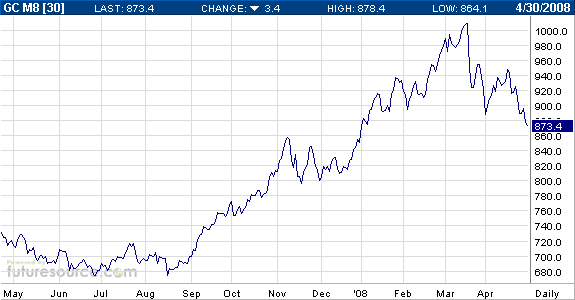
Here's a scary thought. What if Ben Bernanke has been doing the right thing? Not only did GDP come in positive for the month, but core inflation has been running between 2% and 2.5%. Most shocking of all has been the decline in gold. The June contract dropped below $870 an ounce today. That's a major fall from six weeks ago.

goldapril30.png

Posted by edelfenbein at 10:57 AM

The Economy Grew But Just Barely

First-quarter GDP came in at +0.6%. That's not a lot, but it is positive. Naturally, this number will be subject to several revisions and re-revisions of previous revisions.

Even though we haven't reached an official recession yet, which is usually defined as back-to-back quarters of negative GDP, the economy has had below-trend growth for six of the last eight quarters. Below is a table showing economic growth for the trailing eight quarters (not annualized but adjusted for inflation). You can really see how much economic growth has down-shifted.

image649.png

On a bizarre note, today's GDP report showed that the economy grew by almost exactly the same rate in the first quarter of 2008 as in the first quarter in 2007. One year ago, the economy grew by 0.6009%. For this year's first quarter, the number was 0.5966%.

Posted by edelfenbein at 8:41 AM

Even Buffett Isn't Perfect

Author Vahan Janjigian claims that even Warren Buffett isn't perfect in his new book, Even Buffett Isn't Perfect. David Kansas writes:

And there have been memorable stumbles over the years: A Berkshire Hathaway investment in the retailer Pier I, in 2004, unhappily preceded a big drop in Pier I's stock; more famously, a stake in Salomon Bros. in the late 1980s and early 1990s, though it eventually made money, caused more headaches than it was worth. (Salomon eventually became part of what is now Citigroup.)

What's remarkable about Mr. Buffett is that he has made so few mistakes while building Berkshire Hathaway into a stock-market titan. He strongly prefers that the investments of Berkshire Hathaway be referred to as such rather than credited to himself alone. Still, in the popular imagination it would be hard to slide a piece of paper between Mr. Buffett and his company.

Buffett also owned US Air which was a major blunder. To his credit, Buffett has been very candid about his mistakes. This is from his 1996 Chairman's Letter:

When Richard Branson, the wealthy owner of Virgin Atlantic Airways, was asked how to become a millionaire, he had a quick answer: "There's really nothing to it. Start as a billionaire and then buy an airline." Unwilling to accept Branson's proposition on faith, your Chairman decided in 1989 to test it by investing $358 million in a 9.25% preferred stock of USAir.

I liked and admired Ed Colodny, the company's then-CEO, and I still do. But my analysis of USAir's business was both superficial and wrong. I was so beguiled by the company's long history of profitable operations, and by the protection that ownership of a senior security seemingly offered me, that I overlooked the crucial point: USAir's revenues would increasingly feel the effects of an unregulated, fiercely-competitive market whereas its cost structure was a holdover from the days when regulation protected profits. These costs, if left unchecked, portended disaster, however reassuring the airline's past record might be. (If history supplied all of the answers, the Forbes 400 would consist of librarians.)

Posted by edelfenbein at 8:23 AM

RIP: Albert Hofmann

Albert Hofmann, the inventor of LSD, has died at the age of 102. The story of the development of drugs, legal and illegal, is one of the more fascinating business stories of the 20th Century. It's fashionable today to say that we live in the Digital Age. Sometimes I think we live in the Drug Age. (For example, check out the amazing story of Aspirin.)

Hofmann developed LSD in 1938 when he was working for Sandoz (now Novartis, but I doubt you'll find that fact in their annual reports) and took the first hit in 1943. For a while, the drug was seen an aid for the psychiatry profession, hence Timothy Leary and the Army tests. In fact, LSD was perfectly legal up until 1966.

Of all the major stock sectors, the major pharmaceutical stocks have probably had the best long-term performance of any sector. In recent years, stocks like Merck and Pfizer and others have stumbled, but for decade after decade, these types of stocks were world beaters. New leaders will emerge, but this sector has been a great triumph of free enterprise, and I think it will continue to be so.
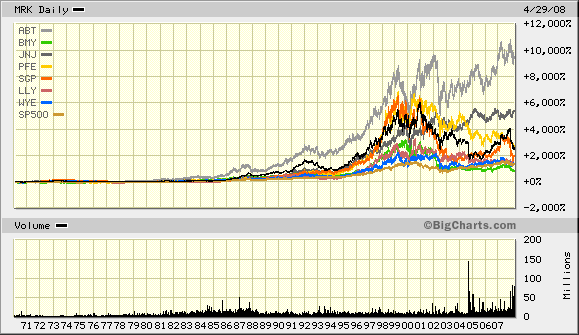
drugslt.gif

Posted by edelfenbein at 7:07 AM

April 29, 2008

Crossing Wall Street: It's Like Reading Tomorrow's Newspaper Today

After the bell, SPSS (SPSS) reported earnings of 51 cents a share. This caught everyone off-guard since Wall Street's consensus was for 44 cents a share. The stock is up nicely after-hours.

Actually, there was one outlet that wasn't surprised. This guy's analysis is brilliant. Almost godlike.

I could go on, but Mensa may call.

Posted by edelfenbein at 7:27 PM

The Decline and Fall of Financials

Look at the stunning decline in the S&P 500 Financial Index (^SPSY).
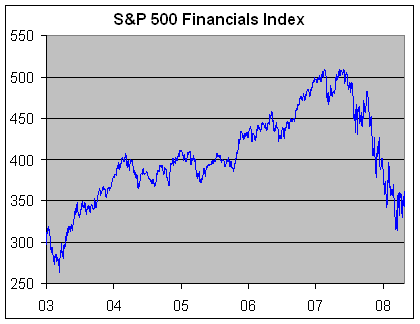
image646.png

Notice how the line went from being somewhat smooth to being extremely jagged. Barry Ritholtz notes that there have been an amazing 12 rallies of 5% or more in the Financials Index since it topped out.

Here's a look at the daily changes. Sometimes a chart says it all:
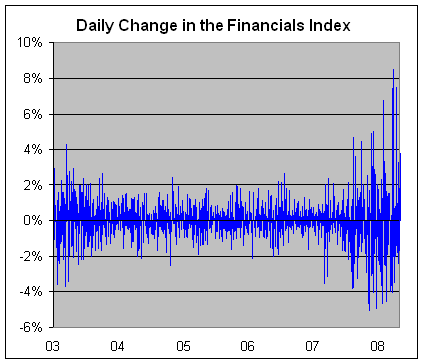
image647.png

Posted by edelfenbein at 2:55 PM

One and Done

The Fed meets again today and tomorrow. According to the futures market, there's about a 70% chance that the Fed will cut by 25 basis points tomorrow. That would bring rates down to 2%. There's close to a 30% chance that the Fed won't make any cut.

Assuming the Fed cuts by 25 points, the futures market believes there's about a 55% chance of no further action at their June meeting. There's about a 10% chance of another 25-point cut, and there's close to a 30% chance of no cut at either meeting.

Interestingly, if the Fed stops at 2%, this will mark the third straight easing cycle where the Fed stopped at a round number. In the early-90s, they went down to 3%, and a few years ago, they went down to 1%.

Posted by edelfenbein at 1:43 PM

Volcker at the Fed

Megan McArdle has a smart post on her choice for the most underrated and overrated presidents of the 20th century. She says that Jimmy Carter’s economic policies are underrated and she cites his appointment of Paul Volcker to head the Federal Reserve as an example.

I agree that Volcker was a good choice and Carter deserves credit for it, however I’m not willing to give him much credit. According to William Grieder’s wonderful book, Secrets of the Temple, Jimmy Carter was almost comically illiterate on monetary policy. Plus, the Volcker selection hardly signaled any policy shift from the Carter administration, and if Carter had realized what he was doing, he probably would have had second thoughts.

Carter’s selection of Bill Miller for Fed Chairman was disastrous, and it made Volcker’s job that much harder. When it came to replace Miller, Volcker was actually Carter’s second choice. His first choice was Tom Clausen, who was the president of Bank of America (he later became head of the World Bank). Also, Volcker was already an important voice on the Fed. He was president of the Federal Reserve Bank of New York, which in the Federal Reserve system, is first among equals. The president of the New York Fed also has a permanent seat on the interest-rate-setting Federal Open Market Committee. The other bank presidents have to rotate. In fact, at the time of his appointment, Volcker was serving as vice-chair of the FOMC.

So Carter’s choice was a natural elevation more than taking a major gamble, or boldly separating himself from a previous path. Still, he did make the right choice and that’s worthy of praise. The point that I find interesting is how often we give credit to people for doing something that really had no intention of doing. Instead, circumstances came to them, and they made the best of it. Perhaps, that’s a good definition of leadership.

Posted by edelfenbein at 12:47 PM

Investors Are Basically Crazy

I'm a bit skeptical of this, but I'll pass this along from the Genetic Engineering & Biotechnology News website (I know, like you don't have it under your favs):

'Emotional inflation' leads to stock market meltdown

Investors get carried away with excitement and wishful phantasies as the stock market soars, suppressing negative emotions which would otherwise warn them of the high risk of what they are doing, according to a new study led by UCL (University College London). Economic models fail to factor in the emotions and unconscious mental life that drive human behaviour in conditions where the future is uncertain says the study, which argues that banks and financial institutions should be as wary of emotional inflation as they are fiscal inflation.

The paper, published in this months issue of the International Journal of Psychoanalysis, explores how unconscious mental life should be integrated into economic decision-making models, where emotions and phantasies unconscious desires, drives and motives are among the driving forces behind market bubbles and bursts.

Visiting Professor David Tuckett, UCL Psychoanalysis Unit, says: Feelings and unconscious phantasies are important; it is not simply a question of being rational when trading. The market is dominated by rational and intelligent professionals, but the most attractive investments involve guesses about an uncertain future and uncertainty creates feelings. When there are exciting new investments whose outcome is unsure, the most professional investors can get caught up in the everybody else is doing it, so should I wave which leads first to underestimating, and then after panic and the burst of a bubble, to overestimating the risks of an investment.

Market investors relationships to their assets and shares are akin to love-hate relationships with our partners. Just as in a relationship where the future is unexpected, as the market fluctuates you have to be prepared to suffer uncertainty and anxiety and go through good times and bad times with your shares. You can adopt one of two frames of mind. In one, the depressive, individuals can be aware of their love and hate and gradually learn to trust and bear anxiety. In the other, the paranoid schizoid, the anxiety is not tolerated and has to be detached, so the object of love is idealised while its potential for disappointment is split off and made unconscious.

What happens in a bubble is that investors detach themselves from anxiety and lose touch with being cautious. More or less rationalised wishful thinking then allows them to take on much more risk than they actually realise, something about which they feel ashamed and persecuted, but rarely genuinely guilty, when a bubble bursts. Again, like falling in idealised love, at first you notice only the best qualities of your beloved, but when everything becomes real you become deflated and it is the flaws and problems that persecute you and which you blame.

Lack of understanding of the vital role of emotion in decision-making, and the typical practices of financial institutions, make it difficult to contain emotional inflation and excessive risk-taking, particularly if it is innovative. Those who join a new and growing venture are rewarded and those who stay out are punished. Institutions and individuals dont want to miss out and regulators are wary of stifling innovation. If other investors are doing it, clients might say why arent you doing it too, because theyre making more money than we are.

You can find the full paper here.

Posted by edelfenbein at 11:06 AM

Markets In Everything

From Bloomberg:

A pair of dinosaur turds, about 140 million years old, will go on the block tomorrow at Bonhams in New York. The rusty-brown mounds, known in scientific circles as "coprolite,'' are estimated to fetch more than $350.

Coprolite comes cheaper than other dinosaur fossils.

"Most people think of dino dung and think, 'Why would I want to have that on my shelf?'" said Thomas Lindgren, the Bonhams specialist in charge of the natural history sale. On the plus side, Lindgren said, the dung "no longer smells."

The seller is a Utah private collector who found the 5- and 7-inch, 2-pound specimens in the Morrison Formation, a layer of sedimentary rock dating back 150 million years, spanning several Western states and known for dinosaur fossils. To the untrained eye, coprolite resembles an ordinary rock.

"The appeal is that it's from a dinosaur," Lindgren said. "This is one of those items that strikes a curious nerve. It's just a great conversation piece."

I'm not sure if that's a good investment. It took 140 million years just to get to $350. Of course, that's starting from a low base.

Posted by edelfenbein at 8:57 AM

Making Millions in Milliseconds

This seems pretty cool, which probably means that I'm not all that cool. At UVA, Professor Stefano Grazioli has an investing tournament at the end of "Financial Systems Engineering" class.

A team wins the tournament by minimizing their 'tracking error' – the difference, measured weekly (i.e. every seven minutes of tournament time), between the value of their portfolio and a portfolio value target that would reflect an 'ideal' rate of return (2.5 percent).

Many of the 15 teams spent 40 hours or more preparing for the event, said Grazioli. "Virtually everybody that I ask tells me that this is the most complex problem that they have solved in their entire academic career. Not necessarily the hardest, but certainly the most complex — the most data, most moving parts, fastest moving, and so on."

If you run a hedge fund and you return 12% a year, you'll be a millionaire. But if you can return 1% a month, every month with very little deviation, then you'll be a billionaire. Many times over.

Read the whole article. Best line: "About 10 percent of them in the anonymous class comments tell me this is the best class they have taken."

Posted by edelfenbein at 12:22 AM

April 28, 2008

Intrade on the Electoral College

I went to Intrade to see the latest results on outcome for each state's vote in the electoral college. The table below shows each state, the latest price for Democratic and GOP candidate to win the state, the number electoral votes and the projected number for the GOP candidate (sorry Dems, it just seemed easier that way).

The projected number is the GOP contract times the number of electoral votes. The total comes to 251.65, which indicates a Democratic victory. Let me add the usual caveats that this is far from scientific, and the trading volume is very light.

State...DEM.......GOP.......EV......Proj. GOP
AL........7.5..........92.5........9........8.33
AK........10.0........90.0........3........2.70
AZ........6.2..........93.8.......10.......9.38
AR........26.0........74.0........6........4.44
CA........91.5........8.5.........55.......4.68
CO........60.5........39.5.......9.........3.56
CT........93.0........7.0.........7.........0.49
DE........90.0........10.0........3........0.30
DC........96.3........3.7........3..........0.11
FL.........20.0........80.0......27........21.60
GA........12.0........88.0......15........13.20
HI........93.0........7.0..........4........0.28
ID........5.0..........95.0........4........3.80
IL........92.2........7.8........21........1.64
IN........24.0........76.0........11........8.36
IA........66.0........34.0........7.........2.38
KN........12.0........88.0........6........5.28
KY........8.7..........91.3........8........7.30
LA........13.2........86.8........9........7.81
ME........80.0........20.0........4........0.80
MD........92.3 ........7.7........10........0.77
MA........92.0........8.0........12........0.96
MI........78.0........22.0........17........3.74
MN........79.0........21.0........10.......2.10
MS........10.5........89.5........6.........5.37
MO........42.5........57.5.......11.......6.33
MT........10.2........89.8........3........2.69
NE........15.0........85.0........5........4.25
NV........50.0........45.0........5........2.25
NH........53.5........43.0........4........1.72
NJ........81.0........19.0........15........2.85
NM........64.0........36.0........5........1.80
NY........92.5........7.5........31........2.33
NC........24.0........76.0........15......11.40
ND........15.0........90.0........3........2.70
OH........61.9........38.1........20......7.62
OK........10.0........90.0........7........6.30
OR........85.0........20.0........7........1.40
PA........70.0........ 33.5........21......7.04
RI........94.0........6.0..........4.........0.24
SC........19.5........85.0........8........6.80
SD........15.0........85.0........3........2.55
TN........10.0........90.0........11.......9.90
TX........14.0........86.0........34.......29.24
UT........7.5........92.5........5..........4.63
VT........89.5........10.5........3........0.32
VA........44.5........55.5........13........7.22
WA........90.0........10.0........11.......1.10
WV........18.0........ 82.0........5........4.10
WI........72.5........27.5........10.........2.75
WY........7.5........92.5........3...........2.78

A few observations. Once again, Ohio is the Middle C State. The states that are more in the GOP column than Ohio added up to 258 electoral votes, the states that are more Democratic add up to 260. You need 270 to win, so as goes Ohio, so goes the nation. At least, according to Intrade.

Currently, five Bush states are in the Democratic column; Nevada, Colorado, Ohio, New Mexico and Iowa.

It seems like there are just few battleground states: Nevade, New Hampshire, Colorado, New Mexico, and most importantly, Ohio. So if you don't live in one of those states, you really don't need to vote.

Posted by edelfenbein at 10:47 PM

Looking at High-Yield Bonds

Thanks to the credit crunch, the market for high-yield bonds is in the toilet. For example, I called Vanguard to see what the yield is on its Vanguard High-Yield Corporate (VWEHX) fund is. The fund is currently yielding 8.3%, and it has rallied a good ways off its mid-March low.

image645.png

Please note that I'm not recommending this fund, I'm just using it to show you the state of the high-yield market.

Posted by edelfenbein at 3:30 PM

Golman Sachs' Top 10 Stocks to Benefit from Rebate Checks

Drum roll please:

Cheesecake Factory
Best Buy
Darden Restaurants
Home Depot
JC Penney
Kroger
Kohls
Royal Caribbean
Safeway
Wal-Mart

Eh, call me unconvinced. I think it's a mistake to over conceptualize investing ideas. (By the way, investing in something due to demographics is another good example.) There really aren't many better ideas than to find great companies going for decent prices.

Posted by edelfenbein at 12:50 PM

The Crash Of Zoe Cruz

NY Mag has a long article on the career of Morgan Stanley's Zoe Cruz. At one point, it looked as if she would be Wall Street's first female CEO. But she was fired in November. Here's a sample:

If that meeting in Mack’s office had been the meeting she was hoping for, Cruz would have made history: No woman has ever been CEO of a Wall Street firm. Now it looks like that won’t change for a very long time—there are no other high-ranking women in serious contention for a top job. If women across Wall Street viewed Cruz’s firing as a blow, there were men at Morgan Stanley who seemed almost gleeful about it. The woman they had nicknamed the “Czarina,” the “Wicked Witch,” and, most famously, “Cruz Missile” was out of the picture. They joked that it was worth the $9 billion loss to have her gone. In her rise through the company, Cruz had become not just one of the most powerful women on Wall Street but also the most loathed. It’s a matter of opinion whether those two things are inextricably linked, but for Cruz the same qualities that propelled her almost to the top also prevented her from reaching it.

Posted by edelfenbein at 12:06 PM

Introduction to Mamajuana Energy

I really don't know what to say about this, but here's Mr. Meredith Whitney's herbal supplement.

(Via: Timothy Sykes)

Posted by edelfenbein at 11:24 AM

Yahoo Finance Malfunction

If you use Yahoo Finance to track your portfolio, except for a small number of tickers, it doesn't seem to be listing current articles this morning.

Update: It looks like it's back up.

Posted by edelfenbein at 11:03 AM

Sysco's Earnings Report

Speaking of Wrigley (WWY), a similar stock on our Buy List is Sysco (SYY), which is up nicely today on a strong earnings report. The WSJ reports:

Food-distribution giant Sysco Corp. posted a 9% rise in fiscal third-quarter net income as strong sales growth more than offset increasing food-cost inflation.

The supplier of food service and equipment to businesses, schools and health-care institutions reported net income of $240.9 million, or 40 cents a share, for the quarter ended March 29, up from $221 million, or 35 cents a share, a year earlier.

Sales rose 6.7% to $9.15 billion. A year ago, an accounting-rule reduced sales by 0.9%.

Analysts polled by Thomson Reuters had expected earnings of 39 cents a share on revenue of $9.21 billion.

The economic downturn amid rising food costs has spelled trouble for restaurant sales. Sysco said Monday it saw food costs jump 6.2% in the quarter.

Here's a look at SYY's sales and earnings of the past few years.

Year..............Sales...............EPS
1998........$15,327.54........$0.47
1999........$17,422.82........$0.54
2000........$19,303.27........$0.68
2001........$21,784.50........$0.88
2002........$23,350.50........$1.01
2003........$26,140.34........$1.18
2004........$29,335.40........$1.37
2005........$30,281.91........$1.47
2006........$32,628.44........$1.35
2007........$35,042.08........$1.60

If you're new to investing, those numbers above are very good.

The fiscal year ends in June, so SYY has already made $1.26 for the first nine months of 2008. The company is on track to make about $1.80 this year, and $2 next year.

Posted by edelfenbein at 10:58 AM

Mars to Buy Wrigley

This is a blockbuster deal in the candy world. Mars, the private candy company, is buying Wrigley (WWY) for $23 billion. Shareholders of WWY will get $80 a share in cash. That’s a nice 28% premium over Friday’s close. Mars is perhaps one of the last, very large privately held companies.

I’ve been a long-time fan of Wrigley and it’s one of the classic stocks on the market. It has a simple, easy-to-understand business. The company is well run, and the stock has a great long-term track record.

As I’ve said many times, investors often make a mistake with investing by looking for a stock that’s trying to invent the seventh dimension. You really don’t need to do that. One of the best ways to invest is to find a solid, stable stock that has churned out earnings year after year.

Twenty-five years ago, shares of WWY were going for about $1 (adjusted for splits). That’s a nice 80-fold return in 25 years, and that doesn’t include a consistently rising dividend. Given Wrigley’s business, it’s probably no surprise that Berkshire Hathaway will be in the deal, providing financing for the purchase.

Andrew Ross Sorkin writes:

Mr. Buffett has a history with iconic food and beverage businesses. He was an early investor in Coca-Cola and is already a candy owner in Sees Candies.

Actually, Buffett didn’t buy Coke (KO) until 1988. I’m not sure if that qualifies as early; it was after the stock had risen a great deal.

WWY1.gif

Posted by edelfenbein at 10:32 AM

Researchers Discover Massive Asshole In Blogosphere

The Onion Radio News is on the scene.

Posted by edelfenbein at 8:55 AM

April 27, 2008

How Rare Is a 56-Game Hitting Streak?

Here's a fascinating article from the NYT looking at the probability of Joe DiMaggio's 56-game hitting streak. It turns out, a 56-game streak isn't that improbable. But from Joe D it is.

(Via: Joe Weisenthal)

Posted by edelfenbein at 2:50 PM

April 26, 2008

Sequoia Fund to Reopen to New Money

After 26 year, the legendary Sequoia Fund will reopen.

Since its inception in 1970, Sequoia has returned more than three times that of the S&P 500. An investor who put $1,000 into the fund at inception would today have a little more than $200,000, compared to about $63,000 in an S&P 500 fund, according to Morningstar Inc.

Sequoia's reopening comes amid a similar move by several other funds, most noticeably the Longleaf Partners Fund, which reopened this year.

Sequoia is managed by New York-based Ruane, Cunniff & Goldfarb Inc., which was co-founded by Mr. Ruane, a friend of Mr. Buffet. In 1970, when Mr. Buffett was liquidating his investment partnership, he advised clients to sign with Sequoia. Mr. Ruane died two years ago, and Mr. Goldfarb became chairmman in 2005.

The fund's managers hope reopening will infuse fresh blood into its client universe.

They said their shareholders have aged since the fund was closed in 1982, "to the point that attrition has become an issue." Its assets are down 2.4% at the end of last year, even though the fund had a positive 8.4% return. The S&P 500 was up 5.5% in 2007.

Posted by edelfenbein at 7:20 PM

April 25, 2008

Mississippi John Hurt

Posted by edelfenbein at 5:14 PM

SPSS Inc. (SPSS)

My latest at RealMoney.com (paid link) on SPSS Inc. (SPSS).

Posted by edelfenbein at 1:29 PM

Arby's Buying Wendy's

From USA Today:

The owner of Arby's said Thursday that it is buying Wendy's International in an all-stock deal worth $2.34 billion after the burger chain's board rejected at least two earlier offers by the company.

Triarc Companies (TRY), which is owned by billionaire investor Nelson Peltz, will pay about $26.78 a share for the company, which has about 87 million shares outstanding. The price is a premium of 6% from the company's closing price of $25.32 Wednesday.

Under terms of the deal, shareholders at Wendy's, the nation's No. 3 hamburger chain, will receive 4.25 shares of Triarc Class A stock for each share of Wendy's (WEN) stock they own.

Pam Thomas Farber, 53, daughter of Wendy's founder Dave Thomas, said the family is devastated by the news.

"It's a very sad day for Wendy's, and our family. We just didn't think this would be the outcome," she said.

Posted by edelfenbein at 10:51 AM

CNBC Anchor Factoid of the Day

I never realized that Trish Regan was Miss New Hampshire. She won the talent night at Miss America. Wow, well done Trish!

Posted by edelfenbein at 10:32 AM

April 24, 2008

Is This a Real Car?

Or a large Matchbox? I'm not really sure.

widdle%20car1.jpg

Posted by edelfenbein at 11:53 AM

Triple-A Failure

I'm currently working my way through Roger Lowenstein's 5,000-word Triple-A Failure in a preview of the Sunday New York Times. I highly recommend it. Here's the opening:

In 1996, Thomas Friedman, the New York Times columnist, remarked on “The NewsHour With Jim Lehrer” that there were two superpowers in the world — the United States and Moody’s bond-rating service — and it was sometimes unclear which was more powerful. Moody’s was then a private company that rated corporate bonds, but it was, already, spreading its wings into the exotic business of rating securities backed by pools of residential mortgages.

Obscure and dry-seeming as it was, this business offered a certain magic. The magic consisted of turning risky mortgages into investments that would be suitable for investors who would know nothing about the underlying loans. To get why this is impressive, you have to think about all that determines whether a mortgage is safe. Who owns the property? What is his or her income? Bundle hundreds of mortgages into a single security and the questions multiply; no investor could begin to answer them. But suppose the security had a rating. If it were rated triple-A by a firm like Moody’s, then the investor could forget about the underlying mortgages. He wouldn’t need to know what properties were in the pool, only that the pool was triple-A — it was just as safe, in theory, as other triple-A securities.

Over the last decade, Moody’s and its two principal competitors, Standard & Poor’s and Fitch, played this game to perfection — putting what amounted to gold seals on mortgage securities that investors swept up with increasing élan. For the rating agencies, this business was extremely lucrative. Their profits surged, Moody’s in particular: it went public, saw its stock increase sixfold and its earnings grow by 900 percent.

By providing the mortgage industry with an entree to Wall Street, the agencies also transformed what had been among the sleepiest corners of finance. No longer did mortgage banks have to wait 10 or 20 or 30 years to get their money back from homeowners. Now they sold their loans into securitized pools and — their capital thus replenished — wrote new loans at a much quicker pace.

Mortgage volume surged; in 2006, it topped $2.5 trillion. Also, many more mortgages were issued to risky subprime borrowers. Almost all of those subprime loans ended up in securitized pools; indeed, the reason banks were willing to issue so many risky loans is that they could fob them off on Wall Street.

Posted by edelfenbein at 11:07 AM

April 23, 2008

Economic Perception Datapoint of the Day

From yesterday's PA exit poll:

Is National Economy in a Recession?

Yes: 88%
No: 11%

National Economic Conditions:

Slowing Down: 11%
Moderate Recession: 47%
Serious Recession: 42%

Remarkably, every group listed above voted for Hillary by a 54-46 margin. In other words, your perception of how well the economy is doing had zero relevance on how you voted.

But I am amazed that 42% of Keystone Staters think we're in a serious recession. We certainly could be heading towards one, but it’s way too early to make that call. The unemployment rate is barely above 5%. To add some perspective, the unemployment rate for March is lower than every single month (save one) from 1975 to 1996.

Irrational pessimism anyone?

Posted by edelfenbein at 9:35 AM

Harris Teeter Finally Opens in Adams Morgan

We in Adams Morgan have been promised a Harris Teeter since, oh, about the Taft Administration. After countless delays, Washington's first Harris Teeter opened this morning. I captured the details.

Here's the ribbon ceremony:

RibbonCutting12.jpg

OMG, it blows away anything else we have in the neighborhood, especially the gawdawful Safeway. Here the fruits and vegetables get my approval:

F%26V%20OK12.jpg

Look, a real salad bar! Check out the chrome. I bet they had salad bars like this on Star Trek:

Salad%20Bar%20a%20Go12.jpg

Here's the Jewel in the Crown. The vino section. It's two freakin aisles!

OMG%20the%20wine%20THE%20WINE12.jpg

Posted by edelfenbein at 8:20 AM

April 22, 2008

Lincare & UnitedHealth

Lincare (LNCR) has been one of our worst Buy List stocks this year, but Q1 earnings were pretty good. The company earned 79 cents a share compared with 59 cents last year. Wall Street was expecting just 71 cents. On the downside, Lincare said that it now expects a $100 million impact from Medicare price reductions. Earlier, the company expected an impact of $65 million to $70 million.

The bad news today came from UnitedHealth (UNH). The company had been pretty consistent in saying it would earn $3.95 to $4 a share for this year. Well, not anymore. For the first quarter, UNH earned 78 cents, which was two cents below Street estimates. But the company lowered its full-year guidance to $3.55 to $3.60 per share. Ouch, that’s a major downgraded. The shares are getting rightly punished today.

Posted by edelfenbein at 2:55 PM

Financial Analysts Offer To Talk About Recession For $5

From The Onion:

NEW YORK—With the nation almost certainly headed toward a recession, a coalition of top financial analysts announced Monday that they would be willing to discuss the economic future of the U.S. at any time for a negotiable fee of $5. "There are many complicated factors that will dictate the direction the economy will take in the coming months," said commodity trading adviser Lucas Brockton, who repeatedly urged reporters at the press conference to leave any empty soda cans with him before they left. "We are more than happy to talk about these factors at length just as soon as we can get a wink from Mr. Lincoln, if you catch my drift." As of press time, the analysts were considering an offer of $3.50 and half a turkey sandwich.

Posted by edelfenbein at 12:09 PM

Texas Passes New York on Fortune 500 List

From the AP:

Texas is king of the hill when it comes to corporate headquarters.

The Lone Star State passed New York as home to the most big companies in the latest list compiled by Fortune magazine.

Texas now boasts 58 headquarters, three more than New York, the previous No. 1, and California, with 52.

Business experts say it's a matter of simple economics – Texas attracts companies with its low taxes, affordable land and large labor force.

Posted by edelfenbein at 10:15 AM

April 21, 2008

Deutsche Bank Gets Mean

This, my friends, is an outrage:

Germany's biggest bank today banned staff from visiting brothels on expenses and putting hotel TV porn channels on their company credit card.

The crackdown came in new rules issued to executives as Deutsche Bank cuts costs after losing at least £2billion so far in the global credit crunch.

"Deutsche Bank does not approve of any adult entertainments and such expenditures will not be reimbursed", according to the memo leaked to news magazine Spiegel.

According to Spiegel, the new edict was aimed at senior staff in the bank's communications and social responsibility department.

The memo further warns that the bank's credit cards must not be used for such purposes.

Whether the ruling was prompted by a recent upsurge in executives seeking erotic relief from subprime deals that have gone bad was not specified.

Further belt-tightening at the bank includes prior approval from a boss before a taxi can be taken, a limit of £50 on a business meal and train rides in Germany must all be second class if they are under one hour.

In the UK, the rule for bank employees is second class unless the journey is over two hours.

One further stiupulation is that employees stepping off of overnight flights who are expected in work or at a business meeting are now to shower at the airport instead of booking a hotel room to do so.

The reason for the memo: apparently there have been "minor infringements" of late which the bank wants to stamp out in hard times.

Posted by edelfenbein at 4:04 PM

More Q1 Earnings Reports

Just to bring you up to speed, there are a few Buy List earnings reports due this week. Lincare Holdings (LNCR) reports after the bell today. SEI Investments (SEIC) and Unitedhealth (UNH) report tomorrow, and AFLAC (AFL) reports on Wednesday.

Posted by edelfenbein at 3:27 PM

Decline and Fall

Two years ago, Crocs (CROX) went public at $10.50. By last October, it got to $75. Now it's back down to $10.29, slightly below its IPO price.

But it was a fun ride while it lasted.

image644.png

Posted by edelfenbein at 3:15 PM

Isaac Newton: Master of the Mint

In Vanity Fair, Christopher Hitchens writes on Sir Isaac Newton, who not only had some rather bizarre ideas on gravity, but some truly whacked-out thoughts on sex and religion, and of course, gold.

In contrast with this clarity and purity, however, Newton spent much of his time dwelling in a self-generated fog of superstition and crankery. He believed in the lost art of alchemy, whereby base metals can be transmuted into gold, and the surviving locks of his hair show heavy traces of lead and mercury in his system, suggesting that he experimented upon himself in this fashion, too.

But his gold obsession didn't end there. Newton also served as Master of the Mint and he had to deal with one of the great questions that men have pondered for centuries--what's the correct price ratio of gold to silver.

Great Britain didn't formally adopt the gold standard until 1819, but it was in effect set over one hundred years before when Newton overvalued gold. For the previous 500 years, Britain had been on the silver standard.

Posted by edelfenbein at 11:07 AM

Leucadia Buys 14% of Jefferies

I noticed that Leucadia (LUK) just bought a 14% stake in Jefferies (JEF). I think we're going to see more of this in the near future. Jefferies is not in good shape and they need the cash. For our purposes, I think we can consider Leucadia to be private equity firm.

Of course, there's the question of why so many banks and brokerages are turning to private equity and SWFs instead of the public market. The easy answer is that they've been completely shut out of the public markets. The other sources are, to borrow from Willie Sutton, where the money is.

Felix Salmon has more.

Posted by edelfenbein at 10:33 AM

Social Networks Just Got Much Less Cool

I'm embarrassed to say that I don't know much about social networking sites. I thought it was where teenagers gathered to discuss Gossip Girl. I understand that it's that and much, much more. Anyway, I finally broke down and joined Facebook. You can add me as a friend, but please don't discuss Gossip Girl.

Posted by edelfenbein at 10:27 AM

April 18, 2008

Erroll Garner

It's just too nice outside to be inside watching stock prices go up and down. Have a listen to the great Erroll Garner...then go home!!

Garner was famous for playing while seated on a phone book, which I think you can barely see around 2:26.

He would also play a few bars of nonsense "teaser" music before each song to fool his audience as to what he was about to play.

Garner used to sing/mumble along to his playing, which you can make out a bit around 1:25 to 2:10.

Posted by edelfenbein at 3:14 PM

More Earnings

Two more earnings reports to pass along. After the bell, Stryker (SYK) reported earnings of 70 cents a share, one penny better than estimates. This is such a great company; they deliver solid earnings like clockwork. Sales rose 14.7% to $1.63 billion from $1.43 billion. The company also forecast full-year earnings of $2.88 (no range?) which was inline with the Street. I think the stock is slightly overpriced here but not dramatically so.

Harley-Davidson (HOG) has a rotten earnings report yesterday. The company earned 79 cents a share compared with 74 cents a share last year. Last year’s first quarter was impacted by the strike.

The worst part was that Harley lowered its forecast. The company now sees an earnings pullback of 15% to 20% instead of the 4% to 7% it predicted before. BusinessWeek has a good article on the challenges facing HOG. This is one I’m not happy with.

This is probably a case of my Buy List rule of not being able to sell until the end of the year will probably help me. Honestly, I’d be tempted to sell HOG right now.

Posted by edelfenbein at 10:18 AM

April 17, 2008

Merrill Loses Fight on Gem Sale

It's not been a good day for Merrill Lynch (MER), with the $2 billion quarterly loss, the Moody's review. Oh, and a few thousand more job cuts. But today just got even worse.

Merrill Lynch & Co.'s plan to auction what Christie's International called ``one of the greatest jewelry collections'' was thwarted by jeweler Ralph O. Esmerian in a 48- hour showdown in three courts.

The sale, which Christie's scheduled for April 15 and then delayed to yesterday amid the legal wrangling, "will not take place," said Helen Chaitman, one of Esmerian's lawyers, after a U.S. bankruptcy court hearing yesterday in Lower Manhattan.

Chaitman's statement followed a private meeting between the lawyers of Esmerian, 68, and Merrill in the chambers of Judge Robert Drain, who didn't issue a formal ruling.

Chaitman said Esmerian, a fourth-generation jeweler, got his wish to sell his family heirlooms through Fred Leighton Inc., the retailer he bought in 2006. Merrill had lent Esmerian $178 million, in part to buy Fred Leighton, and in October declared the loan in default. Merrill then sought to sell its collateral, Esmerian's antique jewelry, through Christie's.

Esmerian argued he could get far more for the jewels through private sales -- and thus pay the debt by selling fewer pieces. Merrill spokesman Bill Halldin said the bank is grateful Leighton and other Esmerian entities will be under court supervision as a result of Leighton's bankruptcy petition this week.

"We look forward to an expedited resolution of these matters and a full repayment of all funds due to us," he said.

Christie's said in a statement that it was "obviously disappointed not to proceed with the auction."

Posted by edelfenbein at 12:39 PM

Former CEO Tell Truth, Apologizes

Jack Welch on Jeffrey Immelt yesterday:

I'd be shocked beyond belief and I'd get a gun out and shoot him if he doesn't make what he promised now.

We begin counting now. One, two, thr...

GE's Welch Defends Immelt, Says Remark Misinterpreted

Posted by edelfenbein at 11:07 AM

More Earnings Reports

There are a few earnings reports to pass along this morning. Danaher (DHR) earned, after adjustments, 89 cents a share. That’s a good number since the Street was looking for 88 cents per share. Previously, the company said that its range for Q1 was 84 to 89 cents per share, so I guess they knew what they were talking about.

The Q1 result is a 15.5% increase over last year’s first quarter, and sales rose by 20%. The company has also said that it’s looking for $4.30 to $4.40 for the full year.

Danaher makes the Craftsman line of tools. So far, the housing slowdown hasn’t had a noticeable impact on its bottom line. At least, not yet. At the current price, the stock seems to be correctly priced.

Amphenol (APH) reported earnings of 54 cents a share, two pennies about the Street’s estimate. The company also guided higher for Q2 and the full year. APH now sees this quarter coming in at 57 to 59 cents a share (the Street was at 55 cents), and $2.26 to $2.31 for the year (the Street was at $2.23).

This is a nice increase in guidance. In January, the company said Q1 was looking to come in at 50 to 52 cents, and $2.18 to $2.25 for the year. The stock seems slightly over priced right now, but not by much.

Posted by edelfenbein at 10:11 AM

April 16, 2008

Market Quiz

What Omaha-based stock has the best long-term performance?

Yep, it's Berkshire Hathaway (BRK-A), which is a stock everyone has heard of. But do you know about Valmont Industries (VMI)? The company is also based in Omaha, and while it's not the amazing success that's Berkshire, Valmont's performance is still quite impressive.

The company reports after the bell today and the shares have, for the first time, ever crack $100 a share. Three years ago, you could have picked up VMI for just $22 a share. If you were around in 1970, you could have got it for just 25 cents a share.

VMI.gif

Posted by edelfenbein at 2:17 PM

Top Hedge Fund Earners for 2007

From Alpha magazine:

1 John Paulson Paulson & Co. $3.7 billion
2 George Soros Soros Fund Management $2.9 billion
3 James Simons Renaissance Technologies Corp. $2.8 billion
4 Philip Falcone Harbinger Capital Partners $1.7 billion
5 Kenneth Griffin Citadel Investment Group $1.5 billion
6 Steven Cohen SAC Capital Advisors $900 million
7 Timothy Barakett Atticus Capital $750 million
8 Stephen Mandel Jr. Lone Pine Capital $710 million
9 John Griffin Blue Ridge Capital $625 million
10 O. Andreas Halvorsen Viking Global Investors $520 million

Of course, that's pre-tax.

Posted by edelfenbein at 11:11 AM

No Comment

From The Inquirer:

Women give out passwords for chocolate

Posted by edelfenbein at 10:55 AM

The Education of Warren Buffett

Here's an interesting article looking at why Warren Buffett has quietly walked away from the coal business. The article contains this tidbit:

A final clue to Buffett's change of direction on coal comes from looking at his history on other controversial issues, especially his decision in the early 1990s to revise his investment policies regarding tobacco. In 1987, Buffett told John Gutfreund of Salomon, "I'll tell you why I like the cigarette business. It costs a penny to make. Sell it for a dollar. It's addictive. And there's fantastic brand loyalty."

By 1994, however, Buffett was ready to drop his tolerance of tobacco lucre, telling Berkshire Hathaway's annual meeting that tobacco investments are "fraught with questions that relate to societal attitudes and those of the present administration ... I would not like to have a significant percentage of my net worth invested in tobacco businesses."

The upshot: Buffett keeps his finger in the wind and reacts quickly when he feels society shift. For this reason, his reversal on coal, though it may have been largely forced upon him, is significant nevertheless. As usual, Buffett has made the "smart move" a bit faster than some of his colleagues. Let's hope they take note and follow his lead.

Posted by edelfenbein at 10:29 AM

Not Getting Predictions Market

James Ledbetter at Slate brings up one of my pet peeves today. He's about the 600th writer to ask why are predictions markets so often wrong.

The answer is simple: They're not predictions markets, they're really odds-setting markets. Just because the event with the highest odds didn't come to pass, doesn't mean that the market is somehow wrong.

The Giants beat the point spread in the Super Bowl. Did Vegas fail? No, it's called an upset.

Nearly four years ago, Google went public at $85. Did the stock market get it wrong? Of course not, Google proved its worth to shareholders over time. Over the last six months, the reverse is happening. The markets adjust.

As I've said many times, I don't take these markets too seriously. They're for fun and most of the standard complaints are accurate (too small, too partisan).

Another aspect that people must understand about these markets is that they're futures markets. This means there's a very large dispersion of returns. In other words, you get all or nothing. That's a little different from your standard stock market. As a result, these markets can be far more volatile than what you may normally be used to.

By the way, John McCain's contract to win the GOP nomination is going for 94.1/94.3. Hmmm. That could be a good money market substitute until the convention this summer.

Posted by edelfenbein at 9:46 AM

Nominal GDP Growth

Continuing on yesterday's post about debt levels and interest rates, I wanted to look at nominal (meaning, not adjusted for inflation) GDP growth. Here's how it looks on a trailing 12-month basis going back to 1986:

image643.png

These are, of course, the government's numbers, so use at your own risk. But you can clearly see where the recessions are, and I expect that for the immediate future, the line will droop down.

What I find interesting is that long-term Treasury yields have still trended below GDP growth. Will all those foreigners dump their Treasuries? I doubt it, but if they do, it's not because we're unable to pay them back.

Posted by edelfenbein at 9:36 AM

April 15, 2008

Herb Greenberg Leaving MarketWatch

Herb Greenberg, one of my favorite reporters, is leaving MarketWatch:

Just a bit of housekeeping – actually, house cleaning!

On May 1, I’m leaving MarketWatch, Dow Jones and traditional journalism to start an independent research firm with my friend, Debbie Meritz, an analyst/accountant who has been a very good source of ideas in the past.

I’ve devoted my career to journalism, starting in elementary school by delivering copies of the Miami News from my bicycle, to my first job out of college in 1974 as the first business reporter for the Boca Raton News.

I’ve since been part of the evolution of modern business journalism, working from beat reporter to correspondent to columnist to blogger.

When Debbie and I first started talking about the idea of setting up a research firm, it seemed like the next logicial step, just as it did when I left traditional print journalism 10 years ago to join the fledging online world.

Change is never easy, especially leaving a place as great as MarketWatch, which has been my home for the past four years. But change is also exciting and I’m looking forward to the next adventure.

Until then… you’re stuck with me for a few more weeks.

The beat goes on…

I'm sad to see you go, but best of luck in your new business.

Posted by edelfenbein at 3:40 PM

Erosion of Support for Free Markets

Free_Markets_April08_graph1.jpg

From World Public Opinion:

Majorities in most countries continue to support the free market system, but over the last two years support has eroded in 10 of 18 countries regularly polled by GlobeScan. In several countries this drop in support has been quite sharp.

The latest polling was completed before the current stock market volatility that began earlier this year.

Back in 2005 only one country polled--France--had more citizens disagreeing than agreeing with the statement that "the free enterprise system and free market economy is the best system on which to base the future of the world."

Displacing France as the least supportive of the free market system today is Turkey where approval of the free market system has plunged from 47 percent in 2005 to 34 percent now, while opposition has risen from 36 to 41 percent.

Support for free markets has also dropped 15 points in South Korea since 2005, though a majority (55%) continue to be supportive. Opposition there has jumped 20 points from 19 to 39 percent.

Support among Chileans is also down 14 points since 2003 when Chileans were last polled on this question.

Support in other countries is down by more modest though significant numbers: China (down 9 points), Britain (7 points), Brazil (7 points), Mexico (6 points), and Kenya (6 points).

The one country to show upward movement in agreement with the free market system is France--up five points. However, more continue to disagree (45%) than agree (41%).

The GlobeScan poll of 9,357 people worldwide also found that large numbers continue to look to their government to take a strong hand in regulating the market. In 17 of the 18 countries a majority (15 countries) or a plurality (two countries) agreed that "the free enterprise system and the free market system work best in society's interest when accompanied by strong government regulation."

Interestingly, supporters of the free market show more enthusiasm for a strongly regulated free market system than critics. Among those who agree that the free market system is the best system, three-quarters also agree that it works best with strong government regulation.

Those who are not enthusiastic about the free market system are divided as to whether it works best with government regulation.

At the same time agreement with this proposition, while still averaging 62 percent across all countries polled, is down in ten countries. This appears to be related to the drop in confidence in the free market system. Among the ten countries for which there was a drop in agreement with the proposition that the free market system works best with strong regulation, six of them also had a significant drop in support for the free market system, and only one had an increase.

Interestingly, three countries that in 2005 were among the four highest in support for the free market system--China, the Philippines, and South Korea--showed substantial increases in agreement with the idea that the market works best with regulation.

The results come from a private multi-client poll conducted by international polling firm GlobeScan between May 29 and August 10, 2007. GlobeScan's paying clients had exclusive use of the poll's findings until today's first-time public release. The Program on International Policy Attitudes (PIPA) at the University of Maryland assisted GlobeScan with the analysis and interpretation of these findings.

GlobeScan president Doug Miller says, "The results suggest that the free enterprise system was already beginning to lose the unquestioned trust of citizens before the current banking meltdown. It underscores the importance of re-building trust sooner rather than later."

Steven Kull comments, "It appears that as people have doubts about the ability of government to regulate the free market, confidence in the market diminishes."

A total of 9,357 citizens in Brazil, Canada, Chile, China, France, Germany, Great Britain, India, Indonesia, Italy, Kenya, Mexico, Nigeria, the Philippines, Russia, South Korea, Turkey, and the United States were interviewed face-to-face or by telephone. Polling was conducted by GlobeScan and its research partners in each country. In eight of the 18 countries, the sample was limited to major urban areas. As the questions were asked to half samples in each country, the margin of error per country ranges from +/-3.3 to 5.0 percent.

Here's a PDF of the report.

Posted by edelfenbein at 3:19 PM

Could the U.S. Lose it AAA Rating?

B-Riz notes a WSJ story on the possibility of the U.S. government losing its triple-A rating. Barry, rightly, thinks S&P isn’t brave enough (though he alluded to their “stones”).

To me, it’s a hugely frivolous issue. U.S. Treasuries receive a credit rating every day. It’s better known as the price. I don’t see how some rating from a questionable firm could possibly have an impact greater than price movements. If anything, a downgrade would merely confirm what the market is already saying.

There’s also the fact that the government owns the printing press, so they’ll get those dollars to bondholders one way or another.

I would go as far as saying it’s safe to look past all forms of debt measurements and ratios, and concentrate on Treasury yields. Is the debt too high? Depends, what are T-bonds yielding? If their yields are going up, then yes. If not, then I’m not concerned.

There are lots of good reasons for lower debt. But long-term nominal GDP growth can easily top current yields.

Posted by edelfenbein at 2:11 PM

Happy Tax Day

Just a quick reminder for those of you who waited to the last minute, you can head on over to Dunkin Donuts for a free doughnut today (with coffee purchase).

Now about taxes, Megan McArdle reposts her clear-the-decks tax plan.

1) Get rid of all our poverty programs, except those aimed at the disabled, and temporary unemployment assistance, and institute the negative income tax. That is to say, the system should be continuously progressive, from a steep negative rate of up to 100% on very low earners, gradually declining until it zeroes out around $28,000 a year, and then rising gradually until it maxes out around 35% on the top brackets.

2) Eliminate FICA and pay for Social Security and Medicare out of general revenue. It's time to stop pretending it's a pension system, when there are no assets in the "trust fund"

3) Eliminate the corporate income tax

4) Eliminate the special treatment for capital gains. All income should be taxed at the same level, regardless of its source.

5) Eliminate all deductions. Period, end of statement. No mortgage, student, child, etc. All causes are equally worthy in the eyes of the person who possesses the deduction; it is a waste of our time as a nation to sit around arguing about who deserves what.

6) Just say no to the Value Added Tax. In theory, it's a good tax. In practice, because it is extremely hard to tell what proportion of the price of anything represents the tax, it removes the good and natural pressure upon tax rates.

7) Get rid of the estate tax, and tax the capital gains on whatever is sold.

I'm on board. Of course, getting rid of the mortgage deduction is about as likely as...let's just say it ain't gonna happen anytime soon.

A few months ago, I listed what a flat tax could look like. I'm not necessarily in favor of this, but I tried to see if a simple tax plan could closely mimic what we already have:

Last month, the CBO released a report on historical effective tax rates. I ran through the data with an odd goal in mind. I wanted to see if I could replicate the existing tax burden with a simple flat tax.

I don’t mean to say that I’m a flat tax advocate. I simply wanted to look at what Americans actually pay and see if I could mimic the real thing with the simple rules of a flat tax.

The answer is, not really, at least not very accurately. The CBO report only gave me eight data points to work with.

Still, this type of analysis has value. In fact, there are emerging fields of study, like Chaos Theory, that look to find simple rules that lie beneath highly complex structures.

Here’s what I was able to come up with. The graph below is my Faux Flat Tax going back to 1979. The blue line follows the left scale and is the flat tax rate. The black line follows the right scale and is the standard household deduction. The deduction is in 2005 dollars.

image588.png

For 2005, I come up with a tax rate of 31.85% and a deduction of $35,725. So every penny a household makes under that, is completely tax free. Every penny above it is taxed at 31.85%. That includes everything—income taxes, social security, Medicare, corporate taxes, the whole shebang. And most importantly, we can abolish the IRS (wait for applause).

I realize these aren’t quite the numbers that most flat taxers have in mind, but my goal is mimicry. I took the current tax code "as is" and tried to be revenue neutral. Obviously, if I had more data points I could be more accurate.

Looking at the table does reveal some interesting information. When the two lines rise, the tax code becomes more progressive (higher taxes on the rich and less on the poor). When both lines fall, the reverse happens.

What I find interesting is that despite using just eight data points, there seems to be some continuity through the years. So even if I had many more data, I think this is a reasonable approximation of what a clear-the-table flat tax would look like.

Notice, for example, how the two lines tended to track each other for most of the 1980s and early 90s. So there was some method to the madness. I’ve scaled the graph so when the lines follow each other, the tax changes had minimal impact on a household making about $80,000. I’m sure no one planned it that way, but that relationship held up for several years and a few tax overhauls. The relationship only broke down over the past few years as we’ve seen larger deductions and lower tax rates.

One of the drawbacks of my flat tax is no matter how impressive my R-square is (.9994 in 2005), any small deviation can be rather unpleasant for certain taxpayers. That’s the messiness of using a simple model to replace a complex one. The flat tax doesn’t quite capture the right “bend” of the current tax burden. For example, under my flat tax, households making $123,500 would have a tax hike of nearly $3,000. I don’t think they would be terribly impressed by my stab at being revenue neutral.

As a general rule, my flat tax is close to the current burden but it tends to be slightly more progressive. The major reason is due to social insurance taxes. Since so many lower income workers are completely exempt from any taxation under my theoretical flat tax, it’s made up for with higher taxes at the upper end. The Top 1% pays about 30% more taxes while the other groups in the Top 20% pay about 5% to 10% more taxes.

Posted by edelfenbein at 1:34 PM

Johnson & Johnson’s Earnings

A small bit of evidence against a broad-based slowdown came today with Johnson & Johnson’s (JNJ) earnings. For the first quarter, the company earned $1.26 a share, which beat the Street’s estimates by six cents a share.

The company said it expects 2008 EPS of $4.40 to $4.45. That’s a penny a share higher on both the high and low ends. I’m not sure if that qualifies as “guiding higher,” but there you are.

Bear in mind that JNJ isn’t 100% health care. The company also has many consumer products (like Listerine). Drug sales only increased by 3.3%, and it you don’t count currency gains, they actually fell a bit. MarketWatch reports:

J&J said that lower sales of the company's anemia drug Procrit contributed to the slump. Sales of Procrit have been under pressure in recent quarters due to the imposition of tightened prescribing restrictions by the Food and Drug Administration and tougher reimbursement standards by Medicare. Amgen Inc. (AMGN) markets a similar product under the name Epogen.

J&J said worldwide Procrit sales fell 27% operationally to $629 million for the quarter. The sharpest decline was seen in the U.S., where Procrit sales tumbled 37% operationally to $334 million.

J&J's top-selling drug, Risperdal, also saw signs of sales erosion, due largely to the advent of generic competition. Worldwide sales of the antipsychotic slid 9% operationally to $809 million. This was offset to some degree by sales of a newer formulation of the drug, Risperdal Consta, which grew 10% operationally to $309 million.

So is JNJ a good buy. Two years ago, I said the stock was cheap. At the time, JNJ was going for $57, and today it's over $65. For an investor with a long-term horizon, I’d say JNJ is a still a good buy. However, it would be a better buy under $60. This is still a nervous market (over $3.5 trillion in cash) and I think JNJ could hit in the next few months.

Posted by edelfenbein at 1:16 PM

WR Berkley Now Trading Under New Symbol

Some Buy List housekeeping. WR Berkley is now trading under WRB instead of of BER, which makes a lot more sense.

Posted by edelfenbein at 10:48 AM

Hormones Driving Credit Crisis

kingkong.jpg

The BBC reports:

A Cambridge University team found testosterone levels were directly linked to the profit they made.

The Proceedings of the National Academy of Sciences study also found levels of the stress hormone cortisol could affect the risks they took.

A psychologist who works with investment bankers said it may help explain seemingly irrational behaviour.

The Cambridge study measured testosterone levels in a small group of male City of London traders at both 11am and 4pm, and matched these to the levels of profit or loss recorded for that day.

In other news, British men have testosterone?

I kid, I kid.

They found that daily testosterone levels were significantly higher on days when traders made more than their average profit.

They ascribe this to the "winner effect", seen in sportsmen, in which success increases testosterone levels, which in turn increase feelings of confidence and ability to take risks, which then increase the chances of further profits.

However, if repeated too much, they say, the rising testosterone levels could eventually compromise their ability to make rational decisions, as the traders take bigger and bigger risks during so-called "bubbles", where the market rises sharply.

Prof Joe Herbert, one of the study's authors, said: "Our work suggests that these decisions may be biased by emotional and hormonal factors that have not so far been considered in any detail.

"Hormones may be important for determining how well an individual trader performs in the stressful and competitive world of the market."

Read the whole thing.

Posted by edelfenbein at 9:11 AM

April 14, 2008

FBN Hits Bottoms, Digs Some More

This might be the worst business interview I've ever seen. I honestly don't think the interviewer is even listening to his guest.

Posted by edelfenbein at 3:40 PM

12% After-Tax Munis

Thanks to the collapse of the auction rate securities market, there are some bargains in munis. Bloomberg writes:

Puerto Rico's tax-free AAA 2024 general obligation bonds are paying 12 percent, equivalent to an 18.5 percent yield on taxable issues. That compares with rates of 4.3 percent for 10-year U.S. Treasuries and 10.5 percent for corporate high- yield, high-risk debt, according to indexes compiled by Merrill Lynch & Co.

Posted by edelfenbein at 2:00 PM

Looking at Earnings Season

First-quarter earnings announcements will kick into high gear this week, and it’s not going to be pretty. We already had bad news from General Electric (GE) and that put the entire market in a bad mood on Friday. This is especially interesting to note because GE is about as close as a company gets to being an index fund. Their operations are so vast and diversified across several industries. There was also bad news at Alcoa (AA) and UPS (UPS).

When looking at the entire market, I prefer to follow the estimates for operating earnings. This isn’t always the cleanest number but I think it’s a good way to compare true business performance. According to S&P, the S&P 500’s operating earnings fell by over 30% in the fourth quarter. But I should add that these results were heavily impacted by the huge losses in the financial sector. To add some context, the loss in that sector was over 140% greater than the gain from one year before. But there was also considerable weakness in other areas like consumer discretionary (homebuilders) and material stocks.

According to S&P, earnings for the first quarter are expected to decline by another 5% (note: This estimate hasn’t been updated in a few days and I expect it to be a bit lower). However, the breadth of the earnings decline is much wider than last quarter’s when so much bad news came from financial stocks. Here’s a look at the operating earnings estimates for the first quarter.

Utilities......................41.2%
Financials..................30.4%
Energy......................23.5%
Materials...................12.2%
Industrials..................6.8%
Tech...........................0.8%
Telecom.....................-0.2%
Discretionary..............-5.8%
Staples......................-8.5%
Healthcare.................-50.0%

Today, David Kostin of Goldman Sachs commented on first-quarter earnings by saying “early signs are awful.” Yep, that pretty much sums it up. He also expects to see lower guidance going forward and I suspect he’s right. According to Bloomberg, Wall Street expects earnings growth of 11% for the entire year and I think that’s far too high. Estimates have been cut almost continuously since the beginning of the year.

So where are the good earnings? It’s still a bit early to say, but I’m interested in tech and health care and fortunately, two heavyweights report tomorrow. The Street expects Johnson & Johnson (JNJ) to earn $1.20 a share, which is just a bit above the $1.16 it made last year. In fact, if you adjust for inflation, that’s not much of a gain at all. Intel (INTC) is expected to earn 25 cents a share, which is below the 27 cents of the Street’s consensus. If either company surprises to the up or down side, it could have a ripple effect on the markets.

This Thursday, three of our Buy List stocks report; Danaher (DHR), Harley-Davidson (HOG) and Stryker (SYK). Danaher and Stryker tend to be fairly consistent with their earnings reports. Both stocks should report decent numbers and I’m not expecting a major surprise or shortfall.

Harley-Davidson, however, is the wild card. The stock has trended downward for nearly 18 months. The stock has lost more than 50% of its value, but Harley has a loyal following. If there’s good earnings news, then Harley could be a great bargain at this price. Unfortunately, there are too many questions and not enough answers right now. The Street is looking for 77 cents a share. If earnings come in at 80 cents or more, Harley-Davidson is definitely a stock to consider.

Posted by edelfenbein at 10:27 AM

April 11, 2008

Mahler's Symphony 5: mvt. 4

Posted by edelfenbein at 7:34 PM

So this Banker Walks Into a Bar

Who knew the Fed was so darn funny.

Well OK, not that funny, but the central bank released its transcripts from 2002 and I’ve collected some highlights.

---

MR. STOCKTON. Thank you, Mr. Chairman. I was impressed at the last meeting with the creative language used by many members of the Committee to describe the economic outlook. So this morning I thought I’d try my hand at explaining the forecast using some of that language. To begin with the current quarter, I can report that—as the saying apparently goes—there has been about as much pumpkin as we had earlier anticipated though there is clearly less pumpkin now than in the third quarter.

CHAIRMAN GREENSPAN. It turned out to be seedy.

---

MR. MCTEER. Mr. Chairman, I’m going to miss Jerry Jordan’s anecdotes and vignettes, but I might note that in this case I think he’s behind the curve. We’ve already done the research and found that forklifts are indeed a leading indicator, but backhoes are a lagging indicator.

CHAIRMAN GREENSPAN. It’s still a very uplifting thing.

From November 6, 2002

---

MR. MOSKOW. For instance, the corrugated box industry, which had been showing signs of strength, now has flattened out, you could say. Or you could say that those manufacturers now view the box as half empty rather than half full.

---

CHAIRMAN GREENSPAN. You say that with a smile? For the official record, we will indicate that he smiled.

---

Moreover, we had a fascinating exchange at our recent advisory council meeting between the steel workers’ union leader and one of the country’s leading duck farmers. The issue was how retaliation to the steel tariffs by some of our trading partners is hurting other subsidized industries.

CHAIRMAN GREENSPAN. What a “fowl” thought!

--

MR. JORDAN. Actually we were in Covington, Kentucky, so there were a lot of references to what it was like over half a century ago when the Chairman played with a band there. In fact, it was pretty exciting.

CHAIRMAN GREENSPAN. I don’t know if I should admit to this, but in the back room there were very peculiar things going on.

---

MS. BIES. However, since I still have a house in Memphis for sale, I’m less inclined to believe that there’s a widespread bubble.

MR. GRAMLICH. Is that house for sale?

MS. BIES. Oh yes.

VICE CHAIRMAN MCDONOUGH. Still.

CHAIRMAN GREENSPAN. Are you bidding?

MR. GRAMLICH. No, I’m just pointing out that there’s a bubble.

---

MR. BERNANKE. Mr. Chairman, I appreciate your analysis. I’m just wondering how you’re going to get all of that in the statement!

CHAIRMAN GREENSPAN. I wrote it in disappearing ink!

---

CHAIRMAN GREENSPAN. Okay, I’ll try my best. I can’t guarantee that what I say will always come out the way I want it to. But I’ve been around long enough that I can put more words into fewer ideas than anyone else I know!

Posted by edelfenbein at 11:04 AM

The Final Frontier

The theme for today is bankruptcies. Frontier Airlines (FRNT) is filing for bankruptcy. Until a few minutes ago, I was an embarrassed shareholder of Frontier. The stock had done so poorly that I had basically ignored it in my portfolio. It was part of my first tracking list in 2005 before I formalized my Buy List at the beginning of 2006. Now I've just taken a 95% loss. Let us never speak of this again.

Posted by edelfenbein at 10:17 AM

Linens 'n Things Expected to File for Bankruptcy

One of Bed Bath & Beyond's (BBBY) major competitors, Linens 'n Things, seems to have come to the end of the road. The WSJ said that the company is expected to file for bankruptcy protection by Tuesday.

Two years ago, the company was part of a private equity buyout from Apollo Management, which has filed to go public (or as DealBook calls it, an Un-IPO). Bed Bath & Beyond is down a bit this morning but I don't see how a competitors' bankruptcy can be all that bad.

Posted by edelfenbein at 10:03 AM

April 9, 2008

Deep Inside an SEC Filing

Ever heard of CHDT Corp. (CHDO)?

Me neither.

Anywho, I was reading their 10-K (page 29) and I came across this under the discussion of country risks.

While dramatic anti-trade shit in Chinese policy or laws would seem to be clearly against the best interests of China and its current economic trends, China has a central government with the authority to make such changes.

It’s true. That shit would be so totally fucked up.

Posted by edelfenbein at 9:05 PM

Ugh....

Bed Bath & Beyond (BBBY) just reported that it earned 66 cents a share for its fourth quarter.

Here are the earnings results going back a few years:

Quarter Sales Gross Profit Operating Profit Net Profit EPS
May-99$356,633$146,214$28,015$17,883$0.06
Aug-99$451,715$185,570$53,580$33,247$0.12
Nov-99$480,145$196,784$50,607$31,707$0.11
Feb-00$569,012$238,233$77,138$48,392$0.17
May-00$459,163$187,293$36,339$23,364$0.08
Aug-00$589,381$241,284$70,009$43,578$0.15
Nov-00$602,004$246,080$64,592$40,665$0.14
Feb-01$746,107$311,802$101,898$64,315$0.22
May-01$575,833$234,959$45,602$30,007$0.10
Aug-01$713,636$291,342$84,672$53,954$0.18
Nov-01$759,438$311,030$83,749$52,964$0.18
Feb-02$879,055$370,235$132,077$82,674$0.28
May-02$776,798$318,362$72,701$46,299$0.15
Aug-02$903,044$370,335$119,687$75,459$0.25
Nov-02$936,030$386,224$119,228$75,112$0.25
Feb-03$1,049,292$443,626$168,441$105,309$0.35
May-03$893,868$367,180$90,450$57,508$0.19
Aug-03$1,111,445$459,145$155,867$97,208$0.32
Nov-03$1,174,740$486,987$161,459$100,506$0.33
Feb-04$1,297,928$563,352$231,567$144,248$0.47
May-04$1,100,917$456,774$128,707$82,049$0.27
Aug-04$1,273,960$530,829$189,108$120,008$0.39
Nov-04$1,305,155$548,152$190,978$121,927$0.40
Feb-05$1,467,646$650,546$283,621$180,980$0.59
May-05$1,244,421$520,781$150,884$98,903$0.33
Aug-05$1,431,182$601,784$217,877$141,402$0.47
Nov-05$1,448,680$615,363$205,493$134,620$0.45
Feb-06$1,685,279$747,820$304,917$197,922$0.67
May-06$1,395,963$590,098$148,750$100,431$0.35
Aug-06$1,607,239$678,249$219,622$145,535$0.51
Nov-06$1,619,240$704,073$211,134$142,436$0.50
Feb-07$1,994,987$862,982$309,895$205,842$0.72
May-07$1,553,293$646,109$154,391$104,647 $0.38
Aug-07$1,767,716$732,158$211,037$147,008 $0.55
Nov-07$1,794,747$747,866$203,152$138,232 $0.52
Feb-08$1,933,186$799,098$259,442$172,921 $0.66

Posted by edelfenbein at 4:26 PM

Irony Overload

Here's a report from Bear Stearns on falling business optimism.

(Via: RCM)

Posted by edelfenbein at 1:55 PM

Stocks Against Bonds

I recently received the latest Ibbotson Yearbook in the mail the other day. If you’re not familiar with it, the book is a great source for long-term returns of different asset classes (click here for more info).

What I find interesting is that the spread between the returns of stocks and bonds really isn’t that much. I think would surprise many investors that boring bonds have held their own. Over the last 40 years, stocks have beaten bonds by a final score 10.5% to 8.4%.

The difference is theoretically due to greater risk for stocks. (Note: This is different from the usual equity risk premium which looks at stocks versus T-bills. Here I’m looking at stocks and long-term corporate bonds.)

Here’s a chart I made of stocks and long-term corporate bonds. The only difference is that I stretched out the bond returns by 2% a year.

image642.png

These two lines have tracked each other remarkably closely. In the 1970s, bonds took a big lead over stocks, and in the late 1990s, stocks shot ahead of bonds. Besides that, it’s been pretty close. You can also see that the market rally of the 1980s really wasn’t much of a bubble, nor is today's market out of whack by historical standards.

Let me add that I do not think this is a good way to time the market.

Posted by edelfenbein at 1:31 PM

The Joys of Living in Washington

I went out for lunch just now and my entire house started to rumble. What was it?

The president just buzzed our block.

marine%20one4.jpg

Posted by edelfenbein at 1:02 PM

Passing Along Without Comment

I apologize for including the first few tedious paragraphs but they're needed for the surprise coming at the end.

Climate change tops list of risks to insurers

Potential climate change is the greatest strategic risk currently facing the property and casualty insurance industry, according to an Ernst & Young report. Demographic changes and catastrophic events follow closely behind.

For the study, Strategic Business Risk 2008, Ernst & Young and Oxford Analytica interviewed more than 70 industry analysts from around the world to identify the emerging trends and uncertainties driving the performance of the global insurance sector over the next five years.

The Top 10 risks identified were: climate change; demographic shifts in core markets; catastrophic events; emerging markets; regulatory intervention; channel distribution; integration of technology with operations and strategy; securities markets; legal risk; and geopolitical or macroeconomic shocks, a release says.

Many of the risks are interlinked, a company release notes, and raise questions about how these risks will change what companies offer customers, the way that they offer their services and where.

The analysts identified five additional emerging risks (not part of the Top 10) that have the potential to become as significant during the next five years.

These include: over reliance on model-based risk management; threats to industry reputation; losing the war for talent; increasing exposure to global regulatory heterogeneity; and the possible emergence of entirely new risks.

Posted by edelfenbein at 11:35 AM

Betting to Improve the Odds

The New York Times looks at how companies are using predictions markets in corporate decision making. I’m a fan of predictions markets and I like to follow some contracts at Intrade.com and Tradesports.com.

I look at these markets as like a parlor game. They’re fun and interesting. Still, there are some drawbacks. First, to be truly effective, the markets must have many participants and it should be very liquid. Secondly, these markets are subject to the kind of biases that all markets are.

For example, at Intrade.com, the contract for Ron Paul to win the GOP nomination is currently 1.3/1.5. I can tell you right now, that Ron Paul does NOT have a 1.3% chance to win the GOP nomination.

His chances are, in fact, ZERO. As in ZERO POINT ZERO. In sophisticated circles, this is known as a Blutarsky. In absolute zero, where all atomic movement ceases, that’s Ron Paul’s chances. No way. Never. In a million years, still wouldn’t happen. Bottomline: The dude ain’t gonna win.

So if markets are efficient *cough cough* why isn’t his contract going for zero? The answer is that it’s a market that’s influenced by partisanship. There are some folks who will buy the contract to boost their candidate’s profile. In November and December, the Paulster’s contract came very close to hitting 10 cents.

I’m not sure if you can short contracts at Intrade, but if you can, there’s a profit opportunity. This is similar to how sophisticated sports bettors know to go against teams from big cities. The partisanship distorts the market.

Another aspect about predictions markets is that I don’t think they’re properly named. They’re really not predictions markets, but odds setting markets.

It’s become fashionable to look at how the markets got something wrong, are thereby, declare them a failure. The markets simply set the odds low for something that eventually came about. Would we ever say the same about financial markets? Going by today’s share price, Google’s IPO price could be called mis-priced. Did that mean that the stock market failed? Not at all, the price adjusted with more information.

Posted by edelfenbein at 10:58 AM

The Death of the Stand-Alone Business Section

The Columbia Journalism Review looks at the disappearance of stand-alone business sections in newspapers. Here's a look at some recent departures:

audit_4.3.08b.gif

I’ve spend most of my life reading the Washington Post, and from what I recall, the daily business section was simply attached on to the end of the sports section. I think that’s how I first got interest in following stocks. It’s not that big a jump from box scores to stock tables.

I don’t see any reason to get nostalgic about stand-alone sections. The amount of business is overflowing. Without pornography and stock quotes, I doubt the Internet would ever have gotten off the ground. CNBC, the Wall Street Journal and a zillion other sites cover business pretty thoroughly. My major quibble isn’t the amount of news, it’s that the news is often not in proper context, and that’s where blogs can play a key role.

I do reserve the right to get nostalgic about reading the stock tables in the daily paper. You had to scroll through hundreds off quotes to find out how well you did. One of my first roles as a broker was simply giving people live quotes during the day. And then there were those awful factions!

On second thought, maybe I won’t get too nostalgic.

Posted by edelfenbein at 10:21 AM

Some Hesitation on the Say on Pay Bandwagon

Holman Jenkins has an article today in the WSJ on Aflac (AFL) and their “say on pay” provision which allows shareholders to have some input on executive salaries. As many of you know, I’m a huge of Aflac and I think it’s an outstanding company. Most people know it for the duck, but few realize just how profitable it is.

Say on pay has generated a great deal of positive press for Aflac, and for that, I’m grateful. However, I think “say on pay” might be a bit overrated and I’d be leery of seeing it become the next shareholder fad.

What’s often overlooked is that Aflac is a closely held company with much of the shares resting in the hands of the Amos family. Dan Amos, the current CEO, is the son and nephew of the Aflac’s founders. The effect of this is that a very small portion of Mr. Amos’ wealth is tied to his yearly salary. Instead, he owns nearly 10 million shares, which makes him about two-thirds the way to being a billionaire. In other words, he can easily afford to have his pay the subject of shareholder debate. It’s almost a trivial amount compared with what he makes as an owner.

Jenkins writes:

Media outlets have fallen all over themselves since Aflac's adoption of "say on pay," but they seldom find room to include Mr. Amos's actual views on executive compensation. For one thing, he doesn't think every company should be required by law to adopt "say on pay." He took up the idea himself only because it was brought to him by activist investor shop Boston Common Asset Management, and then only because he figured more "transparency" might improve the atmospherics around executive compensation and help "calm down" public neuralgia.

Amos is right—not every company should be required. I’d add that many companies shouldn’t do it voluntarily. A good example might be a small-cap tech company going through a corporate restructuring. The best way to lure an experienced outside CEO with could be to pay well above the going rate. Given the legal and technical challenges a company like that faces, a “say on pay” proviso might not be in the companies’ best interest.

I’d prefer to see the subject of executive compensation shift to how much value the executives have “at risk.” That would be far more accurate and I think it would deflate much of the current hysteria directed at executive pay.

Posted by edelfenbein at 8:56 AM

April 8, 2008

Motorola Exec Won't Cut His Hair Until Stock Price Rises

This is pathetic:

At a meeting of Motorola Inc. executives in May 2000, Patrick Canavan loudly announced that he wouldn't cut his hair until the company's share price matched its all-time high of about $60 reached earlier that year. (The figure reflects a subsequent stock split.) Growing a ponytail represented "a symbol of confidence in the company," recalls Mr. Canavan, then its senior vice president for corporate governance.

Nearly eight years later, Motorola shares are languishing more than 80% below Mr. Canavan's target. He's twice lowered the goal, and employed some financial hair-splitting to avoid shears. When it's wet, his hair now stretches halfway down his back.

Mr. Canavan first lowered his goal to $28 in 2003. With Motorola's stock around $23 in September 2005, Mr. Canavan agreed, at the urging of then-Chief Executive Edward Zander, to reduce the target again, to $25. He announced the change in an email to Mr. Zander, titled "Hair Today, Gone Tomorrow.''

When Motorola shares topped $25 several times in early fall 2006, Mr. Zander says he walked into Mr. Canavan's office and declared, "C'mon, we gotta go cut your hair." The CEO threatened to fetch a ladder and let colleagues take turns snipping the tail.

Mr. Canavan balked. "It did not feel right to grow hair for almost seven years, then cut it" after a short-lived stock-price bounce, he says. In another email, he assured Mr. Zander that he would fulfill his pledge if Motorola's share price stayed above $25 through its Jan. 19, 2007, release of full-year earnings. But Motorola's stock plunged in early January after the company said it would miss profit targets.

Posted by edelfenbein at 3:11 PM

Earnings Preview: Bed Bath & Beyond

Bed Bath & Beyond (BBBY) is set to report its earnings tomorrow. Here's part of a preview from AP:

BY THE NUMBERS: Bed Bath & Beyond said it January that it expects to earn 64 cents to 67 cents per share in the fourth quarter, which ends March 1. Analysts polled by Thomson Financial predict earnings of 65 cents per share on revenue of $1.96 billion.

ANALYST TAKE: Matt Nemer of Thomas Weisel Partners LLC said he is concerned about Bed Bath & Beyond's bedding and textiles segment, which potentially accounts for up to 40 percent of its revenue.

"Continued weakness in the category could pressure the top line, and promotional activity could further impact margins," the analyst wrote in a Friday client note.

Home furnishings and accessories retailers are being pressured as the housing market sags and consumers curb discretionary spending due to worsening credit problems and high energy costs.

Nemer anticipates a quarterly profit of 64 cents per share on sales of $1.95 billion.

Deutsche Bank North America's Mike Baker said Bed Bath & Beyond's margins are being squeezed as it deals with higher advertising and postage and paper costs. The company has had to send out more coupons to stay competitive in the latest economic environment, he said. Bed Bath & Beyond is also fighting rising depreciation and a shift toward lower-margin hard goods.

WHAT'S AHEAD: Nemer anticipates Bed Bath & Beyond will provide a weak fiscal 2008 forecast, due to the current economic climate and management's cautious view of the market. He estimates 2008 earnings at $2.11 per share.

Analysts predict full-year net income of $2.15 per share.

Posted by edelfenbein at 9:53 AM

April 7, 2008

Mouse Increases Demand on Tiger

From the NYT:

Yahoo on Monday reiterated its rejection of a takeover offer from Microsoft, again calling it too low.

The company was responding to a letter from Microsoft that threatened to lower the price of its buyout offer and take it directly to Yahoo shareholders.

Although Microsoft’s offer was initially valued at $31 a share, a drop in the price of Microsoft shares has reduced the offer to just more than $29 a share.

Microsoft’s chief executive, Steven A. Ballmer, raised the pressure on Yahoo’s directors on Saturday in a letter warning that Microsoft would begin a proxy fight seeking to oust them if the two companies did not reach a negotiated deal in the next three weeks.

“Our board’s view of your proposal has not changed,” Yahoo said in a statement. “We continue to believe that your proposal is not in the best interests of Yahoo and our stockholders. Contrary to statements in your letter, stockholders representing a significant portion of our outstanding shares have indicated to us that your proposal substantially undervalues Yahoo. Furthermore, as a result of the decrease in your own stock price, the value of your proposal today is significantly lower than it was when you made your initial proposal.”

The statement added: “We consider your threat to commence an unsolicited offer and proxy contest to displace our independent board members to be counterproductive and inconsistent with your stated objective of a friendly transaction. We are confident that our stockholders understand that our independent board is best positioned to objectively and knowledgeably evaluate our company’s alternatives and to maximize value.”

Senior executives from the companies have met on two occasions since Microsoft made its offer public on Feb. 1, but they have not entered formal negotiations. Yahoo rejected Microsoft’s offer, saying it “substantially undervalues” the company.

Posted by edelfenbein at 9:11 AM

April 4, 2008

Inside Sadr City

Posted by edelfenbein at 6:49 PM

What Happens to Bear's Lacrosse Team?

If you have any experience with Wall Streeters, you know that these are the most competitive people you'll ever meet. With the decline and fall of Bear Stearns, we now must ask what will happen to its lacrosse team.

Among the remaining questions hanging over Bear Stearns Cos. is this: What happens to its lacrosse team?

On ultracompetitive Wall Street, lacrosse-loving traders are keenly watching the fate of the battered firm's squad. Bear Stearns vanquished rival Lehman Brothers Holdings Inc. in triple overtime and then upset Credit Suisse First Boston last summer to win bragging rights in the Street's inaugural Gotham Lacrosse tournament.

"I had a couple buddies [at Bear Stearns] who gave me a hard time," says Chad Burdette, Trinity College '06, who is now at Lehman's private investment-management division and is the Lehman team's informal manager. "I guess I got the last laugh now," he jokes.

Lacrosse, a contact sport in which players fling a rubber ball from a net attached to the end of a stick, long has been part of Wall Street's culture. It's popular in the New York area and at many prep schools and Ivy League colleges. According to one old joke, the only way to get a job on Wall Street is to have high test scores or play lacrosse.

"Specifically with lacrosse, people hiring on Wall Street have a lot of respect for athletes," says Bear Stearns's Pete LeSueur, Johns Hopkins '05 and an Academic All-American. "There's definitely a strong correlation between being able to handle pressure as a trader and being able to handle pressure as an athlete."

Posted by edelfenbein at 10:31 AM

April 2, 2008

Perfect Logic

My post yesterday on gold and if it's possibly a deflating bubble elicited a number of interesting, and predictable comments from the gold bugs over at Seeking Alpha. My personal favorite came from Gigem77:

Now let's look at time. Gold is up 34% year over year despite the recent correction. How is the dow doing year over year?

So gold can't possibly be in a bubble. The reason: Because it's up so much.

Posted by edelfenbein at 9:30 AM

FT: A Hard Lesson in Bank Management

The Financial Times looks at the UBS mess. Here are the two last two paragraphs:

The Swiss bank’s rivals should learn, too, from its failure to identify early on the scale of its exposure to mortgage-related assets. Providing as full a disclosure as possible may well help the share price. At least, it is essential for smoother relations with investors.

It will take years for UBS to recover from the fix it finds itself in. The new chairman must rebuild relations with investors and stabilise the bank, and find new opportunities for business, perhaps by expanding wealth management. It will be quite a task.

Posted by edelfenbein at 9:09 AM

April 1, 2008

Wallstrip Does CLARCOR

Julie profiles CLARCOR (CLC), one of our Buy List stocks.

Here's a spreadsheet of Clarcor's results for the past few years.

Posted by edelfenbein at 11:22 AM

The End of the Gold Bubble

A few weeks ago, I wrote a post criticizing the fear the something must be done to counteract investment bubbles. I said that one of the problems is, how do we even know if we’re in a bubble? I wrote:

How can we be sure it’s a bubble when an asset inflates? In the 1950s, stock prices soared and they never really came back down. The phrase “permanently high plateau” hasn’t had a good record since the 1920s, but I think that’s an accurate description of what happened in the 1950s.

Is gold a bubble right now? What about oil? Or the Euro? Or could it be that we’re simply adjusting to a new era of commodity prices? I don’t know and for now, I’m happy to consider these open questions. I will note, however, that adjusted for inflation, commodity prices have historically plunged.

Some commenters wrote that I was crazy (as they often do) because it was perfectly obvious (in all caps) that we were in a credit bubble. But no one addressed my concerns that we could be in a gold bubble. In fact, come said that we’re certainly not because of…well, the standard bullish arguments for gold.

Now it looks like gold’s run may be coming to an end. Again, I’m not saying it is, but look at what’s happening. As I writing this, the contract for June gold is down to $892. That’s a huge drop just in the last two weeks.

june%20gold%204-1-2008.png

Posted by edelfenbein at 10:17 AM

W.R. Berkley to Change Ticker Symbol

Here’s a heads-up to BER shareholders. In two weeks, W.R. Berkley Corp. will change its ticker symbol from “WRB” from “BER.” This is the second ticker symbol change for a stock on our Buy List. In 2006, Harley-Davidson switched from HDI to HOG.

I like HOG a lot better. Personally, I’m a big fan of the fun tickers. Here’s a list of my favorites:

1. (BUD) Anheuser-Busch
2. (WOOF) VCA Antech (veterinary services)
3. (BOOM) Dynamic Materials
4. (FIZ) National Beverage
5. (LVB) Steinway Musical Instruments (in honor of Ludwig Van Beethoven)
6. (ZEUS) Olympic Steel
7. (CHUX) O'Charley's Inc.
8. (TAP) Molson Coors Brewing
9. (BID) Sotheby's Holdings
10. (LENS) Concord Camera

Posted by edelfenbein at 9:54 AM

spacer
bottom of page image