Crossing Wall Street: Your Guide to Financial Success, Hosted by Eddy Elfenbein
spacer About Buy List FAQ Contact Links Home
spacer

« August 2008 | Main | October 2008 »

September 30, 2008

The Third Quarter Ends

Interesting times. On a huge down day yesterday, the Buy List outperformed the S&P 500 by 266 basis points. Today was a huge up day and we underperformed by 172 basis points.

Over two days, we’re down 2.81% compared with a 4.00% loss for the S&P 500, with far less volatility. Score one for buy and hold.

Posted by edelfenbein at 5:24 PM

Investing in 2008

From Guest of a Guest, the 401-keg:

If you had purchased $1,000.00 of AIG stock one year ago you would have $44.34 left.

With Wachovia, you would have had $54.74 left of the original $1,000.00.

With Lehman, you would have had $0.00 left.

But, if you had purchased $1,000.00 worth of beer one year ago…drank all of the beer, then turned in the cans for the aluminum recycling REFUND, you would have $214.00 cash.

Posted by edelfenbein at 4:31 PM

Worst Percentage Days for the Dow

Date......................................% Chg
10/19/1987.............................-22.61
10/28/1929.............................-12.82
10/29/1929.............................-11.73
11/6/1929...............................-9.92
12/18/1899.............................-8.72
8/12/1932...............................-8.40
3/14/1907...............................-8.29
10/26/1987.............................-8.04
7/21/1933...............................-7.84
10/18/1937.............................-7.75
2/1/1917.................................-7.24
10/27/1997.............................-7.18
10/5/1932..............................-7.15
9/17/2001..............................-7.13
9/24/1931..............................-7.07
7/20/1933..............................-7.07
9/29/2008..............................-6.98
7/30/1914..............................-6.91
10/13/1989............................-6.91
1/8/1988................................-6.85

Posted by edelfenbein at 4:04 PM

September 29, 2008

The Dow Vs. the S&P 500

As I mentioned before, the Dow held up much better than the S&P 500. The number 777 is already taken a title for today’s activity, but if the Dow had fallen the same percentage as the S&P 500, the loss would have been 981 points. The 181 basis point difference between the two indexes is one of the biggest gaps in history.

Posted by edelfenbein at 11:10 PM

This Seems Appropriate

Posted by edelfenbein at 10:43 PM

Flashback: WaMu Ad

(Via: Wall Street Fighter)

Posted by edelfenbein at 10:35 PM

House to Wall Street: Drop Dead

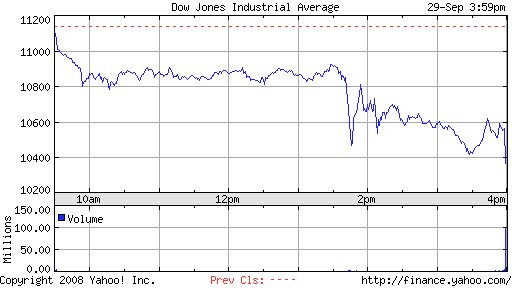
Today was the Dow’s worst point decline ever. The decline amounted to 777.68 points which is more than the Dow was worth at its 1982 low (btw, the Nasdaq closed at 1983 today). On a percentage basis, the Dow lost 6.98%.

Think about this: The sell-off erased $1.2 trillion off the stock market which was in response to a bailout plan of $700 billion.

The S&P 500 lost 106.62 points which is a total of 8.79%. That’s unusual that the Dow held up so much better than the S&P. Our Buy List was “only” down 6.11%.

By percentage terms, this was the worst selloff for the S&P 500 since 1987. My data only goes back to 1950, so it’s the second-worse sell-off since then.

By my records, this is 21st worst percentage decline for the Dow since the index began in 1896. Although, I saw a report from AP saying it was the 17th worst. The Christian Science Monitor said it was the 18th worst.
dow092908.png

Posted by edelfenbein at 9:17 PM

HR 3997

Well, I guess they were right..it was a partisan vote. Large sections of both parties voted against the bill. The Democrats voted 140-95. The Republicans voted 65-133.

Here's the roll call.

Posted by edelfenbein at 3:33 PM

Crossing Wall Street: Tomorrow's News Today, and Cheaper

I'm not going to say I called it. But I did, in fact, call it:

I'm going to be the first to call it, this bailout plan is going down. I don't know how or when, but I don't see this thing lasting. At best, it's going to be dramatically revised.

The plan has all the hallmarks of something the American public hates. It's too expensive. It's secretive...we just woke up one day and were told we needed it. We don't know if it will work. It seems un-American.

Posted by edelfenbein at 3:25 PM

The Nayes Have It

The bailout package goes down 205-228. Ultimately, I think the "or else" predictions weren't credible.

Posted by edelfenbein at 2:32 PM

Should Lehman Have Been Allowed to Fail?

I certainly though so, but now the evidence may point the other way:

Lehman's bankruptcy filing in the early hours of Monday, Sept. 15, sparked a chain reaction that sent credit markets into disarray. It accelerated the downward spiral of giant U.S. insurer American International Group Inc. and precipitated losses for everyone from Norwegian pensioners to investors in the Reserve Primary Fund, a U.S. money-market mutual fund that was supposed to be as safe as cash. Within days, the chaos enveloped even Wall Street pillars Goldman Sachs Group Inc. and Morgan Stanley. Alarmed U.S. officials rushed to unveil a more systemic solution to the crisis, leading to Sunday's agreement with congressional leaders on a $700 billion financial-markets bailout plan.

The genesis and aftermath of Lehman's downfall illustrate the difficult position policy makers are in as they grapple with a deepening financial crisis. They don't want to be seen as too willing to step in and save financial institutions that got into trouble by taking big risks. But in an age where markets, banks and investors are linked through a web of complex and opaque financial relationships, the pain of letting a large institution go has proved almost overwhelming.

In hindsight, some critics say the systemic crisis that has emerged since the Lehman collapse could have been avoided if the government had stepped in. Before Lehman, federal officials had dealt with a series of financial brushfires in a way designed to keep troubled institutions such as Fannie Mae, Freddie Mac and Bear Stearns Cos. in business. Judging them as too big to fail, officials committed billions of taxpayer dollars to prop them up. Not so Lehman.

One of the major problems with this mess is that we don't know what we don't know. If we had saved Lehman, would it have made things much better?

Posted by edelfenbein at 12:02 PM

A Vote is Due Today

It looks like the House will vote today on the bailout plan. You can read the bill here. The market, however, is not in a good mood today. Ultimately, I'm sure the House will pass the plan. If credit markets recover, however is another matter.

Posted by edelfenbein at 10:22 AM

September 25, 2008

WaMu Is Undo

Remember these used to be that company Washington Mutual (WM)?

Washington Mutual Bank, the country's largest savings and loan, was seized late today by federal regulators and immediately sold to JPMorgan Chase & Co., the New York banking giant that has long coveted the thrift's California and Florida branches.

With assets of $307 billion and deposits of $188 billion, Washington Mutual is the largest bank to fail in U.S. history.

Washington Mutual depositors won't lose access to any of their money, even if it wasn't fully insured, the Federal Deposit Insurance Corp. said.

"For all depositors and other customers of Washington Mutual Bank, this is simply a combination of two banks," FDIC Chairman Sheila C. Bair said. "For bank customers, it will be a seamless transition. There will be no interruption in services and bank customers should expect business as usual come Friday morning."

Washington Mutual, one of the country's largest mortgage lenders, was a victim of the housing downturn, recording $6.1 billion in losses in the nine months that ended June 30.

WaMu is a victim?

Posted by edelfenbein at 10:46 PM

Bill O'Reilly on the Bailout Plan

Bill O'Reilly gets angry and incoherent, but mostly angry.

Posted by edelfenbein at 10:42 PM

German Finance Minister Blames "Anglo-Saxon" Banking Model

From Bloomberg:

Steinbrueck, in a speech on the financial-market crisis to lawmakers in Berlin today, set out an eight-point plan urging greater regulation and larger capital reserves for banks. He championed the German banking system over its U.S. counterpart, dismissing the "Anglo-Saxon" model as having "an exaggerated fixation on returns."

Paul Kedrosky neatly fillets this comment with a good amount of contempt ("Right, as opposed to the Teutonic banking system's fixation on what, nice drapes?").

As for me, if the Germans are prepared to call our banks, "Anglo-Saxon" banks, then I consider it an improvement.

Posted by edelfenbein at 1:58 PM

Oh Dear Lord

An actual news story written by actual adults:

Michael Douglas asked about Wall Street crisis

Michael Douglas had to field questions Wednesday about the financial turmoil shaking world markets from reporters recalling his role in the 1987 film "Wall Street."

The actor sought to focus on the subject of Wednesday's news conference — urging the United States and eight other holdout nations to ratify a nuclear test ban treaty.

Douglas won an Academy Award for portraying the rapacious banker Gordon Gekko, who popularized the phrase "greed is good" in the movie.

After world leaders here condemned the "boundless greed" of world markets, Douglas was asked to compare nuclear Armageddon with the "financial Armageddon on Wall Street."

But the likening to Gekko did not end there, with a reporter asking: "Are you saying Gordon that greed is not good?"

"I'm not saying that," Douglas replied. "And my name is not Gordon. He's a character I played 20 years ago."

I've always wanted to ask Mark Hamill how those levitating cars worked.

(Via: DealBreaker)

Posted by edelfenbein at 12:17 PM

Bush's Speech

Here's part of the president's speech from last night:

First, how did our economy reach this point? Well, most economists agree that the problems we're witnessing today developed over a long period of time. For more than a decade, a massive amount of money flowed into the United States from investors abroad because our country is an attractive and secure place to do business.

This large influx of money to U.S. banks and financial institutions, along with low interest rates, made it easier for Americans to get credit. These developments allowed more families to borrow money for cars, and homes, and college tuition, some for the first time. They allowed more entrepreneurs to get loans to start new businesses and create jobs.

Unfortunately, there were also some serious negative consequences, particularly in the housing market. Easy credit, combined with the faulty assumption that home values would continue to rise, led to excesses and bad decisions.

Many mortgage lenders approved loans for borrowers without carefully examining their ability to pay. Many borrowers took out loans larger than they could afford, assuming that they could sell or refinance their homes at a higher price later on.

Optimism about housing values also led to a boom in home construction. Eventually, the number of new houses exceeded the number of people willing to buy them. And with supply exceeding demand, housing prices fell, and this created a problem.

BUSH: Borrowers with adjustable-rate mortgages, who had been planning to sell or refinance their homes at a higher price, were stuck with homes worth less than expected, along with mortgage payments they could not afford.

As a result, many mortgage-holders began to default. These widespread defaults had effects far beyond the housing market.

See, in today's mortgage industry, home loans are often packaged together and converted into financial products called mortgage-backed securities. These securities were sold to investors around the world.

Many investors assumed these securities were trustworthy and asked few questions about their actual value. Two of the leading purchasers of mortgage-backed securities were Fannie Mae and Freddie Mac.

Because these companies were chartered by Congress, many believed they were guaranteed by the federal government. This allowed them to borrow enormous sums of money, fuel the market for questionable investments, and put our financial system at risk.

The decline in the housing market set off a domino effect across our economy. When home values declined, borrowers defaulted on their mortgages, and investors holding mortgage-backed securities began to incur serious losses.

Before long, these securities became so unreliable that they were not being bought or sold. Investment banks, such as Bear Stearns and Lehman Brothers, found themselves saddled with large amounts of assets they could not sell. They ran out of money needed to meet their immediate obligations, and they faced imminent collapse.

Other banks found themselves in severe financial trouble. These banks began holding on to their money, and lending dried up, and the gears of the American financial system began grinding to a halt.

Posted by edelfenbein at 11:57 AM

Bed, Bath & Beyond's Earnings

Amid all the credit market ruckus, Bed, Bath & Beyond (BBBY) reported earnings of 46 cents a share yesterday which was inline with the Street's consensus. For the same quarter last year, the company earned 55 cents a share.

The market seems to be responding well to the earnings report. For this quarter, BBBY is expecting earnings-per-share between 41 and 47 cents, compared with last year's 52 cents. The Street is expecting 45 cents.

Here are the earnings results going back a few years:

Quarter Sales Gross Profit Operating Profit Net Profit EPS
May-99$356,633$146,214$28,015$17,883$0.06
Aug-99$451,715$185,570$53,580$33,247$0.12
Nov-99$480,145$196,784$50,607$31,707$0.11
Feb-00$569,012$238,233$77,138$48,392$0.17
May-00$459,163$187,293$36,339$23,364$0.08
Aug-00$589,381$241,284$70,009$43,578$0.15
Nov-00$602,004$246,080$64,592$40,665$0.14
Feb-01$746,107$311,802$101,898$64,315$0.22
May-01$575,833$234,959$45,602$30,007$0.10
Aug-01$713,636$291,342$84,672$53,954$0.18
Nov-01$759,438$311,030$83,749$52,964$0.18
Feb-02$879,055$370,235$132,077$82,674$0.28
May-02$776,798$318,362$72,701$46,299$0.15
Aug-02$903,044$370,335$119,687$75,459$0.25
Nov-02$936,030$386,224$119,228$75,112$0.25
Feb-03$1,049,292$443,626$168,441$105,309$0.35
May-03$893,868$367,180$90,450$57,508$0.19
Aug-03$1,111,445$459,145$155,867$97,208$0.32
Nov-03$1,174,740$486,987$161,459$100,506$0.33
Feb-04$1,297,928$563,352$231,567$144,248$0.47
May-04$1,100,917$456,774$128,707$82,049$0.27
Aug-04$1,273,960$530,829$189,108$120,008$0.39
Nov-04$1,305,155$548,152$190,978$121,927$0.40
Feb-05$1,467,646$650,546$283,621$180,980$0.59
May-05$1,244,421$520,781$150,884$98,903$0.33
Aug-05$1,431,182$601,784$217,877$141,402$0.47
Nov-05$1,448,680$615,363$205,493$134,620$0.45
Feb-06$1,685,279$747,820$304,917$197,922$0.67
May-06$1,395,963$590,098$148,750$100,431$0.35
Aug-06$1,607,239$678,249$219,622$145,535$0.51
Nov-06$1,619,240$704,073$211,134$142,436$0.50
Feb-07$1,994,987$862,982$309,895$205,842$0.72
May-07$1,553,293$646,109$154,391$104,647 $0.38
Aug-07$1,767,716$732,158$211,037$147,008 $0.55
Nov-07$1,794,747$747,866$203,152$138,232 $0.52
Feb-08$1,933,186$799,098$259,442$172,921 $0.66
May-08$1,648,491$656,000 $118,819$76,777$0.30
Aug-08$1,853,892$739,321 $187,421 $119,268$0.46

image714.png

Posted by edelfenbein at 9:48 AM

September 24, 2008

Jessica Hagy on the Paulson Plan

Perfect.

card1814.JPG

Posted by edelfenbein at 2:34 PM

More Market History

Today is the 139th anniversary of Black Friday. This was when Jay Gould and Jim Fiske tried to corner the gold market. It didn’t work and the bottom fell out of the gold market on September 24, 1869. Fisk was ruined and eventually shot by an angry creditor.

Forty-three years ago, President Eisenhower had a heart attack and that sent the market down 6.5%. This was a time of very low volatility so that sell-off was one of the biggest in years.

(Via: Gary Alexander)

Posted by edelfenbein at 1:13 PM

The Eurozone is Officially in a Recession

There's been a debate on whether the U.S. economy is in a recession. The pro-recession crowd says that it's obvious we are. The anti side tells us the numbers keep saying no. Now the Financial Times says the Eurozone is now in a recession:

The eurozone has fallen into recession, with industry particularly badly hit by the fall-out from global economic turmoil, results of a closely watched survey indicated on Tuesday.

Private sector output in the 15-country region contracted in September for the fourth consecutive month, according to eurozone purchasing managers’ indices. The pace of decline was the fastest since the aftermath of the September 2001 terrorist attacks in the US, with manufacturing faring worse than services.

The latest data indicated that, even if the crisis on Wall Street has yet to have a direct impact on eurozone economies, global economic storms have pushed the region into a technical recession – two quarters of contracting gross domestic product.

The eurozone composite purchasing managers’ index – covering services as well as manufacturing – fell from 48.2 in August to 47 this month. A figure below 50 is meant to indicate a contraction in activity.


Posted by edelfenbein at 10:20 AM

September 23, 2008

FactSet Research Systems' Earnings

FactSet Research Systems (FDS) reported decent earnings today. For its fiscal fourth quarter (ending August 31), the company earned 68 cents a share which was four cents a share better than Street estimates. For last year’s Q4, the company earned 58 cents a share. Sales were up 18.7% to 153.7 million. For Q1, the company sees sales of $154 to $157 million and operating margins between 31.5% and 33%.

The CEO said, “The macro environment has now been challenging for more than a year, yet it is gratifying that again this quarter FactSet grew both its user base and client count. The results point to significant progress in our efforts to increase the engagement level of users and add incremental value to clients. We were also very pleased that our previously announced acquisition of Thomson Fundamentals closed during the fourth quarter. We believe that the estimated market opportunity for fundamental data just among our existing client base is in excess of $100 million, representing a large new source of potential revenue growth for FactSet.”

FDS is often seen as a proxy for the health of the financial sector. I don’t think that’s correct. The company has been holding up very well during the recent unpleasantness. Last quarter, the client count increased by 41 to 2,085, and the number of users climbed by 510 to 40,120.

Year.................Sales...................EPS
1998...............$78.91.................$0.26
1999...............$103.83...............$0.37
2000...............$134.18...............$0.49
2001...............$167.56...............$0.64
2002...............$198.29...............$0.78
2003...............$222.30...............$0.98
2004...............$251.91...............$1.15
2005...............$312.64...............$1.43
2006...............$387.35...............$1.64
2007...............$475.80...............$2.14
2008...............$575.52...............$2.50

Posted by edelfenbein at 9:37 PM

Thanks Hugo

From Comrade Chavez:

"I nationalize strategic companies and get criticized, but when Bush does it, it's OK," Chavez said on weekly television program Sept. 21. "Bush is turning socialist. How are you, comrade Bush?"

(Via: DealBreaker)

Posted by edelfenbein at 1:46 PM

September 22, 2008

We're All Zimbabweans Now

The chart says it all.

Posted by edelfenbein at 12:23 PM

Goldman, Morgan to become holding companies

MarketWatch reports:

In yet another extraordinary development for Wall Street, the Federal Reserve said late Sunday night that venerable investment banks Goldman Sachs and Morgan Stanley will become bank holding companies, subjecting themselves to stricter federal oversight.

The Wall Street titans will be allowed to transition into holding companies following a mandatory five-day waiting period, and will be able to take advantage of credit from the Federal Reserve Bank of New York in order to complete the transition.

So does this mean I'll soon be seeing Goldman Sachs ATMs around town?

Posted by edelfenbein at 12:18 PM

The Bailout Plan

I'm going to be the first to call it, this bailout plan is going down. I don't know how or when, but I don't see this thing lasting. At best, it's going to be dramatically revised.

The plan has all the hallmarks of something the American public hates. It's too expensive. It's secretive...we just woke up one day and were told we needed it. We don't know if it will work. It seems un-American.

Posted by edelfenbein at 11:15 AM

More Stocks You Can't Short

The SEC allowed the exchanges to add stocks to the No-Short List. Here's what the NYSE has added:

1. GLG GLG Partners, Inc.
2. GE General Electric Co.
3. OCN Ocwen Financial Corporation
4. KBW KBW, Inc.
5. GFG Guaranty Financial Group Inc.
6. MFG Mizuho Financial Group, Inc.
7. FMR First Mercury Financial Corporation
8. STC Stewart Information Services Corporation
9. FCF First Commonwealth Financial Corporation
10. MTB M&T Bank Corporation
11. DFS Discover Financial Services
12. BMO Bank of Montreal
13. TD Toronto Dominion Bank
14. CM Canadian Imperial Bank of Commerce
15. FMD The First Marblehead Corporation
16. BBV Banco Bilbao Vizcaya SA
17. CIB BanColombia SA
18. LM Legg Mason, Inc.
19. NFP National Financial Partners Corp.
20. AXP American Express Company
21. CIT CIT Group Inc.
22. GM General Motors Corporation
23. HIG The Hartford Financial Services Group
24. ADS Alliance Data Systems Corporation
25. ALD Allied Capital Corporation
26. RAS RAIT Financial Trust
27. DRL Doral Financial Corporation
28. FSR Flagstone Reinsurance Holdings
29. MCO Moody's Corporation
30. COF Capital One Financial Corporation
31. CS Credit Suisse Group AG


Posted by edelfenbein at 11:06 AM

More Fallout from the Credit Crisis

Well it never end?

Crain's:

New Yorkers hitting the bottle

The Sun:

Credit crunch means couples stay at home making babies

NY Mag:

Eager Ecdysiasts Dance Through Downturn (“Those girls specialize in taking care of their clients’ emotional needs and ‘wellness’—listening to their problems, conversing,” he says. “Forty percent of the time, they’re not even consummating.”)

Posted by edelfenbein at 10:35 AM

September 21, 2008

NYC Strippers Screwed by Sucky Stocks

Is stripping too big to fail?

So the NYC economy is headed for the crapper, sure -- but who's really suffering? Weep for the strippers.

We're told first-hand by the pole-gymnasts at joints like the Penthouse Executive Club in NYC that biz has come to a grinding halt -- and to add insult to injury, strippers say one-dollar bills have replaced tens and twenties. Oh, the humanity!

Sources tell us traffic at some super-exclusive Manhattan nightspots is down 40-50% since the wheels came off.

Posted by edelfenbein at 2:10 AM

September 20, 2008

Howard on the New Financial Frontier

Great post from Howard Lindzon:

The best strategy to come out of this mess will be Global Macro Funds, funds with deep pools making concentrated bets in sectors and countries. They will be funds focused on a longer term horizon with bigger pools of capital. They embrace the volatility because of their connections, patience and deep knowledge of their sectors. The displaced talent from the industry will gravitate to these funds first. It is their best opportunity to be paid for their experience. I am digging through some of the worst performing funds of the last few years in the Global Macro sector and with the help of some of my friends in the industry plan to find a few and make some investments.

At the other end will be the nimble, the creative and the opportunistic. Those willing to change the industry through hard work and the profiting from niche markets afforded to them in the new financial landscape. This is where I will focus my energies and am already writing a few business plans. I now my strengths and weaknesses. I am not a ‘Shark’, but a ‘Pilot Fish’ and very in tune with the limits, and opportunities that affords me.

Thousands of great traders were thrown out into the wild the last few months. They are disoriented, pissed, nervous, but for the most part, they will end up on their feet and contribute back into the financial system in new ways - small hedge funds, start-up economy and other leadership roles. Some will write books and some will leave the financial world for good.

The financial media world on the other hand will continue to talk about ‘BOTTOMS’ - Was this one? If not when?

I am licking my chops because this bottom talk and regulation talk and babble will go on for 6-12 months. It’s noise and it will drag you in if not careful. In the meantime, I will be working towards one end of what I know is going to be a hugely profitable niche and start cranking.

Read the whole thing.

Posted by edelfenbein at 3:34 PM

Jimmy Stewart Singing Easy to Love

Since it's Saturday, I figure we all need a break from the financial mayhem, so here's Jimmy Stewart singing "Easy to Love" to Eleanor Powell in the 1936 movie Born To Dance.

Jimmy Stewart used to make fun of his singing, but I think he does a really nice job. He has an innocent charm that's just so perfect. BTW, this is the original version with the lyric "so sweet to waken with/so nice to sit down to eggs and bacon with."

I think we all know what THAT means! Bowmp chicka bowmp bowmp....

Since the Hays Code was still fairly new, Cole Porter changed the offending lyric to "so worth the yearning for/so swell to keep ev'ry homefire burning for...."

Posted by edelfenbein at 9:43 AM

Swedish Prostitutes Want to Pay Taxes

Who knew?

More and more Swedish prostitutes want to pay taxes in order to receive the social welfare benefits that come with doing so.

“So far this year I’ve spoken with several women who want to make things right,” said Pia Blank Thörnroos, a legal expert with Sweden’s Tax Authority, to the Göteborgs-Posten (GP) newspaper.

While it remains against the law to purchase sex in Sweden, selling sex is perfectly legal according to Sweden’s unique prostitution law, which came into force in 1999.

Moreover, prostitution has been considered a business activity in Sweden since 1982 and as a result proceeds from the sale of sex subject to taxation just like any other form of income.

“You have to keep track of all your income and expenses; all compensation should be accounted for,” explained Blank Thörnroos.

“One should really have accounting records. And in actuality [customers] should write out a receipt, because the transaction is considered a private operation which is subject to value added tax. But customers’ names need not be on the receipt.”

Income recorded on prostitutes’ tax returns gives them the right to sick-leave pay, parental leave benefits, and a pension.

“It’s important to pay taxes if you want to live a normal life,” said ‘Lisa’, a prostitute who spoke with the newspaper.

I'm not sure "Lisa" understands the irony of her statement.

Posted by edelfenbein at 12:32 AM

September 19, 2008

Warren Buffett Made $7 Billion on Friday

Shares of Berkshire Hathaway (BRKA) gapped up $18,990 on Friday which is an increase of 14.8%. Given that Warren Buffett owns 350,000 shares, that increased his wealth by about $6.7 billion. (Buffett also owns two million shares of Class B stock which increased by $345 yesterday, but that only added $700 million to his fortune.)

The Class A shares jumped up about $10,000 starting at 3:57, which means Buffett made over $3.5 billion in about three minutes.

brka91808.png

And I thought I did well on my MS buy!

Posted by edelfenbein at 10:07 PM

The Decline and Fall of the Roman Economy

Historians have long debated what caused the downfall of the Roman Empire. What about its tax policies?

As early as the rule of Nero (54-68 A.D.) there is evidence that the demand for revenue led to debasement of the coinage. Revenue was needed to pay the increasing costs of defense and a growing bureaucracy. However, rather than raise taxes, Nero and subsequent emperors preferred to debase the currency by reducing the precious metal content of coins. This was, of course, a form of taxation; in this case, a tax on cash balances (Bailey 1956).

Throughout most of the Empire, the basic units of Roman coinage were the gold aureus, the silver denarius, and the copper or bronze sesterce. [8] The aureus was minted at 40-42 to the pound, the denarius at 84 to the pound, and a sesterce was equivalent to one-quarter of a denarius. Twenty-five denarii equaled one aureus and the denarius was considered the basic coin and unit of account.

The aureus did not circulate widely. Consequently, debasement was mainly limited to the denarius. Nero reduced the silver content of the denarius to 90 percent and slightly reduced the size of the aureus in order to maintain the 25 to 1 ratio. Trajan (98-117 A.D.) reduced the silver content to 85 percent, but was able to maintain the ratio because of a large influx of gold. In fact, some historians suggest that he deliberately devalued the denarius precisely in order to maintain the historic ratio. Debasement continued under the reign of Marcus Aurelius (161-180 A.D.), who reduced the silver content of the denarius to 75 percent, further reduced by Septimius Severus to 50 percent. By the middle of the third century A.D., the denarius had a silver content of just 5 percent.

Interestingly, the continual debasements did not improve the Empire's fiscal position. This is because of Gresham's Law ("bad money drives out good"). People would hoard older, high silver content coins and pay their taxes in those with the least silver. Thus the government's "real" revenues may have actually fallen. As Aurelio Bernardi explains:

At the beginning the debasement proved undoubtedly profitable for the state. Nevertheless, in the course of years, this expedient was abused and the [fn2]century of inflation which had been thus brought about was greatly to the disadvantage of the State's finances. Prices were rising too rapidly and it became impossible to count on an immediate proportional increase in the fiscal revenue, because of the rigidity of the apparatus of tax collection. [9]

At first, the government could raise additional revenue from the sale of state property. Later, more unscrupulous emperors like Domitian (81-96 A.D.) would use trumped-up charges to confiscate the assets of the wealthy. They would also invent excuses to demand tribute from the provinces and the wealthy. Such tribute, called the aurum corinarium, was nominally voluntary and paid in gold to commemorate special occasions, such as the accession of a new emperor or a great military victory. Caracalla (198-217 A.D.) often reported such dubious "victories" as a way of raising revenue. Rostovtzeff (1957: 417) calls these levies "pure robbery."


Posted by edelfenbein at 9:43 PM

This Isn't a New Game

From 2006:

Lay blames Enron failure on attack of short-sellers

Enron's fault was not having its former CEO as Treasury Secretary.

Posted by edelfenbein at 3:08 PM

Here's the List

I got 799 stocks you can't short right here.

Included on the list is National Atlantic Holdings (NAHC) which was bought out several weeks ago.

Posted by edelfenbein at 1:06 PM

Bush: "Anyone engaging in illegal financial transactions will be caught and persecuted."

Here's President Bush this morning (source White House website).

The Securities and Exchange Commission has issued new rules temporarily suspending the practice of short selling on the stocks of financial institutions. This is intended to prevent investors from intentionally driving down particular stocks for their own personal gain. The SEC is also requiring certain investors to disclose their short selling, and has launched rigorous enforcement actions to detect fraud and manipulation in the market. Anyone engaging in illegal financial transactions will be caught and persecuted [sic].

No we're talking! Let's make the shorts use separate water fountains.

Posted by edelfenbein at 12:10 PM

New Rule

Don’t invade Russia in the winter, and don’t conduct a short raid on Goldman Sachs when the former CEO is the Treasury Secretary.

Posted by edelfenbein at 11:02 AM

The Short Selling Ban

From the WSJ:

The Securities and Exchange Commission on Friday launched an aggressive assault against short-sellers, saying it would temporarily prevent investors from making bets on stock declines in an attempt to stem some of the worst stock-market slides in years.

The SEC, which had convened a late-night commission meeting Thursday to consider several items, said in a statement early Friday morning it is halting short selling on 799 financial stocks. The ban, which is effective immediately, is set to last for 10 days, but could be extended for up to 30 days.

"The Commission is committed to using every weapon in its arsenal to combat market manipulation that threatens investors and capital markets," SEC Chairman Christopher Cox said. "The emergency order temporarily banning short selling of financial stocks will restore equilibrium to markets. This action, which would not be necessary in a well-functioning market, is temporary in nature and part of the comprehensive set of steps being taken by the Federal Reserve, the Treasury, and the Congress."

The SEC announced other temporary measures, including a requirement for large institutional money managers to report short positions in certain stocks. It also eased restrictions on corporate stock buy backs, saying that will give companies greater flexibility to buy their own shares and help restore liquidity at a time "of unusual and extraordinary market volatility."

In short selling, traders borrow shares of stock and sell them, hoping the price of the shares declines and they can profit by buying them back at a lower price. Short sellers have become scapegoats for the big declines in the share prices of weakened companies including Lehman Brothers Holdings Inc. and American International Group Inc., though it is unclear whether they were the cause of the declines.

The cause of the decline? So it's just a coincidence that shorts ganged up on lousy stocks. Funny how they're not shorting Donaldson (DCI).

Posted by edelfenbein at 10:56 AM

Just a Reminder

I know today is a busy day for everyone, but If I need to remind you: Arrrgh!

Posted by edelfenbein at 10:05 AM

September 18, 2008

Short the SEC

This is simply outrageous. The WSJ article isn't clear on what will happen. It appears that the SEC is merely considering a ban of shorting, but it's far from a done deal.

This is so ridiculous, so delusional, that I can't believe it has a prayer of really happening. Banning short-selling? Are they kidding me? The backlash would be overwhelming. At least, I hope it would be. The SEC would be denounced by every major financial organization on the planet.

Short-selling is the free speech of Wall Street.

Half the computer models on Wall Street would explode! Consider this:

About a third of U.S. equities trading is already being done using algorithmic trading, with that figure expected to soar to more than 50 percent by 2010, said Brad Bailey, a senior analyst at the Boston-based researcher Aite Group. "I'm even afraid I'm underestimating that number," Bailey said.

Posted by edelfenbein at 10:12 PM

Oopsie!

From the NY Times:

Editors' Note: September 18, 2008
An earlier version of this article cited two sources who were said to have been briefed on a conversation in which John J. Mack, chief executive of Morgan Stanley, had told Vikram S. Pandit, Citigroup's chief executive, that "we need a merger partner or we're not going to make it." On Thursday, Morgan Stanley vigorously denied that Mr. Mack had made the comment, as did Citigroup, which had declined to comment on Wednesday.

The Times's two sources have since clarified their comments, saying that because they were not present during the discussions, they could not confirm that Mr. Mack had in fact made the statement. The Times should have asked Morgan Stanley for comment and should not have used the quotation without doing more to verify the sources' version of events.

(Via Ribstein via CalculatedRisk)

Posted by edelfenbein at 4:36 PM

Morgan Stanley

Shares of Morgan are now going for about four times earnings. I think the shorts are trying to break this bank and it won't work.

I bought some shares for my personal account just before the close. I don't expect to hold this position very long.

Posted by edelfenbein at 2:59 PM

In the Last Six Weeks

Jos. A Bank Clothiers (JOSB) is up 62%. It's now the big gainer YTD on my Buy List.

Posted by edelfenbein at 2:25 PM

Seven Possible Shorts

Short sellers are a pretty happy bunch this week. In fact, the Brits just banned short selling for the next three months. Every likes to blame shorts for things that go wrong, but shorting is really the free speech of Wall Street.

I don’t do a lot of short selling, but here’s a list of potential shorts from one of my favorite bloggers, Timmy Sykes.

American Dairy (ADY)

EPIQ Systems (EPIQ)

Tanzanian Royalty Exploration (TRE)

Converted Organics (COIN) and the warrants (COINW)

Valence Technology (VLNC)

A-Power Energy Generation Systems (APWR)

Just glancing over these stocks, they appear to be truly awful. I’m not exactly holding my breath for Converted Organics to make that big jump to the NYSE. Tim’s strategy is basically to look at crappy penny stocks and get ready to pounce when the charts look good, meaning bad.

Short sellers have one big advantage over the rest of us: When things go wrong, they go really, REALLY wrong. There are far more crappy stocks that plunge 50% in a single day than there are good stocks that double in one day. To be a good short, you need to be very patience. Also, not having a soul helps.

I should try more shorting. I look through gobs of balance sheets everyday and I’m amazed by how much garbage is out there.

You can sign up to Tim’s Alert service here.

Posted by edelfenbein at 2:00 PM

The Vix Soars

This is getting out of a hand.

vix091808.png

Posted by edelfenbein at 12:30 PM

Kraft Will Replace AIG in the Dow

Sorry, Google. The winner is Kraft.

Kraft Foods Inc. will replace American International Group Inc. in the Dow Jones Industrial Average effective Monday, a further sign of the woes afflicting the insurance giant.

The change comes as the federal government late Tuesday agreed to take over the troubled insurance giant in an $85 billion bailout.

The composition of the Dow industrials was last changed in February, when Bank of America Corp. and Chevron Corp. replaced former Kraft parent Altria Group Inc. and Honeywell International Inc.

Robert Thomson, managing editor of The Wall Street Journal and overseer of the Dow's makeup, said not adding a financial company to replace AIG is prudent at this time "because of the extremely unsettled conditions." He added Kraft was added because the index has no food companies.

Kraft was effectively a member of the Dow until last year when it was spun off from Altria.

Posted by edelfenbein at 10:24 AM

The Panic of 1873 Begins 135 Years Ago Today

panic1873.jpg

On Thursday, September 18, 1873, the Panic of 1873 reached crisis proportions at 11:00am on Wall Street, when H.C. Fahnstock, the New York partner of Jay Cooke (one of the leading gold market participants), announced that Cooke’s office was closed. Cooke, in his Philadelphia office, admitted it was true, and the most prominent banker in the country was suddenly bankrupt.

Robert Sobel, writing like Stephen King in Panic on Wall Street, said the “coal-black steed named Panic” quickly “thundered riderless down Wall Street,” where “a monstrous yell went up and seemed to literally shake the building in which all these mad brokers were for the moment confined.” Along with Jay Cooke, 37 other banks and two brokerage houses closed their doors on this date alone. In the ensuing days, the losses increased and the NYSE was forced to close down for over a week. With the situation growing dire, the secretary of the Treasury decided to infuse the economy with $26 million in paper money and the market eventually re-opened.

Jay Cooke failed over trying to construct a second Transcontinental Railroad, but demand could not support a second line. He was merely a symbol of gross over-speculation in land and securities, followed by the issuance of too much paper money, resulting in higher inflation. (Sound familiar?) The Panic of 1873 started with a bang, as over 5000 businesses failed in the last quarter of 1873, but the Panic lingered long, as another 5,000 failed over the next five years. Panics hit America every 17 years, on average, for about a century, from 1819 to 1920 (in 1819, 1837, 1857, 1873, 1894, 1907 and 1920). The word “panic” aroused such a negative reaction (in 1894 and 1907) that Herbert Hoover invented a less threatening word for the 1929 event—connoting a small pothole in the road. Hoover called the 1929 panic “merely a depression.”

(Via: Gary Alexander)

Posted by edelfenbein at 9:05 AM

September 17, 2008

Weird

On Monday, the S&P 500 lost -4.7136%.

Today, the S&P 500 lost -4.7141%.

Posted by edelfenbein at 4:25 PM

The Three-Month T-Bill

At one point today, the yield on the three-month Treasury bill (^IRX) hit 0.01%!!

One Freakin Bip!!

This means that the risk-free rate is now in direct competition with the underside of your mattress.

one%20freakin%20bip.png

Posted by edelfenbein at 2:58 PM

The U.S. Government Now Sponsors Manchester United

Now that the Feds own 80% of AIG, which is one of Manchester United's largest sponsors. So our government now sponsors Man U.

2034.jpg

Posted by edelfenbein at 1:25 PM

The Next Depression?

Well, I'm not convinced. Here's a look at the Dow from its 1929 peak compared with the Dow from its 2007 peak.

image713.png

Posted by edelfenbein at 12:20 PM

AIG's Advertizing...Now with Irony

Part of the Fed's deal is that AIG's CEO had to go, but what happens to this kid?

Posted by edelfenbein at 10:35 AM

Who Replaces AIG in the Dow? How about the Fed?

Now that AIG (AIG) is public property, I wonder who will replace the stock in the Dow Jones Industrial Average (^DJI).

My choice: The Federal Reserve. Barring that, the Bank of China.

Over the years, the Dow has made many adjustments, but I can’t ever recall a stock being pulled because it nearly went under. AIG was added to the index in April 2004 and from the get-go, it was a drag the Dow. In fact, the last few additions haven’t helped much.

One word to add: The Dow is price-weighted which means that a stock's weighting in the index is solely based on its price, no matter how many shares outstanding there are. To find out the index level, just add up the prices of the 30 stocks and adjust by a divisor (roughly multiply the sum of the stocks by eight).

It’s an antiquated measure, but it’s got quite a nice brand name after 112 years in business. Personally, I prefer the S&P 500 (^SPX) and that’s what I use for comparisons with my Buy List.

The last change to the Dow came in February when Bank of America (BAC) and Chevron (CVX) replaced Altria (MO) and Honeywell (HON). Since changes are pretty infrequent, I hope the gatekeepers make a few more changes along with booting AIG.

I’d vote to remove AIG, plus Alcoa (AA) and General Motors (GM). GM is frankly an embarrassment to the index.

So what should the new stocks be? I’d say the front-runners are Google (GOOG), Cisco (CSCO) and Apple (AAPL). Here’s a list of mega-cap stocks that aren’t currently in the Dow and their market caps (in billions).

Google..............................$139.3
Cisco.................................$134.5
Apple................................$123.9
Wells Fargo.......................$115.6
Pepsi.................................$114.2
Philip Morris.......................$110.8
ConocoPhillips....................$109.8
Schlumberger.....................$104.2
Oracle.................................$97.8
Abbott Labs.........................$92.2
Qualcomm............................$78.6
Amgen.................................$69.7
UPS......................................$69.4

I’d also make a case for a stock like UPS (UPS). It’s not the biggest, but its business is probably a better reflection of the larger economy than many bigger stocks.

On a side note, little changes to the Dow can have major impacts. The editors of the Wall Street Journal changed the index in 1939 by tossing out IBM (IBM). They added it back in 1979. In those 40 years, IBM gained 22,000%. If the editors had left it in, the Dow would now be about 35% higher than where it is now. All the historical benchmarks would be different. The Dow would have cracked 1,000 in 1961 instead of twelve years later.

Behold the power of one really good stock.

Posted by edelfenbein at 6:48 AM

Is the Fed Allowed to do This?

Megan McArdle wonders what legal right the Federal Reserve has to go in the insurance business:

It's probable that they don't actually have the legal right to do anything like this. Their authority is this: who's going to stop them? No one wants to take on responsibility for this mess themselves.

Section 13-3 of the Federal Reserve Act gives them the authority. Assuming you read it very broadly:

In unusual and exigent circumstances, the Board of Governors of the Federal Reserve System, by the affirmative vote of not less than five members, may authorize any Federal reserve bank, during such periods as the said board may determine, at rates established in accordance with the provisions of section 14, subdivision (d), of this Act, to discount for any individual, partnership, or corporation, notes, drafts, and bills of exchange when such notes, drafts, and bills of exchange are indorsed or otherwise secured to the satisfaction of the Federal Reserve bank: Provided, That before discounting any such note, draft, or bill of exchange for an individual, partnership, or corporation the Federal reserve bank shall obtain evidence that such individual, partnership, or corporation is unable to secure adequate credit accommodations from other banking institutions. All such discounts for individuals, partnerships, or corporations shall be subject to such limitations, restrictions, and regulations as the Board of Governors of the Federal Reserve System may prescribe.

Glad that's all clear now.

Posted by edelfenbein at 12:37 AM

September 16, 2008

Colbert: My Portfolio Consisted Of Lehman, Merrill, AIG And Lil' Shavers

Posted by edelfenbein at 11:44 PM

How Times Have Changed

1101990215_400.jpg

It was almost ten years ago that Time magazine ran a cover with Greenspan, Rubin and Summers called "The Committee to Save the World." Let's just say that I couldn't imagine a similar cover running today with Bernanke, Paulson and Geithner.

Posted by edelfenbein at 10:35 PM

The Black Swan Beats Up the Bear

The oil boom of the 1970s was a great financial help to the Soviet Union. It helped fund their strategic acquisition, meaning Afghanistan, which didn't go quite so well. Perhaps the invasion of Afghanistan was a sell signal for commodities since gold peaked a few days later.

The invasion of Georgia may be playing the same roll. Money has poured out of Russia and oil has plunged over $50 a barrel. The Russian market plunged 17% today and the stock exchange was shut down.

"It's panic," said Oleg Vorotnitsky, head of equity trading at Uralsib Financial Corp. in Moscow. "There are problems with liquidity on the market. People are having difficulties with refinancing their positions so they started selling. Concern about AIG" is adding to the panic, he said.

The dollar-denominated RTS Index lost 11 percent to 1,131.12, marking a 55 percent retreat from its highest close of 2,487.92, on May 19. The gauge has fallen 51 percent so far this quarter, the worst performance of major world equities indexes.

Posted by edelfenbein at 10:07 PM

AIG's Move Today

In today's session, shares of AIG ranged from $1.25 to $5.24. Total volume was over 1.23 billion.

aig091608.png

Posted by edelfenbein at 4:02 PM

The Fed Holds

The central bank does nothing.

The Federal Open Market Committee decided today to keep its target for the federal funds rate at 2 percent.

Strains in financial markets have increased significantly and labor markets have weakened further. Economic growth appears to have slowed recently, partly reflecting a softening of household spending. Tight credit conditions, the ongoing housing contraction, and some slowing in export growth are likely to weigh on economic growth over the next few quarters. Over time, the substantial easing of monetary policy, combined with ongoing measures to foster market liquidity, should help to promote moderate economic growth.

Inflation has been high, spurred by the earlier increases in the prices of energy and some other commodities. The Committee expects inflation to moderate later this year and next year, but the inflation outlook remains highly uncertain.

The downside risks to growth and the upside risks to inflation are both of significant concern to the Committee. The Committee will monitor economic and financial developments carefully and will act as needed to promote sustainable economic growth and price stability.

Voting for the FOMC monetary policy action were: Ben S. Bernanke, Chairman; Christine M. Cumming; Elizabeth A. Duke; Richard W. Fisher; Donald L. Kohn; Randall S. Kroszner; Sandra Pianalto; Charles I. Plosser; Gary H. Stern; and Kevin M. Warsh. Ms. Cumming voted as the alternate for Timothy F. Geithner.

Posted by edelfenbein at 2:28 PM

Growth Is the New Safe Haven

Relatively speaking.

fivedaygrwvalue.png

Posted by edelfenbein at 1:07 PM

88 Years Ago Today

jpmorgan_damage.jpg

At 12:01, September 16, 1920, a horse cart packed with dynamite blew up outside 23 Wall Street, which was the headquarters of J.P. Morgan. Thirty-eight people were killed and 400 were injured. Pockmarks from the blast can still be seen on the building and the company has said that it will never been repaired. No one was ever charged.

Posted by edelfenbein at 12:16 PM

Me on LEH in 2005:" I can’t put my finger on it, but I don’t see where all the growth comes from."

At the end of 2005, I posted some thoughts for 2006 including a few stocks to sell immediately. One of the stocks I said to sell was Lehman Brothers:

There’s something about Lehman Brothers (LEH) that I just don’t get. Every quarter they put up great numbers. I can’t put my finger on it, but I don’t see where all the growth comes from. How can they consistently do what others can’t? Maybe the company really is that good. Maybe not. Personally, I’m rooting for the yield curve.

Posted by edelfenbein at 11:50 AM

Let's Have a Commission

Good news! John McCain has a plan to fix the credit crisis, let's form a commission!

We need to set up a 9/11 Commission in order to get to the bottom of this and get it fixed, and act to clean up this corruption…They've violated the social contract that capitalism and the citizen have, and we can't ever let this happen again. I'll make sure it never happens again.

Commissions are basically community organizers, but for nicer communities.

Posted by edelfenbein at 11:38 AM

By the Way

My Buy List is up 0.58% today.

Posted by edelfenbein at 11:23 AM

S&P 500 Daily Changes

Yesterday was the biggest sell-off since 9/11. Here are the daily changes for this decade.

image712.png

The worst day came on April 14, 2000 when the S&P 500 lost -5.83%. The Monday after 9/11 (September 17, 2001), the market dropped -4.92%. Yesterday, the market lost -4.71%.

The best day came on July 24, 2002 when the market jumped 5.73%. The second-best day came five days later when the market rose 5.41%.

Posted by edelfenbein at 11:17 AM

Barclays seals Lehman deal

From the FT:

Lehman Brothers on Tuesday reached a deal to sell certain parts of its business to Barclays, which had been in talks over the weekend to buy the entire investment bank before it filed for bankruptcy protection on Monday.

The two parties reached a deal in the early New York morning, though the exact Lehman businesses involved, and the price at which they will be sold, remained unclear. A deal could be accompanied by a small capital raising by the UK lender.

People close to the matter said it was likely that the deal centered around Lehman’s core US broker-dealer operations, which perform securities underwriting tasks, provide merger advice to lucrative clients, and conduct trading.

Posted by edelfenbein at 10:40 AM

Thanks Eliot

Larry Ribstein has a great post on the failure of SOX. Weren't all those controls there to protect us?

Remember when SOX was supposed to, at enormous cost, expose the weaknesses and risks lurking in companies so they could be addressed to avoid another Enron? As Tom Kirkendall and I have been observing for awhile: fat lot of good SOX did. Could we please think about that when we try to regulate in the wake of this catastrophe?

And while we’re at it, let’s think about yesterday afternoon’s market plummet. That happened (and it's likely to continue this morning) because AIG, facing catastrophic downgrades of its securities, needs 70 billion by tomorrow to avoid bankruptcy.

Should we worry about that? Here’s what the WSJ has to say:

The company, whose stock fell 61% yesterday, is such a big player in insuring risk for institutions around the world that its failure could shake the global financial system. much of its exposure is related to credit default swaps, insurancelike contracts tied to corporate defaults. * * * The market for credit default swaps is immense, trading against about $62 trillion of debt. Some participants in the largely unregulated market worry that the default of a major player such as AIG could trigger chaos. * * *

[T]he firm is used by many companies world-wide to manage a range of risks, including exposure to investments in subprime mortgages. Its demise would potentially make it harder or more expensive for businesses to control their risks.

How did this happen? Well it’s worth speculating that it had something to do with AIG being left without its long-time leader, Hank Greenberg, for which we can thank Eliot Spitzer. As I’ve noted, per the WSJ (last May):

A careful and lengthy look at the evidence available so far . . . suggests that the AIG case, like so many others that Mr. Spitzer brought, was an example of prosecutorial excess. Instead of uncovering some great fraud by a titan of industry, its main result has been to damage the company, and harm innocent managers and shareholders. * * *Trading above $72 in February 2005 before it was Spitzerized, AIG shares closed yesterday at $39.57. The company's directors defend themselves by saying Mr. Spitzer gave them little choice but to dismiss Mr. Greenberg. Whether that was true at the time, they – and Mr. Spitzer – owe an apology to AIG shareholders.

Posted by edelfenbein at 10:29 AM

In Retrospect

The $10 BSC got in March is looking pretty good. Lehman's big mistake was being too small and too late. If they blew up bigger and earlier, they'd probably be in much better shape today. (It would be hard to be in worse shape.)

Posted by edelfenbein at 10:25 AM

Now They Tell Us

WaMu Rating Lowered to Junk by S&P on Mortgage Losses

wm.png

Posted by edelfenbein at 10:15 AM

The Bubble Isn't All Bush's Fault

I just don't get the argument that the credit bubble is the fault of George Bush, or free market ideology. People toss around the words "more regulation" as if that's the obvious cure. Sure, if we restricted the number of people who got mortgages, I assume the bubble would have been averted. But who would have been the first person barred from getting a mortgage? The message I'm getting from this crisis is not that government should do more, but it's really how little the government can do.

Posted by edelfenbein at 10:08 AM

Oil is Down Again

As far as impacting the overall economy, Lehman's downfall doesn't mean very much. In the larger scheme of things, Lehman was never really a big company. The media always like to use the, how will this effect Main Street angle. Simply put, it won't.

But what will impact Americans is the plunge in oil. I see that oil is down sharply again and is now below $92. I remember way, way back when we would have thought $92 for oil was expensive. For example, the beginning of the year.

In my very unsophisticated analysis, I think gold is due for a big fall.

Posted by edelfenbein at 9:51 AM

Goldman's Net Plunges

The market is rattled again this morning as Goldman Sachs (GS) reported a major earnings decline. For their third quarter, Goldman earned $1.81 a share which beat Wall Street's consensus of $1.73. This is a major shortfall compared with the $6.13 a share it made for last year's third quarter.

I'm seeing a lot of scary headlines (Goldman Sachs net plunges 70 percent) but some perspective is needed. Goldman is still making a lot of money, just not the absurd amounts seen in 2006 and 2007. GS's profits are up 25% in the last three years. Annualized, that's not a huge increase, but it's still up.

Posted by edelfenbein at 9:44 AM

September 15, 2008

The Fed’s Suez Crisis

Something that struck me about Lehman’s demise is how little power the Federal Reserve really has. Don’t get me wrong, the Fed is darn powerful, but it’s not all-knowing and all-seeing, despite what some folks think. The Fed is powerful because people think it’s powerful.

Analysts hang on every word in a statement or testimony, but in the case of Lehman Brothers (LEH), the Fed really couldn’t do much. Wall Street basically stood up to the Fed and the central bank was exposed. Since Bear was the first, the Fed can open its mouth and get its way. But the Fed can’t make the weaker argument the stronger, and that’s what was needed with Lehman.

I’d say the Lehman story was a combination of too much debt—at one time they were leverage 40-to-1, they didn’t know what they owned, and they refused to listen to any criticism. To top it off, they had horrible luck too. That’s not a good combination.

With Level 3 assets (these are basically assets that can’t be priced easily so we have to trust Lehman for the price), Lehman once claim they their Level 3 stuff was up 9%, even though the market was down by 10%. When people called them on it, Lehman got mad and blamed the shorts. That’s just arrogance. Then they spent something like $22 billion on Archstone? I mean, what the hell? Talk about the wrong price, the wrong industry at the wrong time. Aside from that, it was a great deal!

Einhirn and other shorts said they didn’t know what their stuff was worth and they were undercapitalized. Fuld & Co. just refused to listen. I don’t think they’re crooks at all, they sincerely believed in what they were doing. Until the end, the company was offering assurance to investors.

With Bear and Lehman we often heard about counterparty risk. Well, that theory got shot down with Lehman. I’m going to go on the idea that the reason there wasn’t a deal for Lehman is that no one wanted one. If someone wanted, it would have happened. Novel thinking I know. But it tells us that the Street is hardly concerned about counterparty risk. JPM was concerned about with Bear because it was mostly their risk.

I heard Hank Paulson talk about bringing stability to the markets. Yeah, right. That’s basically like the flea giving orders to the dog. The Fed and the Treasury do not have this thing contained. If the housing market recovers, then the problem goes away. It’s as simple as that.

Posted by edelfenbein at 3:10 PM

Eddy TV

I was just on Britain's SkyTV discussing Lehman's implosion. If I can find the video, I'll post it here.

Posted by edelfenbein at 2:40 PM

91-Day Treasuries

The yield on the 91-day Treasury basically got chopped in half today. At one point, the yield got down to 0.67%.10-year Treasury futures had their best one-day gain in nearly 20 years. Now if I can only remember what happened in October 1987.

Posted by edelfenbein at 11:03 AM

Happy Birthday General Motors!

GM turns 100 years old today.

The stock is currently around $13. Unfortunately, their book value per share is about -$100.

Someone alert Hank Paulson.

image711.png

Posted by edelfenbein at 9:17 AM

Yale and Harvard's Endowments

From June 30, 2007 to June 20, 2008, the S&P 500 lost -13.1%. But Harvard and Yale managed to eek out gains for their endowments. Yale hasn't announced the figure yet, but it's expected to be positive in the single digits. Harvard gained 8.6%, which is better than 95% of institutional managers, to reach a total of $36.9 billion. Yale's endowment now stands at $23 billion.

Posted by edelfenbein at 8:32 AM

Just a Reminder

Erin Callan from Lehman's conference call in June:

Lowering gross and net leverage to less than 25 times and less than 12.5 times respectively, both of those numbers are prior to today’s capital raise; reducing our gross assets by approximately $130 billion and our net assets by approximately $60 billion with a large part of the reduction, as I will talk about in detail, coming from less liquid asset categories and also providing significant price visibility for marking the remainder of our inventory.

We significantly reduced our exposure to asset classes such as residential and commercial mortgages, and real estate held for sale of approximately 15% to 20% in each case and acquisition and finance exposure by almost 35%. We also reduced our high yield or non-investment grade debt inventory in the aggregate, which includes our funded acquisition finance position by greater than 20% in the quarter.

I want to be clear at this point that we do not intend to lower our leverage ratios from these levels. From a liquidity perspective, we made great progress growing our cash capital surplus to approximately $15 billion, that’s the surplus, from $7 billion in the first quarter. We grew our liquidity pool to almost $45 billion and that compares with $34 billion at the end of the first quarter.

Posted by edelfenbein at 7:19 AM

Lehman Fills for Chapter 11

It's official. After 158 years of business, Lehman Brothers (LEH) is no more. The company has filed for Chapter 11. I was glad to see the Fed walk away from saving them. A year ago, LEH was going for about $60 a share. The current bid is for 70 cents a share.

In a very exciting Sunday, Bank of America (BAC) announced that it's buying Merrill Lynch (MER) for $29 a share. Now Morgan (MS) and Goldman (GS) are the last two independent I-banks standing.

That's not all. There's talk of a Fed rate cut today (bad idea). Also, AIG (AIG) is in very big trouble and is scrambling to raise money. Oil is also down over $4 and is now below $97.

Posted by edelfenbein at 6:49 AM

September 14, 2008

Denouement on Wall Street

It's all falling apart.

Bank of America in Talks to Acquire Merrill Lynch

Lehman Inches Toward Bankruptcy After Potential Buyers Drop Out

The WSJ writes:

In a recent note to clients, Oppenheimer analyst Meredith Whitney pointed out that industry revenue was down 63% in the first half of 2008 from the first half of 2007, but expenses were cut by just 10% during that period. Non-compensation expenses, which include buildings and technology, actually rose 25% from the prior year.

Remember when Sunday wasn't the most newsworthy day on Wall Street.

Posted by edelfenbein at 7:08 PM

September 12, 2008

Why Lehman Brothers Is Not Bear Stearns

From the WSJ's Market Beat:

Despite similarities in equity and credit markets’ perceptions of Lehman Brothers Holdings this week with views of Bear Stearns in its crisis of confidence during the week ended March 14, there are some glimmers of hope for Lehman in the differences.

The magnitude of Lehman’s drop in the stock market and the widening of the spreads in the market for insuring against events of default certainly recall Bear’s last days. The major difference between Bear and Lehman is continued faith in the latter’s short-term liquidity.

That may explain why the equity-options market on Lehman pivoted Wednesday, and some traders appeared to bet on the firm by buying call options. About 15,700 contracts giving the right to buy Lehman stock for $12.50 a share in October changed hands Wednesday, outweighing open interest. Even as the stock trades down 32% to $4.92, a greater number of calls have traded than puts, suggesting a bullish leaning among option analysts.

While options traders also took both sides on Bear Stearns during its crisis, the bias was more clearly on the bearish put side. “We think Lehman is better off than Bear Stearns in a number of respects,” said Scott Sprinzen, credit analyst at Standard & Poor’s. “Their liquidity is stronger, just given the size of their cash position, and (there is) a lesser dependence on credit-sensitive short-term borrowings.”

Reacting to the liquidity scare on Friday, March 14, Standard & Poor’s cut its rating on Bear Stearns’s short-term and long-term counterparty debt. The difference between the ratings agency’s tone on Bear and that on Lehman is hard to miss:

“Ongoing pressure and anxiety in the markets resulted in significant cash outflows toward the week’s end, leaving Bear with a significantly deteriorated liquidity position at end of business on Thursday,” the agency wrote.

Lehman’s prime-brokerage business is smaller than Bear’s relative to its more diverse portfolio, Mr. Sprinzen noted. And Lehman doesn’t depend on hedge-fund clients’ free credit balances to the same extent. In Bear’s case, the “run on the bank” by prime-brokerage clients was a major contributor to its fall.

On the market for credit default swaps, the spreads on Lehman are not far from those on Bear Stearns when it closed Friday March 14. They have since narrowed from their worst levels of the day of 775 basis points to 745 basis points almost twice as wide as where they were Tuesday, according to Phoenix Partners Group. Still, the swaps have not yet started to trade “up front,” indicating traders would want cash on delivery, as happened with the Bear Stearns.

Posted by edelfenbein at 10:05 AM

September 11, 2008

Crossing Wall Street Seven Years Ago

9-11.jpg

Posted by edelfenbein at 12:34 AM

September 10, 2008

The Money Honey Turns 41

MARIA.jpg

Happy Birthday Maria from everyone at Crossing Wall Street!

Posted by edelfenbein at 3:36 PM

The Credit Crisis Fallout Continues

From The Telegraph:

Credit crisis blamed for rising number of adulterous wives

A lonely hearts website for married people claims twice as many wives are signing up as they were a year ago, many of them well-off and living in the Home Counties.

It claims they are turning to adultery because the credit crisis had made their husbands "no fun", causing them to work longer hours, worry about losing their jobs and shun social activities.

This comes just days after an academic study found that couples are more likely to get divorced or separate if one of them gets the sack.

Sara Hartley, a spokesman for IllicitEncounters.com, said one of the website's new members summed up the mood by claiming she had previously coped with being a "golf widow" but now felt as if she was a "downturn widow".

"Her husband had barely paid her any attention since New Year, was no fun and seemed completely pre-occupied.

"She said golf widows at least have happy husbands, but downturn widows are living with men who are starting early, working late, fearing for their jobs, constantly on the phone on holiday and withdrawing from their social lives.

"Half of the new female members we spoke to claimed to be married to professionals or senior managers directly affected by City or economy issues, and all of them said they had joined because their husbands were no fun, and that any sort of passion or intimacy had simply dried up since the New Year.

"They wanted to feel special again, and they craved company away from somebody who was distracted and disinterested."

The website, which was set up in 2003 and now has 235,000 members, said women were joining at a rate of 55 a day in 2007.

But this year the figure has risen to more than 100 a day, and an average of 142 a day last week.

Posted by edelfenbein at 3:24 PM

Donaldson Reports 19th Straight Record Year

I wanted to mention Donaldson’s (DCI) earnings report from last week when I was out. This is a boring stock but it certainly knows how to deliver earnings. For the July quarter, which is the company’s fiscal fourth quarter, Donaldson earned 60 cents a share compared with 53 cents for last year's fourth quarter.

That’s a pretty nice increase although the 60 cents a share was a penny below Wall Street’s consensus. If we want to split hairs, the EPS came in at 60.26 so we’re not talking about a huge miss.

For fiscal 2008, Donaldson earned $2.12 a share. If you recall, the company raised its 2008 forecast three times last year. This was Donaldson’s 19th straight record year!

Bill Cook, the Chairman, President and CEO, said “We also set a new sales record in the fourth quarter, exceeding $600 million for the first time, and a new sales record for the year as we delivered our first $2 billion sales year. Our sales strength was broad-based again this quarter as Engine Products were up 13 percent and Industrial Products were up 20 percent. Geographically, sales grew 24 percent in Europe and 17 percent in Asia, driven by the combination of organic sales volume growth and the benefits of the stronger foreign currencies, and sales grew 9 percent in NAFTA.”

“Our sales trends remain positive as we enter fiscal 2009. We expect to continue making progress on our operating improvement initiatives while continuing to invest in our business for future growth. Although we expect raw material costs to continue to increase, we will work to offset the impact through internal cost reduction efforts, raw material price indexing in some markets, and price increases in other markets. While we are cautious about global economic conditions, we believe that the combination of our business model and extensive diversification of our products, end markets, and geographies will lead to our 20th consecutive year of record earnings.”

For 2009, the company sees EPS climbing 9%-11% which comes to $2.30 to $2.40. I think that’s a bit of low-balling so they can raise estimates later. Still, it’s good to be cautious. Bear in mind that Donaldson earned $1.83 a share in 2007 so that translates to growth of nearly 16%.

So what about a P/E ratio? Well, that's always the tricky part so some guesswork is needed. Donaldson's stock has pulled back from over $51 in May to under $40 recently. That seems like a good buying opportunity. Given Donaldson's historic P/E ratio and its ability to deliver consistent earnings growth, I would give the stock an earnings multiple of 20. Your mileage may vary. That places the stock at $46 to $48 a year from now. That's a decent return from today's price. Donaldson also pays a small quarterly dividend (11 cents a share), but it has increased it for 22 straight years.

Here's a look at Donaldson's incredible earnings streak.

Year.............Sales.................EPS
1990............$422.9...............$0.19
1991............$457.7...............$0.21
1992............$482.1...............$0.23
1993............$533.3...............$0.26
1994............$593.5...............$0.30
1995............$704.0...............$0.37
1996............$758.6...............$0.42
1997............$833.3...............$0.50
1998............$940.4...............$0.57
1999............$944.1...............$0.66
2000............$1,092.3............$0.76
2001............$1,137.0............$0.83
2002............$1,126.0............$0.95
2003............$1,218.3............$1.05
2004............$1,415.0............$1.18
2005............$1,595.7............$1.27
2006............$1,694.3............$1.55
2007............$1,918.8............$1.83
2008............$2,232.5............$2.12

Posted by edelfenbein at 11:56 AM

Curious Intrade Contract

Intrade runs a series of contracts based on "presidential decisions." This includes oil futures and long-term interest rates, which aren't exactly presidential decisions, but I supposed there's some kind of presidential impact.

Anyway, one of the contracts is for troop level in Iraq on June 30, 2010, which is a presidential decision. According to the contract rules, each point is the equivalent to 2,000 troops. If there are over 200,000 troops in theater by the middle of 2010, the contract will be 100.

The current price for a Democratic president -- presumably Barack Obama -- is 45. For a non-Democratic president -- presumably Senator McCain -- the contract is 34. So does this mean that the crowd's wisdom is that John McCain would be more willing to withdraw American troops than Barack Obama? I find that hard to believe, but perhaps I'm missing some Nixon-to-China effect. Or maybe the market is simply very inefficient here. It's happened before.

One other point to mention is that the respective contracts will expire at 0 if the candidates don't win. Fair enough. However, the McCain-to-win and Obama-to-win contracts are roughly the same right now. I don't get why there's such a difference in the troop level contract.

Update: OK, I completely misread this one. A reader writes: "There is no special explanation, what you see is what you said you would expect, Obama is more likely to withdraw troops. Think of it as a stock, if someone were to tell you a stock would be $100 this time next year, one is $45 and one is $34 (completely random), which would be more likely? Of course the $45, like Obama is priced."

Posted by edelfenbein at 9:51 AM

September 9, 2008

The Palin Fund

Here's the governor's financial disclosure form. The last two pages have the First Dude's IRA and 401K.

Posted by edelfenbein at 2:39 PM

Nouriel Roubini Blames Free Market Ideologues for Socialism, or Something Like That

Stand back.

Comrades Bush, Paulson and Bernanke Welcome You to the USSRA (United Socialist State Republic of America)

The now inevitable nationalization of Fannie and Freddie is the most radical regime change in global economic and financial affairs in decades. For the last twenty years after the collapse of the USSR, the fall of the Iron Curtain and the economic reforms in China and other emerging market economies the world economy has moved away from state ownership of the economy and towards privatization of previously stated owned enterprises. This trends was aggressively supported the United States that preached right and left the benefits of free markets and free private enterprise.

Today instead the US has performed the greatest nationalization in the history of humanity. By nationalizing Fannie and Freddie the US has increased its public assets by almost $6 trillion and has increased its public debt/liabilities by another $6 trillion. The US has also turned itself into the largest government-owned hedge fund in the world: by injecting a likely $200 billion of capital into Fannie and Freddie and taking on almost $6 trillion of liabilities of such GSEs the US has also undertaken the biggest and most levered LBO (“leveraged buy-out”) in human history that has a debt to equity ratio of 30 ($6,000 billion of debt against $200 billion of equity).

A little overheated, no? It actually gets worse.

Posted by edelfenbein at 1:54 PM

Investing in Volatility

Did you know you can invest in volatility? Some hedge funds are finding it quite profitable this year.

Hedge funds that profit from turbulence in the financial markets are beating stock, bond and commodity investments for the first time in five years.

Volatility hedge funds returned 7.3 percent this year through August, according to the Newedge Volatility Trading Index, which started in 2003. Hedge funds overall lost 4.8 percent in the same period, according to Hedge Fund Research Inc. in Chicago.

The size of daily fluctuations have increased this year.

The S&P 500 fluctuated by more than 1 percent on 71 trading days this year, the most since 2003 and exceeding the 61-day annual average since 1928, said Howard Silverblatt, an analyst at S&P in New York. The index may have its most volatile year since 2002, when there were 125 swings of more than 1 percent.

I wouldn't say we're in a highly volatile environment, but that volatility has returned to normal after a period of very low volatility.

Posted by edelfenbein at 12:35 PM

American Voices

From The Onion:

The federal government announced this weekend that it would seize control of Freddie Mac and Fannie Mae, the country's two biggest mortgage firms, in order to keep them afloat. What do you think?

Marc Rose,
Welder
"Crap! Almost my entire Fantasy Privatized Social Security portfolio was in Freddie Mac."

Julie Meyer,
Farmer
"Nothing rectifies out-of-control market failures like a healthy dose of government intervention and mountains of bureaucracy."

Max Ramzi,
Roofer
"I think the government should let them go broke and give some of America's mom-and-pop mortgage lenders a chance."

I actually agree with Max.

Posted by edelfenbein at 12:27 PM

30 Years of Fannie Mae

image710.png

A year ago, the shares were close to $70.

Posted by edelfenbein at 11:33 AM

NYT: Why the Bear Is Alive and Well

Over the weekend, Paul J. Lim wrote in the New York Times:

If there’s a silver lining to bear markets, it is that they make stocks cheap for the next wave of investors. But so far in this downturn, it isn’t working out that way.

Based on the price-to-earnings ratio, stocks have actually become more expensive even as share prices have come tumbling down. In fact, the P/E ratio for the Standard & Poor’s 500-stock index, based on earnings over the previous four quarters, has risen to just over 24 from around 19, according to S.& P.

Superficially, that's correct. The problem is that the earnings decline is heavily weighted toward certain sectors -- most particularly financials.

We don't have the final numbers in yet, but the earnings of the financial stocks in the S&P 500 will probably be about -0.01. The S&P 500 Financials Index is currently around 300. So that's a P/E ratio of...negative a lot. Consider that financials make up about 16% of the index, and I think we've found the squeaky wheel. Compare that with Health Care which is currently going for 15.6 times earnings or Staples (18.0), Tech (18.1) and Industrials (13.8).

Bear markets generall come in one of two forms. Either stock prices shoot past reality as they did in 1987 and 2000. Or fundamentals crumble beneath prices, which is what happen in 1990 and is happening again.

Posted by edelfenbein at 11:00 AM

United Shares Plummet on Six-Year Old Story

Yesterday, a financial newsletter circulated a story that United Airlines was seeking bankruptcy protection, which lead to a sell-off in its shares. The story was correct but there was one important detail -- it was from 2002.

Investors clearly took the article as news that the Chicago-based airline had once again sought protection from creditors, a scenario that had grown less remote in the past year as jet fuel prices skyrocketed.

United had refuted a report by late morning in New York, but not before the stock lost more than 75 per cent of its value. The shares appeared to trade at 1 cent, the default price assigned following its halt.

UAL.png

Posted by edelfenbein at 10:55 AM

September 8, 2008

RIP: Georges Yared

I wanted to express my condolences to the family and friends of Georges Yared. I always enjoyed Georges' market commentary and found him to be a sane voice in often insane times. He will be missed.

Posted by edelfenbein at 4:54 PM

Chart of the Day

Here's the S&P 500 Energy Index divided by the S&P 500 Financial Index.

image709.png

Posted by edelfenbein at 11:32 AM

The Fannie and Freddie Take Over

John Hempton at Bronte Capital has an excellent summary of the takeover of Fannie and Freddie. It's odd to say this, but the markets forced the government's hand. The WSJ looks at the events leading up to the takeover.

In the end, Fannie Mae and Freddie Mac had no choice.

Summoned to separate meetings on Friday with Treasury Secretary Henry Paulson and other top officials, the two mortgage giants were told they could either agree to a government takeover or one would be foisted upon them.

"We have the grounds to do this on an involuntary basis, and we will go that course if needed," Mr. Paulson told senior executives at the two companies, who had little idea such a move was coming, according to three people familiar with the meetings.

There was no dramatic trigger, nor was there fear of imminent collapse. Instead, the sweeping government intervention stemmed from a growing realization by Treasury and Federal Reserve officials that the two companies couldn't survive in their present forms, and that any collapse would be devastating to the economy.

The decision was hashed out over weeks of meetings. They included a conclave of Federal Reserve officials during their annual retreat at Jackson Hole, Wyo.; a mid-August polling of bond-market players by Morgan Stanley bankers advising Treasury; and a marathon session over the Labor Day weekend, fueled in part by Diet Coke and Coke Zero.

Dozens of bankers and lawyers were involved in the process. One junior banker joked that the round-the-clock schedule was tougher than prison -- at least there, you got three square meals a day.

In the end, Mr. Paulson, Federal Reserve Chairman Ben Bernanke and James Lockhart, head of the companies' regulator, the Federal Housing Finance Agency, concluded that the two companies had lost the confidence of the markets and couldn't survive as currently structured. No one could say how much money from the Treasury, either via a loan or an equity investment, would be enough to get them through the housing mess. Hence, the need for the government to step in and stabilize what has become a vital cog for the housing and mortgage market.

I'm not against the government's move and I see that it had to happen. Don't believe any of the nonsense that this will "cost the taxpayer" fill-in-the-blank billions of the dollars. It won't at all. What the companies needed as much as money is time and that's what the government has given them.

This is sorta of like sausage-making. I only care about the end result and I'd rather not know how it happens. My problem is that the takeover should (must!) lead to full privatization. This can't be a trip to the repair shop because the problem will happen again. That's not a prediction. It will happen again.

Posted by edelfenbein at 11:01 AM

I'm Back

I'm back to blogging after a great week at the beach. Although I had to leave the Outer Banks a bit early to escape Hurricane Hanna.

So what did I miss? Sarah Palin turned the McCain campaign around. The feds took over Fannie and Freddie and the Panthers stunned the Chargers on the last play of the game!

The Buy List did pretty well in my absence. We had good earnings from both Donaldson (DCI) and Jos. A Banks (JOSB). I'll have more once I catch up on all my email.

Posted by edelfenbein at 10:51 AM

spacer
bottom of page image