Crossing Wall Street: Your Guide to Financial Success, Hosted by Eddy Elfenbein
spacer About Buy List FAQ Contact Links Home
spacer

« September 2008 | Main | November 2008 »

October 31, 2008

The 28th Amendment

How large should a representative assembly be relative to its population? My idea is that it should be the pi root of the population. I figure that since the Greeks invented democracy, it should have some connection to the ancients.

Personally, I’d like to see this as a constitutional amendment (called the Elfenbein Amendment) that will formally determine the size of the U.S. House of Representatives, although I don’t believe it’s required. I think a simple law will do.

I ran the idea passed John Derbyshire, and he had the best response—pi is appropriate given that the place is irrational.

I’ve attached a spreadsheet showing what the historical root has been, and it’s often hovered around 3.14.

Posted by edelfenbein at 10:43 PM

Voting During a Recession

This will be the first time Americans will be voting for president during a recession in 48 years. The National Bureau of Economic Research hasn’t officially declared this a recession, but I’m assuming they’re mark the beginning of this current recession as starting sometime in the second quarter. If I had to guess, I’d say May or June.

NBER has the dates of recessions going back to 1854 and this is the longest stretch without a recession election.

Here are the previous recession elections:

1860
1876
1884
1896
1900
1920
1932
1948
1960

Several of those are now viewed as pretty historic elections. Notice how often there was a change of parties. It’s also pretty amazing how Harry Truman pulled it off 60 years ago.

Posted by edelfenbein at 9:53 PM

The Nouriel Roubini Halloween Facemask

Be afraid.

Be very afraid.

Posted by edelfenbein at 12:46 PM

October 30, 2008

Charlie Gasparino Gets Philosophical...I Think

Posted by edelfenbein at 8:44 PM

The First Trading Day of the Month

As we get set for the weekend, I’ll remind you the first trading day of the month has performed very well. Over the last 13 years, the S&P 500 is up 64.1%, but the combined return of the first trading day is up 68.6%. The first day of the month makes up slightly less than 5% of trading days.
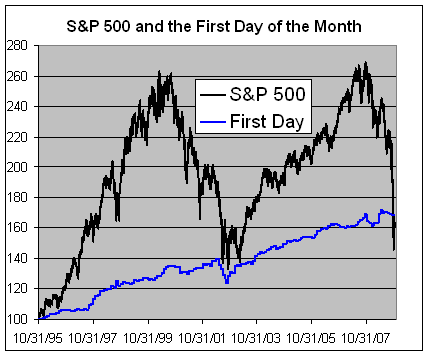
image729.png

Posted by edelfenbein at 7:59 PM

Slowest Eight-Year Economic Growth Rate in 50 Years

With today's third-quarter GDP report, the trailing 32-quarter GDP growth rate is 19.1% which is annualized at 2.2%. That's the lowest since the quarterly records start in 1947.
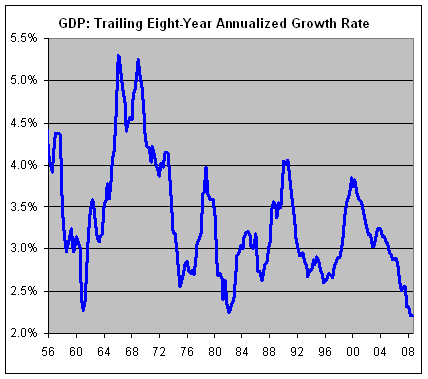
image728.png

Posted by edelfenbein at 1:03 PM

Headlines You Don't See

Market Watch Reports:

Exxon Mobil breaks record with $14.8 billion profit

Or another way of phrasing it:

Exxon Mobil breaks record with $11.3 billion tax bill

Posted by edelfenbein at 12:55 PM

October 29, 2008

Bear Market Rallies

Since the market broke one year ago, the Dow hasn’t been able to sustain one single bear market rally. The largest so far was an 11.2% gain from March 10 to May 2. With yesterday’s 10.9% gain, we might able to break that today.

Bear market rallies are very typical in long down markets. The Dow lost 89% from September 1929 to July 1932, however it was anything but a straight line. There were five separate rallies of 23% or more. By “separate rally,” I mean that Dow lost everything it gained from the rally and went on to make a new lower. Think about that—each one was a false signal that the bad times were over.

When the Nasdaq dropped 78% in the early part of this decade, there were four separate rallies of 24% or more. Three of the rallies were over 35%.

Just a friendly warning for you.

Posted by edelfenbein at 11:15 AM

WR Berkley and Fiserv’s Earnings

I have two recent earnings reports to pass along:

WR Berkley (WRB) yesterday reported third-quarter operating earnings of 73 cents a share. That was two cents more than Wall Street was expecting. Unfortunately, it was down from the 93 cents a share it made in last year’s third quarter. This has been a difficult time for the entire insurance industry, but WRB is still going for less than eight times next year’s earnings.

Fiserv (FISV) reported earnings after charges of 81 cents a share, which was two cents below Street estimates. Despite the miss, it’s an impressive increase over the 72 cents a share from last year’s third quarter. Fiserv's stock is down very sharply in the past few weeks and it's also going for just eight times earnings.

Posted by edelfenbein at 8:55 AM

October 28, 2008

+889.35

Today was the sixth-best day ever for the Dow. The fifth-best day came just two weeks ago yesterday.

You know you're in a different environment when you're up 10% and it's not even the best day of the month.

Posted by edelfenbein at 9:21 PM

The Dow to S&P Ratio

Leaving aside arguments over price-weighted indexes, the Dow has recently been doing better—or rather—falling slightly less dramatically than the S&P 500. The two indexes generally move in tandem, but divergences aren’t unusual and we’re seeing one now.

The ratio of the Dow to the S&P 500 is now at a six-year high. As of today’s close, the Dow is 9.64 times the S&P 500. (This is, of course, index value and not the market value of the two indexes.)

If this trend continues, the ratio could soon reach a 32-year high—and if the trend continues further still, the ratio could break 10.0 for the first time in 42 years.

image725.png

If the Dow had performed as well as the S&P 500 since early 2006, it would be over 1,000 points lower today.

Posted by edelfenbein at 3:00 PM

Consumer Confidence Plunges to Record Low

Consumer confidence is now at the lowest reading since the survey started in 1967:

The survey’s “confidence index” fell to 38 in October, down from 61.4 in September, on a scale where a reading of 100 represents the consumer outlook on the economy in 1985. Expectations for the future also reached an all-time low. The survey dates to 1967.

I think it's interesting that the stock market is reflecting consumers attitudes. Years ago, not many Americans participated in the market. Today, it's a general barometer of consumers' feelings.

Posted by edelfenbein at 12:13 PM

Iceland Goes Full Volcker

The Icelandic Fed, and yes, there is such a thing, just raised interest rates to 18%.

Iceland's central bank has raised its key interest rate to 18% from 12% as it battles against financial collapse.

The rise comes less than two weeks after Iceland cut rates from 15.5%.

The central bank governor said the increase was part of its agreement with the International Monetary Fund, from which it borrowed $2bn (£1.3bn).

Iceland's prime minister said the country needed another $4bn in loans and had approached the European Central Bank and the US Federal Reserve.

Posted by edelfenbein at 11:52 AM

October 27, 2008

Goldman Was Considering Merging with Citi

This is just frightening:

Goldman Sachs CEO Lloyd Blankfein called Vikram Pandit, his Citigroup counterpart, last month to discuss a merger, in a dramatic example of the secret manoeuvring that preceded the government bailout of the financial sector. The call, made at the tentative suggestion of the regulatory authorities or at least with their blessing, was shortly after Goldman won surprise approval to convert itself into a commercial bank on Sept. 21. The conversation was brief as Pandit rejected the proposal at once. A deal would have been structured as a Citi takeover of Goldman. Seperately, The Telegraph reports Goldman Sachs could this week appoint its smallest number of new partners since its flotation, as the bank downsizes in the face of the financial crisis.

Posted by edelfenbein at 10:58 AM

October 25, 2008

What's America's Most Overrated Product

Mart Nemko argues it's the bachelor's degree:

Today, amazingly, a majority of the students whom colleges admit are grossly underprepared. Only 23 percent of the 1.3 million high-school graduates of 2007 who took the ACT examination were ready for college-level work in the core subjects of English, math, reading, and science.

Perhaps more surprising, even those high-school students who are fully qualified to attend college are increasingly unlikely to derive enough benefit to justify the often six-figure cost and four to six years (or more) it takes to graduate. Research suggests that more than 40 percent of freshmen at four-year institutions do not graduate in six years. Colleges trumpet the statistic that, over their lifetimes, college graduates earn more than nongraduates, but that's terribly misleading. You could lock the collegebound in a closet for four years, and they'd still go on to earn more than the pool of non-collegebound — they're brighter, more motivated, and have better family connections.

Of course, locking kids up in college does something very important: it reduces the labor supply. I remember reading in Road to Wigan Pier how the boys around 15 or 16 wanting to get into the mines. They thought staying in school was useless, boring and effeminate.

Posted by edelfenbein at 11:03 AM

October 24, 2008

The S&P 500’s Real Capital Gain

The S&P 500 reached a cyclical high on February 9, 1966 at 94.06. With today’s close of 876.77, that’s a gain of 832.14%.

Let’s look at inflation since then. We won’t get the October inflation report for a few more weeks, but from January 1966 through September 2008, the CPI is up 588.00%.

That works out to a real capital gain of 35.49% stretched over 42.7 years. That’s an annualized gain of 0.71%.

Obviously I'm playing with data a little bit since I'm measuring from a cyclical high to a cyclical trough. But it's interesting that nearly your entire gain since then has been due to dividends.

Posted by edelfenbein at 9:10 PM

When Will It Turnaround?

Now that the S&P 500 hit another new low today, investors are curious when things will finally turnaround. Is every rally just a bear market rally? The market hit a major intra-day level low exactly tow weeks ago, and we've been hovering above it ever since.

I’m no technical analyst but it does seem that the market likes to test its recent lows, and if no new low is made, prices rally. Fortunately, we didn’t break through the intra-day low from October 10. What impresses me is that most of the rally since October 10 was in pretty bad stocks, while the higher quality stocks, like our Buy List, haven’t been doing too well. That just tells me that this two-week interlude was merely a reaction against the reaction.

Today is also the 79th anniversary of Black Thursday, and it’s the 101st anniversary of J.P. Morgan bailing out the economy during the Panic of 1907. The panic ended when J.P. said so -- I wish he were around today. Still, spotting a bottom is tough business, and the rally often begins when things look terrible.

A perfect example is what happened 18 years ago. Note the chart below. The black line is the S&P 500 (left scale) and the gold line is earnings (right scale). The two axes are scaled at a ratio of 16 to 1.

image721.png

The market rallied while earnings continued to fall through 1990 and 1991. Due to the rising market, P/E ratios soared, but that would have been a false signal that stocks were overpriced. Earnings were still plenty lousy through 1992. It wasn’t until 1993 that earnings growth really got going. The yellow line finally caught up to the black line in 1994, but both kept on rising.

The point is that the market can turnaround anytime now. I grew used to clients saying that they’re just “waiting for the smoke to clear.” It doesn’t work that way. The market has already crashed. It can certainly go down further, but most of the risk is gone.

Posted by edelfenbein at 8:08 PM

The 30-Year T-Bond Hits Lowest Yield Ever

The 30-year T-Bond (^TYX) fell below 4%.

Treasuries rose, sending the yield on the 30-year bond to the lowest since regular issuance of the securities began in 1977, as widening financial turmoil wiped more than $10 trillion off stock markets worldwide this month.

U.S. notes rallied on speculation the global slowdown will deepen. The U.K. economy shrank more than forecast, a report showed today. Trading in U.S. stock-index futures was limited after declines of more than 6 percent. U.S. government securities returned 1.6 percent in October, the most since January, according to Merrill Lynch & Co.'s U.S. Treasury Master index, as tumbling stocks spurred demand for the safest assets.

Posted by edelfenbein at 12:20 PM

It's Official: The New York Times Is Junk

Their credit rating that is. Of course, credit ratings are also pretty much junk.

Posted by edelfenbein at 11:25 AM

October 23, 2008

Dollar Bill On Floor Sends Wall Street Into Frenzy

The Onion reports:

Wall Street investors experienced a sudden surge in optimism Tuesday when, after six tumultuous weeks that saw record drops in the Dow Jones industrial average, a $1 bill was spotted on the floor of the New York Stock Exchange.

The dollar bill was discovered in the northwest corner of the trading floor at approximately 12:05 p.m., and its condition was reported as "crinkled, but real." Word of the tangible denomination of U.S. currency spread quickly across the NYSE, sending traders into a frenzied rush of shouting, arm-flailing, hooting, hollering, and, according to eyewitnesses, at least one dog pile.

"With credit frozen and the commercial paper market poised on the brink of collapse, this is the most promising development I've seen on Wall Street in months," said floor trader Tim Formato, one of hundreds who gathered around the $1 bill and excitedly called their clients to inform them that they were looking at actual U.S. tender. "I think I touched it."

According to witnesses, the trading floor was soon abuzz with energy, as traders pointed at the dollar and repeatedly shouted "Look!" and "Money!" A proposal to divide the $1 note into 1,300 equal pieces and distribute them amongst investors was considered, but ultimately rejected. Early reports estimate the dollar may have passed through as many as 65 hands before disappearing in the late afternoon.

The bill's absence, however, did not deter the growing enthusiasm from those on the trading floor. By 2:15 p.m., more than 60,000 shares had been purchased in the new publicly traded asset, DLR, after brokers placed a flurry of calls advising their investors to buy into the booming single-dollar market.

By the close of day, economists were estimating the dollar bill's net worth at just under $270 million.

"We couldn't be in a better situation right now," trader Patrick Kady said. "Unless of course it had been a euro."

However, some financial advisers are warning against the rampant speculation the dollar has caused on Wall Street. Many have cautioned investors not to make rash decisions, such as liquidating all their low-risk government bonds in order to sniff the green paper bill for just a minute.

"I bet it smells like rose petals," mutual funds specialist Ken Stoute said. "My friend's friend Tim Formato? He's on the board at Westminster Securities and he says he touched it. He said it was warm and soft and wonderful. He said he knows where it is now, and I can put in an option on seeing it tomorrow for only $85."

Since the appearance of the dollar, the Dow has spiked an impressive 993 points—its largest gain ever. Initial numbers are showing the most sizable rises in technology stocks, a trend some are attributing to Microsoft's CFO Chris Liddell, who toured the trading floor Tuesday morning with the bill stuck to his left shoe.

The overall projection for the market following the incident has been positive, with many analysts claiming that the $1 bill may be an indication of other spare change lying around. This, coupled with reports out of Europe that there is a German college student who has not yet hit her credit card limit this month, could be enough to stabilize the Dow and jump-start the global economy once again.

"This is just another sign that the U.S. economy is as strong and resilient as it has ever been," said Richard Fuld Jr., former CEO of Lehman Brothers. "I'm just glad we finally have these credit and subprime mortgage loan crises behind us. This $1 bill will carry us through another 10 years of reckless, unregulated borrowing."

Added Fuld, "Just for God's sake, don't invest it in the stock market."

Posted by edelfenbein at 4:52 PM

The Decline and Fall of Old Media

The New York Times Company (NYT) closed yesterday at a 13-year low. The company reported a loss for the third quarter and it considering cuttings its dividend. The current dividend indicates a yield of 8.4%.

image720.png

Posted by edelfenbein at 11:10 AM

Does this Make Any Sense?

In July, Apple said to expect $1 a share in the next earnings report. Since Wall Street had been expecting EPS of $1.23, the stock dropped $4 to $162.

Now here we are three months later and Apple reported earnings of $1.26. So the shares rallied $5…to $96!

Posted by edelfenbein at 11:02 AM

Dennis Kneale Shocked then Composed

Posted by edelfenbein at 10:52 AM

Nicholas Financial's Financials

A reader weighs in:

I am not averse to buying microcaps and have in fact made some good money doing so. I bought stocks that had a good business model and became big companies. This is why I think I can help with regards to NICK.

First, the finance receivables is very large compared to any other part of the left side of the balance sheet. Basically, you are buying the receivables, as a shareholder. You are buying them leveraged a bit (as you mentioned 2:1). You're not really buying the operations of the company because again, earnings and cash flows are tiny compared to the asset side of the balance sheet; there will also be no earnings if receivables shrink and the company can no longer collect interest.

With that being said, I'd like to point out that last quarter there was a charge off of close to $20M, applied to the receivables. This was 9% of the receivables, or roughly 20% of the equity. Meaning your shares, as they represent equity, should have declined by at least that amount -- assuming there was no reason book value would increase in the near-term, which would be a long shot as "charge-offs" tend to be just that... off... for good. These are not to be confused with unrealized losses which occur due to mark-to-market fluctuations.

Delinquencies on payments also increased across all time periods, indicating that further charge offs are in the wings. If the economy recovers soon there's not much to worry about. If consumers pull pack (in Florida in particular) then even just a 20% charge off will have a massive impact. Because the company is leveraged about 2:1, that's a 40% decline in equity. That's also a cumulative ~30% decline in the receivables portfolio, meaning that next year revenues will decline by about 30% as well, because they make money from interest payments. The costs of running the company and collecting those payments are relatively fixed, so you will get an earnings decline of more than 30%, under this scenario. The cost of debt isn't likely to get cheaper either, increasing another cost in the short run.

Finally, in the last year there was a share offering which diluted your ownership stake by another 10-20% depending on the time periods you compare.

If you know the risks then that's fine. I respect the bet, which will either have a huge upside or go to zero. But this really is a bet on the consumer and finance receivables. There is no sustainable operating company if borrowing rates increase and the consumer weakens further. I didn't feel that your post stressed this point enough.

I hope my input is of value. I started looking through the financial thinking you'd spotted a gem. Under most economic scenarios there's no operating company going forward. If we recover, then you are absolutely right, the stock will jump. But don't expect this company to be around in six months if the economy gets much worse.

Posted by edelfenbein at 10:46 AM

October 22, 2008

Your Daily TED Update

We're down to 251. This is looking much better.

Posted by edelfenbein at 9:28 AM

It Was Only a Matter of Time

Brokers With Hands on Their Faces

Posted by edelfenbein at 8:40 AM

October 21, 2008

Some Thoughts on Nicholas Financial

Yesterday, Felix Salmon had some questions for value investors and he concluded by saying: “I might have some faith in the ability of value investors to find cheap stocks, but I have no faith at all in the ability of value investors to time the market.” As usual, I agree with him.

Personally, I don’t try to time the market, and the times that I have tried, I’ve been awful. Perhaps I’m a contrary indicator. Of course, even when I try to go against my instincts, I’m still lousy. I guess it’s just me.

That’s why I stick to stock-picking. As followers of my Buy List know, I’m a buy-and-hold type of guy. The Buy List has 20 stocks that I choose at the beginning of the year. Each year, I’ve only replaced five stocks, so that implies a four-year holding period.

One stock that’s been on my mind lately is Nicholas Financial (NICK). This is what I would call a deep value stock. It’s a very low-priced micro-cap and in all honesty, it probably won’t do much of anything for a bit of time. Still, I like it and I own it.

The reason I find NICK so interesting is that it’s almost a perfect lab experiment for looking at some theories of investing. First, it’s a value stock. Second, it’s a micro-cap stock. Historically, both groups have outperformed the market as a whole. This of course doesn’t mean NICK will outperform, but it’s got those two characteristics on its side.

I should add that NICK isn’t just a micro-cap. It’s really micro. The company has a market value of just $33 million. Some Yankees make more than that. I was buying it last week, and trying my best not to throw the price out of whack, but it’s hard to avoid. Some days, no shares trade.

Also, NICK isn’t just a value stock, it’s a deep value stock. The shares are going for less than four times trailing earnings. The company’s book value runs $7.91 a share. Yesterday’s close was $3.21. That, my friends, is a value stock.

Why is it so cheap? Well, NICK is in the worst possible industry right now. The company makes loans for used cars. Cars sales are plunging and the credit market is frozen. NICK isn’t officially called a subprime lender, but it sort of is. The stock has dropped from $14 to $3. But there’s a lot to like about NICK, and I’m comfortable owning it. Let me explain why.

One thing that makes NICK interesting is that they actually hold their loans to term. Shocking, I know. They don’t sell their loans immediately. Most of the loans they buy from dealers at a discount. NICK also originates some loans, which tend be of decent quality, but that’s a small part of their portfolio.

Here’s very generalized description of their financials from last year. (Please check the SEC docs for the exact numbers. I’m just using this to explain what NICK does.)

NICK has a loan portfolio of about $180 million. That carries an interest rate of 26%. Their debt is about $100 million and they paid about 6.5% on that (it’s tied to LIBOR). So we’re talking about a company leveraged 2-to-1 with $50 million coming in the door and $6 million going out. That sounds good to me. That’s a yield of around 23%. Costs for running the business take out another 10%. The real killer is provisions for credit losses. That ran about 4% last year. This year I think it will be around 7%. NICK's accounting tends to be fairly conservative. In fact, they could be over-providing, but I’m not complaining.

Earnings last quarter were 15 cents a share down from 27 cents a share a year ago. Earnings will be lousy for the next earnings report (due sometime in early November), but they will be positive. I think they’ll probably be about five cents a share, give or take. So they are making money, which is impressive in this environment.

The big driver for NICK is the provision for loan losses. The rest of their business is fairly stable. The major driver of loan defaults in unemployment. There’s a strong relationship between the jobless rate and NICK’s defaults. I think unemployment will top out around 8% sometime in 2009, maybe early 2010. The company isn’t in any danger of going under, although there will be losses for a bit. Once things start to improve, NICK ought to prosper.

If you’re tempted to buy NICK, I will warn you. You probably won’t make anything for over a year. Once the market wakes up and isn’t afraid of less liquid stocks, NICK should rally.

Posted by edelfenbein at 1:53 PM

Lincare and WR Berkley

Two notes from the Buy List to pass on. First, Lincare (LNCR) reported third-quarter earnings of 76 cents a share, which beat estimates by four cents a share. The company earned 66 cents a share for last year’s third quarter, so that’s pretty decent growth. Earnings were squeezed by a 6% cut in Medicare prices.

There’s also some trouble on the horizon.

Revenue and earnings also were impacted by a change in ordering patterns for certain inhalation drugs by customers worried they were going to lose Medicare coverage for these drugs. Some patients placed large orders in June in an effort to get their drugs ahead of the Medicare change, which has since been delayed until Nov. 1.

Wall Street currently sees Lincare’s 2009 earnings falling by 27%.

The other news is that WR Berkley (WRB) said it expects to post a loss for the third quarter between 15 and 20 cents a share. Operating earnings, which is more important for insurance companies, will be between 70 and 75 cents a share. The company is taking an after-tax loss due to the hurricanes. The company also got screwed from owning preferred stock in Fannie and Freddie. WR Berkley is already up about 40% from its panic low on October 10.

Posted by edelfenbein at 12:26 PM

Fed Chairs for Obama

The Bearded One has stepped into the minefield and, apparently, endorsed Obama. Or at least, the Democrats’ stimulus idea. Perhaps Ben just wants four more years as Fed Chair. Is Princeton that bad?

While the Fed chief said any stimulus should be "well targeted," even a general endorsement amounts to a political green light. Mr. Bernanke certainly knows that Mr. Obama and Democrats on Capitol Hill are talking about some $300 billion in new "stimulus" spending, while President Bush and Republicans are resisting. And by saying any help should "limit longer-term effects" on the federal deficit, he had to know he was reinforcing Democratic opposition to permanent tax cuts.

That probably wasn’t a smart move, and I seem to recall Bernanke saying he would try to avoid such actions. One of my complaints about Alan Greenspan was the way he injected himself into policy debates. Still, I don’t see any reason why the Fed Chair can’t give his opinion on fiscal matters.

On an interesting side note, Monica Langley points out in today’s WSJ that Obama is now BFF with 81-year-old Paul Volcker.

On Tuesday, Mr. Volcker is scheduled to appear on the campaign trail with Sen. Obama for the first time. At a round-table discussion with voters in Lake Worth, Fla., he'll "give his view on the state of the economy and the credit markets, and what needs to be done to fix them," says one campaign adviser. Longtime Fed watchers are amused that Mr. Volcker, known for his muttered statements during Fed meetings in the 1980s, will be in a political role on the stump.

For Mr. Volcker, a connection with Sen. Obama could help burnish his record as Fed chairman. The cigar-chomping central banker from 1979 to 1987, he received blame for driving up interest rates and tipping the U.S. into the deepest recession since the Great Depression. But Mr. Volcker is just as well known for taming the runaway inflation of that era. His stock has risen in recent months as his gruff warnings about the risks of deregulating the financial sector have come to look prescient. His successor's reputation, meanwhile, has come under a cloud. Alan Greenspan is under criticism that the low interest rates and deregulatory ideology of his tenure contributed to today's crisis.


Posted by edelfenbein at 9:52 AM

October 20, 2008

Financial Crisis Hits Journalism

Credit crisis hits America's farmers

Financial Crisis Hits Moscow’s Wealthy and Fancy

Crisis hits Aussies' holiday plans

Wall Street Crisis Hits Maine Housing Agency

Credit crisis hits Sands' Macau resort plan

Crisis hits art world in auction flop

Economic Crisis Hits Northwestern, "We Ok, Though," Bienen Reassures

Financial Crisis Hits Hungary Hard

Crisis hits Asia's love affair with luxury

Financial crisis hits common man hard

Financial Crisis Hits Billionaires

Global credit crisis hits the poor, hard

Economic crisis hits home in Brookline

Stallion Fees Sink as Financial Crisis Hits Thoroughbred Market

Financial crisis hits pheasant and partridge shooting

Financial crisis hits your morning joe

Economic Crisis Hits NY's Northern Suburbs Hard

Crisis hits Maine lobster industry

Credit crisis hits Harrisburg incinerator

Global financial crisis hits undertakers

Mortgage Crisis Hits Queens Especially Hard (FYI: They mean the borough)

Credit Crisis Hits Canada

Financial crisis hits many where it hurts the most

Elite Nightclubs Empty as Crisis Hits Oligarchs

Credit crisis hits feeder, stocker cattle

Posted by edelfenbein at 9:25 AM

CEO Pay at the Nine Government-Owned Banks

Here's the 2007 CEO compensation at the nine banks that have been semi-nationalized:

Merrill Lynch
John Thain
$83,092,713

Goldman Sachs
Lloyd Blankfein
$53,965,418

Morgan Stanley
John Mack
$41,734,815

J.P. Morgan Chase
James Dimon
$28,856,330

Bank of New York Mellon
Robert Kelly
$20,515,810

State Street
Ronald Logue
$19,551,400

Wells Fargo
Richard Kovacevich
$18,510,694

Citigroup
Vikram Pandit*
$3,160,000

Bank of America
Kenneth Lewis
$20,040,000

Total: $289,427,180

* Pandit was promoted to CEO in Dec. 2007, 8 months after joining Citigroup.

This, of course, doesn't include taxes.

Posted by edelfenbein at 8:36 AM

Go TED Go

The TED spread is down to 327.

chart.gif

Posted by edelfenbein at 7:48 AM

More Misery in Earnings

If I had to guess, I’d say the economy is in a recession right now. That’s not exactly a brilliant insight. It seems pretty obvious just by looking at equity prices.

Next week, the government will deliver its first report on Q3 GDP and I’m expecting a dismal number. Or rather, whenever we get the final report on Q3 GDP, I expect a dismal number. The problem with GDP reports is that they’re subject to constant revising, so it takes along time, several years in fact, to find out how well the economy is really doing.

A better measure is the unemployment rate. This, too, is imperfect, but it’s good at giving us a look at direction. And that direction has been nothing but down recently. The jobless rate reached 4.4% last March and got to 6.1% in September. If the rate gets to 8%, and we’re already nearly halfway there, that would be a 25-year high. I think 8% is very possible.

We’ll also get a good look at how the economy did in the third-quarter from corporate earnings. This week, one third of the companies in the S&P 500 report. Earnings for the S&P 500 will probably drop about 10% for the third quarter. There’s a lot of guesswork involved but the earnings declines will most likely continue through the first half of 2009.

The Wall Street Journal notes:

Top-down estimates of 2009 earnings range anywhere from $87 a share down to $60 a share. An average of a handful of such forecasts is that earnings will fall roughly 10% next year to about $73 a share. Thus, Wall Street's consensus may be overestimating earnings by at least 25%. Still, that means the S&P is trading at about 13 times forward earnings -- also a relative bargain.

That forecast also assumes earnings will bottom early next year, resulting in at least a 10-quarter earnings decline of 30% from the 2007 peak to their trough. That would roughly match the 1989-91 earnings downturn, which also started with financials, lasted 10 quarters and shaved about 24% off earnings.

The problem with looking at this market isn’t valuations. Equity prices were never in a bubble. The problem was that fundamentals cracked, and we don’t yet know where bottom is.

Posted by edelfenbein at 7:03 AM

Minorities and the Housing Market

I was doing some research on any connection between the rise of minority homeownership and the crash of the housing market. Personally. I'm skeptical but I'm open to the facts. I guess it's a hot issue judging by these two quotes.

Barry Ritholtz:

The four biggest problem areas for housing (by price decreases) are: Phoenix, Arizona; Las Vegas, Nevada; Miami, Florida, and San Diego, California. Explain exactly how these affluent, non-minority regions were impacted by the Community Reinvesment Act?

Steve Sailor:

About half of all mortgages for blacks and Hispanics are subprime, versus roughly one-sixth for whites. Not surprisingly, the biggest home price collapses have occurred in heavily Hispanic cities such as Las Vegas, Miami, Phoenix, and Los Angeles.

I don't have anything profound to add, but I thought it was interesting to come across this two quotes within a few minutes of each other.

Posted by edelfenbein at 3:47 AM

October 17, 2008

CWS: The Most Accuratest Blog in the World

Zignals did an analysis of the TickerSense Blogger Sentiment Poll. I'm proud say that your humble blogger is, by far, the most accurate prognosticator.

Well, there's one small caveat. I made my opinion known in just one of the 19 weeks ( but I was right)!

Full disclosure: I have zero memory of making that call.

Posted by edelfenbein at 3:03 PM

Bank of England to Cut Rates

The Bank of England is poised to cut interest rates to their lowest level since '94.

That would be 1694.

Posted by edelfenbein at 2:52 PM

"Who Put This Dick on My Back?"

You gotta love traders. This is also something you can pull out to anyone defending efficient markets.

(Via: The Danza Tap)

Posted by edelfenbein at 2:29 PM

Sentences I Never Thought I'd Write

Good news, the VIX is down to 67!

Posted by edelfenbein at 1:20 PM

A Former Lehmaner Tries to Make Do

(Hat Tip: B-Riz)

Posted by edelfenbein at 12:56 PM

Debt: The Good and the Bad

Felix comes to the defense of Suze Orman. I think he makes a good case for her. Orman’s advice probably helps more people in more important ways that almost anyone you see on CNBC.

The only curious thing I would add is that when you get right down to it, how hard is it to say, “don’t buy things you can’t afford?” It’s not really about finances, it’s just basic discipline. Don’t buy stupid stuff you don’t need, and save what you can. Repeat. I guess I shouldn’t be too harsh. For many people, this lesson may come as a revelation.

Warren Buffett has often said that the biggest problem that consumers have is credit card debt. I think he’s right. I’m afraid to find out how many people have bought pizzas that turned out to cost them $200.

Speaking about debt. Virginia Postrel has a great column in Forbes decrying the endless hand-wringing of debt-phobes. Yes, debt can be a good thing.

When credit is cheaper to use and easier to arrange, people do use more of it. Hence those big, scary numbers, which grow along with the economy and the population. Contrary to a common perception, however, the people driving up the totals aren’t primarily the financially strapped. They’re “high-wealth consumers in their prime earning years,” observes Andrew Kish, an economist at the Philadelphia Federal Reserve. Almost half the growth in debt between 1989 and 2004 (the most recent year for which data are available) came from the highest-income 20 percent of American households. (By contrast, the bottom 20 percent held about 3 percent of consumer debt—an increase from 1.9 percent—and accounted for a bare 4.5 percent of the growth.) If the rich are getting richer, it makes sense that they’re also running up more debt. They can reasonably expect to pay it.

These affluent families also account for half of the outstanding consumer debt. So the $10,000 average that Obama cited isn’t in fact owed by the “typical” family with an average income. That figure is calculated by spreading the much larger debts of the rich over the population as a whole. All by herself, Cindy McCain owed at least $200,000 on two American Express cards, according to her husband’s campaign disclosure documents. That sounds terrifying until you realize that this wealthy woman pays her monthly AmEx bills in full.

Posted by edelfenbein at 12:33 PM

Remember What I said About Greed Being Good. Um...Maybe Not.

douglas_gordon_gekko.03.jpg

A sequel to Wall Street is moving ahead. According to the Telegraph, the film will be very timely:

The story, which will be set during the current credit crisis, will see Gordon Gekko released from prison into a Wall Street which is in meltdown.

Ideally, Gekko would have his own show on CNBC.

(Via: WSF).

Posted by edelfenbein at 10:35 AM

Finally

Alea notes that the TED Spread finally falls below 400.

Posted by edelfenbein at 10:29 AM

Those Crazy Hand Signals Traders Use

nyse8.jpg

Ever wonder what those crazy hand signals are that traders use? Here's a primer from Britain:

With the introduction of electronic trading, hand signals have disappeared from the London Stock Exchange. But traders on some exchange floors around the world still like to wave their hands and fingers about to strike a deal.

Hands out in front but pulling towards you: I'm buying

Hands out in front, palms out, pushing away: I'm selling

Combination of finger signals indicates the buying/selling price (a closed fist indicates a zero). Then,

Touch the face: signals the amount to buy/sell

Finger to chin: multiples of 1

Finger to forehead: multiples of 10

Fist to forehead: multiples of 100

I'm afraid I'd accidentally buying 10 billion shares of something.

Posted by edelfenbein at 10:16 AM

Buy American. I Am.

gp%5Bvm%20%3D0949f.jpg

The Oracle makes the case for stocks:

Over the long term, the stock market news will be good. In the 20th century, the United States endured two world wars and other traumatic and expensive military conflicts; the Depression; a dozen or so recessions and financial panics; oil shocks; a flu epidemic; and the resignation of a disgraced president. Yet the Dow rose from 66 to 11,497.

You might think it would have been impossible for an investor to lose money during a century marked by such an extraordinary gain. But some investors did. The hapless ones bought stocks only when they felt comfort in doing so and then proceeded to sell when the headlines made them queasy.

Today people who hold cash equivalents feel comfortable. They shouldn’t. They have opted for a terrible long-term asset, one that pays virtually nothing and is certain to depreciate in value. Indeed, the policies that government will follow in its efforts to alleviate the current crisis will probably prove inflationary and therefore accelerate declines in the real value of cash accounts.

Equities will almost certainly outperform cash over the next decade, probably by a substantial degree. Those investors who cling now to cash are betting they can efficiently time their move away from it later. In waiting for the comfort of good news, they are ignoring Wayne Gretzky’s advice: “I skate to where the puck is going to be, not to where it has been.”

Posted by edelfenbein at 10:13 AM

October 15, 2008

-733.08

The Dow dropped today by 733.08 points to close at 8577.91. That's a loss of 7.87%. By percentage, this was worse than both October 9 (-7.33%) and September 29 (-6.98%). This was the worst day for the Dow since October 26, 1987, and it was the ninth-worst day ever. Three of the 19 worst days have come in the last 13 sessions.

The S&P 500 fell by 9.03% today which was much worse than the Dow. The Dow has outperformed the S&P 500 on all three big plunges. It also performed on October 7, which was only a drop of 5.11%.

The Dow has been steadily outperforming the S&P for nearly three years. In fact, last week the Dow-to-S&P ratio hit a 5-1/2 year high. The ratio hasn't broken 9.5 yet, but it seems as if it's about to. The ratio hasn't been over 10 since 1966.

Posted by edelfenbein at 9:06 PM

Unitedhealth Group Moves Up Earnings Data

Unitedhealth Group (UNH) just said that it will report earnings tomorrow, instead of next week as originally planned. Something could be up, but I've lost a lot of faith in this company. Previously, the company said it expects 2008 EPS of $2.95 to $3.05. Since that translates to a P/E ratio of about 7, I don't the market trusts them either.

Posted by edelfenbein at 4:34 PM

Acceleration Matters

Here’s a look at some historical data of the S&P 500 since 1950.

The day after a down day, the S&P 500 has dropped at annualized rate of 12%. The day after that, it’s risen at an annualized rate of 11.3%.

The day after an up day, the S&P 500 has climbed at an annualized rate of 27.9%. The day after that, it’s risen at an annualized rate of 4.3%.

So in both cases we see a reversion to the long-term trend, and interestingly, both show next-day adjustments of about 23%.

After two consecutive down days, on the third day, the market drops at an annualized rate of 8.5%. But if the second day’s drop is greater than the first day’s, then the third-day loss is at an annualized rate of 17.8%. If the second day’s drop is less then first, then the third day shows a small annualized gain of 4%.

After two consecutive up days, the market rises at annualized rate of 21.8% on the third day. Here’s comes the kicker: If the second day’s gain is greater than the first, then the market gains an annualized rate of 42.2% on the third day. If the second day’s gain is less than the first, the third day’s gain is just 5.6%.

Acceleration matters, but it’s not everything. Turnarounds are also very good.

When the market goes down, then up, the third day’s gain is an annualized 36.6%. In fact, that represents nearly the entire gain of the stock market even though those days come about less than one-quarter of the time.

On down-then-up occasions, when the second day’s gain is greater than the first day’s loss, then the third day gains an annualized 49.8%. When the second day’s gain is less than the first day’s loss, the third day gains merely 24.1% annualized.

Posted by edelfenbein at 2:54 PM

Roubini Hasn't Been So Correct

Megan McArdle:

If you keep predicting a recession, eventually you will be right. Every time there was the slightest downturn in the numbers, Paul Krugman predicted a recession. Eventually he was right. Do we give him credit for the one he got right, or the multiple ones he got wrong? To liberals, the answer seems obvious. Which gives credence to the conservative belief that liberals are people who cannot do basic math.

A more interesting question is what to do about doomsayers like Nouriel Roubini, who got the magnitude of the crisis right, but has similarly been predicting a financial holocaust for five years, with changing scenarios which mostly did not come to pass. Obviously, he was right that the global financial system was shaky. On the other hand, his understanding of why the global financial system was shaky does not seem to have been strong enough to predict the source of the failure--the current account deficit and the dollar have been at best minor players, at least in the way that he was worried about way back in 2004.

Finally, someone is criticizing Roubini. His status as a financial visionary is wholly undeserved. He’s been screaming about the downfall of capitalism for years now.

Here's my complaint about making predictions--there’s a lack of balance. Basically, you can call for the world to end for years, then step back and take any crisis and claim vindication. It’s like the people who said they were right about Iraq. But the disaster they saw coming was millions of Arabs rushing to Saddam’s side and a Stalingrad-like siege of Baghdad.

Also, Robert Shiller is a similar story. He never said what people think he said about the stock market. But if you make a bullish prediction and you’re wrong, well then forget about it. Glassman will forever be linked to Dow 36,000. His mistake was being specific. In June 2003, Krugman said the stock market was in a bubble, and he was fantastically wrong. Yet that disappears down the memory hole.

So here's the lesson, if you ever make a forecast always be gloomy and vague.

Posted by edelfenbein at 11:45 AM

Money Galore

This month's Portfolio estimates that the James Bond franchise has generated nearly $14 billion in profits. The authors estimate that $12 billion came from the movies, $812 million from video games and $1 billion from books.

Posted by edelfenbein at 9:47 AM

October 14, 2008

Pennies From Heaven

Does the weather affect market volatility? Apparently, the answer is yes.

The relationship between the weather and stock market returns has been well documented both empirically and theoretically. We extend this literature by considering for the first time the impact of weather conditions on stock market volatility. Specifically, we analyze historical volatility using the extensive data set of Hirshleifer and Shumway (2003) which consists of daily measures of cloudiness along with stock market index returns for 26 stock exchanges internationally between 1982 and 1997. The empirical results suggest that sunnier mornings can be associated with higher levels of time-varying market risk as approximated by the conditional daily volatility of returns from GARCH and EGARCH models. The analysis of the VIX, VXO, VXN and VXD implied volatility indices for the CBOE offers further support to this finding.

Posted by edelfenbein at 1:42 PM

S&P 500 Volatility

I'll spare you 1,000 words and give you the picture.

image719.png

Posted by edelfenbein at 12:36 PM

Nassim Nicholas Taleb Gets Angry

I think I’m one of very few people who isn’t impressed by Nassim Nicholas Taleb. I have the suspicion that The Black Swan is one of the great unread books of modern times. I can’t prove this, but I’ve read the book and it’s one of the most arrogant and incoherent books I’ve ever read. The Black Swan is so bad that it’s nearly unreadable.

Taleb really has one idea—that financial market returns don’t follow a normal distribution. OK, I got it. That’s all that he’s complaining about in this clip. For the record, this isn’t Taleb’s idea. A much better book is Benoit Mandelbrot’s, The Misbehavior of Markets.

At around five minutes into the clip, the interviewer asks, “Climate change, civil liberties, do these now go out the window in the face people losing their jobs and homes?” Yes deary, that’s exactly what it means.

Here’s a short review I did of The Black Swan.

Posted by edelfenbein at 11:03 AM

J&J Beats the Street

Well, not everything is a disaster out there. Johnson & Johnson (JNJ) just reported earnings of $1.17 a share, six cents better than estimates. The company also raised its full-year guidance, which sounds more impressive than it is since there’s just one quarter left this year. But still, they’re holding out well against the Apocalypse. On Friday the stock traded as low as $52.06. Today, it’s over $65.

Posted by edelfenbein at 10:05 AM

Wreck-javik

Poor little Iceland. The country is probably best described as a hedge fund with a vote in the UN. The stock exchange there was shut down for three days and it just reopened. Down 77%.

Kaupthing Bank hf, Glitnir Bank hf and Landsbanki Islands hf collapsed this month with debts equivalent to as much as 12 times the size of Iceland's economy. The three banks accounted for about 76 percent of the ICEX 15 Index's value prior to the nationalization.

The OMX Iceland 15 Index fell 2,317.23, or 77 percent, to 687.39 as of 11:48 a.m. local time. Five of the 13 other stocks in the index didn't trade, while the five that did account for about 7.1 percent of the index's value.

Trading was halted since Oct. 9 after the measure lost 30 percent in nine days as the country's financial system collapsed. Iceland's delegation started talks in Moscow today to secure an emergency loan of as much as 4 billion euros ($5.47 billion) from Russia.

The country should seek aid from the IMF and later apply for European Union membership and adopt the euro, Foreign Minister Ingibjorg Solrun Gisladottir wrote in Morgunbladid on Oct. 13.

Posted by edelfenbein at 9:53 AM

October 13, 2008

Financial Planner Advises Shorter Life Span

From The Onion:

After reviewing his client's income, assets, and personal budget Tuesday, Morgan Stanley financial adviser Henry Dalton determined that Jason Hutchinson, 43, could make the best use of his portfolio by dropping dead at the age of 62. "Taking account of inflation and the rising cost of living versus the projected direction of the economy in the coming decade, I told Mr. Hutchinson that he could significantly reduce his spending by simply living less," Dalton said. "After looking at his investments, I calculated that he really shouldn't live a day over 62—or 59 if he wants a funeral." In order to help his client plan for his financial future, Dalton presented Hutchinson with several of the company's comprehensive suicide packages.

Posted by edelfenbein at 11:52 PM

Krugman Wins Nobel Prize

Congratulations to Professor Krugman. For the record, I’ve often criticized Dr. Krugman on this blog, but not due to his work in economics. I think he’s a brilliant economist and his prize is well-earned. His political commentary, however, is often bizarre and juvenile. I think something in him snapped when George Bush became president. Perhaps the change in administration will get his political writing back on track.

Posted by edelfenbein at 9:52 AM

October 10, 2008

Alec Baldwin, Stockbroker

Posted by edelfenbein at 10:14 PM

The VIX is at 75

I don't even know what to say anymore. Hopefully, there will be a strong rally into the close. Maybe if Nouriel Roubini said he's a buyer...ok, I doubt that will happen.

Here's an idea: Maybe the stock market should open at 3 and close at 3:50.

Posted by edelfenbein at 2:16 PM

So Does this Mean We're Not Going to Have $200 Oil?

Sigh. It seems like only yesterday that everyone had a prediction for oil. Actually, it practically was yesterday...or at least, six months ago. Today oil dropped below $80.

Sooo...let's take a walk down the memory lane, shall we?

An Oracle of Oil Predicts $200-a-Barrel Crude

Arjun N. Murti remembers the pain of the oil shocks of the 1970s. But he is bracing for something far worse now: He foresees a “super spike” — a price surge that will soon drive crude oil to $200 a barrel.

Mr. Murti, who has a bit of a green streak, is not bothered much by the prospect of even higher oil prices, figuring it might finally prompt America to become more energy efficient.

An analyst at Goldman Sachs, Mr. Murti has become the talk of the oil market by issuing one sensational forecast after another. A few years ago, rivals scoffed when he predicted oil would breach $100 a barrel. Few are laughing now. Oil shattered yet another record on Tuesday, touching $129.60 on the New York Mercantile Exchange. Gas at $4 a gallon is arriving just in time for those long summer drives.

Mr. Murti, 39, argues that the world’s seemingly unquenchable thirst for oil means prices will keep rising from here and stay above $100 into 2011. Others disagree, arguing that prices could abruptly tumble if speculators in the market rush for the exits. But the grim calculus of Mr. Murti’s prediction, issued in March and reconfirmed two weeks ago, is enough to give anyone pause: in an America of $200 oil, gasoline could cost more than $6 a gallon.

That would be fine with Mr. Murti, who owns not one but two hybrid cars. “I’m actually fairly anti-oil,” says Mr. Murti, who grew up in New Jersey. “One of the biggest challenges our country faces is our addiction to oil.”

Mr. Murti is hardly alone in predicting higher oil prices. Boone Pickens, the oilman turned corporate raider, said Tuesday that crude would hit $150 this year. But many analysts are no longer so sure where oil is going, at least in the short term. Some say prices will fall as low as $70 a barrel by year-end, according to Thomson Financial.

Posted by edelfenbein at 1:24 PM

October 10 in Bear Market History

Two bear markets ended on October 10th. One in 1990 (at 2365) and again in 2002 (at 7,181.47).

The latter one ended at 10:10 am on 10/10.

Posted by edelfenbein at 10:52 AM

GM Nearing a Penny Stock

The market value of General Motors (GM) now stands at $2.7 billion, which is less than it was in 1929. By contrast, according to Forbes, Oprah Winfrey has a net worth of $2.5 billion. She also has a better book club.

Posted by edelfenbein at 2:06 AM

October 9, 2008

So There’s Good News and Bad News

The good news is that the Dow only fell 678.91 points today which is 99 points better than last Monday’s drop of 777.68.

The bad news is that since the market had fallen 10.7% in the intervening seven days, today’s sell-off is actually larger in percentage terms.

**Long Pause**

Now that I think about it, there’s no good news today.

Today was the 11th worst percentage drop in history.

Posted by edelfenbein at 9:11 PM

Gold Is Now Higher than the S&P 500

Wow.

S&P 500 at 909.92.

Gold at $930

Update: The gold contract for December delivery closed at $886.50 today.

Posted by edelfenbein at 4:05 PM

Remember Dow 9,000

We're now in the 8,000s.

dow100908.png

Posted by edelfenbein at 3:06 PM

Headline of the Day

From the Register:

Oracle shareholders choke on Ellison's package
Size an issue

Posted by edelfenbein at 10:40 AM

October 8, 2008

Great Moments In Government

September 19, 2008:

S.E.C. Temporarily Blocks Short Sales of Financial Stocks

Financial Select Sector SPDR (XLF) closes at $22.38

October 1, 2008

S.E.C. Extends Ban on Short-Selling

Financial Select Sector SPDR (XLF) closes at $20.67

October 8, 2008

A Debate as a Ban on Short-Selling Ends: Did It Make Any Difference?

Financial Select Sector SPDR (XLF) closes at $15.28

Posted by edelfenbein at 9:16 PM

Chart of the Day

image718.png

Posted by edelfenbein at 3:34 PM

Sad Guys on Trading Floors

bLjlTcuJUetsdfhbtCM7wkpso1_400.jpg

The latest blog, nothing but pictures of sad guys on trading floors.

(Via: Ritholtz)

Posted by edelfenbein at 2:56 PM

The British Bank Bailout

I just got back from being on Britain’s SkyNews where I mentioned that Britain’s policy today is better than the Paulson plan, at least in the eyes of taxpayers.

British policy, until now, has been far too reactive and unimaginative. The key difference is that under today’s plan, British taxpayers get a stake in the banks through preferred stock in exchange for loaning banks money. What banks needs is an injection of capital. I think it will be interesting to see how many banks that have hitherto claimed perfect health will start crawling towards the government’s money line.

The key advantage in our takeover of Fannie and Freddie is that we fire management. Some CEOs in Britain deserve the same fate. I should add that I’m not one who’s terribly worried about the issue of CEO compensation. When the conversation involves trillions, we can worry about millions latter.

Posted by edelfenbein at 2:48 PM

Americans’ Satisfaction at All-Time Low of 9%

Yikes! According to Gallup, just 9% of Americans are satisfied with the way things are going in the U.S. right now.

The previous low point for Gallup's measure of satisfaction had been 12%, recorded back in 1979, in the midst of rising prices and gas shortages when Jimmy Carter was president. Gallup has recorded a 14% satisfaction level at several points -- once in the senior Bush's administration in 1992, and several times earlier this year.

The reason for Americans' extraordinarily low level of satisfaction is straightforward: the economy. Asked in the weekend Gallup Poll to name the most important problem facing the country today, almost 7 in 10 Americans mentioned some aspect of the economy, far ahead of any other problem mentioned.

I always thought with polling you could get 15%-20% to agree with any statement. I mean, how many people think Elvis is alive?

Posted by edelfenbein at 12:24 PM

China to the Rescue

Ken Rogoff suggests a plan:

The Chinese government could offer to lend up to $500bn (from its current stock of $1,800bn) to the US government for the rescue of its financial sector. Its previous assistance – buying US bonds – was indirect and unconditional. Not so in this case.

China’s loan offer would be direct to the US government to be spent in the current financial crisis. More important, it would come with strings attached. Tied aid, the preferred mode of operation of western donors since the postwar period, would now be embraced by China.

What would be the nature of the strings – or “conditionality” as the US Treasury, a longtime practitioner of this art, has called it? Conditionality as imposed by the World Bank and International Monetary Fund was underpinned by an ideology that favoured markets and globalisation. But there was also an assumption that either borrowing third world governments did not understand their benefits or the reformers there needed a “spoonful of sugar” to help overcome any internal opposition.

China would impose two conditions. First, it would declare that the offer of money was conditional on the US government’s adopting a particular approach to rescuing the banks, namely to favour in the next round the use of government money to recapitalise the banks. Europe has been using this approach and evidence suggests it is the most effective way of dealing with large-scale financial crises.

The US government – like third world governments in the past – has been unable to adopt the most efficient course of action. This stems from an ideological obsession against “socialising” banks or because inducement is necessary to overcome any domestic opposition to it.

The second condition would relate to “social safety nets”, which had become standard embellishments to World Bank/IMF adjustment programmes. China would stipulate that monies be devoted to cushioning the impact on vulnerable homeowners, so that they would not be forced into forgoing the American dream of home ownership. Chinese conditionality on this front would achieve an outcome that several economists on the left and right have argued for on grounds of fairness, and also to address the fundamental problem in the housing market.

For China, this offer of help would have three virtues. First, it would be riding to the rescue of a situation partly created by its own policies of undervalued exchange rates, which led to lax global liquidity conditions. Second, its economic interest would be served because successful US efforts at rescuing its financial sector could help avert an economic downturn, protecting China’s exports, its growth engine.

Perhaps most important, it would seal China’s status as a responsible superpower willing to deploy its economic resources for the sake of protecting the world economy. And if the means for achieving that are by providing the current hegemon with the largest aid package the world has ever seen with a healthy dose of sensible conditionality, well, what could be more statesmanlike than that?

Posted by edelfenbein at 11:33 AM

October 7, 2008

The S&P 500 Broke 1,000

For the first time in five years, the S&P 500 closed in three-digit territory. The index closed today at 996.23.

Posted by edelfenbein at 4:00 PM

Phases of the Moon and the Stock Market

Some people think it's merely a coincidence. Those people would include me.

Posted by edelfenbein at 11:26 AM

The Worst Decade Since the Thirties

Bespoke points out that this decade has been one of the worst in history for stock returns:

Unless we get a major rally to close out the year (15%+), this will only be the third time since 1900 that the Dow Jones posted negative returns in the first nine years of a decade (excluding dividends).

6a00d8349edae969e20105355fcf70970b-800wi.png

Posted by edelfenbein at 11:11 AM

The Bears Nears Its First Birthday

We’re coming up to the one-year anniversary of the market top. The S&P 500 peaked at 1565.15 on October 9, 2007. Going by yesterday’s close, we’ve lost 32.47%. However, those losses have been heavily skewed toward Mondays.

Here’s the days-of-the-week breakdown:

Monday -26.65%
Tuesday +12.57%
Wednesday -7.33
Thursday -2.71%
Friday -9.29%

It appears that holding over the weekend is to be avoided. In fact, the combined performance of the three middle days of the week is a gain of 1.49%. The market has lost more than one-third on Monday and Friday combined.

Posted by edelfenbein at 11:08 AM

October 6, 2008

What Equity Premium?

One of the fundamental tenants of finance is that stocks do better than bonds over the long haul. The difference is known as the equity risk premium. In other words, it’s the amount that investors are paid to take on the extra risk of owning stocks. (Small but important note: the equity risk premium most often refers to the gain stocks have over short-term T-bills, in this article I’m referring to the gain stocks have over long-term government and corporate bonds.)

The reason for the equity risk premium has puzzled economists for a long time. In fact, Jim Glassman and Kevin Hassett went so far as to say that it shouldn’t exist, and that’s how they got their Dow 36,000 hypothesis. I did some data-crunching today to add in the market’s recent performance and found that there really hasn’t been much of a premium for a long time. So were Glassman and Hassett correct in their theory except the wrote the book 20 years too late?? (Well, no…but I’ll get to that).

The best source for long-term investment information is Ibbotson Associates, now a part of Morningstar. Each year, Ibbotson releases its yearbook for historical returns of stocks, bonds, bills and inflation going back to 1926. I often refer to their work on this blog.

From the end of 1968 to the end of 2007, stocks’ advantage over bonds has been quite modest. Over 39 years, stocks have basically doubled both Treasuries and corporates. Doubling in 39 years may sound nice, but it really isn’t that impressive. It works to about 1.85% a year for corporate bonds and 1.89% for government bonds. Given how much more volatile stocks are, I don’t think you’re being paid a lot.

Since 2008 has been a horrible year for stocks, I was curious how these data sets have changes. I called Ibbotson but unfortunately, they don’t do any mid-year updates. So I want to see if I could find a reasonable estimate. Obviously using different data sources can alter your results, but I was looking for data that’s broadly considered fair.

For the S&P 500, Ibbotson uses the dividend reinvested S&P 500. For the first three quarters of 2008, that index is down 19.3%. For corporate bonds, they use Citigroup’s Long-Term High-Grade Corporate Bond Index and for the government bond, they use the 6.375 Treasury that matures in August 2027 (I assume they’ll use a 2028 bond for this year). I couldn’t find the stats on either of these that but I called Vanguard to see how some of their index funds were doing.

The Vanguard Long-Term Investment-Grade (VWESX) fund is down 7.39% this year, and the Vanguard Long-Term U.S. Treasury (VUSTX) is up 6.69% this year. I think both of these funds can serve as proxies (VWESX has a current yield of 6.69%, an average rating of A1 and an average maturity of 22.5 years; VUSTX has a yield of 3.86% and an average maturity of 17.5 years).

Tacking these numbers onto the data series, that makes the 39.75-year advantage stocks have over corporate bonds just 1.50%, and only 1.10% for government bonds. If we do a little data picking, we can see that long-term Treasury bonds have outperformed stocks since the summer of 1987, and come in just behind stocks since late 1980. Reasonable people can disagree but that certainly sounds like the long-term to me. This means that you could have sat out the entire stock market over the last 28 years, parked your money in long-term T-bonds and done just as well as the stock market, which we know beats the vast majority of fund managers.

Posted by edelfenbein at 2:52 PM

The S&P 500 and Earnings

At times like this, I urge caution when looking at market statistics, but here's the S&P 500 (blakc line, left scale) and its earnings (gold line, right scale).

image716.png

You'll notice that I've scaled the two axises at a ratio of 16-to-1. That means whenever the lines cross, the market's P/E Ratio is exactly 16.

The second-quarter earnings are all in, but we're about to start the third-quarter earnings season, and we won't know fourth-quarter for a few more months. As a result, the last two points on the earnings line are estimates. While the bump up in earnings line looks promising, we still don't know what the future holds.

This could be a great buying opportunity, but as they say, we'll know more when we're a little older.

Posted by edelfenbein at 1:25 PM

60 Minutes on Credit Default Swaps

Posted by edelfenbein at 12:51 PM

The VIX Broke 56

Wow! The Dow is now off by over 500 points.

vix1006082.png


Posted by edelfenbein at 12:23 PM

Meet the New Boss

Hank Paulson is due to name the person who will run the $700 billion bailout package. According to reports, Neel Kashkari will oversee the program. Take a guess where Mr. Kashkari used to work. I'll give you a hint: it rhymes with Boldman Hacks.

Posted by edelfenbein at 10:29 AM

Lehman's Last Days

In today’s must-read article, the WSJ has Lehman Brothers dead to rights:

In the weeks before it collapsed, Lehman Brothers Holdings Inc. went to great lengths to conceal how fast it was careening toward the financial precipice.

The ailing securities firm quietly tapped the European Central Bank and the Federal Reserve as financial lifelines. On Sept. 10, one day after Lehman executives calculated the firm needed at least $3 billion in fresh capital, the firm assured investors on a conference call it needed no new capital at all. Lehman said its massive real-estate portfolio was valued properly, but Wall Street executives who have seen it say it was overvalued by more than $10 billion. As hedge-fund clients began yanking their money from Lehman, the firm assured them it was on solid financial footing.

On Sept. 11, J.P. Morgan Chase & Co. effectively ended Lehman's campaign to appear strong. In its capacity as a middleman between Lehman and its clients, J.P. Morgan knew more about Lehman's predicament than most outsiders, and it didn't like what it saw. J.P. Morgan demanded from Lehman $5 billion in additional collateral -- easy-to-sell securities to cover lending positions that J.P. Morgan's clients had with Lehman -- repeating an unmet request from a week earlier, people familiar with the situation say.

It was a knockout blow. That $5 billion collateral call, coupled with a huge outflow of money from Lehman's hedge-fund clients, so weakened the 158-year-old Wall Street firm that it sought Chapter 11 bankruptcy protection four days later.

The worst thing a bank can do is have people lose confidence in it. At one point, Lehman said its Level 3 assets were up 9% while the stock market was down 10%. When people called fouled, the bank got mad at the messengers. That’s a sign right there that things aren’t going well.

Ultimately, a bank’s product is trust. That’s what they sell. So a bank in trouble has to exude confidence even though it may be crumbling internally. If you look weak, clients will abandon you and you’ll become weak.

Posted by edelfenbein at 10:25 AM

Once More unto the Breach

The market is getting smacked around again. As I write this, the Dow is off over 300 points and we're below 10,000. This takes us back to the beginning of 1999. The good news is that commodities are also down, so at least investors aren't seeking refuge there.

Things are even worse in Russia where the stock market was shut down for the second time. The MICEX plunged 16.7% before trading was halted.

In September, growing financial turmoil in the United States and a wave of margin calls sent the Russian stock markets into their biggest downward spiral since 1998. The MICEX lost 25 percent in just three days, and prompted regulators to shut down the markets to stem the decline. They have since used that tool on several occasions when drops have become severe - to lesser effect.

Russia's stock market in recent years has boomed amid high prices for oil and natural gas. But it began falling sharply in midsummer amid concerns about government interference with businesses, and the drop accelerated as the global economic crisis intensified. Oil prices, the backbone of Russia's economy, have been sharply down in recent days - dropping to $90 a barrel - and investors have also been spooked by August's five-day war between Russia and Georgia. The RTS is now down by 62 percent from its May peak.

Posted by edelfenbein at 10:01 AM

October 3, 2008

Uh Oh

photo_servlet.jpg

I wonder if this is some sort of metaphor:

Armed Bank Robbers Hit Wachovia in Northwest D.C.

WASHINGTON, D.C. – Police in the District are searching for a pair of armed bank robbers who burst into a Wachovia Bank in Northwest D.C. on Friday afternoon and demanded cash from the teller.

Investigators say it happened just as people were sitting down to lunch outside the Wachovia Bank on Connecticut Avenue NW near Van Ness. They say one of the robbers was armed with a shotgun and the other with a handgun.

According to police, the two men ordered the teller to open the vault, and then pistol-whipped her when she couldn't. They say instead, the men bagged cash from the drawers and then took off.

One witness who asked not to be identified told FOX 5 that's when he encountered the suspects up close.

"Two guys came running by the building and I bumped into one of them, brushed him and see his-- what looks like a gun he's carrying-- and the two of them carrying garbage bags with what looks like money," the witness told FOX 5.

Posted by edelfenbein at 6:00 PM

Below 1100

The S&P 500 closed below 1100 for the first time in four years. The index finished the day at 1099.23. The S&P 500 first closed above 1100 over ten years ago, on March 24, 1998. The last time the S&P 500 closed below 1100 was on October 25, 2004.

Posted by edelfenbein at 4:20 PM

Life Imitating Art

From the IMDB plot summary of the movie Wall Street:

Soon, Bud finds himself getting information from any source and using to gain an advantage. It all comes to a head however when Gekko targets Blue Star airlines, the company where Bud's father has worked for 24 years, secretly planning to break it up and plunder the employees' retirement fund.

A Bloomberg article from today:

Blackstone Said to Complete BlueStar Purchase, First in China

Schwarzman, how could you!

Posted by edelfenbein at 12:13 AM

October 2, 2008

The Stimulus Plan that Didn't Stimulate

Remember how those stimulus checks were supposed to help the economy. Well, they didn't:

The US Congress and the Bush administration enacted a $100 billion tax rebate in an attempt to stimulate consumer spending. Those of us who supported this policy generally knew that history and economic theory implied that such one-time fiscal transfers have little effect, but we thought that this time might be different. Our support was, in the words of Samuel Johnson, a triumph of hope over experience.

In the end, our hopes were frustrated. The official national income accounting data for the second quarter are now available, and they show that the rebates did very little to stimulate spending. More than 80% of the rebate dollars were saved or used to pay down debt. Very little was added to current spending.

Posted by edelfenbein at 9:52 PM

The Oracle Speaketh

Warren Buffett on Charlie Rose for the full hour.

Posted by edelfenbein at 1:25 PM

Looks Tempting

image715.png

I have to admit that shares of Apple (AAPL) are starting to look attractive. The stock has come down a lot, but this is still an incredibly strong business. I think investors are getting understandably nervous about this holiday season.

The company said to expect Q4 earnings (ending September 30) of $1 a share. However, the company always low-balls its forecasts so it can say that it beat forecasts. My quick guess is that Apple will probably report about $1.15 to $1.20 a share.

The concern is that Apple will come out with a lousy forecast for 2009, and the market will think that it’s not low-balling. Even if the company only grows its earnings-per-share by a little bit, the current price won’t be a bad entry price. I wouldn't bite just yet, but an $80 share price would be hard to ignore.

Posted by edelfenbein at 9:46 AM

Yahoo at New 52-Week Low

For a long time now, I’ve been criticizing Yahoo’s (YHOO) share price. I just couldn’t see how or why the stock was going for $31 a share. I said on several occasions that I wouldn’t pay half that much. Now the stock is finally close to half that level, and I’m still not buying.

Posted by edelfenbein at 9:31 AM

October 1, 2008

Senate Says Yep

The Senate passed the bailout bill by a vote of 74-25. Here's the roll call.

For now, I'm long wooden arrows.

Posted by edelfenbein at 10:43 PM

Third-Quarter Update

Now that the third quarter is over with, I wanted to pass along some thoughts about changes to my Buy List. I make changes once a year in mid-December, and start tracking the new list on January 1. Right now, I'm considering cutting a few stocks. I don't know yet, but these are on my short list:

Clarcor (CLC)
Harley-Davidson (HOG)
Lincare (LNCR)
SEI Investments (SEIC)
WR Berkley (WRB)
Unitedhealth (UNH)

Posted by edelfenbein at 7:39 PM

The Fine Print

From The Onion:

bailout_stat.jpg

Posted by edelfenbein at 4:25 PM

HR 1424

Here's the Senate's bill. It checks in at 451 pages.

If you turn to page 299, you'll find:

20 SEC. 503. EXEMPTION FROM EXCISE TAX FOR CERTAIN
21 WOODEN ARROWS DESIGNED FOR USE BY
22 CHILDREN.
23 (a) IN GENERAL.—Paragraph (2) of section 4161(b)
24 is amended by redesignating subparagraph (B) as sub
1 paragraph (C) and by inserting after subparagraph (A)
2 the following new subparagraph:
3 ‘‘(B) EXEMPTION FOR CERTAIN WOODEN
4 ARROW SHAFTS.—Subparagraph (A) shall not
5 apply to any shaft consisting of all natural
6 wood with no laminations or artificial means of
7 enhancing the spine of such shaft (whether sold
8 separately or incorporated as part of a finished
9 or unfinished product) of a type used in the
10 manufacture of any arrow which after its as
11 sembly—
12 ‘‘(i) measures 5⁄16 of an inch or less in
13 diameter, and
14 ‘‘(ii) is not suitable for use with a bow
15 described in paragraph (1)(A).’’.
16 (b) EFFECTIVE DATE.—The amendments made by
17 this section shall apply to shafts first sold after the date
18 of enactment of this Act.

Posted by edelfenbein at 12:17 PM

Here We Go Again

The Senate will vote later today on a revised bailout plan.

Senate Majority Leader Harry M. Reid (D-Nev.) called the Senate's revised legislation "the best thing to move forward." Reid was joined on the floor by Senate Minority Leader Mitch McConnell (R-Ky.), who said the plan was "one of the finer moments in the Senate."

A senior House Republican adviser, who spoke on the condition of anonymity to talk about private strategy, said the addition of the FDIC cap increase and the tax credits -- without any corresponding tax increases -- could have "substantial appeal" in that caucus. Boehner was consulted by Senate leaders and gave his approval, the aide said.

But the addition of the tax provisions may entail new risks in the House, which returns to action Thursday. Speaker Nancy Pelosi (D-Calif.) responded tepidly to the Senate announcement, and it remained unclear when the House would would consider the revised bill, though a vote is likely by week's end. "The Senate has made a decision about how to proceed and what can pass that body. The Senate will vote . . . and the Congress will work its will," Pelosi said.

I'm honestly a little confused. I believe the Constitution requires all money bills to start in the House. Perhaps this Senate vote would be to test the waters, then it would go to the House and back to Senate.

The FDIC provision, which would raise the insurance cap for bank accounts to $250,000 from the current $100,000, was discussed during weekend negotiations in Pelosi's office but was not included in the final package. But in what negotiators from both parties considered a critical breakthrough, the largest banking lobby in Washington embraced the idea. "We now see this as a way to help the package pass," said Ed Yingling, president of the American Bankers Association.

While the move would result in banks paying higher fees on their insurance premiums, advocates say it would provide important assurances to small businesses that keep large sums of cash in bank accounts and are reeling from the credit crunch. "We are having an awful lot of people come into banks and ask questions," Yingling said.

Posted by edelfenbein at 1:39 AM

spacer
bottom of page image