![]() |
||||||||
|
« November 2008 | Main | January 2009 » December 31, 2008The 2009 Buy List Here’s my 2009 Buy List. For tracking purposes, I assume it’s a $1,000,000 portfolio and each position is worth $50,000. Here’s each stock, ticker, starting price and number of shares. This is what I'm referring to when I discuss how well the Buy List is doing.
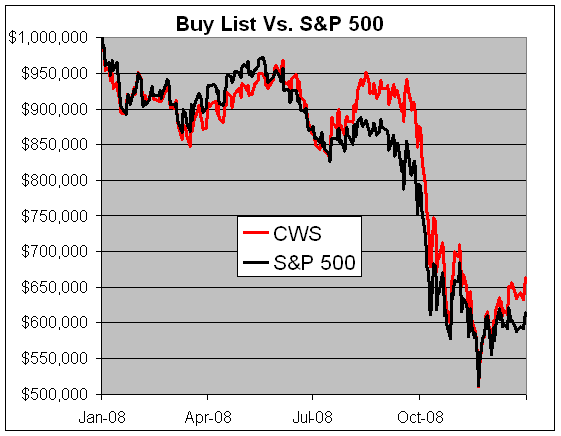
Fifteen stocks return from 2008. The five new stocks are Baxter, Becton Dickinson, Cognizant, Eaton Vance and Eli Lilly. The sells are Clarcor, Harley-Davidson, Lincare, WR Berkley and UnitedHealth Group. We turnover one-fourth of the Buy List each year, however, nine stocks return to the Buy List for the fourth straight year. The total market cap of all the companies is $238 billion. Eli Lilly is the largest at $45 billion. Nicholas Financial is by far the smallest at $24 million. The average dividend yield is 1.29%, which is much higher than we’ve had in previous years. That's it. The list is now "lock and sealed," and I can't touch it until next year. Posted by edelfenbein at 6:22 PM The 2008 Buy List The 2008 trading year has come to a close. Overall, it was an awful year for stocks. The S&P 500 lost 38.49%, making it the worst year for stocks in 71 years. The Crossing Wall Street Buy List lost 33.60% which, once again, beat the market. Including dividends, the S&P 500 lost 37.00% while the Crossing Wall Street Buy List lost 33.01%. For the year, 19 of our 20 stocks lost money. The only winner was a small 3.99% gain in WR Berkeley (WRB). The biggest loser was Nicholas Financial (NICK) which dropped 67.5%, although I’m sticking with in 2009. The second-biggest loser was Harley-Davidson (HOG) which dropped 63.67%. The Crossing Wall Street Buy List again had less risk than the rest of the market. The daily volatility was 2.45% less than the S&P 500. Here's a spreadsheet detailing how the Buy List did in 2008. For tracking purposes, I assume it's a $1 million portfolio and all the stocks are equally weighted at the beginning of the year. The rules state that once the Buy List is set, I can't touch it for the entire year. Here's how the Buy List did throughout the year.
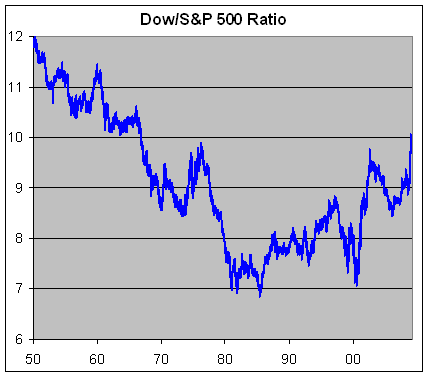
Posted by edelfenbein at 5:33 PM Dow to S&P 500 Ratio
After breaking 10 for the first time in decades, the Dow to S&P 500 ratio has backed off slightly. I wonder if that could have been a signal of a bottom. The low point in 2000 looks like the signal for a top. Posted by edelfenbein at 2:24 PM Is the Storm Passing? It's too early to say but if all holds up, the VIX will close below 40 for the first time in three months. Posted by edelfenbein at 12:03 PM December 30, 2008Six Degrees of Madoff Bernie's latest victim, Kevin Bacon. We'd heard that along with Hollywood boldfacers Jeffrey Katzenberg and Steven Spielberg, Bacon and his wife, Kyra Sedgwick, lost money in Madoff's devastating $50 billion Ponzi scheme, and Bacon's rep, Allen Eichorn, confirmed it for us. "Unfortunately, your report is true," he wrote. Come to think of it, the Madoff scandal does remind me of Tremors. Posted by edelfenbein at 12:21 PM What are the Chances of a Depression in 2009? Intrade says it's up to 30%. For their purposes a "depression is defined as a cumulative decline in GDP of more than 10.0% over four consecutive quarters." Posted by edelfenbein at 12:15 PM Looking at Low Valuations I want to show you the dramatic collapse in stock valuations by taking a close look at Pfizer (PFE), the drug company. I’m not recommending the shares to own, I simply want to show you how extreme the market’s judgments have become. Yesterday, shares of Pfizer closed at $17.29. Looking deeper, we see that the company has a very large cash horde of $26 billion, while a fairly modest long-term debt position of $7 billion. In this environment, it certainly pays to be cash-rich. Pfizer’s cash position works out to about $3.86 a share. That means you can pick up the company’s operations—the nuts and bolts of the business—for just $13.43 a share. Now, here’s a look at Pfizer’s stock along with its earnings-per-share. The black line is the stock and it follows the left scale. The gold line is the EPS and it follows the right scale.
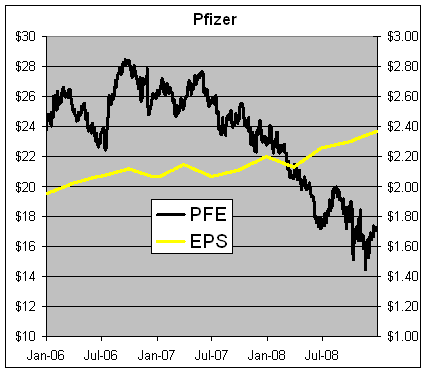
The graph is scaled at a ratio of 10-to-1, so when the lines cross, the P/E ratio is exactly 10. Not a pretty sight, but the earnings are moving in the right direction. As you can see, Pfizer’s P/E ratio has plunged far below 10, and that’s including the company’s generous cash balance. We can see that Pfizer’s earnings are climbing although the growth rate isn’t terribly strong. For 2009, Wall Street sees earnings coming in at $2.49 a share. Just by eyeballing the recent trend, that seems reasonable. So working with the $13.43 figure we can see that Pfizer is really going for about five times next year’s earnings, or an earnings yield of about 18.5%, which is several times what you can find in the bond market. Now let me point out a few caveats. Price/earnings ratio is hardly a perfect measure of value. Also, Pfizer is a company that faces many challenges so many of these numbers are simply guesses about the future. The important point is that the recession has left us with stocks that have much cheaper real valuations than a few months ago, even companies that aren't so dependent on the credit markets. After all, Pfizer is still a cash-flow-positive company and that isn’t about to change anytime soon. Pfizer currently pays a 32-cent quarterly dividend. The company made some news recently by declining to raise its dividend for the first time in four decades. Going by yesterday’s close, that’s a dividend yield of 7.4%. If a five-year Treasury currently gets you just 1.5%, then the market is terrified of stocks like Pfizer. Posted by edelfenbein at 11:27 AM Gazprom Is Feeling the Pain Gazprom, the Russian energy giant, has fallen on hard times. The plunge in commodity prices has caused the company's stock price to fallen by 76%. At one time, Gazprom wanted to become the largest and most powerful company in the world. Today, it might need a government bailout. As ugly as American capitalism can often appear in practice, nothing really comes close to Gazprom. The company is merely a collaboration of the Kremlin and business. There's barely any recognizable difference. Like Lola, whatever Gazprom want, Gazprom gets. The worst thing that can happen to an enterprise like Gazprom is to see initial success in its operations. As gas prices rose, they thought they really had a sound business and used their cash flow to renationalize Russia's oil industry. Once prices turned south, then the whole house of cards began to fall. For a time, Gazprom, a company that evolved from the former Soviet ministry of gas, had been embraced by investors as the model for energy investing at a time of resource nationalism, when governments in oil-rich regions were shutting out the Western majors. In theory, minority shareholders in government-run companies would not face the risk their assets would be nationalized. The New York Times reports: But with 436,000 employees, extensive subsidiaries in everything from farming to hotels, higher-than-average salaries and company-sponsored housing and resorts on the Black Sea, critics say Gazprom perpetuated the Soviet paternalistic economy well into the capitalist era. Perhaps Russia should do what America would do: appoint a Czar. No wait, bad idea. Posted by edelfenbein at 10:29 AM December 29, 2008Is Social Security a Ponzi Scheme? Jim Cramer says it is. “To everybody in the press, who’s calling Bernie Madoff’s alleged $50 billion scam the ‘largest Ponzi scheme ever,’ I say give me a break,” Cramer said on his Dec. 17 show. Oh, please. Social Security is not a Ponzi Scheme. I’ll define a Ponzi Scheme as a fraud that has zero investments; it merely pays off initial investors with funds from new victims, I mean, “investors.” First, the funds from social security do go into Treasury securities, which are real investments. Plus, social security is currently running a very large surplus. How much longer will it continue to run a surplus? Well, that’s a good question. But the system can stay healthy as long as there are adjustments to benefits and how much is paid in. Those choices aren’t easy but that’s a big difference from what Bernie Madoff was doing. Think of it this way: If no new money was allowed into social security, it would still run. When the same happened to Madoff and Ponzi, their frauds were over. Social Security has a lot of problems, but this talk of it being a Ponzi Scheme is just silly. Posted by edelfenbein at 2:23 PM The Danger of Models One of the market’s better timing strategies hasn’t been having a good run decade. I think all models are destined to fall at some point. Still, comparing the market’s return to the yield curve had a very nice run. Perhaps it will make a comeback. Let’s look at the numbers. From 1962 through 1999, when the spread between the 90-day T-bill and the 10-year T-bond was 150 or more points, the S&P 500 returned about 1,140%. That happened slightly less than half the time. When the spread was less than 150 points, the S&P 500 rose just 65%. That’s a pretty sharp divide. Since 2000, the S&P 500 has lost about 41% when the yield spread was over 150 points, and it’s been roughly flat when it’s been under 150 points. Posted by edelfenbein at 2:10 PM The Santa Rally Several months ago, I took the entire history of the Dow Jones and broke down its performance by days of the year (btw, what the hell was I thinking??). As it turns out, the Santa Claus Rally is quite real. By far, the Dow’s best time of the year is the 17-day period from December 21 to January 7. Over that period, the Dow has gained 3.39%—that’s more than 40% of the Dow’s annual capital gain, even though we’re talking about a period that’s less than 5% of the year. The worst time of the year is from September 6 to October 29. Eighty years later, we still feel the effects of 1929.
Posted by edelfenbein at 12:27 PM The Weekend That Wall Street Died Today’s Wall Street Journal has an excellent 4,000-word article on the weekend that Wall Street “died.” Personally, I think that’s a bit strong. A certain crucial aspect of Wall Street is no more, but Wall Street is far from dead. The other issue I have with the article is that it sees the collapse of Lehman as a battle of big personalities. That’s a favorite media take on things, especially when the personalities are big, which is also a Wall Street specialty. Unfortunately, the Panic of 2008 had causes that are far deeper and more complex. In fact, deeper and more complex than we probably understand right now. There’s no economic theory to explain what happened and why. Some day, there will be, but until then, some ideological humility is needed. Here’s a snippet from the article: Mr. Fuld had faced challenges to his firm before. Since taking Lehman's reins in 1994, he expanded the 158-year-old bond house into lucrative areas such as investment banking and stock trading. Over the years, he had tamped unfounded rumors about the firm's health and vowed to remain independent. "As long as I am alive this firm will never be sold," Mr. Fuld said in December 2007, according to a person who spoke with him then. "And if it is sold after I die, I will reach back from the grave and prevent it." Posted by edelfenbein at 10:54 AM Department of Poetic Justice Looks like Bernie got robbed. Swindler extraordinaire Bernard Madoff got a taste of his own medicine last weekend when a burglar stole a $10,000 statue from his posh, $9.4 million Palm Beach estate, according to a police report. From the looks of it, the real criminal was the artist. Oh, snap! Posted by edelfenbein at 10:24 AM December 28, 2008The 2009 Buy List Here’s the Crossing Wall Street Buy List for 2009: AFLAC (AFL) Once again, I’m only making five changes to the Buy List. The five new buys are: Baxter International (BAX) Three of the new buys are in health care. The five sells are: Clarcor (CLC) I’ll start tracking the new list this Friday, January 2, 2009, the first day of trading of the new year. I’ll assume that all of the stocks are equally weighted with the closing price as of December 31 as the buy price. As usual, the rules state that I'm not allowed to make any changes to the Buy List throughout the year. My purpose is to show investors that by buying and holding a well-diversified portfolio of high-quality stocks, you can do well in the market. With only a few days left in 2008, we’re heading toward our second straight year of beating the S&P 500 while using less risk. Plus, our turnover is only 25% which is far less than most professional money managers. You can assume that I own any of the stocks on the Buy List. I won't buy any of the new names until the new year. Posted by edelfenbein at 2:12 AM December 26, 2008The Christmas Bust Despite huge discounts, many retailers had a lousy Christmas: "It’s been difficult, much more difficult than anyone expected,” Gilbert Harrison, chairman and chief executive officer of retail advisory firm Financo Inc., said today in a Bloomberg Television interview from West Palm Beach, Florida. Consumers “will spend on necessities, they’ll spend on what they need, but they’re being very particular in what they’ll buy.” Posted by edelfenbein at 10:27 AM December 25, 2008Peter Schiff on Alex Jones Peter Schiff is not widely considered to be the crank that he is. Here’s a video of him with crackpot Alex Jones who believes, among other things, that 9/11 was a planned and carried out by the Bush administration. Posted by edelfenbein at 2:22 PM Merry Everything
I want to wish everyone a Merry Christmas and a happy, healthy and profitable new year. I’d also like to thank all of my readers over the past twelve months. I’ve had this site going for 3-1/2 years now and it’s truly a labor of a love. I enjoy getting emails and questions from folks all over the world. I really don’t think I could do it without all the feedback I get. I’d also like to thank all of the folks who have linked to this site over the past year, which has brought Crossing Wall Street to an even larger audience. Let’s hope 2009 is a big change from 2008! Oh, one more thing. This. Posted by edelfenbein at 11:40 AM December 23, 2008The Decline and Fall of Oil
The January contract, which expired last week, got to a low of $32.40. On July, 11, oil reached $147.27. Posted by edelfenbein at 3:28 PM How Best to Describe California Imagine if Lehman Brothers had been allowed to issue license plates: In fact, there has been very little interest among institutional investors in municipal bonds since the financial markets began to collapse this fall, and states have had to rely on individual investors — far less plentiful and reliable than institutional investors — to buy bonds. Posted by edelfenbein at 3:16 PM Ouch One year ago, Business Week looked at what the pros were staying: Garzarelli is advising investors to buy some of the most beaten-down stocks, including those of giant financial institutions such as Lehman Brothers (LEH), Bear Stearns (BSC), and Merrill Lynch (MER). What would cause her to turn bearish? Not much. "Our indicators are extremely bullish." Of course, there are six stocks on my Buy List that are down by over 50% this year, and I'm still beating the market by a fe point. Posted by edelfenbein at 3:03 PM Despite Bailout, Market Thinks GM Is a Goner I think the government ought to pay attention to the market on this one. GM dropped as much as 18 percent today in New York trading to extend yesterday’s 22 percent plunge, while credit-default swaps on GM bonds rose 0.5 percentage point in a sign of increasing concern that the Bush administration’s bailout may end in a default. Posted by edelfenbein at 1:44 PM December 22, 2008How it Happened The Onion explains it all:
Posted by edelfenbein at 4:04 PM This Doesn't Look Good Man found dead hanging by his belt in British hotel. Did I mention that he was naked? Or the head of insurance at HSBC? “His death is being treated as non-suspicious.” Speak for yourself. Posted by edelfenbein at 4:01 PM Bernie's Cribs Nice. Very nice.
Posted by edelfenbein at 12:16 PM TED Spreads Narrow TED spreads are at their narrowest since before Lehman went under. The TED spread, a gauge of banks’ willingness to lend, slipped below 150 basis points for the first time since before the collapse of Lehman Brothers Holdings Inc. amid speculation U.S. borrowing costs near zero and promises of further government cash will help unfreeze credit.
Posted by edelfenbein at 12:06 PM December 19, 2008Slowly I Return Once again, let me apologize for the lack of blogging this week. I can’t remember the last time I knocked so hard by ill-health. I wish I could say I did a lot of reading this week, but almost all I did was sleep. I’m feeling much better, and I want to thank everyone who sent their regards. I plan to be up to full-speed soon. There’s one item I felt I had to mention and that’s the passing of the great Irish journalist Conor Cruise O'Brien. What an extraordinary life he led. This is part of the obit from the Telegraph: Conor Cruise O'Brien, who has died aged 91, was the leading Irish intellectual of his generation, though he assumed so many guises – diplomatist, historian, literary critic, proconsul, professor, playwright, government minister, columnist and editor – that he defies further categorisation. Posted by edelfenbein at 2:32 PM December 18, 2008Lack of Posts I have to apologize for the dearth of posts this week. I haven't been feeling well. I hope to return to full blog-mode soon. Posted by edelfenbein at 2:09 PM December 17, 2008Quote of the Day In modern business it is not the crook who is to be feared most, it is the honest man who doesn't know what he is doing. - William Wordsworth Posted by edelfenbein at 12:23 PM December 15, 2008Bernie's Victims Posted by edelfenbein at 8:06 PM SEC v. National Lampoon
From the SEC's website: SEC v. National Lampoon, Inc. et al. (H/T: Kedrosky) Posted by edelfenbein at 3:17 PM Madoff's Campaign Contributions If anyone's curious, Bernie gave a lot. In light of the Madoff scandal, I'd like to announce that I'm opening a new hedge fund. We're doing Bernie one better by not having any auditors. The savings is passed on to you. Assuming you're an early investor. Feel free to join us. The fund will be named Certified Asset Strategic Holdings. Just send me a check...you can make it out to our initials. Posted by edelfenbein at 1:19 PM Harvard Forced to Make Do With Less All the chappers down at Porcellian have been most dreadfully upset: It's as if an heiress had lost her trust fund. Posted by edelfenbein at 10:27 AM Bernie Made-Off Even by Wall Street's standards, the Madoff scandal is stunning. It's hard to imagine anyone with a better reputation than Madoff, and his entire enterprise was a scam. The wealthy enclaves of Florida are especially feeling the effects of Bernie's downfall. Here's the Palm Beach Post: Bernard Madoff didn't accept money from just anyone. Clients ideally had to have at least $10 million to open an account with his New York investment firm. Posted by edelfenbein at 9:36 AM December 14, 2008Deconstructing Rushing Yardage For a nice weekend diversion, here’s another stab at pro football sabermetrics. I’m new at this, so if anyone’s interested in this subject, I’d welcome any feedback, particular with the statistical analysis. I wanted to look at rushing yards which is an interesting data set. I’m amazed at the wide dispersion of rushing gains in football. Basically, it works likes this—when running the ball, the key is to break out for a big gain. While this sounds obvious to anyone familiar with football, the numbers are pretty striking. Consider that roughly 92% of a team’s rushing yards come on just half its rushing plays. The other half accounts for just 8%. I could go so far as to say that we should no longer look at a rushing as the some total of yardage, but rather as a question, did the runner break out or not. I also wanted to see if a particular break out point could be identified. For my data, I went to FootballOutsiders.com and bought the play data sets for the 2005, 2006 and 2007 seasons (the final week of the 2005 regular season isn’t included). I then separated out the 40,000+ running plays. Here are some stats: The average run is for 4.24 yards. The median run is for 3 yards and the mode is for 2 yards. Both numbers suggest that the histogram has a strong rightward tilt. What I wanted to do was construct a running play as a series of odds. Think of it as a probability game. If you gain one yard, what’s the probability that you’ll gain at least one more. Let’s say you pass that threshold and now have a two-yard gain, what’s the probability that you’ll gain at least one more. As I expected the probability that you’ll gain one more yard increases the farther down the field you go. In other words, rushing gains accelerate. Here’s a graph of what rushing gains look like. The chart shows: if you can at least X yards what are the odds you’ll get at least X+1.
As you can see, as the running back breaks out, the yards are increasingly easier to gain. Gains beget more gains -- that's the key. (If you’ve notice a stock market equivalent, then you’ve probably read this blog before.) Here are a few items I need to mention. There’s an unusual depression and spike at the 9- and 10-year mark. That’s probably due to NFL accounting which creates an unusually high number of 9-yard gains (plays that are just short of a first down). For my purposes, I’m side-stepping that issue since it’s not what I’m looking at nor does it seem to have an impact of the trend I’ve found. You’ll also notice that the data become much more volatile as the run goes down the field. This is due to less data. For example, the outlier at the 76-yard mark (80%) is simply due to three runners being tackled there. Remarkably, Fred Taylor accounted for two of those runs! I should add that the graph refers to runs that are stopped, not touchdowns. The hardest yard to gain is going from 3 yards to 4 yards. That’s just a 78.00% chance. But 4 to 5 is 78.11% so it’s not much better, and 5 to 6 is 78.52%. After that the yards are increasingly easier to gain. It would seem that the defense dominates 18 feet behind the line of scrimmage. After that, the field slowly turns in the runners favor. Runs of 7 or more yards make up about 20% of all runs but 60% of all yards gained. Here's a histogram of the rushing gains with a log scale. I had to exclude the extremes since the ones and zeros don't work well with a log scale.
It's that long, fat tail that's so, so important. Here's a spreadsheet of my data. Posted by edelfenbein at 2:18 PM December 13, 2008Peter Cook & Dudley Moore Not terribly mature or safe for work. Posted by edelfenbein at 2:52 PM December 12, 2008Contrary Indicator Harry Reid's market call from yesterday: "I dread, Mr. President, I dread looking at Wall Street tomorrow. It's not going to be a pleasant sight."
Perhaps he was short. Posted by edelfenbein at 4:01 PM December 11, 2008Think You're Having a Bad Day? Visa CEO loses his credit cards Posted by edelfenbein at 2:54 PM Truth in Advertising
I've never understood the appeal of Starbucks. This McDonald's ad sums it up pretty well. Posted by edelfenbein at 10:47 AM First Jobs of The Richest American Entrepreneurs I like reading lists like this: John D. Rockefeller Personally, I think being a gopher at Hewlett Packard could have been cool. Posted by edelfenbein at 10:35 AM December 10, 2008T-Bill Yields Go Negative Here, take my money. I'll pay you. Treasuries rose, pushing rates on the three-month bill negative for the first time, as investors gravitate toward the safety of U.S. government debt amid the worst financial crisis since the Great Depression. Posted by edelfenbein at 1:55 PM Stat of the Day In 2007, Toyota sold 9.37 million vehicles. In 2007, General Motors sold 9.37 million vehicles. In 2007, Toyota made $17.1 billion. In 2007, General Motors lost $38.7 billion. (Source: Mises Blog) Posted by edelfenbein at 10:01 AM December 9, 2008Happy 400th Birthday John Milton If at great things thou would'st arrive, Get riches first, get wealth, and treasure heap, Not difficult, if thou hearken to me; Riches are mine, fortune is in my hand, They whom I favor thrive in wealth amain, While virtue, valor, wisdom, sit in want.
Posted by edelfenbein at 4:57 PM Perfect Here's the December calendar for a Unitarian church near me. I'm not making this up. It'll be closed for Christmas. Posted by edelfenbein at 1:29 AM December 8, 2008Profits for Free Want to buy a dollar for 80 cents? Look at some stocks: Stocks have fallen so far that 2,267 companies around the globe are offering profits to investors for free. That’s eight times as many as at the end of the last bear market, when the shares rose 115 percent over the next year. Please, cash isn't king...it's a dictator. Posted by edelfenbein at 11:21 PM Tribune Co. Files for Bankruptcy The Tribune Company files for bankruptcy. I know because it says so in the New York Times. Meanwhile, the New York Times (NYT) takes out a second mortgage. Posted by edelfenbein at 8:55 PM T-Bills Hit Lowest Rate Since 1929 I forget. What else happened in 1929? Oh, right. That. The Treasury sold $27 billion in three-month bills at the lowest rate since it starting auctioning the securities in 1929 amid record demand for the safety of U.S. debt during the worst financial crisis since the Great Depression. Paul Krugman said recently about a stimulus that we shouldn't worry about a size limit, and spend as much as we can. I'm still for flooding the market with a massive short-term auction. I think this would soften two problems. It would hopefully force money off the sidelines, while also raising money for the Treasury to buy high yield preferreds in troubled banks. Posted by edelfenbein at 8:50 PM Danaher Cuts Guidance Today, Danaher (DHR) pared back its Q4 guidance to a range of $1.03 to $1.10 a share from its previous forecast of $1.17 to $1.25 a share. The CEO said, “Global economic conditions have continued to deteriorate over the last several weeks impacting many of our customers as well as a number of our businesses. In addition, the strengthening of the dollar against other global currencies has created additional headwinds that will negatively impact our financial results.” As bad as that sounds, the change in guidance is far less than what the rest of the market is experiencing. The projections for 2009 earnings at the start of 2008 were way off the mark. I was impressed to see shares of Danaher rally today on its lower forecast. The stock is still a very good buy. Posted by edelfenbein at 8:46 PM Brad DeLong on the Crisis From Cato Unbound, Professor DeLong jumps to the heart of the matter. Things are even worse as far as the risk discount is concerned. Our models predict that in normal times, with the ability to diversify portfolios that exists today, the risk discount on assets like corporate equities should be around 1% per year. It is more like 5% per year in normal times — and more like 10% per year today. And our models for why the risk discount has taken such a huge upward leap in the past year and a half are little better than simple handwaving and just-so stories. Our current financial crisis remains largely a mystery: a $2 trillion impulse in lost value of securitized mortgages has set in motion a financial accelerator that we do not understand at any deep level but that has led to ten times the total losses in financial wealth of the impulse. There's not much else to say. With this crisis, some ideological humility is needed. Someday, a bright economist will develop a theory for what's going on today. But for right now, much of it is a mystery. (H/T: Arnold Kling) Posted by edelfenbein at 8:36 PM Light Posting Today I have jury duty. Posted by edelfenbein at 6:53 AM December 7, 2008The Catastrophe Capitalist NY Mag looks at short-seller Jim Chanos. Posted by edelfenbein at 11:10 PM December 6, 2008Leucadia's Unmined Potential One more Barron’s link. The magazine says there’s good value in Leucadia National (LUK). This is great to see since the media rarely does stories on Leucadia. The two principles, naturally, "couldn't be reached for comment." Fans argue that Leucadia is oversold, noting that it rarely has traded below book in the past decade and in recent years typically has commanded 1.5 to two times book. The stock could hit $30 in the next year if the company's equity holdings turn around and if Steinberg and Cumming take advantage of the current financial distress to display their old stock-picking magic. Says one Leucadia holder: "I don't think that they suddenly took stupid pills." Given market declines since Sept. 30, Leucadia's book value has now probably fallen closer to $20 a share. The stock is down from $57 to $18. Thirty years ago it was going for a split-adjusted price of 3.3 cents a share. Posted by edelfenbein at 9:37 PM Bubbles in the Lab Virginia Postrel has a fascinating article in The Atlantic about economists who have created asset bubble in simulated markets. The great thing about a laboratory experiment is that you can control the environment. Wall Street securities carry uncertainties—more, lately, than many people expected—but this experimental security is a sure thing. “The fundamental value is unambiguously defined,” says the economist Charles Noussair, a professor at Tilburg University, in the Netherlands, who has run many of these experiments. “It’s the expected value of the future dividend stream at any given time”: 15 times 24 cents, or $3.60 at the end of the first round; 14 times 24 cents, or $3.36 at the end of the second; $3.12 at the end of the third; and so on down to zero. Participants don’t even have to do the math. They can see the total expected dividends on their computer screens. Read the whole thing. Posted by edelfenbein at 9:31 PM Barry in Barron's Barry Ritholtz is interviewed in this weekend's Barron's. Here's a sample: Given the uncertainty in the market at large, what appeals to you right now? Barry's book, Bailout Nation, is due out next year. (H/T: Kedrosky) Posted by edelfenbein at 9:17 PM December 5, 2008Best Goal You'll See All Day Posted by edelfenbein at 6:22 PM The Buy List So Far That was a nice turnaround. Hey, let's fire another half million! (Kidding...) Let's see how we're doing. With just 17 trading days left, the Buy List is down 38.22% for the year compared with 40.34% for the S&P 500 (not including divs).
Man will I be happy when this year is done. Posted by edelfenbein at 5:20 PM Crimson in the Red Ha-vahd goes to the bond mah-ket. Harvard College on Friday launched a $1.5 billion three-part taxable bond offer with Goldman Sachs, Morgan Stanley and JPMorgan acting as lead managers, according to IFR. +337 for Harvard! I mean, Yale I could understand, but not Harvard... (H/T: Alea) Posted by edelfenbein at 5:13 PM What Will the Fed Do? The Federal Reserve meets again on December 15-16. They actually increased that meeting from a one-day to a two-day affair. The target rate for Fed Funds is currently at 1%. Just recently, the futures market expected a 0.5% cut. But now it looks like a 0.75% cut. (Note: that's corrected from an earlier version). By the way, have you noticed that the Fed is having a lot of trouble staying on target recently?
Posted by edelfenbein at 2:24 PM Job Losses Soar Ugh...it's not looking so good. U.S. employers axed payrolls by 533,000 jobs in November, the most in 34 years and far more than expected, government data on Friday showed, as the year-old recession hammered every corner of the U.S. economy.
According to the BLS, there are currently 10.3 million Americans out of work. Posted by edelfenbein at 10:47 AM December 4, 2008Michael Moore's Curious Economics At the Huffington Post, Michael Moore writes: Of course, the auto magnates used be the Masters who ruled the world. They were the pulsating hub that all other industries -- steel, oil, cement contractors -- served. Fifty-five years ago, the president of GM sat on that same Capitol Hill and bluntly told Congress, what's good for General Motors is good for the country. Because, you see, in their minds, GM WAS the country. This is the myth that refuses to die. Charles Wilson was the head of General Motors in the 1950s when President Eisenhower selected him to be the Secretary of Defense. During his confirmation hearings, Wilson was asked if he could make a decision against of the interest of General Motors. He said he could but he could think of such a situation “because for years I thought what was good for the country was good for General Motors and vice versa.” Ever since, this humble statement of dedication to public service has been twisted into sounding like some statement of Nietzschean corporatism. Moore even has to add “bluntly” to his description. So what’s Mike’s plan. Nationalize the car companies. I’m serious; he wants the government to buy all the outstanding stock, but he’s quick to add “None of us want government officials running a car company, but there are some very smart transportation geniuses who could be hired to do this.” I’m a little lost of the logic here. Does he think the problem is simply poor management? If so, why is it dragging down all of the companies at once? His complaint is that the companies’ restructuring plan involves cutting jobs. Although that seems perfectly obvious to me, Moore finds it idiotic. His plan is took nationalize the companies, turn them over to “very smart transportation geniuses,” force them to build environmentally friend cars and not lay anyone off. Though I do agree with one part of Moore’s take: “Let me just state the obvious: Every single dollar Congress gives these three companies will be flushed right down the toilet.” Posted by edelfenbein at 12:34 PM Buy List Updates Here’s some recent news on our stocks. Amphenol (APH) cuts fourth-quarter guidance. Stryker (SYK) increases dividend by 21%. Joseph A. Bank’s (JOSB) quarterly profits rise 31% and beat expectations. Bed Bath & Beyond (BBBY) lowers Q3 outlook. Medtronic (MDT) is sued over bone product. Here’s the company’s response. UnitedHealth (UNH) affirms guidance. Plus their new product: Insurance that covers your insurance! Posted by edelfenbein at 10:37 AM December 3, 2008A Healthy Democracy This is stunning. Total Democratic Presidential Votes Since 1932: 745,407,082 Total Republican Presidential Votes Since 1932: 745,297,123 Total Third-Party Presidential Votes Since 1932: 66,061,486 How's that for parity? That's a difference of 109,959 votes out of over 1.5 billion cast. Here's a spreadsheet. Source: uselectionatlas.org Posted by edelfenbein at 11:45 PM Questions about the Wal-Mart Death Wal-Mart is now being sued by the family of the worker who was trampled to death on Long Island. I truly hate these kinds of lawsuits but I can’t say I’m surprised. I would like to raise an uncomfortable question. The City of New York went out of its way to block every attempt by Wal-Mart to open a store in the city which included one in Queens. According to the Census Bureau, the village of Valley Stream is 7.5% black, while the pictures show that the crowd was heavily black. Would a store located in the neighborhood of its customers have been better able to handle a crowd? Please note: I'm not talking about race but geography. I don’t know what the answer is, but I think it’s worth asking. I’m not convinced the anti-Wal-Mart activists helped anyone. Posted by edelfenbein at 4:12 PM 100-Year Bonds David Merkel has advocated the U.S. Treasury issue longer-dated bond, as far as 100 years. It makes sense. We can be pretty sure the government will still be around in 2108. The general idea is that the more in debt you are, the longer you want your term structure to be. Fifteen years ago, Disney issued 100 year bonds, and later Ford did. Of course, I don’t know if Ford will be around in 100 years. Perhaps as a minor division of Toyota. Now, Peter Fisher, who used to be Treasury undersecretary, has also come out in favor of a 100-year bond. Fisher was the same guy who ditched the 30-year bond a few years ago. Of course, Uncle Sam’s finances looked a lot better then. Fisher was also the guy who got calls from Bob Rubin to help out Enron when it was going under. Fisher told Rubin (correctly) that the economy would survive an Enron bankruptcy. I could go one step further and say we need perpetuities—bonds that never mature. The Brits call these consol bonds. Mathematically, there’s something I like about perpetuities. You can ditch the complex YTM formula and simply divide the coupon by the current price of the bond. Posted by edelfenbein at 12:46 PM Big Three Seek $34 Billion Aid Detroit's plan for survival includes a lot of our money: Detroit's Big Three auto makers presented turnaround plans to Congress on Tuesday that indicate both General Motors Corp. and Chrysler LLC could collapse by the end of the month unless they get billions of dollars in emergency government loans. I'm not political strategist, but I don't see how a bailout could pass. The financial bailout was a special situation. But here, the car companies are just going broke. Posted by edelfenbein at 10:44 AM December 2, 2008Time to Ditch the Extra-Point? Extra-points are getting out of hand this year. The PAT success rate is normally very high, but this year it’s reaching absurd levels. Through week 13, only 3 extra-point attempts failed out of 884 tries. That’s a success rate of 99.66%. Sheesh, that’s even higher than Ivory Soap. Sorry, but anything that consistent isn’t a game anymore. To put it in context, the number of missed PATs is down by about 90% from 20 years ago. Remember, football is a game. That means it’s supposed to be, you know, fun to watch. Well, 99.66% ain’t fun to watch. It’s a mockery of sports. The PAT has become a useless play that could only cause injuries. So should we just get rid of it? Nah, it’s been around forever, so let’s try modifying it. How about moving the extra-point line back? Well, let’s look at the data. In the 20 to 29-yard range, kickers have made 203 of 206 attempts this year for a 98.54% success rate. I’m assuming that’s a median attempt of 24.5 yards, meaning the line of scrimmage is about the 7 or 8. Remarkably, that lower success rate is still higher than the league’s extra-point success rate until 15 years ago. One idea would be to move the PAT line back to, say, the 10-yard line. Of course, that would make a two-point conversion much harder. The problem is that the 2-point conversion already can’t compete from the 2-yard line. The success rate runs at 44% which makes it inefficient compared to the 1-point try. The 2 is only used when it has to be. (Do the one- and two-point attempts have to take place at the same place? Hmmm. For simplicity’s sake, I’d say yes). Here’s a look at the percent of missed PATs going back to 1974 when the NFL moved the goalposts to the back of the endzone. I should note that there have been some rule changes. For example, running “leaps” by the defense were banned in 1984. Cool to watch but probably a bit dangerous.
The rule change I’d support wouldn’t be to move the extra-point line back, but moving it in a little bit. Perhaps to the one-yard line, or maybe the four- or five-foot line. That would make the 2-point try more competitive while having no impact on the 1-point try. Just like in economics, it’s all about incentives. Update: Brian Burke has more. He says to narrow the goal posts. Posted by edelfenbein at 10:23 PM Hoofy and Boo Win an Emmy Congratulations to everyone at Minyanville: Minyanville Media, the fast growing financial information and entertainment company, today won a Business and Financial Reporting Emmy for its animated news show "Minyanville's World in Review with Hoofy and Boo." Posted by edelfenbein at 10:10 PM Victoria Secret Model Gets all Pottymouth on CNBC Sorry for the commercial intro. The clip starts at 16 seconds. Here's the clip with Victoria Secret's CEO. Later, Michelle Caruso Cabrera asks who "did the lovely tease for us." Posted by edelfenbein at 3:35 PM 10-Year Yield Drops to 50-Year Low The yield on the 10-year Treasury fell below 2.7%. That’s lowest on the daily records which go back to 1962. The monthly records go back further so it’s the lowest since 1955.
With the S&P 500 currently around 845, this means that index only needs to get to 1073 over the next ten years to beat the Treasury bond. That doesn’t include dividends and the yield on stocks may be higher than 2.7%. (Some in the media have said that the S&P’s yield is already above long-term Treasuries, but I’d rather see how dividend payouts fare in the coming months before I’d say it’s true.) Posted by edelfenbein at 12:49 PM December 1, 2008Kudlow on the Recession From December 5, 2007: The Recession Debate Is Over Posted by edelfenbein at 4:06 PM Want to Know About Hedge Funds Donald MacKenzie in the London Review of Books has a long article on hedge funds: You could walk around Mayfair all day and not notice them. Hedge funds don’t – can’t – advertise. The most you’ll see is a discreet nameplate or two. An address in Mayfair counts in the world of hedge funds. It shows you’re serious, and have the money and confidence to pay the world’s most expensive commercial rents. A nondescript office no larger than a small flat can cost £150,000 a year. Something bigger and in the style that hedge funds like (glass walls, contemporary furniture) can set you back a lot more. It’s fortunate therefore that hedge funds don’t need a lot of space. Two rooms may be enough: one for meetings, for example with potential investors; one for trading and doing the associated bookkeeping. Some funds consist of only four or five people. Even a fairly large fund can operate with twenty or fewer. Posted by edelfenbein at 2:43 PM Investing During a Recession Today, the NBER made news by saying the recession officially started in December 2007. This is the fifteenth recession since 1926. Of the 82 years from the beginning of 1926 through 2007, 182 months have been in recession which is about 18.5% of the time. During those 182 months, the stock market fallen at an annualized rate of 9.6% (including dividends and inflation). Of the 802 months of expansion, the stock market has risen at an annualized rate of 11.3%. Posted by edelfenbein at 2:24 PM NBER: Recession Began in December 2007 I was wrong. I thought the National Bureau of Economic Research would date the beginning of the recession in May of 2008. The committee today pinpointed December 2007. I understand that selection since that’s when employment peaked. The reason for my later date was that GDP numbers continued to look decent through the second quarter. I didn’t think the committee would “overrule” that data, but I guess they did. NBER Announces December 2007 Peak in Economic Activity Next question: When will it end?
Posted by edelfenbein at 1:42 PM Gasoline Down for 75 Straight Days Gas prices fell for the 75th consecutive day on Monday, and sold below $2 a gallon in all but three states and the District of Columbia, according to a daily survey of credit-card swipes at gas stations.
Posted by edelfenbein at 12:04 PM Profiting off the Liquidity Preference One aspect of this market that I find fascinating is the dramatic yield spreads between short-term Treasury yields (^IRX) and just about everything else. Short-term Treasuries have one major benefit over all other securities and that is their safety. No matter what happens, an investor can be very confident that the U.S. Treasury will pay them back. The Feds, after all, own the printing press. But what we’re seeing recently is being caused by another advantage of Treasuries and that is their liquidity. The Treasury market is one of the most liquid markets in the world. If need be, Treasuries can be dumped at a moment’s notice for something else. That factor is drawing lots more buyers. The short-term T-bill continues to trade as inches above 0%. Going further out, the 10-year Treasury is now down to 2.8%. There’s an opposite reaction going on in less-liquid assets. I think this is partly why micro-cap stocks like Nicholas Financial (NICK) are so cheap. There’s an illiquidity discount. In other words, you can’t easily sell when no one is willing to buy. We’re also seeing nearly ridiculous yields for junk bonds. There are a number of junk bond ETFs. For example, the PowerShares High Yield Corporate Bond (PHB) is yielding 13.8% based on its most-recent monthly dividend payment. I think we saw a similar “gravitational pull” during the dot.com bubble. When sock puppet companies were going for over 100 times dreams, many high-quality REITs were paying dividends over 12%. The problem was the REITs had kept going down and the dot.coms kept rallying. It seemed as if the breaking point had already passed. Here's a look at BAA corporate yields, which still isn't junk, compared with short-term Treasuries.
One advantage of the liquidity preference would be for the government to issue massive amount of short-term T-bills at their regular auctions. The proceeds could be used to by high-yielding preferred stock is locked-up companies. That way we could use the liquidity premium to the taxpayers’ advantage. Arnold Kling has more. Posted by edelfenbein at 11:14 AM |
||||||||||||||||||||||||||||||||||||||||||||||||||||||||||||||||||||||||||||||||||||||||||||