![]() |
||||||||
|
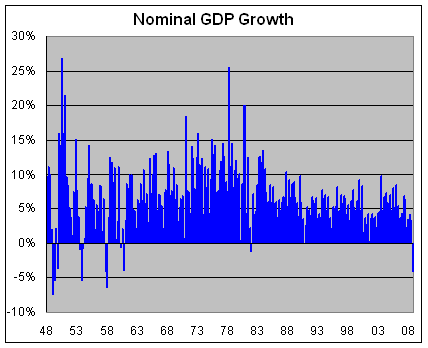
« December 2008 | Main | February 2009 » January 30, 2009It Was 40 Years Ago Today.... Posted by edelfenbein at 8:04 PM Peter Schiff Responds Since I posted Mish's take down of Peter Schiff, I feel obliged to posts Schiff's response. The Wall Street Journal also weighs in. Posted by edelfenbein at 7:51 PM Two More Earnings Yesterday, Eli Lilly (LLY) reported fourth-quarter earnings, after charges, of $1.07 a share, two cents more than expectations. That’s 19% growth although revenue growth was flat. The company sees 2009 earnings coming between $4.00 and $4.25 a share. That means the stock is going for less than 10 times this year’s earnings, plus it currently yields over 5%. SEI Investments (SEIC) reported Q4 earnings of 25 cents a share, three pennies below estimates. This will be a difficult year for SEIC, but I still think it’s a solid company. Posted by edelfenbein at 4:49 PM Today’s GDP Report The GDP report for the fourth quarter was pretty ugly, though not as ugly as it could have been. Let’s also wait for the subsequent revisions, and revisions of those revisions. The initial report showed real growth of -3.8%. Since inflation has been so tame, I was curious to look at nominal growth which was -4.05%. That’s the first down quarter in 25 years and the worst quarter in 50 years.
Posted by edelfenbein at 12:21 PM January 29, 2009Poll: Super Bowl XLIII Let's see how good my readers are. Posted by edelfenbein at 6:26 PM Oh Charlie You Can't Say That 35 second mark. Posted by edelfenbein at 3:38 PM Davos Love Fest Michael Dell asked Putin how we can help Russia expand its IT. Putin: "We don't need help. We are not invalids." Alrighty then.... Posted by edelfenbein at 3:30 PM The Case for Profits Arnold Kling argues that what really need right now is profits: A stimulus will work if and when it serves to increase profits, because profits are at the core of a free market system. The economy will recover if and when profits recover. Posted by edelfenbein at 3:23 PM Nicholas Financial’s Q3 Earnings NICK just came out with its third-quarter earnings and I thought they were pretty good. Or rather, not nearly as horrible as they could have been. For the last three months of 2008, NICK earned $1,266,809 or 12 cents a share. That’s way down from the 22 cents they made a year ago, but it’s an increase from the 8 cents it made in the second quarter. Bottom line, you’re not going out of business when you’re making money. There are a few items to highlight. First, the company changed its financing option which altered how they account for their use of interest rate swaps. This means that that swaps are now recorded on the income statement. For the third quarter, that’s about $1 million or 10 cents a share. As I see, this is merely an accounting issue and it doesn’t impact the company’s business. Well, there is one important impact on NICK’s business and that is they were able to cut their financing expenses in the third quarter. Interest expense dropped to $1.27 million from $1.43 million in the second quarter. Under the company’s line for “Average Cost of Borrowed Funds,” the decrease is from 5.45% to 4.87%. That’s good to see. Personally, I hate dealing in GAAP/non-GAAP jazz, but I’ll do it if there’s a real benefit. According to Peter L. Vosotas, Chairman and CEO, “the business climate remains challenging, auto sales are still well below historical levels and the employment outlook continues to weaken. We expect to see some seasonal improvement in our business during the fourth quarter but remain very cautious about the coming year, as we believe the recessionary pressures embedded in the economy will not subside in the near-term. During the last two quarters we have been tightening our credit underwriting guidelines in response to market conditions. We continue to evaluate markets in which we operate in and we do not anticipate any significant change from our branch-based methodology. Due to a combination of tighter underwriting guidelines and a significant slow down in auto sales during the three months ended December 31, 2008, we have reduced the size of our loan portfolio by approximately $2.6 million and also decreased our credit line outstanding by approximately $4.6 million.” The key line to watch is provision for credit losses. That dropped from $5.1 million last quarter to 4.6 million this quarter. That’s high but moving in the right direction. As a percentage of “average finance receivables, net of unearned interest” credit losses dropped from 9.66% last quarter to 8.77% in the third quarter. This was a decent quarter and if NICK keeps it up, they could be in great shape by next year. Posted by edelfenbein at 3:20 PM January 28, 2009The Stimulus Bill Clears the House The vote was 244 to 188. Eleven Democrats crossed the aisle. No Republicans crossed. So much for the president's urge for bi-partisan support. The Democrats voted 244 to 11. The GOP voted 0 to 177. One GOP member didn't vote. The "nay" Democrats were: Bright (AL) Now...it's off to the Senate. (Here's some help if you need a reminder of how the system works). Posted by edelfenbein at 6:43 PM The Stimlus Bill Nears $900 Billion If you're interested, here's all 647 pages of the bill. Honestly, some parts of it are a bit dull. The WSJ has a nice graphic on who gets what. A vote should come later this evening. "I would love to not have to spend this money," Mr. Obama said, according to individuals familiar with the president's meetings with Republicans. Mr. Obama defended the plan, they said, but suggested he'd be open to new ideas to help small businesses, and that changes could come after the House vote. Posted by edelfenbein at 4:48 PM Becton, Dickinson's Earnings Report Today is another good day for our Buy List. I have one earnings report to pass along. Becton, Dickinson (BDX) earned $1.26 a share for its first quarter which is a nice increase from the $1.07 a share it made for last year’s first quarter. The Street was expecting $1.16 a share. In the biosciences segment, sales rose 11% on demand for clinical and research instruments. Sales were down in the medical segment by 2% as strong sales of insulin delivery products were more than offset by a drop in surgical systems products and an expected decline in prefillable devices in the U.S. The company also said it expects growth this year from 9% to 11%. That seems like a nice increase to me, but I think the Street was expecting more so the shares are down today. Posted by edelfenbein at 3:55 PM The Fed: More of the Same Odd isn't it that the Fed used to rule the world, now the central bank seems to be fighting to stay relevant. You really can't cut rates when they're at zero or next to zero. Sure they can print money, just ask Zimbabwe, but that's pretty much all they can do. The problem is getting the banks to do something with that money. Here's the Fed's statement: The Federal Open Market Committee decided today to keep its target range for the federal funds rate at 0 to 1/4 percent. The Committee continues to anticipate that economic conditions are likely to warrant exceptionally low levels of the federal funds rate for some time. It's the usual five-paragraph statement: 1. What they did Some initial thoughts. The line is the second paragraph about "gradual recovery in economic activity will begin later this year" is a bit surprising. I can't say I'm so optimistic. The fourth paragraph is the key because it describes what they're doing which is basically continuing some of their earlier efforts. I'd like to see the Fed buying 10-year notes, and Jeffery Lacker apparently agrees. Well get a feel for how the market is responding this week when some commercial paper from companies like GE comes due. If they go back to the Fed, it's not a good sign. If they don't need to, then these programs might be working. I think the Fed is trying to convince the Street that it's not out of ammo. This new programs seems to be having an effect. How much it's doing or is it worth it, is debatable. Posted by edelfenbein at 2:57 PM Stimulus Bill Follies I find it remarkable that Obama has something like a 70% approval rating and large majorities in both house, yet the terms of the debate seem to be shifting against him. The bill should still pass, but I'm struck by hard it's been for the Obama team. The Wall Street Journal editorial board, if you can imagine this, doesn't like it: We've looked it over, and even we can't quite believe it. There's $1 billion for Amtrak, the federal railroad that hasn't turned a profit in 40 years; $2 billion for child-care subsidies; $50 million for that great engine of job creation, the National Endowment for the Arts; $400 million for global-warming research and another $2.4 billion for carbon-capture demonstration projects. There's even $650 million on top of the billions already doled out to pay for digital TV conversion coupons. Posted by edelfenbein at 11:53 AM Stryker's Earnings After the bell, Stryker (SYK) reported Q4 EPS of 74 cents which is in line with estimates. Sales rose 3.6% to $1.72 billion. The company said that EPS for 2009 will range between $3.12 and $3.22. The company earned $2.83 for 2008 so that’s growth of 10% to 13%...not bad for a depression. Last month, the company increased its dividend by 21%. Here's the earnings call transcript from Seeking Alpha. Also, here's the recent EPS trend: 2002: $0.88 Six months ago, I wrote: “I like Stryker a lot but I wouldn’t mind seeing it cheaper.” Well, the stock is 38% cheaper. Since Stryker's IPO, the stock is up 49,160%. Berkshire Hathaway (BRKA) is up “only” 45,222%. Posted by edelfenbein at 12:38 AM January 27, 2009Pfizer & Wyeth Now that Pfizer (PFE) and Wyeth (WYE) are getting together, I wanted to take a quick look at the long-term performance of both stocks. They’re done pretty well. Since the beginning of 1982, Pfizer’s stock is up 1,346.4% while Wyeth is up 875.4% (neither figure includes dividends). For comparison, the S&P 500 is up 589.1%.
Interestingly, both stocks peaked nearly ten years ago on the same day, April 12, 1999. Posted by edelfenbein at 9:26 PM The Most Predictive Factor: Momentum Mebane Faber posts about Richard Tortoriello’s book, Quantitative Strategies for Achieving Alpha. In the more than 40 single factors he tested from 1987-2006, guess which factor was most predictive? This isn’t a surprise to me. I think the power of momentum is one of the great mysteries of finance. Why has it been so successful and can it make me money? Mebane also notes the limitations of quant analysis. Right now, everyone is working from the same data so how can anyone gain an advantage? Posted by edelfenbein at 12:37 PM Credit Default Swaps Peter J. Wallison writes "Everything You Wanted to Know about Credit Default Swaps--but Were Never Told." This comes on the heels of Gretchen Morgenson's recent column, "Time to Unravel the Knot of Credit-Default Swaps." Posted by edelfenbein at 10:44 AM Thain Doing His Part According to the New York Post, while dining recently, John Thain, "loudly told the waiter, for all to hear, 'under the circumstances with this tough economy, I think I'll have tap water.'" Going by his recent track record, I'm guessing he offered to pay $3.7 billion for the tap water. Posted by edelfenbein at 10:13 AM Dividends Being Cut at Fastest Pace in 50 Years Bank of America (BAC) recently cut its annual dividend from $1.28 a share to four cents. (Why even keep it?) Of course, now that you're on Uncle Sam's bailout list, it's hard to justify send profit checks to your owners. Dividends had made a big comeback in recent years, now it looks like the trend is in the other direction: Already this year, seven companies in the Standard & Poor's 500 index have decreased their dividends, removing some $12 billion from shareholders' pockets in the coming months. On Monday, Pfizer became the latest blue-chip company to do so. Posted by edelfenbein at 9:54 AM January 26, 2009Geithner Is Confirmed The Senate votes to confirm Geithner 60-34. Posted by edelfenbein at 6:24 PM Cyclical Stocks Still Have a Long Way to Fall Here’s a look at the Morgan Stanley Cyclical Index (^CYC) divided by the S&P 500 (^SPX). For such a simple metric, I think is an often-revealing look at the market’s mentality. What it tells us is how well economically sensitive stocks are performing compared with the overall market. About two years ago, I started warnings investors that cyclical stocks were heading towards a top. On July 19, 2007, the CYC reached its peak ratio against the S&P 500 at 0.7273. Since then, all most all kinds of stocks have down poorly but cyclical stocks have down much worse. Through Friday, the S&P 500 is down 46.4% from July 19, 2007, but the CYC is down 62.3%. The other reason why I like to follow this ratio is that it tends to move in multi-year waves, as one would expect from looking at economic cycles. Until the ratio starts to show some improvement, I’m not going to be terribly optimistic for the broader economy. The ratio is currently around 0.51 which is still well above typical cycle lows.
Posted by edelfenbein at 3:59 PM Blame China Sebastian Mallaby claims China’s currency policy was a major cause of the housing bubble: Geithner is correct that China manipulates its currency. What's more, this manipulation is arguably the most important cause of the financial crisis. Starting around the middle of this decade, China's cheap currency led it to run a massive trade surplus. The earnings from that surplus poured into the United States. The result was the mortgage bubble. Posted by edelfenbein at 12:56 PM A Capital-less Financial System Here’s a sample of a fascinating article from Ricardo Caballero at the Financial Times Economists Forum: Forcing institutions to raise capital, be it private or public, at panic-driven fire sale prices threatens enormous dilutions to already shell-shocked shareholders, further exacerbating uncertainty and fuelling the downward spiral. This is self-defeating. Posted by edelfenbein at 12:19 PM Buy List Updates There are a couple of items to pass along this morning. Danaher’s (DHR) earnings were down from last year, but the company still beat estimates. Excluding charges, DHR made $1.11 a share, seven cents more than what the Street was expecting. The stock has been up by as much as 11% this morning. Moog (MOG-A) also has a good earnings report, but it lowered its revenue estimate for this year. The company’s Q1 EPS came in at 70 cents which is up from 64 cents last year, plus it’s two cents more than Street expectations. Moog cut its revenue outlook for the year from $2 billion to $1.95 billion. The shares are up about 5% so far today. Stryker (SYK) was downgraded from Buy to Hold by Needham. The company reports earnings tomorrow (Andrew Leckey has a good summary of SYK). Bed Bath & Beyond (BBBY) was downgrade by J.P. Morgan from neutral to underweight, although the downgrade doesn’t seem to be hurting the shares at all. Overall, the Buy List is having a good morning. Posted by edelfenbein at 10:48 AM The Peter Schiff Backlash Begins I've been saying for some time that I'm not particularly impressed with Peter Schiff and his hyper-bearish calls. Fortune just had an article on how prescient Schiff has been: "As one of the few talking heads who loudly, relentlessly, and more or less accurately sounded the alarm about the mortgage bubble and its consequences - in the process becoming the latest bearish commentator to earn the moniker "Dr. Doom" - Schiff has suddenly emerged as a cult hero and something of a minor celebrity." Well, Dr. Doom has predicting disaster for several years now, and what we're seeing now isn't quite what Schiff predicted. Jonas Elmerraji of the Rhino Stock Report writes: While Schiff has proved himself as an economist, his ability to parlay those predictions into profits for his clients was questionable for 2008. For the last few years, he’s been betting big on overseas investments and precious metals – two areas that got hit as hard or harder than the S&P last year. Mish breaks it down in list form: 12 Ways Schiff Was Wrong in 2008 Posted by edelfenbein at 10:05 AM January 25, 2009The Obama Plan President Obama has laid out his plans to revive the economy, and the price tag will be “at least $820 billion.” Something tells me that the “at least” part means “at the very, very least.” Obama’s goal is to create four million jobs. Dean Baker works out the math and says that the plan comes down to $65,000 per job. In my mind, the empirical evidence in favor a stimulus package is, at beat, inconclusive. The major problem, however, is that the recovery plan is no longer theoretical—we can see what it is. A lot of this spending isn’t for short-term fiscal stimulus, it’s merely larger government. The Washington Post opines: Helping hire, equip and pay police, a $4 billion item under the bill, might be a good idea, but writing checks to individual households for the same amount would do more to stimulate the economy. Ditto for $16 billion in Pell Grants for college students, $2.1 billion for Head Start and $50 million for the National Endowment for the Arts. All of those ideas may have merit, but why do they belong in an emergency measure aimed to kick-start the economy? The short answer is, they don’t belong. I expect the plan to sail through Congress. The only upside I see is that future economists will now have another bit of evidence to weight. Posted by edelfenbein at 11:46 AM January 23, 2009Contra Geithner Joe Weisenthal makes the case against Geithner: We know that not everyone would've made the same decision here. We've worked with people in our professional life, who everytime they encountered something legally or ethically murky opted to make the conservative choice that wasn't immediately beneficial to them. They do exist, believe it or not. We suspect a guy like Warren Buffett would've asked for a professional opinion on the tax issue, were he in that same position. Geithner said he simply made a mistake on his taxes and apologized. Well, the apology is good but it misses the point, the mistake is the issue. Calling it one doesn't diminish the significance. The Secretary of the Treasury should know how to do his taxes without making obvious, boneheaded mistakes. Larry Ribstein has more. Posted by edelfenbein at 12:38 PM New Stock Options for Google Employees A few years ago, I criticized a Wall Street Journal story that claimed corporate executives were profiting off 9/11 by granting themselves new options after the market dropped. I thought this was a completely made-up scandal. The article described perfectly legal activity in such a way as make it seem sinister (see here for my original post). The reason why I mention this is that Google has essentially done the same thing the WSJ was complaining about two-and-a-half years ago. Here’s the AP story in full: Google Inc. is allowing its employees to swap their stock options for new ones that will give them a better chance to profit from their holdings. For the record, I don’t think there’s anything wrong in what Google is doing. But I’m curious if we’ll hear the same screams of protest that we got in the summer of 2006. To use the problematic logic from the WSJ’s original article, Google executives are “profiting off” the global economic turmoil. Worse, they’re giving themselves raises while they’re laying their own people off. Where’s the media outrage? Posted by edelfenbein at 10:35 AM Aflac's Press Release I'm glad to see AFLAC (AFL) making a public statement: "I think it's also appropriate to comment on the status of the perpetual debentures, or so-called "hybrid securities" we own. Based on preliminary year-end numbers, our holdings of hybrid securities at fair value were $8.1 billion, or approximately 11.8% of our consolidated investment portfolio of $68.6 billion. We purchased the hybrid securities from 1993 to 2005. For GAAP accounting purposes, the perpetual debentures are held in the available-for-sale category. As such, they are marked to market and reflected on the balance sheet at fair value. By contrast, these perpetual debentures are carried at amortized cost for statutory accounting purposes. That means that the changes in the fair value of these hybrid securities are not included in, and therefore do not impact, the risk-based capital ratio. Posted by edelfenbein at 10:12 AM January 22, 2009Worst Hoax Ever Dude, if you're going to be a jerk, at least get a copy-editor. Posted by edelfenbein at 4:08 PM Strong Earnings from Baxter Baxter International (BAX), one of the new stocks on my Buy List, posted decent earnings for the fourth quarter. Earnings-per-share came in at 91 cents, two cents ahead of the Street’s estimate. The company sees 2009 EPS ranging from $3.70 to $3.78. That could be on the low side. JP Morgan analyst Michael Weinstein wrote in a research note. "To put this in perspective, at the start of 2008, management provided initial guidance of $3.10 to 3.18 a share, yet ended up delivering $3.38."
Posted by edelfenbein at 2:19 PM AFLAC’s Hybrids The problems in the British banking sector have spread back across the Atlantic to strike our very own AFLAC (AFL). The stock is getting crushed today on concerns about its losses in UK bank investments. Like a lot of insurance companies, AFLAC invests in perpetual debenture investments or “hybrid securities,” and an analyst is worried about the losses they’ve taken in banks like Royal Bank of Scotland, HBOS or Barclays. Morgan Stanley said, ”If even a small portion of these losses are realized, the hit to Aflac’s capital ratios could be substantial, and their overall capital adequacy could be significantly less than most investors believe.” Barron's notes: According to Morgan, Aflac has nearly $8 billion exposure to hybrid securities, with as much as 80% of this exposure to European financial services companies, including Royal Bank of Scotland (RBS) and Barclays (BCS), both of whose solvency has become a subject of open conjecture amid talk that the British Treasury might nationalize some of its financial institutions. The stock opened down 11% but it’s slid all morning. At one point, AFL was down 39% for the day. In the most recent 10-Q, AFLAC discussed some of the accounting issues involved in their hybrids: Securities and Exchange Commission Guidance: On October 14, 2008, the Securities and Exchange Commission (SEC) issued a letter to the FASB addressing recent questions raised by various interested parties regarding declines in the fair value of perpetual preferred securities, or so-called “hybrid securities,” which have both debt and equity characteristics and the assessment of those declines under existing accounting guidelines for other-than-temporary impairments. In its letter, the SEC recognized that hybrid securities are often structured in equity form but generally possess significant debt-like characteristics. The SEC also recognized that existing accounting guidance does not specifically address the impact, if any, of the debt-like characteristics of these hybrid securities on the assessment of other-than-temporary impairments. AFLAC has said that it's "comfortable" with its capital position. Earnings are due on Monday, February 4. Posted by edelfenbein at 11:44 AM Political Interference in Bank Bailout Decisions I'm shocked! Absolutely shocked something like this could happen: Troubled OneUnited Bank in Boston didn't look much like a candidate for aid from the Treasury Department's bank bailout fund last fall. The WSJ has a nice graphic showing the distribution of TARP funds. Posted by edelfenbein at 11:10 AM January 21, 2009Parsons Named Chairman of Citigroup Remember George W. Bush? Me neither, but once he said that "Wall Street got drunk." Few folks got more boozed than the kids down at Citigroup (C). The good news is that Dick Parsons has been named as their new chairman. The irony, of course, is that Parsons is a vinter. No seriously. Naturally, here's the family crest. Posted by edelfenbein at 5:51 PM The House of Commons Is a Tough Crowd (Via: Paul K) Posted by edelfenbein at 5:23 PM This Day in Gold History From This Day in Market History: On January 21, 1974, gold hit a record $161.31 and silver hit a record $3.97 an ounce in London. It was still illegal for Americans to own the metal, until it was legalized on the last day of 1974. Posted by edelfenbein at 5:20 PM Apple’s Earnings Here’s a quick follow-up on my previous post. Apple’s Q4 net came in at $1.78 a share. Sheesh, their guidance is a joke. I’ve always known it’s a joke, but come on. Apple said to expect a range of $1.06 to $1.35. That’s not even in the ballpark. Sorry, guys. You got to have some credibility here. For the quarter ended Dec. 27, traditionally the best of the year because it includes the holiday season, the maker of computers and electronic devices reported net income of $1.61 billion, or $1.78 a share, up from $1.58 billion, or $1.76 a share, a year earlier. Excluding items, earnings were $2.56 a share. The company said to expect Q2 EPS of 90 cents to $1. Yeah, right. Posted by edelfenbein at 5:17 PM TARP Application Just in case anybody needs this. Posted by edelfenbein at 2:45 PM Jobs that Americans Won't Do Mexican billionaire invests in the New York Times: A Latin American billionaire looks to expand his empire in the United States in a deal that could make him the largest shareholder of The New York Times Co. Posted by edelfenbein at 1:57 PM Anyone Remember What Interest Rates Were? David Merkel takes a look at the dollar’s role in the banking crisis. Since the dollar is the reserve currency of the world, and by definition there can only be one of those, it’s doing much better than other currencies out there. David cites the British pound which has much in common with the dollar, but since it’s not the global powerhouse, it’s getting left behind. The Canadians just lowered rates. The EU is bringing down rates, though they’re still above most everyone else (which may lead to some intra-continental strife). The Bank of England now has rates at 300-year lows. In looking at alternatives to the dollar, David asks: “External commodity-based currencies? None that I know of; few governments want to limit their power by tying their hands on monetary policy.” He’s right. I do wonder why gold continues to be so strong against the dollar. It made more sense before the global economy fell apart, but I’m not so sure now. Is gold ready to plunge, or do gold investors think inflation is about to come roaring back. I suspect the former, but I’m not willing to make that bet. Posted by edelfenbein at 1:49 PM Arthur Nadel Touted as America's Top Ranked Money Manager Before Arthur Nadel disappeared, along with $350 million of his clients money, he was touted as "America's Top Ranked Money Manager" in a 2003 issue of the Wall Street Digest The FBI's Tampa office opened an investigation into Nadel on Tuesday, launching a search for the 76-year-old former New York jazz pianist whose disappearance has drawn parallels to last month's arrest of former Nasdaq Stock Market chairman Bernard Madoff. Posted by edelfenbein at 11:50 AM The BIX Imploads Good golly. The Bank Index is on life support:
Posted by edelfenbein at 11:40 AM The Irish Banking Crisis Not too long ago, Ireland was hailed as the European economic miracle. The country even got full Gladwell treatment (his explanation was the "dependency ratio," Irish women were having fewer babies). Now we learn that the Irish banking is in a world of trouble. The bloodletting may be far from over for Ireland’s banks as the wheels come off what was once Europe’s fastest-moving economy. It looks like the country is heading towards nationalizing its banks. The housing market continues to be a mess. Betweeen 1997 and 2007, home prices in Ireland rose by fourfold. In the end, the Celtic Tiger didn't have much in the way of teeth. Posted by edelfenbein at 10:23 AM January 17, 2009Looking at Apple’s Financial Performance I just wanted to add a quick post on Apple (AAPL). A number of you have asked for Apple’s recent financial numbers, so I’ve added this spreadsheet which contains the quarterly figures going back ten years. As you can see, Apple’s performance has been staggering. Sales and earnings growth is through the roof. Gross margins are around 35% and operating margins are near 20%. Most impressively, Apple has zero debt and a gigantic cash horde that comes to $27.55 a share. Given Apple’s closing price on Friday of $82.33, that means that the “nuts of bolts” of the company are worth $54.78 a share, which is roughly 10 times trailing earnings. Obviously the key factor is future earnings, not trailing. I’ll have more this Wednesday when Apple reports its fiscal Q1 earnings. This will almost certainly be Apple’s first report of lower earnings in over five years. Sales will probably be flat. The first quarter is traditionally Apple’s most important quarter when the company records about one-third of its yearly sales and earnings. Posted by edelfenbein at 3:51 PM Offshore Tax Havens From the NYT: Many of the largest United States corporations, including big banks now receiving federal bailout money, operate scores of subsidiaries in offshore tax havens that may let them evade or defer their tax bills, according to a government study released Friday. Posted by edelfenbein at 12:16 PM January 16, 2009The Buy List Year to Date I'll probably jinx it but even mentioning this, but our Buy List is off to a great start this year. By that, I mean we're up a whopping 0.62% (woo!). Still, the S&P 500 is down -5.88%. So we're already 6.5% ahead of the market and we've beaten the S&P for nine of the eleven days so far this year. Posted by edelfenbein at 5:38 PM "Cannot be Underestimated" The New York Review of Books notes: Moreover, Iranian paranoia about the US cannot be underestimated. Alerting the Iranian government in advance to the timing and objectives of each of the steps described above would avoid a negative reaction. It would also prepare the way for a major new approach to the issues concerning nuclear enrichment, Iraq, and Afghanistan. The authors use "cannot be underestimated" to express the exact opposite of the meaning they wish to convey. My favorite such mistake is still Rod Stewart's, "Just let your inhibitions run wild." Posted by edelfenbein at 2:51 PM Put Gasparino and Kneale on the Air and Guess What Will Happen (H/T: MediaBistro) Posted by edelfenbein at 2:10 PM The S&P 500 Banking Index Banks are getting smacked around again today. The Bank Index (^BIX) is now below 100. Jeez Louise! Eighteen months ago, the index was around 400.
Now check out the rise in daily volatility:
Posted by edelfenbein at 1:08 PM The End of the Media The Star Tribune files for Chapter 11 -- as reported by The Star Tribune: The Star Tribune, saddled with high debt and a sharp decline in print advertising, filed a Chapter 11 bankruptcy petition Thursday night. These companies are in free fall. Posted by edelfenbein at 11:18 AM Circuit City at Four Cents a Share
Thirty-four years ago, Circuit City was going for $1 a share. Adjusted for splits, that was 0.4611 cents a share. Nine years ago the stock reached a split-adjusted level of $40.920606 a share. That's a return of 887,356% The stock is now at four cents a share. Posted by edelfenbein at 10:32 AM January 15, 2009The Market Wastes No Time How US Airways Group (LCC) traded today:
Posted by edelfenbein at 5:30 PM Amphenol's Earnings Not Good But Could Have Been Much Worse Nice turnaround today which isn't surprising since the bears have been in control the last few days. The Dow briefly dipped below 8,000 at one point.
The Buy List is getting a nice boost from Amphenol's (APH) earnings report. The shares are currently up 12%. This was an interesting earnings report for APH. The company's bottom line has been growing pretty nicely over the past few years. In October, when the company reported Q3 earnings, it said to expect Q4 EPS of 58 cents to 60 cents. That wasn't good news. Personally, I had pegged EPS at 62 cents a share. Well, things soon got a lot worse. APH said a few weeks ago to ignore what they said earlier, and EPS will come in between 50 cents and 52 cents. Now we come to today where we learn that Amphenol earned 56 cents a share. I'm not a big fan of analyst forecasts but here the company didn't even know what to expect. The company also said that Q1 will be weak, and they expect EPS of 39 cents and 41 cents. The bottom line is that things are tough for Amphenol just like everyone else. The company is a solid outfit and even in rough patches, it can still deliver pleasant surprises. Quarter.....................EPS Posted by edelfenbein at 3:06 PM January 14, 2009According to Intrade the Chance of a Depression Is 54%
Posted by edelfenbein at 10:44 PM Dan Lyons Vs. Jim Goldman On CNBC tonight, Dan Lyons, aka Fake Steve Jobs, and Jim Goldman let the sparks fly. Goldman had said that a Gizmodo report on Jobs' health was incorrect. Lyons called him out for that. Unfortunately, Dennis Kneale gets in the way. Posted by edelfenbein at 10:28 PM Breaking: Steve Jobs Takes Leave of Absense Unitl June The shares closed today at $85.33. I'm afraid what will happen tomorrow morning. The New York Times reports: Saying his health-related issues were “more complex” than he originally thought, Steven P. Jobs, Apple’s chief executive, announced Wednesday that he would take a medical leave of absence from the company until the end of June. Posted by edelfenbein at 4:40 PM Meet the Man Responsible for the Credti Crisis It may sound like a ridiculous question, but it's not as mad as it seems. Even when it comes to finances Bowie leads the way - and back in 1997 he did something called 'securitisation'. Personally, I blame Ziggie Stardust. Posted by edelfenbein at 3:11 PM Bernie-Cam CNBC has a live webcam at the Federal Courthouse for Madoff's bail hearing. So now you can sit around and wait while watching other people sit around and wait. See, this is why I love new media. Posted by edelfenbein at 2:33 PM Investor Therapy (H/T: DealBreaker). Posted by edelfenbein at 1:06 PM January 13, 2009Finger Length May Predict Financial Success I don't even know what to say about this one: The length of a man's ring finger may predict his success as a financial trader. Researchers at the University of Cambridge in England report that men with longer ring fingers, compared to their index fingers, tended to be more successful in the frantic high-frequency trading in the London financial district. Posted by edelfenbein at 11:23 AM Are You Born to Be a Trader? It might depend on your level of testosterone: A new study has found that men who were programmed in the womb to be the most responsive to testosterone tend to be the most successful financial traders, providing powerful support for the influence of the hormone over their decision-making. Yet another argument against the efficiency of markets. BTW, I think Spock would make an excellent trader. That death grip thingy would really come in handy in the trading pits. Posted by edelfenbein at 11:04 AM Bernanke in London Here's a snippet of the bearded one speaking at the London School of Economics: One important tool is policy communication. Even if the overnight rate is close to zero, the Committee should be able to influence longer-term interest rates by informing the public's expectations about the future course of monetary policy. To illustrate, in its statement after its December meeting, the Committee expressed the view that economic conditions are likely to warrant an unusually low federal funds rate for some time.2 To the extent that such statements cause the public to lengthen the horizon over which they expect short-term rates to be held at very low levels, they will exert downward pressure on longer-term rates, stimulating aggregate demand. It is important, however, that statements of this sort be expressed in conditional fashion--that is, that they link policy expectations to the evolving economic outlook. If the public were to perceive a statement about future policy to be unconditional, then long-term rates might fail to respond in the desired fashion should the economic outlook change materially. Posted by edelfenbein at 10:19 AM January 11, 2009Economics the 60 Minutes Way 60 Minutes just ran a comically slanted story on the rise in oil prices. I know that the price of oil is now down by $100 a barrel over the past few months, but that doesn’t seem to matter when you’re in the alarmism business.The 60 Minutes story is wretched, incoherent and it engages in the worst form of scapegoating. It’s hard to believe that this made it to air. According to 60 Minutes, the surge in oil prices was due to...(wait for it)...deregulation! Yes, it seems that “hedge funds” (cue Darth Vader’s theme) and “speculators” were buying oil in order to make money. If you just toss around these scare words long enough, people will think it makes sense. Somehow this was all due to deregulation. Of course, oil is traded all over the world, but logic doesn’t play a major role in this story. First, Steve Kroft first talked with Dan Gilligan, the president of the Petroleum Marketers Association. Gilligan admitted that the members of his trade group, the people who pay his salary, are the ones responsible and he wouldn’t hear of anyone trying to shift the blame. Kidding! "Approximately 60 to 70 percent of the oil contracts in the futures markets are now held by speculative entities. Not by companies that need oil, not by the airlines, not by the oil companies. But by investors that are looking to make money from their speculative positions," Gilligan explained. Egad, speculators trying to make money! Next we’ll hear that other people buy things and “sell it for more than they paid for it.” Of course, if you do the opposite for long enough, like GM, you may get a bailout, so maybe “profiting” isn’t a great plan. Next we'll hear that there are oil ETFs so anyone can buy it, not just scary hedge funds. Asked who was buying this "paper oil," Masters told Kroft, "The California pension fund. Harvard Endowment. Lots of large institutional investors. And, by the way, other investors, hedge funds, Wall Street trading desks were following right behind them, putting money - sovereign wealth funds were putting money in the futures markets as well. So you had all these investors putting money in the futures markets. And that was driving the price up." So the scandal is that the rise in oil was benefiting schools and retirees. Got it. Look, speculators don't make an asset go up all buy itself. For any buyer, there also must be a seller. The people who bought oil were taking on the risk, and that later hurt them. If anyone had any doubts, they were dispelled a few days after that hearing when the price of oil jumped $25 in a single day. That day was Sept. 22. The complaint is that oil went from $60 to $147 in less than a year. But now, it’s lower than where it started. Steve doesn't bother to mention that fact which seems pretty important to me. Hey, let’s talk with a wiped out speculator. And that $25 one-day jump came AFTER oil hit its peak. So supply and demand did work after all. What failed was the ability of Mr. Greenberger or anyone else in the government to see it coming. Seems like a good argument against regulation. "From quarter four of '07 until the second quarter of '08 the EIA, the Energy Information Administration, said that supply went up, worldwide supply went up. And worldwide demand went down. So you have supply going up and demand going down, which generally means the price is going down," Masters told Kroft. So Steve, a reasonable question would be: “Did you short oil?” Or, did you ever wonder why demand was falling? The answer is simple: Higher prices were impacting demand. The system was working. Masters believes the investor demand for commodities, and oil futures in particular, was created on Wall Street by hedge funds and the big Wall Street investment banks like Morgan Stanley, Goldman Sachs, Barclays, and J.P. Morgan, who made billions investing hundreds of billions of dollars of their clients’ money. There's no need to use the phrase "quote/unquote." Commodities are indeed an asset class. This is fear-mongering masquerading as "quote/unquote" journalism. As far as suitable long-term investments go, gold has been holding its own against stocks for a couple years now. And what’s worse, I bet a lot of gold investors never take delivery either. "Are you saying that companies like Goldman Sachs and Morgan Stanley and Barclays have as much to do with the price of oil going up as Exxon? Or…Shell?" Kroft asked. Anyone see Morgan’s stock lately? I have. I own it. The Wall Street bank Goldman Sachs also has huge stakes in companies that own a refinery in Coffeyville, Kan., and control 43,000 miles of pipeline and more than 150 storage terminals. So Goldman drove up an asset that it owned. Do we know if the bank got clobbered once oil plunged? Asked if there is price manipulation going on, Dan Gilligan told Kroft, "I can't say. And the reason I can't say it, is because nobody knows. Our federal regulators don't have access to the data. They don't know who holds what positions." So now we have our scoop. Price manipulation might be going on, but we have zero evidence of it. But now we’re going to hear that dark forces are at work. And in 2000, Congress effectively deregulated the futures market, granting exemptions for complicated derivative investments called oil swaps, as well as electronic trading on private exchanges. Just mention Enron and suddenly you have a story. Let's ignore the fact that nearly every commodity was soaring. "When Enron failed, we learned that Enron, and its conspirators who used their trading engine, were able to drive the price of electricity up, some say, by as much as 300 percent on the West Coast," he added. Again, we have zero proof of anything. Just some people made money and some people lost money. Now Kroft has to update the story to account for the gigantic decline in oil, so we now do a quick about-face. But some of them may now be looking for work. The oil bubble began to deflate early last fall when Congress threatened new regulations and federal agencies announced they were beginning major investigations. It finally popped with the bankruptcy of Lehman Brothers and the near collapse of AIG, who were both heavily invested in the oil markets. With hedge funds and investment houses facing margin calls, the speculators headed for the exits. Yes, it’s the only way. Just as it is all the time. The last sentence is the worst. I can’t believe a professional journalist said these words: The regulatory lapses in the commodities market that many believe fomented the rampant speculation in oil have still not been addressed, although the incoming Obama administration has promised to do so.
Posted by edelfenbein at 8:33 PM January 10, 2009Citigroup Starts to Break Apart Now that everything has blown up in their faces, Citigroup (C) is taking the first steps in breaking itself up. The WSJ reports: Citigroup Inc., under pressure from the federal government, took a big step toward breaking up the financial supermarket, entering discussions to spin-off its Smith Barney brokerage unit into a joint venture with rival Morgan Stanley, according to people familiar with the talks. This is long, long overdue. In fact, some of us were telling them to break long before the troubles started: The financial supermarket idea doesn’t work. Repeat after me, Mr. Prince, it doesn’t work. I know, it sounds good on paper, but people don’t do their finances that way. They never have and they’re not about to now. This was just a nice idea to justify some lousy acquisitions many, many years ago. Posted by edelfenbein at 3:11 PM Some Madoff "Victims" Made Profits The Securities Investor Protection Corp. has informed Madoff investors that they can apply for up to $500,000 in aid. There’s one little problem: Many of these folks made money from Madoff. Jonathan Levitt, a New Jersey attorney who represents several former Madoff clients, said more than half of the victims who called his office looking for help have turned out to be people whose long-term profits exceeded their principal investment. Legally, this isn’t going to be pretty. The courts may rule that the recent profits have to be returned. This will pit the Madoff winners against the Madoff losers. Posted by edelfenbein at 11:18 AM January 9, 2009Dow and the S&P 500 On November 20, the Dow’s ratio to the S&P 500 broke 10-to-1 for the first time in over four decades. What did that mean? I’m not sure but it did happen to coincide with the market’s bottom. Both indexes have rallied nicely since then.
The black line is the Dow and it follows the left scale. The blue line is the S&P 500 and it follows the right scale. The lines are scaled at 10-to-1. Posted by edelfenbein at 6:36 PM Dennis Kneale Asks if Steve Jobs has PMS Stay classy, Dennis. Posted by edelfenbein at 1:44 PM Today's Jobs Report The jobs report today was terrible. The good news is that the market was expecting it, so stocks aren't getting clobbered. Here's some perspective: On average, 16,000 people lost their job every day for the last four months of the year. That's like a decent-sized town getting wiped out every day. Here's the NFP (in thousands):
That trend does not look good. Eleven million Americans are now unemployed. Over the last three years, the labor force has grown by 4.44 million, yet employment has grown by 555,000.
Posted by edelfenbein at 1:23 PM Daron Acemoglu Arnold Kling points to some thoughts from Daron Acemoglu on what caused our blindness: The first is that the era of aggregate volatility had come to an end. We believed that through astute policy or new technologies, including better methods of communication and inventory control, the business cycles were conquered. Our belief in a more benign economy made us more optimistic about the stock market and the housing market. If any contraction must be soft and short lived, then it becomes easier to believe that financial intermediaries, firms and consumers should not worry about large drops in asset values. Posted by edelfenbein at 12:42 PM Stryker Delivers The company reaffirmed that it expects a 2008 profit, excluding special items, of $2.82 to $2.84 per share, an increase of 18 percent from 2007. Check out this trend in EPS growth: 2002: $0.88 Posted by edelfenbein at 10:28 AM The Politics of Fear? Remember how George Bush used the "politics of fear" during a national crisis to "scare voters" into approving his pre-existing agenda? Maybe it's just me. Anyway, here are some choice quotes from Obama’s speech yesterday: We start 2009 in the midst of a crisis unlike any we have seen in our lifetime. Wow, I'm sold. Posted by edelfenbein at 8:30 AM Anti-TARP Day Today seems to be Anti-TARP day. The first salvo comes from a congressional oversight committee: The U.S. Treasury has failed to reveal its strategy for stabilizing the financial system, not answered questions asked by a government watchdog, and has done nothing to help struggling homeowners, a report being released Friday charges. Even harsher news comes from this Bloomberg article: Henry Paulson may be the most powerful manager of money in the world and he still couldn’t do for taxpayers with the $700 billion bailout of American banks what Warren Buffett did for his shareholders in investing in Goldman Sachs Group Inc. Posted by edelfenbein at 8:11 AM January 8, 2009Bank of England Cuts Rates to Lowest Level Since '94 That would be 1694 when the bank was started: The Bank of England cut the benchmark interest rate to the lowest since the central bank was founded in 1694 as policy makers tried to prevent the credit squeeze from deepening Britain’s recession. Posted by edelfenbein at 9:39 AM January 7, 2009Wallstrip Unstripped Wallstrip has come to the end of the road: Like much of Wall Street, Wallstrip is pulling in its horns. This is sad; I'm a huge WallStrip fan. Posted by edelfenbein at 10:04 PM The Strange Death of Risk Management I just got around to reading Joe Nocera’s recent article on the life and death of risk management, and the titanically overrated blowhard Nassim Nicholas Taleb. The media tends to like these “Big Think” articles as it feeds into the Malcolm Gladwell-style of bring Big Ideas to the masses. Gladwell, in fact, was one of the first to highlight Taleb a few years ago in the New Yorker. If you’re not familiar with Taleb, he has one idea and one idea alone. Actually, it’s not even his idea. The man who really impresses me Benoit Mandelbrot. Anyway, the idea is that stock returns don’t follow the normal distribution (the bell curve). That’s it—that’s the Big Think idea. Here’s the deal: If stocks don’t follow a bell curve, then a lot of the ways we measure risk are flawed. For Taleb, of course, it’s much more than that. His idea (meaning Mandelbrot’s) is really an impossible to comprehend discourse on the human soul. In short, everyone else is a moron and only Taleb gets it. He highlighted his idea in his two awful books, Fooled by Randomness and the Black Swan. I’ve actually read both books and I’m curious how many people who bought the books have actually read them. My hunch is that these could be part of the great unread books of the world. The reason is that the books are so bad that they’re barely literate. Taleb goes on and on about how he’s such an aesthete living in a world of philistines, yet he can’t write a single coherent page. Now expand that 400 pages. If people knew just how tedious these books are, I doubt they would receive so much praise. Taleb and others now claim that Value at Risk, or VaR, played a large role in the credit mess. Sorry, that simply isn’t the case. Risk models are perfectly fine to use as long as you’re aware of the limitations. Every financial ratio or metric is like that. Just because it has some flaw is no reason to blame the movement of the economy on the misuse of math. Nocera points out that once Goldman Sachs saw problems with their VaR numbers, they adjusted. No big deal and Goldman is still in business today. Nocera quote one risk manager, “VaR is a peacetime statistic.” Exactly. Here’s an excerpt from the article: “VaR was inevitable,” Gregg Berman of RiskMetrics said when I went to see him a few days later. He didn’t sound like an intellectual charlatan. His explanation of the utility of VaR — and its limitations — made a certain undeniable sense. He did, however, sound like somebody who was completely taken aback by the amount of blame placed on risk modeling since the financial crisis began. Here’s another good snippet: And yet, instead of dismissing VaR as worthless, most of the experts I talked to defended it. The issue, it seemed to me, was less what VaR did and did not do, but how you thought about it. Taleb says that because VaR didn’t measure the 1 percent, it was worse than useless — it was downright harmful. But most of the risk experts said there was a great deal to be said for being able to manage risk 99 percent of the time, however imperfectly, even though it meant you couldn’t account for the last 1 percent. Howard has more. As usual, he's bang on. Posted by edelfenbein at 4:43 PM Bed, Bath & Beyond's Q3 Earnings For their third-quarter (ending November 29), Bed Bath & Beyond (BBBY) just reported earnings of 34 cents a share. That’s pretty ugly, but honestly, it’s not bad considering the crappy environment they’re in. The earnings were a penny below the Street's consensus, and the company earned 52 cents a share for last year's Q3. Sales came in at $1.783 billion which was slightly below last year’s Q3. Same-store sales were just ugly, down 5.6%. The company sees Q4 EPS coming in at 40 to 46 cents which is less than the 49 cents the Street was expecting. Here are the earnings results going back a few years:
Here's their trailing four-quarter earnings-per-share. The two red lines show the upper and lower band of the company's projection.
It's not hard to find the squeaky wheel. Take at look at their operating margins:
That's based on trailing four quarter numbers. This means the company is doing a lot of price-cutting. Posted by edelfenbein at 4:20 PM The End of Times Michael Hirschorn says the New York Times could go bankrupt, by May. It’s certainly plausible. Earnings reports released by the New York Times Company in October indicate that drastic measures will have to be taken over the next five months or the paper will default on some $400million in debt. With more than $1billion in debt already on the books, only $46million in cash reserves as of October, and no clear way to tap into the capital markets (the company’s debt was recently reduced to junk status), the paper’s future doesn’t look good. Posted by edelfenbein at 11:45 AM January 6, 2009Mean Automakers Dash Nation's Hope For Flying Cars
Posted by edelfenbein at 4:56 PM Earnings Preview: Bed Bath & Beyond Bed Bath & Beyond Inc. reports results for its fiscal third quarter on Wednesday. The following is a summary of key developments and analyst opinion related to the period. Posted by edelfenbein at 1:20 PM Where Do You Place Johnny Cash? Tyler Cowen asks: "Where is the geographic center of Johnny Cash's moral and musical universe?" I'm particularly pleased with my answer. Johnny Cash walks the line. Posted by edelfenbein at 12:11 PM More Financial History The Economist opens its vault: Having fully admitted the disappointments, we find some justification for regarding 1928 as a year of no small promise for the future. Quite possibly it will be remembered in history as a year in which the foundations of recovery were laboriously laid. Posted by edelfenbein at 12:06 PM Iceland to Sue Britain From the 1950s through much of the 1970s, Britain and Iceland were involved in the Cod Wars, which was an overgrown fishing dispute. Now the financial mess has brought these two rivals back to confrontation. Iceland’s state-run Kaupthing bank will sue the British government for its decision to force the bank’s British subsidiary into a form of bankruptcy, the Icelandic Prime Minister’s office said Tuesday. Honestly, it's hard for me to read that last sentence without laughing. Posted by edelfenbein at 11:05 AM The Price of Forecasts Here's Paul Farrel highlighting absurdly bullish forecasts from 10 years ago. Let me again make my claim that overly bullish forecasts are routinely held to account, but absurdly bearish ones are rarely held accountable. Here's some advice: If you ever go in the econ-predictions biz, be pessimistic and vague. Then claim anything that goes wrong as something you predicted. By the way, are we allowed to start making fun of this? Posted by edelfenbein at 12:28 AM Prepayments and the Subprime Market Here's the abstract of a recent paper: This paper demonstrates that the reason for widespread default of mortgages in the subprime market was a sudden reversal in the house price appreciation of the early 2000s. Using loan-level data on subprime mortgages, we observe that the majority of subprime loans were hybrid adjustable rate mortgages, designed to impose substantial fi nancial burden on reset to the fully indexed rate. In a regime of rising house prices, a fi nancially distressed borrower could avoid default by prepaying the loan and our results indicate that subprime mortgages originated between 1998 and 2005 had extremely high prepayment rates. Most important, prepayment rates on subprime mortgages were extremely high (i) not just for ARMs but FRMs as well, (ii) even before the reset dates on hybrid-ARMs and (iii) despite prepayment penalties on the contract. However, a sudden reversal in house price appreciation increased default in this market because it made this prepayment exit option cost-prohibitive. In short, prepayments sustained the subprime boom and the extremely high default rates on 2006-2007 vintages were largely due to the inability of these mortgages to prepay (an option that was available for mortgages of earlier vintages). Posted by edelfenbein at 12:01 AM January 5, 2009Two Days in 2009 and We’re Kicking Butt With two days under our belt, the Buy List already has a lead over the S&P 500, 4.12% to 2.68%. Obviously, a two-day lead doesn’t mean much, but I mention it because the Buy List was helped out enormously today by the 27.7% jump in Nicholas Financial (NICK). Since NICK is such a low-priced stock, the bid/ask spread can make a big difference on how well the Buy List does each day. Some days we’re punished, but some days, like today, it’s a big, big help. Posted by edelfenbein at 11:16 PM Meg Whitman for Governor? Meg Whitman stepped down from the boards of Procter & Gamble Co., eBay Inc. and Dreamworks Animation SKG Inc. effective Dec. 31, her spokesman said. Posted by edelfenbein at 3:28 PM The Gold-to-Silver Ratio In 1792, the U.S. Congress, at the advice of Alexander Hamilton, passed the Coinage Act of 1792. This was the government’s first attempt at price-fixing. The act defined a U.S. dollar as 371.25 grams of silver or 24.75 grams of gold. In other words, gold was worth 15 times as much as silver. So how did they do? Well, not too well. The guys at Bespoke posted a chart looking at the ratio of gold to silver over the past few years. The ratio has exploded in the past year, rising from under 50 to nearly 80 today. They conclude: “Based on the ratio of gold to silver over the last ten years, a reversion of the mean trade would be to go long silver and short gold.” Posted by edelfenbein at 11:29 AM Best Paragraph of the Day James Surowiecki on Wall Street con games: In David Mamet’s movie “House of Games,” the grifter played by Joe Mantegna explains to a former mark, “It’s called a confidence game. Why? Because you give me your confidence? No. Because I give you mine.” So the bankers gave us their confidence, in the form of mortgages and other forms of credit, and we gave them ours. This culture of credulity did plenty of damage to the economy, but now it has given way to something even more corrosive; namely, endemic mistrust. Because if there’s one thing worse than too much confidence it’s not enough. Fraud impoverishes a few; fear impoverishes the many. As long as mistrust prevails, people will keeping pulling money out of the system—sometimes even at gunpoint. Posted by edelfenbein at 11:16 AM Renaissance Waives Fees James Simons, the Grand Poobah of Renaissance Technologies, said he's going to waive the fees on his futures fund which was down 12% last year, or as Simons called his performance, "less than stellar." The break in fees for this year adds up to $30 million for his $3 billion futures fund. In light of Simons move, I'd also like to announce that I'm waiving all user fees for this blog due to the Buy List's less-than-stellar performance. Simons' Medallion Fund, I should add, was up 80% last year.
Posted by edelfenbein at 10:45 AM The Frank Pentangeli Defense Harry Markopolos won't testify in front of Congress today due to illness. This is strangely similar to The Godfather Part 2. (H/T: Naked Shorts). Posted by edelfenbein at 2:03 AM Down with Financial History Paul Kedrosky has a very good post on the uselessness of financial history. I think he’s exactly right. Finance people tend to be very loose with historical comparisons. I’ll often hear that some situation is “eerily similar” to some year. I don’t buy it—all these historical scenarios are incredibly different. That’s also why I don’t buy the “madness of crowds” explanations about speculative bubbles (there’s another overrated book). Paul writes: I’m torn on the subject, but I’m also increasing skeptical of any and all comparisons to prior historical periods. I don’t buy trough P/E, or recession length, or relative valuation, or interest rate, or sectoral rotation arguments, or… you get the picture. I love data, but I’m increasingly close to being an outright nihilist when it comes to over-reliance on historical financial data without any truly coherent supporting rationale. We are in a grand experiment with no real history to draw on, and anyone who pretends otherwise is deluded or selling something, or both. My view is all these models and comparisons are useful fictions. To put it succinctly: Some are more useful than others. The danger is thinking they’re overly determinant. All comparisons need to be put in context, and context changes constantly. The more I study investing, the more I admire a truly independent mind. David Merkel has more. Posted by edelfenbein at 1:36 AM Dubai, Do Sell Posted by edelfenbein at 1:14 AM Lewis and Einhorn in the NYT The must-read article from yesterday is Michael Lewis and David Einhorn’s two-parter (here and here) in the New York Times. For the most part, I think they describe the problems fairly well. My issue is that I’m not entirely satisfied when a highly complex issue is reduced to the long-term good being sacrificed for short-term gain. Whenever I hear problems put in a neat package like that, I’m suspicious. It’s like hearing that a problem is due to “a lack of communication.” Call me skeptical. The more I look at the credit mess, the more bewildering I find it. For proposed solutions, Lewis and Einhorn have some good ideas and some not-so-good ideas. For example, when firms get into trouble, let them fail. However, they don’t go all they way and instead suggest nationalizing a failed firm. Well, that’s not letting it fail. When I think of letting a company fail, I mean the real thing. I think the supposed “chaos of bankruptcy” is overrated. Going into bankruptcy protection is a very well-defined area of our legal system. Airlines can exist for a long time in Chapter fill-in-the-blank. The question I have is can the FDIC come up with a way to protect counter-party risk in a failed firm ala deposit insurance. Plus, an off-with-their-head strategy, as Lewis and Einhorn propose, could cause even more mischief from execs who have nothing left to lose. Lewis and Einhorn also suggest regulating credit-default swaps but they’re a little thin on the details. More specifically, there are no details. They also propose breaking up “any institution that becomes too big to fail.” Hmmm. Again, that’s a lot easier said than done. Particularly when you consider that firms often (though not always) become large through success. Therefore the government has to effectively punish success. I have some issues with that. Posted by edelfenbein at 1:09 AM January 4, 2009Ed Reed In today’s playoff game, Raven’s safety Ed Reed had two interceptions, including one he returned for 64 yards and a touchdown. What’s remarkable about Reed is his ability to return inceptions for big yardage. He has 43 career regular season inceptions, which ties him for 58th place all-time. For yardage, however, Reed has 1,144 yards which ranks him sixth all-time. In week 12 of this season, Reed returned a pick 107 yards for a touchdown to set an all-time record for the longest interception return in the history of the NFL. The previous record was 106 yards. Set by Ed Reed in four years ago. Posted by edelfenbein at 11:50 PM January 2, 2009Not Getting the Year Off on the Right Foot Posted by edelfenbein at 1:14 PM Madoff Statue Returned! The thieves brought it back. And attached a note: "Bernie the Swindler, Lesson: Return Stolen Property to rightful owners. Signed by - The Educators." The copper statue was reported stolen from Madoff's $9.2 million mansion on Dec. 22 - about a week after the Wall Street money man was accused of scamming investors in a $50 billion Ponzi scheme. Posted by edelfenbein at 12:04 PM What's the Difference Between a Recession and a Depression? Hebert Hoover used the word "depression" instead of "panic" to describe the events of his administration. Since then, there's been a battle to define what's a recession and what's a depression. Most seem to define a depression as a 10% drop in GDP. The Economist says that it's "a decline in real GDP that exceeds 10%, or one that lasts more than three years." America’s Great Depression qualifies on both counts, with GDP falling by around 30% between 1929 and 1933. Output also fell by 13% during 1937 and 1938. The Great Depression was America’s deepest economic slump (excluding those related to wars), but at 43 months it was not the longest: that dubious honour goes to the one in 1873-79, which lasted 65 months.
Posted by edelfenbein at 11:16 AM Belarus Ruble Plunges 20% Think you're having a tough day? Check out Belarus. Belarus' central bank sharply devalued the Belarusian ruble Friday, allowing the currency to plunge 20 percent in a move that will stop the hemorrhaging of its reserves. Posted by edelfenbein at 10:56 AM January 1, 2009A Look Back at 2008 Here's how the S&P 500 industry groups performed in 2008:
It almost looks like the Financials served as an early warning signal. Posted by edelfenbein at 10:40 PM Russia Cuts Gas to Ukraine Russia halted gas supplies to Ukraine today for the second time in three years in a payments dispute, raising the threat of disruption to natural-gas shipments to Europe, as both sides said they wanted talks to resume. The global economic meltdown will have geopolitical effects. We may already be seeing it. Posted by edelfenbein at 4:08 PM A Year to Forget The Mercury News has the details on the Wall Street's annus horribilis: The Russell 3000, which covers 98 percent of investable equities, shed $6.7 trillion or 39.7 percent of its value during 2008. Posted by edelfenbein at 4:03 PM |
||||||||||||||||||||||||||||||||||||||||||||||||||||||||||||||||||||||||||||||||||||||||||||||||||||||||||||||||||||||||||||||||||||||||||||||||||||||||||||||||||||||||||||||||||||||||||||||||||||||||||||||||||||||||||||||||||||||||||||||||||||||||||||||||||||||||||||||