Crossing Wall Street: Your Guide to Financial Success, Hosted by Eddy Elfenbein
spacer About Buy List FAQ Contact Links Home
spacer

« January 2009 | Main | March 2009 »

February 28, 2009

Time for a Nice Shot in the Arm

Barron's has good things to say about one of our Buy List stocks, Baxter International (BAX):

The giant health-care company, which specializes in blood-protein treatments and medical-delivery systems for hemophilia, infectious diseases and kidney failure, among other ailments, is one of the few large-cap companies that delivered double-digit earnings growth last year. Even better, it is expected to give a repeat performance this year.

Baxter (ticker: BAX) has forecast 2009 sales growth of 7%, excluding any foreign-exchange impact, and fully diluted earnings of between $3.70 and $3.78 a share, before any special items, up from $3.38 last year. Cash flow for the full year is expected to exceed $2.6 billion.

In an investment sector that is, by its nature, defensive, Baxter could be a real winner, with growth prospects that look unusually alluring at a time when more investors are seeking stocks perceived to be safe.

Compared with the erosion in the broader market, the shares have been a bastion of strength the past 52 weeks, trading until days ago at roughly the same level they did a year earlier, and representing a market value of about $32 billion. At about 52 Friday, the stock was changing hands at 14 times estimated earnings for '09 and about 12.3 times the forecast for '10.

There's a strong case for the shares to reach 65 by year's end, or nearly 20% above current levels, based on strong earnings growth, margin expansion and continuing share buybacks. Bulls note that management has a habit of providing conservative guidance, and that Baxter could well exceed its current expectations of 10% to 12% earnings growth.

Posted by edelfenbein at 2:19 PM

Warren Buffett's 2008 Shareholder Letter

Here's the latest shareholder letter from Warren Buffett. This is part of what he said to say about 2008:

As the year progressed, a series of life-threatening problems within many of the world’s great financial institutions was unveiled. This led to a dysfunctional credit market that in important respects soon turned non-functional. The watchword throughout the country became the creed I saw on restaurant walls when I was young: “In God we trust; all others pay cash.”

By the fourth quarter, the credit crisis, coupled with tumbling home and stock prices, had produced a paralyzing fear that engulfed the country. A freefall in business activity ensued, accelerating at a pace that I have never before witnessed. The U.S. – and much of the world – became trapped in a vicious negative-feedback cycle. Fear led to business contraction, and that in turn led to even greater fear.

This debilitating spiral has spurred our government to take massive action. In poker terms, the Treasury and the Fed have gone “all in.” Economic medicine that was previously meted out by the cupful has recently been dispensed by the barrel. These once-unthinkable dosages will almost certainly bring on unwelcome aftereffects. Their precise nature is anyone’s guess, though one likely consequence is an onslaught of inflation. Moreover, major industries have become dependent on Federal assistance, and they will be followed by cities and states bearing mind-boggling requests. Weaning these entities from the public teat will be a political
challenge. They won’t leave willingly.

Whatever the downsides may be, strong and immediate action by government was essential last year if the financial system was to avoid a total breakdown. Had that occurred, the consequences for every area of our economy would have been cataclysmic. Like it or not, the inhabitants of Wall Street, Main Street and the various Side Streets of America were all in the same boat.

I particularly enjoyed this nice little rant:

For a case study on regulatory effectiveness, let’s look harder at the Freddie and Fannie example. These giant institutions were created by Congress, which retained control over them, dictating what they could and could not do. To aid its oversight, Congress created OFHEO in 1992, admonishing it to make sure the two behemoths were behaving themselves. With that move, Fannie and Freddie became the most intensely-regulated companies of which I am aware, as measured by manpower assigned to the task.

On June 15, 2003, OFHEO (whose annual reports are available on the Internet) sent its 2002 report to Congress – specifically to its four bosses in the Senate and House, among them none other than Messrs. Sarbanes and Oxley. The report’s 127 pages included a self-congratulatory cover-line: “Celebrating 10 Years of Excellence.” The transmittal letter and report were delivered nine days after the CEO and CFO of Freddie had resigned in disgrace and the COO had been fired. No mention of their departures was made in the letter, even while the report concluded, as it always did, that “Both Enterprises were financially sound and well managed.”

In truth, both enterprises had engaged in massive accounting shenanigans for some time. Finally, in 2006, OFHEO issued a 340-page scathing chronicle of the sins of Fannie that, more or less, blamed the fiasco on every party but – you guessed it – Congress and OFHEO.

Nicely put. Warren should start blogging.

Posted by edelfenbein at 11:17 AM

February 27, 2009

Stat of the Day

Shares of Citigroup (C) are currently trading at $1.52. The current divisor for the Dow Jones Industrial Average is 0.125552709. That means that Citigroup makes up just 12 of the Dow's 7100 points.

Will anybody miss this company?

Posted by edelfenbein at 1:18 PM

The End of the Euro

According to some, the euro could come to an end soon:

Richard Howard, a managing director for global markets at Dallas-based Hayman, said Germany may opt to shore up its own economy, Europe’s biggest, rather than bail out fellow euro nations such as Austria, Italy and Spain as their banks sag under the weight of bad debts. That might lead to defaults and compel Germany to renounce the euro, he said.

“People said subprime could never blow up but it did and now they’re saying the exact same thing about the eurozone,” said Howard. “There’s no stopping what is now a downward spiral.” He declined to discuss his investments.

Hayman joins a growing number of investors seeing the possibility of a breakup of the $12 trillion euro bloc, conceived more than 10 years ago to cut unemployment, tame inflation and create a rival to the dollar. Societe Generale SA said this week Germany may refuse a bailout in an election year. ABN Amro Holding NV said Feb. 17 the crisis is “Europe’s subprime.”

Euro-region bank loans to Eastern Europe topped $1.3 trillion in the third quarter last year, or about 9 percent of the bloc’s gross domestic product, ING Groep NV said Feb. 18, citing Bank for International Settlements data. Now lenders face losses after extending credit to finance everything from industrial development to domestic real estate.

Irish banks took on debt equivalent to 11 times the nation’s own gross domestic product, Dutch-bank credit reached seven times GDP and Belgium four times, according to BNP Paribas SA.

Posted by edelfenbein at 12:41 PM

More Troubles With Double Negatives

This time from the White House.

"This is the first step towards getting health-care reform done this year," White House domestic policy adviser Melody Barnes told allies in one call. "We can't underestimate the importance of rallying around this budget. It serves as a footprint for something bigger."

Posted by edelfenbein at 12:23 PM

Puzzling Quote of the Day

From the New York Times:

Mr. Pandit described the exchange as “bridge to profitability” that was intended to appease the markets. On a conference call Friday morning with investors, he said the bank was committed to its remaining businesses and strategy. Mr. Pandit also tried to squelch concern that the government would play a more influential role at the company. “We are going to run Citi for the shareholders,” he added.

If you're going to run Citi for the shareholders, that means you're running it for the government.

Posted by edelfenbein at 12:11 PM

Q4 GDP Revised Downard

The Feds just revised fourth-quarter GDP to -6.2% from its earlier estimate of 3.8% growth. This was the worst quarter since 1982; although the current quarter might be worse.

Output fell 6.2 percent at an annualized rate in the fourth quarter of 2008, revised downward from a previous estimate of a 3.8 percent decline. The drop was even steeper than many economists had feared, and was much lower than the 0.5 percent contraction from the previous quarter.

The announcement comes on the heels of a new budget from the Obama administration that assumes what some economists have called an unrealistically optimistic view of the near-term future of the American economy.

The downward revisions came primarily because of a larger-than-anticipated contraction in inventories of unsold goods. A wider trade gap than previously reported — that is, fewer American goods being purchased abroad — also pushed G.D.P. downward. Lower consumer sales sliced off some of the previously reported economic output, as well.
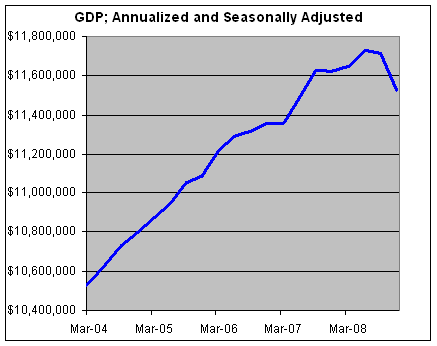
image779.png

Posted by edelfenbein at 9:25 AM

Citi and Feds Reach Deal

The WSJ reports:

Under terms being finalized late Thursday, the Treasury has agreed to convert some of its current holdings of preferred Citigroup shares into common stock, a move that could better protect shareholders against future losses.

As a condition, the government is demanding that the New York company overhaul its board of directors, the people said. Treasury will call for Citigroup's board to be comprised of a majority of independent directors. Chief Executive Vikram Pandit is expected to keep his job under the agreement.

The government will convert its stake only to the extent that Citigroup can persuade private investors such as sovereign wealth funds do so as well, the people said. The Treasury will match private investors' conversions dollar-for-dollar up to $25 billion.

The size of the government's new stake will hinge on how many preferred shares private investors agree to convert into common stock. The Treasury's stake is expected to rise to up to 40% of Citigroup, the people said.

Posted by edelfenbein at 12:31 AM

February 26, 2009

Department of Irony

Good news! Congress has passed House Resolution 180 which supports "the goals and ideals of the third annual America Saves Week."

The vote was 415 to 2, which automatically make me think--who was the other guy besides Ron Paul? It turns out it was Jeff Flake of Arizona.

Here's part of the resolution:

Resolved, That the House of Representatives--
(1) recognizes the importance of savings to financial security;
(2) supports the goals and ideals of `America Saves Week';
(3) acknowledges the tireless efforts of the late Congresswoman Stephanie Tubbs Jones to eliminate predatory lending, increase the nation's savings rate, and improve the overall economic situation of all those residing in the United States; and
(4) requests that the President issue a proclamation calling on the Federal Government, States, localities, schools, nonprofit organizations, businesses, other entities, and the people of the United States to observe the week with appropriate programs and activities with the goal of increasing the savings rates for individuals of all ages and walks of life.

Meanwhile, here's Obama's $3.6 trillion budget.

Posted by edelfenbein at 8:27 PM

The Sinking Mortgage Expert

There's got to be a metaphor in here somewhere.

Posted by edelfenbein at 2:57 PM

Donaldson’s Earnings Streak Set to End

Today is a sad day for lovers of high-quality stocks. Donaldson (DCI) lowered its 2009 EPS forecast to a range of $1.70 to $1.90, which means that the company will almost certainly end its 19-year streak of delivering record earnings.

Donaldson isn’t very well known, but it’s a remarkable company. Their market cap is about $2 billion and they’re in the S&P 400 Mid-Cap Index (^MID). Donaldson is the filtration business which is about as dull as they come.

Last year, the company earned $2.12 a share and the outlook for this year (the fiscal year ends in July) was a range of $2.16 to $2.36. So even before today, the streak looked to be in jeopardy.

For the second quarter, Donaldson earned 43 cents a share which was a mere penny a share more than last year’s Q2. Net income was actually down, but the company has fewer shares outstanding.

I’m not particularly worried about Donaldson. I don’t think they’re in any more trouble than anyone else. I was also happy to see this nugget from their press release:

In addition, since a significant portion of our pay is 'at risk' and paid based on our actual financial performance, executive officer compensation is expected to be reduced by 30 to 50 percent this year due to lower incentive payouts. In addition, officer base salaries have been frozen at January 2008 levels.

Here's a look at Donaldson's stock along with its EPS line in blue. The two axes are scaled at 20 to 1.

image778.png

Here's the earnings streak:

Year.............Sales.................EPS
1990............$422.9...............$0.19
1991............$457.7...............$0.21
1992............$482.1...............$0.23
1993............$533.3...............$0.26
1994............$593.5...............$0.30
1995............$704.0...............$0.37
1996............$758.6...............$0.42
1997............$833.3...............$0.50
1998............$940.4...............$0.57
1999............$944.1...............$0.66
2000............$1,092.3............$0.76
2001............$1,137.0............$0.83
2002............$1,126.0............$0.95
2003............$1,218.3............$1.05
2004............$1,415.0............$1.18
2005............$1,595.7............$1.27
2006............$1,694.3............$1.55
2007............$1,918.8............$1.83
2008............$2,232.5............$2.12

Posted by edelfenbein at 1:26 PM

February 25, 2009

WSJ: Stocks Drop to 50% of Peak

The Wall Street Journal notes that the S&P 500 is now half of its peak. This is the only the second time in history that has happen. The first time was the grandaddy -- 1929.

Bespoke writes:

Ultimately in the bear that started in 1929, the S&P 500 dropped a whopping 86.19% from its all-time high. This low occurred 679 trading days after the all-time high was reached, or about two years and nine months. The current decline has lasted one year and four months.

But by far the most depressing aspect of the 50%+ decline back in the 1930s was how long it took for the index to make a new all-time high. Following the peak in 1929, the S&P 500 went 6,251 trading days before hitting a new all-time high 25 years later.

I'm a glass-is-half-full kind of guy so can't we turn that around? If the market does fall by 86%, think of the buying opportunity!

Posted by edelfenbein at 4:34 PM

P/E Ratios Don’t Need to Be Cyclically Adjusted

The Cyclically Adjusted Price/Earnings Ratio (or CAPE) has been getting a lot of attention lately. It was originally developed by Benjamin Graham, and Robert Shiller has been the latest proponent.

In today’s Financial Times, John Authers writes:

Long-term measures of value are also finely poised. Take the cyclical price/earnings ratio, which compares share prices with average earnings during the past decade, rather than to the most recent year's earnings. This evens out bumps in earnings multiples caused by the profit cycle, and has proved to be a great market timing vehicle - highs and lows for this metric have overlapped almost perfectly with highs and lows for the market.

Robert Shiller, the Yale university economist, has done much to popularise the measure. According to his calculations, it makes US stocks look distinctly cheap. The cyclical p/e, at 13.38 entering this week, is below its average since 1870 of 16.34. It is also at its lowest since 1986.

However, this should not be treated as a short-term buying signal because cyclical p/es have dropped to as low as 6 at the bottom of previous bear markets. This would imply that stocks could fall 50 per cent more, before hitting bottom.

I don’t think adjusting earnings multiples for the economic cycle is a sound idea. The obvious reason is that stock prices are themselves cyclical. I dispute Authors points that CAPE has been “a great market timing vehicle.” In fact, I think it’s been pretty bad.

According to data off Professor Shiller’s website, when the market’s CAPE was below 21, the market returned 1.35% annualized and adjusted for inflation. When it was above 21, the market did slightly better, growing by 1.82% annualized and adjusted for inflation.

For the unadjusted 12-month P/E Ratio, the market grew by 1.79% when it was below 21, and it contracted by -1.29% when it was above 21. In other words, the traditional P/E Ratio told you a lot more about how well the market was valued.

Neither metric, however, comes close to the easiest—momentum. If the market fell in the previous month, then it has continued to fall by an annualized and adjusted for inflation rate of -8.36%. If the market has been rising, then it continues to grow by a rate of 10.09%.

Posted by edelfenbein at 1:40 PM

Ditch the Home Mortgage Deduction?

Ed Glaeser says it's time to do away with the home mortgage interest deduction. His five reasons are:

Problem #1: Subsidizing interest payments encourages people to leverage themselves to the hilt to bet on housing markets.

Problem #2: The deduction pushes up prices in places where the supply of new homes is constrained, as it is in many coastal markets.

Problem #3: The deduction is wildly regressive.

Problem #4: The deduction encourages people to buy larger, single-family detached homes, and that increases carbon emissions and pushes people out of cities.

Problem #5: The home mortgage interest deduction is poorly designed to encourage homeownership, which is, after all, the alleged desideratum.

Posted by edelfenbein at 12:10 PM

The Wisdom of John Pilger

Two quotes from the vanguard of the proletariat:

The New Statesmen, November 15, 1999:

“No one can doubt [the Milosevic’s regime’s] cruelty and atrocities, but comparisons with the Third Reich are ridiculous.”

The Guardian, February 3, 2003:

“The current American elite is the Third Reich of our times.”

Oliver Kamm has more.

Posted by edelfenbein at 10:54 AM

Eaton Vance's Earnings Plunge

Shares of Eaton Vance (EV) are up modestly this morning. The mutual fund company reported Q1 earnings of 21 cents a share, which is a big drop from the 46 cents it made during last year’s first quarter. The silver lining is that Wall Street was expecting 19 cents a share. Revenues dropped from 28%, from $289.8 million to $209.5 million. This is going to be a rough year for Eaton Vance, but few stocks have the long-term record they do. The stock is worth holding, and it also carries a nice 4% yield.

Posted by edelfenbein at 9:51 AM

Dogbert Keeps It Real

Dilbert.com

Posted by edelfenbein at 9:22 AM

"Well That Day of Reckoning Has Arrived"

The president lays out his plans:

First, we are creating a new lending fund that represents the largest effort ever to help provide auto loans, college loans, and small business loans to the consumers and entrepreneurs who keep this economy running.

Second, we have launched a housing plan that will help responsible families facing the threat of foreclosure lower their monthly payments and re-finance their mortgages. It's a plan that won't help speculators or that neighbor down the street who bought a house he could never hope to afford, but it will help millions of Americans who are struggling with declining home values - Americans who will now be able to take advantage of the lower interest rates that this plan has already helped bring about. In fact, the average family who re-finances today can save nearly $2000 per year on their mortgage.

Third, we will act with the full force of the federal government to ensure that the major banks that Americans depend on have enough confidence and enough money to lend even in more difficult times. And when we learn that a major bank has serious problems, we will hold accountable those responsible, force the necessary adjustments, provide the support to clean up their balance sheets, and assure the continuity of a strong, viable institution that can serve our people and our economy.

I understand that on any given day, Wall Street may be more comforted by an approach that gives banks bailouts with no strings attached, and that holds nobody accountable for their reckless decisions. But such an approach won't solve the problem. And our goal is to quicken the day when we re-start lending to the American people and American business and end this crisis once and for all.

I intend to hold these banks fully accountable for the assistance they receive, and this time, they will have to clearly demonstrate how taxpayer dollars result in more lending for the American taxpayer. This time, CEOs won't be able to use taxpayer money to pad their paychecks or buy fancy drapes or disappear on a private jet. Those days are over.

Still, this plan will require significant resources from the federal government - and yes, probably more than we've already set aside. But while the cost of action will be great, I can assure you that the cost of inaction will be far greater, for it could result in an economy that sputters along for not months or years, but perhaps a decade. That would be worse for our deficit, worse for business, worse for you, and worse for the next generation. And I refuse to let that happen.

I understand that when the last administration asked this Congress to provide assistance for struggling banks, Democrats and Republicans alike were infuriated by the mismanagement and results that followed. So were the American taxpayers. So was I.

So I know how unpopular it is to be seen as helping banks right now, especially when everyone is suffering in part from their bad decisions. I promise you - I get it.

Posted by edelfenbein at 12:46 AM

Home Prices Post Biggest Drop in 21 Years

From BusinessWeek:

The S&P/Case-Shiller U.S. National Home Price Index plunged 18.2% during the final quarter of 2008, the biggest annual decline in the closely watched index's 21-year history.

Separately, for the month of December alone the Case-Shiller 20-City Composite Index fell 18.5% compared with the previous December, also a record decline. The most severe declines were in Phoenix, Las Vegas, and San Francisco, which all dropped by more than 30% in December compared with December 2007.

But the financial crisis has helped to spread the pain across the nation. Other cities that were holding up relatively well until recently are now seeing a quickening pace of declines. The year-over-year price decline in the New York metro area, which is at the center of the financial meltdown, was 9.2% in December, compared with 8.6% in November and 7.7% in October. Home prices in Charlotte, a major banking hub, fell by 7.2% in December. In October, Charlotte prices fell at just 4.4% compared with a year earlier. And home prices were actually increasing on an annual basis as recently as March 2007.

Posted by edelfenbein at 12:42 AM

Market Returns by Days of the Week

Here’s a look at market returns by days of the week. I did this last year but now I have more data including Saturdays. There was actually trading on Saturdays up to the early 1950s.

image776.png

Here’s the breakdown: From 1932 through Monday, Wednesday was the best day of the week. In fact, Wednesday beat the four days (and Saturday) combined. Not including dividends, the S&P 500 returned 2,179% on Wednesdays, 502% on Thursdays, 244% on Tuesdays, 175% on Thursdays and an ugly -98.5% on Mondays.

Let me add what I hope is an obvious point—these stats don’t mean anything. It’s just fun trivia. You really can’t build a workable trading strategy around these numbers. We’re also talking about results of nearly 80 years of data. Even starting 20 years ago, Monday suddenly becomes the second-best day.

A few other points to mention. When Saturday trading was around, it was a great day. The market returned 389% on Saturdays from 1932 to 1952. Plus, even when there was Saturday trading, the market was often closed on Saturdays over the summer.

Statistically, the only really noticeable standout is the awful performance on Mondays. As I said, even that has diminished in recent years.

As strong as Wednesdays have been, they recently came through an awful stretch. The S&P 500 dropped on 10 straight Wednesdays this past fall. And they were big drops—the losing streak knocked one-third off the Wednesday’s historic return.

The S&P 500 is in the negative on Monday, Tuesday, Thursday and Saturday. The market's entire return has come just on Wednesday and Friday. Here's a look at Wednesday against the rest of the week:

image777.png

Posted by edelfenbein at 12:06 AM

February 23, 2009

Happy Fun Day

Stock-Market Crashes and Depressions by Robert J. Barro and Jose F. Ursua

Long-term data for 25 countries up to 2006 reveal 195 stock-market crashes (multi-year real returns of -25% or less) and 84 depressions (multi-year macroeconomic declines of 10% or more), with 58 of the cases matched by timing. The United States has two of the matched events - the Great Depression 1929-33 and the post-WWI years 1917-21, likely driven by the Great Influenza Epidemic. 45% of the matched cases are associated with war, and the two world wars are prominent. Conditional on a stock-market crash, the probability of a minor depression (macroeconomic decline of at least 10%) is 30% and of a major depression (at least 25%) is 11%. In a non-war environment, these probabilities are lower but still substantial - 20% for a minor depression and 3% for a major depression. Thus, the stock-market crashes of 2008-09 in the United States and other countries provide ample reason for concern about depression. In reverse, the probability of a stock-market crash is 69%, conditional on a depression of 10% or more, and 91% for 25% or more. Thus, the largest depressions are particularly likely to be accompanied by stock-market crashes, and this finding applies equally to non-war and war events. We allow for flexible timing between stock-market crashes and depressions for the 58 matched cases to compute the covariance between stock returns and an asset-pricing factor, which depends on the proportionate decline of consumption during a depression. If we assume a coefficient of relative risk aversion around 3.5, this covariance is large enough to account in a familiar looking asset-pricing formula for the observed average (levered) equity premium of 7% per year. This finding complements previous analyses that were based on the probability and size distribution of macroeconomic disasters but did not consider explicitly the covariance between macroeconomic declines and stock returns.

After reading that, here's something that might cheer you up.

Posted by edelfenbein at 9:24 PM

Zero for 9,000

Mebane Faber reports that out of Morningstar’s database of 9,000 stock mutual funds, not one is up for the year.

Oh, and it's still February.

Posted by edelfenbein at 5:11 PM

The S&P 500 Just Above Intra-Day Low

I noticed that the S&P 500 was hanging at 755, which always make me think of Hank Aaron. The index got as low as 749.69 this morning. The intra-day low from November 21 was 741.02.

image774.png

Posted by edelfenbein at 2:35 PM

It Had to Happen Sooner or Later

From the NYT:

Nigerian Accused in Scheme to Swindle Citibank

To carry out the elaborate scheme, prosecutors in New York said on Friday, the man, identified as Paul Gabriel Amos, 37, a Nigerian citizen who lived in Singapore, worked with others to create official-looking documents that instructed Citibank to wire the money in two dozen transactions to accounts that Mr. Amos and the others controlled around the world.

The money came from a Citibank account in New York held by the National Bank of Ethiopia, that country’s central bank. Prosecutors said the conspirators, contacted by Citibank to verify the transactions, posed as Ethiopian bank officials and approved the transfers.

Posted by edelfenbein at 8:16 AM

February 22, 2009

U.S. Eyes Large Stake in Citi

From the WSJ:

Under the scenario being considered, a substantial chunk of the $45 billion in preferred shares held by the government would convert into common stock, people familiar with the matter said. The government obtained those shares, equivalent to a 7.8% stake, in return for pumping capital into Citigroup.

The move wouldn't cost taxpayers additional money, but other Citigroup shareholders would see their shares diluted. A larger ownership stake by the federal government could fuel speculation that other troubled banks will line up for similar agreements.

image773.png

Posted by edelfenbein at 8:57 PM

February 20, 2009

Sign of the Times

Rep. Michael Capuano to the bank executives last week:

Basically you come to us today on your bicycles after buying girl scout cookies and helping out Mother Teresa, telling us "We're sorry, we didn't mean it, we won't do it again, trust us"...I don't really have a question, but I was told that I can use my five minutes.

In other news:

Girl Scout cookie sales crumbling

Posted by edelfenbein at 10:52 PM

Velkomme to Sweden

I hate saying this, but we have to stop kidding ourselves—it’s time to nationalize our rotten banks. I’m not really pro nationalization but I’m anti stupidity and that’s what we’ve been doing up till now.

My normal fear of nationalizing is that it would lead to a moribund industry incapable of turning a profit. Well, we're already there.

My only hope is that it’s done quickly. Very quickly. Before anyone notices.

Posted by edelfenbein at 1:32 PM

Blast From the Past

With the market at new lows, it's time to recall some predictions. This is from January 2, 2008:

Christian broadcaster Pat Robertson, who has made predicting the future an annual tradition, predicts a recession and a major stock market upheaval are on their way for the United States.

Aside from a recession this year, Robertson suggested Wednesday that Americans will be paying much more for gas at the pump as the price of a barrel of oil rises by 50 percent in the coming months.

Specifically, he said oil would reach $150 a barrel - the price hit $100 on Wednesday - with the dollar continuing to lose value in 2008.

"I also believe the Lord was saying by 2009, maybe 2010, there's going to be a major stock market crash," said Robertson, who is a millionaire businessman as well as an evangelical leader.

Not bad. Oil topped out at $147. The stuff about nuclear war? Well, unfortunately, that didn't pan out.

Still, that's some pretty good predictioning from Pat. No wonder he came in second in the Iowa caucus.

Posted by edelfenbein at 1:04 PM

Paragraph of the Day

From Arnold Kling:

Starting last September, our country has gone through six months that shook the world. We have abandoned free markets. We have abandoned democracy, in the sense of having policies that reflect the popular will. The United States has become a technocratic dictatorship.

Posted by edelfenbein at 12:57 PM

How Things Have Changed

James Surowiecki from January 6:

As I showed yesterday, investors overwhelmingly supported the Paulson plan: it was only when it was killed, that stock prices really started their downward spiral. And it was only after Obama unveiled his economic team and made clear how big his stimulus plans were that the market began its sharp recovery (the S. & P. 500 is now up twenty-five per cent since Nov. 20th).

Surowiecki made what I call, the “Daniel Gross Mistake” which is to read partisan political opinions from stock market returns. January 6 turned out to be the exact near-term high. Since then, the S&P 500 is down 16.7%.

Posted by edelfenbein at 1:18 AM

Stocks Hate the Dollar

A strong dollar used to be good for U.S. stocks, but since the credit crisis broke, that relationship has completely reversed itself.

Here are some numbers: Starting from the beginning of 1999 and going through September 17, 2008, on days when the dollar has rallied against the euro, the S&P 500 was up an annualized rate of 34.9%. But when the dollar fell against the euro or stayed the same, the S&P 500 dropped by an annualized rate of 26.7%. Stocks clearly liked a strong dollar.

Since September 18, the numbers are striking. On days when the dollars has rallied against the euro, the S&P 500 has fallen at an annualized rate of 95.7%. When the dollar has lost ground to the euro, the S&P is up by an amazing 747.5% annualized. Of course, that’s a much smaller sample size, but the early evidence suggests that stock investors now favor a weaker greenback.

Posted by edelfenbein at 12:46 AM

February 19, 2009

New York Times Suspended Dividend.

Not a big surprise:

The publisher said in a statement today it suspended its quarterly dividend of 6 cents a share to help reduce debt, three months after slashing the payout. It joins McClatchy Co., owner of the Sacramento Bee, and Media General Inc. in halting dividends.

The suspension will save New York Times about $34.5 million annually, based on shares outstanding. The publisher is cutting jobs and selling assets as advertising dwindles. It’s seeking buyers for its stake in the Boston Red Sox baseball team and is in talks about a sale-leaseback on its Manhattan headquarters.

“It’s going to be very challenging for them to generate much free cash flow even after this cut,” said Mike Simonton, a credit analyst at Fitch Ratings. “It’s certainly a prudent move to preserve liquidity in light of the difficult credit market and their heavy debt burden.”

New York Times fell 20 cents, or 5.4 percent, to $3.51 at 4:15 p.m. in New York Stock Exchange composite trading, before the announcement. The shares have declined 82 percent in the past 12 months.

“Today’s decision provides the company with additional financial flexibility given the current economic environment and the uncertain business outlook,” Chairman Arthur Sulzberger Jr. said in the statement. The Ochs-Sulzberger family controls New York Times and has benefited from the dividend on its Class B stock.

Here's the Times opining against cutting dividend taxes in 2003.

Posted by edelfenbein at 7:29 PM

Dow Closes at 6-Year Low

The Dow closed today at 7,465.95, its lowest close since October 9, 2002. The Dow is off 47% from its high of 14164.53 which came on October 9, 2007.

The Dow is now lower than where it was on June 9, 1997.

image772.png


Posted by edelfenbein at 4:35 PM

Irish Bank Workers Spat Upon

I hope your day is going better than this:

Irish bank workers are being spat at and threatened with physical violence by customers who are incensed at scandals in the industry, a union said on Thursday.

The IBOA, which represents over 20,000 workers in Ireland's financial sector, said staff at banks had been facing growing abuse.

"We are seeing this kind of abuse not just in the working day but even socially in the evening," said IBOA general secretary Larry Broderick.

Same thing happened to John Rambo after the Nam.

(Via: Alea.)

Posted by edelfenbein at 4:14 PM

Santelli Calls for Tea Party

Grab your pitchforks. We have a leader.

Posted by edelfenbein at 2:00 PM

February 18, 2009

Speaketh thy Beard

Ben at the National Press Club. Here's an excerpt:

Some observers have expressed the concern that, by expanding its balance sheet, the Federal Reserve will ultimately stoke inflation. The Fed's lending activities have indeed resulted in a large increase in the reserves held by banks and thus in the narrowest definition of the money supply, the monetary base. However, banks are choosing to leave the great bulk of their excess reserves idle, in most cases on deposit with the Fed. Consequently, the rates of growth of broader monetary aggregates, such as M1 and M2, have been much lower than that of the monetary base. At this point, with global economic activity weak and commodity prices at low levels, we see little risk of unacceptably high inflation in the near term; indeed, we expect inflation to be quite low for some time.

However, at some point, when credit markets and the economy have begun to recover, the Federal Reserve will have to moderate growth in the money supply and begin to raise the federal funds rate. To reduce policy accommodation, the Fed will have to unwind some of its credit-easing programs and allow its balance sheet to shrink. To some extent, this unwinding will happen automatically, as improvements in credit markets should reduce the need to use Fed facilities. Indeed, where possible, we have tried to set lending rates and other terms at levels that are likely to be increasingly unattractive to borrowers as financial conditions normalize. In addition, some programs--those authorized under the Federal Reserve's so-called 13(3) authority, which requires a finding that conditions in financial markets are "unusual and exigent"--will, by law, have to be phased out once credit market conditions substantially normalize. However, the principal factor determining the timing and pace of that process will be the Federal Reserve's assessment of the condition of credit markets and the prospects for the economy.

A significant shrinking of the balance sheet can be accomplished relatively quickly, as a substantial portion of the assets that the Federal Reserve holds--including loans to financial institutions, temporary central bank liquidity swaps, and purchases of commercial paper--are short-term in nature and can simply be allowed to run off as the various programs and facilities are scaled back or shut down. As the size of the balance sheet and the quantity of excess reserves in the system decline, the Federal Reserve will be able to return to its traditional means of making monetary policy--namely, by setting a target for the federal funds rate.

Importantly, the management of the Federal Reserve's balance sheet and the conduct of monetary policy in the future will be made easier by the recent congressional action to give the Fed the authority to pay interest on bank reserves. Because banks should be unwilling to lend reserves at a rate lower than they can receive from the Fed, the interest rate the Fed pays on bank reserves should help to set a floor on the overnight interest rate. Moreover, other tools are available or can be developed to improve control of the federal funds rate during the exit stage. For example, the Treasury could resume its recent practice of issuing supplementary financing bills and placing the funds with the Federal Reserve; the issuance of these bills effectively drains reserves from the banking system, thereby improving monetary control. As we consider new programs or the expansion of old ones, the Federal Reserve will carefully weigh the implications for the exit strategy. And we will take all necessary actions to ensure that the unwinding of our programs is accomplished smoothly and in a timely way, consistent with meeting our obligation to foster maximum employment and price stability.

Posted by edelfenbein at 1:51 PM

Analysts Were Way Off

I prefer to use trailing Price/Earning Ratios, though it's not the only metric I use, when looking at stocks. The problem with forecasts is how far wrong you can be. The guys at Bespoke have tracked how poorly analysts did this past earnings quarter. Just four-and-a-half months ago, Wall Street saw a rosy future.

6a00d8349edae969e2011278f9a1c328a4-800wi.png

It's actually worse than that. If I understand the chart correctly, it shows the sum of the previous four quarter earnings. Wall Street analysts weren't even close this earnings quarter.

Posted by edelfenbein at 12:29 PM

Hedgies to Consolidate

From Bloomberg:

Hedge funds are looking to consolidate after record investment losses and customer withdrawals cut assets by 37 percent in the second half of 2008, squeezing their main source of fees. As many as 40 percent of the 9,000 hedge funds and funds of funds may disappear in the next two years, according to Karamvir Gosal, a New York-based investment banker at Jefferies Putnam Lovell. While some will return money to investors and shut their doors, mergers and acquisitions will be more prevalent than in the past.

“The conditions at the moment lend themselves to a surge in M&A activity in the hedge-fund world,” said Udi Grofman, a partner at Schulte Roth & Zabel LLP, a New York-based law firm that advises hedge funds. “We’ve already seen some players looking to take advantage of the low valuations and get their foot in the door, particularly when it comes to managers specialized in areas that are likely to be active in the near future, like mortgages and distressed debt.”

Posted by edelfenbein at 12:25 PM

Yesterday's Close

The Dow finished yesterday at 7,552.60 just 0.31 point above the November 20th close which was the lowest close since March 2003.

Posted by edelfenbein at 12:23 PM

February 17, 2009

New York Times’ Share Price Less Than Sunday Newspaper Price

Check out this very ugly chart:

image770.png

Shares of NYT (NYT) dropped 29 cents today to close at $3.77. The Sunday paper goes for $4 at the newsstand.

Maybe they could save costs by printing the paper on their stock certificates.

Posted by edelfenbein at 10:46 PM

Yes We Can!

Posted by edelfenbein at 4:29 PM

Obama Signs

Congratulations bill, you're a law.

President Obama on Tuesday signed the $787 billion American Recovery and Reinvestment Act into law.

But he's far from being able to declare "mission accomplished."

"Today does not mark the end of our economic troubles," Obama said before signing the bill at the Denver Museum of Nature and Science. "But it does mark the beginning of the end -- the beginning of what we need to do to create jobs for Americans scrambling in the wake of layoffs; to provide relief for families worried they won't be able to pay next month's bills; and to set our economy on a firmer foundation."

Posted by edelfenbein at 3:38 PM

Fourth-Quarter Earnings

According to the latest numbers I have from S&P, fourth-quarter S&P 500 earnings reports are 85% in. The number for operating earnings looks to be $5.77 which is down from $15.22 from the fourth quarter of 2007. The “as reported” earnings negative.

I doubt operating earnings will crack $50 for all of 2009. Here’s a look at the S&P 500 and operating earnings for the past few years.

image769.png

The black line is the S&P 500 and it follows the left scale. The gold line is operating earnings and it follows the right scale. The two lines are scaled at a ratio of 16 to 1 so when the lines cross, the P/E Ratio is exactly 16.

What's interesting is that the earnings multiple hasn't changed much over the past few years. You can also see how much of 90s rally was due to multiple expansion.

Posted by edelfenbein at 2:15 PM

SEC Charges Stanford Financial in $8B Fraud

Finally:

The Securities and Exchange Commission today charged a prominent Texas businessman and three of his companies with an $8 billion fraud in the sale of certificates of deposit. The case appears to mark one of the largest alleged frauds by a money manager in U.S. history.

Robert Allen Stanford and his companies sold $8 billion of CDs -- guaranteed fixed-income investment products -- to investors by "promising improbable and unsubstantiated high interest rates," the SEC said in a statement. The agency named in its complaint Stanford International Bank Ltd., based in Antigua, and related firms based in Houston.

The SEC said the firms falsely claimed that their deposits were safe, that more than 20 analysts monitor the investments, and that yearly audits were being conducted.

In addition, one of Stanford's companies falsely told customers that it was not exposed to the $50 billion Ponzi scheme allegedly orchestrated by Bernard L. Madoff, the SEC said.

Posted by edelfenbein at 1:44 PM

Shoichi Nakagawa at the G7

If you haven't seen it, here's Shoichi Nakagawa sounding a bit drunk at the G7 meeting.

He's resigned.

Posted by edelfenbein at 1:39 PM

Medtronic’s Earnings

Unlike most of the market, Medtronic (MDT) is having a good day today. The stock is up on decent earnings.

For the quarter ended Jan. 23, Medtronic reported net income of $723 million, or 65 cents a share, up from $77 million, or 7 cents, a year earlier. Excluding acquisition-related charges, earnings rose to 71 cents a share from 63 cents.

Net sales rose 2.6% to $3.49 billion, or 6% excluding foreign-currency changes.

Analysts surveyed by Thomson Reuters were expecting earnings, excluding items, of 70 cents on revenue of $3.51 billion.

This is good to see. Last quarter’s performance was not comforting. Here's a look at MDT's sales and earnings for the past few quarters:

Quarter...........EPS.............Sales
Jul-01............$0.28...........$1,455.70
Oct-01...........$0.29...........$1,571.00
Jan-02...........$0.30...........$1,592.00
Apr-02...........$0.34...........$1,792.00
Jul-02............$0.32...........$1,713.90
Oct-02...........$0.34...........$1,891.00
Jan-03...........$0.35...........$1,912.50
Apr-03...........$0.40...........$2,148.00
Jul-03............$0.37...........$2,064.20
Oct-03...........$0.39...........$2,163.80
Jan-04...........$0.40...........$2,193.80
Apr-04...........$0.48...........$2,665.40
Jul-04............$0.43...........$2,346.10
Oct-04...........$0.44...........$2,399.80
Jan-05...........$0.46...........$2,530.70
Apr-05...........$0.53...........$2,778.00
Jul-05............$0.50...........$2,690.40
Oct-05...........$0.54...........$2,765.40
Jan-06...........$0.55...........$2,769.50
Apr-06...........$0.62...........$3,066.70
Jul-06............$0.55...........$2,897.00
Oct-06...........$0.59...........$3,075.00
Jan-07...........$0.61...........$3,048.00
Apr-07...........$0.66...........$3,280.00
Jul-07............$0.62...........$3.127.00
Oct-07...........$0.58...........$3,124.00
Jan-08...........$0.63...........$3,405.00
Apr-08...........$0.78...........$3,860.00
Jul-08............$0.72...........$3,706.00
Oct-08...........$0.67...........$3,570.00
Jan-09...........$0.71...........$3,494.00

Posted by edelfenbein at 12:57 PM

February 13, 2009

Michael Moore Needs Help

From MichaelMoore.com:

Friends,

I am in the middle of shooting my next movie and I am looking for a few brave people who work on Wall Street or in the financial industry to come forward and share with me what they know. Based on those who have already contacted me, I believe there are a number of you who know "the real deal" about the abuses that have been happening. You have information that the American people need to hear. I am humbly asking you for a moment of courage, to be a hero and help me expose the biggest swindle in American history.

All correspondence with me will be kept confidential. Your identity will be protected and you will decide to what extent you wish to participate in telling the greatest crime story ever told.

The important thing here is for you to step up as an American and do your duty of shedding some light on this financial collapse. A few good people have already come forward, which leads me to believe there are many more of you out there who know what's going on. Here's your chance to let your fellow citizens in on the truth.

If you have any info that would help, please contact me at my private email address: bailout@michaelmoore.com.

First, I hate to tell Michael this but the story has already been exposed. Secondly, is bailout@michaelmoore.com really your private e-mail?

Posted by edelfenbein at 11:06 AM

The Stimulus Bill Reaches 1,434 Pages

Here's the complete text of the economic stimulus bill. All 1,434 pages.

Posted by edelfenbein at 10:09 AM

February 12, 2009

Happy 200th Birthday Lincoln and Darwin

I just finished watching an interesting BBC series, The Voyage of Charles Darwin. I had no idea how important Darwin's journey on the Beagle was to his work. He was at sea for five years.

Posted by edelfenbein at 6:47 AM

February 11, 2009

James Wolcott Admits Defeat in an Argument

In other words, he calls Arnold Kling a racist:

A few days ago notice was taken (I'm practicing my passive voice) of economist Arnold Kling's contention that the Obama stimulus plan was actually "reparations" in disguise. Given the complexion of our new president, this was interpreted as injecting a needless bit of race-baiting into the economic debate, raising the specter of a million Jeremiah Wrights marching on the capital mall with outstretched hands, demanding their cut of the action.

One of the great advantages of seeing the race card played is that it tells me which side realizes it's losing the argument.

Thanks, James. You saved folks a lot of time.

Posted by edelfenbein at 11:13 PM

Bailout for Bailout Nation

Yesterday, Jesse Eisinger reported that McGraw Hill dropped Barry Ritholtz's book, Bailout Nation. Barry said that it’s due to his harsh treatment of the ratings agencies (Standard & Poor's is owned by McGraw Hill).

McGraw Hill says that it’s dropping the book due to editorial conflicts. This strikes me as an exceedingly lame excuse. Jesse quotes Barry, “All the conversations I had with them, they made apparent this was all about S&P's role as sister company.”

Felix says that the relationship probably fizzled due to chemistry as well, and I think he’s right. McGraw Hill certainly didn’t want the book to be dropped. I think they underestimated dealing with a blogger like Barry who’s not going to let himself get pushed around. They pushed too hard and he walked.

The bottom line is that McGraw Hill is making a big mistake. The book was going to be a hit and now it’s going to be an even bigger hit. My bet is that a publisher will pick it up by the end of the week.

Posted by edelfenbein at 11:27 AM

P.J. O’Rourke on the Death of Capitalism

From the Financial Times:

The free market is dead. It was killed by the Bolshevik Revolution, fascist dirigisme, Keynesianism, the Great Depression, the second world war economic controls, the Labour party victory of 1945, Keynesianism again, the Arab oil embargo, Anthony Giddens’s “third way” and the current financial crisis. The free market has died at least 10 times in the past century. And whenever the market expires people want to know what Adam Smith would say. It is a moment of, “Hello, God, how’s my atheism going?”

Adam Smith would be laughing too hard to say anything. Smith spotted the precise cause of our economic calamity not just before it happened but 232 years before – probably a record for going short.

“A dwelling-house, as such, contributes nothing to the revenue of its inhabitant,” Smith said in The Wealth of Nations. “If it is lett [sic] to a tenant for rent, as the house itself can produce nothing, the tenant must always pay the rent out of some other revenue.” Therefore Smith concluded that, although a house can make money for its owner if it is rented, “the revenue of the whole body of the people can never be in the smallest degree increased by it”. [281]*

Smith was familiar with rampant speculation, or “overtrading” as he politely called it.

Posted by edelfenbein at 10:28 AM

February 10, 2009

The Geithner Plan

The Washington Post:

Treasury Secretary Timothy F. Geithner this morning announced an aggressive and multi-faceted program that could commit $1.5 trillion or more in public and private funds to rescue banks and financial institutions and thaw frozen credit markets.

The gravity of the financial crisis confronting the Obama administration was brought into stark focus as Geitner unveiled a financial stability plan that would more closely scrutinize the risks banks are facing and offer public and private capital to those that need it; create a fund, with a starting value of $500 billion, to buy up toxic real estate loans; and commit up to $1 trillion to reopen lending markets for consumer, student, small business, auto and commercial loans.

Geithner said the administration was also working on a plan to address the nation's housing crisis by bringing down mortgage payments and reducing interest rates. President Obama, appearing at a town hall meeting in Fort Myers, Fla., said he would personally outline the details of that plan within the next few weeks.

Geithner did not ask Congress for more funds than the roughly $350 billion that remain in the Treasury Department's original rescue package for the financial system. He said the balance of the money for the stability plan would, for now, come from other government agencies, such as the Federal Reserve, as well as private-sector contributions.

"To get credit flowing again, to restore confidence in our markets, and restore the faith of the American people, we are fundamentally reshaping the government's program to repair the financial system," Geithner said. " . . . We believe that the policy response has to be comprehensive, and forceful. There is more risk and greater cost in gradualism than in aggressive action."

Posted by edelfenbein at 2:01 PM

February 9, 2009

The Black Swan Song

I’ve already devoted too much space to Nassim Taleb and his Black Swan nonsense. It’s a mystery as to why he’s considered such a visionary. But now people are claiming he’s one of the people who saw the financial crisis coming. I’ve read both of his awful books and he never made such a prediction.

Taleb is a Johnny One-Note. He can talk about how people have trouble with risk. Fine, got it. But when we go to any other topic, he can’t deal. He always goes into his Napoleon Dynamite routine where he’s brilliant and everyone else is a “freakin’ idiot!”

Notice in this clip when he’s asked what to do now and he has no clue. His answer is to fire Bernanke. Yep, that’ll solve things. Strip away the attitude and vindictiveness, and there’s nothing to him.

Posted by edelfenbein at 4:01 PM

SNL: Pelosi and Reid

Posted by edelfenbein at 3:41 PM

Lloyd Blankfein in FT

Here's a sample of Lloyd Blankfein in today's Financial Times:

As policymakers and regulators begin to consider the regulatory actions to be taken to address the failings, I believe it is useful to reflect on some of the lessons from this crisis.

The first is that risk management should not be entirely predicated on historical data. In the past several months, we have heard the phrase “multiple standard deviation events” more than a few times. If events that were calculated to occur once in 20 years in fact occurred much more regularly, it does not take a mathematician to figure out that risk management assumptions did not reflect the distribution of the actual outcomes. Our industry must do more to enhance and improve scenario analysis and stress testing.

Second, too many financial institutions and investors simply outsourced their risk management. Rather than undertake their own analysis, they relied on the rating agencies to do the essential work of risk analysis for them. This was true at the inception and over the period of the investment, during which time they did not heed other indicators of financial deterioration.

The most provocative part is here:

The percentage of the discretionary bonus awarded in equity should increase significantly as an employee’s total compensation increases. An individual’s performance should be evaluated over time so as to avoid excessive risk-taking. To ensure this, all equity awards need to be subject to future delivery and/or deferred exercise. Senior executive officers should be required to retain most of the equity they receive at least until they retire, while equity delivery schedules should continue to apply after the individual has left the firm.

Posted by edelfenbein at 10:31 AM

February 8, 2009

The Money Song

Posted by edelfenbein at 2:57 PM

February 6, 2009

Mapping Bernie's Victims

Zero Hedge has some great maps showing where Bernie Madoff's victims are. Why is it always the rich people who have all the money?

Posted by edelfenbein at 3:27 PM

Just Get it Over With

Another brilliant graph from Jessica at Indexed:

card2017.jpg

Posted by edelfenbein at 9:59 AM

Today's Job Report

Holy crap! Unemployment jumped to 7.6% last month, the worst since September 1992. Nonfarm payrolls plunged by 598,000. The economy has lost jobs for 13 straight months. Since the recession began, the economy has lost 3.6 million jobs--half of that came in the last three months of 2008.

Here's a look at the unemployment rate since 1995:

image766.png

Here's another measure of employment, the number of employed as a percent of the total population.

image767.png

The traditional unemployment rate only counts folks "in the labor force" so if you're not looking for a job, you're not counted. Of course, people stop looking for jobs when there are no jobs so I really don't get that one.

How's this for a scary number. If the employed/population rate was at the level it was in April 2000, there would be nearly 10 million more jobs today. Wow.

I'm not a big fan of the nonfarm payroll report because it's constantly getting revised. Today, the government revised all the monthly numbers for 2008. Can you guess if they were revised better or worse?

image768.png

Actually, the numbers for January and February were a tiny bit better, most everything else is a lot worse.

Posted by edelfenbein at 8:29 AM

February 5, 2009

The Action Americans Need

The president makes his case in today's WaPo:

This plan is more than a prescription for short-term spending -- it's a strategy for America's long-term growth and opportunity in areas such as renewable energy, health care and education. And it's a strategy that will be implemented with unprecedented transparency and accountability, so Americans know where their tax dollars are going and how they are being spent.

In recent days, there have been misguided criticisms of this plan that echo the failed theories that helped lead us into this crisis -- the notion that tax cuts alone will solve all our problems; that we can meet our enormous tests with half-steps and piecemeal measures; that we can ignore fundamental challenges such as energy independence and the high cost of health care and still expect our economy and our country to thrive. (Has anybody said this?)

I reject these theories, and so did the American people when they went to the polls in November and voted resoundingly for change. They know that we have tried it those ways for too long. And because we have, our health-care costs still rise faster than inflation. Our dependence on foreign oil still threatens our economy and our security. Our children still study in schools that put them at a disadvantage. We've seen the tragic consequences when our bridges crumble and our levees fail.

Every day, our economy gets sicker -- and the time for a remedy that puts Americans back to work, jump-starts our economy and invests in lasting growth is now.

Now is the time to protect health insurance for the more than 8 million Americans at risk of losing their coverage and to computerize the health-care records of every American within five years, saving billions of dollars and countless lives in the process.

Now is the time to save billions by making 2 million homes and 75 percent of federal buildings more energy-efficient, and to double our capacity to generate alternative sources of energy within three years.

Now is the time to give our children every advantage they need to compete by upgrading 10,000 schools with state-of-the-art classrooms, libraries and labs; by training our teachers in math and science; and by bringing the dream of a college education within reach for millions of Americans.

And now is the time to create the jobs that remake America for the 21st century by rebuilding aging roads, bridges and levees; designing a smart electrical grid; and connecting every corner of the country to the information superhighway.

These are the actions Americans expect us to take without delay. They're patient enough to know that our economic recovery will be measured in years, not months. But they have no patience for the same old partisan gridlock that stands in the way of action while our economy continues to slide.

Posted by edelfenbein at 2:33 PM

Russia Is Trying to Shore Up the Ruble By Giving Banks Money to Bet Against the Ruble

Or something like that.

Russia’s central bank is exacerbating the ruble’s 35 percent plunge since August, even as it struggles to defend the exchange rate, by providing loans to banks that speculate on the currency, say Alfa Bank and UniCredit SpA.

Bank Rossii lent 7.7 trillion rubles ($214 billion) in overnight and seven-day loans secured with bonds or other collateral in the 16 trading days last month, about double the 4.8 trillion rubles provided in so-called repurchase auctions in December, central bank data show. The ruble lost 18 percent against the dollar in January. It weakened today beyond the lower limit that the central bank said it will defend.

“A significant amount, if not all, of the speculative attacks on the ruble are funded by the central bank itself,” said Vladimir Osakovsky, Moscow-based economist for UniCredit, Italy’s largest bank.

Prime Minister Vladimir Putin praised the central bank’s “gradual devaluation” policy in a Bloomberg Television interview Jan. 25, saying it avoided a repeat of the financial crisis a decade ago when the ruble plunged as much as 29 percent in a day as the government defaulted on $40 billion of debt. Jim Rogers, chairman of Rogers Holdings, said today that Russia has become “unstable” and may break apart. He’s considering betting against the ruble because of central bank mismanagement.

Policy makers are trying to stop speculators from driving down the currency, which makes it more expensive for borrowers to pay back debt and fuels inflation, at the same time it seeks to hold down interest rates to keep the economy from contracting for the first time since 1998. Russia’s inflation rate rose in January for the first time in five months to 13.4 percent as the weakening ruble pushed up the cost of imports.

Posted by edelfenbein at 12:54 PM

Slate's Curious Economics

In Slate, Dan Gross attacks "nutso" claims the government doesn't creates jobs. He singles out Michael Steele's for saying, "Let's get this notion out of our heads that the government create jobs. Not in the history of mankind has the government ever created a job."

Gross writes: "These claims are so peculiar that it's hard to know where to begin. Contrary to Steele's assertion, in the history of mankind, the government has in fact created many, many jobs (including the one he held for a few years: lieutenant governor of Maryland)."

This is news to me. This morning, the Labor Department reported that initial jobless claims rose by 35,000 to reach 626,000, a 26-year high. So let's make all those folks the lieutenant governor of Maryland.

Problem solved.

Posted by edelfenbein at 10:42 AM

February 4, 2009

Trouble With Double Negatives

"One cannot underestimate how widely admired Tom Daschle is in Washington for his integrity."

- David Gergen

Think about that statement for a bit. Gergen says the exact opposite of what he means to say which would have been a false statement that would have been ironically true.

After that, the sentence disappears into a post-modernist vortex.

Posted by edelfenbein at 2:11 PM

Fiserv’s Earnings

Fiserv’s (FISV) earnings took a big hit last quarter due to a loss on the sale of part of its business. Fiserv made 39 cents a share compared with 58 cents a share for last year’s fourth-quarter. Once you toss out all the charges and one-time stuff, FISV made 85 cents a share which was just a penny below the Street’s estimate. Revenues dropped 4% to $1.06 billion from $1.11 billion.

For the year, adjusted EPS was up 23% to $3.29 compared with $2.67 in 2007. For this year, Fiserv sees adjusted EPS rising 10% to 14% which works out to a range of $3.61 to $3.75.

big.chart020409b.gif

The stock has basically followed the stock market even though its earnings outlook is far brighter.

Posted by edelfenbein at 1:41 PM

Quote of the Day

David Viniar, Goldman's CFO:

“I would not pick up the Wall Street Journal every morning looking for the big Goldman Sachs acquisition because I think you will be disappointed,” he said. “We don’t really like or know the retail business and I don’t expect that to change too much.”

I think he could have expressed the same thought without saying he didn't like retail brokerage.

Posted by edelfenbein at 12:18 PM

February 3, 2009

A for Effort

Maybe I'm wrong, but I admire this.

A bumbling New York Post reporter was busted Saturday after he tried to sweet-talk his way into Bernie Madoff's upper East Side penthouse, police said.

Josh Saul, 25, claimed to be a real-estate broker when he entered the Ponzi scheme swindler's building at 133 E. 64th St. around 1 p.m., police said. "He misrepresented himself," a police source said.

Saul was escorted upstairs by a doorman and was near the front door of the $50 billion scam artist's $7 million duplex when he was unmasked, cops said.

The hapless hack's weekend at Bernie's did not end with the exclusive interview he was angling for. Instead, he was arrested, charged with trespassing and issued a summons.

Saul, 25, of Greenwich Village, has been working at the Post for about a year. He is also the dubious star of a Web site that includes photos of him dancing in his underwear, chugging beer from a keg, wearing a woman's wig and balancing objects on his head.

Well, that part could damage the credibility of our media.

Posted by edelfenbein at 4:05 PM

Happy Boycott CNBC Day!

Stock Twits has declared today to be Boycott CNBC Day!

We are boycotting CNBC on Tuesday February 3, 2009 and ask you to join us.

We are boycotting CNBC because of what we perceive as a gross lack of accountability and editorial judgment.

We are boycotting CNBC because they produce shows with personalities who take zero responsibility for stock picks and markets calls which misinform viewers and distort the severity of the economic crisis.

We are boycotting CNBC because they trot out so called expert guests who have cost investors millions without warning viewers and allow these guests to pump themselves up without demanding the disclosure of performance.

We are boycotting CNBC because we want to send a message that such asshat behavior is unacceptable to us, their viewers.

Please help us spread the word by retweeting or reblogging and let them know you will not be watching.

Thanks,

- @StockTwits

Apparently, Denny's is honoring the boycott with a free Grand Slam Breakfast.

Posted by edelfenbein at 3:59 PM

Sysco & AFLAC

We had two more earnings reports yesterday. Sysco (SYY) reported Q2 EPS of 40 cents which was down 10% from last year but still two cents above Wall Street. The company’s COO said: “Though not in line with our historical performance, our results for the quarter were solid given the difficult economic conditions,” Revenue dropped slightly to $9.1 billion. In November, the company raised its quarterly dividend from 22 cents a share to 24 cents a share, which translates to a yield of 4.1%. The shares rallied 5.6% yesterday. I expect Sysco to have a flattish year this year and next, which isn’t bad considering the environment.

AFLAC (AFL), a company that’s been under a lot of scrutiny lately, reported Q4 EPS of 42 cents which is a 48% drop from last year. But with insurance companies, it’s better to look at operating earnings. There, AFLAC earned 98 cents a share which was two cents below expectations.

The company’s investment losses were pretty big, $262 million. Nearly half came from investments in Icelandic banks. AFLAC also took a major bath in certain collateralized debt obligations.

Despite criticisms from Wall Street, the company has defended itself and said that its balance sheet is strong. AFLAC also said that it expects operating earnings growth of 13% to 15% this year, which means $4.51 to $4.59. AFLAC currently yields nearly 4.9%.

Posted by edelfenbein at 5:51 AM

February 2, 2009

Madoff's Judge Hit Wife: Cops

Ugh.

The federal judge overseeing the liquidation of Bernard Madoff's collapsed investment firm was arrested for smacking his wife around in their Park Avenue apartment, sources said yesterday.

Bankruptcy Judge James Peck, 63, was charged with attempted second-degree assault and harassment following a Saturday-afternoon tiff with his wife, Judith, 64.

Peck, who's also handling the massive bankruptcy of failed Wall Street giant Lehman Bros., was released on his own recognizance.

"We've been married 42 years," the judge told cops who arrived at the tony building following a 911 call by Judith Peck, according to the sources.

"We love each other very much. I have never hit her before. This was not about tonight."

Judith Peck, who complained of pain and suffered some bruising to the jaw, was taken to New York Presbyterian Hospital for evaluation.

Neither the judge nor his wife answered a message left for them at the front desk of their building.

Cops arrived to find Peck and his wife in separate rooms, the sources said.

Peck allegedly told police that the blowup began over his wife's late arrival at the house from the Hamptons, where she'd been earlier in the week.

Peck said his wife slapped him first, as he was taking a ladder out of his closet.

"She slapped me," the judge told police, according to the sources. "I put the ladder down. I slapped her. Then we started slapping each other back and forth."

Remorse apparently set in quickly for Peck, when he told cops, "I will never do it again. We need to go to counseling."

Peck was appointed to the federal bench in 2006.

Posted by edelfenbein at 3:41 PM

Zimbabwe removes 12 zeroes from currency

Here's a way to cure inflation. Just divide everything by 1 trillion:

Zimbabwe slashed 12 zeroes from its currency as hyperinflation continued to erode its value, the country's central bank announced Monday.

"Even in the face of current economic and political challenges confronting the economy, the Zimbabwe dollar ought to and must remain the nation's currency, so as to safeguard our national identity and sovereignty. ... Our national currency is a fundamental economic pillar of our sovereignty," said Gideon Gono, governor of the Reserve Bank of Zimbabwe.

"Accordingly, therefore, this monetary policy statement unveils yet another necessary program of revaluing our local currency, through the removal of 12 zeroes with immediate effect."

The move means that 1 trillion in Zimbabwe dollars now will be equivalent to one Zimbabwe dollar.

The old notes -- with the highest being 100 trillion dollars -- not enough to buy a loaf of bread -- will remain valid until June 30, after which they will cease to be legal tender. One U.S. dollar is trading above 300 trillion Zimbabwe dollars.

This third attempt to lop off zeros comes barely six months after the Zimbabwe government last adjusted its currency as it continues to lose value.

World-record inflation estimated to be in the billions of percent -- but officially at 231 million percent as of July last year -- has quickly eroded the currency's value again and again. The highest note on the new set is 500 Zimbabwe dollars.

Many Zimbabwean traders have stopped accepting the local currency, preferring foreign currency due to the hyperinflationary environment. Last week, the country's acting finance minister, Patrick Chinamasa, allowed the use of foreign currency by everyone else.

Despite the use of foreign currency, the Zimbabwe dollars are in acute shortage, resulting in many people sleeping outside their banks hoping to get money the following day.

Regarding the cash shortages, Gono blamed Germany for dropping a contract that helped the country print money.

"The country has suffered bouts of cash shortages, which have disadvantaged both the corporate and household sectors," he said.

"As a country, we have come to terms with this stubborn reality that we were put under economic sanctions by Germany, which unilaterally cut a 50-year-old contract to supply us with currency printing paper, machinery, spare parts and inks without notice in July last year."

Posted by edelfenbein at 2:57 PM

Daschle Is Disappointed

Former Senator and HHS-designate Tom Daschle has apologize for his tax errors: "I am deeply embarrassed and disappointed by the errors that required me to amend my tax returns.”

I note this because “disappointed” seems to be his favorite word. A few years ago, Ben Pershing of Roll Call took a hilarious look at Daschle’s One-Word Lament:

He rose from a small town in South Dakota to become Majority Leader of the United States Senate. He wrested control of the chamber away from the GOP and regularly squares off with President Bush. He is the most powerful Democrat in the country. Still, Thomas Daschle is disappointed.

Amid all the ups and downs of politics and the rhetorical bombast of Washington, where lawmakers often verbally eviscerate their opponents for sport, Daschle has been consistent in his disappointment.

On Nov. 28, he said he was "disappointed" with the White House's "negative reaction" to his plans on supplemental spending.

At a press conference the next day, Daschle was "disappointed" that the stimulus issue had become so "partisan" - so much so that he used the term twice in the same answer.

Similarly saddening to Daschle was a statement by White House economic adviser Lawrence Lindsey, who suggested that Daschle was moving a railroad retirement bill at the behest of the AFL-CIO.

"I think that rhetoric is way off base, and I'm disappointed that people are using it," Daschle told NBC's Tim Russert on Dec. 2.

In the past year Daschle has also been "disappointed" by the appropriations schedule, the lack of progress on a patients' bill of rights ("and, frankly, saddened" as well as "dismayed, really"), the media's coverage of the stem-cell research debate, criticism of Democrats' stance on Mexican truck safety, the White House position on the Kyoto treaty, the report of the Social Security Commission, the scope of the tax rebate, and the "millionaires" amendment to campaign finance reform.

For someone who is consistently described as "cool" and "mild-mannered," disappointment is usually the strongest negative sentiment Daschle can muster publicly. His colleagues have noticed.

Quoted in National Journal's Oct. 20 issue, Sen. Russ Feingold (D-Wis.) pointed out that Daschle had been "disappointed" by his efforts to block a Congressional pay raise and "very disappointed" by the Wisconsin lawmaker's vote against the terrorism bill.

"I am wondering when he will be Ôvery, very disappointed,'" Feingold mused.

He presumably missed Daschle's Oct. 15 press conference, when the Majority Leader admitted he was "very, very disappointed and angered" that anthrax had been mailed to his office.

Asked why Daschle was so fond of the word, spokeswoman Anita Dunn drolly took a page from her boss's thesaurus.

"We're disappointed that Roll Call has chosen to focus on one word rather than the broader rhetorical issues facing Congress," she offered.

Although Daschle's use of "disappointed" might be considered mild compared with the way some of his colleagues choose to express their frustration, experts say the word certainly has an element of head-shaking condescension.

"I've always been struck by his soft-spoken nature, and his use of Ôdisappointed' dovetails well with that," said George Washington University Professor Steven Keller, an expert on political oratory at the School of Media and Public Affairs. "It allows him to come off as parental, always wishing for something better. ... It's almost grandparent-like."

In some cases, Daschle will give a warning of his pending disappointment before he actually encounters it, as when he told reporters Nov. 8, "I would be disappointed, to say the least, if there were delaying tactics" on moving to an economic-stimulus conference.

In fact, that issue had already been a big let-down for the Majority Leader. On Oct. 12, Daschle said he was "disappointed that the House was going off on one of its tangents again" with its version of the stimulus bill.

That particular Friday was apparently one of Daschle's least satisfying days, as he shared his disappointment with reporters five times on four issues.

At other times, Daschle even expresses disappointment with himself, as when he told CBS News last month he was "disappointed" Congress didn't take more action before Sept. 11 to prevent terrorist attacks.

"And I'm part of the reason we didn't," he said.

When Senate Republicans were holding up the foreign operations spending bill, Daschle confessed he was "not surprised, just disappointed."

Yet disappointment isn't always a stand-alone emotion for South Dakota's most influential politician; sometimes it works in concert with other feelings.

When he believed there wasn't enough being done for laid-off airline workers, Daschle made it known on Oct. 11 that he was "troubled, disappointed, disillusioned."

On a lighter note, Daschle said on Nov. 30 that he was both "amused and disappointed" by some tort reform provisions in the House insurance bailout bill.

Although it could be argued that the deliberative nature of the chamber would frustrate anyone, Daschle's disappointment predates his Senate career.

Back in 1985, when he was a House Member, Daschle was "deeply disappointed" that the Reagan administration was continuing to train foreign police forces.

He was also disappointed ("frankly, very") in 1982 by GOP criticism of a farm subsidy bill.

Maybe it's just a South Dakota thing. In an Oct. 10 Associated Press story, Daschle's home-state colleague Sen. Tim Johnson (D) said he'd be "enormously disappointed" if the state didn't get a new underground science lab in the Black Hills.

"It's very South Dakota, isn't it?" said Elizabeth Smith, a professor of political science at the University of South Dakota. "People here are kind. We don't say bad things about each other. We don't browbeat people or make a lot of demands.

"[Daschle] really lets us know that he hopes for the best in people, but sometimes we disappoint him, don't we?"


Posted by edelfenbein at 1:12 PM

spacer
bottom of page image