Crossing Wall Street: Your Guide to Financial Success, Hosted by Eddy Elfenbein
spacer About Buy List FAQ Contact Links Home
spacer

« April 2009 | Main | June 2009 »

May 31, 2009

Very Cool Interactive Map of GM Fallout

Check it out.

(HT: ZH)

Posted by edelfenbein at 11:54 PM

GQ quotes Nassim Nicholas Taleb as saying that in the falling market he “made $20 billion for our clients, half a billion for the Black Swan fund.” Yeah...about that.

Janet Tavakoli does some great legwork:

A recent GQ article quoted Nassim Nicholas Taleb as saying that in the falling market he “made $20 billion for our clients, half a billion for the Black Swan fund.”

I checked with Nassim Taleb regarding the $20 billion in gains and asked if he were misquoted. He responded via email: “The quote is inaccurate. THe [sic] 20 billion might correspond to the face value of positions.” This response is both vague and different in character from the mythical $20 billion in gains inaccurately quoted in GQ’s article. The total gains could be a tiny fraction of what Taleb loosely describes as “face value.”

Why is GQ’s mistake important? In my opinion, public claims of enormous private hedge fund gains require credible back up, and one would think that GQ would have known that before it inaccurately quoted Taleb as having made a bell ringing gain of $20 billion for clients. Presumably, the error referred to outside clients, not the black swan fund itself, but it could have the side effect of attracting investors to the black swan fund, similar to advertising or salesmanship.

The black swan fund’s strategy is purportedly to buy out-of-the-money put options on stocks and broad market indices and hedge tail risk for clients. The strategy may produce long periods of mediocre—or even negative—returns followed by a large gain and vice versa. No one can tell you for certain exactly when (or for how long) large gains are possible. Initial success in a newly created fund may not be replicated in the future, and there is always the problem of scaling. Scaling refers to the fact that an individual fund may make a high return on an initial investment, say 100% on $100 million, but lose 10% on $1 billion.

Read the whole thing.

Posted by edelfenbein at 10:45 PM

Jack Welch's Challenge

Dealbook:

It was Jack Welch’s night to reign supreme once more.

That’s the assessment of Vanity Fair magazine, which along with Bloomberg News staged a panel discussion in Manhattan on Thursday evening on how the economy got into its current mess and how to get out of it. Vanity Fair said Mr. Welch, the former longtime chief executive of General Electric, was the audience favorite as he gave what it called “an unapologetic defense of old-school capitalism in a room teeming with past and future Masters of the Universe.”

Mr. Welch went head to head with the other panelists and the moderator, DealBook’s Andrew Ross Sorkin. At one point, he challenged the Nobel Prize-winning economist Joseph Stiglitz on the role of unions, saying, “Give me a highly successful, unionized American industry.”

Hollywood.

Want another? Pro Sports.

Posted by edelfenbein at 12:23 PM

Corporate Dividends Are Drying Up According to Bankrupt Newspaper

The Minneapolis Star Tribune reports:

In February, General Electric Co. -- the classic widows-and-orphans stock -- cut its dividend for the first time since 1938, a move that will save the company about $9 billion a year.

The January to March period marked the first quarter since Standard & Poor's started recording dividend data in 1955 that the number of dividend cuts was greater than the number of dividend increases. A record low 283 companies announced dividend increases in the first quarter of 2009.

"While the number of dividend decreases is at a record high, the number of increases has set a new record low,'' said S&P senior index analyst Howard Silverblatt in April. "Since 1955, the average has been 15 increases for every decrease. Now its three increases for every four decreases."

Posted by edelfenbein at 12:13 PM

May 30, 2009

Barron's Punches Hole in Green Mountain Coffee (GMCR)

Bill Alpert looks at one of the hottest stocks around, Green Mountain Coffee Roasters (GMCR), and isn't impressed:

At almost 60-times the earnings forecast for the current fiscal year ending Sept. 2009, Green Mountain's valuation warrants a closer examination of the business. That's more than it seems to have gotten from sell-side bulls -- none of whom said much about why March earnings beat analysts' forecasts by 40% when sales beat forecasts by only 8%. Powering those earnings was an 85% jump in the royalties Green Mountain gets from other companies selling coffee in its K-Cup single-serve pods. As it turns out, a significant portion of those royalty generating sales were to Green Mountain itself, which sells both its own coffee pods, and those of other brands. By boosting its wholesale purchases from K-Cup licensees, Green Mountain can trigger royalty payments that directly boost its profits. Indeed, Green Mountain nearly tripled its March-quarter purchases from one licensee -- the publicly-held Diedrich Coffee (DDRX) -- thereby generating royalties that we estimate were almost 10% of the $21 million in pre-tax profits that Green Mountain reported in the quarter. As the bottom-right chart shows, Green Mountain has benefited from these transactions for many quarters; Diedrich is just one of a number of K-Cup licensees from whom it has made royalty-triggering purchases. In March, Green Mountain bought the wholesale business of a struggling licensee -- the Tully's unit of TC Global -- whose sales to Green Mountain had been rising like Diedrich's.

Posted by edelfenbein at 3:30 PM

Western Civilization Peaks

Posted by edelfenbein at 3:04 PM

First Sanjaya, Now This

Here are seven portfolios larger than yours. Oh, did I mention they're cats and dogs.

I'm serious.

1. Gunther IV, the German Shepherd: This dog actually received his inheritance from his father, Gunther III, a German Shepherd who received an inheritance from Karlotta Liebenstein, a German countess. Gunther IV has bought a Miami villa from Madonna and won a rare white truffle in an auction. Learn more about Gunther IV on a Web site devoted to him and those he hangs out with. He’s worth about $372 million right now, thanks to his growing trust fund.

2. Oprah’s dogs: Oprah Winfrey has several animals, including some dogs. She wants to make sure that her dogs are cared for when she is gone. Her will specifies that that her dogs receive $30 million for their care. (Just a drop in the bucket when you look at the billions Oprah is worth.) True, that money will be split amongst all dogs that she has, but even so, each and every one is probably richer than you are. They’re definitely richer than I am.

Read the rest here.

Posted by edelfenbein at 2:31 PM

Harvard MBAs Promise to Be Ethical

The New York Times reports that 20% of the graduating MBA class at Harvard has signed a pledge to be ethical. Oh boy. Have far have we fallen that you sign a pledge to be a decent human being?

Here's the MBA Oath (the short version).

As a manager, my purpose is to serve the greater good by bringing people and resources together to create value that no single individual can create alone. Therefore I will seek a course that enhances the value my enterprise can create for society over the long term. I recognize my decisions can have far-reaching consequences that affect the well-being of individuals inside and outside my enterprise, today and in the future. As I reconcile the interests of different constituencies, I will face choices that are not easy for me and others.

Therefore I promise:

* I will act with utmost integrity and pursue my work in an ethical manner.
* I will safeguard the interests of my shareholders, co-workers, customers and the society in which we operate.
* I will manage my enterprise in good faith, guarding against decisions and behavior that advance my own narrow ambitions but harm the enterprise and the societies it serves.
* I will understand and uphold, both in letter and in spirit, the laws and contracts governing my own conduct and that of my enterprise.
* I will take responsibility for my actions, and I will represent the performance and risks of my enterprise accurately and honestly.
* I will develop both myself and other managers under my supervision so that the profession continues to grow and contribute to the well-being of society.
* I will strive to create sustainable economic, social, and environmental prosperity worldwide.
* I will be accountable to my peers and they will be accountable to me for living by this oath.

This oath I make freely, and upon my honor.

Two quick points:

When reading an ethical oath, should it be perfectly obvious how the authors voted?

Isn't pride also a sin?

Posted by edelfenbein at 12:11 AM

May 29, 2009

Right-Wing Comment of the Day

Guess who spouted this?

It must be said, that like the breaking of a great dam, the American decent into Marxism is happening with breath taking speed, against the back drop of a passive, hapless sheeple, excuse me dear reader, I meant people.

Give up? Here's you answer:

Pravda.

(HT Jay Nordlinger)

Posted by edelfenbein at 7:24 PM

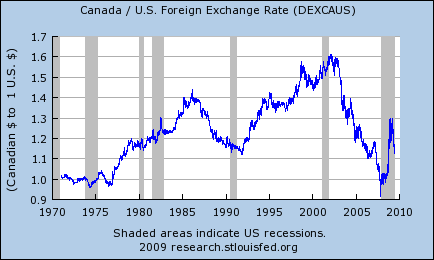
Canadian Euro Has Best Month in 60 Years

The loonie is making us look like a bunch of hosers:

Canada’s currency headed for the biggest monthly gain since the Korean War as commodities surged, global stocks rallied and the U.S. dollar tumbled.

The Canadian dollar rose 9.2 percent since April 30, the most since at least October 1950, according to data from the Bank of Canada and Bloomberg.

“This does seem like a historic move,” said David Watt, a senior currency strategist in Toronto at RBC Capital Markets. “The biggest driver has been the decline in general fear, compounded by an increase in specific fear for the U.S. dollar, which might or might not be appropriate.”

The Canadian currency appreciated as much as 2.1 percent to C$1.0898 per U.S. dollar, the strongest level since Oct. 6, and traded at C$1.0908 at 2:15 p.m. in Toronto, from C$1.1133 yesterday. One Canadian dollar buys 91.68 U.S. cents.
fredgraph052909.png

The Onion notes: U.S. Dollar Slips Against Canadian Acorn

Posted by edelfenbein at 4:28 PM

Best Name of a Penny Stock You'll See Today

Ladies and gentleman, I give you Jedi Mind, Inc. (JEDM).

The company just announced a share buyback, but I have to add, these aren't the shares you're looking for.

Posted by edelfenbein at 4:19 PM

Arianna Huffington: Only subsription that works is selling "weird porn." With video (of the quote, not of porn weird or otherwise)

HuffPo:

The Huffington Post will not be seeking subscription revenues anytime soon, Arianna Huffington told Kara Swisher on stage yesterday at the All Things D Conference.

"Unless you're selling porn -- especially weird porn -- I would not go the subscription route," Arianna told the crowd.

It's advice we think the woman sitting next to Arianna on stage, Katharine Weymouth of the Washington Post, will probably have to eventually ignore.

But then, Katharine's media company has a different cost base than the HuffPo, spending $1 million dollars a year on a Baghdad bureau, for example.

Posted by edelfenbein at 10:25 AM

Schumpeter's Moment

Carl Schramm has a good article on Joseph Schumpeter in today's WSJ. Here's a taste:

From Schumpeter's vantage point, capitalism's very success allows rich societies to use government to relax the impersonal rules that govern markets, creating new rules that buffer citizens from the rigors of risk-taking and failure. In that sense, government invents for itself the task of mediating market outcomes. Schumpeter had seen the dangers of this play out in Bismarck's conception of Prussia's welfare state. In the face of the Marxist threat, the elite secured its position by causing government to dispense social benefits. Political entrenchment, not charity, had motivated Bismarck. When distorted in such a way, free-market capitalism is seen to suppress -- rather than to encourage -- social and economic mobility.

Since the New Deal, Americans have come to see government as somehow the ultimate protector of their financial welfare. In reality, though, the evidence of the U.S. government behaving in this way during the New Deal is thin to say the least. Although it is largely forgotten now, much of the government's action during the Depression actually had a marginal impact on individual lives. Monetary expansion and technological innovation boosted the economy, while the "second" depression of 1937-1938 is widely understood as having been induced by Roosevelt's attempt to manipulate credit markets.

Posted by edelfenbein at 9:16 AM

Ted Tuner: AOL/TWX Meger "Better than Sex"

Mark Hulbert writes on the dissolution of AOL and Time Warner's nine-year marriage. I had never heard this quote before but Ted Turner said that the deal was "better than sex." He was married to Jane Fonda at the time.

Posted by edelfenbein at 8:41 AM

May 28, 2009

Exceedingly Bizarre Marx Brothers Trivia That I Must Be the Only One Interested In

I noticed this story today that the two surviving Dionne quintuplets just turned 75. That's whom Chico is referring to in the classic "contract" scene from A Night at the Opera (0:47 to 1:02):

Posted by edelfenbein at 9:17 PM

The 90s Finally End

CNBC reports:

Time Warner to Spin Off AOL

Time Warner says its board has approved plans to spin off AOL, the company's lagging Internet unit.

The New York company, which owns 95 percent of AOL, said Thursday it will buy out Google's 5 percent stake during the third quarter and spin the unit off to Time Warner shareholders.

The long-anticipated move is expected to be completed around the end of the year.
AOL and Time Warner combined in 2001 in a deal they said would produce a powerful marriage of content and the Internet. But it produced big losses instead.

In a statement, Time Warner Chief Executive Jeff Bewkes said, "We believe AOL will then have a better opportunity to achieve its full potential as a leading independent Internet company."

Time Warner shares rose almost 3 percent in premarket trading.

For a good laugh, here's the CNN story announcing the merger more than nine years ago.

In a stunning development, America Online Inc. announced plans to acquire Time Warner Inc. for roughly $182 billion in stock and debt Monday, creating a digital media powerhouse with the potential to reach every American in one form or another.

With dominating positions in the music, publishing, news, entertainment, cable and Internet industries, the combined company, called AOL Time Warner, will boast unrivaled assets among other media and online companies.

The merger, the largest deal in history, combines the nation’s top internet service provider with the world’s top media conglomerate. The deal also validates the Internet’s role as a leader in the new world economy, while redefining what the next generation of digital-based leaders will look like.

"Together, they represent an unprecedented powerhouse,” said Scott Ehrens, a media analyst with Bear Stearns. "If their mantra is content, this alliance is unbeatable. Now they have this great platform they can cross-fertilize with content and redistribute.”

big.chart052809.gif

Posted by edelfenbein at 10:03 AM

The Most Useless Index of the Financial Crisis

Daniel M. Harrison awards the honor of most useless index of the financial crisis to Dow Jones and their Economic Stimulus Index:

In other words, the DJ Economic Stimulus Index aims to capture how well bailout recipients are faring among investors. That in turn is supposed to be some sort of indicator of U.S. economic momentum.

But there are two factors that make this index really redundant, and even dangerous to use.

Firstly, as I discussed yesterday, companies’ capitalizations are more or less irrelevant as a sign of economic growth unless consumer spending is being directed at the products these firms manufacture. Just because there’s a bunch of investors looking to get in on beaten-down share prices, that doesn’t mean that economic conditions in the U.S. are fundamentally getting any better.

For example, higher share prices among banks and automakers says nothing about lending conditions, home foreclosure rates, auto sales or any of the other indicators you would traditionally associate with economic growth.

Instead of tracking share prices, a really useful economic stimulus index would monitor the earnings of the top 50 stocks which are recipients of the bailout funds. Then we’d have a much better idea of how these companies are performing.

But most of all: why does anyone want an index tracking these companies when the stock market is pretty much moving in tandem with their trading patterns these days anyway? Since the stimulus packages were put in place, you could just as easily have glanced at any of the major indexes on pretty much any day and concluded how GM, Bank of America, Citigroup, or Ford are faring.

Read the whole thing.

Update: S&P has upped the competition. They have a new index that follows companies that adhere to Sharia Islamic law. In other words, no alcohol, pork or tobacco. Best of all...it's Canadian!

Posted by edelfenbein at 9:03 AM

The Yield Curve Steepens

The widening yield curve is the most important recent development on Wall Street. Long-term interest rates had already been creeping upward, but they started to break out after mid-May.

Tyler Durden notes that the spread between the 2- and 10-year yield is now at an all-time record. Arnold Kling says that the short-term effect of stimulus package is negative.

Here’s a look at the yield curve since December.

image811.png

Posted by edelfenbein at 8:32 AM

South Wins Civil War

The WSJ reports:

Some laid-off workers in the financial-services industry are making a novel pitch for jobs: They are offering to work for nothing.

“People have been sending their CVs to our New York office saying, ‘hire me for free for six months.’” says Christophe Chouard, head of sales at French fund of hedge funds manager HDF Finance. “The CVs we are receiving are pretty good. These people are saying, ‘just let me show you what I can do.’”

Headhunters said redundant financial-services staffers, particularly those working on institutional sales, were keen to keep their knowledge of the industry and their contacts up to date when they weren’t earning.

It isn’t just the prospect of cheap labor that might appeal to companies. The chief executive of one asset-management company said it was sad to see rows of empty desks–fully equipped but vacated–as a result of cost cutting.

Posted by edelfenbein at 8:07 AM

May 27, 2009

Who Should Replace GM in the Dow?

I guess a 30-year Treasury bond makes the most sense.

Outside that, I'd vote for UPS (UPS).

Posted by edelfenbein at 8:52 PM

Why the Dow 36,000 Argument Doesn't Work

From nine years ago, here's my review of Dow 36,000:

Now that the Dow Jones Industrial Average has soared over 4,500 points since Alan Greenspan warned us of the market's "irrational exuberance," a mini-industry has evolved of publishing books that attempt to explain the "new market." The latest addition to the genre is Dow 36,000 by James K. Glassman and Kevin A. Hassett, both of the American Enterprise Institute. To give you an idea of how crowded the field is becoming, two other books are titled Dow 40,000 and Dow 100,000.

Unfazed by the Dow’s stunning climb, mega-bulls Glassman and Hassett have developed their own theory as to why the market has risen so much and why it will continue to rise. Their theory isn’t the usual litany one hears from Wall Street bulls (demographics, triumph of capitalism). Instead, their “36,000” theory goes right to the heart of investment analysis by questioning one of its elemental suppositions: namely, the idea that investments in stocks should demand a premium over investments in bonds due to the riskier nature of stocks. This isn’t split hairs they’re taking on.

Reciting historical data, Glassman and Hassett show that over the long haul, there is no difference between the risks of stocks and Treasury bonds. Therefore, they reason, there should be no risk premium at all. The authors claim that with the risk premium excised from the market, the perfectly reasonable price, or PRP as they call it, for the Dow is 36,000 (more on that later). Mind you, they’re not merely saying the Dow will eventually hit this magic number sometime in the future. Instead, Glassman and Hassett claim that 36,000 is where the Dow ought to be right now. Or more precisely, that’s where the Dow should have been early this year when they started writing the book. Could they be onto something? At the time, the Dow was at 9000.

The Dow very well may head to 36K, but it will have little to do with Glassman and Hassett’s theory. Their theory is seriously flawed due to major methodological errors.

First, Glassman and Hassett err in their selection of an appropriate measure of risk for their purpose. The free market prices risk, just like it prices everything else. That price is included in the price of stocks. In order to measure risk, Glassman and Hassett should use a measurement that isolates risk from the price of stocks. They don’t do this. Instead, they compare the standard deviation of stock returns to the standard deviation of risk-free-bond returns. That’s a different animal. Sure enough, with progressively longer holding periods, stock returns’ standard deviations gradually get smaller. Upon realizing that at long term, the standard deviation of stock returns is the same as bond returns’, actually slightly less, Glassman and Hassett conclude that stocks are “no more risky” than Treasury bonds.

That’s a faulty conclusion. Even if the standard deviations are the same size, it doesn’t say anything about the risk that they’re looking for. The point is, that risk has still never been isolated: It’s inside those returns no matter how long term you go. The variability of risk’s part of all these returns may be diminishing as well. That can happen even if risk stays exactly the same size. With Glassman and Hassett’s method, we have no idea how big the risk inherent in stock ownership is.

Without all the mumbo-jumbo, think of two houses, identical in every way except one has a great view of the river, the other does not. How much does the river view cost? Easy. Compare the prices of the two homes, and the difference must be the price of the view. The fact that the prices paid may deviate from their own respective averages the same way, speaks nothing as to the price of the view. Glassman and Hassett are saying that since those deviations are the same, the river view is free.

Running with this assumption, Glassman and Hassett reason that since risk and reward are related, assets with the same risk will have the same return. Therefore, stocks and bonds will have the same returns. For this to happen, they claim, “the Dow should rise by a factor of four.” How do they get four?

Glassman and Hassett start with the “Old Paradigm” premise that bond returns plus a risk premium equals stock returns. With the risk premium “properly” removed, the yield on Treasuries—meaning their expected return—should be the same as the expected return for stocks. And that’s their dividend yield plus the dividend’s growth rate. So far, so good. Since the sum of these two is now about 1.5% above today’s Treasury yield, the yield on stocks needs to be adjusted downward in order to bring everything into balance. Specifically, it needs to drop from about 2% to 0.5%. With the yield dropping to one-fourth its previous level, stock prices will jump fourfold. Presto. That’s how we get from 9000 to 36000.

Not exactly. The authors have made another mistake. It’s impossible to have a one-time-only ratcheting down of the market’s dividend yield. The reason is that if long-term stock returns don’t change, as the authors do assume, a lower dividend yield will always create a commensurate increase in the dividend growth rate. As a result, there will always be a new higher dividend whose yield will always be in need of being notched back down. And as a result, the dividend growth rate will increase, and the cycle will continue ad infinitum. The correct conclusion from their model is not a one-time-only fourfold increase in stocks, but one-time-only infinite increase in stocks. This means the authors are actually insufficiently bullish and, moreover, they’ve mistitled their book.

Fortunately, the second half of the book is the more valuable by far. Once the authors stop making theories, they start making some sense. In this section, the authors discuss how investors can capitalize on the continuing market boom. The authors estimate the market has another three to five years perhaps before 36K is reached. In any case, their strategies are rather conservative: Buy and hold, diversify, don’t trade too much, don’t let market fluctuations rattle you, don’t time the market. All perfectly sound ideas and not specifically dependent on “Dow 36,000.”

Glassman and Hassett also give the names of stocks and mutual funds they like. There’s nothing wrong with their stocks in the realm of theory, but readers definitely ought to avoid the author’s so-called Perfectly Reasonable Prices, which invite comparison to the famous description of the Holy Roman Empire—not holy, not Roman, not an empire.

I’m not familiar with Kevin Hassett’s former work, but I’ve always liked James Glassman’s investing articles for The Washington Post. His articles are consistently incisive and informative. This book, however, is nothing of the sort. Dow 36,000 contains egregious errors and fallacious reasoning.

Still, I do admire their ambition. With this book, Glassman and Hassett challenged a well-entrenched perception of reality. Being that this perception underwrites trillions of dollars, it’s a very, very, very, well-entrenched perception. Glassman and Hassett lost, and they lost badly. Old paradigms die hard, but they do die.

Posted by edelfenbein at 2:26 PM

Donaldson’s Earnings Plunge

Donaldson (DCI) is one of my favorite stocks. This company really should be better known. The problem holding them back is that their business is about as dull as you can get—filtration systems.

Still, the company has performed a remarkable feat. They’ve reported higher earnings for 19 straight years. Unfortunately, that’s all coming to an end this year.

For the first two quarter of this fiscal year (ending in July), Donaldson earned $1.03 a share which was a bit higher than the 95 cents a share from the same period last year.

The Q3 report came out yesterday and Donaldson earned just 35 cents a share which is a massive drop from the 57 cents a share last year. So for the first three quarters of this fiscal year, the company has made $1.37 a share compared with $1.52 from last year.

In November, Donaldson said they expect full-year EPS of $2.16 to $2.36. In February, they said you better make that $1.70 to $1.90. This confirms Elfenbein’s Investing Rule #174503B: One Earnings Warnings Leads to Another. Then yesterday, they said $1.55 to $1.70. They made $2.12 a share for all of 2008.

This is still a company I like a lot. Unfortunately, we’re in the worst part of its cycle right now. Even the best stocks will get slammed in order to please the market gods. I’m sticking with Donaldson but if you want to get in, you’ll probably see a better entry price in a few months.

Year.............Sales.................EPS
1990............$422.9...............$0.19
1991............$457.7...............$0.21
1992............$482.1...............$0.23
1993............$533.3...............$0.26
1994............$593.5...............$0.30
1995............$704.0...............$0.37
1996............$758.6...............$0.42
1997............$833.3...............$0.50
1998............$940.4...............$0.57
1999............$944.1...............$0.66
2000............$1,092.3............$0.76
2001............$1,137.0............$0.83
2002............$1,126.0............$0.95
2003............$1,218.3............$1.05
2004............$1,415.0............$1.18
2005............$1,595.7............$1.27
2006............$1,694.3............$1.55
2007............$1,918.8............$1.83
2008............$2,232.5............$2.12

Posted by edelfenbein at 1:16 PM

Don't They Know It's Just a Bear Market Rally

Wisconsin fifth-graders kick the stock market's ass:

If your stock portfolio isn't performing as well as you'd like, maybe you could hand it over to these fifth-graders. Four students at Tullar Elementary School in Neenah won the recent Wisconsin Stock Market Game, turning $100,000 of hypothetical money into more than $203,000 in 10 weeks.

The winning team of Annie Czech, Bailey Morton, Jen Sagehorn and Sam Weiler invested exclusively in 15 financial stocks, of which 13 proved profitable.

"It felt amazing," Bailey said. "It felt like I was getting a quick sugar rush."

"I was really excited," Annie said. "I wanted to scream."

Tim Hopfensperger, a teacher at the school and adviser to the young investors, also had teams finish second and fourth in the competition, which is sponsored by the nonprofit EconomicsWisconsin.

"I am really pleased," Hopfensperger said. "I am waiting to see what they will do in the future. A number of them will get involved in the financial industry."

I'm glad the gains were hypothetical. A real sugar rush is probably banned from school.

Posted by edelfenbein at 11:05 AM

Behind the Scenes at CNBC

Hear Dennis Kneale say that stories need "conflict, drama and struggle" to fool people into learning good information.

Posted by edelfenbein at 10:20 AM

How Many Gallons of Gas Does the S&P 500 Buy

Cool "Chart of the Day" from Clusterstock:

clusterchart052709-gas-to-s%26p.gif

Posted by edelfenbein at 9:36 AM

AutoZone Beat Expectations But Not By Enough So Shares to Fall

This is getting a little post-modern for me. Shares of AutoZone (AZO) just reported blow-out earnings. The company earned $3.13 a share, 24 cents more than expectations. Obviously, consumers would rather fix up a car now rather than get a new one. Plus, the dealerships aren't in the best of shape right now.

But here's the weird part: The shares are trading lower in the pre-market. Why? Reuters writes:

Shares of the largest U.S. auto parts retailer fell 2.2 percent in premarket trading on Wednesday, with analysts noting that investors expected more from the company after a string of solid profit reports.

So they beat expectations but not by enough. Um...then what was the expectation?

Posted by edelfenbein at 9:21 AM

AP: Roubini recommends Chinese model for North Korea

The AP reports:

Impoverished North Korea can liberalize its economy while maintaining its political system if it follows the path taken by China and Vietnam, prominent economist Nouriel Roubini said Wednesday.

"I think the lesson is that progressive economic opening and liberalization even in a formerly centrally-controlled economy can lead to beneficial changes," Roubini told reporters on the sidelines of a technology forum.

The headline reads "Roubini recommends Chinese model for North Korea" when I think he means that it's one possibility. The AP makes it sound like Roubini supports the Chinese model.

To Kim Jong Il, I think the words "Chinese model" mean something very different.

Posted by edelfenbein at 9:09 AM

The 20 Best-Performing Stocks of the Last Decade

From Business Week:

Southwestern Energy (SWN)...................3,662%
Celgene (CELG).........................................2,607%
XTO Energy (XTO).....................................2,088%
Stericycle (SRCL)......................................1,503%
Gilead Sciences (GILD).............................1,491%
Denbury Resources (DNR)........................1,271%
FLIR Systems (FLIR).................................1,190%
Ventas (VTR)..............................................1,127%
Range Resources (RRC)............................1,124%
Lab Corp of America (LH).........................1,107%
Quest Diagnostics (DGX).............................835%
Chesapeake Energy (CHK)..........................813%
C.H. Robinson (CHRW).................................692%
Varian Medical Systems (VAR)....................677%
Occidental Petroleum (OXY).......................634%
EOG Resources (EOG).................................599%
Express Scripts (ESRX)................................595%
EQT Corp (EQT)...........................................540%
Apache Corp (APA)......................................486%
CONSOL Energy (CNX)...............................486%

(Note: BW restricted the list to S&P 500 members with betas less than 1.)

Posted by edelfenbein at 8:22 AM

May 26, 2009

Rand Disappearing from Circulation in Harare

Megabe may be a dictator but there's one law he can't change--Gresham's:

The South African rand is disappearing from circulation especially in Harare, as it continues to gain value over the American dollar.

The rand however, remains the reference currency and is widely used in Midlands and Matabeleland.

Traders in the market now prefer to sell their good in rand as compared to the US dollar.

The parallel market is trading at a cross rate of US$1 at an equivalent of R9 with some trading as low as R8, 50 for a dollar.

Posted by edelfenbein at 10:48 PM

If you've ever wondered if shooting off fireworks under a frozen lake is cool, it turns out that it totally is.

Posted by edelfenbein at 6:00 PM

Figures on government spending and debt

From AP:

Total public debt subject to limit May 22.......11,241,715
Statutory debt limit.......................................12,104,000
Total public debt outstanding May 22...........11,301,676
Operating balance May 22.................................229,391
Interest fiscal year 2009 thru April....................193,439
Interest same period 2008................................243,904
Deficit fiscal year 2009 thru April........................802,294
Deficit same period 2008...................................153,471
Receipts fiscal year 2009 thru April.................1,256,066
Receipts same period 2008 ............................1,549,720
Outlays fiscal year 2009 thru April...................2,058,360
Outlays same period 2008..............................1,703,191
Gold assets in April...............................................11,041

I'm assuming these are in millions of dollars.

Posted by edelfenbein at 4:44 PM

Apparently, Everyone Saw It Coming

Google results for "predicted the recession."

Posted by edelfenbein at 2:48 PM

The Savings Glut Is Legit

Megan McArdle has a very good defense of the savings glut argument. Just because Alan Greenspan believes something doesn't mean it's wrong.

I think the giant amount of Chinese investment that came into U.S. Treasuries massively altered our financial system. Too many folks see this story as an excuse to get Greenspan off the hook. That's not necessarily the case.

We tend to think of lending someone money is doing them a favor. If you really want to hurt a country, don't invade them, lend them too much money.

Posted by edelfenbein at 2:16 PM

10 Things You Didn't Know About Ben Bernanke

From US News & World Report:

1. Ben Shalom Bernanke was born Dec. 13, 1953, in Augusta, Ga. The family moved to Dillon, S.C., when he was 4 months old.

2. Bernanke's father, Philip, was a partner in a pharmacy; his mother, Edna, was a substitute teacher.

3. Bernanke learned to read in kindergarten and skipped first grade. At age 11, he won the South Carolina state spelling bee.

4. In high school, he taught himself calculus, since his school did not offer the course. He scored a 1590 out of 1600 on the SAT and graduated at the top of his class in 1971.

5. He received his B.A. in economics from Harvard in 1975 and his Ph.D. from the Massachusetts Institute of Technology in 1979.

6. During college breaks, Bernanke worked a variety of jobs, including a summer as a waiter at South of the Border, a Mexican-themed roadside attraction near the border of North and South Carolina.

7. In 1979, Bernanke moved to California, where he taught economics at Stanford while his new wife, Anna, pursued her master's.

8. In 1985, Bernanke moved back east to teach at Princeton; in 1996, he became chairman of the university's economics department.

9. In 2002, he became a Federal Reserve governor. Three years later, he was named chairman of President George W. Bush's Council of Economic Advisers. In February 2006, he became the 14th chairman of the Federal Reserve Board.

10. Bernanke learned Hebrew partly from his grandfather. He officiated at the bar and bat mitzvahs of his children, Joel and Alyssa, without the help of a rabbi.

(HT: WSF)

Posted by edelfenbein at 12:11 PM

Reuters on Zari Rachev

Here's an interesting article on Zari Rachev.

Professor Zari Rachev scorns the idea that market cataclysms cannot be forecast. He says his statistical models have predicted them, and his customers agree.

His daughter is now president of New York-based company FinAnalytica, which uses his models to provide investors and risk managers with a risk indicator that takes into account the worst-case scenarios.

As those who have so far survived the financial crisis pick over the wreckage to develop enhanced predictors of market risk, Rachev's are among the offerings for people who believe statistical models can help.

"This past year was very important for us, because it validated everything that we worked for," Boryana Racheva-Iotova told Reuters by telephone from Bulgaria.

Her firm's risk measure, fat-tailed expected tail loss or ETL, gave investors advance notice of a sharp fall in the Dow Jones Industrial Average among other markets: the Dow fell from a life high in November 2007 to a 12-year low in March 2009, sliding sharpest after Lehman Brothers failed in September 2008.

You can read the rest here.

Posted by edelfenbein at 10:31 AM

Zimbabwe's Mugabe Stands by Central Bank Chief

The AP reports:

President Robert Mugabe has vowed to keep the central bank governor in his post despite demands by Prime Minister Morgan Tsvangirai that he be removed.

State radio on Tuesday quotes Mugabe as saying central bank chief Gideon Gono "saved the country" with the measures he took.

Others have criticized Gono for printing Zimbabwe dollars until they were worthless and raiding hundreds of millions of dollars from foreign currency accounts belonging to aid groups and private businesses.

Mugabe made his comments during a funeral Monday for Gono's brother Peter.

Mugabe reappointed Gono to a second five-year term in November. Former opposition leader Tsvangirai says that appointment violates his power-sharing deal with Mugabe.

I like how the highlighted paragraph is an attempt to show balance.

Posted by edelfenbein at 10:23 AM

It's All About the Axes

Here's a slightly more accurate view of Amazon.com (AMZN):

image810.png

Posted by edelfenbein at 10:01 AM

Best Headline of the Day

From CNBC:

Depression Likely, but Buy Stocks: Strategist

Posted by edelfenbein at 9:10 AM

Lower Libor May Not Be a Good Sign

Bloomberg has an interesting article saying that the lower Libor may actually reflect growing worries in the credit markets instead of a thawing.

“The disparity and the difference is really a signal to the market of who really wants to make some loans and who’s got the ability to make those loans,” said Mark MacQueen, partner and money manager at Austin, Texas-based Sage Advisory Services Ltd., which oversees $7.5 billion. “A lot of banks are just trying to hold on to what they have and not really make loans.”

Rather than signaling that the world’s banks are more willing to lend to each other, some investors and strategists say the decline in Libor has more to do with deposits reducing demand for funds in the interbank market. Deposits at U.S. banks jumped by almost $400 billion in the past six months, according to Jim Vogel, head of bond research at Memphis, Tennessee-based FTN Financial.

“Libor’s decline is not necessarily a sign of improving bank credit or the willingness of banks to lend to each other,” said Vogel, whose firm is one of the 10 biggest underwriters of Fannie Mae, Freddie Mac and other U.S. government agency debt. “It’s a sign of improving bank liquidity as customer deposit growth replaces borrowing in the short-term money markets.”

Posted by edelfenbein at 8:59 AM

May 25, 2009

The Challenge for Economics

In the NYT, Greg Mankiw writes on how the credit crisis will affect economics. His answer: Not much. The basics of economics are still in place although some topics will deserve more attention. Here's a sample:

THE LIMITS OF MONETARY POLICY

The textbook answer to recessions is simple: When the economy suffers from high unemployment and reduced capacity utilization, the central bank can cut interest rates and stimulate the demand for goods and services. When businesses see higher demand, they hire more workers to meet it.

Only rarely in the past did students ask what would happen if the central bank cut interest rates all the way to zero and it still wasn’t enough to get the economy going again. That is no surprise; after all, interest rates near zero weren’t something that they, or even their parents, had ever experienced. But now, with the Federal Reserve’s target interest rate at zero to 0.25 percent, that question is much more pressing.

The Fed is acting with the conviction that it has other tools to put the economy back on track. These include buying a much broader range of financial assets than it typically includes in its portfolio. Students will need to know about these other tools of monetary policy — and will also need to know that economists are far from certain how well these tools work.

Posted by edelfenbein at 9:49 AM

Thanks Vets

a200406071141.jpg

Posted by edelfenbein at 8:26 AM

May 22, 2009

Weekend Poll

Posted by edelfenbein at 10:09 AM

Have a Great Weekend!

The weather is beautiful so don't expect much posting here today. Also, I finally broke down and joined Twitter (EddyElfenbein) so you can follow me there in 140-character-or-less increments.

I hope everyone has a great weekend!

Posted by edelfenbein at 9:56 AM

The First Trading Day of the Month

So far this decade, the market hasn’t done very well except for one small phenomenon—the first trading day of the month. Through yesterday, the S&P 500 is down 39.5% for the decade. But the market has returned over 21% on the first day of the month (neither figure includes dividends).

What’s interesting is that first days of the month occur less than 5% of the time, so sitting out the rest of the time would have been a smart strategy. How’d you like a job that probably improved your performance if you took over 20 days a month?

image809.png

Posted by edelfenbein at 9:39 AM

May 21, 2009

"Mother of inflated hope/Mistress of despair"

The Chronicle of Higher Education interviewed economist Stephen Ziliak.

In haiku.

Q. How does writing verse
Help your students understand
A math-based science?

A: Thought transportation --
Newton's laws might still abide,
Listen: Einstein's train.

Q: A labor union
Protects workers from abuse --
But what does it cost?

A: Green Knights of Labor,
free Haymarket Anarchists,
cost less than Madoff.

Q: Debt plus recession --
Which is the better move:
saving or spending?

A: Treasury shoppers
choose plain broth over duck soup,
Nudge this paradox.

Q: Regarding Wall Street,
Do virtues of laissez-faire
Apply as elsewhere?

A: Traders are human,
swapping vices for virtues
and vice versa.

Q: Mom and Dad, I'm home!
The job market is nasty --
Where is my bedroom?

A: Invisible hand:
Mother of inflated hope,
Mistress of despair!

Q: Haiku might seem dumb
to bean counters and stuffed shirts --
Students disagree?

A: In this other world
wild orchids freely blossom --
haiku GDP.

Posted by edelfenbein at 2:06 PM

First They Came for My Natty Bo...

USA Today reports:

WASHINGTON (AP) — Consumers in the United States may have to hand over nearly $2 more for a case of beer to help provide health insurance for all.

Details of the proposed beer tax are described in a Senate Finance Committee document that will be used to brief lawmakers Wednesday at a closed-door meeting.

Taxes on wine and hard liquor would also go up. And there might be a new tax on soda and other sugary drinks blamed for contributing to obesity. No taxes on diet drinks, however.

Beer taxes would go up by 48 cents a six-pack, wine taxes would rise by 49 cents per bottle, and the tax on hard liquor would increase by 40 cents per fifth. Proceeds from the new taxes would help cover an estimated 50 million uninsured Americans.

I bet Obama would never tax appletinis or mojitos.

Posted by edelfenbein at 11:30 AM

Very Short Post on MO

If you're looking for a nice yield, it's hard to find something better than Altria Group (MO). The company just declared a quarterly dividend of 32 cents a share. That comes to 7.8% a year. The company has decent cash flow so I don't see the dividend being cut to pieces.

Posted by edelfenbein at 11:13 AM

May 20, 2009

Disturbing Segment on CNBC

On CNBC, Jeff Macke starts acting weird, then very weird. You know it's bad when Dennis Kneale is the sane one.

I've watched this clip a few times and I have no idea what Macke is talking about. It seems like he's referring to some inside joke, but I don't get where he's going. Poor Dennis just backs away.


(Via: Clusterstock)

Posted by edelfenbein at 2:12 PM

Gold Vs. the S&P 500

Here’s a look at how gold has done against the S&P 500:

image806.png

Here's the same graph but I divided the two numbers (S&P 500 by gold):

image808.png

On the day of the inauguration, exactly four months ago, the ratio slipped below 1.0. The ratio has previously bounced off 1.0 on November 20. Since the inauguration, it’s closed above 1.0 only once and that was on April 17 which was the day of Citigroup's (C) **cough** "earnings" report.

Interestingly, the S&P has stayed roughly even with gold over the past few weeks which puts the rally in a different light.

My view is that we’ll test 1.0 again. If the market likes what it sees, then we might move much higher.

Posted by edelfenbein at 12:42 PM

Nouriel Roubini in TNR

Saturday Night Live recently had a strange skit about a talk show hosted by the Bee Gees. Honestly, it wasn’t terribly funny but what struck me was that one of the guests was supposed to be Nouriel Roubini (I think it was Fred Armisen).

The Roubini character was the straight man in the skit, but it’s telling that he’s reached the point where he can be a typical “important person” you’d see on a talk show, even a parody of one.

Roubini is probably the hottest economist in the world right now. More tellingly, we live in a time where there is a hottest economist in the world.

Roubini just got another honor, a profile in the New Republic. It’s a pretty good profile. One complaint I have is that these profiles often try a tired formula—that the person’s ideas are an outgrowth of who they are. The New York Times tried that recently with Freeman Dyson and it didn’t work.

The truth is that you often can’t see a connection between important thinkers and their personalities or backgrounds. This sort of game can easily descend in psycho-babble. It will read something like, “He’s ideas are outside the mainstream and in high school, he was...wait for it...an outsider. Hello, Theme!!”

There’s even a theory that the stalemate in economics between investment (the male) and savings (the female) was finally broken by Keynes, the homosexual. That’s totally loopy to me but hey, it's not my idea.

I’ve never met Roubini, but I would think the interesting angle to take is that he seems to be the opposite of his ideas—the playboy professor with the buzzkill forecasts.

Unquestionably, Roubini is an important thinker. However, I was glad to see the profile mention that Roubini hasn’t been as prescient as many people believe:

Anirvan Banerji, an economist with the Economic Cycle Research Institute, has been particularly dismissive of Roubini's forecasting abilities: "The average time between recessions is about five years in the postwar period," he says. "So, if you forecast a recession one year and it doesn't happen, and you repeat your forecast year after year ... at some point the recession will arrive."

And Roubini has undeniably overshot. In 2004, he predicted that the oncoming recession would precipitate the crash of the dollar. The crisis has mainly buoyed it. On September 1, 2005, three days after Hurricane Katrina made landfall, Roubini told Reuters that economic disaster was imminent. What followed instead was a bump in financial activity that forestalled the recession for more than two years.

If you’re waiting for Jon Stewart to do a sanctimonious takedown of Roubini, I wouldn’t hold your breath. Though I nearly choked when the profile mentioned Nassim Taleb, “who also predicted a catastrophe in his book The Black Swan.” The old adage is true: It's not what books say that's important, it's what people assume they say that's important.

I’m glad to see Roubini get the attention, fame and fortune he deserves. But I have to add we shouldn’t judge economists by how accurate their macro forecasts are. That’s a losing game. Instead, we should focus on the power of their ideas to explain the economy, and see the connections that they see.

If you want to be a prognosticator, then go on the record with specific advice. If not, then you should try to explain the economy as clearly as you can.

Posted by edelfenbein at 7:56 AM

May 19, 2009

This Just In...

People With Higher IQs Make Wiser Economic Choices, Study Finds

People with higher measures of cognitive ability are more likely to make good choices in several different types of economic decisions, according to a new study with researchers from the University of Minnesota's Twin Cities and Morris campuses.

The study, set to be published online in the Proceedings of the National Academy of Sciences this week, was conducted with 1,000 trainee truck drivers at Schneider National, Inc., an American motor carrier employing 20,000. The researchers measured the trainees' cognitive skills and asked them to make choices in several economic experiments, and then followed them on the job.

People with better cognitive skills, in particular higher IQ, were more willing to take calculated risks and to save their money and made more consistent choices. They were also more likely to be cooperative in a strategic situation, and exhibited higher "social awareness" in that they more accurately forecasted others' behavior.

I'm looking forward to authors' follow-up study, "Your Ass and a Hole in the Ground: A Study on Dissimilarities."

Posted by edelfenbein at 5:51 PM

The VIX and Market Returns

Most commentators assume that low volatility is good for the market. That's not necessarily the case. All a high low or VIX is at predicting is high or low volatility, not direction.

CNBC reports:

Historically, the S&P has seen an average of 3% and 6% gains respectively over the 3 and 6 months that follow a crossover below 30.

That's a completely useless stat. The general market averages close to those returns anyway. Given the historical sample size, that study simply measures noise and nothing else.

Here are some numbers I came up with:

Since 1990, when the VIX is below 15 (about 31% of the time), the S&P's annualized return is 7.8%.

When the VIX is between 15 and 20 (27% of the time), the S&P's annualized return is 2.8%.

When the VIX is between 20 and 25 (22% of the time), the S&P's annualized return is -1.5%.

When the VIX is over 25 (20% of the time), the S&P's annualized return is 11.1%.

To the extent there's a tipping point, it seems to be a VIX of 13. Above 13, the S&P shows an annualized return of 3.0%, below 13 it jumps to 14.1%. However, 13 is a very low VIX reading; it's been below 13 about 18% of the time.

Outside that, there doesn't seem to be much of a trend.

Posted by edelfenbein at 4:17 PM

Amazon at $77

Amazon (AMZN) is at $77 a share!

Really? Is that real money, or Monopoly money or Canadian euros??

If they mean actual U.S. dollars, I wouldn't pay half that much.

Posted by edelfenbein at 1:17 PM

Volatility Chills

The Volatility Index (VIX), which is also known as the "fear index," dipped below 30 today for the first time in eight months. Personally, I'm glad I'm not in my 20s anymore.

image805.png

At one point, the VIX nearly hit an intra-day high of 90. A lower VIX isn't necessarily good for the bulls or bears, but it does show that the market is very different from a few months ago.

Posted by edelfenbein at 12:10 PM

Medtronic's Earnings -- Blah

Despite getting some great press for Barron’s, Medtronic’s (MDT) earnings report was rather uninspiring. Their fiscal Q4 earnings came in at $250 million or just 22 cents a share. That’s a huge drop from the 78 cents a share they made a year. However, if you knock out all the charges, and there were many, the company made 82 cents a share which was in line with the Street.

The Wall Street Journal reports:

Revenue slipped 0.8% to $3.83 billion. In February, the company had said it expected revenue of about $3.84 billion. Excluding currency fluctuations, revenue grew 5%. Sales of heart-rhythm devices fell 5% as ICD sales declined 3.2%. The spinal business grew 1%.

Cardiovascular revenue was flat amid a 15% fall for stents, the scaffoldings that prop open arteries. The company said late Monday that the Endeavor stent was the first coronary stent to receive the European Economic Area's CE mark of approval for treating patients with acute coronary syndrome, which includes unstable angina and heart attacks.

What’s more, the company is cutting 1,500 to 1,800 jobs. For this fiscal year, Medtronic projects earnings at $3.10 to $3.20 per share where the Street was looking for $3.20.

I have to agree that the stock is cheap, but I think it will become even cheaper. If you’re looking to add shares, wait for it to drop below $30.

Here's a look at MDT's sales and earnings for the past several quarters:

Quarter...........EPS.............Sales
Jul-01............$0.28...........$1,455.70
Oct-01...........$0.29...........$1,571.00
Jan-02...........$0.30...........$1,592.00
Apr-02...........$0.34...........$1,792.00
Jul-02............$0.32...........$1,713.90
Oct-02...........$0.34...........$1,891.00
Jan-03...........$0.35...........$1,912.50
Apr-03...........$0.40...........$2,148.00
Jul-03............$0.37...........$2,064.20
Oct-03...........$0.39...........$2,163.80
Jan-04...........$0.40...........$2,193.80
Apr-04...........$0.48...........$2,665.40
Jul-04............$0.43...........$2,346.10
Oct-04...........$0.44...........$2,399.80
Jan-05...........$0.46...........$2,530.70
Apr-05...........$0.53...........$2,778.00
Jul-05............$0.50...........$2,690.40
Oct-05...........$0.54...........$2,765.40
Jan-06...........$0.55...........$2,769.50
Apr-06...........$0.62...........$3,066.70
Jul-06............$0.55...........$2,897.00
Oct-06...........$0.59...........$3,075.00
Jan-07...........$0.61...........$3,048.00
Apr-07...........$0.66...........$3,280.00
Jul-07............$0.62...........$3.127.00
Oct-07...........$0.58...........$3,124.00
Jan-08...........$0.63...........$3,405.00
Apr-08...........$0.78...........$3,860.00
Jul-08............$0.72...........$3.706.00
Oct-08...........$0.67...........$3,570.00
Jan-09...........$0.71...........$3,494.00
Apr-09...........$0.78...........$3,830.00

Posted by edelfenbein at 11:47 AM

May 18, 2009

The ungovernable state

There’s an election tomorrow in California. If several initiatives pass, the state budget deficit will be $15.4 billion. If they fail, it will be $21.3 billion.

The state is royally screwed. It’s not economics, it’s the state’s political culture.

Between democracy, immigration and big government, you can choose any two. You can't have all three.

The Economist reports:

The broken budget mechanism and the twin failures in California’s representative and direct democracy are enough to guarantee dysfunction. The sheer complexity of the state exacerbates it. Peter Schrag, the author of “California: America’s High-Stakes Experiment”, has counted about 7,000 overlapping jurisdictions, from counties and cities to school and water districts, fire and park commissions, utility and mosquito-abatement boards, many with their own elected officials. The surprise is that anything works at all.

As a result, there is now a consensus among the political elite that California’s governance is “fundamentally broken” and that the state is “ungovernable, unless we make tough choices”, as Antonio Villaraigosa, the mayor of Los Angeles and a likely candidate for governor next year, puts it.

Notice that what needs to be done is perfectly clear. We all know the answer. Like any tragedy, the problem is simply a lack of will.

Posted by edelfenbein at 10:37 PM

My Lunch with Timmy

I went to see Treasury Secretary Tim Geithner be interviewed by Newsweek editor Jon Meacham today at the National Press Club. The back story is that after 76 years, Newsweek is relaunching itself. The new issue is out today and the magazine is smaller and more “engaged,” though it’s also more expensive. Today’s interview was part of their rebranding campaign.

The folks at Clusterstock were invited and they generously passed their invitation onto me. This was an odd day to see the Treasury secretary be interviewed since the Washington Post ran a story this morning on the sad state of affairs at the department. The article’s message was clear: Geithner is a weak manager and the White House has the whole department on a tight leash.

Government officials, inside the Treasury and out, say the unresolved issues are piling up in part because of vacancies in the department's top ranks. But some of the officials also cite the Treasury's ad-hoc management, which is dominated by a small band of Geithner's counselors who coordinate rescue initiatives but lack formal authority to make decisions. Heavy involvement by the White House in Treasury affairs has further muddied the picture of who is responsible for key issues, the officials add.

To his credit, Meacham led off by mentioning the article and asked Geithner about it. This turns to problem I have with Geithner—he seems to have the soul of a bureaucrat. He speaks too quickly and he avoids the heart of nearly every question.

This is, of course, what people in power are paid to do. But when someone as artful as Obama does it, you feel that the question has been answered. With Geithner, you simply feel like he’s evading you and he has contempt for the question. On top of that, he seems so damn ineffectual. Once you see the package at work, it doesn’t inspire much confidence. Especially when you compare him with his boss, the gap is downright embarrassing.

So what was his answer? He garbled on about more time, things were progressing nicely, yadda yadda yadda and the administration was “ahead of the curve.” You just knew that phrase was coming. Still, he never addressed the issue at hand which is him—and ironically, that answers the question.

When asked about the economy, Geithner said that things were stabilizing but there’s still a lot of pain out there. (Gee, thanks for that, Tim.) When asked about the efficacy of the Fed, he said that it’s performed “very well over time,” but didn’t comment more about the current Fed. Bernanke’s term as Fed Chair expires next year.

The closest Geithner came to being emphatic was we he reiterated the administration’s view that something had to be done quickly and be done big, so the issue of the debt and deficit weren’t top priorities. I would have like to see Meacham press him further about how the stimulus us being spent, but no such luck.

Meacham asked Geithner how much money he makes as Treasury secretary. Geither said that he’s generously compensated and that he makes under $200,000. Ugh. Here’s a question that can be answered with a specific number and its public information, yet even here, Geithner still bobs. Fortunately, he went on to say that he doesn’t favor compensation caps for bankers. Instead, he supports altering scope of incentives, but still he was vague on that point outside of the usual boiler plate like “say on pay.”

Meacham threw a bit of a curveball by mentioning critics to the left of the administration, specifically Paul Krugman, and the charge that they’re too soft on bankers. Geithner completely dodged the whole thing.

Perhaps the most illuminating part was when Meacham turned to the issue of California and states in general. Geithner said they’re in close consultation with the states. When Meacham pressed him about a federal bailout, Geithner said that he wouldn’t use the words “federal” or “bailout,” and repeated that he was in close consultation with the states. I’m not sure what to take from that.

Meacham concluded by asking Geithner about being named one of “Barack’s Beauties” by People. At this point the Treasury Secretary simply blushed. Meacham made some joke about Alexander Hamilton probably never blushed, and Geithner being in “close consultation” with People.

All in all, I would rather have seen Geithner (or anyone) interview Meacham. In addition to being a thoughtful observer of religion in America, he recently won the Pultizer Prize for American Lion, his book on Andrew Jackson. Plus, he’s in the middle of trying to revamp one of the country’s oldest and most influential news magazines.

Posted by edelfenbein at 4:35 PM

Geithner at the National Press Club

I’m heading off to the National Press Club to hear Tim Geithner be interviewed by Newsweek’s Jon Meacham.

This is rather a delicate time for the Treasury Secretary. The Washington Post ran an article this morning saying there’s no coherence at the Treasury Department. The claims are that he’s a weak manager, important slots are still unfilled, important decisions are made on an ad hoc basis and the White House grants it little autonomy.

The article states that the White House even reviewed the department's design for its web site (btw, the right side bar needs a wider margin).

I'll have a complete report when I get back.

Posted by edelfenbein at 10:33 AM

May 17, 2009

The Strange Death of American Capitalism

Book Review of Bailout Nation by Barry Ritholtz

In The Strange Death of Liberal England, George Dangerfield famously described how the British Liberal Party—and by extension, England’s once-unshakable faith in liberalism—suddenly and unexpectedly vanished. Despite its outward appearance of solidity, once liberalism was challenged, it crumbled to dust. How could a faith that was so dominant for so long, suddenly disappear; not only die quickly—indeed with a whimper—but do so without putting up any resistance?

These are similar questions future historians will have when they look back at the first decade of twenty-first century America. At the dawn of the new millennium, America’s faith in capitalism was also unshakable. Yet, within a few short weeks in 2008, the entire edifice came crashing down. Even voting didn’t seem to matter. First under a Republican administration and then under a Democratic one, large sectors of the economy received unprecedented amounts of government support. A staggering $15 trillion of taxpayer money has been put on the line.

The American economy reached its humiliating nadir at Davos earlier this year when our fiscal profligacy was criticized by the Wen Jiabao, the premier of what was once-called Red China. Worst of all, he was right.

What Happened?

In Bailout Nation: How Greed and Easy Money Corrupted Wall Street and Shook the World Economy, Barry Ritholtz takes on that question with gusto and the result is a wonderfully engaging book. Bailout Nation describes not only what happened and what went wrong, but also why. Don’t worry, you don’t need an advanced degree in economics to follow the story. Bailout Nation manages to be both comprehensive and easy to read.

Ritholtz is already known to countless investors through his invaluable blog, The Big Picture. (Full disclose: He’s been a supporter of CWS from its earliest days.) I have to confess to having some initial reservations about Ritholtz’s book. What makes him a great blogger, I feared, might not transfer well to a 300-page sustained argument. Let’s just say that Ritholtz isn’t exactly a “shades of gray” kind of guy. When a rapier is needed, Ritholtz is fully willing to use a cluster bomb. If you don’t think it’s possible to get a true sense of moral outrage over, say, the latest BLS report, well...you haven’t read The Big Picture.

Fortunately, my fears were unfounded. Ritholtz does very well in book form. His editor, Aaron Task, served him well; the prose is compact and well-organized, though I’m fairly certain of the sentences where Ritholtz shook off all editorial changes. Where Ritholtz truly shines is in drawing connections between seemingly disparate events; the fall of Bear Stearns, oleaginous mortgage brokers, the repeal of Glass-Steagall, the growth of credit default swaps, even the effects of reforming the Consumer Price Index, all play a role in this complex mess of unintended consequences, vicious cycles, ideological blindness and abject stupidity. I can't remember the last time I had so much fun reading about the Apocalypse

There are, however, a few minor errors. The Jefferson quote, “Banking establishments are more dangerous than standing armies” (page 15) is probably bogus. Also, on page 96, Ritholtz writes, “the psychological impact that feeling financially flush has on spending cannot be underestimated.” He surely means overestimated. These errors are minor of course, and it may be a reflection of covering events in real time.

Even before its release, Bailout Nation itself became a news story. In February, McGraw-Hill, the originally publisher, announced that it was ditching the project. Ritholtz claimed it was due to his criticisms of the Wall Street ratings agencies (McGraw-Hill owns Standard & Poor’s). McGraw-Hill denied this although curiously, the editor Ritholtz had been working with, resigned one week later. Fortunately, John Willey & Sons picked up the project and brought it to life (or, if you prefer, bailed it out).

Lockheed Was the Original Sin

So how did we end up were we are? Ritholtz persuasively makes the case that we didn’t suddenly abandon our capitalist faith. Instead, he argues that our fondness for bailouts isn’t new. Ritholtz pinpoints our original sin in the 1971 bailout of Lockheed. By today’s standard, that bailout was laughably small—just $250 million.

The important point is that a new standard had been established, and the government and Corporate America responded accordingly. Soon, bailouts became like a narcotic. Our fixes could only be satiated by steadily larger rescues. Soon Penn Central received a bailout, followed by Chrysler a few years later, then Continental Illinois (which ironically found itself in the hands of Bank of America).

Ritholtz agues that the bailouts, even when successful in the short-term, do considerable long-term damage. After the Chrysler bailout, for example, the already somnolent auto industry grew even more complacent. Ritholtz considers an alternative history: What if Chrysler had been allowed to fail? Might Detroit have reformed itself? We’ll never know because as the public became slowly inured to these bailouts, they were free to grow larger.

Ritholtz expands his argument by adding the machinations of the Federal Reserve to the growing bailout trend. This is a crucial point because too few observers see the motives behind the central bank. Any good story needs a top-notch villain and in Bailout Nation, it’s a certain Randian jazz musician named Alan Greenspan.

The Mess That Greenspan Made

Ritholtz doesn’t suffer fools gladly and Greenspan gets a well-deserved skewering.
Ritholtz tracks how Greenspan purposely and quite clearly altered the Fed’s mandate to include supporting asset prices. The facts Ritholtz presents are strong. The Fed-orchestrated bailout of LTCM had a profound effect on Wall Street’s risk-taking mentality. Whenever the market tumbled, Greenspan jumped in to cut rates. Bubbles, however, in tech stocks and later in housing were allowed to grow unchecked.

According to Ritholtz, it was Dr. Greenpan’s tonic of absurdly low interest rates that led to an historic housing bubble and all the unpleasantness that followed. The effect was far more damaging than easy money.

Ritholtz stresses that the Fed’s policies changed the rules of the game. For example, the bond market was now forced into a reckless “scramble for yields.” This in turn fed the practice of securitization which, in turned, fueled the disgraceful behavior of the ratings agencies. When yields were low, mischievous behavior flourished. At each juncture, the dots connect back to Greenspan who even disregarded his fellow members of the Federal Open Market Committee.

Incidentally, the section on ratings agencies (pages 111 to 113) is hardly controversial. Ritholtz simply states what’s widely known, that the ratings practiced a form of payola. There’s no other way to say it—the agencies abandoned their professional and moral obligations.

Real Capitalists Nationalize

As for the debt crisis, Ritholtz writes, “From 1 million B.C. up until the present day, the ability to repay the debt has always been the dominant factor—except, however, for a brief five-year period starting around 2002.” It’s sadly true. One strawberry picker in California got a $720,000 loan despite his annual income of $14,000. The system morphed into capitalism without capital.

Technically, the bubble wasn’t in housing, it was in credit. The numbers are staggering. At one point, close to half of all the new jobs created were tied to real estate. Between 2003 and 2006, 75% of GDP growth was solely due to mortgage equity withdrawals. From December 2006 to December 2007, the notional amounts outstanding of credit fault swaps more than quadrupled from $14 trillion to $58 trillion.

Bailout Nation is quick-paced and Ritholtz sprinkles the test with illuminating charts and eye-catching statistics (i.e., Bear Stearns’ liquidity pool dropped by 90% in three days). He wryly notes that it you want to play the bailout game, make sure you do it first and do it big. Ritholtz also has a novel theory for the explosion in executive compensation on Wall Street, but I won’t spoil it for you here.

Characteristicly, Ritholtz isn’t shy about naming names. In Chapter 19, he lists the folks most at fault for the credit mess. It won’t surprise you that Greenspan tops the list. Personally, I think the "savings glut" deserves more attention. Chapter 20 is an interesting take-down of the phony causes of our troubles, like naked shorting and the Community Reinvestment Act.

I should add that Ritholtz is an equal opportunity critic. Many liberals won’t be pleased by his criticisms of bailouts and his dismal of systemic risk (or more accurately, the threat of systemic risk). Parts of the book could have been written by Milton Friedman. Ritholtz even repeats Friedman’s famous mantra, “there is no free lunch.” Plus, any book with a chapter titled, “The Virtues of Foreclosure,” isn’t about to win a Bleeding Heart of the Year award.

Conservative will certainly take issue with Ritholtz’s criticisms of financial deregulation and his call for therapeutic nationalization. What I find most disturbing is how much of the government’s behavior was simply arbitrary. Ritholtz makes it clear: They were just making it up as they went along.

Ritholtz favors temporarily nationalizing insolvent banks. Mind you, this ain’t exactly Pol Pot. Ritholtz merely wants bad banks taken out, cleaned up and restored to health. He believes it’s the solution that will cause the least damage (“real capitalists nationalize”). I think he’s on sound footing here. It’s odd that we can watch Citigroup fall from $57 to 97 cents, yet bringing it that last bit to $0 is somehow unacceptable. Ritholtz concludes, "Real capitalists nationalize; faux capitalists look for the free lunch."

At the beginning of The Strange Death of Liberal England, Dangerfield wrote of the Liberal’s final triumph, “From that victory they never recovered.” Let’s hope American capitalism doesn’t share their fate.

Posted by edelfenbein at 2:54 PM

May 16, 2009

Barron's Calls Shares of Medtronic "Cheap"

In this weekend's Barron's, Neil Martin makes the case for Medtronic (MDT):

Good news or bad, Medtronic's stock is cheap. The shares are trading for 11.4 times fiscal '09 estimates, and 10.5 times fiscal '10 projections of $3.20 a share. That's well below the 13 price/earnings multiple on the Standard & Poor's 500 Health Care Equipment and Services index, and a P/E of 15 on the broader S&P. Medtronic itself hasn't had such a low P/E in at least 10 years.

Analyst Rick Wise at Leerink Swann rates the stock Market Perform, but hails the ability of management, led by Chief Executive Officer William Hawkins, to set "achievable growth targets" resulting in 5% to 7% organic top-line growth. "Longer term, for investors who have the patience to watch this scenario unfold, Medtronic is one of the least expensive stocks in the health-care universe," he says.

Earnings are coming out on Tuesday.

Posted by edelfenbein at 8:12 PM

The Market Punishes Greed

From George Will's column:

Studying the Internet site Stubhub, which is owned by eBay, Harrington monitored the secondary market in Ohio State University football tickets for the Oct. 25, 2008, game against Penn State that was attended by a stadium record crowd of 105,711. Stubhub acts as a broker, charging 15 percent from buyers and 10 percent from sellers, who can charge whatever they choose. Generally, a ticket's value depends on the seat's location -- the lower in the stadium and the closer to the 50-yard line the better.

Harrington collected two sets of information, one on Oct. 13, 12 days before the game, the other on Oct. 21, four days before. On Oct. 13 there were 346 sellers offering 682 tickets. Eight days later, 411 sellers were offering 845 tickets. In the interval, Ohio State beat Michigan State and undefeated Penn State beat Michigan, intensifying fans' interest in the game.

Yet the average price of the tickets offered declined from $359 to $304. This was partly because the quality (seat location) of the remaining tickets declined. Also the number of selling days was becoming smaller. Seats at entertainment events are, like airline seats, a perishable inventory: When the plane takes off, or the game begins, the value of an unsold ticket becomes zero.

A greedy seller -- one who priced his tickets too high -- was less likely than other sellers were to sell them two weeks before the game. Hence he had to resort to much deeper discounts than others did as game day, and the potential worthlessness of his assets, drew near. The larger the number of seats available in the secondary market, and the more transparent that market is, thanks to the Internet, the more likely it is that greed will be punished.

Posted by edelfenbein at 6:25 PM

Steven Pinker on The Cognitive Niche

Here's Part 1 of the always fascinating Steven Pinker discussing the Cognitive Niche:

Part 2
Part 3
Part 4
Part 5
Part 6

Posted by edelfenbein at 12:18 AM

May 15, 2009

Stock Returns and Employment

From 1947 through 2007, the nations’ unemployment rate was under 6% about two-thirds of the time, and over 6% the other one-third of the time.

For the time the rate was under 6%, the stock showed an annualized real return of 3.7%. When the rate was over 6%, the real return jumped to 17.3%.

The moral of the story is one I’m sure you already knew: Rotten times are great times to invest.

Posted by edelfenbein at 1:32 PM

Depressing Stockton!

Clusterstock has an uplifting slide show of the most-depressing places in America. If you were thinking of moving to East St. Louis, this may cause you to think again.

(Warning: It's depressing)

Posted by edelfenbein at 10:33 AM

May 14, 2009

Friday Rallies

The S&P 500 has rallied for the last five straight Fridays. That's pretty impressive that there are buyers going into the weekend, and I think it signals some important confidence in the market.

So what's the record for consecutive "up" Fridays? It turns out, we're not even close. This is one of those Dimaggio-like records that may never be topped. From April to September 1955, the S&P 500 rose for an astounding 22 straight Fridays!

In the 1950s, Friday was almost a guaranteed money maker. During the decade, the market rose on 63% of the Fridays. The cumulative return was 138% over effectively two years (one-fifth of a decade).

For many years, the stock exchange had a brief Saturday session but that was eventually ditched in the early 50s.

Posted by edelfenbein at 4:23 PM

Not Regina!

Zero Hedge has this ultra-cool map of Chrysler dealership closures.

States that are big losers are:

* Pennsylvania: 53
* Ohio: 47
* Texas: 45
* Illinois: 43
* Michigan: 40
* California: 31
* New Jersey: 30
* Florida: 29
* New York: 26

Posted by edelfenbein at 2:24 PM

8 Bedroom/7 Bathroom House for $675,000

Here's a great deal on an 8 bedroom/7bathroom Tudor home. It has a three-car garage and a koi pond.

About the location....

Posted by edelfenbein at 1:00 PM

Merrll Lynch Goes After Zero Hedge

This is not good news:

Now that Merrill Lynch has upgraded every single REIT and has a price target of +/- infinity, (conveniently pocketing over $100 million in the process), the company can focus on more pressing issues at hand (and no, not redecorating Thain's legacy office in the neo-uber-criminal style). Instead, the bank has sent not one, not two, but a whopping six cease and desist orders to Zero Hedge. As the recently acquired bank can finally afford to pay lawyers again compliments of its REIT analysts, it has decided to pursue the source of all evil: all those David Rosenberg posts Zero Hedge has published, that seek to educate and provide some color to otherwise confused and CNBC abused readers and investors.

If it is any consolation, now that David is literally out of the building, ML can sleep soundly that ZH will only focus on the bank's daily REIT upgrades (no, we have not forgotten about those) as it is alas the only source amusement coming out of doomed mother Merrill.

So, dear readers, please be aware that the following six posts will be removed at some point tonight as Zero Hedge is unable to underwrite and collect on average $10 million per REIT dilution events and thus afford any lawyers (except potentially for White & Case's Tom Lauria).

http://zerohedge.blogspot.com/2009/05/parting-thoughts-from-rosenberg-ver-10.html
http://zerohedge.blogspot.com/2009/05/shooting-shoots.html
http://zerohedge.blogspot.com/2009/05/look-back-at-week.html
http://zerohedge.blogspot.com/2009/04/are-fed-and-markets-on-same-page.html
http://zerohedge.blogspot.com/2009/04/spin-on-6-gdp.html
http://zerohedge.blogspot.com/2009/04/busy-day-for-reit-analysts.html

As for the 500 or so websites that fervently and automatically repost and redistribute ZH content, well, those we have no control over.

Posted by edelfenbein at 10:18 AM

May 13, 2009

See! I Told You This Was a Bigus Rally!

image804.png

Posted by edelfenbein at 4:02 PM

The Yield Curve Knows Best

Caroline Baum is one of my favorite columnists. She has an article on one of the best economic forecasters out there. His name is Dr. Yield Curve.

The yield curve, or spread, has several things going for it: First, it’s a leading economic indicator, officially added to the index designed to predict the economy’s ebbs and flows in 1996. It was a leader well before that, even though it was unofficial.

Second, what you see is what you get. The spread is never revised, always available and in no way proprietary.

Third, and most curious, the majority of economists don’t get it. They see rising bond yields in isolation -- without paying attention to what that price-setter, the Fed, is doing at the front end of the curve.

It’s the juxtaposition of short and long rates, not their level, that conveys information about monetary policy.

In a July 2008 working paper, San Francisco Fed economists Glenn Rudebusch and John Williams examined the tendency for professional forecasters to ignore the spread. They compared the forecasts provided by the Survey of Professional Forecasters (SPF) to that generated by a simple, real-time model based on the yield spread.

Guess who won? And it wasn’t even close.

Two years ago, I looked at the impact of the yield curve on the stock market and I was stunned to find:

Probably the most fascinating stat is that all of the stock market’s net capital gains have come when the 10-year yield is 65 or more basis points above the 90-day yield (that happens about 70% of the time). The yield curve hasn’t been that positive in 15 months.

Anything less than 65 basis points, including a negative yield curve, works out to a net equity return of a Blutarsky. Zero Point Zero.

Today the spread is out to nearly 300 basis points.

Posted by edelfenbein at 11:53 AM

FactSet Raises Dividend

I have to add one quick post on the news that FactSet Research Systems (FDS) raised its dividend from 18 cents to 20 cents a share. It’s not a gigantic increase—last year FDS raised the dividend by 50% and the year before, they doubled it—but it’s very nice to see.

The dividend increase is 11% and FactSet is probably on its way toward growing its earnings by 15% this year. That’s very good considering the rotten environment. You really don’t buy FactSet for the dividend yield (currently 1.5%), but it’s a nice reminder from the company that they’re continuing to prosper.

Posted by edelfenbein at 11:45 AM

Outrageous Executive Perks

MarketWatch lists 10 of the most egregious executive perks. I liked #3 in particular, a "stay" bonus even if you die:

Some companies are so keen to hold on to executives that they promise big pay and benefits even if the talent dies -- in contracts known as golden coffins.

Life insurance policies worth millions of dollars are the least controversial part of these packages -- even though buying such coverage without company help shouldn't be too difficult for executives pulling in six or seven figures a year.

A peek under the lid of several golden coffins also reveals big severance payments, pensions and continued salaries if executives pass away.

Abercrombie & Fitch agreed to pay Chief Executive Michael Jefferies a $6 million "stay bonus" to keep him running the successful fashion clothing retailer, according to its 2007 proxy statement.

If Jefferies dies, the bonus stays and is paid out, along with $10 million from a company-purchased life insurance policy, to his estate. The retailer would also pay some of his incentive compensation, bringing the golden coffin's value to more than $17 million, assuming he died on Feb. 2, 2008, according to the proxy.

Posted by edelfenbein at 9:58 AM

May 12, 2009

The Wonderful Dullness of Small Banks

David Segal writes about a topic that’s near and dear to our hearts—the boring stability of small banks. There are tons of little banks across the country that have barely noticed that credit crisis. Their businesses are boring and predictable, plus many of them are publicly traded.

Segal quotes a small-town banker:

“I was on vacation in California and this guy I had just met said, ‘So, traveling on that bailout money, huh?’ ” said Blake Heid, of First Option Bank in Paola, Kan., which didn’t take any bailout money. “I didn’t find that very amusing.”

Though they greatly outnumber the national and regional banks, community banks have barely registered in any of the fallout from the credit crisis, in part because they hold less than 10 percent of the $13.8 trillion in bank assets nationwide.

A few years ago, I wrote about three high-quality small-town banks. Not a single analyst followed them. Not long after I highlighted them, all three were bought out.

Posted by edelfenbein at 1:31 PM

Obama Beats Buffett In Market Timing

Bloomberg reports:

President Barack Obama is proving to be a better judge of the stock market than Warren Buffett, the world’s second-richest person.

The CHART OF THE DAY shows the Standard & Poor’s 500 Index began its biggest rally since the 1930s after Obama said on March 3 that equities offered bargains for investors with a “long-term perspective.” While the measure fell 3.5 percent over the next week, reaching a 12-year low on March 9, it went on to surge as much as 37 percent.

Buffett, the chairman of Berkshire Hathaway Inc., wrote a column titled “Buy American. I Am.” for the New York Times in October, saying he may put all of his personal investments into U.S. stocks. The S&P 500 then plunged 29 percent through March 9 and is still down 3.9 percent. Berkshire, based in Omaha, Nebraska, posted its largest loss in at least two decades on May 8, in part because of Buffett’s “major mistake” of buying ConocoPhillips shares before oil retreated from a record.

obama051209.png

Congratulations Mr. President! We've gained back everything we lost during you administration.

Posted by edelfenbein at 1:00 PM

The Diamond Market Is a Scam

The New York Times has an article today on the diamond market and how Russia is loading up on supply and waiting for the economy to recover.

I find the world diamond market fascinating because it’s almost completely rigged. If the free market had its way, diamonds would be insanely cheap.

The diamond market used to be controlled by De Beers. They’re the ones who run those “diamonds are forever” ads. (Sure they’re forever, all carbon is.) I believe that diamond rings are a wedding staple only in the United States. Lately, De Beers has fallen on hard times and Russia is taking over the market.

The recession also coincided with a settlement with European Union antitrust authorities that ended a longtime De Beers policy of stockpiling diamonds, in cooperation with Alrosa, to keep prices up.

Though it is a major commodity producer, Russia has traditionally not embraced policies that artificially keep prices up. In oil, for example, Russia benefits from the oil cartel’s cuts in production, but does not participate in them.

Diamonds are an exception. “If you don’t support the price,” Andrei V. Polyakov, a spokesman for Alrosa, said, “a diamond becomes a mere piece of carbon.”

You know the song, “carbon is a girl’s best friend.”

Posted by edelfenbein at 11:11 AM

General Motors Drops to Lowest Price Since 1933

Shares of Government Motors (GM) got down to $1.09 today which is the lowest price since 1933. It's so bad at GM that even the execs have dumped their shares:

General Motors Corp. reported that six executives sold shares in the company, as the largest U.S. automaker said it’s more probable than previously thought that it will need to file for bankruptcy.

Vice Chairman Bob Lutz and North America President Troy Clarke sold all their holdings in the Detroit-based company, according to regulatory filings today.

The upshot is that this was the first smart move by GM execs in decades. (Ooohh, burn!)

Posted by edelfenbein at 10:29 AM

May 11, 2009

Nicholas Financial Hits $5.25

More great news from Nicholas Financial (NICK) today. The stock got up to $5.25 a share today.

We’ve certainly waited a long time for this one to move. The story of NICK underscores an important point about investing. The market can simply be wrong, and you have to wait for a bit for it to be right again. The facts haven’t changed much with NICK. The value was visible in plain sight. We just had to sit and wait it out.

Also, when it came, the adjustment back to reality was very quick. Not too long ago, NICK was going for half this price. That’s the story of investing—lots of boredom and frustration, and then very quick and exciting moves.

Let me hear from you if you’re a NICK owner. I’m curious how many stop by here.

Posted by edelfenbein at 3:15 PM

Who's Watching the Fed?

Joe Weisenthal points out this hysterical SNL skit about the person who's in charging of monitoring the Federal Reserve, but the official is totally clueless. OMG, those guys at 30 Rock kill me!

Update: Several readers have said that this isn't an SNL skit but it's real reality.

Posted by edelfenbein at 2:59 PM

For the First Time Ever, Microsoft Turns to the Bond Market

Microsoft (MSFT) said that it’s going to raise money from the bond market for the first time in its history. The company is going to sell $3.75 billion worth of debt in order to buyback shares and fund technology investments.

Frankly, I’ve become very skeptical of share buybacks. On paper, what Microsoft is doing makes a lot of sense. Implicitly, the company is saying the stock is too low and bonds are too high. That’s probably right.

However, I’d rather not have a company try to fatten its profits by making guesses in the financial markets—even if they’re good guesses. According to their latest statements, Microsoft has a cool $25 billion in cash and short-term investments. Why not draw from that? By just sitting there, it’s probably drawing a microscopic yield. Better, why not return a lot of that to shareholders. That might even get the stock up.

Ideally, a company should focus on its business and their financial strategy should merely serve what the business needs. Also, the government’s tax policy should be neutral in this regard so there’s no advantage in ignoring dividends.

Over the last eight years, Cisco Systems (CSCO) has spent over $46 billion on buying back shares of Cisco. The company has simply traded valuable cash for overpriced stock.

Posted by edelfenbein at 2:53 PM

SNL Looks at the Stress Test

Posted by edelfenbein at 1:11 PM

Goldfinger’s Plan Backfires Again

Central Bank Gold Sales Began 10 Years Ago This Week:
Has it Worked?

In the spring of 1959, 50 years ago, the seventh of Ian Fleming’s James Bond novels, Goldfinger, was published. The plot (made into a classic 1964 movie) featured a crazy idea – to blow up all of the U.S. gold at Fort Knox, making it radioactive and worthless. That would make Auric Goldfinger’s gold worth more. However, he didn’t need to stage all that drama to make money. If he had just held on to his gold 20 years, it would be worth 25 times as much. A decade ago, some nations in Europe decided to blow out their gold instead of profiting from buy-and-hold. Their initial plan, from May 1959, has now backfired.

10 years ago, on Friday, May 7, 1999, the Bank of England announced that it would start selling a large share of its gold reserves in favor of assets offering interest rates – namely bonds. That announcement came after a decade of gold going nowhere, causing the impatient anti-gold forces among central bankers to demand a positive return on their investments. On the day of the Bank of England announcement, gold was trading $282.40, but the announcement of the forthcoming sale drove gold prices down to 20-year lows over the next 90 days. In fact, gold traded narrowly between $252 and $262 per ounce all through July & August of 1999, due to the anticipation of the damage done by massive central bank liquidations.

Many central banks followed Britain’s example, including France, Switzerland, Spain, the Netherlands and Portugal. As a result, the proportion of gold in central bank coffers has now slipped from 60% (in 1980) to 10%. European banks eventually sold around 3,800 tons (122 million ounces) of gold, freeing $56 billion to buy their beloved bonds. However, that sold gold would now be worth twice is much: $112 billion! Central banks are finally learning to hold on to their gold. Last year, central banks sold 246 tons, the lowest annual sales in 10 years – equivalent to about 10% of newly-mined annual supplies of gold.

Even accounting for the interest income on the bonds, a study last week showed that central banks lost $40 billion by selling their gold prematurely. The biggest loser was the Swiss National Bank, which sold 1,550 tons over the last 10 years, or more than 40% of all central bank sales. As a result, the Swiss are $19 billion poorer than they would have been by holding on to all their gold. Meanwhile, the U.S., Italy and Germany held all their central gold, so they now represent three of the four top national holdings:

Largest Gold Holdings among Central Banks

United States.......................8,138.9 (no sales since 1999)
Euro Central Bank................6,434.7
Germany..............................3,412.6 (no sales)
Int’l Monetary Fund..............3,217.3
France.................................2,487.1
Italy.....................................2,451.8 (no sales)
China...................................1,054.0 (and rising)
Switzerland..........................1,040.1 (down 60% since 1999)

Bottom line: A decade ago, the Dow was 11100 and gold was $277, for a 40-to-1 ratio. Today, the Dow is 8450 and gold is $910, for a 9.3-to-1 ratio. Translated into comparative performance over a 10-year period, gold provided 330% greater returns than the Dow since the day central banks began selling gold.

Gold Baffles the Gurus
Experts Yell “May Day” Way Too Soon

Last Monday, May 4, was a bank holiday in most of Europe. Originally called International Worker’s Day, the first Monday in May has now morphed into a genteel bank holiday. Last Monday, London’s Financial Times surveyed several gold gurus and concluded that most long-term bulls were turning short-term bearish. Dennis Gartman, for instance, was quoted as saying, “I don’t think gold recovers for a long time. You will be surprised by how far down it goes. I can see gold going back to $750 with ease.” The FT’s bottom line advice was to “wait until it gets close to, or past, $800” to buy. The next day, however, gold rose $25 per ounce and stayed cover $900 all week, making all those gurus look a little foolish.

Silver rose even more dramatically, from $12 to $14 in three trading days. The initial impetus for the recovery in the precious metals was a weaker dollar (down 3% to the euro last week, measuring from Monday’s peak to Friday’s trough), plus fear of future inflation, based on record-high levels of money supply creation by the world’s central banks. In addition, oil and natural gas were rising dramatically in price, even though inventories were large and growing. Then, the Euro Central Bank (ECB) cut rates to 1% last week. Lower rates make gold seem more competitive on a total return basis, since gold offers no interest income. After all, the lure of high interest rates initially drove central banks to sell their gold 10 years ago today. Here is the capsule tale of the tape from precious metals last week.

London Daily pm Fix................Gold..................Silver......................Platinum
Year-end 12/31/08....................865.00...............10.79............................899
Friday, May 1............................884.50................12.15...........................1076
Tuesday, May 5........................910.00................13.11...........................1135
Wednesday, May 6...................910.00................13.44...........................1136
Thursday, May 7.......................912.25................14.01...........................1161
Friday, May 8............................907.00................13.90............................1149
Changes Last Week.............+$22.50 (+2.5%)....+$1.75 (+14.4%)..........-$99 (+6.8%)
Changes so far in 2009.........+$42 (+4.9%)........+$1.36 (+28.8%).........+$177 (+27.8%)

Gold 52 weeks ago (May 9, 2008): $876.00................Gold’s low for 2009: $810 on January 15
Gold’s average price during 2009 so far: $904.06.......Gold’s high for 2009: $990 on February 24

Bottom line: Gold gurus, like most other gurus, are adept at extrapolating short-term trends into long-term and non-sustainable straight lines. This refers to downward trends as well as upward surges. (The same Wall Street firm that predicted $200 oil a year ago predicted $40 oil when the tide turned last summer.)

(Posted by CWS contributor Gary Alexander.)

Posted by edelfenbein at 12:59 PM

Strange End-of-Day Phenomenon

The Financial Times notes that the market is becoming seriously weird late in the day:

“Despite higher liquidity, the equity market has become hard to trade,” stated a December 10 2008 research note from Credit Suisse: “We are seeing volume surge at the end of the day, accompanied by extreme price swings and spreads – yet surprisingly little movement overnight.”

That research team works with Credit Suisse’s advanced execution services algorithmic trading group (AES) in New York, and has tracked the end-of-day phenomenon carefully. In November 2008, it reports, 8 per cent of trades occurred in the last 10 minutes of the day, versus 6 per cent in 2006 and 2007, and end-of-day volatility in November rose to 2.5 per cent from about 0.5 per cent in July 2008.

Posted by edelfenbein at 10:57 AM

May 8, 2009

Some Quick Hits

Just a few quick things:

One, did you see NICK at $4.48 today? Yeah, baby!

Also, Alfac is now up to $35. The stock has been up huge off its low, more than tripling in price. Of course, that’s because it had a big spike down. I still like the stock and think it’s a solid bargain, but most of the super easy profits have been erased over the last two months.

Finally, I’m not sure why “bear market rally” is used as an epithet. What’s so bad about them? The gains are real. Even if it is one, we can still enjoy it.

Bear market rally? So was the Renaissance.

Posted by edelfenbein at 12:53 PM

Time to Go on the Record

Bloomberg recently quoted our old friend Nassim Taleb as saying that the global crisis is “vastly worse” than the 1930s. That’s quite a tall order. In the United States, unemployment peaked around 25% while GDP fell by 30%. We’re not even remotely close to those numbers much less can we say that it’s “vastly worse.”

Taleb said, “This is the most difficult period of humanity that we’re going through today because governments have no control.” Joe Weisenthal rightly points out that loss of government control may not be such a bad thing. (Also, are the words “of humanity” really needed?)

What I find frustrating about many prominent bearish forecasters is the refusal to give concrete investment advice. I don’t see the point of telling people how bad things will be if you’re not offering advice on what to do about it. Yes, the world’s going to blow..tell me what to do now. As someone who has his portfolio viewable for free to all-comers 24-hours a day, it’s annoying that these bears refuse to back up their words. There’s no way to hold them accountable.

Is Taleb recommending anything? This is what Bloomberg writes:

Gold, copper and other assets “that China will like” are the best investment bets as currencies including the dollar and euro face pressures, Taleb said. The IMF expects the global economy to shrink 1.3 percent this year.

Hmmm...seems a bit vague. Once CNBC tried to get Taleb to give advice. The Maureen Tkacik article I linked to includes this snippet:

In February, Power Lunch, the midday show, booked two of the canniest thinkers to emerge in the crisis, Nassim Nicholas Taleb, the options trader and Black Swan author, and the economist Nouriel Roubini—only to find the two men stubbornly averse to saying anything that might risk making viewers any money. Roubini expounded upon the virtues of the Swedish model of bank nationalization and the dangers of a bubble-driven economy but refused to set a date at which he expected the market to turn around. When reporter Roben Farzad asked “Mr. Black Swan” where he would invest his money for the college fund of a hypothetical child born next month, Taleb began unloading on the extravagant compensation schemes that incentivized investment bankers to take excess risk. “But how is this actionable? How is this actionable? Do I stick my money under a mattress?” Farzad pressed. “I’m not here to give immediate investment advice” Taleb shot back. “Yeah, you’re the prophet of gloom and doom, but I need to know where to put my money now,” Farzad continued, and Mr. Black Swan finally offered that all his money was in various currencies, though he wouldn’t say which. The bullying wasn’t personal.

That’s a very revealing passage. I disagree that the reporter was bullying, he was trying to get a stubborn guest to go on record.

Taleb is happy to say that all these economists and bankers are clowns and fools, but he won’t say what investors should be doing. For many folks, vagueness seems to be fine but it’s not for me. I can’t take a market commentator seriously unless I’m able to hold them accountable. Vague pronouncements don't cut it.

One of the things I like about Cramer is that he’s not afraid to make himself look bad. For all his antics, what he says here is exactly right.

Posted by edelfenbein at 12:38 PM

May 7, 2009

Maureen Tkacik on CNBC

Maureen Tkacik looks at CNBC which includes a quote from yours truly.

Posted by edelfenbein at 11:03 PM

Multiply Your Money with Bontrust

Posted by edelfenbein at 9:49 PM

Paging All Chinese Lenders to the Yellow Courtesy Phone

This does not look good.

big.chart050709a.gif

Meanwhile, Libor is at a new low.

Posted by edelfenbein at 1:56 PM

May 6, 2009

"I Assure You It's Just a Bear Market Rally"

image803.png

Listen folks, it's just a bear market rally.

Nothing to see here, please keep moving.

I'm telling you -- it's all phony, none of this counts.

Look at the tape. It's just shorts, nothing more.

Goldman prolly wants to unload some crap.

Trust me. I've seen this a hundred times.

Have you seen those phony bank "profits"??

Load up on gold, my friend. $2,000 here we come!

They're just setting you up for another decline.

Do you have "sucker" written on your forehead?

Roubini said it's a false rally.

I assure you it's just a bear market rally.

Vote Ron Paul.

Posted by edelfenbein at 3:57 PM

Market Winning Streaks

The Nasdaq is now up for the ninth straight week. Jason Goepfert at Sentimental Trader takes an interesting look at historic winning streaks.

20090504_streaks_up.PNG

Posted by edelfenbein at 7:37 AM

More on NICK’s Earnings

I’ve looked through Nicholas Financial’s (NICK) earnings and the numbers look solid. Almost all the metrics improved over last quarter. However, there could be some seasonality to their business. Comparisons with a year ago almost seem like comparing them to the 19th century.

The company earned 20 cents a share. Annualized, that’s 80 cents which means the stock could be going for around four times earnings. Book value per share is now $8.21. Also remember that in 2006 and 2007, NICK earned over $1 a share.

The big worry I have each quarter is the line “Provision for credit losses as a percentage of average finance receivables, net of unearned interest.” That’s the unhappy line. The good news is it fell from 8.77% in the December quarter to 6.26% in the March quarter. That’s a difference of $1.3 million which is huge for a company like NICK. It’s still higher than a year ago, 6.26% to 5.20%, but we’re not seeing the huge increases from previous quarters. In the third quarter, for example, loss provisions were up 225% from the year before.

I have little doubt that NICK will survive the only question is when will things turnaround. Delinquencies are down a lot from last quarter, though that may be seasonal. There was a similar drop, though not as large, between the third and fourth quarters of a year ago. Delinquencies are still up from a year ago, but again, they seem to be leveling off.

The bottom line is that this was a very good quarter for NICK. In fact, I wasn’t expecting to see numbers like this until later in the year. At this rate, the loss provisions may soon show year-over-year decline. That will be time to celebrate.

I’ll repeat what I’ve said before about NICK. It won’t be a fun stock to own. It’s small and may drive you crazy. In fact, most investors shouldn’t own it. But if you have a long time horizon and can safely ignore a microcap, then NICK is a great buy.

Posted by edelfenbein at 7:10 AM

May 5, 2009

NYT Climbs to $5, the Sunday Paper Not the Stock

A few weeks ago, I noted that the price of a Sunday New York Times ($4) was worth more than one share of the New York Times (NYT).

The good news is that the stock has rallied since it hit its 52-week low of $3.44.

The bad news is that they’re raising the price of the Sunday paper to $5.

I wonder who will make it to $10 first.

Posted by edelfenbein at 10:18 PM

GM plans 1-for-100 reverse stock split

That'll help get the share price up:

General Motors Corp. said Tuesday it is planning a reverse stock split that would give shareholders one share of new stock for every 100 shares they currently own.

The automaker said in a filing with the Securities and Exchange Commission that the deal would be part of an agreement with the Treasury Department in which the government would assume at least half of GM's debt in exchange for company shares.

The filing said both sides are still negotiating the terms of the debt swap.

Under GM's plan, the U.S. government would get a 50 percent equity stake in exchange for about $10 billion in loan forgiveness. The UAW, for its part, would get a 39 percent stake in exchange for $10 billion in payments to its health care trust in stock. GM would issue up to 60 billion shares as a result of the bond exchange, Treasury loan and VEBA agreement.

At this point, wouldn't it be easier to split the Treasury 100-to-1?

Posted by edelfenbein at 7:08 PM

NICK Update

Just for the record, the stock did volume of 1,200 shares yesterday. Today the stock opened at $3.22 shot to $4.37, a gain of 37%. Then promptly fell back to $3.52 which is a loss of nearly 20%.

Overall, it's a gain of 10.7%.

Posted by edelfenbein at 7:00 PM

Found Deep Inside an SEC Filing

First Financial Bancorp (FFBC) discuss its retirement plans:

These changes also resulted in revisions to our non-qualified retirement plans. Generally, benefits under previous formulas were frozen and current participants accrue under new formulas. The changes reflect a shift towards account balance formulas and a shit away from traditional annuity-type formulas.

At least they're not wasting money on copy-editors.

Posted by edelfenbein at 4:25 PM

"Don't Open Your Mouth And Say Dumb Things"

The fun begins at 6:55:


(Via Joe W and ZeroHedge)

Posted by edelfenbein at 3:46 PM

Nicholas Financial Reports Earnings of 20 Cents a Share

Excellent news! Our favorite little micro-cap, Nicholas Financial (NICK) reported Q1 earnings of 20 cents per share, the same as last year’s Q1. Revenues increased 3.9% to $13,224,000.

I’ll have to look more into the numbers when I have a chance, but this is great news. The stock has been up by as much as 37% today!

Posted by edelfenbein at 12:23 PM

Cognizant Beats the Street and Guides Higher

This is turning into a very good day for the Buy List. Cognizant Technology Solutions (CTSH) reported earnings of 42 cents a share, five cents more than estimates. For Q2, CTSH said it expects to earn 42 cents a share and $1.71 for the full year. The shares are still reasonably priced. The stock is up for the sixth day in a row.

Posted by edelfenbein at 11:56 AM

How David Beats Goliath

I have to confess having a love-hate relationship with Malcolm Gladwell. He writes very well and I’m always eager to read his next Big Think-Middle Brow article. I want to like his articles, but whenever I finish one, I feel like I just ate a bowl of whipped cream.

Gladwell has a winning formula. Take an interesting law of social science (or a humdrum truism) and show how it’s applied in several incomprehensively different scenarios. Self-parody lurks behind the scenes.

Seeing the scenarios is the payoff of any Gladwell piece. Personally, I fill out a little bingo grid before hand. In each box, I’ll write things like “wine-making in the Yukon” or “hedge funds during the Ming Dynasty.” Then I check off each one Gladwell references.

His latest article is about how underdogs can win by resorting to unconventional strategies—or as he says, how David can beat Goliath (Biblical reference...bingo!). Seems pretty obvious to me, but now I have to know the connections!

The connections Malcolm! What are the connections??

Twelve-year-old girls basketball and Lawrence of Arabia! No, I’m not making this up. Hell, I couldn’t make it up.

The coach of the 12-year-old girls team decided to press the entire basketball floor and challenge every in-bounds pass. This was an unconventional strategy. The opposing teams got flustered and often turned over the ball, and the weaker team could pull off the upset.

I have a great deal of sympathy for this type of thinking. How can you look at a game, or any activity, in a different way and challenge orthodoxy? That’s what investing is all about. For example, I think there’s good evidence showing that punting on fourth-down isn’t worth it. But it will be odd for a pro team to start doing that. I’ve also heard that shooting foul shots underhanded is far superior than overhand. Yet what macho ball player will start doing that? The numbers geeks have shown that stealing bases is very risky and you shouldn’t do it unless you’re pretty darn sure you’ll make it.

The crawl style of swimming was unknown to the West until a competition in 1844 when Native American crushed a bunch of British swimmers who used the preferred-method, the breaststroke. (I used to think the crawl style was called freestyle.) It’s rather disquieting to think that some strategy that has stood the test of time is simply wrong.The economist Joseph Schumpeter said that innovation isn’t merely part of the economy, it’s the heart of the economy.

So I do enjoy Gladwell’s pieces yet I feel as if he stretches his themes further than the facts allow. For example, the last scenario presents a computer programmer who wins a naval war-game contest by ignoring strategies and crunching the numbers in the rulebook. That doesn’t sound too innovative to me. I wouldn’t call it poor sportsmanship but it’s hardly within the spirit of the law. In that case, I’d rather go with Goliath.

Posted by edelfenbein at 11:41 AM

Wasn't There a 10th Amendment?

USA Today reports:

In a historic first, Uncle Sam has supplanted sales, property and income taxes as the biggest source of revenue for state and local governments.

(Via: Arnold Kling and Nick Schulz)

Posted by edelfenbein at 11:37 AM

Cayman Islands' Tax Haven

Ugland House is a five-story office building on on South Church Street in the Caymans. Guess how many companies are based there?

Answer: 18,857.

Posted by edelfenbein at 10:45 AM

The Credit Crisis Explained

The Crisis of Credit Visualized from Jonathan Jarvis on Vimeo.

Posted by edelfenbein at 9:54 AM

The Cyclicals Have Led the Charge

One thing to point out about this rally is that it’s been hugely led by cyclicals. Since March 9, the S&P 500 is up 34% but the Morgan Stanley Cyclical Index (^CYC) is up a stunning 98%. That’s a huge move for an index. Cyclicals have outperformed the market for 19 of the last 23 sessions.

Too many analysts like to downplay a rally because it’s slanted one way or the other. But almost all rallies are initially geared toward one sector or another -- and just because it starts that way doesn’t mean it will end up that way. Broad-based rallied are far more the exception than the rule.

I like to follow the ratio of the CYC to the S&P 500 because it tends to move in long-term cycles (hence the name cyclicals). See the chart below, and note how dramatic the move has been over the last six months.

image802.png

I'll warn you not to mistake this for a market-timing device. Instead, it's a way to get a look at the internals of the market. I think the broader rally still has legs but I’m beginning to doubt that the cyclicals will continue their lead. They’ve earned a nice rest for now.

P.S. The ratio reached its peak on July 19, 2007 at 0.7273. One month before, I warned investors that the cyclical party was coming to an end.

Posted by edelfenbein at 8:10 AM

The California Problem

George Will has a good albeit scary column on the political economics of California. He calls Arnold Schwarzenegger, "the best governor the states contiguous to California have ever had."

Here's a sample:

Liberal orthodoxy has made the state dependent on a volatile source of revenue -- high income tax rates on the wealthy. In 2006, the top 1 percent of earners paid 48 percent of the income taxes. California's income and sales taxes are among the nation's highest and its business conditions among the worst, as measured by 16 variables directly influenced by the Legislature. Unemployment, the nation's fourth-highest, is 11.2 percent.

I’m worried that the issue isn’t simply one of balancing a budget. I’m afraid that it’s deeper than that. It’s that the model of California’s society is fundamentally broken. Big government and high taxes combined with massive immigration and multiculturalism.

I can’t help but think of New York during the 1970s when the city experienced a dramatic downfall. Crime exploded and the population imploded. In 1965, there was a blackout and the city was calm. Twelve years later, there was a blackout and massive looting.

Think of all those great 70s movies that showed the grit and grim of New York, or Howard Cossell saying during the World Series, “There it is, ladies and gentlemen, The Bronx is burning.”

This could be California’s future.

Posted by edelfenbein at 1:22 AM

May 4, 2009

Re: S&P Nears 2009 High

Thanks to a late-day surge, the S&P 500 broke 900 and closed at 907.24. The index is now positive for the year! (Slightly). Our Buy List is currently up 10.34%. Since March 9, the S&P 500 is up 34% which works out to a cool $2 trillion.

Posted by edelfenbein at 11:53 PM

Inflation Nation

Allan Meltzer has a good article in today’s New York Times on the threat of inflation created by the Fed’s policies. The Fed has tossed tons of money into the economy and there will be a reckoning. Policy is, of course, a matter of choices and the Fed has decided to put inflation concerns on the back-burner while trying to help the economy right now.

Once the economy finally gets back on its feet, tough decisions will need to be made. What needs to be done isn’t hard to figure out—massively drain liquidity. Instead, it will be a question of political will. Meltzer is concerned that the Fed has “sacrificed its independence and become the monetary arm of the Treasury.” That’s a good point.

I currently lean toward downplaying the impact of inflation. Why? Well, because everyone else sees it as inevitable. No one seemed terribly worried that Mine That Bird would come flying up the inside rail...so it happened.

With Tall Paul in his corner, I think Obama realizes the importance of the Fed’s role in combating inflation. I guess there really is no such thing as an independent Fed.

Posted by edelfenbein at 10:37 PM

Poll Update

Thanks again to everyone who participated in my latest poll on how much tax should a family earning $40,000 pay. I was curious to see what the median or middle answer would be. Since I used 5% blocks, I’d have to estimate that it was about 8.2% which comes to a tax bill of $3,280.

The earlier poll asked how much should a family making $250,000 pay, and that median came to about 22.6% or $56,500.

There are lots of ways to reconcile the two answers but one would be (roughly, not exactly) a flat rate of 25% on income above $27,000.

Posted by edelfenbein at 7:00 PM

S&P Nears 2009 High

The S&P 500 got up to 899.01 today which is the highest its been since early January.

image801.png

Posted by edelfenbein at 1:48 PM

The Boston Globe May Be No More

I was a rookie broker in Boston and I loved that Boston was an authentic two-paper town. Whenever you got on the T you could easily find a Boston Herald but it was much harder to find a Boston Globe. The Herald was far more populist and conservative, while the Globe was a bastion of liberalism. It's hard to imagine that the Glove may soon go away.

The paper's circulation dropped 14 percent in the most recent six-month period. The Globe is expected to lose $85 million this year, the company says.

Boston residents have long resented the takeover of the Globe by a company based in New York, with which the region competes in sports, banking and cultural bragging rights.

The notion that Boston, home to some of the country's top universities, could lose its major daily would have been unthinkable before the recent nationwide plunge in advertising revenue. That dive has triggered a wave of newspaper bankruptcies and the closing of the Rocky Mountain News and the Seattle Post-Intelligencer.

A Globe shutdown would leave the city with only one daily newspaper, the tabloid Boston Herald, which has just 10 news reporters and is battling its own financial difficulties.

I can't help thinking of this scene:

Posted by edelfenbein at 1:15 PM

Cognizant Seen Posting Higher Q1 Profit

Cognizant Technology Solutions (CTSH) reports tomorrow. Here's a preview from Reuters:

IT service provider Cognizant Technology Solutions Corp (CTSH.O) is expected to post a higher first-quarter profit as it benefits from a stable and diversified customer base, even as the sector has been hit by delays in client decision-making and sluggish demand.

Analysts expect Cognizant to back its 2009 revenue outlook, citing its ability to handle pricing pressure and the offshore focus maintained by its largest customer, JPMorgan Chase (JPM.N).

"JPMorgan, among other banks, is probably in a better shape, and on top of that the bank seems to be continuing to have a very strong commitment to its offshore strategy," Cowen & Co analyst Moshe Katri said by phone.

JPMorgan accounts for about 4 percent to 6 percent of Cognizant's revenue, according to Katri. Other key customers include Pfizer Inc (PFE.N), eBay Inc (EBAY.O) and Credit Suisse (CSGN.VX).

"The better sentiment around financials and stock markets is an incremental positive as Cognizant gets 45 percent of revenue from the financial services sector," UBS analyst Jason Kupferberg said.

For the first quarter, analysts on average expect the company to earn 37 cents a share, excluding items, on revenue of $735.4 million, according to Reuters Estimates. The company posted a profit of 34 cents a share in the year-earlier quarter.

In February, Cognizant had forecast 2009 full-year revenue of at least $3.1 billion. Analysts are expecting $3.06 billion.

Cognizant is our second-best performing stock this year. It's up more than 40%.

Posted by edelfenbein at 11:48 AM

Buffett Attacks the Stress Test

From the BBC:

US investor Warren Buffett has hit out at the government's "stress tests" of US banks, saying they do not properly assess the industry's health.

Mr Buffett's Berkshire Hathaway company holds stakes in three banks that underwent the tests.

He said the tests ignored differences in business models, but added it was right the government try to save banks.

The results of the stress tests were due to be published on Monday, but have been delayed until Thursday.

Referring to Berkshire Hathaway's holdings in Wells Fargo, US Bancorp and SunTrust Banks, he said, "I think I know their future, frankly, better that somebody that comes in to take a look.

"They may be using more of a checklist-type approach."

I was also glad to hear Buffett criticize the crazy practice of stock buy-backs.

Posted by edelfenbein at 10:59 AM

Sysco’s Earnings Fall

While the rest of the market is higher today, Sysco (SYY) is down modestly on its earnings report. Earnings were in line at 38 cents a share, down from 40 cents a year ago. Revenue declined 4.5% to $8.7 billion.

Overall, I like Sysco a lot. This is one of the most stable companies on the market. I recently pointed out that the stock has been an amazing performer after a Citigroup exec looked down on Sysco's employees.

Posted by edelfenbein at 10:55 AM

May 1, 2009

Weekend Poll

Posted by edelfenbein at 8:24 PM

Fiserv’s Earnings Still Growing

Pretty good.

Fiserv Inc. said its earnings from continuing operations increased in the first quarter, reflecting improved operating margins from the growth in sales of more profitable services.

The Brookfield-based provider of services and technology to the financial services industry reported income from continuing operations of $102 million, or 65 cents per share, compared with $99 million, or 60 cents per share, for the same period a year ago.

Continuing operations excludes the results of the firm's 51-percent investment in the insurance business, which Fiserv (NASDAQ: FISV) sold in July 2008.

Revenue declined in the quarter to $1.04 billion from $1.31 billion. The decline in revenue was attributed in part to declines in the home equity processing business.

“Our results showcase the strength of our business model as we continue to deliver highly valued products and services across the financial services market,” said Jeffery Yabuki, president and CEO of Fiserv. “In spite of the expected revenue weakness in the quarter, we managed the business to optimize margins and grew adjusted earnings per share 10 percent."

Fiserv continues to expect full-year 2009 adjusted earnings per share from continuing operations to be within a range of $3.61 to $3.75, which represents growth of 10 to 14 percent compared with $3.29 in 2008.

Fiserv (FISV) is a good stock going for a good price. The shares got punished way too much during September and October.

Here's the earnings call from Seeking Alpha.

Posted by edelfenbein at 3:37 PM

Strangest Graph You’ll See All Day

Bear with me on this one. The long-term evidence suggests that the stock market’s total return outperforms inflation by about 7% a year (or doubling in real terms every ten years). That’s of course an average—the stock market has been dead flat against inflation for 12 years now.

Here’s a look at the stock market’s real total return, meaning with dividends and adjusted for inflation, divided by a line rising at 7% a year. In other words, a flat line is a real increase of 7% a year.

Just to make things even weirder, I used a log scale. The idea is to get the purest measure of the stock market’s performance.

image800.png

Since earnings growth tends to be fairly consistent, this line is surprisingly similar to a graph of price/earnings ratios. Of course, there’s no guarantee that stocks will continue to outperform inflation by 7% a year.

What I find interesting is that the peaks and valleys seem to line up well. Warning: It’s dangerous to see relationships where none may exist. Still, it’s kind of interesting. I think it’s also interesting to see that there are very long periods of out-performance and under-performance. Stock investing is hardly a game for all seasons.

Posted by edelfenbein at 2:59 PM

spacer
bottom of page image