Crossing Wall Street: Your Guide to Financial Success, Hosted by Eddy Elfenbein
spacer About Buy List FAQ Contact Links Home
spacer

« June 2009 | Main | August 2009 »

July 31, 2009

More U.S. Banks Put on Probation

From Reuters:

U.S. federal regulators have raised the number of struggling banks which they have essentially put on probation, forcing them to fix their problems to avoid potential failures, the Wall Street Journal said.

Citing data obtained under the Freedom of Information Act requests, the paper said The Office of the Comptroller of the Currency (OCC), along with the Federal Reserve, have issued more memorandums of understanding so far this year than in all of 2008.

At the current rate of at least 285, the Fed, OCC and Federal Deposit Insurance Corp are in line to issue nearly 600 of these secret agreements this year, the paper said, compared with last year when 399 such agreements were issued.

So that's secret probation, but what about double-secret probation?

Posted by edelfenbein at 12:21 PM

The Government Revises GDP Growth for the last 70 Years

Congratulations, we all just got wealthier today! Or I should say that according to the government, we got wealthier—not only today, but in the past as well.

The Commerce Department released its second-quarter GDP report this report and along with it, they revised ALL the GDP numbers going back to 1929.

Today, BEA is releasing revised statistics of gross domestic product (GDP) and other national income and product accounts (NIPAs) series from 1929 through the first quarter of 2009. Comprehensive revisions, which are carried out about every 5 years, are an important part of BEA’s regular process for improving and modernizing its accounts to keep pace with the ever-changing U.S. economy.

Paging Mr. Orwell, to the yellow courtesy phone.

These weren’t small changes either. Here’s a look at the old and new quarterly series which begins in 1947 (in trillions of dollars chained at 2000 prices):
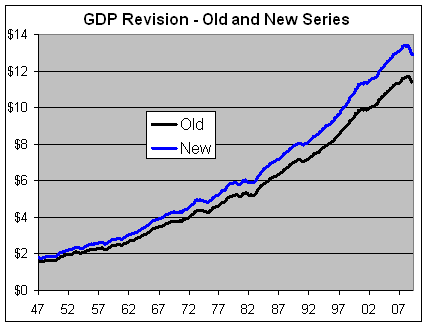
image838.png

Be sure to tell your grandparents that things weren't as rough as we thought back in the day. Here's a look at the percentage difference between the old and new series:

image839.png

Here are the recent old and new quarterly growth numbers. There are some significant changes. For example, the fourth quarter of 2007 was -0.17%, now it’s positive 2.12%. According to NBER, the recession began in December 2007.

image840.png

The first quarter of 2008 used to be positive 0.87%, now it’s -0.73%. Growth for the second quarter of 2008 was nearly cut in half. The contraction for the third quarter of 2008 was more than five times worse than originally thought!

Going back a few years, the third quarter of 2000 was originally -0.46% but now it’s positive 0.33% (that’s a Clinton quarter not a Bush quarter for all you political folks). This is important because journalists often refer to a recession as back-to-back quarters of negative economic growth. It’s technically not, although a NBER recession usually corresponds with back-to-back quarters of negative growth. Well, in 2000, it never happened. According to the old series, we had negative growth in three of five quarters. Now it was just two out of three quarters.

If anyone needs me, I'll be in East Germany updating some crop reports.


Posted by edelfenbein at 11:16 AM

July 30, 2009

Because Financial New Isn't Creepy Enough, We Have Fox Business News

Posted by edelfenbein at 11:34 PM

Nasdaq-to-S&P 500 Ratio

The Nasdaq has been on fire lately. The ratio of the Nasdaq to the S&P 500 is currently hovering right around 2.0. Two weeks ago, the ratio crossed above 2.0 for the first time since early 2001.
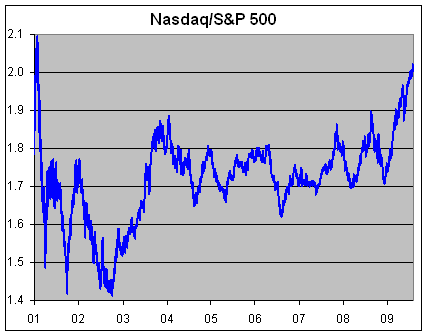
image836.png

Don't worry that we're headed back to the Nasdaq bubble days just yet. We still have a long way to go to match the earlier peak.

Consider these numbers: On March 10, 2000, the ratio hit 3.62. To match that today, either the Nasdaq would have be around 3570, or the S&P 500 would have to be at 548 -- a 44% drop from here.

In other words, what the hell were people thinking in 2000?

Posted by edelfenbein at 4:10 PM

Dow Flashes Buy Signal

The Dow has gone from 10% below its 200-day moving average to 10% above it. That's happened 21 times since 1921 and it's been good for stocks 18 times. The average gain over the next year has been 18%.

Posted by edelfenbein at 11:30 AM

What's the Definition of Speculation?

A price move Congress doesn't like.

Posted by edelfenbein at 11:16 AM

Stocks Hate Congress

The S&P 500 is close to 1,000 this morning. There could be more good news on the way -- Congress will soon go on recess.

Believe it or not, the stock market performs much better than average when Congress is not in session.

That at least is the finding of an academic study several years ago by professors Michael Ferguson of the University of Cincinnati and Hugh Douglas Witte of the University of Missouri at Columbia. Specifically, they found that "about 90% of the capital gains over the life of the Dow Jones Industrial Average have come on days when Congress is out of session."

Posted by edelfenbein at 11:10 AM

Nicholas Financial Reports Big Earnings Gain

Nicholas Financial (NICK) just reported earnings for the June quarter which is the company's fiscal first quarter. Net earnings, excluding non-cash unrealized mark-to-market gain on interest rate swaps increased 34% to $2,081,000 as compared to $1,558,000 for the three months ended.

On an earnings-per-share basis, NICK earned 20 cents a share compared with 15 cents a year ago. Revenue increased 4% to $13,694,000 for the three months ended June 30, 2009 as compared to $13,119,000 for the three months ended June 30, 2008.

According to Peter L. Vosotas, Chairman and CEO, "We are pleased with our solid first quarter results. We concentrated on basic careful lending and collecting fundamentals and will continue to do so. Our results were favorably impacted by a reduction in the net charge-off rate, lower operating expenses as a percentage of average net receivables and a reduction in the cost of borrowed funds. While we remain cautious, we are encouraged that the economy is showing some signs of stability and we feel comfortable proceeding with our planned expansion. This expansion will include new branch locations in Akron, Ohio and in Gastonia, North Carolina, which will bring our number of branch locations to 50 in 12 states. The Company remains open to acquisitions should an opportunity present itself," added Vosotas.

This is a great report. The most important fact is that the provision for credit losses is lower than it was one year ago. This most likely means that worst of the storm has passed for NICK. Bear in mind that this is a stock that's still trading around 25% below book value. NICK is an outstanding buy.

Posted by edelfenbein at 10:34 AM

Stocks Love Obama

The stock market seems to love President Obama. It's made back nearly everything it lost since he got elected.
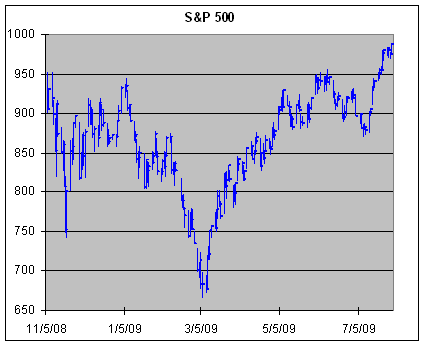
image835.png

The S&P 500 has been as high as 988 this morning. This could be the highest close since 1,005.75 on election day.

Posted by edelfenbein at 9:52 AM

Buy List Updates

There were three recent Buy List earnings reports to pass on.

First, Aflac (AFL) came through with strong numbers. Aflac has been one of our worst-performing stocks this year but I’m not about to give up. The shares are looking very good at this price.

The company earned $1.20 a share in operating earnings for the second quarter. That easily beat Wall Street’s expectations of $1.14 a share. The company also said that it expects full-year EPS of $4.59 to $4.73. Wall Street had been looking for just $4.65 per share. This means the stock is going for less than eight times earnings. The company said it sees Q3 coming in between $1.19 to $1.22 per share, compared to the Street’s view of $1.16 per share. Alfac is a very good buy.

Fiserv (FISV) earned 90 cents a share, two cents more than estimates. They also affirmed full-year EPS guidance in a range of 10% to 14% growth which comes to $3.61 to $3.75. Fiserv recently sold 51% of Fiserv Insurance Solutions Inc. to a private equity fund for $510 million. The stock will probably take a hit today, but it’s still a good buy.

Finally, Becton Dickinson (BDX) earned $1.30 a share, six cents more than expectations. The company issued full-year EPS guidance of $4.92 to $4.96. This is a good stock but it's looking a bit pricey here.

Posted by edelfenbein at 9:32 AM

July 29, 2009

2009 Earnings: A Moving Target

Earlier this week, I mentioned that earnings have been running well ahead of expectations so far this earnings season. Of course, expectations were pretty low.

For all of 2009, Wall Street now sees the S&P 500 earnings $59.80. If we continue to beat expectations, then we have a good shot of exceeding $60.

To put that number in context, here's a table John Mauldin posted earlier this year of the trend in analyst expectations for 2009.

jm010209image008_5F00_07151C9D.gif

So expectations are now higher than they were on September 10, 2008. The difference is that the S&P 500 then stood at 1,232.04 compared with yesterday's close of 979.62.

Posted by edelfenbein at 8:46 AM

July 28, 2009

Decade Inflection Points

If March 9th holds up as the low, this could continue a tradition of major market turning points near the turn of a decade.

The Nasdaq peaked in March 2000 over 5,000. It’s still down over 60%.

The Japanese Nikkei peaked on the last day of trading of 1989 near 39,000. It’s still down around 75%.

Gold peak at $850 just three weeks into the 1980. Gold eventually bottomed out around $253 in 1999, again close to a new decade.

One of the greatest bull markets in history began in June 1949. Thanks to high dividends, the market averaged over 20% a year above inflation for the next seven years.

Finally, in late 1929, stocks ran into a wee bit of trouble.

Posted by edelfenbein at 2:44 PM

95 Years Ago This Week on Wall Street

On Tuesday, July 28, Austria-Hungary attacked Serbia, and World War I officially began. Stock markets around the world collapsed (some closed), and the price of gold soared. On Wall Street, trading volume hit 1,020,000 shares, and market officials pondered closing the exchange.

On Wednesday, July 29, politicians were trying to halt the European violence, but Austro-Hungary bombed Belgrade and Russia mobilized troops along Austria’s border. In response, three major European stock exchanges (Vienna, Rome and Berlin) closed their doors.

On Thursday, July 30, the rush to sell stocks and buy gold escalated. Panic selling on the New York exchange reached 1.3 million shares, the highest volume since the Panic of 1907. Many blue chip stocks crashed, falling 20% to 30% that single day. GM fell from $59 to $39 (-34%). Even Bethlehem Steel, which figured to profit from making war armaments, was down 14%. That night, exchange officials met to decide whether or not to close the exchange on Friday.

Early in the morning of Friday, July 31, the London Stock Exchange announced that it would suspend trading until further notice, the first time it had done so in its centuries-long heritage. If the New York Stock Exchange opened for trading on this final day of July, it would have been the only open stock market in the world. Since markets were now connected by undersea cables, all the world’s sellers would converge on Wall Street. In fact, the overnight sell orders “at any price” were lined up for the opening bell, so the NYSE governors decided to close for only the second time in its history. The NYSE was totally closed until the middle of December, 1914, but only a few stocks traded then. The full board only re-opened in April, 1915 – nine months later.

However, U.S. banks stayed open, and the rush to convert cash to gold wiped out many banks. From July 27 to August 7, 1914, $73 million in gold was withdrawn from New York banks alone.

On Monday, August 3, 1914, no stock markets in Europe or America were open. On that day, Germany declared war on France and invaded Belgium; very soon, Britain declared war on Germany, and Turkey signed a military pact with Germany. As the sun set on that dismal day, Sir Edward Grey, British foreign secretary, said, “The lamps are going out all over Europe; we shall not see them lit again in our lifetime.”

(via: Gary Alexander)

Posted by edelfenbein at 1:20 PM

IBM Snatches Up SPSS

Fifteen months, I highlighted SPSS (SPSS), the predictive analysis company, as a good stock to own during tough economic times. When I wrote about SPSS, it was around $42 a share and it promptly dropped in half. So much for my predictive analysis.

Fortunately, IBM (IBM) came to my rescue today (admittedly, that probably wasn't their top priority). They're buying SPSS for $50 a share.

The lesson is an old one: Just because a trade goes against you doesn't mean you're wrong. Good stocks show their value, but it takes patience.

Posted by edelfenbein at 12:22 PM

Baxter International Announced $2 Billion Share Buyback

Although the market is down this morning, our Buy List isn't down nearly as much. In fact, we just passed the 15% outperformance mark.

The good news today isn't terribly good news. Baxter International (BAX) just announced a $2 billion share buyback. I've grown to hate share repurchases. Just give me the money and don't worry about the share price.

This is a pretty big repurchase from BAX. The company has 605 million shares, so that's over $3 a share or about 6% of the share price.

Posted by edelfenbein at 11:40 AM

Everybody Celebrate! Home Prices Rise By Tiny Amount!

image834.png

We finally had some good news in housing today (ok, modestly good news). The Case-Shiller Index of home prices in 20 leading cities showed a very slight advance in May. Not any second derivative stuff, but an actual real live gain.

The gain was tiny but at least it’s a gain. This ends a run of 34 straight months of declines.

The S&P/Case-Shiller home-price index rose 0.5 percent from April, the first monthly gain since July 2006 and biggest since May of that year, the group said today in New York. The measure was down 17.1 percent from May 2008, less than forecast and the smallest year-over-year drop in nine months.

Price declines may keep moderating as demand steadies and distressed properties account for a smaller share of transactions. Even so, rising unemployment, stagnant confidence and the loss of wealth caused in part by the drop in property values mean a rebound may be slow to take hold.

“After three years of this nasty housing recession, I think we’ve got to be pleased with such an improvement in a relatively short period,” said Harm Bandholz, U.S. economist at UniCredit Research in New York.

Economists forecast the index would drop 17.9 percent from a year earlier, according to the median of 32 projections in a Bloomberg News survey. Estimates ranged from declines of 17.5 percent to 18.3 percent.

Compared with a month earlier, 14 cities showed price gains, led by a 4.1 percent jump in Cleveland and a 1.9 percent increase in Dallas.

Home prices in Las Vegas and Phoenix are more than half off their peak.

Posted by edelfenbein at 10:55 AM

Lithuania's GDP plummets 22.4%

Wow. It's astounding that a country's economy can fall by nearly one-fourth.

Lithuania's economy shrank 22.4 percent in the second quarter compared to the same period a year ago, the biggest drop since the Baltic country broke away from the Soviet Union in the early 1990s, officials said Tuesday.

The preliminary figures from Statistics Lithuania were worse than expected, and raised concerns that neighboring Latvia and Estonia may also post steeper-than-expected declines in the second quarter.

The Baltic countries enjoyed strong growth after joining the EU in 2004 but their economies stalled as a property bubble burst and gross domestic product started falling last year amid the global credit crunch.

In the first quarter, EU statistics showed Latvia, Estonia and Lithuania had the worst performing economies in the 27-member bloc, with annual drops in output of 18.6 percent, 15.6 percent and 10.9 percent, respectively.

Danske Bank analyst Lars Christensen said Lithuania's worse-than-expected figures for the second quarter calls into question whether the EU's euro3.1 billion bailout package for Latvia was based on "too optimistic" economic forecasts.

The deal relies on an estimate that Latvia's gross domestic product will drop by 18 percent this year, but Christensen said he expected GDP to fall "no less than 20 percent."

Unlike Latvia, Lithuania has not requested help from international lenders.

"The GDP fall is just catastrophic, but we were not expecting anything else," said Gitanas Nauseda, analyst at SEB bank in Vilnius. He said the annual drop is expected to be smaller in the second half of the year.

Posted by edelfenbein at 9:12 AM

Coach’s Earnings Fall

It’s always interesting to keep on eye on how well high-end retailers are doing. Consumers tend to cut back on luxury items during a recession.

Coach (COH), the handbag maker, just reported bleak earnings.

Profit for the quarter ended June 27 fell to $145.8 million, or 45 cents per share, from $213.5 million, or 62 cents per share, a year ago. Excluding one-time items, including tax accounting adjustments and other items, net income totaled 43 cents per share.

Revenue fell less than 1 percent to $777.7 million from $781.5 million last year.

Analysts polled by Thomson Reuters, on average, predicted a profit of 43 cents per share on revenue of $780.4 million. Analyst estimates typically exclude one-time items.

When sales are flat and profits fall, that means that profit margins drop. Running the math, the profit margin is close to 19% which is down from 27% a year ago. Still, Coach has pretty high margins for a retailer.

Posted by edelfenbein at 9:01 AM

July 27, 2009

Recession Leading to Rise in Public Sex

In Britain anyway.

Police say there has been a huge increase in the number of folk enjoying outdoor romps since the economic downturn began.

Sex experts reckon with 2.4million out of work and those in jobs putting in fewer hours, people are having to look outside the workplace for their kicks.

Behavioural expert Judi James said: “When people are working long hours they are knackered and also using up a lot of testosterone in the workplace. People may see it as daring and risky, which also perhaps replaces the lack of risk in the current work environment.”

Dogging hotspots have seen record activity. In Ripponden, West Yorks, chiefs have stepped up patrols following a huge number of complaints.

Other areas to have seen big increases include Thetford Forest in Norfolk, Clapham Common in London and Ashgrove picnic site, Bucks.

Posted by edelfenbein at 10:11 AM

Wall Street Analysts Are Finally Raising Dismal Profit Estimates

The good news is that Wall Street is raising its earnings estimates. The bad news is that the old estimates were for incredibly lousy earnings. Now, they’re just expecting somewhat lousy earnings. Still!

Wall Street firms raised forecasts on Standard & Poor’s 500 Index companies 896 times in June and lowered 886, according to data compiled by JPMorgan Chase & Co. The last time analysts were bullish on a net basis was in April 2007, before more than $1.5 trillion of bank losses tied to subprime loans spurred the first global recession since World War II, the data show.

The failure to anticipate Goldman Sachs Group Inc.’s record second-quarter profits or Freeport-McMoRan Copper & Gold Inc.’s tripling of bullion sales forced analysts to boost 2010 projections. Wall Street firms estimate the S&P 500 will earn $74.55 a share next year, up from $72.54 in May. Stocks now trade at 13.13 times estimated profit, indicating a 26 percent increase in the S&P 500 should the index return to its five-decade average of 16.54 times annual income.

Wall Street currently sees the S&P 500 earning $59.80 this year. So far, 75% of earnings reports have beaten expectations this earnings season. That’s on track to be a new record since they started keeping data in 1993.

Let’s look at Black & Decker’s (BDK) earnings because they serve as microcosm for what we’re seeing this earnings season. BDK’s Q2 EPS plunged 60% to 63 cents. However, that came in well above Wall Street’s consensus of 37 cents a share.

What caused the earnings surprise? Cost-cutting. Lots of it. The company cut SGA (sales, general, and administrative costs) from nearly $400 million a year ago to $300 million. That’s pretty impressive. Obviously, one of easiest ways to cut overhead is to reduce your staff and that’s why the unemployment rate has steadily climbed higher.

Some people are quick to dismiss these earnings as somehow phony. They’re not. The earnings are real and the companies who cut costs should be rewarded. But there is room for skepticism because you can’t cut costs indefinitely. At some point, a business needs to expand to survive.

For their part, Black & Decker’s full-year EPS forecast was above the Street, even though the Q3 number was below consensus.

Posted by edelfenbein at 9:48 AM

July 24, 2009

RIP: John S. Barry

Let’s take a moment to honor the memory of John S. Barry who recently passed away. Mr. Barry’s service to American capitalism can be found in each can of WD-40.

He didn’t invent the stuff, but he ran the company that put it in 80% on American homes. In fact, it was Barry’s idea to change the name of the Rocket Chemical Company into the WD-40 Company (WDFC).

Mr. Barry was fiercely dedicated to protecting the secret formula of WD-40, not to mention its trademarks and distinctive container. The company never patented WD-40, in order to avoid having to disclose the ingredients publicly. Its name became synonymous with the product, like Kleenex.

Mr. Barry acknowledged in interviews with Forbes magazine in 1980 and 1988 that other companies, including giants like 3M and DuPont, made products that closely resembled WD-40.

“What they don’t have,” he said, “is the name.”

Mr. Barry brought marketing coherence and discipline to the company. He spruced up the packaging and increased the advertising budget, but most of all he pushed for distribution. He emphasized free samples, including the 10,000 the company sent every month to soldiers in the Vietnam War to keep their weapons dry.

Within a little more than a decade, Mr. Barry was selling to 14,000 wholesalers, up from 1,200 when he started.

He kept tight control of the product. When Sears wanted to package WD-40 under its own label, Mr. Barry said no. When another big chain wanted the sort of price concessions to which it was accustomed, he refused.

He pushed to get WD-40 into supermarkets, where people buy on impulse. He also began an aggressive effort to sell WD-40 in foreign countries.

“We may appear to be a manufacturing company,” Mr. Barry said to Forbes, “but in fact we are a marketing company.”

Posted by edelfenbein at 10:37 AM

More on Mo

Over at the Economist, Buttonwood highlights a study that touches on one of our favorite subjects—momentum investing. The study shows that momentum has been a big winner.

Over the period 1980-2009, AQR's momentum index returned 13.7% a year against 11.2% for the Russell 1000 index. The volatility of the momentum index was rather higher but the Sharpe Ratio (excess return divided by volatility) was still better than the Russell index. In the smallcap section, the return was 15.4% a year. Again the volatility was high but the Sharpe ratio was significantly better than that of the Russell 2000.

Analysis shows that stocks with the big mo (as the first President Bush called it) are more correlated with growth than value. Potentially this makes the approach a good diversifier for value investors who, as is well known, suffer from some terrible periods of underperformance. Adding a 50% momentum weight to a value portfolio would have increased both returns and volatility by a percentage point over the last 29 years, a decent trade-off.

The problem, of course, is that this has already happened. Some analysts, like David Merkel, think that the momentum is getting crowded—and I suspect he’s right.

I think the fascinating part is the fact that the stock market is self-aware. That's a crucial point -- it's not a blank slate. The market knows where stocks have been and past prices do have an impact on future prices.

Posted by edelfenbein at 10:19 AM

July 23, 2009

Gasparino Responds to Crossing Wall Street

When he talks about the “one blogger” who made the George Eliot remark yesterday, that was me.


I’ll reiterate—I’m a CG fan. I use my real name and most other finance bloggers use their real names as well.

The reason some folks don’t is due to serious professional concerns. Sure, I’m not wild about the use of pseudonyms, but I think we ought to respect it.

And everybody—pen named or real named—ought to be civil.

Posted by edelfenbein at 3:21 PM

More Diverse Financial Journalism

Justin Fox comes to the defense of Matt Taibbi in the name of “more diverse” financial journalism.

Indeed, it would be more diverse to include both honest and dishonest journalism, but I still fail to see the benefits.

Posted by edelfenbein at 3:03 PM

The Dow Breaks 9,000

The market is up strongly today to another new post-March high. Our Buy List is now up over 20% this year. The Dow just broke 9,000 and the S&P 500 peaked above 975. Since March 9, the S&P 500 is up 44% and our Buy List is up 59%.

Thanks to recent article in Barron’s, Bed Bath & Beyond (BBBY) is over $35 today which is a new 52-week high.

Here are some earnings updates for our Buy List:

Yesterday, Eli Lilly (LLY) posted a very strong earnings beat and guided higher. The company earned $1.12 which was 10 cents higher than consensus. They made 99 cents per share for last year’s Q2 so that’s decent growth. LLY also raised its full-year EPS range to $4.20 to $4.30, from its earlier range of $4 to $4.25. This stock is a good buy.

Danaher (DHR) has been the dud so far. They reported earnings of 89 cents per share, one penny ahead of expectations. That’s a big drop-off from a year ago when they earned $1.09 a share. It’s a tough environment for Danaher, but it’s still a solid company.

SEI Investments (SEIC) saw its earnings-per-share drop from 24 cents to 22 cents, which was a penny better than consensus. Business has been rough for SEIC but the earnings drop for the second quarter is far better than the earnings drop for the first quarter. Hopefully, things will continue to improve for them.

Posted by edelfenbein at 11:38 AM

July 22, 2009

The Buy List Hits a New High

Boo-Yah! We're up 18.56% for the year.

image833.png

Not only is this blog free -- it makes you money. If you started the year with $1 billion, I made you over $185 million.

(BTW, did I mention the 2&20? We'll talk later.)

Posted by edelfenbein at 4:44 PM

"People Who Don't Matter On Wall Street"

To people who aren’t familiar with the ways of Wall Street, one of the things I try hardest to convey is the absurd level of male-posturing. You have to see it to believe it. It’s as if a squadron of B-52s douses the Street each morning with massive amounts of testosterone.

This is all the more absurd because Wall Streeters are well…let’s be honest, geeks in suits. They don’t work with their hands and most wouldn’t know how to operate a hammer to save their lives. Never fear, they’ve found a sure-fire way to make up for their inadequacy.

It’s with that that I turn to Charlie Gasparino’s response to Janet Tavakoli:

I generally don't respond to people who don't matter on Wall Street. But any rational, sane person who hasn't been either hitting the bottle or smoking a joint would watch what I said about Goldman Sachs and come away with two things. 1) I am very tough on them-- they always complain about what I say. and 2) In the so-called 'caving' clip I was letting them give their side of the story because that's what journalists do. If someone named Janet thinks I'm selling out, she's entitled to her opinion, which I hate to break it to her, really doesn't matter.

I’m a big fan of Gasparino, but that’s an awful statement. Whenever I see an ad hominem attack, it has zero effect on me except I assume that the ad hominemer has a weak case.

Here's Gasparino responding -- the fun begins around 2:30:

"Tyler Durden is probably not even his name!" Yes, that's right Charlie. Also, George Eliot wasn't a man.

Posted by edelfenbein at 1:32 PM

The S&P 500 Edges Out Gold

For the last several weeks, the price of gold and the S&P 500 have followed each other closely. Most of the time, gold has been ahead, but just recently stocks have gained the upper hand.

image832.png

Although stocks have been perking up lately, the last ten years have been all about gold. Consider that in 2000 the S&P 500 used to be five times the prices of gold and now they're equal. But in 1980, gold was more than seven times the S&P 500.

Posted by edelfenbein at 12:09 PM

July 21, 2009

Stryker's Q2 Earnings

After the closing bell, Stryker (SYK) reported second-quarter earnings of 73 cents a share. This was the same as last year’s Q2 and it was a penny a share better than consensus. Sales came in at $1.634 billion which was down 4.6% from last year’s second quarter. Adjusting for currency moves, it’s about flat.

This is a decent report, not great but in this environment, it’s certainly respectable. I wouldn’t be surprised if Stryker is at the trough of its earnings cycle—and if that means flat growth, that’s pretty good.

I was pleased to see the company back its previous guidance for full-year EPS of $2.90 to $3.10. In January, Stryker originally pegged this year in a range of $3.12 to $3.22. Then in April, they lowered it to the current range. Personally, I think $3 may be a stretch, but we’ll see. For comparison, last year came in at $2.83 and 2007 came in at $2.40.

Second Quarter Highlights

* Net sales of $1,634 million were flat (0.1% decrease) on a constant currency basis (4.6% decrease as reported)
* Orthopaedic Implants sales increased 5.1% on a constant currency basis (0.2% decrease as reported)
* MedSurg Equipment sales decreased 7.7% on a constant currency basis (11.0% decrease as reported)
* Net earnings decreased 4.7% from $306 million to $291 million
* Diluted net earnings per share were unchanged at $0.73

"In a challenging environment, we were very pleased with the growth of our U.S. Orthopaedic Implant businesses, which accelerated from last quarter and showed strong year-over-year gains. This performance, combined with our heavy focus on controlling costs across the company preserved our diluted earnings per share results in the face of the steep short term slowdown in our MedSurg businesses, and the foreign currency headwinds in the quarter," commented Stephen P. MacMillan, President and Chief Executive Officer.

Net sales were $1,634 million for the second quarter of 2009, representing a 4.6% decrease compared to net sales of $1,713 million for the second quarter of 2008, and were $3,236 million for the first half of 2009, representing a 3.3% decrease compared to net sales of $3,347 million for the first half of 2008. On a constant currency basis, net sales decreased 0.1% for the second quarter and increased 1.6% for the first half.

Net earnings for the second quarter of 2009 were $291 million, representing a 4.7% decrease compared to net earnings of $306 million for the second quarter of 2008. Diluted net earnings per share for the second quarter of 2009 were unchanged at $0.73 compared to the second quarter of 2008. Net earnings for the first half of 2009 were $572 million, representing a 4.0% decrease compared to net earnings of $596 million for the first half of 2008. Diluted net earnings per share for the first half of 2009 increased 0.7% to $1.44 compared to $1.43 for the first half of 2008.

Sales Analysis

Domestic sales were $1,047 million for the second quarter of 2009, representing a decrease of 0.5%, as a 9.1% increase in shipments of Orthopaedic Implants was offset by an 11.0% decrease in shipments of MedSurg Equipment. Domestic sales were $2,089 million for the first half of 2009, representing an increase of 0.2%, as a result of a 7.5% increase in shipments of Orthopaedic Implants offset by an 8.0% decrease in shipments of MedSurg Equipment.

International sales were $587 million for the second quarter of 2009, representing a decrease of 11.0%. The impact of foreign currency comparisons to the dollar value of international sales was unfavorable by $77 million in the second quarter of 2009. On a constant currency basis, international sales increased 0.6% in the second quarter of 2009, as a result of a 0.4% increase in shipments of Orthopaedic Implants and a 1.1% increase in shipments of MedSurg Equipment. International sales were $1,146 million for the first half of 2009, representing a decrease of 9.1%. The impact of foreign currency comparisons to the dollar value of international sales was unfavorable by $164 million in the first half of 2009. On a constant currency basis, international sales increased 3.9% in the first half of 2009, as a result of a 3.3% increase in shipments of Orthopaedic Implants and a 5.2% increase in shipments of MedSurg Equipment.

Worldwide sales of Orthopaedic Implants were $1,014 million for the second quarter of 2009, representing a decrease of 0.2%, and were $1,987 million for both the first half of 2009 and 2008. On a constant currency basis, sales of Orthopaedic Implants increased 5.1% in the second quarter and 5.7% in the first half of 2009, based on higher shipments of reconstructive, trauma, spinal and craniomaxillofacial implant systems.

Worldwide sales of MedSurg Equipment were $620 million for the second quarter of 2009, representing a decrease of 11.0% as reported and 7.7% on a constant currency basis based on lower shipments of surgical equipment and surgical navigation systems; endoscopic, communications and digital imaging systems; and patient handling and emergency medical equipment. Worldwide sales of MedSurg Equipment were $1,248 million for the first half of 2009, representing a decrease of 8.2% as reported and 4.4% on a constant currency basis as higher shipments of surgical equipment and surgical navigation systems were offset by lower sales of endoscopic, communications and digital imaging systems and patient handling and emergency medical equipment.

The company also reduced its sales forecast by just a hair. Bottom line: This is a good stock and it's still a relative bargain.

big.chart072209.gif

Posted by edelfenbein at 4:56 PM

Open Letter to Dennis Kneale

(I'm a little new to phony arguing so here goes.)

Dear Mr. Kneale,

Listen Dennis -- I'm tired you "telling it like it is." Oooh, that burns me up! But you know what I really can't stand? It's your no holds barred approach. YuckI can't tell you how angry it makes me when you stand up for the little guy!

Mt. Kneale, we both know that I have no arguments, so the only way I'm going to respond to you is by calling you names! Do you understand that, Beaker?

Mind you, I'm terrified to appear on your show, however if invited, I will appear.

You stupid, stupidhead.

Love,
Eddy


Posted by edelfenbein at 3:36 PM

It's Bernanke Day!

Today is Ben Bernanke. For one, he gives the first part of his twice annual report to Congress. Secondly, he led off the day with an editorial in the WSJ.

Here's his written testimony. Near the end, he addresses the audit issue:

The Congress has recently discussed proposals to expand the audit authority of the Government Accountability Office (GAO) over the Federal Reserve. As you know, the Federal Reserve is already subject to frequent reviews by the GAO. The GAO has broad authority to audit our operations and functions. The Congress recently granted the GAO new authority to conduct audits of the credit facilities extended by the Federal Reserve to "single and specific" companies under the authority provided by section 13(3) of the Federal Reserve Act, including the loan facilities provided to, or created for, American International Group and Bear Stearns. The GAO and the Special Inspector General have the right to audit our TALF program, which uses funds from the Troubled Assets Relief Program.

The Congress, however, purposefully--and for good reason--excluded from the scope of potential GAO reviews some highly sensitive areas, notably monetary policy deliberations and operations, including open market and discount window operations. In doing so, the Congress carefully balanced the need for public accountability with the strong public policy benefits that flow from maintaining an appropriate degree of independence for the central bank in the making and execution of monetary policy. Financial markets, in particular, likely would see a grant of review authority in these areas to the GAO as a serious weakening of monetary policy independence. Because GAO reviews may be initiated at the request of members of Congress, reviews or the threat of reviews in these areas could be seen as efforts to try to influence monetary policy decisions. A perceived loss of monetary policy independence could raise fears about future inflation, leading to higher long-term interest rates and reduced economic and financial stability. We will continue to work with the Congress to provide the information it needs to oversee our activities effectively, yet in a way that does not compromise monetary policy independence.

Posted by edelfenbein at 10:08 AM

Can the Nasdaq Make it 10 in a Row?

The Nasdaq has risen for the last nine straight sessions. So far today, it's down slightly.

We're nowhere close to a record. In August 1979, the Naz rose for an amazing 19 straight sessions!

Posted by edelfenbein at 10:00 AM

July 20, 2009

The Black Turkey

Check out Scott Locklin’s brutal takedown of our favorite blowhard, Nassim Taleb. The only part I disagree with it where Locklin calls Taleb a “good writer.” Here's a sample:

Mountebanks like Taleb sell their wares by making the regular jamoke reading his books and essays feel fiendishly intelligent for understanding the concept of fat tails at the expense of all those pointy headed Ph.D.’s in the back room with their slide rules and white laboratory jackets. I think there would be a lot of social equity in doing this, except, the dudes in the white laboratory jackets are well aware of those fat tails. As such, Taleb is merely setting himself up as some sort of heretical alpha monkey of the quants for stating the obvious, the misleading, and occasionally the gratuitously wrong-headed and untrue.

Very true. The exact same could be said for Matt Taibbi.

Posted by edelfenbein at 7:48 PM

The Mighty Potato

Paul Kedrosky points to a fascinating academic study:

We have estimated the effect of the introduction of the potato on Old World population growth and urbanization. The nutritional and caloric superiority of the potato, and its diffusion from the New World to the Old, allows us to estimate causal effects using a difference-in-differences estimation strategy. According to our most conservative estimates, the introduction of the potato explains 22% of the observed post-1700 increase in population growth. These results show that food and nutrition matter. By increasing the nutritional carrying capacity of land they can have large effects on population.

To the extent that urbanization serves as a measure of the shift from rural agriculture to urban manufacturing, our estimates also provide historic evidence of the importance of agricultural productivity for economic development. According to our estimates, the introduction of the potato explains 47% of the post-1700 increase in the average urbanization rate. Our estimates suggest that increased agricultural productivity can play a significant part in promoting the rise of urban centers, industry, and economic development. [Emphasis mine]


Posted by edelfenbein at 11:06 AM

Barron’s on Bed, Bath & Beyond

First Time took a look at Bed, Bath & Beyond (BBBY), now Barron's comes out with a very favorable article on BBBY.

Shares of home-furnishings giant Bed Bath & Beyond have climbed 11% in the past year, outpacing those of retailers Target , Wal-Mart and JCPenney , each of which is down at least 10%.

Still, investors would be foolish to bail out of Bed Bath now. The stock, which last week was at 31 and change, could climb nearly 25% in the next year, according to some savvy investors.

That is because even in this lousy economy, Bed Bath (ticker: BBBY) is boosting its store base and earnings. Meanwhile, some competitors have gone belly-up, most notably Linens 'N Things, which began liquidating its 500-plus stores late last year. A shake-out of the competitive landscape bodes well for Bed Bath longer-term, as it picks up market share.

"This is a high-quality company with lots of financial flexibility," says David Fording, co-manager of the William Blair Growth Fund (WBGSX), which has held the stock since late last year, when it was around 25. He figures the shares are worth close to 40.

The shares are inches away from a new 52-week high.

Posted by edelfenbein at 10:51 AM

The Market Has Other Ideas

Check out this headline:

Eaton cuts guidance as profit falls 91%

Naturally, shares of Eaton (ETN) are up 8% today.

Posted by edelfenbein at 10:21 AM

S&P 500 Nears Eight-Month High

The S&P 500 is currently near its highest level in 8-1/2 months. If the market were to close right now, it would be the highest close since November, although some of the intra-day levels reached back in June were slightly higher.

image831.png

Posted by edelfenbein at 10:13 AM

July 19, 2009

New York Times editorial; July 17, 1969

A correction 49 years later:

A Correction. On Jan. 13, 1920, "Topics of the Times," and editorial-page feature of the The New York Times, dismissed the notion that a rocket could function in vacuum and commented on the ideas of Robert H. Goddard, the rocket pioneer, as follows:

"That Professor Goddard, with his 'chair' in Clark College and the countenancing of the Smithsonian Institution, does not know the relation of action to reaction, and of the need to have something better than a vacuum against which to react - to say that would be absurd. Of course he only seems to lack the knowledge ladled out daily in high schools."

Further investigation and experimentation have confirmed the findings of Isaac Newton in the 17th Century and it is now definitely established that a rocket can function in a vacuum as well as in an atmosphere. The Times regrets the error.

Posted by edelfenbein at 9:19 PM

Dow Rallies After Escaped Chimpanzee Rings Opening Bell

Posted by edelfenbein at 9:15 PM

July 17, 2009

Anyone Remember the TED Spread?

On October 10, the infamous TED Spread peaked at 464 basis points. Now it's down below 35 basis points.

TED%20Spread%20071709.gif

Posted by edelfenbein at 2:10 AM

July 16, 2009

The Goldman Sachs Careers Page

Look, I help my readers out. Here's the Goldman Sachs "Careers" part of their website.

Be sure to tell them that you read this blog religiously -- and you'll be so in.

One more thing, here are the Do's and Don'ts for your Goldman internship:

No matter where your summer experience takes you, you can benefit from these useful tips and hints. They may seem simple, but your colleagues will notice if you aren’t acting on them.

The Do's

* Be eager for a challenge
* Be yourself
* Be open-minded
* Be on time
* Know the dress code
* Observe and ask thoughtful questions
* Treat everyone you meet with respect and professionalism
* Understand that everyone makes mistakes
* Carry a notebook with you at all times
* Pay attention to the details
* Be proactive
* Show energy and interest
* Set goals for yourself

The Don’ts

* Let a bad day get you down
* Take on more than you can handle
* Pretend to know something you don’t
* Have nothing to do
* Ask everyone the same questions
* Take yourself too seriously
* Talk negatively about co-workers
* Focus all of your attention on senior management
* Bring your personal life into the office
* Surf the web all day (BWAHAHAHAHA - Eddy)
* Spend working hours on social networking sites or texting friends

Posted by edelfenbein at 3:49 PM

Iceland Votes to Join EU

Obviously this isn't a major story but it's interesting that this vote only could have happened once the island's economy went kablooey:

Iceland's parliament voted on Thursday to authorise the government to begin accession talks with the European Union, an all but unthinkable prospect until the global financial crisis wrecked the island's economy.

Members of parliament voted 33 to 28 in favour of an EU application following a final round of marathon debates that have lasted for several days. Two MPs abstained from the vote.

The vote paves the way for an application to be sent to Brussels later in July -- something which Icelandic Prime Minister Johanna Sigurdardottir has campaigned for vigorously following the country's financial meltdown.

If its application is approved by EU member states, Iceland would put the question on actual EU membership to voters in a referendum.

Posted by edelfenbein at 2:53 PM

Earnings Are Running Better than Estimates

Bloomberg notes that earnings are running 20% above estimates. The downside is that the bar was set low, as in it was buried a few feet below ground. Secondly, only a handful of companies have reported so far.

Posted by edelfenbein at 2:39 PM

Baxter and Amphenol’s Earnings

We had two earnings reports this morning from our Buy List stocks, and so far, the results seem to be canceling each other out. Amphenol’s loss is wiping out Baxter’s gain.

Amphenol (APH) reported earnings of 43 cents a share which beat the Street by a penny a share. In April, APH said to expect earnings between 41 cents and 43 cents a share, so this isn’t much of a surprise. But it's a big drop from the 61 cents a share they made last year.

The company sees Q3 earnings coming in—same as Q2—between 41 cents and 43 cents a share, which is below the Street’s view of 44 cents. Amphenol is a good stock but not a great buy right now.

Baxter International (BAX) earned 96 cents a share which was two cents more than expectations, and one penny more than the high end of the range they provided in April. For Q3, they said to expect earnings between 95 cents and 97 cents a share (btw, I like companies with that kind of precise guidance). Last year's Q2 came in at 85 cents a share.

They slightly raised their full-year EPS guidance to a range of $3.76 to $3.80 from the previous range of $3.72 to $3.78. They had also raised guidance in April as well, so this is good to see.

I like this stock but I'd like it more at $45.

Posted by edelfenbein at 11:25 AM

Let's Try a Small Thought Experiment

The stock market is up again and I’m outraged!! The market closed yesterday just 1.5% below our June 12th high, and we’re up about 38% from the March low.

How could so many market gurus lead us astray!

Shiller, Taleb, Schiff, Roubini. They all FAILED to see this horrible bull rally that has crippled MILLIONS AND MILLIONS of shorts.

Congress needs to investigate! I want to see people go to JAIL!

In the spirit of Jon Stewart, don’t they know that investing isn’t a game???

Think of all the children of shorts who now go hungry every night. Think of the shorts who have seen their retirement savings get ransacked by this cruel bull market. Think of all those investors who now can only afford a BMW 328 i? It makes me sick!

Let’s start compiling a list of VILLAINS who are responsible for this rally!

I can’t wait to Matt Taibbi take these frauds down!

I DEMAND that Shiller, Taleb, Schiff and Roubini go on Jon Stewart’s show and GROVEL, and say that they’ll try to do a better job in the future. These people need to be publicly HUMILIATED!

They have NO SHAME.

I DEMAND that left-wing groups start a petition asking CNBC to BAN everyone who missed this cruel and vicious rally.

Posted by edelfenbein at 10:14 AM

July 15, 2009

Prominent Economists: Leave the Fed Alone

Here's a petition that's been signed by a slew of well-known economists (you can see the names at the link):

Amidst the debate over systemic regulation, the independence of U.S. monetary policy is at risk. We urge Congress and the Executive Branch to reaffirm their support for and defend the independence of the Federal Reserve System as a foundation of U.S. economic stability. There are three specific risks that must be contained.

First, central bank independence has been shown to be essential for controlling inflation. Sooner or later, the Fed will have to scale back its current unprecedented monetary accommodation. When the Federal Reserve judges it time to begin tightening monetary conditions, it must be allowed to do so without interference. Second, lender of last resort decisions should not be politicized.

Finally, calls to alter the structure or personnel selection of the Federal Reserve System easily could backfire by raising inflation expectations and borrowing costs and dimming prospects for recovery. The democratic legitimacy of the Federal Reserve System is well established by its legal mandate and by the existing appointments process. Frequent communication with the public and testimony before Congress ensure Fed accountability.

If the Federal Reserve is given new responsibilities every effort must be made to avoid compromising its ability to manage monetary policy as it sees fit.

Earlier this week, my in-box was crammed full of morons who insisted in perpetuating the lie that the Federal Reserve is a private bank. However, I've never fully understood the sacredness of central bank independence. Why is this some great ideal? The Fed is a dependency of Congress and I don't see what's wrong with treating it that way.

Can anyone point to an instance of where Fed independence turned out to be helpful? Perhaps the early 1980s but I highly doubt Paul Volcker would have intimated by anyone. The Fed doesn't need to be independent. It does need to have latitude and flexibility within a framework of Congressional oversight. If the Fed fails to do its job well, that's a political issue and politicians should be held accountable.

The function of the Fed has changed a lot in the past year and I think it's reasonable to revisit some core assumptions. Questioning the Fed's independence is a good start.

Posted by edelfenbein at 2:48 PM

Used Car Prices Up in June

Today's CPI report showed that "used cars and trucks" rose nearly 1.4% last month. That's not seasonally adjusted. This might be evidence that used cars are doing well which may say something about Nicholas Financial (NICK). It's a small bit of news, but worth passing on.

By the way, NICK just posted their latest annual report. The stock is still going for less than two-thirds of its book value.

Posted by edelfenbein at 1:51 PM

Carney Defends Capitalism

John is spot on. CIT really made a mistake in not failing earlier and more massively. Oh well.


Posted by edelfenbein at 1:32 PM

Lap Dances Apparently Not Hurt By Recession

Guess what strip club stock is 200% in the last four months?

Rick's Cabaret International (RICK)

Special bonus! Hear Erin Burnett make a reference to Mark Haines' ass. It's not business, it's CNBC.

Posted by edelfenbein at 12:06 PM

Today's Rally Is Led by the Cyclicals

It's all about the cyclicals:

yhoo071509.png

Posted by edelfenbein at 11:57 AM

The Puzzling Equity Premium Puzzle

David Merkel has some interesting thoughts on the Equity Premium Puzzle.

My so-far-ignored-by-the-Noble committee idea is that there is and should be an premium for equities, but it shouldn’t be very much. The idea is simple: If you lend a company money, both you and the company implicitly agree that they can do better with it than you. Therefore, their ROE ought to top the interest rate on the loan.

A bond can’t buy a stock, but a stock can buy a bond. Moreover, a stock can use leverage to buy even more bonds. Therefore the size of the equity premium ought to be related to the size of the yield curve. What exactly the relationship is…well, I haven’t worked that part out yet.

Posted by edelfenbein at 10:28 AM

July 14, 2009

Stat of the Day

General Motors, days in bankruptcy = 39

Jesus, days in wilderness = 40

(Source: Bloomberg, KJV)

Posted by edelfenbein at 3:41 PM

Daniel Gross: The Recession is Over (Sorta)

At the new-and-improved Newsweek, Daniel Gross hops on the Dennis Kneale bandwagon and declares the recession over -- though he has a far more intelligent and sardonic analysis:

(T)wo of the best and most objective forecasters, who are not connected to investment banks or to the CNBC noise machine, have recently called the upturn. Macroeconomic Advisers, the St. Louis-based consulting firm that compiles a monthly GDP index, reported to its clients Monday that while second-quarter GDP was tracking at negative 0.1 percent (recession), the third quarter was tracking at 2.4 percent growth.

The folks at the Economic Cycles Research Institute agree enthusiastically. It's not because they've detected green pea shoots in Central Park. Rather, it's because we've seen the three P's, says Laskhman Achuthan, managing director at ECRI, which has been studying business cycles for decades and was one of the few outfits to call the last two recessions with any degree of accuracy.

The economic data that get the most play in the news—unemployment, retail sales—are coincident or lagging indicators and historically have not revealed much about directional changes in the economy. ECRI's proprietary methodology breaks down indicators into a long-leading index, a weekly leading index, and a short-leading index. "We watch for turning points in the leading indexes to anticipate turning points in the business cycle and the overall economy," says Achuthan. It's tough to recognize transitions objectively "because so often our hopes and fears can get in the way." To prevent exuberance and despair from clouding vision, ECRI looks for the three P's: a pronounced rise in the leading indicators; one that persists for at least three months; and one that's pervasive, meaning a majority of indicators are moving in the same direction.

The long-leading index—which goes back to the 1920s and doesn't include stock prices but does include measures related to credit, housing, productivity, and profits—hits bottom and starts to climb about six months before a recession ends. The weekly leading index calls directional shifts about three to four months in advance. And the short-leading index, which includes stock prices and jobless claims, is typically the last to turn up.

All three are now flashing green. According to Achuthan, the long-leading index growth rate has been recovering since November 2008, the weekly leading index has been recovering since last December, and the short-leading index growth rate bottomed in February 2009. In sequence, each turned up, "and by April the three Ps had all been satisfied." Sure, corporate profits continue to disappoint, and the unemployment rate is climbing. But for ECRI, which navigates by relying exclusively on its instruments, that's only a part of their picture. They're the Spocks of the economic forecasting crowd—unemotional, uninvested in anything but the logic of what history and their dashboard tell them. "From our vantage point, every week and every month our call is getting stronger, not weaker, including over the last few weeks," says Achuthan. "The recession is ending somewhere this summer." In fact, it may already be over.

Hmmm...I hope he's right but hope isn't a good research tool. The fact is that the economy still faces a number of headwinds, the most crucial is the deleveraging that's going on. My fear is that we're in for a prolonged period of sluggish growth.

Posted by edelfenbein at 3:13 PM

Goldmine $achs

050411_darthVader_hmed2_3p.hmedium.jpg

When J.P. Morgan formed U.S. Steel in 1901, Henry Adams said that he was “apparently trying to swallow the sun.” Now it looks like Goldman Sachs has swallowed the galaxy.

Goldman’s second-quarter earnings report was staggering. From April through June, Goldman earned $3.44 billion. That works out to $4.93 a share which is head and shoulders above Wall Street’s consensus of $3.53.

Chief Executive Officer Lloyd Blankfein made Goldman Sachs the highest-paying Wall Street firm in history before last year’s credit freeze led him to convert to a bank, accept government funds and report the first quarterly loss as a public company. This year Goldman Sachs has issued new stock, repaid the U.S. Treasury and reaped fees from selling stocks and bonds.

“Goldman’s got a sweet spot in here, they were the go-to players,” said Peter Sorrentino, a senior portfolio manager at Huntington Asset Advisors in Cincinnati, which oversees $13.8 billion including Goldman shares, before earnings were released. “For the time being, they’ve got kind of an open playing field all to themselves.”

The stock is down slightly this morning, but that’s following its big day yesterday.

big.chart071409.gif

Posted by edelfenbein at 10:02 AM

BusinessWeek Could Be Sold for $1

From the FT:

McGraw-Hill could reap just $1 from a sale of Business Week, according to people familiar with the 80-year-old financial magazine’s losses.

The publisher has appointed Evercore, the boutique investment bank, to sell the business after concluding it was non-core, two people familiar with the decision said.

McGraw-Hill, which owns the Standard & Poor’s rating agency and a large educational publisher, would only say it was “exploring strategic options” for Business Week. Evercore did not return calls.

(Via: Ritholtz)

Posted by edelfenbein at 9:54 AM

Will Someone PLEASE Pay Attention to Me?


Posted by edelfenbein at 12:52 AM

July 13, 2009

Sorry Folks, the Fed is NOT a Private Bank

I’m afraid that I don’t know exactly who Spencer Pratt and Heidi Montag are. I gather they’re celebrities of some sort, but perhaps not truly authentic celebrities.

In any event, what brought them to my attention was Mr. Pratt’s recent commentary on the Federal Reserve on Alex Jones’ InfoWars. Jones is someone I am familiar with; he uses his show to warn Americans of the growing danger posed by the New World Order.

The NWO is apparently a conspiracy so vast and complex that it actually reaches into the depths of human understanding of reason and logic to cruelly twist all of Mr. Jones’ arguments into errant nonsense.

If you jump to the eight minute mark you can hear Spencer tell us that the Federal Reserve is a private company just like Federal Express.

This seems to be a popular misconception about the Federal Reserve. Like many things said about the Fed, it’s not true—the Fed is not a private bank. The best way to describe it would be a hybrid quasi public system. Not surprisingly, the end result was part of a political compromise. If my business were run that way, I wouldn’t consider it private.

The members of the Fed's board are appointing by the President and are confirmed by Congress. The FOMC, which is the policy committee, is mixed with board members and regional bank presidents.

The regional reserve banks do issue stock to member banks but it’s very different from owning shares in FedEx. For one, the banks can’t sell or trade the stock. The dividends are set at 6% a year. Everything after that goes to the Treasury. Plus, the banks have to invest 3% of their capital in the Fed.

Incidentally, FedEx's CEO is Fred Smith who's a member of Skull and Bones so perhaps it too is part of the New World Order.

(HT: LOLfed)

Posted by edelfenbein at 1:09 PM

More Innumeracy from Jeremy Siegel

In the Wall Street Journal, Jason Zweig criticizes Jeremy Siegel’s use of historical statistics when looking at long-term market returns. Siegel’s book "Stocks for the Long Run," purports to tell us that stocks have returned 10% a year on average since 1802.

Well...it might not be that way.

Before inspecting the details, I’m suspicious of any study that goes back before the 1920s. The capital markets were simply not mature enough to use in such studies.

The problem Zweig highlights is how few stocks comprise the study Siegel relies on. Zweig notes that Siegel ignores 97% of stocks that were trading in that time frame—and most of those stocks he uses were blue chips. All those ignored dud stocks would certainly have lowered the 10% per year number.

Zweig also finds that Siegel raised the average dividend yield from the 1802 to 1870 period from 5% to 6.4%. That’s a huge increase and it alters the long-term results very significantly.

I’m glad to see someone else finally criticizing Siegel’s work, and Stock for the Long Run in particular. I've been doing this for a few years. Here’s a post I wrote in 2006 detailing Siegel’s misunderstanding of the concept of standard deviation:

Jeremy Siegel is a distinguished professor of finance at the Wharton Business School. He’s written many important articles and books on investing and finance (here’s my review of his last book, “The Future for Investors”). However, I’m afraid Dr. Siegel misunderstands a basis mathematical concept.

This is from his most-recent “The Future For Investors” column:

Stock returns are composed of the sum of the average real return on safe bonds, such as U.S. government bonds, which has been about 3 percent, plus an extra risk premium that has averaged between 3 percent and 4 percent per year. This risk premium has propelled stocks above other asset classes in investor returns.

But this premium may be overly generous. Although stocks are indeed much riskier than bonds in the short run, in the long run they are safer. In fact my studies have shown that over periods 20 years or longer, a portfolio of diversified stocks has been more stable in purchasing power than a portfolio of long-term government bonds. As a result, a long-term stock investor gets rewarded for risk that basically only a short-term stock investor endures.

He says that over periods of 20 years or longer, a diversified portfolio of stocks has been more stable than a portfolio of long-term bonds. The problem is, that’s not what his research indicates.

In Chapter 2 of his book, “Stocks for the Long Run,” Siegel looks at how stocks and bonds have performed over long periods. His point is that stocks are more volatile than bonds in the short-term, but over time, stocks have a very good track record of beating bonds. That’s a very important point for all investors.

But then, he makes a critical error. On page 33, he writes:

As the holding period increases, the dispersion of the average annual return on both stocks and bonds falls, but it falls faster for stocks than bonds. In fact, for a 20-year holding period, the dispersion of stock returns is less than for bonds and bills, and becomes even smaller as the holding period increases.

His numbers are right, but his conclusion is wrong. By dispersion, he’s referring to standard deviation. If you recall from your high school math, standard deviation measures variation against the mean. What his data shows is that the variation of returns decreases as you have progressively longer holding periods. That’s a tautology. It must happen, but it doesn’t say anything about inherent risk.

What Siegel says is that the variation of stock returns against the mean of stock returns decreases faster than the variation of bonds returns against the mean of bond returns. (That’s a mouthful!) But at no point are we comparing stocks against bonds. It’s merely stocks against themselves and bonds against themselves. Siegel is using the wrong instrument to make his point.

Let’s say we have an asset class that has returned, on average, 10% a year for 100 years. The one-year holding periods might be very volatile. However, the two-year and three-year holding periods will become progressively less volatile. But there’s no insight here, the holding periods have to. They’ll eventually zero in on 10% a year.

Siegel compares the rate at which stocks "zero in" to the rate at which bonds "zero in." He says that since stocks zero in on their long-term average faster than bonds zero in on theirs, stocks are safer. They may indeed be safer, but his point doesn’t support that conclusion.

By the way, it's Siegal's error here that led to the disastrous book Dow 36,000. Here's my explanation.

Posted by edelfenbein at 12:06 PM

Best Video Title

I found this at Barry's joint this morning:

“Precarious State”: Stocks Fairly Valued But “Could Go Down a Lot,” Shiller Says

Or maybe they won't.

Posted by edelfenbein at 11:36 AM

July 11, 2009

Wells Fargo Bank Sues Itself

That's one way to control for risk:

You can't expect a bank that is dumb enough to sue itself to know why it is suing itself.

Yet I could not resist asking Wells Fargo Bank NA why it filed a civil complaint against itself in a mortgage foreclosure case in Hillsborough County, Fla.

"Due to state foreclosure laws, lenders are obligated to name and notify subordinate lien holders," said Wells Fargo spokesman Kevin Waetke.

Being a taxpayer-subsidized, too-big-to-fail institution, it's possible that one of the few ways for Wells Fargo & Co. (WFC: 22.91, -0.34, -1.46%) to know what it is doing is to notify itself with a court filing.

In this particular case, Wells Fargo holds the first and second mortgages on a condominium, according to Sarasota, Fla., attorney Dan McKillop, who represents the condo owner.

As holder of the first, Wells Fargo is suing all other lien holders, including the holder of the second, which is itself.

Sounds like a Coen brothers movie.

(Via Calculated Risk Via Howard.)

Posted by edelfenbein at 11:43 PM

The Real World in Washington

They're currently filming the Real World in Washington.

I saw a few of the housemates strolling along Florida Avenue yesterday. Here's a bad picture of some of the girls:

Real%20World2.jpg

If you squint carefully you can make out the cameraman stalking them in the bushes, which looks kind of creepy (as opposed to me and my cellphone).

Posted by edelfenbein at 6:12 PM

Crossing Wall Street Turns Four

Happy fourth birthday to Crossing Wall Street! This is my 4,289th post.

Here's my very first:

Europe Vs. Gillette and P&G

The European Constitution finally ended its nasty losing streak yesterday when it was approved by voters in Luxembourg. Even if the good people of the Grand Duchy had voted against the referendum, the Eurocrats don’t seem terribly interested in losses at the polls. The Constitution is quite popular as long as no one actually has to vote on it. That’s why the Luxembourgian Yes vote (or Jo vote?) is so important. It keeps “the process” alive. And that’s the important thing—the process. The Constitution has already been shot down by voters in Holland and France, yet the EU leaders insist that “the process” continues, which I take to mean as “vote until you get it right.”

However, there’s another election coming this Tuesday that might similarly be ignored by the Brussels Busybodies. In Boston, Gillette’s shareholders will meet to vote to approve their merger with Procter & Gamble. The deal will almost certainly be approved. Warren Buffett, Gillette’s largest shareholder, has called it a “dream deal.” That’s a nice endorsement to have.

But the merger has hit an unexpected snag—the EU doesn’t like it. Now let’s recount the action: We have two U.S.-based businesses agreeing to a friendly merger. The deal has been approved by U.S. regulators, and it will certainly be approved by shareholders. But the regulars in another country (or entity, at least) object. And what’s the sticking point?

Toothbrushes.

I’m not making this up. Gillette owns the Oral-B brand of battery-powered toothbrushes, and P&G has its own Crest brand. The EU thinks that if the two are combined, the new cowboy superpower will have a competition-stifling command of the global toothbrush market. Think of the horror. Across the continent, mom-and-pop toothbrush makers will be driven out of business by uncouth Americans. Oral care has generally not been a major concern for Europeans, so I guess this is progress of some sort, but it’s a disturbing trend nonetheless.

This isn’t the first time Europe has interfered with American business. As the economy has gone global, so have the bureaucrats. Four years ago, the EU blocked General Electric’s merger with Honeywell. But the issue there was at least something cool, aircrafts. But toothbrushes?

If you had to sum up the pettiness of the European bureaucracy, this would be as good as any. But this is what the Global Economy looks like. Gillette and P&G will have no problem finishing their merger. The Europeans might delay it for a while, and the companies will probably have to sell off some units. But now, every time two businesses even think about merging, they’ll have to consider what might happen in Brussels, not to mention, Luxembourg.

Posted by edelfenbein at 5:58 PM

July 10, 2009

The Power of Free

From Virginia Postrel's review of Chris Anderson's Free: The Future of a Radical Price:

Monty Python created a YouTube channel with their most popular skits in hopes of enticing fans to buy their DVDs. Their shows and movies soon hit Amazon’s best-seller list, with increased sales of 23,000 percent.

Posted by edelfenbein at 10:24 PM

Fans Flock to Mourn California, 1849-2009

Iowahawk is on the scene:

From a humble beginning as a water-poor remote Spanish mission outpost, California proved to be a precocious and talented child performer. It struck gold with ‘Sutter’s Mill’ in 1849, earning accolades and attracting millions of crusty bearded prospectors. Black gold soon followed with ‘Arizona.’ Unlike many child acts, California made a smooth transition to adolescence, scoring a major hit with ‘Agriculture’ in 1891.

Even a frightening bout with tremors did not stop the flow of hits. The 1915 megasmash ‘Hollywood’ broke all records, as did the wartime favorite ‘Aerospace.’ More recently, California topped the charts with ‘Tourism,’ ‘High Tech,’ and ‘Coastal Pretension.’

For a time it seemed as if the superstar could do no wrong, but behind the glittering facade of Disneyland Manor troubling signs of mental instability began to emerge. The state developed a well-publicized drug problem during filming of 1967’s ‘Summer of Love,’ and briefly dabbled in strange religious cults. Under the influence of spiritual guru Jerry Brown, it began wholesale experimentation in exotic spending programs, eventual resulting in a traumatic 1979 stay at the Prop 13 Rehab Center.

During the 80’s and 90’s California enjoyed a brief career renaissance with hits like ‘Olympics,’ ‘Real Estate’ and ‘Dot Com Boom,’ but personal problems plagued the reclusive star once again. During the recording of the ‘OJ’ and ‘Rodney King’ albums, friends and visitors expressed concern over its recurring tremors and penchant for self-mutilation.

“California used to be so happy and beautiful,” said a horrified Ohio. “I hardly recognize it any more.”

During that period, camp insiders say the increasingly psychotic state began driving away its long time professional management team and support crew. In its place, it assembled an entourage of con men and embezzlers, some of who stoked California’s increasingly bizarre environmental paranoia. It was seldom seen in public without a breathing mask to ward off imagined pollutants.

Worse, the hits began drying up; the huge 2001 flop ‘Dot Com Bust’ put a huge crimp into California’s once unlimited cash flow. Despite the setback, insiders say the superstar was unwilling to change its lavish lifestyle, and retreated once again into spending abuse. Personal expenses skyrocketed, propelled in part by California’s eight million adopted foster children. During the 90’s sensationalistic accounts of child abuse began surfacing. Eyewitnesses reported California cruising local neighborhoods in school buses, luring unsuspecting kid for sessions of ‘public education.’ By some estimates hundreds of thousands were left traumatized and severely brain damaged.

Read the whole thing.

Posted by edelfenbein at 1:47 PM

The Big Business of Overdraft Fees

Contrary to what you might think, banks love overdrafts. They’re happy to cover you then charge a hefty fee. This year banks will rake in close to $40 billion through overdraft fees. To put that in context, it’s about double what they’ll make off credit card penalties. If it weren’t for overdraft fees, nearly half of all banks and credit unions wouldn’t have made any money last year.

USA Today reports:

Large banks also reserve the right to process large transactions first, triggering more overdraft fees by emptying the account more quickly. Some even charge consumers before they overdraw by deducting a purchase when it's made, rather than when it clears, pushing the account into the red sooner.

There is a simple way for consumers to avoid all this—balance your freakin checkbook!

Posted by edelfenbein at 11:05 AM

The Volatility Storm Has Passed

What happened to all the volatility? Here are the closing S&P 500 levels for Tuesday, Wednesday and Thursday—881.03, 879.56 and 882.68. Snore!

Here’s a look at the S&P 500’s daily changes going back to 2005.

image830.png

Right now we’re at 881.38. This market is flat!

Posted by edelfenbein at 10:38 AM

CNBC Follows Up Its Special Report on Weed with One on Hookers and Another on Porn. Trend?

Is it me or does there seem to be a trend with CNBC’s special reports? First David Faber did an excellent job with “Marijuana Inc: Inside America's Pot Industry.” Tonight is the premiere of “Dirty Money: The Business of High-End Prostitution.” And next Wednesday, they air “Porn: Business of Pleasure.”

And they employ Dennis Kneale.

Don’t get wrong, I’m all for this vice stuff. But some of their sponsors aren’t too thrilled with the idea. Mediaite notes that Charles Schwab pulled it sponsorship of Fast Money—though not from CNBC entirely.

Posted by edelfenbein at 10:15 AM

July 9, 2009

Same-Stores Sales for June

Here are the mostly ugly totals for June:

DISCOUNT

BJ's Wholesale Club -7.5 pct
Costco -6 pct
Target -6.2 pct

DEPARTMENT STORES

Bon-Ton Stores -8 pct
Dillard's -14 pct
Fred's 0.2 pct
J.C. Penney -8.2 pct
Kohl's -5.6 pct
Neiman Marcus -20.8 pct
Nordstrom -10 pct
Macy's -8.9 pct
Saks -4.4 pct
Stage Stores -12.6 pct

CLOTHING AND TEEN-ORIENTED

Abercrombie & Fitch -32 pct
Aeropostale 12 pct
American Apparel -13 pct
American Eagle Outfitters -11 pct
The Buckle 9.6 pct
Cato Corp. -3 pct
The Children's Place Retail Stores -12 pct
Destination Maternity -10.7 pct
Gap Inc. -10 pct
Hot Topic -7.9 pct
Limited Brands -12 pct
Ross Stores 1 pct
Stein Mart -8 pct
TJX Cos. 4 pct
Wet Seal -11.1
Zumiez -19.3 pct

DRUG

Rite Aid Corp. -0.6 pct
Walgreen Co. 3.4 pct

Posted by edelfenbein at 3:18 PM

The Fed Strikes Back

Despite have a ton of cosponsors, Ron Paul’s bid to get a full audit of the Fed seems have died in the Senate. Vice Chairman Donald Kohn took on the issue today on Capitol Hill:

The Congress, however, has purposefully--and for good reason--excluded from the scope of potential GAO audits monetary policy deliberations and operations, including open market and discount window operations, and transactions with or for foreign central banks, foreign governments, and public international financing organizations. By excluding these areas, the Congress has carefully balanced the need for public accountability with the strong public policy benefits that flow from maintaining the independence of the central bank’s monetary policy functions and avoiding disruption to the nation’s foreign and international relationships.

The same public policy reasons that supported the creation of these exclusions in 1978 remain valid today. The Federal Reserve strongly believes that removing the statutory limits on GAO audits of monetary policy matters would be contrary to the public interest by tending to undermine the independence and efficacy of monetary policy in several ways. First, the GAO serves as the investigative arm of the Congress and, by law, must conduct an investigation and prepare a report whenever requested by the House or Senate or a committee with jurisdiction of either body. Through its investigations and audits, the GAO typically makes its own judgments about policy actions and the manner in which they are implemented, as well as recommendations to the audited agency and to the Congress for changes or future actions. Accordingly, financial markets likely would see the grant of audit authority with respect to monetary policy to the GAO as undermining monetary independence--with the adverse consequences discussed previously--particularly because GAO audits, or the threat of a GAO audit, could be used to try to influence monetary policy decisions.

Permitting GAO audits of monetary policy also could cast a chill on monetary policy deliberations through another channel. Although Federal Reserve officials regularly explain the rationale for their policy decisions in public venues, the process of vetting ideas and proposals, many of which are never incorporated into policy decisions, could suffer from the threat of public disclosure. If policymakers believed that GAO audits would result in published analyses of their policy discussions, they might be less willing to engage in the unfettered and wide-ranging internal debates that are essential to identifying the best possible policy options. Moreover, the publication of the results of GAO audits related to monetary policy actions and deliberations could complicate and interfere with the communication of the FOMC’s intentions regarding monetary policy to financial markets and the public more broadly. Households, firms, and financial market participants might be uncertain about the implications of the GAO’s findings for future decisions of the FOMC, thereby increasing market volatility and weakening the ability of monetary policy actions to achieve their desired effects.

These concerns extend to the policy decisions to implement the discount window and broadly available credit facilities. These facilities are extensions of our responsibility for promoting financial stability, maximum employment and price stability. Indeed, unlike the institution-specific loans that the Federal Reserve has made that now are subject to GAO audit, these broader market facilities are designed to unfreeze financial markets and lower interest rate spreads in concert with our other monetary policy actions. It is important that, like other monetary policy decisions, the Federal Reserve remain independent in making policy decisions regarding these facilities.

An additional concern is that permitting GAO audits of the broad liquidity facilities the Federal Reserve uses to affect credit conditions could reduce the effectiveness of these facilities in helping promote financial stability, maximum employment, and price stability. For example, even if strong confidentiality restrictions were established, individual banks might be more reluctant to borrow from the discount window if they knew that their identity and other sensitive information about their borrowings could be disclosed to the GAO. Rumors that a bank may have used the discount window can cause a damaging loss of confidence even to a fundamentally sound institution. Experience, including experience in the current financial crisis, shows that banks’ unwillingness to use the discount window can result in high and volatile short-term interest rates and limit the effectiveness of the discount window as a tool to enhance financial stability.

Overall, the Federal Reserve believes that removing the remaining statutory limits on GAO audits of monetary policy and discount window functions would tend to undermine public and investor confidence in monetary policy by raising concerns that monetary policy judgments in pursuit of our legislated objectives would become subject to political considerations. As a result, such an action would increase inflation fears and market interest rates and, ultimately, damage economic stability and job creation.

Posted by edelfenbein at 1:49 PM

Earnings Calendar

Earnings season is approaching and 13 of the 20 stocks on the Buy List have a quarter ending in June. Here’s a calendar of report dates. A few haven’t said when they’ll report so I’m estimating by what they’ve done in previous years:

Amphenol (APH) July 16
Baxter (BAX) July 16
Stryker (SYK) July 21
Eli Lilly (LLY) July 22
SEI Investments (SEIC) July 22 est
Danaher (DHR) July 23
Aflac (AFL) July 29
Fiserv (FISV) July 29
Becton, Dickinson (BDX) July 30
Nicholas Financial (NICK) July 30 est.
Moog (MOG-A) July 31 est.
Cognizant Technology Solutions (CTSH) August 5 est.
Sysco (SYY) August 6 est.

Posted by edelfenbein at 12:06 PM

Altria Is Still Cheap

Just another quick note on Altria (MO). The stock is still very attractive at this price. MO is going for less than 10 times this year's estimate. The dividend currently yields 7.8% and it could be raised soon. Earnings are due two weeks from yesterday.

Posted by edelfenbein at 11:03 AM

July 8, 2009

Meep! Meep! Meep! Meep! Meep!

Apparently, someone hurt Beaker's feelings.


Posted by edelfenbein at 2:52 PM

One From the Time Machine

Less than nine years ago:

President Clinton: The United States on Track to Pay Off the Debt by End of the Decade

Today, President Clinton will announce that The United States is on course to eliminate its public debt within the next decade. The Administration also announced that we are projected to pay down $237 billion in debt in 2001. Due in part to a strong economy and the President’s commitment to fiscal discipline, the federal fiscal condition has improved for an unprecedented nine consecutive years.

Clinton wasn't talking about balancing the budget or even reducing the debt, he meant paying off the debt. The only time the government has been debt free was in 1835 and 1836.

Posted by edelfenbein at 1:17 PM

July 7, 2009

Pope Proposes New Financial Order
Guided By Ethics

The AP reports:

Pope Benedict XVI called Tuesday for a new world financial order guided by ethics, dignity and the search for the common good in the third encyclical of his pontificate.

In "Charity in Truth," Benedict denounced the profit-at-all-cost mentality of the globalized economy and lamented that greed has brought about the worst economic downturn since the Great Depression.

"Profit is useful if it serves as a means toward an end," he wrote. "Once profit becomes the exclusive goal, if it is produced by improper means and without the common good as its ultimate end, it risks destroying wealth and creating poverty."

Hmm...sounds interesting, but what exactly are these "ethics." I think I read about them in a history book.

Meanwhile, in breaking news from last July: Weak US dollar hits papal profits:

The Vatican made a loss last year as the weaker dollar reduced the value of donations from the faithful in the United States.

Almost a quarter of the $79.8m (£40.4m) worth of offerings it received came from collections made in US churches.

But as the dollar lost 15% of its value against the euro, the Catholic Church's governing body made a loss of 9.1m euros (£7.3m: $14.3m) in 2007.

At least there's one person named Ben who's long the dollar.

Posted by edelfenbein at 10:55 AM

Pro Golfers and Amateur Investors

After being in this game for a few years, one statement I can make with absolute certainty is that the worst investor in the world is the person who’s down slightly in a lousy stock. I’ve seen this countless times and it’s painful to watch. Maybe you’ve been this person, I know I have.

The problem with being down slightly in a loser stock is that the investor refuses—absolutely refuses!—to take a loss. Determination, which is normally a good trait, works against you. You wait and wait and wait, but the stock still sucks. The fallacy is that the stock doesn’t know you own it or where you bought it. Your entry point is completely unrelated to the stock’s quality. Many new investors don’t grasp this basic point.

The reason why this is so dangerous is that it reflects one of our strongest cognitive biases. In this case, it’s mental accounting. In our minds, we maintain a strict balance sheet or wins and losses. We think that selling for a loss is admitting defeat. In a sense, it is but experienced investors know that taking a loss can be a very smart move. It’s often far easier to recoup your losses in a new high-quality stock then waiting for the same old dud to finally turn around. Successful isn’t just managing your winners, it’s also about managing your losers.

This probably explains why market technicians often see stocks make short-term highs at similar levels because the folks who bought at the previous peak are determined to unload their shares for a gain, no matter how puny.

A recent study found that pro golfers suffer the same bias. PGA golfers are significantly more likely to make a par putt than an identical birdie putt. In golf, the rules are simple—a shot is shot. But the golfers don’t see it that way. Par is to be expected and birdies are a gift, therefore the pros are more conservative in their birdie putts than in their putts for par. The numbers say this is a bad move, but the pros do it anyway.

Not surprisingly, the difference comes down to length. The golf pros tend to bring their birdie putts up short. However, the easy tap in for par doesn’t come close to making up for their conservatism. The study’s authors calculate that the average PGA pro could take a full stroke their game for a 72-hole tournament. If a Top 20 player did this, it would improve their yearly haul by over $1 million.

Remember that a shot is just a shot, and a stock is just a stock. Where you bought it doesn’t matter to where it’s going.

Posted by edelfenbein at 10:20 AM

Deutsche Bank Spied on Board Members and Shareholder

Oh dear lord:

An investigation commissioned by Deutsche Bank has revealed that Germany's largest bank spied on several of its management board members, supervisory board members and on at least one shareholder. The 150-page report was prepared by legal firm Cleary Gottlieb Steen & Hamilton.

Like Deutsche Telekom and Deutsche Bahn, which have also been hit by internal snooping scandals, it seems that Deutsche Bank also succumbed to a mixture of paranoia and megalomania.

Leading executives at the bank hired external "specialists" to solve their security problems -- some of them real, some of them imagined -- and those specialists in some cases resorted to dubious methods.

It's 2009. Do they really think this will never come to light?

Posted by edelfenbein at 8:46 AM

July 6, 2009

Relative Strength By Industry Group

Here's a look at the relative strength of the ten S&P 500 industry groups since the beginning of the year. I took each sector index and divided it by the S&P 500, and based that to 100 at the start of the year.

image829.png

What's interesting is that only three of ten sectors are leading the market this year. What's also interesting is that since April, it looks like a logjam. This is important because it shows that stocks are highly correlated among themselves -- no group is really standing out.

In the hedge fund biz, it's all about finding out who's doing something that everyone isn't.

Posted by edelfenbein at 3:42 PM

News from Japan

Bloomberg reports:

Porn Downloads Strain Japan Phone Network, Prompt DoCoMo Curbs

Here's a snippet:

Global revenue from pornography on mobile devices will more than double to $4.9 billion in the five years to 2013, while music sales will grow by about a third, said Juniper, which provides global research on the telecommunication industry and includes Finland’s Nokia Oyj, the world’s largest maker of mobile phones, Apple and Microsoft Corp. among its clients.

“We can’t see customers’ data but can surmise the biggest portion of it is probably movies,” said KDDI spokesman Keiichi Sakurai. “We can’t deny the possibility those movies include adult content.”

Customers have complained about stoppages or slow Web access, mainly around midnight when traffic from “heavy users” spikes, Sakurai said. Japanese carriers spent $74 billion building their networks since 2000, based on data provided by Wireless Intelligence, a London-based researcher.

Japan has more than 1,000 companies producing adult-content movies, generating about 17,000 titles last year, said Tim Smith, who’s worked in Japan’s telecommunications industry since 1999 and is chief executive officer of 3G service company Sairis Group KK.

View the full DCM chart at Wikinvest

Posted by edelfenbein at 12:32 PM

The Male Recession

Since March 2007, the unemployment for males over the age of 16 has risen from 4.5% to 10.6%. For females over the age of 16, the rate has increased from 4.3% to 8.3%. The advantage women have over men has grown from 0.2% to 2.3%. Of course, getting rid of men saves you more money.

Posted by edelfenbein at 12:28 PM

Meet Gerry Pasciucco

Meet Gerry Pasciucco, the head of AIG's Financial Products unit. His job: "unwind AIGFP’s portfolio of 44,000 often complex, long-dated derivatives with a notional value of $2 trillion, close the unit, then fire what remained of its 428 employees and resign."

Posted by edelfenbein at 11:49 AM

It's the Zero-Down, Stupid

The WSJ has a fascinating article on what caused the foreclosure crisis. It wasn't subprime. Instead, it was no money down:

The analysis indicates that, by far, the most important factor related to foreclosures is the extent to which the homeowner now has or ever had positive equity in a home. The accompanying figure shows how important negative equity or a low Loan-To-Value ratio is in explaining foreclosures (homes in foreclosure during December of 2008 generally entered foreclosure in the second half of 2008). A simple statistic can help make the point: although only 12% of homes had negative equity, they comprised 47% of all foreclosures.

Further, because it is difficult to account for second mortgages in this data, my measurement of negative equity and its impact on foreclosures is probably too low, making my estimates conservative.

What about upward resets in mortgage interest rates? I found that interest rate resets did not measurably increase foreclosures until the reset was greater than four percentage points. Only 8% of foreclosures had an interest rate increase of that much. Thus the overall impact of upward interest rate resets is much smaller than the impact from equity.

Posted by edelfenbein at 11:23 AM

A Possible Trading Scandal at Goldman

Well, this is interesting:

Did someone try to steal Goldman Sachs’ secret sauce?

While most in the US were celebrating the 4th of July, a Russian immigrant living in New Jersey was being held on federal charges of stealing top-secret computer trading codes from a major New York-based financial institution—that sources say is none other than Goldman Sachs.

The allegations, if true, are big news because the codes the accused man, Sergey Aleynikov, tried to steal is the secret code to unlocking Goldman’s automated stocks and commodities trading businesses. Federal authorities allege the computer codes and related-trading files that Aleynikov uploaded to a German-based website help this major “financial institution” generate millions of dollars in profits each year.

The platform is one of the things that apparently gives Goldman a leg-up over the competition when it comes to rapid-fire trading of stocks and commodities. Federal authorities say the platform quickly processes rapid developments in the markets and uses top secret mathematical formulas to allow the firm to make highly-profitable automated trades.

The criminal case has the potential to shed a light on the inner workings of an important profit center for Goldman and other Wall Street firms. The federal charges also raise serious questions about the safeguards Wall Street firms deploy to protect their proprietary trading systems.

Posted by edelfenbein at 11:22 AM

July 4, 2009

Amsterdam to Consider Bailout...for Prostitutes

Amsterdam is considering bailing out prostitutes. Although I'm sure if prostitutes want to be associated with a profession as unsavory as banking.

Posted by edelfenbein at 9:27 AM

Happy 233rd Birthday!

fireworks3.jpg

Posted by edelfenbein at 9:09 AM

July 3, 2009

The SEC Bash

The SEC Historical Society -- not the SEC, mind you -- just threw a big bash celebrating the commission's 75 years of sucking ass. My invitation must have gotten lost in the mail.

A giant screen projected images of SEC luminaries over the diners, who savored main course selections that included port wine and orange-glazed rock Cornish game hen. Each attendee was given a hardcover, elaborately produced book commemorating the occasion with photos from the commission’s history, including Joseph P. Kennedy giving a press conference in 1934 and the all-female 1939 SEC bowling league.

The dinner was financed by donors to the Historical Society who purchased tables ranging in price from $3,500 to $7,500 and placed notices in the bound book congratulating the commission on its achievements. (“Each new day presents an opportunity to celebrate,” read the ad from Fidelity Investments. “A blue ribbon achievement? It certainly is!” gushed a full-page ad by the accounting firm Ernst & Young.)

Tickets cost $250 per person but $50 for SEC staffers or government employees.

Yes, these are same folks guy missed Bernie Madoff even when they were told exactly what was going on. Here are some more details of the SEC's incompetence:

The internal watchdog at the Securities and Exchange Commission revealed Monday his office is investigating several employees, including one top SEC official, after receiving complaints alleging they improperly disclosed non-public information.

One pending investigation by SEC Inspector General H. David Kotz comes in response to an allegation that a top SEC official improperly disclosed non-public information to a large investment bank.

In another case, Kotz reported that his office is investigating two enforcement attorneys for possibly disclosing non-public information from an internal SEC database to a corrupt FBI agent and short seller who was later convicted of fraud, racketeering and conspiracy.

Then, in yet a third case, the inspector general said he's looking into whether a former SEC attorney may have revealed confidential investigative information in a book he wrote. Kotz said the attorney may have provided the privileged information to a company where he worked as a lobbyist after leaving the SEC.

Separately, his office is also trying to determine if non-public information may have been disclosed to a national news outlet.

Kotz, who is leading the internal investigation into the agency's failure to detect Bernard Madoff's Ponzi scheme, disclosed some details about his pending investigations in his newly published semi-annual report to Congress on Monday.

In it, he said he has 19 pending investigations, one of which is tied to the Madoff failings.

Poltico notes that the dessert options included rum baba with tropical fruits and berry coulis.

Posted by edelfenbein at 5:14 PM

NYSE Cuts Trade Times to 5 Milliseconds

Back in my day, we didn’t have any of this new-fangled quick stuff. If we got executed in 300 milliseconds, we were thankful -- dagnabit!!

NYSE Cuts Trade Times to 5 Milliseconds

NYSE Euronext cut order-execution times 20-fold at the New York Stock Exchange, part of an effort to catch up to faster competitors that have taken market share.

With the implementation of a new system for processing orders on the NYSE, customers will see trades executed within five milliseconds, compared with 105 milliseconds previously. As recently as 2007, the time was 350 milliseconds.

That change is huge in the realm of high-frequency trading firms, which now measure time by the microsecond, or one-millionth of one second.

Posted by edelfenbein at 5:10 PM

July 2, 2009

The Savings Glut

Brad Setser looks at the role of the savings glut. I think this topic has been beaten up unfairly:

In a global economy, a rise in savings relative to investment in one part of the world necessarily implies a fall in savings relative to investment in the rest of the world; sorting out why key macroeconomic variables change is always difficult.

Maybe this equilibrium was a function of excessive demand stimulus by the advanced economies in the aftermath of the last recession – and lax financial regulation that allowed households to over-borrow. High US and European demand allowed the emerging world to save more. Maybe it was a function of policies in the emerging economies, policies sometimes put in place to support undervalued exchange rates. That would explain why the growing US savings deficit didn’t put upward pressure on global interest rates and why the rise in the US external deficit didn’t lead to a rise in US real interest rates — something would have short-circuited the housing boom. Probably it was a mix of both. Emerging market savers (really their governments, as private savers weren’t exactly seeking out depreciating dollars) helped to provide Wall Street and the City the rope they (almost) used to hang themselves.

If you ever want to punish another country, don't send in tanks -- just lend them too much money.

Posted by edelfenbein at 1:27 PM

If You Were Concerned About Death Threats Against You, Would You Go on TV and Talk About the Death Threats Against You?

Me neither.

Posted by edelfenbein at 11:17 AM

The June Jobs Report Majorly Sucked

The Labor Department released its jobs report this morning and the results were pretty lousy. Employers slashed 467,000 which was far more than forecasts. The unemployment rate is now up to 9.5%.

Since the recession started, we've lost 6.5 million jobs.

image828.png

Posted by edelfenbein at 10:41 AM

Time Looks at BBBY

Time's Sean Gregory looks at Bed Bath & Beyond (BBBY):

Call it the Bed Bath & Beyond barometer. Some recent data indicate that as consumers prepare to open up their wallets, they'll be very likely to spruce up their homes. According to a survey from WSL Strategic Retail, of shoppers who say they want to splurge, 44% want to do so on their digs. NPD Group, a market-research firm, also found that when shoppers are asked where they are most likely to spend money, a majority point to their homes. "The nest is where we'll likely see the early signs of a recovery," says Marshal Cohen, a retail analyst at NPD Group.

On a June evening at a sprawling Bed Bath & Beyond store in New York City, a checkout line snaked around the corner as consumers hoarded pots, soaps and Cuisinarts. "Your home is your place of comfort, the only thing you can count on," says Tina Genitti, 21, while carrying a featherbed, a pillow and body creams to the checkout line. "A few months ago, I would have gone for the cheap featherbed. But I spent the extra $5 here because it's time for a treat."

Posted by edelfenbein at 10:24 AM

Kudos to Cramer

I can believe I'm saying this but Jim Cramer's show last night was...pretty good.

As someone who hasn’t exactly been shy about criticizing CNBC or Jim Cramer, I feel an obligation to praise them when they do a job, and I think Cramer did a good job last night. Perhaps he’s taking Jon Stewart’s criticisms to heart.

In any event, it’s not perfect but it’s a lot better than the “buy, buy, buy” antics of two or three years ago. Instead, he does a good job of explaining what makes a stock a buy or a sell. There's needs to be more of this on TV (and in the blogosphere).

Some clips of the show are after the jump. (See, we're not all cranks all the time on the Internet.)


Posted by edelfenbein at 7:16 AM

July 1, 2009

Albert Pujols and the Triple Crown

Now that it’s July I think we can say that the Triple Crown is now in play for Albert Pujols. It’s a long short, but it can happen.

No one has won the Triple Crown in 42 year, but Pujols currently leads the NL in home runs and rbi’s, plus he’s sixth in batting. He’s just .013 behind David Wright.

Pujols also leads the league in runs and he’s tied for second in walks. Unfortunately, the Cardinal’s line-up is pretty thin outside of Phat Albert.

Posted by edelfenbein at 11:14 PM

The S&P 500 and Dividends

Here’s a look at the growth of the S&P 500 along with its dividends over the past 20 years. The S&P 500 is the black line and it follows the left scale, the dividends are the blue line and follow the right scale. The two scales are matched up at a ratio of 50-to-1, meaning the dividend yield is exactly 2% when the lines cross.

image827.png

That’s actually a very lenient standard. To be a better reflection of valuation, I should have set the scales at a ratio of 30-to-1, but I’m not presenting this as an outlook on stock valuations. The point I want to get across is how stable dividends are over time compared with stock prices. The average swing in stock prices is almost exactly five times the average swing in dividends.

It's interesting to see that dividends never bought into the late 90's rally although they were more impressed by the tepid recovery of the middle of this decade (the dividend tax cut surely helped).

As an investor, sometimes it’s to your benefit to ignore stock prices and focus solely on your dividends. That’s money they can’t take back from you. The other nice thing about dividends is that you pretty much know what you’re going to get. The line doesn’t jump around too much.

Stock investing in the 19th century was really about the dividend. Sometimes I think they were a lot smarter than us. The idea of continuously rising capital gains really dates from the 1920s.

One other point about the table: It goes up to the first quarter of 2009. We’ve seen a lot of dividend cuts this year. I’ll update the chart once the latest numbers are in.

Posted by edelfenbein at 9:45 AM

ZeroHedge Vs. Dennis Kneale

Sheesh, I take a week off, come back and everyone in blogland is fighting—even more than usual! First, we have Barry Ritholtz and John Carney debating and possibly betting on the role that the Community Reinvestment Act played in the housing blow-up. Steve Sailer has also joined the fray.

Now a fight has broken out between ZeroHedge and CNBC’s Dennis Kneale. Actually, as fights go, this one is a pretty pathetic. It’s transparently obvious that Kneale is trying force a confrontation where it’s completely unnecessary.


That’s what galls me about CNBC. They can’t just tell us they news. No, that would be too easy. Instead, they have to trick us into watching fights thinking that’s the only way we’d pay attention.

I’m not being paranoid here. A few weeks ago, we found a video where Dennis Kneale freely admitted that stories need “conflict, drama and struggle” to fool people into learning good information (the video has since been removed, so you’ll have to trust me that’s what he said). Do they really need to insult us this way?

Perhaps he’s right.

Unfortunately, ZeroHedge fell for Kneale’s bait and their readers are in a tizzy. Trust me, I see their point and from the emails Tyler posted, it’s clear that Dennis isn’t being truthful about Tyler’s “dodge.” Well, what did you expect from someone who’s trying to force “conflict, drama and struggle”?

In my opinion, Tyler’s response is all wrong. The problem is he’s missing Dennis’ agenda. Tyler wants to have a high-minded discussion of the issues and not on Dennis’ home turf. Well, that’s a noble idea but it won’t get you anywhere with Dennis Kneale.

As usual, Monty Python is way ahead of us. This is from the Argument Sketch where a man pays to have an argument and is disappointed by what he gets:

M: Oh look, this isn't an argument.
A: Yes it is.
M: No it isn't. It's just contradiction.
A: No it isn't.
M: It is!
A: It is not.
M: Look, you just contradicted me.
A: I did not.
M: Oh you did!!
A: No, no, no.
M: You did just then.
A: Nonsense!
M: Oh, this is futile!
A: No it isn't.
M: I came here for a good argument.
A: No you didn't; no, you came here for an argument.
M: An argument isn't just contradiction.
A: It can be.
M: No it can't. An argument is a connected series of statements intended to establish a proposition.
A: No it isn't.
M: Yes it is! It's not just contradiction.
A: Look, if I argue with you, I must take up a contrary position.
M: Yes, but that's not just saying 'No it isn't.
A: Yes it is!
M: No it isn't!
A: Yes it is!
M: Argument is an intellectual process. Contradiction is just the automatic gainsaying of any statement the other person makes.
(short pause)
A: No it isn't.
M: It is.
A: Not at all.

I’m all for a good fight. They can illuminate and be great TV. But cramming histrionics down our throats ain’t the right way. It’s bad TV and not very enlightening. Dennis Kneale has dumbed down his own standards and still failed to meet them.

Yes, Beaker deserves to be mocked, but not for the reasons he wants us to use.

Posted by edelfenbein at 8:46 AM

spacer
bottom of page image