Crossing Wall Street: Your Guide to Financial Success, Hosted by Eddy Elfenbein
spacer About Buy List FAQ Contact Links Home
spacer

« August 2009 | Main | October 2009 »

September 30, 2009

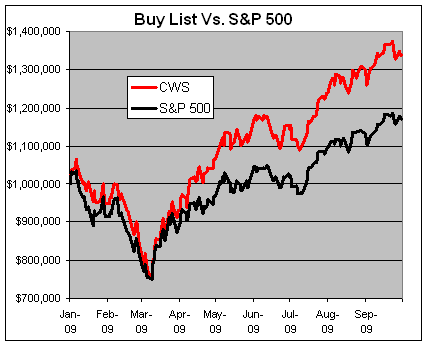
Buy List YTD

Three quarters are now on the books. This was the best quarter for stocks in 11 years, and the best two-quarter gain in 34 years.

For the year so far, our Buy List is up 33.87% and including dividends it's up 34.87%.

For comparison, the S&P 500 is up just 17.03%, and with dividends it's up 19.26%.

image857.png

Posted by edelfenbein at 10:55 PM

Turns Out, the Gem of Tanzania Is Just a Rock

There could be a metaphor in here:

One of the strangest tales in the history of company accounting looks increasingly likely to end with a fabled gem being downgraded to an unusual paper weight.

The Gem of Tanzania, a large ruby whose £11m valuation once underpinned the finances of a failed company with yearly turnover of £103m, may be worth as little as £100.

(Via: Felix)

Posted by edelfenbein at 4:31 PM

Fake Press Release Causes IMAX Shares to Surge

In today's pre-market, shares of IMAX (IMAX) rose as much as 6% on the news that it was being acquired by Disney. There's one problem. It's not being acquired by Disney. The press release was a scam.

Whoever did, just cut and pasted the press release for the Marvel purchase and added the name IMAX. Smart move! They also added this sentence, "If you can get in at a good price tomorrow morning at the open, it maybe something to ask the advise of your broker on." Gee I wonder what gave them away.

I'm guessing now they better seek the advise of their lawyers.

Posted by edelfenbein at 2:29 PM

September 28, 2009

Well, That's a V-Shaped Recovery

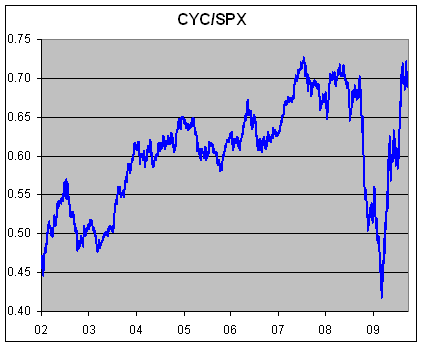
I often like to look at how the Morgan Stanley Cyclical Index (^CYC) is performing relative to the S&P 500.

The past year has been a dramatic ride. Cyclicals led the market down, the led them back up. Here's the CYC divided by the S&P 500.

image856.png

If the equity market is correct, perhaps we're in for a V-shaped recovery.

Posted by edelfenbein at 3:44 PM

Zeroing in on Zero Hedge

Joe Hagan profiles the financial blog Zero Hedge in New York Magazine. In the past, I’ve defended Zero Hedge from attacks on its decision to use a pseudonym. And that defense, incredibly led to me being attacked on CNBC!

Well, now we know that Dan Ivandjiiski is the man behind Tyler Durden:

(A) 30-year-old Bulgarian immigrant banned from working in the brokerage business for insider trading. A former hedge-fund analyst, he’s also a zealous believer in a sweeping conspiracy that casts the alumni of Goldman Sachs as a powerful cabal at the helm of U.S. policy, with the Treasury and the Federal Reserve colluding to preserve the status quo. His antidote? A purifying market crash that leads to the elimination of the big banks altogether and the reinstatement of genuine free-market capitalism.


While many of the posts are excellent, more than a few are—as the passage above suggests—completely off the fringe. They’re poorly reasoned, paranoid and highly conspiratorial.

I wondered why could there be such a difference in the quality of the posts. Apparently, Ivandjiiski is merely the leader but there are up to 40 different people who write under the name Tyler Durden.

I have to agree with Felix, the Durden cell should be broken up. Again, I have no problem with the use of pseudonyms, but we should know which pseudonym wrote what so readers can skip over the Grassy Knoll stuff.

I think ZH's success underscores the fact that the blogosphere is biased toward sites that express moral outrage. Criticizing people is, apparently, far too tame. No, you need to explain why your opponents are evil. In fact, they’re doubly evil because they know they’re evil yet they do nothing about it. Now that’s evil!

I guess a lot of folks aren’t happy unless they’re upset. And with that we go to today’s poll question: Should we increase welfare payments to illegal immigrants?

Posted by edelfenbein at 2:13 PM

Michael Moore: Jesus Wouldn't Play the Stock Market

As to the Jesus’ financial views, I’ll have to defer to those with greater Biblical knowledge. The only financial stand I know Jesus had was his expelling the money changers from the Temple.

But I don’t follow the argument that investing in the stock market is itself immoral. In fact, I think preventing capital from getting to prospective entrepreneurs is morally questionable.

Posted by edelfenbein at 1:05 PM

The Five Most Overpaid CEOs

CNNMoney.com lists the five most overpaid CEOs. They are:

Michael Jeffries, Abercrombie & Fitch
James W. Stewart, BJ Services Company
Brian Roberts, Comcast Corp.
John Faraci, International Paper
Eugene Isenberg, Nabors Industries

Once again, I didn't make the list.

Posted by edelfenbein at 12:26 PM

My Thoughts on HR 1207

I want to address the issue of HR 1207 and the Fed audit. If I were in Congress, I would support the bill. I say this even though I find the much of the pseudo-populist impulse behind the bill repellent.

I’ve read Mr. Alvarez’s testimony and I think he makes several good points. The problem is that too much of the argument relies on scenarios that are too distant from coming about.
The crux of his argument is that all these bad things will happen once a full audit is allowed. Yes, they could happen but it’s not clear that these are immediate dangers.

I’m still curious as to what the conspiracy crowd expects to find out. Matt Taibbi writes: “It’s becoming abundantly clear that at some point we’re going to start to hear details about monstrous front-running operations involving the major banks on Wall Street."

Hmmm. Call me a doubter on that. And if the Fed has been trying to manipulate the market, I’m afraid they’re not doing a very good job.

Posted by edelfenbein at 12:24 PM

Get Your Resumes Ready

Goldman Sachs is hiring.

It must be part of some plot.

Posted by edelfenbein at 11:54 AM

Gambling on Zombie Stocks

The LA Times writes that investors are speculating on busted stocks like Lehman and Washington Mutual that are still trading.

Shares of Lehman have nearly quintupled in the last four weeks despite having some business problem. Some of those problems include having no business or employees.

Still, did I mention the stock? Boo-yah!!

big.chart092809.gif

These folks are literally buying shares that are worth less than the paper they're printed on. If you’ve ever needed clear-cut proof against efficient markets, this is it.

Posted by edelfenbein at 11:41 AM

WaPo Rewrites History

The Washington Post runs a very deceptive article today claiming that community groups warned the Federal Reserve about subprime loans and the Fed repeatedly ignored them.

In fact, the groups were complaining about the interest rate charged on the loans, not on the subsequent housing bubble. The Post writes: “Subprime mortgage lending sneaked up on the Federal Reserve.”

Not at all. The Fed knew about subprime and fully encouraged it. Here’s Greenspan quoted four years ago in, of all places, The Washington Post:

"Where once-marginal applicants would simply have been denied credit, lenders are now able to quite efficiently judge the risk posed by individual applicants and to price that risk appropriately," he said in a speech. "These improvements have led to rapid growth in sub-prime mortgage lending; indeed, sub-prime mortgages account for roughly 10 percent of the number of mortgages outstanding, up from just 1 or 2 percent in the early 1990s."

That’s not all. In June, Connie Bruck wrote in the New Yorker:

In 1992, a landmark study by the Federal Reserve Bank of Boston made it clear that there were systemic underwriting issues relating to the treatment of African American and Hispanic borrowers. Policymakers called upon the mortgage industry to change their practices and redouble their efforts to better serve minorities and underserved communities.

If the community organizers had their way, the bubble would have been far worse, and their communities would be far more disorganized.

Posted by edelfenbein at 11:23 AM

Earnings Revisions At Two-Year High

Bespoke notes that analysts are becoming more bullish:

Our daily tracking of analyst revisions for stocks in the S&P 1500 shows that over the last four weeks, 578 companies in the S&P 1500 have seen their earnings estimates increase, while 389 have seen their numbers cut. This works out to a net of 189, or 12.6% of the index. As shown in the chart below, this is the highest level since at least the start of 2008 (red line), and is a major improvement off of where we were six months ago, when the net earnings revision ratio was closer to "-50%". While analysts are typically thought of as being behind the curve, so far this year they have done a good job of leading the market. When equities bottomed in March (blue line), analyst revisions were already well off their lows of the year.

I should add that analysts aren't so much as increasing their earnings estimates, they're softening the earnings plunges. Still, it's how bull markets start and it's another reason why this isn't a bear-market rally.

Posted by edelfenbein at 10:18 AM

Taleb Watch

Joe Weisenthal spots bigmouth Nassim Taleb in the news again.

“Bernanke, Geithner and Summers didn’t see the crisis coming so why are they still there?” Taleb told a group of business people in Hong Kong. Bernanke is like “a pilot who didn’t see a hurricane,” he added.

Joe shrewdly notes, “We thought prediction was basically impossible.” Not only is Taleb’s comment silly, which they usually are, but this time Taleb’s metaphor shows a fundamentally misunderstanding of what a central does. And as far as predictions go, Taleb isn’t doing so hot. Just five months, he was saying that today’s crisis is “vastly worse” than the Great Depression.

Now that it looks like the recession has past, the GDP numbers will soon reveal how far off the market Taleb was. He also chimed in on financial regulation.

Many people, such as traders, benefit from these black-swan events and it’s up to regulators to ensure rules and disincentives are in place to discourage them from triggering these occurrences, he said.

That’s exactly the wrong approach. The problem is that our regulators have tried to design a system that’s impossible to break. Instead, their focus should be on making a system that’s easy to fix.

Posted by edelfenbein at 10:03 AM

September 26, 2009

Time May Sell Time Magazine

Unthinkable.

Time Warner Inc will eventually sell the Time Inc magazine unit and could buy holdings in its core entertainment category, Gordon Crawford, its largest shareholder, said during a presentation this week.

"Time Warner just spun off their cable division, they are going to sell their print division, they are going to spin off AOL and they're just going to be Warner Brothers, HBO and the Turner Networks," said Crawford, managing director of The Capital Group.

"Now, they will make acquisitions ... but they're probably going to buy just stuff in their wheel house of those businesses. They're not going to, I don't think, go very far afield from their core competency."

Posted by edelfenbein at 12:42 PM

Guess What Bank Has Made $33 Billion This Year?

Give up?

The Fed.

Posted by edelfenbein at 12:20 PM

Sand Animation

Posted by edelfenbein at 11:54 AM

September 25, 2009

Museum Day

Tomorrow is Museum Day! Hundred of museums are letting folks in free of charge.

You can download an admissions card here, and see what museums are participating.

Posted by edelfenbein at 4:01 PM

Kevin Warsh In Today's WSJ

Kevin M. Warsh of the Federal Reserve wrote an op-ed in today’s Wall Street Journal titled “The Fed's Job Is Only Half Over.”

I’ve read the article twice and it’s one of the platitudinal pieces I’ve ever read. I’m not expecting high prose from an economist, but man, this writing is dry. It reads like a committee report, which it may be. All Warsh does is restate the title about a dozen times.

Here are some choice excerpts:

“We are at a critical transition period, of still unknown duration, and we must prepare diligently for an uneven road race ahead.”

“And our policy judgments will ultimately prove worthy of the accolades, and tender the ultimate rejoinder to our critics, if we rise to meet this heightened responsibility. I am confident we will.”

“That outcome will require that policy makers have equal parts capability, clairvoyance and courage—perhaps the most important of which is courage.”

“A nimble, even-handed approach toward our risk-management challenges will prove necessary.”

“Today, even more than usual, we should maintain considerable humility about optimal policy.”

“Financial market developments bear especially careful watching.”

“Nonetheless, I would hazard the view that prudent risk management indicates that policy likely will need to begin normalization before it is obvious that it is necessary, possibly with greater force than is customary, and taking proper account of the policies being instituted by other authorities.”

Posted by edelfenbein at 3:11 PM

The Argument Against HR 1207

You don't hear it much, but there is principled opposition to Ron Paul's HR 1207 bill to conduct full audits of the Federal Reserve. This is from Scott G. Alvarez's testimony today to the House Financial Services Committee:

Through its investigations and audits, the GAO typically makes its own judgments about policy actions and the manner in which they are implemented and makes recommendations to the audited agency and to the Congress for policy changes or future policy actions. Accordingly, financial markets likely would see the grant of audit authority to the GAO with respect to monetary policy as undermining the Federal Reserve's independence in this crucial area, particularly because GAO audits or the threat of a GAO audit could be used both to second-guess the Federal Reserve's monetary policy judgments and to try to influence subsequent monetary policy decisions.

Permitting GAO audits of monetary policy also would likely cast a chill on monetary policy deliberations if policymakers believed that GAO audits would result in early publication and analyses of their policy discussions. Unfettered and wide-ranging internal debates are essential to identifying the best possible policy options for achieving maximum employment and stable prices in light of data that may be conflicting or, at best, ambiguous as to the optimum policy path.

Moreover, publication of the results of GAO audits related to monetary policy actions and deliberations would complicate and interfere with the FOMC's communications to the markets and the public about current economic conditions and the appropriate stance of monetary policy. Households, businesses, and financial market participants would understandably be uncertain about the implications of the GAO's findings for future decisions of the FOMC, thereby increasing market volatility and weakening the ability of monetary policy actions to achieve their desired effects.

The exception from GAO audit for monetary policy matters rightfully extends to the Federal Reserve's use of market credit and liquidity programs to support the functioning of financial markets, stimulate the economy, and unfreeze credit markets. During the crisis, as use of the federal funds rate and discount rate to achieve policy objectives became constrained by the zero bound, the Federal Reserve established several broadly available market credit facilities.8 These broad-based facilities are fundamentally different from the institution-specific loans that the Federal Reserve has made and that are already subject to GAO audit. These broader market facilities are designed to unfreeze credit markets and lower interest rate spreads and are a natural extension of the traditional central bank responsibility to serve as a backup source of liquidity during periods of financial strain.9 In this way, these facilities represent an essential part of the Federal Reserve's efforts to promote financial stability and its monetary policy objectives.

Permitting GAO audits of discount window lending and the broad liquidity facilities that the Federal Reserve uses to affect credit conditions generally could reduce the effectiveness of these facilities in promoting financial stability, maximum employment, and price stability. Experience, including during the current financial crisis, shows that banks' unwillingness to use the discount window can result in high and volatile short-term interest rates and greatly limit the effectiveness of the discount window as a tool to enhance financial stability. Indeed, one of the important difficulties that hampered the effectiveness of the Federal Reserve's early response to the crisis was the unwillingness of many banks to draw discount window credit because of concerns about stigma; institutions were concerned that, if their discount window borrowing from the Federal Reserve became known, they would be subject to adverse reactions from the market or other sources. Authorizing the GAO to audit the discount window and other broad-based lending programs could significantly increase potential borrowers' fears of stigma and adverse reactions.

H.R. 1207 would completely remove the exceptions from GAO audit in current law for monetary policy and discount window deliberations and operations, thereby allowing frequent and ongoing audits in these areas. Financial market participants likely would see passage of H.R. 1207 as a substantial erosion of the Federal Reserve's monetary policy independence. Accordingly, enactment of the bill would tend to undermine public and investor confidence in monetary policy by raising concerns that monetary policy judgments in pursuit of our legislated objectives would become subject to political considerations.

(Via: Alea)

Posted by edelfenbein at 11:39 AM

September 24, 2009

Tall Paul

At 82, Paul Volcker is well worth listening to.


Posted by edelfenbein at 2:20 PM

Peter Schiff: Gold to Hit $5,000

Here's a bold prediction:

Unlike the "legitimate bull markets" of many foreign markets, Peter Schiff believes the U.S. is merely experiencing a "rally in a bear market," and is lagging the rest of the world "for a reason."

The worst is not over, according to Euro Pacific Capital's Schiff, who predicts the Dow will fall another 90% from current levels when measured against gold.

A longtime dollar bear and gold bull, he foresees gold hitting $5000 per ounce "in the next couple of years," and predicts the Dow and gold will trade on a one-to-one ratio vs. the current level of around 9.7-to-1.

Schiff believes gold is currently "climbing a wall of worry" but will eventually become as hot as tech stocks in 1999 and start moving up $100 per day.

Schiff's forecast is based on his view the U.S. dollar is going to collapse under the weight of our massive deficit and reckless policies of the Obama administration, which he compares to the massive spending programs of the 1960s, which paved the way for gold's ascent in the 1970s. "Obama is making the same mistakes as Bush, but he's doing them on a grander scale," says Schiff, who is running for U.S. Senate in Connecticut as a Republican.

I wish Peter will in his Senate bid,, however I have a feeling this prediction won't be remembered in a few years.

Posted by edelfenbein at 12:23 PM

For Valuations, You Need to Look Forward

David Rosenberg writes in the Financial Times:

An unprecedented eight-point price/earnings multiple expansion during a six-month faith-based rally has left the market at its most expensive (26 times operating profit, 180 times reported profit) in seven years. On a reported basis, this market is nearly four times overvalued, as it was during the tech bubble!

The problem is Rosenberg is looking backward not forward. The S&P500’s earnings for the fourth quarter of last year were dismal. In fact, they weren’t even earnings, it was a slight loss. Once that weight is off the trailing four quarters, things will look much better.

The latest estimates say that the S&P 500’s operating earnings will hit $54 for 2009, and nearly $73 for 2010. A multiple of 15 gives the market a fair value of roughly 1100. Discounted back to today means the market is fairly accurately priced.

Of course, the underlying assumptions may be wrong, but I don’t see any current disconnect between today’s outlook and prices.

Posted by edelfenbein at 11:48 AM

BBBY Is Down Today

Just a quick note. I'm not sure why BBBY is down today. I thought it was a good earnings report.

Oh well. A wiser feller than myself once said, "Sometimes you eat the bar and sometimes the bar, well, he eats you."

Posted by edelfenbein at 11:27 AM

September 23, 2009

Bed Bath & Beyond Reports 52 Cents a Share

Bed Bath & Beyond (BBBY) reports Q2 earnings of 52 cents a share. This is good news. The Street's consensus was 47 cents; I said 50 cents.

Bed Bath & Beyond Inc. today reported net earnings of $.52 per diluted share ($135.5 million) in the fiscal second quarter ended August 29, 2009, an increase of approximately 13.0% over net earnings of $.46 per diluted share ($119.3 million) in the same quarter a year ago. Net sales for the fiscal second quarter of 2009 were approximately $1.915 billion, an increase of approximately 3.3% from net sales of approximately $1.854 billion reported in the fiscal second quarter of 2008. Comparable store sales in the fiscal second quarter of 2009 decreased by approximately 0.6%.

For the fiscal first half ended August 29, 2009, the Company reported net earnings of $.86 per diluted share ($222.7 million), an increase of approximately 13.2% over net earnings of $.76 per diluted share ($196.0 million) in the corresponding period a year ago. Net sales for the fiscal first half of 2009 were approximately $3.609 billion, an increase of approximately 3.1% from net sales of approximately $3.502 billion in the corresponding period a year ago. Comparable store sales for the fiscal first half of 2009 decreased by approximately 1.1%.

Here are the earnings results going back a few years:


Quarter Sales Gross Profit Operating Profit Net Profit EPS
May-99$356,633$146,214$28,015$17,883$0.06
Aug-99$451,715$185,570$53,580$33,247$0.12
Nov-99$480,145$196,784$50,607$31,707$0.11
Feb-00$569,012$238,233$77,138$48,392$0.17
May-00$459,163$187,293$36,339$23,364$0.08
Aug-00$589,381$241,284$70,009$43,578$0.15
Nov-00$602,004$246,080$64,592$40,665$0.14
Feb-01$746,107$311,802$101,898$64,315$0.22
May-01$575,833$234,959$45,602$30,007$0.10
Aug-01$713,636$291,342$84,672$53,954$0.18
Nov-01$759,438$311,030$83,749$52,964$0.18
Feb-02$879,055$370,235$132,077$82,674$0.28
May-02$776,798$318,362$72,701$46,299$0.15
Aug-02$903,044$370,335$119,687$75,459$0.25
Nov-02$936,030$386,224$119,228$75,112$0.25
Feb-03$1,049,292$443,626$168,441$105,309$0.35
May-03$893,868$367,180$90,450$57,508$0.19
Aug-03$1,111,445$459,145$155,867$97,208$0.32
Nov-03$1,174,740$486,987$161,459$100,506$0.33
Feb-04$1,297,928$563,352$231,567$144,248$0.47
May-04$1,100,917$456,774$128,707$82,049$0.27
Aug-04$1,273,960$530,829$189,108$120,008$0.39
Nov-04$1,305,155$548,152$190,978$121,927$0.40
Feb-05$1,467,646$650,546$283,621$180,980$0.59
May-05$1,244,421$520,781$150,884$98,903$0.33
Aug-05$1,431,182$601,784$217,877$141,402$0.47
Nov-05$1,448,680$615,363$205,493$134,620$0.45
Feb-06$1,685,279$747,820$304,917$197,922$0.67
May-06$1,395,963$590,098$148,750$100,431$0.35
Aug-06$1,607,239$678,249$219,622$145,535$0.51
Nov-06$1,619,240$704,073$211,134$142,436$0.50
Feb-07$1,994,987$862,982$309,895$205,842$0.72
May-07$1,553,293$646,109$154,391$104,647 $0.38
Aug-07$1,767,716$732,158$211,037$147,008 $0.55
Nov-07$1,794,747$747,866$203,152$138,232 $0.52
Feb-08$1,933,186$799,098$259,442$172,921 $0.66
May-08$1,648,491$656,000 $118,819$76,777$0.30
Aug-08$1,853,892$739,321 $187,421 $119,268$0.46
Nov-08$1,782,683$692,857 $136,374 $87,700$0.34
Feb-09$1,923,274$785,058$231,282 $141,378 $0.55
May-09$1,694,340$666,818$142,304$87,172$0.34
Aug-09$1,914,909$773,393 $222,031 $135,531$0.52

image855.png

Posted by edelfenbein at 4:18 PM

Imagine If Lehman Brothers Had a Football Team

Lately it’s been all the rage to complain about companies that are too big to fail. However, there’s another prominent American institution that’s also become too big to fail. It’s bloated, overstaffed and often fails to meet the most basic need of its customers.

Welcome to American higher education.

More Americans are wising up to the fact that college is a big fat waste of money. Sure, if you’re lucky enough, and smart enough, get into a big-name school, college is just fine. But for millions of other students, a four-year degree often puts them in a mountain of debt and doesn’t give them the skills they need in the job market.

First, let’s consider how long it takes many students to finish college. Even after six years, only 54% of college students even get a degree. For high-school students in the bottom 40% of their class and who go to a four-year college, an amazing two-thirds hadn’t earned a diploma after eight-and-a-half years. Sheesh, that’s worse than Bluto! I can’t think of another industry that has such a dismal record.

David Leonhardt recently wrote at the New York Times: “At its top levels, the American system of higher education may be the best in the world. Yet in terms of its core mission—turning teenagers into educated college graduates—much of the system is simply failing.” He’s exactly right.

Still, tuition costs continue to skyrocket. Between 1982 and 2007, tuition and fees rose 439% compared with just 147% for median family income. The trend shows no sign of stopping. One year at Yale now goes for $47,500. The University of Florida system wants to raise tuition by 15%, the maximum allowed.

Much like the housing bubble, the Higher Ed bubble is being driven by cheap, government supported credit. The problem is compounded by the fact that hugely important financial decisions are placed on the backs of 19-year-olds, many of whom simply don’t have the life experience to weigh the implications of a gigantic, 20-year debt load. Heck, at least the irresponsible mortgage borrowers during the crazy days were adults (even though many acted like infants).

One report shows that students from lower-income families need to pay 40% of their family income to enroll in a public four-year college. That’s a lot of coin to have some Marxist feminist theorist tell you about atavistic nature of late-stage capitalism. Please, you can watch the Oscars to learn that. Don’t think community colleges are a bargain, either. The average tuition is up to 49% of the poorest families’ median income from 40% in 1999-2000.

The pro-college crowd likes to repeat the claim that college grads earn $1 million more, on average, over their working lifetime. Sure, this is true, but college grads start out in a big hole. On average, they don’t even catch up to high school grads until age 33.

The debt load piled on students is scandalous. One in five students who graduated in the 1992–93 school with over $15,000 in debt defaulted on his or her loan within 10 years of graduation. We’re setting young people up for failure and ruin credit records. Thanks to the recession defaults are up 43% over the last two years. Many students go to grad school and pile on even more debt. The average law grad owes $100,000. Plus, many schools often use grad students as greatly underpaid professors in order to cut costs. Think of Lehman Brothers. Now imagine if they had a football team.

The loans fall especially hard on minorities since colleges love to boast their “diversity.” For African-American students, the overall default rate is more than one-third. That’s five times higher than white students and over nine times higher than Asian students.

What makes things even worse for many colleges is that the recent bear market put the squeeze on their endowments. Harvard’s endowment dropped by $11 billion and they announced they’re laying off 25% of their investment staff. Cornell’s endowment plunged 27% in the final six months of 2008. Yale lost $5.9 billion, or one-fourth its value. Lower endowments means...you guessed it, higher tuition.

School financing has exploded in recent years, doubling in just ten years. Total student debt now stands at over half a trillion dollars. The average borrow took out a loan worth $19,200. That’s a 58% jump since 1993.

Naturally, the government is set to make a bad situation worse. Last week, the House of Representatives voted to elbow Sallie Mae (SLM) out of the student loan biz and shift all student loans to a government-run, taxpayer financed system. So instead of government subsidized loans run through banks to students, we’ll now have a government monopoly. Hmmm…what could possibly go wrong?

I got a better idea. It’s a real simple government program. I call it, “Dude, you really shouldn’t be going to college.” Best of all, the program is very cheap. The costs are solely a postcard and my consulting fee. If don’t want to listen to me, fine, then listen to the folks at the ACT who say that only 23% of students have the skills to do well in college.

The good news is that Americans are catching on to the college scam. Admissions applications are dropping at elite school. Applications are off by 20% at Williams College. Middlebury saw a 12% decline and Swarthmore had a 10% drop. I believe this is just the beginning.

The reason I’m so confident is that these are boom times for the for-profit education sector. Long derided as diploma mills, these companies are raking it. Already this decade, shares of Strayer Education (STRA) are up over 1,000% and shares of ITT Educational Services (ESI) are up over 1,300%.

Business is so strong that the schools are having difficulty even making earnings estimates. In January, ESI issued 2009 EPS guidance of $6.25 to $6.45 which well above the Street’s view of $5.73. Since then, the company raised guidance three times. The current EPS range is now $7.55 to $7.85. In other worlds, no bailouts needed here.

These schools are ideal for older students who are attending school on their own initiative instead of doing what their parents expect. Many of the schools have comprehensive programs but students often go there to take a few courses to round out their job qualifications. Businesses also like to use the schools for employee training. The graduation rates tend to be high and the default rates are low (though still not ideal as some members of Congress have noted).

I also like the fact that the school has an efficient business mode. Operating margins tend to be high and they businesses don’t drain capital.

Look at the success of a company like Lincoln Educational Services (LINC). A few weeks ago, Lincoln reported blowout Q2 earnings. Check out these digits. Revenue rose 51% and earnings-per-share jumped an astounding 440%. The company netted 27 cents a share which schooled the Street’s consensus of 19 cents a share. On top of that, Lincoln boosted its full-year EPS guidance to a range between $1.40 and $1.45 from their prior range of $1.25 to $1.30. Who’s laughing at the diploma mill now?

Lincoln is hardly alone. Last month, Corinthian Colleges (COCO) issued 2010 EPS guidance of $1.30 to $1.36 which was well above the Street’s view of $1.14. If COCO hits their range, then we’re talking about a growth rate of over 50%.

The big kid on the block is Apollo Group (APOL) owner of the University of Phoenix which has more than 200 campuses and over 400,000 students. Apollo has a market cap of $10 billion and it’s one of the two for-profit ed stocks in the S&P 500 (DeVry being the other). The shares have vaulted nearly 100-fold since the IPO 15 years ago. Apollo is doing more than any bureaucrat to reshape the landscape of American higher education. Make no mistake how serious they are. Three years ago, the company shelled out $150 million to turn the home of the Arizona Cardinals into the University of Phoenix stadium.

The for-profit sector still contains many risks. Loan defaults rates are a problem which doesn’t look so good considering the schools have healthy operating margins. The industry was dreading a recent GAO report which turned out to be milder than expected.

Of all the for-profit schools, I think Lincoln Educational Services offers the best value right now. The company just gave a big earnings boost and the shares are now going for about 12 times 2010’s forecast. Strayer, on the other hand, is the one to avoid. The stock is up to 23 times next year’s consensus. For a school stock, that’s not very smart.

Posted by edelfenbein at 3:02 PM

The Fed's Statement

Yawn.

Information received since the Federal Open Market Committee met in August suggests that economic activity has picked up following its severe downturn. Conditions in financial markets have improved further, and activity in the housing sector has increased. Household spending seems to be stabilizing, but remains constrained by ongoing job losses, sluggish income growth, lower housing wealth, and tight credit. Businesses are still cutting back on fixed investment and staffing, though at a slower pace; they continue to make progress in bringing inventory stocks into better alignment with sales. Although economic activity is likely to remain weak for a time, the Committee anticipates that policy actions to stabilize financial markets and institutions, fiscal and monetary stimulus, and market forces will support a strengthening of economic growth and a gradual return to higher levels of resource utilization in a context of price stability.

With substantial resource slack likely to continue to dampen cost pressures and with longer-term inflation expectations stable, the Committee expects that inflation will remain subdued for some time.

In these circumstances, the Federal Reserve will continue to employ a wide range of tools to promote economic recovery and to preserve price stability. The Committee will maintain the target range for the federal funds rate at 0 to 1/4 percent and continues to anticipate that economic conditions are likely to warrant exceptionally low levels of the federal funds rate for an extended period. To provide support to mortgage lending and housing markets and to improve overall conditions in private credit markets, the Federal Reserve will purchase a total of $1.25 trillion of agency mortgage-backed securities and up to $200 billion of agency debt. The Committee will gradually slow the pace of these purchases in order to promote a smooth transition in markets and anticipates that they will be executed by the end of the first quarter of 2010. As previously announced, the Federal Reserve’s purchases of $300 billion of Treasury securities will be completed by the end of October 2009. The Committee will continue to evaluate the timing and overall amounts of its purchases of securities in light of the evolving economic outlook and conditions in financial markets. The Federal Reserve is monitoring the size and composition of its balance sheet and will make adjustments to its credit and liquidity programs as warranted.

Voting for the FOMC monetary policy action were: Ben S. Bernanke, Chairman; William C. Dudley, Vice Chairman; Elizabeth A. Duke; Charles L. Evans; Donald L. Kohn; Jeffrey M. Lacker; Dennis P. Lockhart; Daniel K. Tarullo; Kevin M. Warsh; and Janet L. Yellen.

Posted by edelfenbein at 2:27 PM

The Swine Flu Index

It had to happen sooner or later:

Rather than reaching for rubber gloves and face masks for protection, some investors are trying to expose their portfolios to the swine flu.

As governments brace to see if the H1N1 flu strain, better known as swine flu, worsens, investors are looking for companies that might profit from the pandemic.

"Investors can make money and avoid losses when it comes to swine flu," says Jason Kantor, analyst at RBC Capital. "The secret is to own companies that will benefit directly regardless of (the outbreak's) severity."

That includes companies that:

•Produce mainstream flu treatments. Perhaps the most straightforward way to invest in swine flu is through companies that make popular mainstream drugs that fight viral infections.

GlaxoSmithKline's (GSK) Relenza and Gilead Sciences (GILD)' co-developed Tamiflu are two of the most commonly used to combat swine flu symptoms, says analyst Jason Kolbert of ThinkEquity. Gilead gets a roughly 20% royalty from Tamiflu sales from Roche, which makes and sells the product.

Gilead stands to benefit if the regular flu this year is worse than expected, Kolbert says, and also benefits if the H1N1 flu is more virulent than forecast. It's a highly profitable licensing arrangement, Kantor says. Gilead is expected to reap $200 million in sales from Tamiflu in 2010. GlaxoSmithKline and Novartis could benefit, too, since they make seasonal flu vaccines, he says.

•Develop vaccines targeted to swine flu. BioCryst (BCRX) is working on the antiviral agent peramivir, which may be more appropriate for H1N1 due to its greater potency, says analyst Joe Schwartz of Leerink Swann. If H1N1 is more serious than thought, this treatment may be more popular. Plus, the drug is more important economically to BioCryst than Tamiflu is to Gilead. Monday, BioCryst got $77.2 million more in funding from the U.S. Department of Health and received a request for information about potentially stocking the treatment.

Other smaller firms working on H1N1 vaccines include Novavax (NVAX) and Vical (VICL), Kolbert says. If those vaccines pan out, they could be more meaningful than Tamiflu is to Gilead at 5% of revenue, Schwartz says. Meanwhile, large French drugmaker Sanofi-Aventis (SNY) said Monday that it received an additional order from the U.S. for H1N1 vaccine, bringing the total order to 75.3 million doses. And Monday, the U.S. ordered more nasal-spray vaccine from AstraZeneca's (AZN) MedImmune.

But there's reason to be skeptical. Previous scares, such as mad cow disease and avian flu, only gave stocks a short-term boost until the hysteria faded. "The concern is H1N1 gets worse. That's the unknown," Schwartz says. "It has that potential, but that's far from a certainty."

Posted by edelfenbein at 10:13 AM

September 22, 2009

AP: Hedge fund sells part of its New York Times stock

From AP:

Harbinger Capital Partners LLC says it has sold part of its 20 percent stake in The New York Times Co., but still considers the company a core holding.

The hedge fund said in a securities filing this week that it sold 5 million Times shares at $8.25 each. That leaves it with about 23.5 million shares, or a 16.4 percent stake in the company.

Fund spokesman Charles V. Zehren says the media company "is still a core holding, and the sale was done to take advantage of the strength in the market."

The New York Times Co. publishes The Boston Globe, the International Herald Tribune and 15 other dailies along with its flagship newspaper.

Its shares rose 36 cents, or 4.4 percent, to $8.52 in morning trading.

Posted by edelfenbein at 10:59 AM

FactSet Guides Higher

FactSet Research Systems (FDS) reported fiscal fourth-quarter earnings this morning. For the June through August period, the company earned 74 cents a share compared with 67 cents last year. That matched Wall Street’s estimate. Revenue rose 1% to $155 million which slightly better than estimates.

Here are some highlights of the quarter listed by the company:

* Client count was 2,045 at August 31, 2009, a net increase of 12 clients during the quarter.
* Professionals using FactSet increased to 37,300, up 200 users.
* Portfolio Analytics ("PA") 2.0 was deployed by 647 clients representing 5,640 users. PA users increased by 40 during the quarter, while the number of PA clients remained the same as the previous quarter.
* Annual client retention rate was greater than 95% of ASV and 87% of clients.
* Employee count at August 31, 2009 was 2,962, up 412 employees during the quarter.
* Common shares outstanding at August 31, 2009 were 46.7 million. The Company repurchased 594,600 shares during the quarter and $102 million remains authorized for future repurchases.

For their first quarter, FactSet sees EPS ranging between 73 and 75 cents which is higher than the Street’s consensus of 71 cents. The shares have been up as much as 10% to a new 52-week high.

Posted by edelfenbein at 10:37 AM

Oh Becky

Posted by edelfenbein at 10:21 AM

September 21, 2009

The Worse the Economy, the Better the Recovery

Jim Grant has a typically smart piece in the WSJ. Although he's known to be a pessimist, Grant has turned bullish recently:

Americans are blessedly out of practice at bearing up under economic adversity. Individuals take their knocks, always, as do companies and communities. But it has been a generation since a business cycle downturn exacted the collective pain that this one has done. Knocked for a loop, we forget a truism. With regard to the recession that precedes the recovery, worse is subsequently better. The deeper the slump, the zippier the recovery. To quote a dissenter from the forecasting consensus, Michael T. Darda, chief economist of MKM Partners, Greenwich, Conn.: "[T]he most important determinant of the strength of an economy recovery is the depth of the downturn that preceded it. There are no exceptions to this rule, including the 1929-1939 period."

Ah, our old friend Mr. Reversion to the Mean. He's made smart people look dumb and dumb people look smart.

Posted by edelfenbein at 2:15 PM

Stimulus Program

Not sure what to made of this one: French workers strip to try to save their jobs.

Posted by edelfenbein at 1:24 PM

Q&A With Doug Kass

Dan Holland of Real Clear Markets sat down with the always-valuable Doug Kass. Here's a sample:

RealClearMarkets: You made a huge, once-in-a-lifetime call when you correctly predicted the stock market bottom back in early March-a generational low as you called it. Equities launched an extraordinary rally on cue with your call, and are up over 60 percent as of this interview. Was this good fortune, or was your call borne out of a repeatable investment process?

Kass: Consider the market as a triangle. The bottom left angle is sentiment and the bottom right angle is valuation. On top is the most consequential angle (the one I weigh most heavily) - the fundamentals.

In March, 2009, sentiment and valuation was clearly stretched to a negative extreme. Investors were fearful of "being in" -- as a result, retail investors and institutional investors (especially of a hedge fund kind) were at record low net invested positions. At the same time, valuation was pushed down to nearly unprecedented low levels vis a vis "normalized" S&P earnings of about $70/share and were trading at a discount to replacement book value (compared to an historic average of about 140% of replacement book value).

In terms of fundamentals, I had a specific Watch List which helped me gain comfort that stocks were creating a Generation Low. I believe, by following this list, that the process is repeatable.

My Watch List indicators were getting "less worse" six months ago - and that a second derivative recovery was well underway, but, at the time, was being ignored as fear reigned.

Here is a partial check list of (ignored) indicators that I was looking at six months ago which led to my adopting a more favorable stock market outlook:

• Bank balance sheets were being recapitalized.
• Bank lending was slowly being restored as the industry was experiencing record wide net interest spreads and margins.
• Financial stocks' performance was improving.
• Commodity prices were beginning to rise- a sign that worldwide economic growth was mending.
• Credit spreads and credit availability were slowly improving.
• With affordability at record levels, the cost of home ownership versus renting becoming more favorable and with the Federal Reserve providing a low interest backdrop - a bottom in the housing markets was growing more likely.
• Corporations' draconian cost cutting was accelerating - sowing the seeds for upside margin and earnings surprise in 2009's second half.
• Corporations had cut inventories to the bone - a record low level of inventory to sales augured positively for corporate profits.
• There was growing evidence of favorable reactions to disappointing earnings and weak guidance - a sign that the poor operating environment had been discounted.
• Evidence of strength in China's economy (two consecutive months of a rising PMI) and in its equity market (seen in strong absolute and relative strength in Chinese stock market.
• Market volatility was starting to decline.
• Hedge fund and mutual fund redemptions were easing.
• Pension funds were far too skewed towards fixed income and provided the potential to buoy stocks in a reallocation in the months ahead.

Posted by edelfenbein at 1:07 PM

TARP Application: “Two Pages, Most of it White Space”

Vanity Fair looks at how the TARP Program was run. After making all the big boys participate, Treasury strong-armed smaller banks as well. Ray Davis, the head of Umpqua Bank, a financially sound bank in Oregon, got the message that he’d better play ball and take TARP money:

The “application” was the paperwork for a capital infusion, and Davis was told it would be faxed over right away. By now he was sold on participating. “Here was somebody from the secretary of the Treasury calling,” Davis says, “and complimenting us on the strength of our company and saying you need to do this, to help the government, to be a good American citizen—all that stuff—and I’m saying, ‘That’s good. You’ve got me. I’m in.’”

The most urgent task was to complete the application and get it back to Treasury the next day, and this had Davis in a sweat: “I pictured this 200-page fax that would take me three weeks of work crammed into one evening.” Imagine Davis’s surprise when a staff member walked in soon afterward with the official “Application for tarp Capital Purchase Program.” It consisted of two pages, most of it white space.


Posted by edelfenbein at 11:51 AM

Happy 10th Birthday to Dow 36,000

Brett Arends notes that it’s the 10-year anniversary of Dow 36,000. Over that time, the Dow has fallen from about 10,300 to around 9,700 today. According to the book, the Dow was to reach 36,000 in three to five years.

Here’s a review I wrote of the book when it came out.

Now that the Dow Jones Industrial Average has soared over 4,500 points since Alan Greenspan warned us of the market's "irrational exuberance," a mini-industry has evolved of publishing books that attempt to explain the "new market." The latest addition to the genre is Dow 36,000 by James K. Glassman and Kevin A. Hassett, both of the American Enterprise Institute. To give you an idea of how crowded the field is becoming, two other books are titled Dow 40,000 and Dow 100,000.

Unfazed by the Dow’s stunning climb, mega-bulls Glassman and Hassett have developed their own theory as to why the market has risen so much and why it will continue to rise. Their theory isn’t the usual litany one hears from Wall Street bulls (demographics, triumph of capitalism). Instead, their “36,000” theory goes right to the heart of investment analysis by questioning one of its elemental suppositions: namely, the idea that investments in stocks should demand a premium over investments in bonds due to the riskier nature of stocks. This isn’t split hairs they’re taking on.

Reciting historical data, Glassman and Hassett show that over the long haul, there is no difference between the risks of stocks and Treasury bonds. Therefore, they reason, there should be no risk premium at all. The authors claim that with the risk premium excised from the market, the perfectly reasonable price, or PRP as they call it, for the Dow is 36,000 (more on that later). Mind you, they’re not merely saying the Dow will eventually hit this magic number sometime in the future. Instead, Glassman and Hassett claim that 36,000 is where the Dow ought to be right now. Or more precisely, that’s where the Dow should have been early this year when they started writing the book. Could they be onto something? At the time, the Dow was at 9000.

The Dow very well may head to 36K, but it will have little to do with Glassman and Hassett’s theory. Their theory is seriously flawed due to major methodological errors.

First, Glassman and Hassett err in their selection of an appropriate measure of risk for their purpose. The free market prices risk, just like it prices everything else. That price is included in the price of stocks. In order to measure risk, Glassman and Hassett should use a measurement that isolates risk from the price of stocks. They don’t do this. Instead, they compare the standard deviation of stock returns to the standard deviation of risk-free-bond returns. That’s a different animal. Sure enough, with progressively longer holding periods, stock returns’ standard deviations gradually get smaller. Upon realizing that at long term, the standard deviation of stock returns is the same as bond returns’, actually slightly less, Glassman and Hassett conclude that stocks are “no more risky” than Treasury bonds.

That’s a faulty conclusion. Even if the standard deviations are the same size, it doesn’t say anything about the risk that they’re looking for. The point is, that risk has still never been isolated: It’s inside those returns no matter how long term you go. The variability of risk’s part of all these returns may be diminishing as well. That can happen even if risk stays exactly the same size. With Glassman and Hassett’s method, we have no idea how big the risk inherent in stock ownership is.

Without all the mumbo-jumbo, think of two houses, identical in every way except one has a great view of the river, the other does not. How much does the river view cost? Easy. Compare the prices of the two homes, and the difference must be the price of the view. The fact that the prices paid may deviate from their own respective averages the same way, speaks nothing as to the price of the view. Glassman and Hassett are saying that since those deviations are the same, the river view is free.

Running with this assumption, Glassman and Hassett reason that since risk and reward are related, assets with the same risk will have the same return. Therefore, stocks and bonds will have the same returns. For this to happen, they claim, “the Dow should rise by a factor of four.” How do they get four?

Glassman and Hassett start with the “Old Paradigm” premise that bond returns plus a risk premium equals stock returns. With the risk premium “properly” removed, the yield on Treasuries—meaning their expected return—should be the same as the expected return for stocks. And that’s their dividend yield plus the dividend’s growth rate. So far, so good. Since the sum of these two is now about 1.5% above today’s Treasury yield, the yield on stocks needs to be adjusted downward in order to bring everything into balance. Specifically, it needs to drop from about 2% to 0.5%. With the yield dropping to one-fourth its previous level, stock prices will jump fourfold. Presto. That’s how we get from 9000 to 36000.

Not exactly. The authors have made another mistake. It’s impossible to have a one-time-only ratcheting down of the market’s dividend yield. The reason is that if long-term stock returns don’t change, as the authors do assume, a lower dividend yield will always create a commensurate increase in the dividend growth rate. As a result, there will always be a new higher dividend whose yield will always be in need of being notched back down. And as a result, the dividend growth rate will increase, and the cycle will continue ad infinitum. The correct conclusion from their model is not a one-time-only fourfold increase in stocks, but one-time-only infinite increase in stocks. This means the authors are actually insufficiently bullish and, moreover, they’ve mistitled their book.

Fortunately, the second half of the book is the more valuable by far. Once the authors stop making theories, they start making some sense. In this section, the authors discuss how investors can capitalize on the continuing market boom. The authors estimate the market has another three to five years perhaps before 36K is reached. In any case, their strategies are rather conservative: Buy and hold, diversify, don’t trade too much, don’t let market fluctuations rattle you, don’t time the market. All perfectly sound ideas and not specifically dependent on “Dow 36,000.”

Glassman and Hassett also give the names of stocks and mutual funds they like. There’s nothing wrong with their stocks in the realm of theory, but readers definitely ought to avoid the author’s so-called Perfectly Reasonable Prices, which invite comparison to the famous description of the Holy Roman Empire—not holy, not Roman, not an empire.

I’m not familiar with Kevin Hassett’s former work, but I’ve always liked James Glassman’s investing articles for The Washington Post. His articles are consistently incisive and informative. This book, however, is nothing of the sort. Dow 36,000 contains egregious errors and fallacious reasoning.

Still, I do admire their ambition. With this book, Glassman and Hassett challenged a well-entrenched perception of reality. Being that this perception underwrites trillions of dollars, it’s a very, very, very, well-entrenched perception. Glassman and Hassett lost, and they lost badly. Old paradigms die hard, but they do die.

Posted by edelfenbein at 10:09 AM

The Long-Tail Effect Will Revolutionize Business. Yeah…About That.

Some folks at Wharton found that the Long-Tail Effect isn’t all it’s cracked up to be.

The Wharton researchers find that the Long Tail effect holds true in some cases, but when factoring in expanding product variety and consumer demand, mass appeal products retain their importance. The researchers argue that new movies appear so fast that consumers do not have time to discover them, and that niche movies are not any more well-liked than hits.

According to Netessine, the Long Tail effect may be present in some cases, but few companies operate in a pure digital distribution system. Instead, they must weigh supply chain costs of physical products against the potential gain of capturing single customers of obscure offerings in a rapidly expanding marketplace. Companies, they add, must also consider the time it takes for consumers to locate off-beat items they may want.

"There are entire companies based on the premise of the Long Tail effect that argue they will make money focusing on niche markets," says Netessine. "Our findings show it's very rare in business that everything is so black and white. In most situations, the answer is, 'It depends.' The presence of the Long Tail effect might be less universal than one may be led to believe."

The researchers used data from Netflix who made their numbers available as past of a $1 million competition to improve predicting consumer ratings by 10%.

Posted by edelfenbein at 9:44 AM

Looking Ahead to Bed, Bath & Beyond’s Earnings Report

Bed, Bath & Beyond (BBBY) is due to report its fiscal second-quarter earnings on Wednesday. I’ve been eagerly awaiting this earnings report because last earnings report was surprisingly strong. The company was certainly helped by Linens 'N Things going under, so I’m curious if last quarter’s earnings were an outlier or if BBBY’s business is truly recovering.

For the fiscal first quarter, Wall Street was expecting earnings of 25 cents a share, but Bed, Bath & Beyond actually earned 34 cents a share for a large earnings beat. This also topped the result from the first quarter of one year before which broke a five-quarter run of lower year-over-year declines. After the earnings report, the stock got a nice one-day bounced but didn’t really start to rally for another two weeks. Since then, the stock has been on an impressive run.

For the second quarter, the consensus on the Street is for earnings of 47 cents a share, which is a penny higher than one year ago. I’m expecting 50 cents a share. There’s a lot to like about BBBY. The balance sheet has $857 million in cash, or $3.27 a share, and zero debt. In July, the company was highlighted in Barron’s and Time.

The smart thing that BBBY did was to fight Linens 'N Things on price. The downside is that there are too many coupons out there and it’s hurting their margins. Net margins for the last four quarters are down to 6% compared with 10% four years ago. That effectively erases the benefits of 66% jump in sales.

Posted by edelfenbein at 9:36 AM

September 20, 2009

Quote of the Day

From David Merkel:

Auction rate preferred securities — when I was younger, I wondered how they worked. By the time I figured that out, the market failed.

Posted by edelfenbein at 12:44 PM

September 19, 2009

David K. Levine Responds to Krugman

At the Huffington Post:

More to the point: our models don't just fail to predict the timing of financial crises - they say that we cannot. Do you believe that it could be widely believed that the stock market will drop by 10% next week? If I believed that I'd sell like mad, and I expect that you would as well. Of course as we all sold and the price dropped, everyone else would ask around and when they started to believe the stock market will drop by 10% next week - why it would drop by 10% right now. This common sense is the heart of rational expectations models. So the correct conclusion is that our - and your - inability to predict the crisis confirms our theories. I feel a little like a physicist at the cocktail party being assured that everything is relative. That isn't what the theory of relativity says: it says that velocity is relative. Acceleration is most definitely not. So were you to come forward with the puzzling discovery that acceleration is not relative...

Of course some people did predict the crisis. Some might even have been smart enough to know that if they consistently predict the opposite of a consensus point forecast, eventually they will be right when everyone else is wrong. If I say every year: there will be war; there will be an asset market crash; there will be a recession; there will be famine; we will run out of oil - eventually I'll be right. These kind of predictions are only meaningful if more people than can be attributed to random good luck got it right at the right time or if whatever method they used to reach that conclusion is replicable. Or does the ability to replicate results fall under the category of "not very interesting because that would be an elegant theory?"

Posted by edelfenbein at 12:19 PM

September 18, 2009

Trader Quits Job to Run Hot Dog Stand

This doesn't seem kosher:

"I've heard lots of people moaning about their jobs," said Mr Brause. "As soon as people get to management level they dream of this, and this was a dream of mine for a while because I was pretty fed up with my job too. The office politics was terrible."

But as the sausages sizzled on a hot plate, Thomas said quitting his high-powered job had not made life less stressful.

"I work 14-hour days," he said. "I get up at 0530. This is more stressful than before! I did my previous job for 24 years so I was very used to it. Now, I have to learn a lot of things and cope with circumstances I've never seen before.

"But I would say I'm happier. If you're not happy with your job, it's bad for you. I lost everything but it was an opportunity. So now I'm here - and I'll see where I am in a year's time."

Posted by edelfenbein at 4:37 PM

Beeker Goes Down

0226-beeker.jpg

From Dennis Kneale: "newflash to friends fans & foes: my 8pm show, "cnbc reports," just got cancelled. let the blogosphere dance with joy! me? i'm devastated."

Finally. I hope the network moves toward the kind of journalism that David Faber does, and away from the gimmicks of Kneale.

Posted by edelfenbein at 4:26 PM

September 17, 2009

Just In Case No One Remembers

From almost the exact bottom, March 12, 2009, Nouriel Roubini wrote a column in Forbes "How Low Can The Stock Markets Go? The answer: Lower ... much lower."

To be clear, I'm not trying to paint Roubini in a bad light. I'm trying to point out the folly of market forecasts.

Posted by edelfenbein at 12:02 AM

September 16, 2009

Fourth Downs: Kick, Punt or Go for It?

Brian Burke runs the excellent Advanced NFL Stats blog. He combs through mountains of data to uncover interesting aspects of the game.

Burke recently completed a big study looking at fourth downs and the advantages of going for it versus kicking or punting. As it turns out, football teams ought to go for it on fourth downs far more than they do.

After crunching tons of data, this is the chart Burke came up with showing the recommended option of what to do on fourth down.

The charts shows that football coaches have been far too risk averse. In fact, if they were to follow the advice on Burke’s chart, I think the number of field goal attempts would plummet.

The lingering question is why are coaches so conservative? Perhaps it has to due with the fact that the future points you might get are abstract, whereas punting down field is obvious.

Bear in mind that the advantage of going for it on fourth down isn’t that you’ll make the first down. Instead, it’s the net result of giving up the ball versus surrendering the ball with a punt farther down field. There are lots of variables in play.

There is a financial equivalent (I’m sure you were waiting). What Burke’s study is really looking is risk management. That’s what a lot of investing is about as well. The question investors need to ask isn’t if Dell is a good investment. Instead, is Dell a good investment given its risk compared with other investments with similar risk?

Behavioral economists have shown that we’re not so good at measuring probabilities. We’re far more likely to horde what we have rather than risk an uncertain payoff (See here where I asked: Which would you choose; $1,000 guaranteed or a 50% chance at making $3,000?)

For many years now, gold has outperformed stocks and Treasuries have beaten stocks for decades. According to conventional wisdom, that’s not supposed to happen but it did. Punting on fourth down is conventional wisdom so it will take a brave coach to be the first one to challenge this orthodoxy.

Posted by edelfenbein at 7:26 PM

Another New High

The market was up yet again today. This was the eighth rally in the last nine sessions. I’ve been a fan of this rally, and I’ve had a lot of fun teasing the doubters, but it’s started to look tired to me (I mentioned I sold Dell earlier today).

For the year, the S&P 500 is now up over 18% not including dividends, and it’s up 58% since the March 9th closing low. Our Buy List has done even better, up 36.3% for the year and 80.3% since March 9th.

The VIX, or volatility index, got close to a new 52-week low today. Interestingly, the VIX rose today even though it usually falls on days when stocks rally. In October, the VIX came close to breaking 90. Today, it’s at 23.

Here’s a look at the S&P 500 (black line, right scale) and the VIX (blue line, right scale):

image854.png

Posted by edelfenbein at 4:46 PM

Technical Number to Watch

When the S&P 500 hits 1,066.86, that's exactly a 60% gain from the March 6 intra-day low.

Posted by edelfenbein at 3:04 PM

Bed Bath & Beyond Makes New High

Bed Bath & Beyond (BBBY) just broke out to a new 52-week high today. The stock has been as high as $38.38 in today's trading. In July, Barron’s said that stock was headed to $40 and it looks like they might be right. At the time of their call, BBBY was at $32.65.

One of the new stocks I added to this year’s Buy List was Baxter International (BAX). I’m pleased with how the company has performed although the share price hasn’t done that well. It’s currently up about 3% this year. The company beat earnings estimates by two cents a share in January, April and July. That’s a good sign.

The company said today that its goal is to grow EPS by 11% to 13% over the next five years. For this year, they see EPS in a range of $3.76 to $3.80. That’s what they had said in July when they raised guidance slightly. They also raised guidance in April (notice a trend here). I'm sticking with Baxter.

Posted by edelfenbein at 2:54 PM

Intrade on Healthcare Reform

The futures market doesn't expect anything to happen before the end of the year:

chart124721675729522848.png

Posted by edelfenbein at 1:07 PM

Sold My Position in Dell

I used to be a big fan of Dell (DELL) which was a horrible mistake on my part. Nevertheless, any investor will have good ideas and dumb ideas. This was a dumb one.

I initially bought Dell in late 2005 around $30.50 a share and rode it all the way down to $8 earlier this year. When you’re down that much, the temptation is to say “Screw this” and sell out at any price. Fortunately, I fought that and held on for a bit more.

I decided to come up with a fair price and wait until Dell came within range. The fair price I chose was $15 a share. The stock recently hit it though I held out for a little more and sold today at $17.

big.chart091609.gif

It’s easy to talk about your winners but I wanted to share some of my big losers as well. Still, the lesson is the same and that’s not to let your emotions get the best of you.

Posted by edelfenbein at 12:56 PM

Archbishop of Canterbury: Bankers Have Failed to Repent

The Archbishop of Canterbury, Dr. Rowan Williams, has said that bankers have failed to repent for the financial crisis.

Dr Williams said: "There hasn't been a feeling of closure about what happened last year. There hasn't been what I would, as a Christian, call repentance. We haven't heard people saying 'well actually, no, we got it wrong and the whole fundamental principle on which we worked was unreal, empty'."

Asked if the City was returning to business as usual he said: "I worry. I feel that's precisely what I call the 'lack of closure' coming home to roost. It's a failure to name what was wrong. To name that, what I called last year 'idolatry', that projecting of reality and substance onto things that don't have them."

Dr. Williams has already shown himself to be economically illiterate ("Every transaction in the developed economies of the West can be interpreted as an act of aggression against the economic losers in the worldwide game"), but this last statement is truly bizarre. More importantly, it has zero understanding of the credit crisis. As Oliver Kamm points out: “You could have saints and archangels trading derivatives, but if their risk models are wrong then you'll get the same result.”

Posted by edelfenbein at 10:31 AM

September 15, 2009

One Year Ago Today

Me one year ago today:

The Fed's Suez Crisis

Something that struck me about Lehman’s demise is how little power the Federal Reserve really has. Don’t get me wrong, the Fed is darn powerful, but it’s not all-knowing and all-seeing, despite what some folks think. The Fed is powerful because people think it’s powerful.

Analysts hang on every word in a statement or testimony, but in the case of Lehman Brothers (LEH), the Fed really couldn’t do much. Wall Street basically stood up to the Fed and the central bank was exposed. Since Bear was the first, the Fed can open its mouth and get its way. But the Fed can’t make the weaker argument the stronger, and that’s what was needed with Lehman.

I’d say the Lehman story was a combination of too much debt—at one time they were leverage 40-to-1, they didn’t know what they owned, and they refused to listen to any criticism. To top it off, they had horrible luck too. That’s not a good combination.

With Level 3 assets (these are basically assets that can’t be priced easily so we have to trust Lehman for the price), Lehman once claim they their Level 3 stuff was up 9%, even though the market was down by 10%. When people called them on it, Lehman got mad and blamed the shorts. That’s just arrogance. Then they spent something like $22 billion on Archstone? I mean, what the hell? Talk about the wrong price, the wrong industry at the wrong time. Aside from that, it was a great deal!

Einhirn and other shorts said they didn’t know what their stuff was worth and they were undercapitalized. Fuld & Co. just refused to listen. I don’t think they’re crooks at all, they sincerely believed in what they were doing. Until the end, the company was offering assurance to investors.

With Bear and Lehman we often heard about counterparty risk. Well, that theory got shot down with Lehman. I’m going to go on the idea that the reason there wasn’t a deal for Lehman is that no one wanted one. If someone wanted, it would have happened. Novel thinking I know. But it tells us that the Street is hardly concerned about counterparty risk. JPM was concerned about with Bear because it was mostly their risk.

I heard Hank Paulson talk about bringing stability to the markets. Yeah, right. That’s basically like the flea giving orders to the dog. The Fed and the Treasury do not have this thing contained. If the housing market recovers, then the problem goes away. It’s as simple as that.

Posted by edelfenbein at 12:21 PM

Boo Hoo Column of the Day

The following is from Jane Pedreira, a former senior Veep at Lehman:

I was robbed first by Ben Bernanke, the Federal Reserve chairman, and Henry Paulson, the former Treasury secretary, who refused to support a sale of the company, and later by the bankruptcy judge who approved the sale of Lehman to Barclays for peanuts.

I am still unable to pay all of my bills. I know the public at large doesn’t have sympathy for Wall Street employees, but did I deserve to be robbed because of the mistakes of others?

Oh brother.

(Via: Carney)

Posted by edelfenbein at 12:17 PM

Bernanke: Recession Probably Over

From the AP:

Federal Reserve Chairman Ben Bernanke said Tuesday that the worst U.S. recession since the 1930s is probably over.

Mr. Bernanke said the economy likely is growing now, but it won't be sufficient to prevent the unemployment rate, now at a 26-year high of 9.7 per cent, from rising.

“The recession is very likely over at this point,” Mr. Bernanke said in responding to questions at the Brookings Institution.

The Fed chief also said he is confident Congress will enact a revamp of the nation's financial rule book to prevent a future crisis from happening.

“I feel quite confident that a comprehensive reform will be forthcoming,” Mr. Bernanke said. It has been “too big a calamity” over the past year, with the near meltdown of the U.S. financial system, for Congress not to take action, he added.

Posted by edelfenbein at 12:00 PM

Quote of the Day

From Arnold Kling:

All of the main elements of the financial crisis were policy-driven, because of self-defeating housing policy and bank capital policy.

Posted by edelfenbein at 11:39 AM

September 14, 2009

How Much Natural Gas to Buy the S&P 500

The price of natural gas recently hit a seven-year low. As bad as it’s been, natural gas has actually outperformed the S&P 500 for many several years.

Here’s a look at how many hundreds of cubic meters of natural gas it would take to buy the S&P 500:

image853.png

Posted by edelfenbein at 9:13 PM

The Best Stocks Post Lehman

Bespoke lists the best performing stock S&P 500 stocks since Lehman went under:

6a00d8349edae969e20120a56ee5f8970b-800wi.png

There are no financials.

Posted by edelfenbein at 7:45 PM

“We Will Not Go Back To the Days of Reckless Behavior and Unchecked Excess”

The president speaks on Wall Street:

Thank you all for being here and for your warm welcome. It’s a privilege to be in historic Federal Hall. It was here more than two centuries ago that our first Congress served and our first President was inaugurated. It was here, in the early days of our Republic, that Hamilton and Jefferson debated how best to administer a young economy and to ensure that our nation rewarded the talents and drive of its people. Two centuries later, we still grapple with these questions — questions made more acute in moments of crisis.

It was one year ago that we experienced just such a crisis. As investors and pension-holders watched with dread and dismay, and after a series of emergency meetings often conducted in the dead of the night, several of the world’s largest and oldest financial institutions had fallen, either bankrupt, bought, or bailed out: Lehman Brothers, Merrill Lynch, AIG, Washington Mutual, Wachovia. A week before this began, Fannie Mae and Freddie Mac had been taken over by the government. Other large firms teetered on the brink of insolvency. Credit markets froze as banks refused to lend not only to families and businesses but to one another. Five trillion dollars of Americans’ household wealth evaporated in the span of just three months.

Congress and the previous administration took difficult but necessary action in the days and months that followed. Nevertheless, when this administration walked through the door in January, the situation remained urgent. The markets had fallen sharply; credit was not flowing. It was feared that the largest banks — those that remained standing — had too little capital and far too much exposure to risky loans. And the consequences had spread far beyond the streets of lower Manhattan. This was no longer just a financial crisis; it had become a full-blown economic crisis, with home prices sinking, businesses struggling to access affordable credit, and the economy shedding an average of 700,000 jobs each month.

We could not separate what was happening in the corridors of our financial institutions from what was happening on factory floors and around kitchen tables. Home foreclosures linked those who took out home loans and those who repackaged those loans as securities. A lack of access to affordable credit threatened the health of large firms and small businesses, as well as all those whose jobs depended on them. And a weakened financial system weakened the broader economy, which in turn further weakened the financial system.

The only way to address successfully any of these challenges was to address them together, and so this administration — with terrific leadership by my Treasury Secretary, Tim Geithner, as well the Chair of my Council of Economic Advisers, Christy Romer, and the Chair of the National Economic Council, Larry Summers — moved quickly on all fronts, initializing a financial stability plan to rescue the system from the crisis and restart lending for all those affected by the crisis. By opening and examining the books of large financial firms, we helped restore the availability of two things that had been in short supply: capital and confidence. By taking aggressive and innovative steps in credit markets, we spurred lending not just to banks, but to folks looking to buy homes or cars, take out student loans, or finance small businesses. Our home ownership plan has helped responsible homeowners refinance to stem the tide of lost homes and lost home values.

And the recovery plan is providing help to the unemployed and tax relief for working families, all while spurring consumer spending. It’s prevented layoffs of tens of thousands of teachers, police officers, and other essential public servants. And thousands of recovery projects are underway all across America, putting people to work building wind turbines and solar panels, renovating schools and hospitals, and repairing our nation’s roads and bridges.

Eight months later, the work of recovery continues. And although I will never be satisfied while people are out of work and our financial system is weakened, we can be confident that the storms of the past two years are beginning to break.

In fact, while there continues to be a need for government involvement to stabilize the financial system, that necessity is waning. After months in which public dollars were flowing into our financial system, we are finally beginning to see money flowing back to the taxpayers. This doesn’t mean taxpayers will escape the worst financial crisis in decades unscathed. But banks have repaid more than $70 billion, and in those cases where the government’s stake has been sold completely, taxpayers have actually earned a 17-percent return on their investment. Just a few months ago, many experts from across the ideological spectrum feared that ensuring financial stability would require even more tax dollars. Instead, we’ve been able to eliminate a $250 billion reserve included in our budget because that fear has not been realized.

While full recovery of the financial system will take a great deal more time and work, the growing stability resulting from these interventions means we are beginning to return to normalcy. But what I want to emphasize is this: normalcy cannot lead to complacency.

Unfortunately, there are some in the financial industry who are misreading this moment. Instead of learning the lessons of Lehman and the crisis from which we are still recovering, they are choosing to ignore them. They do so not just at their own peril, but at our nation’s. So I want them to hear my words: We will not go back to the days of reckless behavior and unchecked excess at the heart of this crisis, where too many were motivated only by the appetite for quick kills and bloated bonuses. Those on Wall Street cannot resume taking risks without regard for consequences, and expect that next time, American taxpayers will be there to break their fall.

That’s why we need strong rules of the road to guard against the kind of systemic risks we have seen. And we have a responsibility to write and enforce these rules to protect consumers of financial products, taxpayers, and our economy as a whole. Yes, they must be developed in a way that does not stifle innovation and enterprise. And we want to work with the financial industry to achieve that end. But the old ways that led to this crisis cannot stand. And to the extent that some have so readily returned to them underscores the need for change and change now. History cannot be allowed to repeat itself.

Instead, we are calling on the financial industry to join us in a constructive effort to update the rules and regulatory structure to meet the challenges of this new century. That is what my administration seeks to do. We have sought ideas and input from industry leaders, policy experts, academics, consumer advocates, and the broader public. And we’ve worked closely with leaders in the Senate and House, including Senators Chris Dodd and Richard Shelby, and Congressman Barney Frank, who are now working to pass regulatory reform through Congress.

Taken together, we are proposing the most ambitious overhaul of the financial system since the Great Depression. But I want to emphasize that these reforms are rooted in a simple principle: we ought to set clear rules of the road that promote transparency and accountability. That’s how we’ll make certain that markets foster responsibility, not recklessness, and reward those who compete honestly and vigorously within the system, instead of those who try to game the system.

First, we’re proposing new rules to protect consumers and a new Consumer Financial Protection Agency to enforce those rules. This crisis was not just the result of decisions made by the mightiest of financial firms. It was also the result of decisions made by ordinary Americans to open credit cards and take on mortgages. And while there were many who took out loans they knew they couldn’t afford, there were also millions of Americans who signed contracts they didn’t fully understand offered by lenders who didn’t always tell the truth.

This is in part because there is no single agency charged with making sure it doesn’t happen. That is what we’ll change. The Consumer Financial Protection Agency will have the power to ensure that consumers get information that is clear and concise, and to prevent the worst kinds of abuses. Consumers shouldn’t have to worry about loan contracts designed to be unintelligible, hidden fees attached to their mortgages, and financial penalties — whether through a credit card or debit card — that appear without warning on their statements. And responsible lenders, including community banks, doing the right thing shouldn’t have to worry about ruinous competition from unregulated competitors.

Now there are those who are suggesting that somehow this will restrict the choices available to consumers. Nothing could be further from the truth. The lack of clear rules in the past meant we had innovation of the wrong kind: the firm that could make its products look best by doing the best job of hiding the real costs won. For example, we had “teaser” rates on credit cards and mortgages that lured people in and then surprised them with big rate increases. By setting ground rules, we’ll increase the kind of competition that actually provides people better and greater choices, as companies compete to offer the best product, not the one that’s most complex or confusing.

Second, we’ve got to close the loopholes that were at the heart of the crisis. Where there were gaps in the rules, regulators lacked the authority to take action. Where there were overlaps, regulators often lacked accountability for inaction. These weaknesses in oversight engendered systematic, and systemic, abuse.

Under existing rules, some companies can actually shop for the regulator of their choice — and others, like hedge funds, can operate outside of the regulatory system altogether. We’ve seen the development of financial instruments, like derivatives and credit default swaps, without anyone examining the risks or regulating all of the players. And we’ve seen lenders profit by providing loans to borrowers who they knew would never repay, because the lender offloaded the loan and the consequences to someone else. Those who refuse to game the system are at a disadvantage.

Now, one of the main reasons this crisis could take place is that many agencies and regulators were responsible for oversight of individual financial firms and their subsidiaries, but no one was responsible for protecting the whole system. In other words, regulators were charged with seeing the trees, but not the forest. And even then, some firms that posed a “systemic risk” were not regulated as strongly as others, exploiting loopholes in the system to take on greater risk with less scrutiny. As a result, the failure of one firm threatened the viability of many others. We were facing one of the largest financial crises in history and those responsible for oversight were caught off guard and without the authority to act.

That’s why we’ll create clear accountability and responsibility for regulating large financial firms that pose a systemic risk. While holding the Federal Reserve fully accountable for regulation of the largest, most interconnected firms, we’ll create an oversight council to bring together regulators from across markets to share information, to identify gaps in regulation, and to tackle issues that don’t fit neatly into an organizational chart. We’ll also require these financial firms to meet stronger capital and liquidity requirements and observe greater constraints on their risky behavior. That’s one of the lessons of the past year. The only way to avoid a crisis of this magnitude is to ensure that large firms can’t take risks that threaten our entire financial system, and to make sure they have the resources to weather even the worst of economic storms.

Even as we’ve proposed safeguards to make the failure of large and interconnected firms less likely, we’ve also proposed creating what’s called “resolution authority” in the event that such a failure happens and poses a threat to the stability of the financial system. This is intended to put an end to the idea that some firms are “too big to fail.” For a market to function, those who invest and lend in that market must believe that their money is actually at risk. And the system as a whole isn’t safe until it is safe from the failure of any individual institution.

If a bank approaches insolvency, we have a process through the FDIC that protects depositors and maintains confidence in the banking system. This process was created during the Great Depression when the failure of one bank led to runs on other banks, which in turn threatened the banking system. And it works. Yet we don’t have any kind of process in place to contain the failure of a Lehman Brothers or AIG or any of the largest and most interconnected financial firms in our country.

That’s why, when this crisis began, crucial decisions about what would happen to some of the world’s biggest companies — companies employing tens of thousands of people and holding trillions of dollars in assets — took place in hurried discussions in the middle of the night. And that’s why we’ve had to rely on taxpayer dollars. The only resolution authority we currently have that would prevent a financial meltdown involved tapping the Federal Reserve or the federal treasury. With so much at stake, we should not be forced to choose between allowing a company to fall into a rapid and chaotic dissolution that threatens the economy and innocent people, or forcing taxpayers to foot the bill. Our plan would put the cost of a firm’s failure on those who own its stock and loaned it money. And if taxpayers ever have to step in again to prevent a second Great Depression, the financial industry will have to pay the taxpayer back — every cent.

Finally, we need to close the gaps that exist not just within this country but among countries. The United States is leading a coordinated response to promote recovery and to restore prosperity among both the world’s largest economies and the world’s fastest growing economies. At a summit in London in April, leaders agreed to work together in an unprecedented way to spur global demand but also to address the underlying problems that caused such a deep and lasting global recession. This work will continue next week in Pittsburgh when I convene the G20, which has proven to be an effective forum for coordinating policies among key developed and emerging economies and one that I see taking on an important role in the future.

Essential to this effort is reforming what’s broken in the global financial system — a system that links economies and spreads both rewards and risks. For we know that abuses in financial markets anywhere can have an impact everywhere; and just as gaps in domestic regulation lead to a race to the bottom, so too do gaps in regulation around the world. Instead, we need a global race to the top, including stronger capital standards, as I’ve called for today. As the United States is aggressively reforming our regulatory system, we will be working to ensure that the rest of the world does the same.

A healthy economy in the 21st Century also depends upon our ability to buy and sell goods in markets across the globe. And make no mistake, this administration is committed to pursuing expanded trade and new trade agreements. It is absolutely essential to our economic future. But no trading system will work if we fail to enforce our trade agreements. So when, as happened this weekend, we invoke provisions of existing agreements, we do so not to be provocative or to promote self-defeating protectionism. We do so because enforcing trade agreements is part and parcel of maintaining an open and free trading system.

And just as we have to live up to our responsibilities on trade, we have to live up to our responsibilities on financial reform as well. I have urged leaders in Congress to pass regulatory reform this year and both Congressman Frank and Senator Dodd, who are leading this effort, have made it clear that that’s what they intend to do. Now there will be those who defend the status quo. There will be those who argue we should do less or nothing at all. But to them I’d say only this: do you believe that the absence of sound regulation one year ago was good for the financial system? Do you believe the resulting decline in markets and wealth and employment was good for the economy? Or the American people?

I’ve always been a strong believer in the power of the free market. I believe that jobs are best created not by government, but by businesses and entrepreneurs willing to take a risk on a good idea. I believe that the role of government is not to disparage wealth, but to expand its reach; not to stifle markets, but to provide the ground rules and level playing field that helps to make them more vibrant — and that will allow us to better tap the creative and innovative potential of our people. For we know that it is the dynamism of our people that has been the source of America’s progress and prosperity.

So I certainly did not run for President to bail out banks or intervene in the capital markets. But it is important to note that the very absence of common-sense regulations able to keep up with a fast-paced financial sector is what created the need for that extraordinary intervention. The lack of sensible rules of the road, so often opposed by those who claim to speak for the free market, led to a rescue far more intrusive than anything any of us, Democrat or Republican, progressive or conservative, would have proposed or predicted.

At the same time, what we must do now goes beyond just these reforms. For what took place one year ago was not merely a failure of regulation or legislation; it was not merely a failure of oversight or foresight. It was a failure of responsibility that allowed Washington to become a place where problems — including structural problems in our financial system — were ignored rather than solved. It was a failure of responsibility that led homebuyers and derivative traders alike to take reckless risks they couldn’t afford. It was a collective failure of responsibility in Washington, on Wall Street, and across America that led to the near-collapse of our financial system one year ago.

Restoring a willingness to take responsibility — even when it is hard — is at the heart of what we must do. Here on Wall Street, you have a responsibility. The reforms I’ve laid out will pass and these changes will become law. But one of the most important ways to rebuild the system stronger than before is to rebuild trust stronger than before — and you do not have to wait for a new law to do that. You don’t have to wait to use plain language in your dealings with consumers. You don’t have to wait to put the 2009 bonuses of your senior executives up for a shareholder vote. You don’t have to wait for a law to overhaul your pay system so that folks are rewarded for long-term performance instead of short-term gains.

The fact is, many of the firms that are now returning to prosperity owe a debt to the American people. Though they were not the cause of the crisis, American taxpayers through their government took extraordinary action to stabilize the financial industry. They shouldered the burden of the bailout and they are still bearing the burden of the fallout — in lost jobs, lost homes and lost opportunities. It is neither right nor responsible after you’ve recovered with the help of your government to shirk your obligation to the goal of wider recovery, a more stable system, and a more broadly shared prosperity.

So I want to urge you to demonstrate that you take this obligation to heart. To put greater effort into helping families who need their mortgages modified under my administration’s homeownership plan. To help small business owners who desperately need loans and who are bearing the brunt of the decline in available credit. To help communities that would benefit from the financing you could provide, or the community development institutions you could support. To come up with creative approaches to improve financial education and to bring banking to those who live and work entirely outside the banking system. And, of course, to embrace serious financial reform, not fight it.

Just as we are asking the private sector to think about the long term, Washington must as well. When my administration came through the door, we not only faced a financial crisis and costly recession, we also found waiting a trillion-dollar deficit. Yes, we have had to take extraordinary action in the wake of an extraordinary economic crisis. But I am committed to putting this nation on a sound and secure fiscal footing. That’s why we’re pushing to restore pay-as-you-go rules, because I will not go along with the old Washington ways which said it was OK to pass spending bills and tax cuts without a plan to pay for it. That’s why we’re cutting programs that don’t work or are out of date. And that’s why I’ve insisted that health insurance reform not add a dime to the deficit, now or in the future.

There are those who would suggest that we must choose between markets unfettered by even the most modest of regulations — and markets weighed down by onerous regulations that suppress the spirit of enterprise and innovation. But if there is one lesson we can learn from the last year, it is that this is a false choice. Common-sense rules of the road do not hinder the markets but make them stronger. Indeed, they are essential to ensuring that our markets function, and function fairly and freely.

One year ago, we saw in stark relief how markets can err; how a lack of common-sense rules can lead to excess and abuse; how close we can come to the brink. One year later, it is incumbent on us to put in place those reforms that will prevent this kind of crisis from ever happening again; that reflect the painful but important lessons we’ve learned; and that will help us move from a period of recklessness and crisis to one of responsibility and prosperity. That is what we must do. And I’m confident that is what we will do.

Thank you.

Posted by edelfenbein at 2:37 PM

Roubini on Lehman, Global Financial Crisis


Posted by edelfenbein at 12:39 PM

Non Tarp Banks Are Doing Better

Paul R. La Monica finds that stocks that didn’t take TARP money have done better than the ones that did.

I've dug up, with the help of research available on TARP tracker Bailoutsleuth.com, at least 54 publicly traded banks that explicitly refused to take part in TARP. And it's worth pointing out that several of them are decent-sized.

Hudson City Bancorp (HCBK) and People's United Financial (PBCT) are both in the S&P 500. Commerce Bancshares (CBSH), BOK Financial (BOKF) and NY Community Bancorp (NYB) are among the 50 largest banks in the country as ranked by assets, according to figures from the Federal Reserve.

That's interesting considering many big-bank executives argued that they only took TARP funds because they were strong-armed into do it and thought not taking the cash would make them look weak and unworthy of government support. That justification sounds pretty bogus now.

Consider this: Shares of the 54 banks that didn't want a bailout are, on average, down just 16% since last September. That's compared to a 30% drop for the KBW Bank Index and 36% plunge for the S&P Regional Bank Index.

That’s not all. The non-TARPers are expected to see a 17% jump in profits this year, plus their dividend yield now stands at 3.3%.

Posted by edelfenbein at 12:29 PM

Eli Lilly Announces Reorg

Eli Lilly (LLY) announced a major reorganization effort today. In an effort to cut costs, the company will organize itself into five different business units. Lilly will also pare back thousands of jobs.

Lilly said that its goal is to cut cost by $1 billion a year and to have 35,000 employees by the end of 2011. That’s a reduction of about 5,500 from today.

I’m not terribly impressed when companies announced cost-cutting initiatives. Shouldn’t they be trying to cut costs all the time? Too often, these announcements are just to put out good sounding press releases. The stock is up a little today so it might be working.

While Lilly’s earnings have been good, last quarter was troubling since it came below the first-quarter’s earnings. The next earnings report may show an earnings drop over the past year. The good news is that the company reiterated its 2009’s EPS guidance of $4.20 to $4.30. Still, Lilly’s performance of late has not won my confidence.

Posted by edelfenbein at 9:49 AM

September 11, 2009

Happy Birthday Maria

The Money Honey turns 42.

MARIA.jpg

Posted by edelfenbein at 1:45 PM

Crossing Wall Street Eight Years Ago

9-11.jpg

Posted by edelfenbein at 9:04 AM

September 10, 2009

The Buy List YTD

The CWS Buy List continues to perform very well. Through yesterday's close, the Buy List is 33.31% compared with 14.41% for the S&P 500 (neither figures includes dividends). That's a YTD high for the Buy List and it's a high for its outperformance against the S&P 500 which now stands at 18.9%.

image852.png

The Buy List was helped yesterday by Cognizant Technology Solutions (CTSH) which said that positive demand trends are continuing into the third quarter. The stock is now a double for us. Also, Nicholas Financial (NICK) announced the opening of a new branch in Akron, Ohio.

Posted by edelfenbein at 12:14 PM

September 9, 2009

Myths of the Credit Crisis

Arnold Kling has a good article looking at some myths of the financial crisis. One that he tackles is the idea that there was too little regulation. Instead, Kling asserts that regulation was one of the problems.

The myth is that the regulators failed to focus on the systemic implications of financial innovation. The reality is that the regulators were keenly interested in systemic risk. However, like their counterparts in the financial industry, the regulators thought that the innovations had reduced systemic risk. The problem was not that regulators lacked a mandate to address systemic risk. What they lacked was judgment and insight.

Posted by edelfenbein at 2:02 PM

Greenspan: Market crisis "will happen again" Me: Greenspan "will not happen again."

From the BBC:

"The crisis will happen again but it will be different," he told BBC Two's The Love of Money series.

He added that he had predicted the crash would come as a reaction to a long period of prosperity.

But while it may take time and be a difficult process, the global economy would eventually "get through it", Mr Greenspan added.

"They [financial crises] are all different, but they have one fundamental source," he said.

"That is the unquenchable capability of human beings when confronted with long periods of prosperity to presume that it will continue."

Speaking a year after the collapse of US investment bank Lehman Brothers, which was followed by a worldwide financial crisis and global recession, Mr Greenspan described the behaviour as "human nature".

Follow link to video.

Posted by edelfenbein at 11:38 AM

From Wall Street to Seasame Street

It's getting rough out there. Elmo's mom (who's apparently from Virginia) loses her job.

Visit msnbc.com for Breaking News, World News, and News about the Economy

Next up, a discussion on the national debt with Count Von Count. This may take awhile.

Posted by edelfenbein at 10:46 AM

September 8, 2009

China alarmed by US money printing

The good news is that someone is alarmed by U.S. monetary policy. The bad news is that it's a top member of the Chinese Communist hierarchy.

Cheng Siwei, former vice-chairman of the Standing Committee and now head of China's green energy drive, said Beijing was dismayed by the Fed's recourse to "credit easing".

"We hope there will be a change in monetary policy as soon as they have positive growth again," he said at the Ambrosetti Workshop, a policy gathering on Lake Como.

"If they keep printing money to buy bonds it will lead to inflation, and after a year or two the dollar will fall hard. Most of our foreign reserves are in US bonds and this is very difficult to change, so we will diversify incremental reserves into euros, yen, and other currencies," he said.

China's reserves are more than – $2 trillion, the world's largest.

Posted by edelfenbein at 3:54 PM

51.04% of all trading on the NASDAQ Friday was short selling

Check this out:

There were 6,516 stocks with daily short volume reported and total NASDAQ trading volume of 1,318,772,463 shares. Total Daily Short Volume was 673,135,041 shares. 51.04% of all trading on the NASDAQ Friday was short selling.

Posted by edelfenbein at 12:31 PM

UN wants new global currency to replace dollar

This is a pipe dream:

In a radical report, the UN Conference on Trade and Development (UNCTAD) has said the system of currencies and capital rules which binds the world economy is not working properly, and was largely responsible for the financial and economic crises.

It added that the present system, under which the dollar acts as the world's reserve currency , should be subject to a wholesale reconsideration.

Although a number of countries, including China and Russia, have suggested replacing the dollar as the world's reserve currency, the UNCTAD report is the first time a major multinational institution has posited such a suggestion.

In essence, the report calls for a new Bretton Woods-style system of managed international exchange rates, meaning central banks would be forced to intervene and either support or push down their currencies depending on how the rest of the world economy is behaving.

The proposals would also imply that surplus nations such as China and Germany should stimulate their economies further in order to cut their own imbalances, rather than, as in the present system, deficit nations such as the UK and US having to take the main burden of readjustment.

"Replacing the dollar with an artificial currency would solve some of the problems related to the potential of countries running large deficits and would help stability," said Detlef Kotte, one of the report's authors. "But you will also need a system of managed exchange rates. Countries should keep real exchange rates [adjusted for inflation] stable. Central banks would have to intervene and if not they would have to be told to do so by a multilateral institution such as the International Monetary Fund."

The proposals, included in UNCTAD's annual Trade and Development Report, amount to the most radical suggestions for redesigning the global monetary system.

Although many economists have pointed out that the economic crisis owed more to the malfunctioning of the post-Bretton Woods system, until now no major institution, including the G20 , has come up with an alternative.

Posted by edelfenbein at 11:05 AM

Buffett Sees More Trouble Ahead

The New York Times catches up with the Oracle of Omaha:

After boldly buying when so many were selling assets, his conglomerate, Berkshire Hathaway, is pulling back, buying fewer stocks while investing in corporate and government debt. And Mr. Buffett is warning that the economy, though on the mend, remains deeply troubled.

“We are not out of problems yet,” Mr. Buffett said last week in an interview, in which he reflected on the lessons of the last 12 months. “We have got to get the sputtering economy back so it is functioning as it should be.”

Still, Mr. Buffett hardly sounded shellshocked in the wake of what he once called the financial equivalent of Pearl Harbor. (An estimated net worth of $37 billion would be a balm to anyone’s psyche.)

Posted by edelfenbein at 10:25 AM

How the SEC Failed

Larry Ribstein points us to the SEC’s report on Bernie Madoff and it’s absolutely scathing. Here’s a sample:

The investigation that arose from the most detailed complaint provided to the SEC, which explicitly stated it was "highly likely" that "Madoffwas operating a Ponzi scheme," never really investigated the possibility of a Ponzi scheme. The relatively inexperienced Enforcement staff failed to appreciate the significance ofthe analysis in the complaint, and almost immediately expressed skepticism and disbelief. Most of their investigation was directed at determining whether Madoff should register as an investment adviser or whether Madoff's hedge fund investors' disclosures were adequate.

As with the examinations, the Enforcement staff almost immediately caught Madoff in lies and misrepresentations, but failed to follow up on inconsistencies. They rebuffed offers of additional evidence from the complainant, and were confused about certain critical and fundamental aspects of Madoff's operations. When Madoff provided evasive or contradictory answers to important questions in testimony, they simply accepted as plausible his explanations.

Ouch! When you see the sheer incompetence of the government, it ought to serve as a great refutation to conspiracy theorists. Yet I have a feeling that logic and facts won’t make a dent in their efforts.

Bonus: Madoffs get $13,800 property tax rebate

Posted by edelfenbein at 10:09 AM

Oliver Stone Is Back

The New York Times looks at the return of Oliver Stone:

While Mr. Stone’s youth was steeped in the ways of finance, thanks to his father’s profession, he did not inherit a facility for such matters. He did poorly in economics at Yale, and turned to filmmaking. He has spent the last several months researching the financial collapse by reading and by meeting with executives and academics.

Earlier in the summer he brought Mr. LaBeouf to a cocktail party organized by Nouriel Roubini, a New York University economics professor and chairman of a consulting firm, and held in rented space at the Maritime Hotel in Chelsea. There Mr. Stone and Mr. LaBeouf discussed the financial collapse with hedge fund managers who are clients of Mr. Roubini’s firm.

“In this financial crisis it was the traditional banks and the investment banks that had a larger role in doing stupid and silly things than the hedge funds,” said Mr. Roubini, who earned acclaim for being early in predicting the financial crisis. (Mr. Stone offered Mr. Roubini a small role in the film as a hedge fund manager.)

I'm not surprised to hear that Stone did poorly in economics. It doesn't sound like he's gotten much better. The late Pauline Kael said she despised his movies. I'm not sure why anyone takes Stone seriously:

"They control culture, they control ideas. And I think the revolt of September 11th was about 'Fuck you! Fuck your order—' "

"Excuse me," a fellow-panelist, Christopher Hitchens, said. " 'Revolt'?"

"Whatever you want to call it," Stone said.

"It was state-supported mass murder, using civilians as missiles," said Hitchens, a columnist for Vanity Fair and The Nation.

Posted by edelfenbein at 8:28 AM

September 5, 2009

Pujols Versus A-Rod

Here’s a look at the home run race between Alex Rodriguez and Albert Pujols. The horizontal axis shows the number of home runs and the vertical axis shows the age.

image851.png

A-Rod is 4-1/2 years older than Pujols and he currently has 215 more home runs. That’s a nice safe lead, but I wouldn’t say it’s safe. A-Rod has struggled lately. He hit “only” 35 home runs last year and has just 24 so far this year. The big unknown is who will stay healthy. Ken Griffey Jr. would probably be well over 700 home runs if he had stayed off the DL.

The chart shows that for the most part, A-Rod has been on a faster track than Pujols, although Pujols has had the lead a few times (he got his 250th when he was 19 days younger than A-Rod).

Both players are still well ahead of Hank Aaron’s pace, although Hammerin’ Hank had some of his best years when he was over 35. I don’t care what the record books say but I don’t recognize Bonds as the Home Run King.

Posted by edelfenbein at 6:06 PM

September 4, 2009

80 Years Ago

The great bull market peaked 80 years ago yesterday -- September 3, 1929. The Dow closed at 381.17. The crash didn't come until October. Three years later, the Dow was down to 41.22.

The Dow didn't make a new high until November 23, 1954.

Posted by edelfenbein at 11:15 AM

The State of Macro

Paul Krugman has a very good article in the New York Times on the state of macroeconomics and how the profession got blindsided by the credit crisis. As an economics writer, there simply isn’t anyone better at bringing complex issues to the average reader. As a partisan political writer, well, that’s a different matter.

I only have two minor quibbles. The first is that I think Krugman overstates the importance that economic ideas have on theory. Just because a lot of professors who write in journals and show up at conferences believe in efficient markets doesn’t mean that impacts policy at all. That’s a tough line to draw from theory to results.

The second point is that I think he overstates the faith in efficient markets. I could be wrong here, but I’ve rarely met a trader of professional investors who believes in, or even cares about, efficient markets. Krugman makes it sounds as if this were a widely held doctrine that was suddenly exposed by the housing bubble. For many economists, that could be correct. I would think the tech bubble, which Krugman doesn’t mention, was a better refutation of efficient markets.

Anyway, those are minor points. It’s a good read.

Posted by edelfenbein at 10:31 AM

Most Folks Trade Too Much

Wise words from David Merkel:

Most people and investment managers trade too often. They sell their winners too rapidly, and panic too soon on their losers. Now, I’m not advocating “buy and forget,” or Buffett’s statement, “Our favorite holding period is forever.” Buffett has had a huge opportunity loss on many of his “permanent” holdings. Granted, when you are managing that much money, it is tough, so I give him a pass, not that he needs it from me. (Rather, I am the needy one. If you ever read me, Mr. Buffett, sir, would you send me an e-mail? I have one favor to ask.)

Measure twice, cut once. Risk control is best done on the front end, analyzing what you will buy, rather than having strict sell rules that limit losses. Many who have strict sell rules die the death of a thousand cuts. Careful selection matters more, in my opinion. What should you aim for at present?

* A strong balance sheet
* Cheap price versus earnings and book
* An industry that is needed even in bad times.
* Earnings quality — low earnings from accrual entries.

You can also check out David's list of buy candidates.

Posted by edelfenbein at 10:13 AM

September 2, 2009

The Market and Future Earnings

I was playing with some numbers I got off Robert Shiller’s website. I was curious to see historically how long it’s taken the market to earn back its value. The P/E ratio is concerned with past earnings, but I wanted to see how good the market is at valuing future earnings.

It turns out, the market is generally worth about its earnings for the next 40 quarters, or 10 years. This makes sense since the historic P/E ratio is around 14-16, so going by normal growth, it ought to take roughly ten years to earn your money back. Let me add that the market has been known to be wrong about such things.

Here’s a look at the S&P 500 compared with its earnings ten years hence. Because of that restriction, the chart has to stop in the late 1990s.

image850.png

From the 1929 peak, it took the market 24 years to earn its money back. In 1942 and 1982, it took less than seven years.

Posted by edelfenbein at 11:17 AM

Morning News

I’m relieved to see that Donaldson (DCI) has come off its rotten open from this morning. This is typical after bad news—a sharply lower open followed by a rally. Let’s hope it holds.

Danaher (DHR) is in the news today. The company said it’s cutting 3,300 jobs and it will close 30 facilities which more than previously planned. The company also said it’s paying $1.1 billion for MDS's instruments business. The shares are up today.

Joe Bank (JOSB) is also doing nicely today. The company just reported earnings of 68 cents a share, 14 cents better than estimates. Sales were up close to 10%. A year ago, the company earned 48 cents a share so that's very nice growth. This stock is insanely erratic, but it’s been good to us this year. JOSB is up over 70% since January 1.

Posted by edelfenbein at 10:47 AM

September 1, 2009

Donaldson’s Earnings Report

Our filtration company, Donaldson (DCI), released pretty bad earnings after the close. For their fiscal fourth quarter, Donaldson made 35 cents a share which was five cents better than estimates but still down from 60 cents a year ago. Sales dropped over 30%.

More bad news is that the company sees fiscal 2010 EPS ranging between $1.44 and $1.64 which is less than Wall Street was expecting. I’m afraid that the stock is too high right now.

Posted by edelfenbein at 11:26 PM

S&P 500 Total Return Index

Forget talk of a V-shaped or W-shaped economy, we've had an M-shaped market for the last several years. Here's the S&P 500 total return index since 1997:

image848.png

Through Monday, the S&P 500 is up 14.97% this year including dividends.

Posted by edelfenbein at 11:05 PM

Altria Yields 7.5%

I really like shares of Altria (MO) and it’s probably a good candidate for next year’s Buy List. The stock is going for about 10 times this year’s earnings. The company just raised its quarterly dividend by two cents a share to 34 cents. That works out to an increase of 6.25%, and a yearly dividend payment of $1.36 comes to a yield of 7.5%.

I’ve also been impressed by the recent earnings trend. For Q2, Altria earned 50 cents a share, three cents better than expectations. The company also raised its 2009 EPS outlook for continuing ops to a range of $1.51 to $1.56 from the earlier range of $1.47 to $1.52. The net EPS range increased to $1.72 to $1.77 from $1.70 to $1.75, hence the roughly 10 times earnings I mentioned before.

Posted by edelfenbein at 12:35 PM

Bernie's Beach House Up for Sale

ALeqM5iVqbK4hyNHUYzJMe0n14DY0KPmyA.jpg

If you're in the market for some beach front property, Bernie Madoff's crib in Montauk is up for sale. The Feds are asking for $8.75 million. I should warn you that the AP said it's “not that palatial.”

Posted by edelfenbein at 10:25 AM

A Real Cash Cow

expensive-cow.jpg

Looking to find a higher yield? French savers are turning to cows. I'm serious.

Pierre Marguerit, director of Gestel, a company in southeastern France that manages some 30,000 animals on behalf of 1,000 investors, said sales have doubled in the past year.

"You buy one or more cows, which are rented out to professional farmers. Your herd then increases as the years go by. A herd of 20 cows will bring you one extra cow every year, that's roughly 4-5 percent," said Marguerit.

Although the birth rate within the herd is higher, a portion of the offspring will make up for deaths, while others are sold off to cover the costs of rearing the animals.

However, in a particularly fertile year, the net increase can run as high as 7 percent.

Investors can choose to sell the new cows and take the cash, or allow their herd to build up over the years by keeping the offspring, then draw a regular income at retirement.

Posted by edelfenbein at 10:06 AM

U.S. Libor Drops to Record Low

How things have changed. Last October 10, the three-month Libor hit 4.8%. Now it's down to 0.33%. The TED spread has plunged as well.

Posted by edelfenbein at 9:59 AM

spacer
bottom of page image