Crossing Wall Street: Your Guide to Financial Success, Hosted by Eddy Elfenbein
spacer About Buy List FAQ Contact Links Home
spacer

« December 2009 | Main | February 2010 »

January 29, 2010

GDP +5.7%

Good news! Real Q4 GDP growth came in at 5.7%. That's the best growth in over six years. This probably means that the recession is over, even though it still doesn't feel like it.

Interestingly, the GDP report also showed that nominal GDP increased by a slight 0.81% over the fourth quarter in 2008. This comes after three straight declines. If it weren't for the lag time, this metric would make a good interest rate peg for the Federal Reserve.
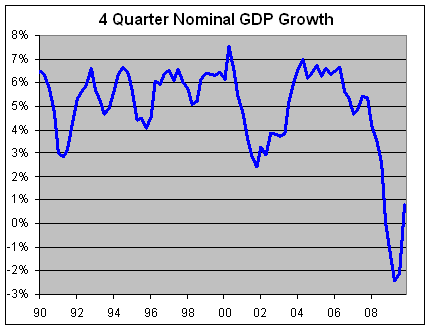
image897.png

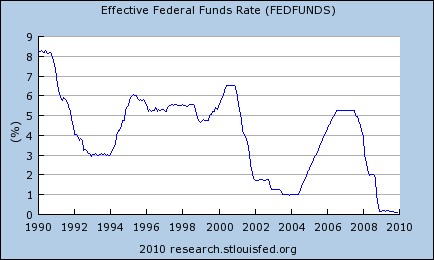
Here's a look at the Fed fund rates over the same period.
fredgraph012910.png

You can see that in the period of 2002 to 2004, the Fed Funds rate was well below nominal GDP growth.

Posted by edelfenbein at 6:02 PM

Bin Laden Comes Out Against Dollar

And he's reading Noam Chomsky:

He called for a worldwide boycott of American goods and the dollar. He faulted the United States for failing to sign the Kyoto Protocol, which sought to curb global warming by restricting greenhouse gas emissions. And he offered a word of praise for Noam Chomsky, the American linguist and liberal political activist.

“Noam Chomsky was correct when he compared the U.S. policies to those of the Mafia,” Al Jazeera quoted Mr. bin Laden as saying. “They are the true terrorists and therefore we should refrain from dealing in the U.S. dollar and should try to get rid of this currency as early as possible.”

By the way, the Saudi riyal is tied to the U.S. dollar.

Posted by edelfenbein at 1:21 PM

January 28, 2010

Ben Bernanke Wins

Ben gets another term. The cloture vote was 77-23 and the confirmation vote was 70-30.

In the cloture vote, Democrats voted 53 to 5, and Republicans voted 23 to 17. The two independents split (Lieberman Yes, Sanders No). Note that Senator Kirk is still in office.

The seven senators who voted for cloture but against the nomination were Boxer, Dorgan, Franken, Harkin, Kaufman, LeMieux and Whitehouse.

Full roll calls after the jump.

Here's the roll call of the cloture vote:

Begich D AK Nay
Cantwell D WA Nay
Feingold D WI Nay
Merkley D OR Nay
Specter D PA Nay
Sanders I VT Nay
Brownback R KS Nay
Bunning R KY Nay
Cornyn R TX Nay
Crapo R ID Nay
DeMint R SC Nay
Ensign R NV Nay
Grassley R IA Nay
Hutchison R TX Nay
Inhofe R OK Nay
McCain R AZ Nay
Risch R ID Nay
Roberts R KS Nay
Sessions R AL Nay
Shelby R AL Nay
Thune R SD Nay
Vitter R LA Nay
Wicker R MS Nay
Akaka D HI Yea
Baucus D MT Yea
Bayh D IN Yea
Bennet D CO Yea
Bingaman D NM Yea
Boxer D CA Yea
Brown D OH Yea
Burris D IL Yea
Byrd D WV Yea
Cardin D MD Yea
Carper D DE Yea
Casey D PA Yea
Conrad D ND Yea
Dodd D CT Yea
Dorgan D ND Yea
Durbin D IL Yea
Feinstein D CA Yea
Franken D MN Yea
Gillibrand D NY Yea
Hagan D NC Yea
Harkin D IA Yea
Inouye D HI Yea
Johnson D SD Yea
Kaufman D DE Yea
Kerry D MA Yea
Kirk D MA Yea
Klobuchar D MN Yea
Kohl D WI Yea
Landrieu D LA Yea
Lautenberg D NJ Yea
Leahy D VT Yea
Levin D MI Yea
Lincoln D AR Yea
McCaskill D MO Yea
Menendez D NJ Yea
Mikulski D MD Yea
Murray D WA Yea
Nelson D FL Yea
Nelson D NE Yea
Pryor D AR Yea
Reed D RI Yea
Reid D NV Yea
Rockefeller D WV Yea
Schumer D NY Yea
Shaheen D NH Yea
Stabenow D MI Yea
Tester D MT Yea
Udall D CO Yea
Udall D NM Yea
Warner D VA Yea
Webb D VA Yea
Whitehouse D RI Yea
Wyden D OR Yea
Lieberman I CT Yea
Alexander R TN Yea
Barrasso R WY Yea
Bennett R UT Yea
Bond R MO Yea
Burr R NC Yea
Chambliss R GA Yea
Coburn R OK Yea
Cochran R MS Yea
Collins R ME Yea
Corker R TN Yea
Enzi R WY Yea
Graham R SC Yea
Gregg R NH Yea
Hatch R UT Yea
Isakson R GA Yea
Johanns R NE Yea
Kyl R AZ Yea
LeMieux R FL Yea
Lugar R IN Yea
McConnell R KY Yea
Murkowski R AK Yea
Snowe R ME Yea
Voinovich R OH Yea


Here's the confirmation vote:

Akaka D HI Yea
Alexander R TN Yea
Barrasso R WY Yea
Baucus D MT Yea
Bayh D IN Yea
Bennet D CO Yea
Bennett R UT Yea
Bingaman D NM Yea
Bond R MO Yea
Brown D OH Yea
Burr R NC Yea
Burris D IL Yea
Byrd D WV Yea
Cardin D MD Yea
Carper D DE Yea
Casey D PA Yea
Chambliss R GA Yea
Coburn R OK Yea
Cochran R MS Yea
Collins R ME Yea
Conrad D ND Yea
Corker R TN Yea
Dodd D CT Yea
Durbin D IL Yea
Enzi R WY Yea
Feinstein D CA Yea
Gillibrand D NY Yea
Graham R SC Yea
Gregg R NH Yea
Hagan D NC Yea
Hatch R UT Yea
Inouye D HI Yea
Isakson R GA Yea
Johanns R NE Yea
Johnson D SD Yea
Kerry D MA Yea
Kirk D MA Yea
Klobuchar D MN Yea
Kohl D WI Yea
Kyl R AZ Yea
Landrieu D LA Yea
Lautenberg D NJ Yea
Leahy D VT Yea
Levin D MI Yea
Lieberman I CT Yea
Lincoln D AR Yea
Lugar R IN Yea
McCaskill D MO Yea
McConnell R KY Yea
Menendez D NJ Yea
Mikulski D MD Yea
Murkowski R AK Yea
Murray D WA Yea
Nelson D FL Yea
Nelson D NE Yea
Pryor D AR Yea
Reed D RI Yea
Reid D NV Yea
Rockefeller D WV Yea
Schumer D NY Yea
Shaheen D NH Yea
Snowe R ME Yea
Stabenow D MI Yea
Tester D MT Yea
Udall D CO Yea
Udall D NM Yea
Voinovich R OH Yea
Warner D VA Yea
Webb D VA Yea
Wyden D OR Yea
Begich D AK Nay
Boxer D CA Nay
Brownback R KS Nay
Bunning R KY Nay
Cantwell D WA Nay
Cornyn R TX Nay
Crapo R ID Nay
DeMint R SC Nay
Dorgan D ND Nay
Ensign R NV Nay
Feingold D WI Nay
Franken D MN Nay
Grassley R IA Nay
Harkin D IA Nay
Hutchison R TX Nay
Inhofe R OK Nay
Kaufman D DE Nay
LeMieux R FL Nay
McCain R AZ Nay
Merkley D OR Nay
Risch R ID Nay
Roberts R KS Nay
Sanders I VT Nay
Sessions R AL Nay
Shelby R AL Nay
Specter D PA Nay
Thune R SD Nay
Vitter R LA Nay
Whitehouse D RI Nay
Wicker R MS Nay

Posted by edelfenbein at 3:45 PM

Lily's Earnings

The earnings parade continues. Eli Lilly (LLY) just reported Q4 earnings of 91 cents a share which was a penny below expectations although revenues exceeded expectations.

For the full year, Lilly earned $4.33 billion, or $3.94 per share, compared with a loss of $2.07 billion, or $1.89 per share, in 2008. Revenue rose 7 percent to $21.84 billion from $20.37 billion.

Looking ahead, the company expects a profit of $4.65 to $4.85 per share in 2010, excluding any possible impact from the health care overhaul currently being considered by Congress. Analysts expects a profit of about $4.73 per share.

At $4.73 per share, that means the stock is going for 7.5 times this year's earnings.

Posted by edelfenbein at 2:34 PM

The Global Business Oath

Felix Salmon is in Davos and he points us to something that truly cannot be parodied, the Global Business Oath:

As a business leader I recognize that

* The enterprise I lead must serve the greater good by bringing together people and resources to create value that no single individual can create alone,
* My decisions can have far-reaching consequences that affect the wellbeing of individuals inside and outside my enterprise, today and tomorrow,
* As I reconcile the interests of different constituencies, I will face choices that are not easy for me and others.

So I promise that

1. I will manage my enterprise diligently and in good faith and will not let personal considerations and compensation supersede the long-term interest of my enterprise and society at large,
2. I will understand and uphold, both in letter and spirit, the laws and contracts governing my own conduct and that of my enterprise,
3. I will respect and protect the human rights and dignity of all people who are affected by my enterprise and will oppose all forms of discrimination and exploitation,
4. I will respect and protect the right of future generations to enjoy a clean and resourceful planet,
5. I will not engage in nor tolerate bribery or any other form of corruption,
6. I will represent the performance and risks of my enterprise accurately and honestly to each of the constituencies that are affected by it,
7. I will actively engage in efforts to finding solutions to critical social and environmental issues that are central to my enterprise, and
8. I will invest in my own professional development as well as the development of other managers under my supervision.

In exercising my professional duties according to these principles I recognize that my behavior must set an example of integrity and responsible conduct.

This pledge I make freely and upon my honor.

I pledge to use inane sound bites, empty slogans and boring cant in the service of all humanity.

P.S. I misread the title of Felix's post. "Youthful swearing at Davos" didn't mean what I had hoped.

Posted by edelfenbein at 2:03 PM

Baxter Reports In Line

For the first time in 20 quarters, Baxter International (BAX) failed to beat expectations:

Baxter International reported a 1 percent profit increase for the fourth-quarter on Thursday, meeting Wall Street expectations but failing to impress analysts accustomed to bigger gains from the medical products maker.

The company's broad mix of medically necessary products -- including blood plasma, kidney dialysis treatments and cancer drugs -- continued to post solid returns, though analysts said its guidance for 2010 appeared conservative.

Baxter earned $572 million, or 94 cents per share, up from $569 million, or 91 cents per share, a year prior. Revenue rose 11 percent to $3.47 billion from $3.13 billion.

Excluding charges, the Deerfield, Ill., company said it earned $1.03 per share, in-line with estimates by analysts polled by Thomson Reuters.

While the company successfully met Wall Street projections, Leerink Swann analyst Rick Wise noted that the company has beat such estimates the last 20 consecutive quarters. The last period when the company achieved in-line results was in 2004, according to an investment note from Wise.

Posted by edelfenbein at 12:20 PM

College Endowments Got Hammered Last Year

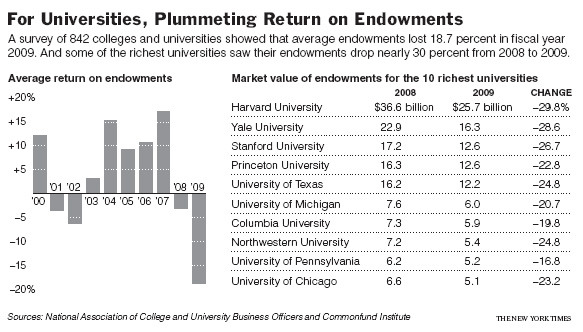
The New York Times reports that the average college endowment lost 18.7% last fiscal year which is the worst showing since the Great Depression.

The study, by the National Association of College and University Business Officers and Commonfund, a nonprofit organization that manages university investments, also found that in the last year, many endowment managers increased the move from traditional fixed-income instruments and stocks into alternative investments like private equity, hedge funds, venture capital and private-equity real estate — all of which performed badly in fiscal 2009.

Unusually, the universities with endowments over $1 billion had the greatest decline, an average of 20.5 percent. Harvard, Yale and Stanford, the wealthiest universities, all lost more than 26 percent of their endowment values.

At the same time, the study found, debt rose, especially at the largest universities, and gifts declined.

The 2009 losses in endowment income come on top of an average loss of 3 percent in fiscal 2008. The three-year average return, which most universities use to determine how much of their assets to spend, was negative 2.5 percent, compared with the five-year average of 2.7 percent, and the 10-year average of 4 percent.
popup.jpg

If there were only some place these school could receive free market-beating investing advice.

Posted by edelfenbein at 12:11 PM

January 27, 2010

Still At Zero

Here's the latest Fed statement:

Information received since the Federal Open Market Committee met in December suggests that economic activity has continued to strengthen and that the deterioration in the labor market is abating. Household spending is expanding at a moderate rate but remains constrained by a weak labor market, modest income growth, lower housing wealth, and tight credit. Business spending on equipment and software appears to be picking up, but investment in structures is still contracting and employers remain reluctant to add to payrolls. Firms have brought inventory stocks into better alignment with sales. While bank lending continues to contract, financial market conditions remain supportive of economic growth. Although the pace of economic recovery is likely to be moderate for a time, the Committee anticipates a gradual return to higher levels of resource utilization in a context of price stability.

With substantial resource slack continuing to restrain cost pressures and with longer-term inflation expectations stable, inflation is likely to be subdued for some time.

The Committee will maintain the target range for the federal funds rate at 0 to 1/4 percent and continues to anticipate that economic conditions, including low rates of resource utilization, subdued inflation trends, and stable inflation expectations, are likely to warrant exceptionally low levels of the federal funds rate for an extended period. To provide support to mortgage lending and housing markets and to improve overall conditions in private credit markets, the Federal Reserve is in the process of purchasing $1.25 trillion of agency mortgage-backed securities and about $175 billion of agency debt. In order to promote a smooth transition in markets, the Committee is gradually slowing the pace of these purchases, and it anticipates that these transactions will be executed by the end of the first quarter. The Committee will continue to evaluate its purchases of securities in light of the evolving economic outlook and conditions in financial markets.

In light of improved functioning of financial markets, the Federal Reserve will be closing the Asset-Backed Commercial Paper Money Market Mutual Fund Liquidity Facility, the Commercial Paper Funding Facility, the Primary Dealer Credit Facility, and the Term Securities Lending Facility on February 1, as previously announced. In addition, the temporary liquidity swap arrangements between the Federal Reserve and other central banks will expire on February 1. The Federal Reserve is in the process of winding down its Term Auction Facility: $50 billion in 28-day credit will be offered on February 8 and $25 billion in 28-day credit will be offered at the final auction on March 8. The anticipated expiration dates for the Term Asset-Backed Securities Loan Facility remain set at June 30 for loans backed by new-issue commercial mortgage-backed securities and March 31 for loans backed by all other types of collateral. The Federal Reserve is prepared to modify these plans if necessary to support financial stability and economic growth.

Voting for the FOMC monetary policy action were: Ben S. Bernanke, Chairman; William C. Dudley, Vice Chairman; James Bullard; Elizabeth A. Duke; Donald L. Kohn; Sandra Pianalto; Eric S. Rosengren; Daniel K. Tarullo; and Kevin M. Warsh. Voting against the policy action was Thomas M. Hoenig, who believed that economic and financial conditions had changed sufficiently that the expectation of exceptionally low levels of the federal funds rate for an extended period was no longer warranted.

Posted by edelfenbein at 4:45 PM

Gilead Sciences Leads Our Buy List Higher

The market is somewhat soggy this morning, but our Buy List is being helped by a very strong earnings report from Gilead Sciences (GILD). For the fourth-quarter, the company earned 93 cents a share which easily beat Wall Street’s estimate of 85 cents a share. The company now projects 2010 net products sales of $7.6 billion to $7.7 billion, which translates to a growth rate of 17% to 19% for this year. Wall Street had been forecasting earnings of $3.31 a share for this year, but that will now increase.

The shares have been up by as much as 6.6% today. Here’s a look at the earnings call from Seeking Alpha

The other earnings report was from Stryker (SYK), and that wasn’t so strong. On absolute terms, they did just fine as they almost always do. Stryker earned 82 cents a share but that merely matched Wall Street’s consensus. They reiterated their 2010 outlook of $3.20 to $3.30 per share. I'm fine with that but I guess investors wanted a little more.

Here’s the CEO on CNBC this morning.
.

Stryker is down about 4% this morning.

Posted by edelfenbein at 10:38 AM

January 26, 2010

Investing By Day of the Month

Here’s a breakdown of how well the stock market has performed during the first 10 trading days of the month. Each line is based on S&P 500’s cumulative gain on each particular trading day of the month (i.e., being long on the X day of the month, then all cash until the X day of the following month).
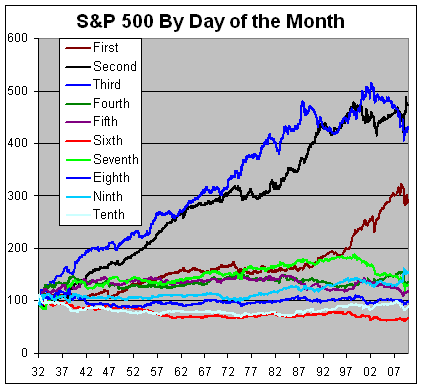
image895.png

The clear winners are the first three days of the month. In fact, stocks aren’t worth the bother for the next seven days. (I know the last few days of the month are also quite good, but I’ll look at that another time.)

If you had invested solely during the first three days of each month, you would have made 5,824% (dividends not included) over the last 78 years. Even though this represents a small sliver of time (about 13.7%), it’s still a hefty portion of the S&P 500 gain which is about 14,000%.

The combined return of the fourth through tenth day is a tad over 100% which is less than inflation.

Here's a breakdown of the average daily gains:

Day Gain
First 0.115%
Second 0.166%
Third 0.155%
Fourth 0.033%
Fifth 0.018%
Sixth -0.042%
Seventh 0.029%
Eighth 0.000%
Ninth 0.046%
Tenth -0.011%

To give you a reference point, a daily return of 0.1% works out to over 28% a year.

Posted by edelfenbein at 10:12 PM

J&J's Earnings Beat the Street

Johnson & Johnson (JNJ) reported fourth-quarter earnings of $1.02 a share which was five cents higher than Street forecasts.

Fourth-quarter sales rose 9% to $16.55 billion, also exceeding Wall Street expectations. Favorable currency-exchange comparisons contributed 4.5 percentage points of the growth, reversing the currency headwinds that J&J and other multinational drug companies had faced in previous quarters.

J&J's biggest unit, medical devices and diagnostics, had sales of $6.31 billion, up 11.8%. Pharmaceutical sales rose 5.4% to $5.99 billion, while consumer-product sales rose 10.2% to $4.25 billion.

For the full year, J&J said it earned $4.63 a share excluding items, which exceeded the forecast range J&J had provided in October, of earnings between $4.54 and $4.59 a share. Full-year sales were $61.9 billion, in line with the forecast range of $61 billion and $62 billion.

J&J said it expects 2010 earnings of $4.85 to $4.95 a share, excluding certain items.

That means that JNJ is going for about 12.8 times this year's earnings estimates which is about 13% less than the S&P 500.

Posted by edelfenbein at 11:31 AM

January 25, 2010

Odd Lots

SEC mulled national security status for AIG details

Abnormal Returns & Stocktwits!!

Home sales tumble as tax credit lift wanes

Feinstein throws her support behind Fed chairman Bernanke

The President's Bank Reforms Don't Add Up

Reviews of Crossing Wall Street at Investimonials

Clearwater woman called 911 saying she was tired of her husband

Posted by edelfenbein at 3:38 PM

About That Plunging Dollar

I hear all the time about the plunging dollar, but if it has plunged, I'm afraid I missed it. You'd never know this by listening to the rhetoric, but the dollar lost only -2.9% against euro last year. The year before that, the dollar gained 4.9% against the euro. Doesn't sound like a plunge to me.

fredgraph012510.png

(The chart above is dollars-per-euro, so a downward line means a strengthening dollar.)

Posted by edelfenbein at 2:52 PM

AXA to Delist from NYSE

The French insurance company, AXA (AXA) has announced that it will delist from the NYSE due to lacking of trading volume. This strikes me as very bad news for New York and the American market. I would think that at least some American investors would be interested in trading a $45 billion insurance company. Based on revenue, this is one of the largest companies in the world.

Is this solely about trading volume, or are the French concerned about our regulatory climate?

Posted by edelfenbein at 10:55 AM

Should You Listen to Your Broker?

New research shows that you should pay careful attention to what your stock broker says.

Then do the exact opposite.

It turns out, there is information in analyst forecasts, specifically, shorting your broker. In Long-Term Earnings Growth Forecasts, Limited Attention, and Return Predictability by Da and Warachka, they find that if you take the long-run earnings growth and divide by the recent earnings growth, you get a straightforward metric of optimism: higher is more optimistic. It turns out, the highest decile has a 4% annualized lower risk-adjusted return than the lowest decile; more optimistic stocks have lower returns.

A simple explanation (see here) is that mutual funds "herd" (trade together) into stocks with consensus analyst upgrades and (especially) herd out of stocks with consensus downgrades. Stronger fund herding occurs when analyst recommendation revisions are more unanimous.

However, there is some information that analyst recommendations are more useful at the industry level. Portfolios long in industries about which analysts are optimistic and short in industries about which analysts are pessimistic generate significant abnormal returns (see here).

So, listen to your broker's advice on sectors and stocks, just remember to short the stock picks.

Posted by edelfenbein at 10:34 AM

Four More Years

The stock market is rebounding this morning and the news that it appears that Ben Bernanke will be confirmed for another term as Fed chair, though of course, it’s hard to tie any one-day rally to a specific news item.

I think the anger at Bernanke closely resembles the Two-Minute Hate Sessions in George Orwell’s 1984. Americans are rightfully angry, but they don’t know exactly who to be angry. They were angry at George Bush and he’s not around. Alan Greenspan? He’s also gone. That leaves Ben Bernanke.

If having him reconfirmed by a whisker placates enough folks, I’m fine with that. But rejecting Bernanke would be an awful, awful move. Consider the take of one Nebraska-based investor:

CNBC:….Should he be confirmed?

Buffett: If I could vote twice I would. He should be. He did a magnificent job over this period… We can’t sit here and armchair quarterback him. But when we look back at September and October 2008, he took some extraordinary actions….we talked about it being an economic pearl harbor. He did what he should have done in response.

Q: What happens if he’s not recommended?

Buffett: Well, just tell me a day ahead of time so I can sell some stocks.

There seems to be a view that deep with the offices of the Federal Reserve is a large machine called a Bubble Popper. At anytime, the Fed can wheel it out, aim and fire. Then magically, whatever bubble formed will be popped without damaging anything.

My guess is that Bernanke will be passed with just a few votes over 60, but there was no real danger to his reconfirmation.

Posted by edelfenbein at 10:28 AM

January 23, 2010

What's Down the Most?

The S&P 100 is down -5.25% since Tuesday. Here's a look at how the 100 stocks have performed.

You can see that just three stocks were up and 97 were down. The banks seem to be most common among the big losers:

Ticker Gain
RF 1.38%
USB 0.73%
CL 0.15%
BNI -0.03%
MCD -0.14%
GILD -0.43%
XRX -0.55%
CPB -0.82%
BK -0.88%
TGT -1.60%
AMGN -1.65%
WMT -2.02%
WAG -2.04%
CVS -2.09%
PG -2.28%
GE -2.60%
NKE -2.67%
HNZ -2.69%
AEP -2.80%
VZ -2.85%
AVP -2.93%
ABT -3.01%
T -3.09%
RTN -3.11%
PEP -3.11%
COST -3.19%
MO -3.29%
JNJ -3.29%
SO -3.30%
DIS -3.32%
LOW -3.46%
LMT -3.49%
WFC -3.61%
KO -3.86%
HD -4.02%
BMY -4.09%
WMB -4.24%
MMM -4.28%
MRK -4.31%
BAX -4.39%
OXY -4.40%
ETR -4.41%
UTX -4.44%
ALL -4.49%
XOM -4.58%
ORCL -4.66%
MON -4.72%
BA -4.75%
SLE -4.80%
AMZN -4.84%
MA -4.89%
QCOM -5.15%
GD -5.19%
PFE -5.20%
KFT -5.24%
TWX -5.33%
EXC -5.40%
INTC -5.42%
UNH -5.61%
UPS -5.62%
CMCSA -5.71%
COP -5.79%
DVN -5.80%
MDT -5.93%
CVX -6.39%
GOOG -6.40%
NSC -6.41%
IBM -6.44%
TXN -6.51%
FDX -6.53%
PM -6.55%
HPQ -6.56%
DD -6.72%
MSFT -6.88%
HON -6.93%
EMC -7.35%
NWSA -7.39%
CSCO -7.57%
GS -7.64%
WY -7.74%
BHI -7.87%
DELL -7.93%
SLB -8.02%
AAPL -8.04%
C -8.19%
MET -8.21%
S -8.42%
BAC -8.70%
NYX -9.19%
DOW -9.52%
JPM -9.52%
NOV -9.66%
HAL -9.97%
AXP -10.17%
F -10.47%
MS -10.78%
CAT -10.96%
FCX -12.26%
COF -12.74%
AA -14.21%

Posted by edelfenbein at 10:16 PM

January 22, 2010

S&P 500 to Close Below 50-Day Moving Average

For the first time since November, the S&P 500 will close below its 50-day moving average.

image894.png

This ends a 79-day run of closing over the 50DMA. From July to October there was a 106-day run.

The VIX is up 5.04 points to 27.31.

Posted by edelfenbein at 3:38 PM

The Withdrawl Countdown

My guess is that Ben Bernanke would withdraw and spare the president of losing a confirmation vote. That is, if it looks like he'd lose a confirmation vote.

Posted by edelfenbein at 1:16 PM

January 21, 2010

Bernanke Reconfirmation in Doubt

This is not what the market needs to hear:

Amidst the voter anger at Wall Street and Washington, D.C., ABC News has learned that the Senate Democratic leadership isn't sure there are enough votes to re-confirm Ben Bernanke for another term as chairman of the Federal Reserve.

Bernanke's term expires on Jan. 31.

The White House did not respond to many requests for comment.

"The American people are disgusted with the greed and recklessness of Wall Street," Sen. Bernie Sanders, I-Vt., said in an interview with The Associated Press last month. "People are asking, 'Why didn't the Fed intervene at the appropriate time to stop the casino-type activities of large financial companies?'"

Sanders, Sen. Jim Bunning, R-Ky., Sen. Jim DeMint, R-S.C., and Sen. David Vitter, R-La., have all put holds on Bernanke's nomination, requiring 60 votes to proceed to a vote.

Voter anger is of heightened concern to members of Congress given the surprise victory of Sen.-elect Scott Brown, R-Mass., who rode a tide of voter discontent and economic anxiety to an upset victory in a special election earlier this week.

Last month, the Senate Banking Committee voted in favor of Bernanke's nomination by a vote of 16-7, not exactly a reflection of overwhelming positive feelings towards the Fed chair given the fact that he was first appointed in 2006 by President George W. Bush and nominated by President Obama for a second term last August.

Senate Majority Leader Harry Reid, D-Nev., at one point was planning on scheduling a vote on Bernanke for Friday, but the Senate is currently in the midst of a debate over raising the debt limit and the vote has been pushed.

Posted by edelfenbein at 11:20 PM

S&P 500 Erases Most of this Year's Gain

The S&P 500 closed 2009 at 1115.10. At one point today, we dipped below that to 1114.84. It seems like only Monday that we were over 1150.

Posted by edelfenbein at 3:05 PM

The Volcker Rule

The White House announced its major initiative today.

Declaring that huge banks had nearly brought down the economy by taking “huge, reckless risks in pursuit of profits,” President Obama on Thursday proposed legislation to limit the scope and size of large financial institutions.

The changes would prohibit bank holding companies from owning, investing, or sponsoring hedge fund or private equity funds and from engaging in proprietary trading — what Mr. Obama called the Volcker Rule, in recognition of the former Federal Reserve chairman, Paul A. Volcker, who has championed the restriction.

In addition, Mr. Obama will seek to limit consolidation in the financial sector, by placing curbs on the growth of the market share of liabilities at the biggest firms. An existing cap, put in place in 1994, put a limit of 10 percent on the share of insured deposits that can be held by any one bank. That cap would be expanded, officials said, to include liabilities other than deposits.

Both changes require legislation by Congress, and Republican leaders, as well as the banking industry, signaled on Thursday that they would resist the proposals.

This is a big deal and I expect most of the proposal to pass. I think this will have a major impact on the hedge fund industry. I'm also surprised that Tim Geithner has been tossed overboard.

I suspect that when a discussion is held on a future financial crisis, someone will say, "Well, it all started back in January 2010 when the government decided..."

Posted by edelfenbein at 2:35 PM

Goldman's Huge Quarter

Goldman Sachs (GS) reported its best quarter ever:

Goldman posted quarterly profit of $4.95 billion, or $8.20 a share, for the quarter, on revenue of $9.62 billion. Analysts surveyed by Thomson Reuters predicted earnings of $5.20 a share and revenue of $9.65 billion.

In the year-earlier period Goldman had a loss of $2.29 billion, or $4.97 a share, on negative revenue of $1.58 billion. The prior-year period ended on Nov. 28, before the company shifted to a different reporting calendar.

Fixed-income trading slowed after extraordinary profits in the previous three quarters. Revenue from fixed income, currency and commodities was $3.97 billion, down from the $5.99 billion in the third quarter.

But investment-banking revenue moved higher, after falling almost a third in the third quarter. It rose 82% from the previous quarter to $1.64 billion.

Revenue from principal investments, those made with the firm's own capital, fell from the previous period.

The investment bank's impressive results in 2009 propelled it further ahead of rivals, many of which have struggled to overcome the credit crisis. Goldman has been able to take on more risk and grab market share while competitors were licking their wounds.

The company is setting aside $16 billion for bonuses which works out to about $500,000 per employee.

Posted by edelfenbein at 11:40 AM

January 20, 2010

Copper Calls Top in Stocks. Wait...What?

Copper, apparently, is a pretty good predictor of stock prices.

The stock market may be headed to or already mired in a correction mode, with the price of copper among the signals telegraphing caution for equities.

"Copper prices recently recorded a 12-month rolling rate of return in excess of 150%. Historically such a 'copper cropper' has market a 'grading top' in copper and telegraphed caution for the equity markets," writes Jeffrey Saut, an investment strategist at Raymond James.

Not all, however, agreed with Saut's take.

"I still believe the uptrend is currently in place, that we're in a full-fledged bull market," said Robert Pavlik, chief market strategist at Banyan Partners LLC.

While copper futures hit a new high earlier this month, "there is no indication in the five-month chart that copper is about to approach a correction of any sort," said Pavlik.

Used in both residential and commercial construction, copper has long been dubbed the metal "with the PhD" due to its ostensible ability to forecast changes in the economy based on its pricing and demand.

And if you're planning on converting your entire retirement nest egg into pennies, think again. A modern penny on only one part per 40 copper, the other 39 parts are zinc.

The old alloy (pre 1982) was 95% copper and just 5% zinc. The metal in that penny is now worth more than one penny. The government, however, has made melting them down a crime.

Posted by edelfenbein at 2:58 PM

Berkshire Votes to Splti 50-for-1

If you’ve always wanted to own a piece of Warren Buffett but didn’t want to shell out a few thousand dollars, you’re in luck. The company voted to split the B shares by 50-for-1.

The pricey A shares aren’t splitting. These are the shares currently for nearly $105,000.

The B shares are worth about $3500 and will be worth about $70 after the split takes effect.

Posted by edelfenbein at 2:53 PM

January 19, 2010

New Highs All Around

So far today, Aflac (AFL), Eaton Vance (EV), Johnson & Johnson (JNJ), Medtronic (MDT), Reynolds America (RAI) and Stryker (SYK) have all hit new 52-week highs. The Buy List is now up 6% for the year. Did I mention it’s January?

Before I get too cocky, let me reread my previous post.

Posted by edelfenbein at 11:01 AM

The Market Doesn’t Always Do What We Want

Before Intel’s earnings came out I wrote, “The Street is looking for 30 cents a share which is definitely too low. I expect earnings around, 35 cents a share, but the mystery is how Wall Street will react.”

I was more right than I realized. Intel obliterated the Street by earning 40 cents a share, yet the stock fell 3.2% the next day. So if exceeding expectations disappoints, you have to wonder what the true expectations were.

There was some talk that Intel’s gross margins are now so high (67%) that there’s no way they can increase them anymore. Sure, I buy that. The company has said it’s targeting margins 61% for this year. But it in way means that Intel will be less profitable.

The point for us is how unpredictable investing can be. Even when all the fundamentals go our way, we can still lose. If the market wants to go down, it will go down. The media and analysts will attempt to seize on any bit of info to explain the sell-off. Yet, the accurate explanation for why it happened is simply unknowable.

Unfortunately, that doesn’t make for a good analyst report or news item. In the long run, stock prices do make sense. But in the short term, it might as well be astrology.

Posted by edelfenbein at 10:20 AM

January 14, 2010

Intel Delivers Huge Quarter

Yesterday I said that I expected Intel (INTC) to report earnings of 35 cents a share which was well above Wall Street's consensus of 30 cents a share. Even my optimistic estimate was too low. The company just reported earnings of 40 cents a share.

Here's a look at their future guidance:

Q1 2010

* Revenue: $9.7 billion, plus or minus $400 million.
* Gross margin percentage: 61 percent, plus or minus 2 percentage points.
* R&D plus MG&A spending: Approximately $3 billion.
* Amortization of acquisition-related intangibles and costs associated with the Wind River acquisition: Approximately $20 million.
* Impact of equity investments and interest and other: Gain of approximately $20 million.
* Depreciation: Approximately $1.1 billion.

Full-Year 2010

* Gross margin percentage: 61 percent, plus or minus 3 percentage points.
* Spending (R&D plus MG&A): $11.8 billion, plus or minus $100 million.
* R&D spending: Approximately $6.2 billion.
* Tax rate: Approximately 30 percent.
* Depreciation: Approximately $4.4 billion, plus or minus $100 million.
* Capital spending: Expected to be $4.8 billion, plus or minus $100 million.

That Q1 revenue target of $9.7 billion +/-$400 million is well above Wall Street's consensus of $9.35 billion.

Posted by edelfenbein at 4:17 PM

Barney Vs. Erin

Here's an entertaining interview of Barney Frank by Erin Burnett:

Posted by edelfenbein at 4:02 PM

The Dow Jones Hit Its Bull Market High 10 Years Ago Today

On Friday, January 14, 2000, the Dow closed at 11,722.98 -- a level it wouldn't break for over six years. That peak capped an amazing 17-1/2 year run. In the ensuring 10 years, we’ve lost about 1,000 points or roughly 8.9%. Inflation, or at least the CPI, has increased by about 28% which makes the inflation-adjusted close from ten years more like 15,000. Ten years ago, gold was going for about $280 an ounce (around $360 inflation adjusted).

In the letters section of the January 2000 issue of the Atlantic, J. Douglas Van Sant of Stockton, California criticized the article in the September 1999 issue on Dow 36,000 by James Glassman and Kevin Hassett.

Mr. Van Sant wrote:

I would be willing to bet Glassman and Hassett that even ten years from now, when earnings and dividends should have nearly doubled, the Dow Jones Industrial Average will still be closer to its current level of 11,000 than to their hyperbolic projection of 36,000.

Good call. The Dow closed yesterday at 10,680.77.

Glassman and Hassett replied:

To J. Douglas Van Sant we say, if the Dow is closer to 10,000 than to 36,000 ten years from now, we will each give $1,000 to the charity of your choice.

I recommend Haiti.

image893.png

Posted by edelfenbein at 6:48 AM

January 13, 2010

Once Again, Economists Are Split

I sometimes think that a group of academic economists couldn't agree on the color of the sky. The WSJ surveyed economists over Ben Bernanke's view that low rates didn't contribute to the housing bubble (to be fair, Bernanke merely said it wasn't the primary cause of the bubble).

Here's what the WSJ found:

NA-BD420_Bernan_NS_20100112225240.gif

Posted by edelfenbein at 12:21 PM

This Just In

"Whatever we did, it didn't work out well." Lloyd Blankfein CEO of Goldman Sachs

Posted by edelfenbein at 12:16 PM

The Buy List So Far

I probably shouldn’t mention this so early and jinx myself, but the Buy List has gotten off to a very nice start this year. Through 11am this morning, the Buy List is up 3.77% for the year which is almost exactly double the S&P 500, which is up 1.88%. So far, so good.

The Buy List will get a big test tomorrow when Intel (INTC) reports its earnings. The Street is looking for 30 cents a share which is definitely too low. I expect earnings around, 35 cents a share, but the mystery is how Wall Street will react.

Posted by edelfenbein at 11:20 AM

The Credit Market Slowly Wakes Up

The credit markets recently passed an important milestone when the spread between the BAA corporate bond index and the 10-year Treasury bond fell below 250 basis points. This spread is a good measure of the willingness of lenders to take on default risk.

image891.png

In the best of times, the spread is around 160 basis points, and that’s where it was during the summer of 2007. By early 2008, the spread doubled and then nearly doubled again during the frantic days of September 2008. The spread reaches its peak of 616 basis points on December 4, 2008.

Since then, the spread has plunged. It dropped below 300 over the summer, and it just recently fell below 250 for the first time in over two years.

image892.png

So what does that means for equities? It’s hard to put an exact effect on each instance, but historically stocks have shown a clear preference for a tighter BAA-10YTB spread.

I ran the numbers and found that since 1986, when the spread is 250 basis points or more, the stock market has lost an average of -4.50% annually. When the spread is 249 basis points or less, the market has gained an average of 12.13% annually.

There’s probably a feedback loop at work. Because the yield spread narrows, it’s good for companies because it lowers their borrowing costs. The lower borrowing costs make them more profitably and in turn, less likely to default.

Posted by edelfenbein at 10:57 AM

Chinese Revaluation Needs to Come Soon

The WSJ writes on the most important economic issue right now, the absurd peg of the Chinese yuan:

Surging Chinese exports and an expansion in the U.S. trade deficit have shown this week that a revaluation in the Chinese yuan is the most urgent item of unfinished business for the global economy.

Most economists believe a modest appreciation in the yuan is inevitable sometime this year. The latest move by the People's Bank of China -- an incremental increase in its T-bill rate last week and a hike in reserve ratios and one-year T-bills on Tuesday -- could even pave the way for this.

But time is running out. Anger is growing around the world over what many see as a grossly unfair advantage for China's exporters. "The monetary disorder has became unacceptable," said French President Nicolas Sarkozy last week.

China's leaders have said nothing of plans to raise the value of their currency -- even though this would help diffuse inflationary pressures -- and have at times sounded hostile to the suggestion.

This could get ugly. China currently holds $2 trillion in reserves.

Posted by edelfenbein at 9:56 AM

January 12, 2010

One Bank Had a Very Good Year

The Federal Reserve earned $45 billion last year:

Much of the higher earnings came about because of the Fed's aggressive program of buying bonds, aiming to push interest rates down across the economy and thus stimulate growth. By the end of 2009, the Fed owned $1.8 trillion in U.S. government debt and mortgage-related securities, up from $497 billion a year earlier. The interest income on those investments was a major source of Fed profits -- though that income comes with risks, as the central bank could lose money if it later sells those securities to reduce the money supply.

The Fed also made money on its emergency loans to banks and other firms and on special programs to prop up lending, such as one that supports credit cards, auto loans, and other consumer and business lending. Those programs impose interest and fees on participants, with the aim of ensuring that the Fed does not lose money.

And while the central bank in its most recent financial report had recorded a $3.8 billion decline in the value of loans it made in bailing out the investment bank Bear Stearns and the insurer American International Group, the Fed also logged $4.7 billion in interest payments from those loans. Further losses -- or gains -- on the two bailouts are possible as time goes by. The Fed also charges fees for operating the plumbing of the financial system, such as clearing checks and electronic payments between banks.

Despite what conspiracy theorists think, any profit over the Fed's 6% dividend goes right to the U.S. Treasury.

Posted by edelfenbein at 10:26 AM

January 11, 2010

Well Played Sir

I'm not sure if this is real, but I like it anyway.

(HT: Footnoted)

Posted by edelfenbein at 12:37 PM

January 9, 2010

Animated Reconstruction of Hudson River Landing

Here's an amazing animated reconstruction of Captain Sullenberger bringing Flight 1549 into the Hudson nearly one year ago.

(HT: Ritholtz)

Posted by edelfenbein at 11:20 AM

January 8, 2010

Trills Just Don't Make Sense

David Merkel has written a few on Robert Shiller's idea of GDP-linked US Treasury bonds, or trills (see here, here and here). In his first post, David wrote:

My interest rate models indicate that if the US were to issue a consol, a perpetual bond, it would have a yield near 4.4%. Here’s the question: what do you think nominal GDP growth will be on average forever? If it is above 4.4%, one should be willing to pay an infinite amount to buy it. At lower rates of nominal GDP growth, the security will have a finite value that declines rapidly with lower nominal GDP growth.

I think he's exactly right. The rational price for a trill would be an infinite amount which is another way of saying that trills don't make sense. The Treasury can get the same thing for a lower price. Trills would be a waste of taxpayer money.

Here's a comment I left on David's most recent post:

A few quick points.

There’s no way to pay off a trill except by running a budget surplus or by issuing conventional debt, thus negating the need for trills.

There might also be a slight risk premium due to the uncertainty of each coupon payment. It might be small but even a small amount comes of out taxpayers’ wallets.

The Q3 GDP for 1983 has been revised 10 times since it first came out. The last time was in 2009. Imagine the headache for trills.

I keep coming back to your point that trills would be worth an infinite amount. I think that’s exactly right. For the borrower, trills are irrational. The US Treasury can get the exact same thing for less.

Posted by edelfenbein at 1:28 PM

The Plunging VIX

The Volatility Index (^VIX) hit 18.70 today which matches yesterday's low. That's a level we haven't seen in 19 months.

Posted by edelfenbein at 11:06 AM

December Unemployment Report

The Labor Department reported that the unemployment rate for December was unchanged at 10%. Nonfarm payrolls declined by 85,000.

For October, the loss of 11,000 was revised to a gain of 4,000. For November, the loss of 111,000 was revised to a loss of 127,000.

image890.png

Posted by edelfenbein at 8:32 AM

January 6, 2010

Bed, Bath & Beyond's Huge Quarter

After the bell, one of my favorite Buy List stocks, Bed, Bath & Beyond (BBBY) reported earnings of 58 cents a share which was 15 cents more than the Street's forecast! Dayum... that's a huge earnings beat. The stock is up 8% after-hours.

Sales rose 10.8% to $1.98 billion which topped the Street's estimate of $1.91 billion. Note that this was their November quarter so it didn't include much of the holiday shopping season.

BBBY also forecast earnings for this quarter of 67 to 71 cents a share which was above the Street's estimate of 63 cents.

There's a lot I like about this earnings report. First is that sales growth came in strong. This is the best top-line growth number in two years. And with that, margins didn't suffer which has been a problem in recent years. Year-over-year net margins fell for 14 straight quarters, but have now risen for the past three.

Decreasing margins are like kryptonite for a company. In BBBY's case, net margin fell from about 10% to 6%. That effectively erases a 66% gain in sales. Rising margins have the opposite effect. The problem for every retailer is that you have to walk the line between higher margins and its impact on sales. BBBY has pulled in more sales and higher margins.

Here are the earnings results going back a few years:


QuarterSalesGross Profit Operating Profit Net Profit EPS
May-99$356,633$146,214$28,015$17,883$0.06
Aug-99$451,715$185,570$53,580$33,247$0.12
Nov-99$480,145$196,784$50,607$31,707$0.11
Feb-00$569,012$238,233$77,138$48,392$0.17
May-00$459,163$187,293$36,339$23,364$0.08
Aug-00$589,381$241,284$70,009$43,578$0.15
Nov-00$602,004$246,080$64,592$40,665$0.14
Feb-01$746,107$311,802$101,898$64,315$0.22
May-01$575,833$234,959$45,602$30,007$0.10
Aug-01$713,636$291,342$84,672$53,954$0.18
Nov-01$759,438$311,030$83,749$52,964$0.18
Feb-02$879,055$370,235$132,077$82,674$0.28
May-02$776,798$318,362$72,701$46,299$0.15
Aug-02$903,044$370,335$119,687$75,459$0.25
Nov-02$936,030$386,224$119,228$75,112$0.25
Feb-03$1,049,292$443,626$168,441$105,309$0.35
May-03$893,868$367,180$90,450$57,508$0.19
Aug-03$1,111,445$459,145$155,867$97,208$0.32
Nov-03$1,174,740$486,987$161,459$100,506$0.33
Feb-04$1,297,928$563,352$231,567$144,248$0.47
May-04$1,100,917$456,774$128,707$82,049$0.27
Aug-04$1,273,960$530,829$189,108$120,008$0.39
Nov-04$1,305,155$548,152$190,978$121,927$0.40
Feb-05$1,467,646$650,546$283,621$180,980$0.59
May-05$1,244,421$520,781$150,884$98,903$0.33
Aug-05$1,431,182$601,784$217,877$141,402$0.47
Nov-05$1,448,680$615,363$205,493$134,620$0.45
Feb-06$1,685,279$747,820$304,917$197,922$0.67
May-06$1,395,963$590,098$148,750$100,431$0.35
Aug-06$1,607,239$678,249$219,622$145,535$0.51
Nov-06$1,619,240$704,073$211,134$142,436$0.50
Feb-07$1,994,987$862,982$309,895$205,842$0.72
May-07$1,553,293$646,109$154,391$104,647 $0.38
Aug-07$1,767,716$732,158$211,037$147,008 $0.55
Nov-07$1,794,747$747,866$203,152$138,232 $0.52
Feb-08$1,933,186$799,098$259,442$172,921 $0.66
May-08$1,648,491$656,000 $118,819$76,777$0.30
Aug-08$1,853,892$739,321 $187,421 $119,268$0.46
Nov-08$1,782,683$692,857 $136,374 $87,700$0.34
Feb-09$1,923,274$785,058$231,282 $141,378 $0.55
May-09$1,694,340$666,818$142,304$87,172$0.34
Aug-09$1,914,909$773,393$222,031 $135,531$0.52
Nov-09$1,975,465$812,412$245,611 $151,288$0.58

Finally, here's a BBBY's trailing four-quarter EPS with the red being the company's forecast:

image889.png

Posted by edelfenbein at 4:35 PM

A New Relative Strength High for Cyclicals

A reader points out that the ratio of the Morgan Stanley Cyclical Stock Index (^CYC) relative to the S&P 500 (^SPX) has reached another new all time high. The ratio closed over 0.76 for the first time ever yesterday.

image888.png

I think there are three takeaways from this. The first is that it could be that cyclicals are due to lag the market very soon. That's one of the reasons why the Buy List tilts toward non-cyclical areas like health and consumer stocks.

The second is that if the market is correct, then this is one of the sharpest V's in a V-shaped recovery that I've ever seen.

The third is that you can really see how much of the market's swoon and recovery was focused on cyclicals. If you had completely ignored this ratio from September 2008 to September 2009, then you'd find it almost exactly where you left it.

Posted by edelfenbein at 12:53 PM

The Bubble Popper

Listening to some people, you’d think the Fed chairman has a machine in his office called “the bubble popper.” It will instantly pop any bubble without affecting anything else. If only, he would just turn it on.

Posted by edelfenbein at 10:40 AM

January 5, 2010

Looking At the Numbers at Nicholas Financial

I’ve always been impressed with the amount of financial info that Nicholas Financial (NICK) provides about their portfolio in their quarterly statements. I wish more companies were this forthcoming. I’ve assembled a portfolio summary on this spreadsheet of how they’ve done over the last several quarters.

By looking at this spreadsheet you can see why I’m such a big fan of the stock. The pre-tax bottom line is column N. However, the most important line to watch is column K, the provision for credit losses. That zoomed up during the credit crisis and it took out a huge chunk of NICK’s earnings.

The pre-tax yield before adjusting for credit losses has been remarkably consistent for the past 12 quarters, usually around 12.5%. The credit losses completely altered NICK’s profitability. But something big happened the last two quarter. The eight-quarter run of year-over-year increases in the provision for credit losses finally stopped. It’s still high, but if it continues to drop, that will give a big boost to NICK’s bottom line.

Let’s make some assumptions for the next earnings report. If the pre-tax yield for the last quarter hit 7% on receivables of $230 million that comes to about $4 million pre-tax for the quarter. With the new shares post stock dividend, that’s 35 cents a share. After taxes, that’s about 22 cents a share.

For the first six months of the fiscal year (ends March 31), NICK made 40 cents a share. So we’re probably talking about stock on its way to making around 80 cents a share for the year during an awful recession. As I see it, this company is almost like an 11% or 12% bond and the credit quality is improving.

Posted by edelfenbein at 3:50 PM

Your Home Is a Terrible Investment

So says Karen Pence who runs the Fed's household and real estate finance research group. Here are her five reasons:

1. It is an indivisible asset. If you own stocks and bonds and suddenly need a little cash, you can sell some of your stocks or bonds but not all. With a home, on the other hand, “you can’t just slice off your bathroom and sell it on the market.”

2. It is undiversified. You can buy stocks or bonds in industries or countries all over the world. A home is a bet on one single neighborhood.

3. Transaction costs are very high when you buy or sell a home because of real estate agent fees, mortgage fees and moving costs.

4. It is asymmetrically liquid, meaning it’s easy to get money out when home prices are going up. (You just take out a bigger mortgage.) But it’s hard to take money out when prices are going down because refinancing becomes more difficult. Put another way, the leverage that you have in your house with a large mortgage means your investment does well in good times but could be lousy in bad times.

5. It is highly correlated to the job market, meaning that home prices in a neighborhood tend to rise when the job market is improving in the area and fall when the job market is worsening. This means that your main financial asset provides the smallest cushion to you when you might need it most.

Posted by edelfenbein at 1:48 PM

Lilly Works to Improve Drug Pipeline

One of my Buy List stocks, Eli Lilly (LLY), has often been criticized for its dwindling pipeline of new drugs. That’s probably one of the reasons the stock goes for less than eight times next year’s earnings and it carries a dividend yield of 5.5%.

Lilly, however, has been working hard to fix the problem. The WSJ focuses today on the company’s use of outside research firms:

Eli Lilly & Co., like many other pharmaceutical companies, is seeking to make its drug-development efforts more productive as it copes with thin new-product pipelines. Its approach: hiring outside contractors to run tests on its drug candidates.

Pharmaceutical companies have traditionally kept a tight lid on drugs under development, conducting key work in-house. But early this year, the Indianapolis drug maker will decide whether to move a promising molecule to treat rheumatoid arthritis into late-stage testing, based on mid-stage data developed by scientists outside of its own research team. If the drug eventually wins regulatory approval, it will compete in a $16 billion annual market.

By outsourcing human tests of such a potentially important drug, Lilly is among a crowd of pharmaceutical giants adopting out-of-the-box strategies to revive fallow research-and-development organizations.

Posted by edelfenbein at 9:59 AM

Bloomberg Profiles David Tepper

Bloomberg profiles hedge fund manager David Tepper who make a few billion dollars last year betting that the world was not, in fact, coming to an end.

“It was crazy,” says Tepper, a Pittsburgh native. “In February and early March, people were in a panic.”

Appaloosa began scooping up bank-related securities, including common and preferred shares and junior subordinated debt. The Short Hills, New Jersey-based hedge fund firm bought into Bank of America, Citigroup, Fifth Third Bancorp and SunTrust Banks Inc. Tepper also bought the bonds of New York- based American International Group Inc., Frankfurt-based Commerzbank AG and London-based Lloyds Banking Group Plc, paying as little as a nickel on the dollar.

Posted by edelfenbein at 8:31 AM

20 Years Since the Nikkei's Peak

Thinks it’s been bad here? Check out how the Japanese market has done over past two decades.

image887.png

The Nikkei hit its peak 20 years ago on December 29, 1989 at 38,916. This past March, the index hit a low of 7054. That’s an 82% drop.

Posted by edelfenbein at 8:07 AM

January 4, 2010

Remembrance of Stocks Past

Mark Hulbert has an article in the New York Times on one of my favorite topics—momentum investing. The issue I take with Mark is that he focuses on the intermediate-term impact of momentum. The impact where momentum has been most strongly felt is in the short-term. The shorter the term, the stronger it is. Historically, the impact has been very real and quite large. Whether it will continue is another question, and I tend to doubt it will.

The article contains this quote:

“We can be comforted by the fact that reasonably efficient markets always base their level on anticipated future returns,” he added, “and do not include history in the calculation.”

Sorry, but that’s just not true. One of the mysteries of the stock market is that the past does have an effect on the future. What it is and how it works isn’t exactly clear. For example, the stock market does significantly better on days following up days, and significantly worse on days following down days. Also, the persistence of tall heads and fat tails suggests (but isn’t proof) that the past impacts the future. In other words, stocks may go down simply because they’re going down.

Hulbert then goes on to discuss one area of market inefficiency which is the historical outperformance of small-cap stocks. Interestingly, this is the one anomaly that I’m most skeptical of. Historically, the numbers back it up but the small-cap premium is highly volatile compared with its size. In fact, small-caps have experienced decades of lagging the market.

I’m currently reading Eric Falkenstein’s fascinating book, Finding Alpha which discusses the small-cap premium and suggests that it may be an illusion due to methodological errors. I suspect he’s right. The January Effect doesn’t make much sense without it.

Posted by edelfenbein at 3:47 PM

2010 Gets Off to a Nice Start

The new year has gotten off to a very good start. The Dow has been up by as much as 170 points today and it came close to breaking 10,600 for the first time in 15 months. The Nasdaq is now at a 16-month high.

The new Buy List is also doing well. Moog (MOG-A) is up over 4% today, plus Leucadia (LUK) and Stryker (SYK) are both up over 3%. Stryker is up thanks to an analyst upgrade, and price target revision from $48 a share to $59.

Our new additions are also holding their own. I should add that I announce the new buys two weeks before the new year so I can’t be accused of trying to goose the numbers. Wright Express (WXS) is up about 4.5% today, and the big news of the day is an upgrade on Intel (INTC). The analyst at Robert W. Baird raised the stock to Outperform from Neutral, and bumped up the price target from $24 a share to $26.

Posted by edelfenbein at 2:14 PM

Bernanke Defends the Fed

I continue to be very impressed with Ben Bernanke. Yesterday, he gave a speech to the American Economics Association which defended the Federal Reserve from the charge that easy monetary policy caused the housing bubble. Naturally, this won’t sit well with the Fed’s critics.

If you have the time, I encourage you read Bernanke’s speech. It’s long but he uses the length to carefully consider the evidence leveled against loose monetary policy. He briefly mentions a favorite topic of his, the global savings glut, as explaining some of the housing bubble. I think this is a very important topic. As I’ve said before, if you really want to damage another country, don’t send in tanks. Instead, lend them too much money.

Posted by edelfenbein at 12:50 PM

Female CEOs Win Again

From the Chicago Sun-Times:

Still, the year after Hillary Clinton and Sarah Palin fell just short of becoming the first female president or vice president, and heading into 2010, when women will begin outnumbering men in the work force, stocks of the 13 Fortune 500 companies that had a woman at the helm for all of 2009 were up an average 50 percent.

Posted by edelfenbein at 9:46 AM

January 2, 2010

Ah, Economists

From the WSJ:

Stanford University economist Robert Hall, incoming president of the American Economic Association, values his time so highly that his wife, economist Susan Woodward, occasionally puts her foot down. "Bob doesn't see why we can't just hire people to trim the Christmas tree," she says. "I tell him that's not what it's supposed to be about."

Posted by edelfenbein at 5:22 PM

January 1, 2010

Mars Goal By 2010, Soviets Say

So reads the Anchorage Daily News from Jul 7, 1988. Sixteen months later, the Berlin Wall would come down.

In 1984, there was talk of the U.S. colonizing the Moon by 2010.

The Reading Eagle from Nov 6, 1910 reports that there will be 6 billion people by 2010, which was a pretty good estimate.

The Modesto Bee from July 11, 1966 tells us that our Story & Clark piano will still be insured in 2010. That's good to know.

The downside is that by 2010, the Ottawa Citizen from November 5, 1960 tells us that food scarcity will lead us to eat...baby bees!

The Spokesman-Review from Apr 6, 1962 writes that some historical material isn't to be opened until 2010. Also, the Gadsden Times from May 6, 1960 reported that 85-year-old former President Herbert Hoover helped dedicate a new Boy's Club of America headquarters with a time capsule to be opened in 2010.

Posted by edelfenbein at 12:26 AM

spacer
bottom of page image