Crossing Wall Street: Your Guide to Financial Success, Hosted by Eddy Elfenbein
spacer About Buy List FAQ Contact Links Home
spacer

« January 2006 | Main | March 2006 »

February 28, 2006

What's Your Wonderlic?

Vince Young got a 6 on his Wonderlic test.

What's your score?

Posted by edelfenbein at 6:15 PM

Donaldson's Earnings

The press release makes it sound great, but this was a disappointing quarter for Donaldson (DCI). The company missed the Street's estimate by a penny a share.

Donaldson Company, Inc. today announced record second quarter diluted earnings per share ("EPS") of $.32, up from $.31 last year. Net income was a record $26.9 million, versus $26.7 million last year. Sales were a record $392.9 million, up from $388.4 million in fiscal 2005.

For the six-month period, EPS was another record at $.69, up from $.62 last year. Net income increased 9 percent to $59.1 million compared to $54.1 million last year. Sales were a record $796.3 million, up 5 percent from $761.3 million in fiscal 2005.

"Our operating margin improved to 10.2 percent year-to-date from 9.6 percent last year, despite absorbing $2.2 million, or $.02 per share, of stock option expenses into operating profits this year," said Bill Cook, Chairman, President and CEO. "Donaldson is running very well, with our continued focus on cost reduction efforts offsetting higher commodity prices and driving the improvement in our profit margins. We reduced our full year sales outlook mainly due to currency translation since the dollar is currently weaker against the Euro and Yen than it was in the second half of last year. However, we expect continued positive year-over-year sales growth and for operating margins to continue at these improved levels, giving us confidence in delivering our 17th consecutive year of record earnings."


Posted by edelfenbein at 4:36 PM

Google Is Having Issues

Down 10%.

Google Inc. shares slid as much as 13 percent, their biggest-ever decline, after finance chief George Reyes said growth is slowing at the world's most-used Internet search engine.

"We're getting to the point where the law of large numbers starts to take root," Reyes said today at a Merrill Lynch & Co. investor conference in New York. "Growth will slow. Will it be precipitous? I doubt it."

I wish someone had seen this coming.

More: Mark Hulbert on insider selling at Google ("off the charts").

gooog.bmp

Posted by edelfenbein at 11:28 AM

Burger King's IPO

IBD looks at Burger King's IPO:

THE BUZZ

Unlike last year, 2006 is set to produce some massive, high-profile initial public offerings. And while the terms for Burger King's IPO are still in the works, the deal should be — if you'll pardon the expression — a whopper.

Burger King's rivals have certainly been busy. McDonald's scored a hit when it did a partial spinoff of Chipotle Mexican Grill in January.

Wendy's is planning a similar spinoff of Tim Hortons sometime next month.

Now comes the debut of the world's second-largest fast-food operation. The main question will be how much investors believe in the financial turnaround engineered by Burger King's new chief executive, Greg Brenneman.

When the company filed its prospectus on Feb. 16, analysts could look at the numbers in detail for the first time.

"The balance sheet is nothing to write home about," said Francis Gaskins, president of IPOhome.com. "But they've turned it around on an operating basis. That's the interest here."

THE COMPANY

Burger King was founded as a drive-up hamburger stand in 1954. Three years later it rolled out its trademark Whopper.

In 1967, after much growth, the company was bought by the Pillsbury Co., which in turn was bought by Grand Met in 1989.

A still bigger fish, Diageo, came in and swallowed up Grand Met. Diageo is a British beverage company that owns venerable booze brands such as Gordon's, Smirnoff, Johnnie Walker and Jose Cuervo.

It was an odd fit for a U.S. fast-food giant, and Burger King suffered an identity crisis. Between 1989 and 2002 the chain went through eight chief executives and drifted out of the limelight.

In 2002 a group of equity investors — led by Texas Pacific Group, Bain Capital Partners and the Goldman Sachs Funds — bought Burger King. What they found was financial chaos.

More than a third of Burger King's North American franchisees were over-leveraged, and its largest franchisee declared bankruptcy.

In 2004 the investment group tapped Brenneman, a turnaround specialist, to head Burger King.

Brenneman wasted no time shuffling the deck. On his watch Burger King has closed more than 800 underperforming restaurants, written off some $106 million in franchisee debts and experimented with aggressive discounting.

By last year Burger King's finances were improving.


Posted by edelfenbein at 10:14 AM

The Derivatives Mess

I meant to post this earlier. This WSJ article highlights the problems of the growth of derivatives on Wall Street.

Derivatives allow banks, companies and investors to transfer financial risk, much as homeowners buy insurance to shift the risk of repairing fire damage to an insurer. In the simplest form, Joe's Manufacturing Inc. borrows $5 million at an interest rate that moves up and down with market rates, and then cuts a deal with Frank's Investment Bank in which Joe promises to pay a fixed rate and Frank pays the variable rate.

The subspecies known as credit-default swaps allow banks that have lent money to, say, General Motors Corp. to shift risk of default to a risk-loving investor for a fee. As the market has evolved and drawn speculators, as well as banks looking to lay off risk, investors now place bets not only on individual firms, but on baskets of credits and on risks sliced and diced in increasingly complex ways.

You would think that Wall Street would have computerized this when the market started taking off a few years ago. But deals were, and often still are, done by telephone and fax. Detailed confirmations, important in avoiding nettlesome disputes later, weren't completed. One firm confessed in June that it had 18,000 undocumented trades, several thousand of which had been languishing in the back office for more than 90 days. It wasn't unusual.

That's not all. One party to a two-party deal was routinely turning obligations over to a third party without telling the first one. It was as if you lent money to your brother-in-law and later learned that he had passed the debt to his deadbeat cousin without so much as an email. "When I realized how widespread that was, I was horrified," says Gerald Corrigan, a former New York Fed president now at Goldman Sachs. "What it meant was that if you and I did a trade, and you assigned it without my knowing it, I thought you were my counterparty -- but you weren't."

In LTCM's case, each player knew the dimensions of its exposure; no one realized how exposed other firms were and how fragile LTCM's strategy was. In the case of credit derivatives, the problem has been worse: Record-keeping, documentation and other practices have been so sloppy that no firm could be sure how much risk it was taking or with whom it had a deal. That's a particularly embarrassing problem for an industry that has resisted regulation of derivatives by arguing that big firms would police each other.

Stocks, bonds and options traded on exchanges go through clearinghouses, which pick up the pieces when something goes awry with a trade. In this market, there's no clearinghouse yet. Until recently, dealers didn't even enter most credit-default-swap trades into a computer database to be sure both sides agreed on the terms.

Mr. Geithner, the Paul Revere of this story, began shouting about all of this before the end of his first year on the job. In an October 2004 speech, he noted that inadequate financial plumbing was "a potential source of uncertainty that can complicate how counterparties and markets respond in conditions of stress." That's central-bank speak for: The car is careening down the highway at 85 miles an hour and the lug nuts aren't tight. If we hit a pothole, look out!

Posted by edelfenbein at 10:02 AM

Fourth-Quarter GDP

GDP growth raised to 1.6%.

You wouldn't know this from how people talk about the economy, but GDP growth is far more stable than most people realize. I often hear that the economy is "surging" or "crashing." In reality, economic growth is a pretty stable trend that occasionally has some minor bumps.

Here's a graph of real GDP growth over the last 60 years (red line) with a trend line line (black line).
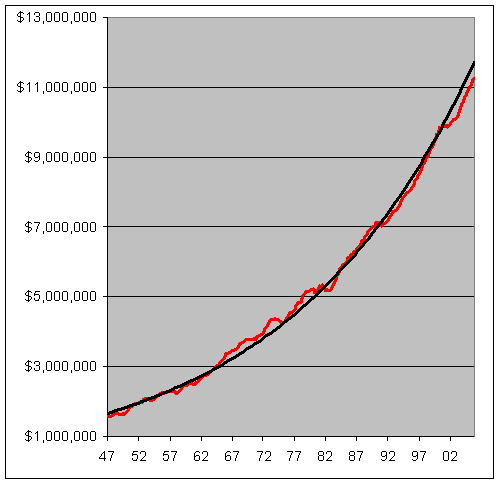
GDP.png

Here's a look at the trailing three-quarter growth rate of real GDP. I'm not sure why, but the nine-month view seems to work the best.

Notice how over the last 20 years, the economy has become far less cyclical. The peaks are getting lower, and the valleys are getting higher.

GDPtrend.png

The Stalwart has speculated that as the overall economy has become more stable, the individual pieces have become more volatile. I think he's right. Perhaps the price for collective security is the growth of constituent risk.

Posted by edelfenbein at 9:01 AM

February 27, 2006

PhytoMedical Technologies

David Phillips at 10Q Detective is unimpressed with PhytoMedical Technologies (PYTO.OB):

The 10Q Detective suggests that if PhytoMedical Technologies really wants to be taken seriously by the investment community—Perchance the Company could design a clinical trial that examines the safety and efficacy on the potential appetite-stimulating properties of a well-known plant-derived compound on the cachexia of cancer, HIV/AIDS symptomatology, and other wasting syndromes. This medicinal plant is called, cannabis sativa.

To be blunt (BA!)—given the Company’s current fundamental outlook—one would have to be smoking cannabis daily to even consider buying this stock.

I guarantee you'll never read that in a Merrill research report.

Posted by edelfenbein at 10:06 PM

The Future of Food

Steven Milloy, the author of Junk Science Judo: Self-defense Against Health Scares and Scams, looks at the film "The Future of Food."

Produced by Deborah Koons Garcia, the widow of the Grateful Dead’s Jerry Garcia, the movie’s overriding themes are allegations that biotech crops and food are unsafe and that a government-industry cabal is foisting dangerous products on an unwitting public.

Nothing could be farther from the truth.

Biotech crops and foods are among the most thoroughly tested products available. No other food crops in history have been so thoroughly tested and regulated. Before biotech products are marketed, they undergo years of safety testing including thousands of tests for potential toxicity, allergenicity and effects on non-target insects and the environment.

‘The Future of Food,’ for example, dredges up the 2000 scare involving a biotech corn that had not yet been approved for human consumption but that was detected in Taco Bell taco shells. A few consumers, egged on by anti-biotech activists, alleged the corn caused allergic reactions. But the movie glossed over the fact that the U.S. Centers for Disease Control and Prevention tested those consumers and reported there was no evidence that the biotech corn caused any allergic reaction in anyone.

Another long-buried myth excavated by Garcia was that biotechnology harms biodiversity. But so far it doesn’t appear to represent any greater risk to biodiversity than conventional agriculture and it actually seems to have some demonstrable beneficial impacts on biodiversity. An infamous biodiversity scare featured in the movie involved Monarch butterflies. The scare occurred during 1999-2000 when the media trumpeted alarmist results from two laboratory studies reporting that biotech corn might harm Monarch butterfly larvae. Subsequent field studies soon debunked the scare, reporting that Monarch larvae actually fared better inside biotech cornfields than in natural areas because of less pressure from predators. Needless to say, Monarchs in biotech cornfields also did much better than those in conventional cornfields sprayed with insecticides.

The movie claims that once biotech crops are planted, control over them is lost and they ‘contaminate’ non-biotech or organic crops. This is misleading since 100 percent purity has never been the reality in agriculture. Biological systems are dynamic environments, meaning that regardless of the method of production -- conventional, organic or biotech -- trace levels of other materials are always present in seed and grain. Since all commercial biotech traits are fully approved by U.S. regulatory agencies, their presence -- in large amounts or trace amounts -- is fully legal and safe.

With respect to organic farmers, the Department of Agriculture’s rules for organic products specifically say that the certification of organic products is process-based -- meaning that if the proper processes are followed, the unintended presence of non-organic or biotech traits doesn’t disqualify the product from being labeled as ‘organic.’

To date, biotech crops haven’t harmed organic farmers. The coexistence of biotech, conventional and organic corn, soybean, and canola has been effectively working since 1995, when the first biotech crops were introduced. During that period, in fact, both biotech and organic farming have grown remarkably.

Garcia wants movie viewers to overlook the fact that U.S. regulators -- including the Department of Agriculture, Environmental Protection Agency and the Food and Drug Administration -- have established a robust framework and rigorous process for evaluating biotech product safety. Developers spend years generating data for one product to be submitted for approval.

A major take-home message of the movie is that consumers should demand labeling of biotech foods. But this would only increase the cost of food production while failing to provide any meaningful information to consumers. Biotech crops have been determined by regulators to be essentially equivalent to those of conventional crops. Corn is corn, in other words, no matter what anti-biotech activists would have us believe.

While emphasizing ‘scare,’ the movie overlooks biotechnology’s advantages. Biotech crops require less tilling. This reduces soil erosion; improves moisture retention; increases populations of soil microorganisms, earthworms and beneficial insects; and reduces sediment runoff into streams.

The movie mocks biotechnology’s potential value to the developing world, characterizing the argument as one designed for public relations use. But biotech crops such as ‘golden rice’ could help with the severe Vitamin A deficiency that afflicts hundreds of millions in Africa and Asia, ¬ including 500,000 children who lose their eyesight each year.

As pointed out by Greenpeace co-founder Patrick Moore, now a vociferous critic of the activist group, ‘Greenpeace activists threaten to rip the biotech rice out of the fields if farmers dare to plant it. They have done everything they can to discredit the scientists and the technology.

‘A commercial variety is now available for planting, but it will be at least five years before Golden Rice will be able to work its way through the Byzantine regulatory system that has been set up as a result of the activists’ campaign of misinformation and speculation,’ Moore said. ‘So the risk of not allowing farmers in Africa and Asia to grow Golden Rice is that another 2.5 million children will probably go blind.’

Garcia’s ‘The Future of Food’ is steeped in the Greens’ tragic campaign of misinformation. Many long-time anti-biotech campaigners helped her make the movie, in which not a balancing thought or counter-opinion is presented.

The ‘Future of Food’ purports to be a ‘documentary’ – a movie that sticks to the facts. It doesn’t. Hollywood will need a new Oscar category for this one. How about ‘crockumentary’?


Posted by edelfenbein at 7:59 PM

Lowe's Vs. Home Depot

Lowe's reported great earnings today. Stephen D. Simpson looks at the battle between Lowe's and Home Depot:

For those who would suggest that home improvement retailing ultimately has to be like The Highlander ("in the end, there can be only one..."), I'd observe that Wal-Mart and Target have profitably co-existed, as well as Office Depot, Staples, Wal-Mart's Sam's Club, and Costco.

All that said, it's clearly true that Lowe's is the pluckier and faster-growing of the two concepts. Sales in the fourth quarter climbed over 26% (nearly 8% on a comp-store basis), and earnings per share rose nearly 36%. Certainly those numbers outstrip what Home Depot managed to accomplish.

And there are certainly aspects of Lowe's model that could be seen as working better than Home Depot's. Lowe's is generally thought to have better customer service, and the notion of trying out metro/urban stores is interesting.

By the way, Home Depot still has superior returns on capital. Home Depot also has a leg up in terms of international expansion and is moving aggressively into service businesses and MRO/industrial supply. So in this Fool's opinion, comparing Home Depot and Lowe's is no longer a fair straight-away comparison.


Posted by edelfenbein at 2:19 PM

Good Day Today

If the market holds, the S&P 500 will close at a four-year high. The S&P 600 Small-Cap Index (^SML) and S&P 400 Mid-Cap Index (^MID) might close at new all-time highs. Plus, all 20 stocks on the Buy List are higher today.

Posted by edelfenbein at 12:57 PM

Failure Never Felt So Good

Attention corporate weasals. Don't try to get anything past Michelle at Footnoted.org. It just ain't gonna fly.

And speaking of former executives, there was also this little snippet buried in Morgan Stanley’s (MS) proxy, which was also filed late Friday. Again, while the broad-brush details were known, such as Philip Purcell’s $44 million bonus, the blow-by-blow was included in the proxy (do a search for CEO settlement to find it quickly). Among the pearls are that Purcell’s secretary, which the company has agreed to pay for as long as Purcell lives, will cost the company $1.8 million and that donations to Purcell’s favorite charities (again for life) will cost the company $2.9 million. And there’s another $3.1 million for benefits the company will provide the former executive, again for the rest of his life.

Indeed, failure never felt so good.

And it pays well too.

Can you order Michelle's book? But of course. I'll be here when you get back.

Posted by edelfenbein at 11:21 AM

Owning a Toll Booth

GroovyStocks on Intel (INTC):

According to Yahoo Finance, shares of Intel are now trading at 14.7 times trailing earnings and 14.1 times forward earnings with an EV/EBITDA ratio of 6.7. We think these are very reasonable multiples to pay for such a high quality company.

Sticking with Yahoo’s numbers, INTC has an operating margin of 31.1% and a profit margin of 22.3%. Return on assets is 15.7% and return on equity is 23.2%. The balance sheet has $12.8 billion in cash and $2.4 billion in debt, or over $10 billion in net cash. If you know another place where we can buy such high profitability and returns with balance sheet strength even half as good, please let us know!

Intel’s size gives it a huge competitive advantage. Here’s a quote from Columbia Business School professor Bruce Greenwald that sums the matter up:

"When Intel goes after the next generation chip, because it’s got some degree of customer captivity — which is crucial to scale advantages — Intel can expect, if it’s successful, to get 10 times as many customers as AMD. That means Intel can spend 10 times as much on developing and marketing the new chip. That’s the advantage of scale. So who’s going to win that race every time? Intel." (Related Post)

We view owning Intel as owning a toll booth: (almost) every time somebody buys a computer you collect a fee. Sounds like a good business to us!

Posted by edelfenbein at 11:15 AM

Back Where We Started

Price chart of Intel (gold line) and Microsoft (black line) over the last eight years:

MSFTINTC.bmp

Posted by edelfenbein at 10:34 AM

Confessions of an Economic Hit Man

The latest offering from the Grassy Knoll gang is "Confessions of an Economic Hit Man" by John Perkins. The book has become a bestseller. In it, he claims that the world is governed by big, evil corporations who use "a combination of bribes, assassins and seductive women to enslave the poorest countries." In contrast, Sebastian Mallaby uses a combination of facts, reason and logic to expose this nonsense.

Perkins likes to say that of the world's 100 biggest economies, 51 are companies. This old chestnut is based on a fallacious comparison of companies' sales to countries' gross domestic product: Whereas GDP measures the amount of value added in an economy, sales lump together a firm's value-added with inputs bought in from suppliers. According to an apples-to-apples comparison done by the United Nations, just two of the world's top 50 economies were companies in the year 2000. Of the top 100 economies, 29 were companies.

That may still sound like a lot, but remember that companies compete against each other. In the world as Perkins dreams it, the top 100 or so firms are joined in a shadowy conspiracy. But the reality is that Exxon Mobil schemes to undermine BP and Shell, and General Electric plots against Siemens and Hitachi. Countries don't face a united corporatocracy. They play firms off against each other.


Posted by edelfenbein at 9:44 AM

1040 Tax Mistakes

MarketWatch looks at the lines on the 1040 Form that stumble most folks. Here's a sample:

Line 6

This year, you may trip as early as Line 6 because that's where taxpayers enter their dependents, and the rules for who qualifies as a dependent have changed.

"Now, instead of determining whether you provided half this person's support, the test is did they provide over half of their own support," said Cindy Hockenberry, tax information analyst with the National Association of Tax Professionals, a trade group. See this IRS page for more information on the new definition.

The rules for a qualifying dependent "have changed to such an extent that it has left people really scratching their heads. If you can get past that, you're doing good," Hockenberry said.


Posted by edelfenbein at 12:15 AM

February 26, 2006

Hedge Fund Manager Splits

Good news: Investigators have finally tracked down missing funds of a hedge fund.

Bad news: Except for $150,000, $150 million is still missing.

More bad news: So is the CEO.

Kirk S. Wright, founder and CEO of Atlanta-based International Management Associates LLC, said the firm was beset with redemptions but had about $150 million of client assets in the bank, during a Feb. 15 interview with The Wall Street Journal. Two days later, a Georgia state justice froze the assets of the firm and its three principals, including Mr. Wright, after several current and former professional football players (who? tell me!). who invested more than $15 million with the firm accused the company of fraud, forgery and refusing to meet redemption requests.

Other International Management clients quickly made similar allegations, kicking a regulatory inquiry into high gear. Over the past week, the Securities and Exchange Commission and a receiver (possible pun, not sure) appointed to mind International Management's assets have scoured the hedge-fund firm's offices, records and accounts, but found only crumbs (crumbs??). To date, investigators have only tracked down a tenth of one percent of the money Mr. Wright claimed was in the bank on Feb. 15.

A warrant was issued for his arrest in Georgia state court late Friday. Mr. Wright, who claims an investor has threatened his life, hasn't been seen for more than a week, according to people close to the situation. He postponed a visit to the SEC's Atlanta office to answer questions last week, saying he needed time to hire local counsel.

Let's assume it was a player who made the threat, which one could it be? I mean, there are so many possible suspects.

According to the Rocky Mountain News:

The former Denver Broncos players liked the investment pitch, pouring millions of dollars into the Atlanta-based hedge funds.

Now they say they were burned.

Steve Atwater, Terrell Davis and Ray Crockett, along with other investors including current Broncos wide receiver Rod Smith, have filed a lawsuit in Georgia against International Management Associates, saying the firm and its fund managers committed fraud and forgery and failed to return their money.

Clyde Simmons, who played with the Philadelphia Eagles and the Chicago Bears, among other teams, and Blaine Bishop, a former Eagle and Tennessee Titan, entrusted money to the firm, too, the lawsuit said.

Here’s what they had:

Atwater, a former safety, and his family had $4.5 million in the funds, the lawsuit said. Davis, a star running back in the late 1990s, had investments valued at $2.2 million, while Crockett, an ex-cornerback, had a total of $3.7 million. Smith, meanwhile, had $1.5 million.

If anyone needs me, I'll be scanning eBay for Super Bowl rings.

Posted by edelfenbein at 11:33 PM

February 25, 2006

SEC Subpoenas Herb Greenberg & Carol Remond

Omigod, the SEC subpoenaed two journalists! Herb Greenberg and someone else. This is government repression. Oh, wait. The Feds have backed off. The NYT:

The abrupt about-face was an unaccustomed victory for a news organization, as journalists have found themselves under increasing pressure in recent months from law enforcement authorities for information and testimony. In several notable instances over the last two years, including one involving The New York Times, the journalists have gone to jail rather than cooperate with law enforcement officials.

Um, the SEC is looking into stock manipulation. I’m sorry, but isn’t in the same league as leaking classified national security information. Actually, since it involves Salesforce.com (who else), one could argue that this is in the interests of national security, but that’s for another time.

The problem with this article is that journalists see the issue as being themselves. That ain’t it. The real issue is campaigns launched in order to drive down a stock’s price. It’s illegal to manipulate a market, but it’s certainly legal (and ethical) to air criticisms of a company. As long as they’re accurate.

Sure, investors go to Greenberg and others with an agenda. As long as they have valuable and accurate information, that shouldn’t be a problem. The sticky point is when others know that a resulting article will move a stock.

I honestly don’t know what the answer is.

Update: Here's Greenberg's response:

For those following the saga: a Dow Jones representative said Friday that the SEC has decided not to seek production of any documents "at this time" related to a subpoena I had received. "The SEC may come back in the future," the representative said.

But bottom line is that I'm no longer being asked to provide the SEC all of my "unpublished" communications, including emails and phone records, between me and people and organizations I've quoted -- and at least one I've never quoted.

To repeat what I wrote earlier Friday: The subpoena was part of the SEC's investigation into Gradient Analytics -- a research outfit that has served and continues to serve as a valued source for this column. It appears the investigation stems from the recent publicity surrounding Overstock.com Inc. and its controversial CEO, Patrick Byrne.

Gary Weiss takes aim at the SEC:

So today we have the SEC, in full flower of stupidity, chasing down the private vendettas of Overstock Inc.'s CEO, Patrick Byrne, whose principal problem is that his company just isn't a very good investment. Who is to blame? Well, I don't have to tell you, it certainly isn't him! Why, he is just the CEO of the company. Not his fault. It's them! The conspiracy! Joe Nocera's column today in the New York Times is the definite article on this one-ring corporate circus. It's impossible to mock or parody Byrne, because he does such a great job himself.

Enter the SEC. Instead of consigning his rants and conspiracy theories and private vendettas against shorts and the press into the round file, it launches an investigation. In other words, the pinnacle of our self-regulatory system did precisely what it did with the naked shorting conspiracy nuts.

Don't get me wrong -- this is serious business. Herb Greenberg of Marketwatch, one of the subpoena recipients, is correct in saying that the SEC's action will have a chilling effect on financial journalism. He and Carol Remond of Dow Jones News Service, the other subpoenaed reporter, are two of the toughest financial reporters around. They and others have paid the price for good work by being regularly smeared by Byrne and his lowlife sidekick, an Internet nutjob who goes by the phony name "Bob O'Brien." The latter is the naked shorting cult's Cowardly Lion, roaring against real and imagined enemies while carefully guarding his identity to avoid being held accountable for his constant barrage of lies and smears.

If you're not familier with Patrick Byrne, he's truly the Lyndon Larouche of Wall Street. Here's more from Joe Nocera:

For some time now, Mr. Byrne has been saying that his company is the victim of a Wall Street conspiracy intended to drive down its stock, which has fallen to the mid-20's from the mid-70's since the fall of 2004. Last August, Overstock sued Rocker Partners, a short-selling hedge fund that has been openly negative on the company, and Gradient Analytics, an independent research firm that has written consistently bearish reports on Overstock's mounting business problems.

The lawsuit asserted that the two firms were acting in concert to hurt the company and manipulate its stock price. Both Donn W. Vickrey, who runs Gradient Analytics, and David A. Rocker, the managing partner of Rocker Partners, have been sources for Mr. Greenberg over the years. And Mr. Greenberg has written about Overstock and Mr. Byrne from time to time, in his typically tough-minded fashion.Which of course makes Mr. Greenberg a charter member of the Overstock conspiracy. To hear Mr. Byrne tell it, Mr. Greenberg's role is to do the bidding of Rocker Partners and Gradient Analytics; when asked last year by Ron Insana of CNBC whether he was accusing Mr. Greenberg of "helping others front-run or trade illegally in the shares of your company's stock," Mr. Byrne replied, "That's correct, that's what I am doing." He described Mr. Greenberg to me as a "lapdog."

Although Mr. Byrne says he did not know about the subpoena, he clearly knew something was afoot. (He later told me that he had "just come from an interview with certain law enforcement people" who had been asking about Mr. Greenberg.) "As I take a sip," he taunted in his e-mail, "I find myself curious: do you guys know? Are you sitting somewhere, blithely oblivious, still chuckling about Whacky Patty, and all that? Or do you understand now that this is going to end badly for you?"

If you know anything about Patrick Byrne, it's probably his famous "Sith Lord" conference call. Held last summer, it was an hourlong monologue during which Mr. Byrne laid out a vast, overarching conspiracy, made up of dozens of Wall Street players — including the New York attorney general, Eliot Spitzer! — all under the thumb of an mysterious puppet master, whom Mr. Byrne labeled the Sith Lord. He titled the conspiracy "The Miscreants' Ball," an obvious reference to Michael Milken's old Predators' Ball.

Although Mr. Byrne told me that his Sith Lord speech ranked among "the 10 proudest moments of my life," most people, including me, thought it was loony beyond belief. Roddy Boyd of The New York Post recalled hearing about it from someone on Wall Street. "When he described it, I thought he was embellishing," Mr. Boyd said. But when he listened to the replay, "my jaw dropped — you cannot make up what occurred on that phone call."In addition to his conspiracy-mongering, Mr. Byrne talked about Stinger missiles, Wayne and Garth, a mysterious Spanish phone message, stuttering and cocaine. ("I'm not a coke head," he said, unprompted.)


Posted by edelfenbein at 4:03 PM

Deconstructing TheStreet.com

Ed at Daily Dose of Optimism does a thorough analysis of TheStreet.com (TSCM). Here are parts one and two. (Preview: He's not a fan of their Web design.)

Ed sold the stock for a 75% gain in two years. My advice: Sell, Sell, Sell!

Posted by edelfenbein at 3:19 PM

February 24, 2006

Q&A: Small-Cap Stocks

Hi Eddy,

I think that your article regarding the "weak case" for better returns small caps doesn't make a lot of sense. If you or I got our legs amputated, we'd be a lot shorter too. But we don't - nor can you exclude January as a return month. Last time I checked the calendar, it was still on there. :-)

You’re right.

Although it's not my article, it's Mark Hulbert’s. He cites a finance professor who claims that the January returns for small-caps are illusionary. But if that’s true, there should be a corresponding correction in February. There isn’t. February is also an up month.

The January returns may be odd or abnormal, but they still count.

Posted by edelfenbein at 4:11 PM

Danish Embassy Rally

A small, but spirited crowd rallied in support of Denmark today outside the Danish Embassy in Washington.

The festive crowd of about 200 broke into chants of "We're All Danes Now!" Lots of flag-waving and Danish-eating.

Here are a few photos:

Notice that unlike the mobs in Syria, this was an orderly, well-behaved crowd. Nothing was on fire (well...except for Andrew Sullivan).

#3.jpg

Free Speech in Legos

Legos2.jpg

Here's Christopher Hitchens confering with a police officer. The officer was asking him about his permit. I heard Hitchens say that he had downloaded the form and faxed it in. I'm guessing this is a long way from Chicago '68.

HitchandCop.jpg

Cop: What's your group's name?

Hitch: We don't have a name.

Cop: You need a name.

Hitch: Um, Citizens for Denmark.

(I'm quoting from memory.)

Here's Bill Kristol with Hitchens. The truck symbolizes the working class.

KristolandHitch2.jpg

Tony Blankley

Blankley2.jpg

Some Bad Puns

Dont Be Blue2.jpg

All in all, it was a fun rally.

Here's some more coverage from other bloggers:

Vital Perspective

The Political Pit Bull

Vodkapundit

Corsair

Andrew Sullivan

Amerikanere demonstrerer til fordel for Danmark

Speech By Hitchens

Posted by edelfenbein at 2:35 PM

Are We Really in an Empire of Debt?

Gary Alexander has been in financial publishing for over 30 years. His specialty is taking apart the arguments of scare-mongers. Here's his review of Empire of Debt:

Agora Publishing was kind enough to send me a free copy of their book, Empire of Debt (by Bill Bonner and Allison Wiggin), and I actually read it cover to cover during my debt-free (paper money, not plastic) Christmas shopping season. All along, I sensed something missing. When I finished the book, I looked in the index to confirm what I already knew. There was a very important word missing. Indeed, it only appeared on one page, according to the index, and that key word is “ASSETS.” How can you write 300 pages about debts without mentioning assets?

The Empire of Debt, as colorfully written as it was, failed to address the vital question of the corresponding growth in American household, corporate and government assets, which offset debts. The only reference to assets referred to a page describing most assets as "overvalued."

Certainly, there will always be people who live beyond their means, and many of them will face a day of reckoning. Each of us probably know some specific people in this category,. Maybe some members of your extended family fit this bill. As a general rule, young people get in debt, and older people pay off their debts and then get rich, but I hate to generalize, so let's look at the facts.

On an aggregate basis, Americans are getting richer and are paying down their debts. The stock market crash of 2000-02 (you may have read about that one in the papers) "wiped out $14 trillion of wealth," it was said, with no mention of the accumulation of wealth before or since. I looked up those figures recently, at the Federal Reserve: Sure enough, net household wealth declined all three years of the crash, from a peak of about $42 trillion at year-end-1999, but it was only down $4 trillion, not $14 trillion, bottoming out at $38 trillion at the end of 2002. Considering the size and scope of that once-in-a-generation market crash, a net decline of 10% in household wealth was not such a huge blow.

Then, in 2003, the tax cuts boosted our take-home pay for income and growth investments, and the American wealth machine revived with a vengeance

Year-end Net U.S. Household Wealth
2002 $38 trillion
2003 $43 trillion
2004 $48 trillion
2005 $51 trillion *
* Through the third quarter of 2005, not counting a strong fourth-quarter stock market rally.
Source: Federal Reserve

Household wealth refers to household assets minus liabilities. In the Doomsday press, all you read about is the near-$10 trillion in household debts, but have you heard anyone quote the $61 trillion in gross assets, six times the debt totals, resulting in net assets of $51 trillion (61 minus 10). In the 2.5 years since the 2003 tax cut, per capita net worth has increased 16%, and the average household is now 27% better off than in 1998, in the middle of the stock market bubble. And U.S. household wealth has almost doubled since 1995. That's not counting business, which controls an $11 trillion "savings glut" of hoarded cash.

Here’s another wealth statistic the media missed: In 2005, for the third consecutive year, the number of households with more than $1 million in net worth (excluding their primary residence) has risen. According to TNS Financial Services’ latest Affluent Market Research Program (AMRP) annual survey of U.S. households, the number of millionaires increased 8%, to 8.9 million families as of mid-2005.

U.S. Millionaire Households (in millions)

2001: 6.0 million (a decline of 4% from 2000, due to the tech stock bubble)
2002: 5.5 million (another 9% decline)
2003: 6.2 million (+13%)
2004: 8.2 million (+33%)
2005: 8.9 million (+8%)

The immediate reaction is that this 61% growth in millionaire households since 2002 is due to the housing bubble, but these figures exclude the household's primary residence. Most of this gain is from accumulation of common stock. The report said that ownership of stocks and bonds was up (72% of millionaires owned individually held stocks and bonds in 2005, up from 63% in 2003), while their debt decreased substantially. In 2004 the average debt was $179,000. In 2005, that number fell to $165,000, an 8% decrease.

This annual report reflects and updates the research done by Tom Stanley in his book, The Millionaire Next Door. The vast majority of millionaires are patient, debt-averse investors. The TNS report says “When asked about their investment approach over the past year, 61% of millionaires said their approach has changed very little, indicating they have a strategy and they are sticking to it.” Nor is real estate and its famed “bubble” a driving force behind the increase in the number of millionaires. In fact, ownership in investment real estate was down from 2004, when 50% of millionaires owned investment real estate, including second or vacation homes, compared to 44% in 2005, but these households are not becoming wealthy based on real estate, the report confirmed.

The AMRP survey is based on a representative national sample of over 1,800 households with a net worth of $500,000 or more, excluding their primary residence. The survey also includes additional interviews of households with $1 million or more in investable assets. They also poll the next rung of the wealth ladder, or what they call the “emerging affluent households,” those with $100,000 to $500,000 in positive net worth, excluding their primary residence. This group has also increased in the past year, from 23.9 million in 2004, to 24.5 million in 2005.

I cite these facts in detail because nobody else seems to be reporting on the positive side of America’s “debt crisis.” As Sophie Tucker famously said, "I've been rich, I've been poor. Rich is better." Most of the poor are young, but then they grow (in wealth) over a lifetime, not suddenly. Over 65% of the Forbes 400 started with essentially nothing. Only 15% inherited their wealth. The migration of wealth from the slackers to the hard-worker, well educated and imaginative innovators is an essential fact of life in a free economy. Those deep in debt, with no exit strategy, will most likely suffer. But the majority of Americans are growing richer almost every year. Unfortunately, that won't make the evening news, but maybe it should.


Posted by edelfenbein at 1:56 PM

Patterson Lowers Guidance

One of my favorite "watch list" stocks reported earnings yesterday. Patterson Companies (PDCO) earned 39 cents a share, which was inline with Wall Street’s estimates. Last year, Patterson earned 36 cents a share.

If you’re not familiar with Patterson, it’s a dental, pet and rehabilitation supply distributor. Don’t laugh, it has one of the best records for long-term growth. For several years, Patterson consistently delivered 20% earnings growth quarter after quarter.

But year last, that streak abruptly came to a halt. For two straight quarters, Patterson increased its EPS by just one penny. I find that pretty unnerving since I place a lot of emphasis on a company’s consistency (just look at our Buy List).

Companies aren’t like athletes that hit slumps. They also don’t turn things around so easily. It does happen, but it’s much less frequent than most people imagine. High-quality companies usually stay high quality, and low-quality ones stay low quality. The reason I like to focus on numbers like return-on-equity is that it tends to be a fairly consistent metric for a company.

For whatever reason, Patterson has lost its mojo. The company just lowered its guidance for this year to $1.42 to $1.44 a share, from its earlier forecast of $1.44 to $1.46 a share. That may seem small, but it shows us that the company is not moving in the right direction. It also means that shares of PDCO are going for about 25 times next year’s earnings. I can find better growth for less elsewhere.

Posted by edelfenbein at 10:06 AM

Oil Prices Soar

From the AP:

Crude-oil futures soared nearly $2 a barrel Friday after a Saudi official reported an explosion at a major oil refinery in eastern Saudi Arabia.

Light, sweet crude for April delivery rose $1.97 to $62.51 a barrel in electronic trading on the New York Mercantile Exchange by afternoon in Europe. Brent crude futures for April initially jumped $1.96 to $62.50 on London's ICE Futures exchange.

Nymex gasoline advanced more than 3 cents to $1.550 a gallon, while heating oil gained 4 cents to $1.7066 a gallon. Natural gas futures fell 12 cents to $7.335 per 1,000 cubic feet.

The pan-Arab satellite channel Al-Arabiya TV reported the authorities foiled an attempt to bomb the refinery with two vehicles packed with explosives. The channel did not give a source for the report.

Earlier Al-Arabiya quoted its reporter in the kingdom as saying shots and an explosion were heard, and they may have been part of an attempt to attack the refinery.

The oil official, who spoke on condition of anonymity, said he did not know the cause of the explosion.


Posted by edelfenbein at 9:23 AM

February 23, 2006

Fiserv to Buy Back 5.6% of Its Stock

Sloppy day today. The cyclicals were particularly weak. The Consumer Index (^CMR) actually closed slightly higher, and our Buy List beat the S&P 500 for the second day in a row. The metals got punished today, which I like to see.

Home Depot (HD) announced today that it's increasing its share buyback program by $1 billion. As I've mentioned before, I not a big fan of share repurchases. I'd rather just get a dividend.

Fiserv (FISV) said that it will repurchase up to 10 million shares. Considering the size of the company ($8 billion market cap), that's huge. It works out to 5.6% of the company's stock.

What I find so interesting about Fiserv is the way the stock's P/E ratio has collapsed in recent years. It's always tricky predicting where a stock's P/E ratio ought to be, but let's look at the facts. Fiserv's earnings multiple has been dropping like a stone, and it's lower now than it was during much of the 1990's (see below). Also, Fiserv's earnings have increased pretty consistently for the past few years.

FISV.bmp

Posted by edelfenbein at 5:47 PM

Consumer Prices Rise 0.7%

I usually don’t go too much into macroeconomics, but I wanted to say a few words about inflation. Yesterday, the government reported that consumer prices rose 0.7% last month. This has some people worried that inflation is coming back, or perhaps it’s already here. Call me a doubter. Of course, if you’ve been anywhere near a gas pump, you know we have inflation there. But so far, it doesn’t seem to be many other places.

Mind you, inflation is bad news, especially for stocks. The problem with inflation is that it builds upon itself, and it can easily get out of control. For more details, feel free to ask Jimmy Carter what he’s up to these days.

Personally, I think the inflation that we’re seeing is fairly tepid. Some in the inflationophobic camp point to low interest rates and the rising prices of commodities, especially gold. That’s certainly an issue, but major price increases have not been passed on to consumers. At least, not yet. I also believe that gold’s ability to predict inflation is vastly overrated (this is heresy to some).

When we look at consumer inflation it’s also important to look at what economists call the “core rate.” This is the regular inflation rate except for food and energy prices. This often gives us a better picture of what inflation is really up to because prices for food and energy can be very volatile.

Over the last 15 years, the core rate has been a slowly descending line. Or in the case of my chart below, a slowly descending red line. The core rate even got down to one single percent two years ago. What’s striking about the progress of core inflation is the steadiness of the trend. For the last ten years, there hasn’t been a single alarming bump in the overall trend. Even the jump from 1% to 2% has lost its oomph.

Despite looking at the core rate, people do in fact spend money on food and energy. On my chart, the regular rate of consumer inflation is represented by the black line. That trend has been far more erratic, and the overall rate of consumer inflation is on the rise. However, it doesn’t appear to be much outside the band of the last 15 years. You can see that overall inflation jumped in the late-90s, but it was still well under control. Even if inflation is coming back, the evidence we have so far is quite modest.

CPI.bmp

Posted by edelfenbein at 11:30 AM

February 22, 2006

The Market Is Closing in on a New High

The market is looking good today. If the S&P 500 closes above 1294.18, it will be our highest close in 57 months. Right now, we’ve very close.

Over the past few years, small stock indexes have done much better than the S&P. In fact, they’ve hit all-time highs in recent weeks, however, small stocks have underperformed the market since the beginning of the year.

One of the important lessons of investing in the stock market is that stocks don’t move rationally. At least, not in the short-term. We have all these hi-tech toys that are used to analyze things that really don’t make much sense on closer inspection.

Trends are often much stronger and longer-lived than you think. For example, Home Depot (HD) had a good earnings report and the stock basically ignored it. Medtronic (MDT) also had a good report, and the stock is weaker today.

As long as the earnings are good, I’m not concerned about those stocks. Their time will come. Remember, if the Dow were to accurately reflect its underlying value, it would move about four or five points each day.

Expeditors (EXPD), Danaher (DHR) and Donaldson (DCI) are all at new highs today. As much as I like Expeditors (which is a lot), I have to admit that its shares are fairly pricey. Yet, the stock keeps going up. Who am I to say stop?

On the other hand, we have Bed Bath & Beyond (BBBY) which is very cheap, and its shares seem to be going nowhere. It’s time will also come. I don’t know when, but I’m holding on.

Dell (DELL) postponed an analyst meeting. I don’t think it’s anything to worry about. I noticed this factoid from the article: "Concerns about growth have held back Dell's shares, which trade at about 15 times estimated fiscal earnings per share for the coming year, the same as No. 2 PC maker Hewlett-Packard Co. That is a discount, since Dell's estimated long-term growth rate is about twice that of HP, according to Sanford C. Bernstein analyst Toni Sacconaghi."

Twice the long-term growth rate, yet it trades with the same P/E ratio. Like I said, this isn't always rational.

For the year, our Buy List is up 2.98% versus 3.57% for the S&P 500.

Posted by edelfenbein at 1:22 PM

America Movil

Here’s an interesting article on America Movil (AMX). The company is the largest cellphone company is Latin America. Carlos Slim, who’s the fourth-richest man in the world, bought TelMex from the Mexican government in the early 90s. A few years later, he spun-off America Movil. The company now has over 90 million subscribers, including six million in the U.S.

The company is hugely profitable in Mexico and it’s used its success there to move into other Latin American markets. In the last three years, shares of AMX are up 650%.

amx.bmp

Posted by edelfenbein at 12:17 PM

February 21, 2006

Medtronic Reports Inline Earnings

After the bell, Medtronic (MDT) reported earnings of 55 cents a share, matching Wall Street's forecast:

Medtronic, Inc. today announced record revenue for the quarter ended January 27, 2006, of $2.770 billion, a 9 percent increase over the $2.531 billion recorded in the third quarter of fiscal year 2005. On a constant currency basis, growth was 12 percent with a negative currency translation impact of $72 million or 3 percent.

As reported, third quarter net earnings were $670 million or $0.55 per diluted share, an increase of 23 percent and 22 percent respectively over the prior year third quarter. Excluding the litigation charge included in the prior year third quarter, net earnings and earnings per share increased 20 percent.

"Solid overall growth was again led by our two largest product lines, implantable defibrillators and spinal products. These two product lines accounted for about 45 percent of the corporation's revenue and, on a constant currency basis, they collectively grew 22 percent compared to the prior year third quarter," said Art Collins, chairman and chief executive officer of Medtronic. "This year's growth reflects the impact of ongoing investments; for example, during this quarter R&D expenditures increased 16 percent to $280 million."


Posted by edelfenbein at 4:20 PM

TheStreet.com Initiates Dividend

Good news! TheStreet.com (TSCM) has announced its first-ever quarterly dividend! The company is going to pay out 2.5 cents a share. Booyah! That works out to $2.5 million a year.

Hold up! Where exactly will this money come from? Aren’t dividends supposed to be from profits?

Well, the company isn’t exactly profitless. After several years of gushing money, TheStreet finally registered a profit in 2005. A whopping $246,000. Or a penny a share (slightly less actually). That’s about what a 7-11 makes.

Due to discontinued operations, that EPS number jumps to 23 cents, but it’s still hardly comforting. First, they’re discontinuing operations. They shuttered their brokerage and research businesses last year. Now they’re focusing on subscriptions for revenue, and that rose by 3% last year.

The company still has over $30 million in cash so they can pay dividends for a while. But I hope they don’t think they’re fooling anyone.

Posted by edelfenbein at 12:04 PM

Radio Shack's CEO resigns

As we celebrate George Washington's birthday, we should remain that our nation's first chief executive didn't go to college. Likewise, David J. Edmondson, Radio Shack's chief executive, also didn't earn a college degree.

Unlike Edmonston, Washington didn't lie about it. The good news is that Edmonston will get a $1.5 million severance package.

Posted by edelfenbein at 10:58 AM

Home Depot Tops Earnings

The stock is up this morning on a good earnings report. The company beat the Street's forecast by four cents a share:

Home Depot Inc., the world's largest home-improvement retailer, said fourth-quarter profit rose on sales of major appliances and cabinets.

Net income climbed to $1.29 billion, or 60 cents a share, from $1.04 billion, or 47 cents, a year earlier. Sales in the period ended Jan. 29 increased to $19.5 billion from $16.8 billion, the Atlanta-based retailer said today in a statement sent by PR Newswire.

Profit was helped as U.S. consumers spent more on refrigerators, cabinetry and faucets to remodel their kitchens and bathrooms. Chief Executive Robert Nardelli is also seeking to boost sales to professional contractors with last month's $3.19 billion acquisition of Hughes Supply Inc.

Home Depot is "going after the larger contactors and infrastructure-related businesses," said Peter Jankovskis, director of research at Oakbrook Investments LLC, which has $1 billion under management, including about 760,000 Home Depot shares. "It's given them greater exposure to large homebuilders and municipalities as well and that's a much more steady source of income."

Shares of Home Depot were unchanged at $41.86 on Feb. 17 in New York Stock Exchange composite trading. They fell 5.3 percent last year, while rival Lowe Cos.'s gained 16 percent.

Home Depot made more than a dozen acquisitions in the past year to build its supply business into a unit with $12 billion in revenue. The company, which has more than 2,000 stores, is increasing sales to professionals and expanding in Mexico, Canada and China to keep pace with the faster growth at Lowe's.

Forecast

Piper Jaffray & Co. analyst Michael Cox expected Home Depot to earn 56 cents a share in the quarter, the same as the average estimate of 22 analysts surveyed by Thomson Financial. Minneapolis-based Cox is the top-ranked analyst for Home Depot by StarMine Inc. Thomson declined to disclose the parameters for the estimates in its average.

Last month, Home Depot affirmed its fiscal 2005 earnings forecast of $2.64 to $2.67 per share. The average estimate of 21 analysts surveyed by Thomson is $2.67. The company projected an 11 percent sales gain for last year.

Analysts are estimating Home Depot will earn $3.03 this year, one cent below Cox's estimate.

Nardelli, 57, said last month that he will slow the company's retail expansion. Home Depot will open as many as 500 stores through 2010, about 75 less than in recent years.

'Growth Company'

"While the looming saturation of home-improvement retail boxes in this country is bringing a natural slowdown in the rate of new store growth, Home Depot remains a growth company," Cox wrote in a research note on Jan. 20.

U.S. spending on home remodeling increased 4.3 percent both in the fourth quarter and for all of 2005, according to the Harvard Joint Center for Housing Studies.

The company said on Jan. 19 annual sales will grow as much as 17 percent over the next five years and earnings per share will rise as much as 14 percent.

Home Depot's sales have gained an average of 11 percent a year over the past three years. Revenue for Lowe's, which has about 1,200 stores, increased an average of 16 percent over the same period.

Lowe's reports fourth-quarter earnings on Feb. 27.

Home Depot met or exceeded analysts' estimates in the four prior quarters. Of the 24 Home Depot analysts tracked by Bloomberg, 16 recommend buying the shares, eight suggest holding them and one has a "sell" rating.


Posted by edelfenbein at 10:03 AM

February 20, 2006

Royal Philips cancels $700M Dell contract

From Reuters:

Royal Philips Electronics NV canceled a $700 million contract with Dell Inc.

The contract called for Dell to provide desktops and other hardware, managed services and software packaging to Philips Electronics (NYSE: PHG) over five years. The contract was signed in December 2004.

According to Reuters, a Philips spokesman says the companies concluded that the contract "did not sufficiently guarantee success for completion."

In morning trading, Dell's stock was down 4.94 percent to $30.38 a share.

Based in the Netherlands, Royal Philips Electronics is one of the world's largest electronics companies. Round Rock-based Dell is one of the world's largest computer manufacturers.


Posted by edelfenbein at 2:16 PM

February 19, 2006

Ten Straight Years of Earnings Growth

The following 34 stocks have grown their earnings for 10 straight years:

NVR NVR
Apollo Group-Cl A APOL
Moog-Cl A MOGA
Dollar Tree Stores DLTR
Bed Bath & Beyond BBBY
Compass Bancshares CBSS
City National CYN
Donaldson DCI
Ross Stores ROST
SEI Investments SEIC
Expeditors Intl Wash EXPD
Toll Brothers TOL
Patterson Companies PDCO
Lincare Holdings LNCR
Home Depot HD
Health Mgmt Assoc HMA
Knight Trans KNX
Harley-Davidson HDI
Paychex PAYX
Applebee's Intl APPB
Brown & Brown BRO
O'Reilly Automotive ORLY
Hilb Rogal & Hobbs HRH
Heartland Express HTLD
Capital One Financial COF
Copart CPRT
Walgreen WAG
Sysco SYY
Wal-Mart Stores WMT
D.R. Horton DHI
Synovus Financial SNV
General Electric GE
Cathay Gen Bancorp CATY
Trustco Bank Corp/NY TRST

Posted by edelfenbein at 5:07 PM

All Hail the Dollar

From some reason, the news media seems unable to report on issues regarding international currencies. I’m not sure why this is, but once people start talking "dollars" and "euros," everyone’s eyes start to glaze over. Otherwise fine reporters become a mixture of alarmism and incoherence. It’s as if currencies are like, say, very large hurricanes.

Daniel Gross has an article on today’s New York Times on the growing trend of Latin American countries abandoning their sovereign currencies for the U.S. dollar. Is this a good thing, or a bad thing? I think Dr. Roubini answers the question well.

"If you have sound economic policies in a country, you don't need dollarization," said Nouriel Roubini, professor of economics at New York University's Stern School of Business. "And if you follow poor policies, I don't think dollarization will solve your problems."

Currencies themselves don’t produce wealth, or the lack thereof. Currencies are only as strong as the economies they support. Disraeli said (rightly): "Our gold standard is not the cause, but the consequence of our commercial prosperity."

Posted by edelfenbein at 4:53 PM

Earnings Preview: Home Depot

From the AP:

Home Depot Inc. reports earnings for the fourth quarter on Tuesday, Feb. 21 before the market opens. The following is a summary of key developments and analyst opinion related to the period.

EXPECTATIONS: The world's biggest home improvement retailer in January forecast fiscal 2005 earnings between $2.64 and $2.67 per share, on sales of at least $81 billion.

Wall Street expects Home Depot to post earnings of 56 cents per share, the mean estimate of 22 analysts surveyed by Thomson Financial, on $18.74 billion in sales.

ANALYST TAKE: "We remain very positive on the home improvement sector and Home Depot's prospects, particularly given current valuation levels," Lehman Brothers analyst Alan Rifkin wrote in a client note. "Home Depot shares are currently trading in line with the five-year historic low forward price-to-earnings ratio, based on consensus estimates."

QUARTER DEVELOPMENTS: Home Depot in January said it would acquire Hughes Supply, one of the nation's biggest sellers of construction, repair and maintenance products, for $3.19 billion, its biggest ever acquisition.

Also in January, Home Depot said it would scale back new store openings over the next five years, as it shifts from the retail business in favor of the wholesale commercial and industrial markets. The company, which currently operates 2,043 stores in the United States, Canada and Mexico, said it will open 400 to 500 stores through 2010, down from the 941 it opened since late 2000.

Earlier this month, the Financial Times reported Home Depot was in talks to buy up to 49 percent of Orient Home, a Chinese retail chain, for more than $200 million. The company declined to comment on the report.

COMPETITORS: Home Depot competes with Lowe's Cos., the nation's No. 2 home improvement chain, which on Feb. 1 said it would bolster its current share buyback program by up to $1 billion. The company is scheduled to report its quarterly results later this month.

STOCK PERFORMANCE: Home Depot shares are up 3 percent so far this year and trading near a 52-week high of $43.98 it hit in July 2005.

Posted by edelfenbein at 4:10 PM

February 17, 2006

Turin Duct-Tape Police Target Non-Sponsors

First they came for the logos, but my logo wasn't for an official sponsor, so I didn't speak out:

Samsung can't put its name on its popular flat-screen televisions, even in its own VIP lounge. Workers at Winter Olympic venues are taping over the Dell logos on laptops in the press boxes. The Austrians had to cover up the spiders on their Spyder jackets.

The advertising police are out in force at the Turin Games, enforcing arcane rules with a vigor unmatched at Olympics past.

Under International Olympic Committee rules:

-- Sponsor logos are allowed, but only in certain places;

-- Non-sponsors are out, no matter where;

-- Venues must be kept free of advertising.

Even bottles of Coca-Cola, one of the Games' biggest sponsors, have been ordered stashed out of view of the TV cameras.

"We don't want the Olympic Games becoming, let's say, a Formula-1 event where sponsors are on cars, on banners, everywhere," said Cecilia Gandini, the head of brand protection for the Turin organizing committee. Gandini can recite Olympic advertising regulations from memory and spends her days touring venues in search of violations.

"We want to protect the value of the Olympic Games," she said.


The value of the Olympic Games?? Oh, dear lord.

That reminds me of quote attributed to Churchill about the "traditions" of the British Navy: "Don't talk to me about naval tradition. It's nothing but rum, sodomy and the lash."

Posted by edelfenbein at 3:45 PM

Analyst Watch

Today, Keith Bachman of Banc of America Securities lowered his rating on Dell to neutral. But he doesn’t think the stock is hopeless.

Strategic changes that we think could help us get more interested in the stock include selling more partner programs with companies like Google....

Yep, that's just what they need.

Posted by edelfenbein at 3:33 PM

The Small-Cap Effect

Mark Hulbert in Barron's on the Small-Cap Effect:

Just how strong is the statistical and historical support for the notion that the average small-cap stock outperforms the average large cap -- the much-vaunted small-cap effect?

It certainly looks very strong: Virtually every major discussion of small caps' supposed relative strength refers to the famous Ibbotson Associates data set, which shows that small-cap stocks have significantly outperformed large caps since the 1920s (see Electronic Q&A, "Ibbotson: Small Caps Still Have Big Bang," Feb. 14).

What could be stronger than that? Most of the other alleged patterns about which investors spin endless tales have just a fraction of the apparent support that the small-cap effect has.

Yet, sacrilegious though it may be, I decided to take a closer look at the historical case for small caps' relative strength, and it turns out that this case is surprisingly weak.

I reached this conclusion by analyzing data provided on the Website of Dartmouth University finance professor Kenneth French. This comprehensive data set, compiled by French and University of Chicago finance professor Eugene Fama, reflects the performances of virtually all publicly traded U.S. stocks from mid-1926 to the present. It is free and publicly available; those of you who enjoy crunching numbers will find it invaluable.

Consider first the returns of five different portfolios that Fama and French formed based on the market capitalizations of various stocks.

The first portfolio contained the 20% or so of stocks that had the largest market caps, while the fifth portfolio had the smallest stocks; the middle three portfolios comprised the roughly 60% of stocks in the middle. Fama and French rebalanced these portfolios yearly to take into account changes in stocks' market caps.

At first blush, these portfolios' returns provide incredibly strong support for the small-cap effect. The average return of the stocks in the portfolio containing the smallest-cap stocks was 17.1% on an annualized basis between mid-1926 and the end of 2005, versus 10.2% for the quintile that had the largest-capitalization stocks -- for an impressive difference of 6.9 percentage points annually.

But, as broadcaster Paul Harvey might say, here's the rest of the story.

It turns out that all of the small caps' extra return comes in January.

If we focus on all months besides January, the largest-cap quintile has produced a 9.1% annualized return since mid-1926, in contrast to 7.8% annualized for the smallest-cap portfolio. The small caps' 6.9-percentage-point advantage over the largest caps becomes instead -- without January -- a 1.3-percentage-point deficit!

The files at Kenneth French’s site also contain data for size deciles. From June 1932 to the end of 2004, the smallest decile, or 10% of stocks, gained nearly 10,875,000%. January was responsible for 26,170% of the total.

Here are the annualized micro-cap returns by month from July 1926 to December 2004:

January.........159.82%
February.........25.10%
March...............1.21%
April................12.86%
May...................6.85%
June..................6.57%
July.................22.64%
August.............8.16%
September.......-7.75%
October..........-14.60%
November..........7.97%
December.........-1.94%

Posted by edelfenbein at 12:32 PM

Dell's Earnings

This is from today’s Wall Street Journal:

For the quarter ended Feb. 3, the Round Rock, Texas, company reported net income of $1.01 billion, or 43 cents a share, up from $667 million, or 26 cents a share, a year earlier. The results exceeded Wall Street's expectations of 41 cents a share.

Revenue rose 13% to $15.18 billion from $13.46 billion a year earlier.
The company said sales outside the U.S. were 43% of its overall revenue for the fourth quarter, up from 40% in the year-earlier period. The company said it gained share in every region during the year. In Europe, revenue rose 18% to $3.7 billion, while Asia Pacific-Japan revenue was up 21% to $1.7 billion.

Kevin Rollins, Dell's chief executive, said the company's success in countries such as China and Germany shows that its direct-sales business model is preferred by people in all regions. Overall demand is "pretty darn healthy," he said in a conference call with reporters.

Yet the stock is trading about 5% lower today. Wall Street’s reaction simply makes no sense. They lower expectations, and the stock falls. They beat expectations, and the stock falls.

I’ll have more to say on this later. Meanwile, here's Dell's conference call from Seeking Alpa.

Posted by edelfenbein at 11:53 AM

February 16, 2006

Dell Earned 43 Cents a Share

Revenues of $15.2 billion.

Posted by edelfenbein at 4:09 PM

The Fears Under Our Prosperity

Robert J. Samuelson has an interesting editorial today on the growth of individual instability amid rising collective stability:

A puzzle of our time is why the economy has become increasingly stable while individual industries have become increasingly unstable. The continuing turmoil at General Motors and Ford simply reflects this more pervasive industrial instability -- also in airlines, telecommunications, pharmaceuticals and the mass media, among others. Hardly a week passes without layoffs from some major company, which is "downsizing," "restructuring" or "outsourcing." And yet, the broader economy has undeniably become more stable. Since the early 1980s, we've had only two recessions, lasting a combined year and four months and involving peak unemployment of 7.8 percent. By contrast, from 1969 to 1982, we had four recessions lasting altogether about four years and having unemployment as high as 10.8 percent.

A cottage industry of economists is cranking out studies on these questions. One intriguing theory -- completely counterintuitive -- is that the greater overall stability stems in part from the increased instability of individual industries. You would, of course, expect the opposite: As individual industries became less stable, so would the larger economy.

But the reality may be more complex. Different industries may go through cycles that are disconnected from each other, argue economists Diego Comin and Thomas Philippon of New York University. All don't rise and fall simultaneously. To simplify slightly: Housing, autos and farming might strengthen, while computers, airlines and chemicals weaken.

Assuming there's something to this theory -- which seems a good bet -- it helps explain the riddle of why there's so much anxiety amid so much prosperity. As Americans stock up on BlackBerrys and flat-panel TVs, it's hard to deny the affluence. But people also look to their employers for a sense of confidence about the future -- and here doubts have multiplied, because more companies and industries seem assailed by menacing forces.


Posted by edelfenbein at 2:12 PM

Medtronic Continued Selling Flawed Defibrillators

From Bloomberg:

Medtronic Inc. continued selling flawed cardiac defibrillators for two years after learning that some of them may suddenly quit working, according to company documents filed in a California lawsuit.

After Medtronic last year recalled the devices, 19,000 people had to have surgery for a replacement, said Medtronic spokesman Rob Clark. At least one of them died from post- surgical complications, according to the man's widow. Defibrillator patients are vulnerable to potentially fatal heartbeat irregularities, which the $20,000 devices detect and correct using electrical shocks.

"Medtronic has been taking products they know are not quite right and putting them into people rather than take the loss," said Hunter Shkolnik, a New York lawyer, who said in a Feb. 13 interview that he represents more than 200 people whose Medtronic devices were recalled. "If you know there's a problem with a component, you don't put it out and sell it to people."

Medtronic, the leader in the $10 billion-a-year market for heart rhythm devices, told 87,000 patients in February 2005 that the defibrillators implanted in their chests might fail. According to company documents filed in federal court in San Jose, California, the Minneapolis-based company had discovered the flaw in January 2003 and started producing a redesigned product one year later.


Posted by edelfenbein at 2:02 PM

Danaher Reaffirms Outlook

One of the easiest stories to ignore is when a company “reaffirms” its outlook. Don’t. This is one of the most underrated things a company can do. I love seeing out stocks reaffirm guidance. Don’t ever worry that they didn't "guide higher."

Yesterday, Danaher’s (DHR) CEO confirmed guidance of 59 to 64 cents a share for this quarter, and $3.02 to $3.12 a share for this year. Danaher earned $2.76 a share last year.

Posted by edelfenbein at 1:53 PM

Dell's Earnings Preview

Today is D-Day for Dell (DELL). The company reports earnings after today’s close.

Analysts surveyed by Thomson First Call are forecasting Dell will earn 41 cents a share on $14.8 billion in revenue, up from 37 cents a share and revenue of $13.5 billion a year ago.

In early trading Thursday, Dell shares fell 13 cents to $31.64.

But Dell has had a difficult time meeting or exceeding forecasts in the past year because it has faced more competition from Hewlett-Packard Co., International Business Machines Corp. and even Apple Computer Inc.

And Dell's stock suffered, slumping 29% in 2005.

In November, Dell reported third-quarter earnings fell to $606 million, or 25 cents a share, from $846 million, or 33 cents, a year earlier. Excluding $442 million in one-time charges, Dell earned 39 cents a share, in line with its revised forecast.

Revenue rose to $13.9 billion from $12.5 billion a year earlier, but slightly below the $13.97 billion expected by Wall Street.

I really don’t have a good idea of what Dell will report. Probably, 41 cents a share. I still think that the reaction to Dell’s “troubles” has been greatly exaggerated. The stock fell from $42 to $29 over a few pennies a share. Expect to hear a lot of silly talk about Dell losing market share. In my opinion, a rational price for Dell is about $35. Remember that Keynes said, "the market can stay irrational longer than you can stay solvent."

Posted by edelfenbein at 1:44 PM

February 15, 2006

HP Earns 48 Cents a Share

Whaddaya know? Hewlett-Packard (HPQ) earned 48 cents a share for its fiscal first quarter. The (cough) estimate was for (cough) 44 cents a share. Now HPQ shareholders should be happy, right?

Sorry to spoil the party. Those estimates were low-balled (as I said yesterday). The important number to look at is sales, which rose just 5.6%. The company guided higher for next quarter on the bottom line, but not for revenues. I wonder if that's some sort of hint.

Posted by edelfenbein at 4:34 PM

The Hottest Stock Market in Europe

The Brazilian stock market continues to be the hottest stock market in the world, but the hottest market in Europe can be found in Malta.

No, seriously. Malta.

Malta.gif

The Economist has more:

Local officials say that, as a new member of the European Union, Malta would like to repeat the success of Dublin or even Luxembourg. The record of the Malta Stock Exchange (MSE) has helped. Its equity index surged by more than 60% last year, after a 40% rise in 2004 (see chart). But for a 7% limit on the daily movement of individual share prices, it might have risen faster still: a number of stocks were trading near the top of the range “regularly” last year, says Mark Guillaumier, the MSE's chief executive, a descendant of a French sea captain who landed in the 18th century to trade with the Knights of St John.

Posted by edelfenbein at 11:22 AM

Morningstar Sees Value in Cendant

I will never understand the appeal of Cendant's (CD) stock. I think people are determined to see value there no matter what reason and logic say. The stock just took a hit again, on lowered guidance. Here's part of a new report on Cendant from Morningstar:

Cendant reported fourth-quarter results Monday that were in line with its lowered guidance. The company also reduced its forecast for the first quarter of 2006, citing weakness in its real estate and auto rental divisions. Cendant's overall revenue and profit expectations for 2006 are consistent with ours, though, and we see no reason to change our $23 fair value estimate. We believe the shares, which have steadily declined in recent months, offer a highly attractive risk/reward trade-off now. Uncertainty is likely to remain high in the near term, owing to concerns surrounding the cooling real estate market, the woeful performance of the travel distribution business (notably online agent e-bookers), and the impending four-way split. Because we are convinced that the core elements of our Cendant thesis still hold--its businesses generate lots of free cash flow and solid returns on capital--we think this uncertainty has created a compelling opportunity for investors. We have reviewed several valuation scenarios and are confident that Cendant is worth $22-$25 per share; in light of recent poor execution and earnings disappointments, we think it's prudent to err toward the lower end of this range. The real estate and hospitality divisions will be spun off in the second and third quarters, respectively, while the travel distribution arm spin-off will be completed in October.

Posted by edelfenbein at 10:59 AM

James Stewart on the Yield Curve

From the WSJ:

The most prevalent explanation is that buyers of the long bond accept the lower yield in anticipation of a recession, which is likely to drive long rates even lower. In this theory, such expectations in the markets become self-fulfilling. But I have yet to see any empirical data to support this notion.

In any event, inverted yield curves rarely last long. At this juncture, either long rates will rise, short rates will fall, or some combination of the two will occur, restoring the normal upward slope. You don't want to own long-term bonds when rates are rising.

To me, this makes it even more paradoxical that investors were so keen for those low-yielding 30-year bonds. It wouldn't take many cuts in short-term rates for the Fed to restore the slope of the yield curve. But how much lower can long-term rates fall? True, rates in deflationary Japan got close to zero, but the possibility of deflation in the U.S. seems a distant memory with gold trading at well over $500 an ounce. The likelihood that long-term rates will go above 4.48% over the next 30 years strikes me as close to a certainty.

And what if the yield curve turns out to be wrong this time, and there isn't any recession? Not only will economists return to the drawing board, but that means economic growth will continue, putting more upward pressure on long-term rates.

This seems yet another argument for investing in shorter maturities at today's relatively high rates. Short maturities, like the one- to three-year bank certificates of deposit I've recommended, have little risk of principal erosion even if rates rise. Meanwhile, you can collect close to 5%, and if the Fed continues its rate-rising campaign, you'll soon be able to earn even more.


Posted by edelfenbein at 10:53 AM

February 14, 2006

AFLAC Increases Its Dividend

The market had a great turnaround today. The Dow broke 11,000. The S&P 500 broke 1,275 and closed up 1.00%.

Expeditors (EXPD) had a strange day. First, the stock opened 46 cents higher on its earnings news. It then fell to a loss of $1.57 a share. But the market changed its mind and decided that the earnings were good, and the stock then rallied to a gain of $2.22, an all-time high. Before the end of trading, that gain was halved and Expeditors finished with a still-impressive gain of $1.09. The stock is up nearly 14% for the year. I love this stock, but I’m afraid it’s getting a bit rich.

Donaldson (DCI) also plugged higher to a new all-time high, and SEI Investments (SEIC) is within striking distance of a new high.

After the bell, AFLAC (AFL) announced that it’s raising its dividend for the 24th straight year. That’s another reason to love this stock. The new quarterly dividend is 13 cents a share, an 18% increase over the old 11-cent dividend. The company will also buy back 30 million shares of stock.

Hewlett-Packard (HPQ) reports tomorrow. I hope this company can manage its business as well as it manages Wall Street. Investors are in love with this stock. Wall Street’s earnings consensus, so we’re told, is for 44 cents a share. Please. HPQ should easily report, I’ll say, 46 cents a share. The crowd wants permission to love the stock some more, however, I wouldn’t be surprised to see the stock pull back in the next few days.

I’m always skeptical of turnarounds. Not that companies don’t turn around. They do. But in HPQ’s case, it’s still HPQ. Once they stop improving their margins (hey, you lay off 15,000 people, your margins will improve, too), how fast can the company grow? Ten percent tops. I expect to see that sales rose about 5%, and that’s probably what they’ll do next quarter. This is not a great business to be in. There are only so many profiles you can read about CEO Mark Hurd.

Posted by edelfenbein at 8:15 PM

S&P Says Home Depot Is Worth $52

From Business Week:

Even though the shares have lost ground thus far in 2006, we think it's possible to build a strong case for Home Depot. First, we think that a low unemployment rate and robust wage growth should continue to propel the U.S. economy (and, more importantly, consumer spending) at a modest clip. Second, while we're slightly concerned with the recent rapid increases in housing prices, we believe demand will remain strong enough to avert a major problem.

Finally, we think the valuation is very compelling, with the shares trading below the broader market, despite sporting a higher growth rate and stronger balance sheet. The stock carries S&P's highest investment ranking of 5 STARS (strong buy).

Home Depot is the world's largest home-improvement retailer and the second-largest retailer in the U.S., in terms of sales. As of October 31, 2005, it operated 1,972 stores, including 1,913 Home Depot stores (of which 126 were in Canada and 49 in Mexico), 34 EXPO Design Centers, five Home Depot Supply stores, 11 Home Depot Landscape Supply stores, two Home Depot Floor stores, and seven Contractors' Warehouse stores.

NUTS AND BOLTS. Home Depot stores sell a wide assortment of building materials, as well as home improvement and lawn and garden products. The company also provides installation services. Typical stores average 106,000 square feet plus 22,000 square feet of garden center and storage space, and stock 40,000 to 50,000 items, including brand name and proprietary items.

The flagship Home Depot stores serve three primary customer groups: Do-It-Yourself (DIY) customers, typically homeowners who complete their own projects and installations; Do-It-For-Me (DIFM) customers, homeowners who purchase materials and hire third parties to complete the project and/or installation; and Professional customers, consisting of professional remodelers, general contractors, repairmen, and tradesmen.

By product group, plumbing, electrical, and kitchen (29% of fiscal 2005 revenues) represents Home Depot's largest source of revenue. Hardware and seasonal (27%), building materials, lumber, and millwork (24%) and paint, flooring, and wall coverings (20%) make up the remainder.

R.I.P. CONSUMER? We believe several factors bode well for the company in 2006, including a resilient consumer, the company's shift in focus away from the cyclical domestic housing market, a dramatic 2005 hurricane season, and an economy on solid footing.

Some economists and investment professionals have been quick to point to the national savings rate, which has now been negative over the past seven months, as a key indicator of the impending retrenchment of the U.S. consumer. While this lack of savings is justifiably a cause for concern and could become quite problematic over the long term, we think the near-term ramifications of this statistic may not be that significant at all. Because the savings rate excludes capital gains on investments, we suspect the recent wealth that was built up as a result of the stock market in the late 1990s and real estate boom over the last five years will continue to drive spending over the coming years.

In addition, the job market remains very healthy, in our view, so we think it's unlikely consumers will feel the need to drastically tighten their purse strings any time soon. Furthermore, while increased interest rates make refinancing a less likely option for consumers in 2006, we expect home-equity loans will continue to buoy spending. S&P predicts that consumer spending will increase 3.2% in 2006.

HOUSING VALUES. While the current status of the housing market has been well documented -- and a topic of discussion at many cocktail parties -- we foresee only a modest decline in new home activity in 2006. S&P economists predict an 8.8% decline in housing starts for 2006, following a 6.2% increase in 2005. We also predict that declines in real estate values may occur in certain geographic "pockets," but that, overall, little attrition will occur. We believe it may take several years for houses to "grow" into their current values, but we don't foresee a dramatic decline in overall prices.

Also, government spending on the reconstruction of New Orleans will be the most expensive such effort in U.S. history, with estimates ranging from $100 billion to $200 billion. We believe Home Depot will benefit substantially from this increased spending.

For Home Depot, the biggest development over the past year, in our view, has been the aggressive push by the company to expand its Home Depot Supply business in the $410 billion professional market. In July, 2005, the company acquired National Waterworks, the leading distributor of water and wastewater transmission equipment in the U.S. Then, on January 10, 2006, it agreed to purchase Hughes Supply (HUG ; $46) for $3.47 billion (including the assumption of debt), which would be its largest acquisition ever.

MOVING ABROAD. While these acquisitions may appear puzzling to many investors, as they go well beyond Home Depot's core retail business, we believe these investments will ultimately prove to be net positives for the company. For one, both are expected to be slightly accretive to earnings. In addition, we believe they will reduce the cyclicality of Home Depot's business, which is strongly correlated with housing turnover. We're confident that Home Depot can properly integrate both companies.

We think international expansion is another major focus for Home Depot, and will likely be one of the future growth drivers for the company, as the domestic market approaches saturation levels. It has followed an acquisition-based strategy when first entering a new market, followed by organic growth. We expect continued organic growth to occur in Canada and Mexico, where Home Depot is the market leader, and expect the company to make an acquisition bid for a Chinese company sometime in the first half of this year.

In fact, according to an unconfirmed report in the Financial Times on Feb. 13, Home Depot is in talks to buy up to a 49% stake in Chinese retail chain Orient Home, for more than $200 million. We expect the company to work diligently on securing a foothold in China's $50 billion retail home improvement market.

U.S. PULLBACK. At its annual investor and analyst meeting on Jan. 19, Home Depot announced that it would open between 400 to 500 new stores over the next five years (with total square footage growth of 40 million to 55 million). This is a significant deceleration from the rapid pace at which Home Depot had previously been opening stores, and indicates to us that the company believes the U.S. market is nearing saturation. We view positively this difficult decision by HD to slow new store growth, and believe it will relieve some of the pressure on same-store sales results from stores in overlapping markets.

Furthermore, we think this decision should free up the cash that Home Depot will require to grow in the Professional and international markets. While we expect Home Depot to finance the majority of its expansion plans from the significant cash flow it derives from operations, we do think it's likely that the company will assume a greater debt load in order to accomplish all of its objectives.

We're projecting EPS of 56 cents in the coming January quarter (results to be released on Feb. 21). Overall, we expect the company to earn $2.67 in fiscal 2006 on sales growth of approximately 11% and a 0.6% improvement in operating margins. Fueled by acquisitions, we expect fiscal 2007 sales to increase about 15%, driving EPS to $3.05.

EPS FORECAST. In our view, the quality of Home Depot's earnings, as indicated by our proprietary Standard & Poor's Core Earnings per share model, is high. In the absence of pension-related adjustments (the company doesn't have a defined benefit pension plan), the main impact to earnings quality comes from the expensing of stock options.

After deducting stock-option expense, we arrive at S&P Core EPS of $1.78 for fiscal 2004 and $2.19 for fiscal 2005, representing a divergence of 5.3% and 3.1%, respectively, from GAAP-based EPS for the two fiscal years. This differential compares favorably with that of other constituent companies of the S&P 500.

We see Home Depot's earnings quality improving further, as the company has already begun expensing options. Therefore, our estimates of option expense in fiscal 2006 and 2007 are for un-expensed options granted in previous years. Our S&P Core EPS estimate for fiscal 2006 is $2.63, indicating a 1.6% impact to our operating EPS estimate of $2.67. For fiscal 2007, we have incorporated the unexpensed stock options into our operating EPS projection of $3.05.

BALANCED BALANCE SHEET. Recent selling pressure has Home Depot shares approximately 3.5% lower since the start of 2006. We believe that a strong January-quarter and robust guidance will help fuel investor enthusiasm in the shares once again.

The shares are currently trading at 14.7 times our fiscal 2006 EPS estimate and 12.9 times our fiscal 2007 EPS estimate, below the S&P 500 and well below the stock's historical average of 22 times. Home Depot shares have historically traded at nearly a 15% premium to the broader market due, we think, to the company's above-average sales and earnings growth, along with its strong balance sheet. Currently, the shares trade at a 15% discount to the S&P 500.

We believe the company has one of the stronger balance sheets in our specialty-retail coverage universe, with over $1 billion in cash and manageable debt levels. In addition, its asset base is formidable, with the company owning 86% of its stores, a huge point of differentiation in the world of retail, in our opinion. Lastly, the company's commitment of returning cash to shareholders is exemplary, we think. Home Depot has returned nearly $13 billion over the past five years in the form of dividends or share repurchases, or approximately 58% of the company's cumulative earnings.

LEVEL BOARD. Our discounted cash-flow (DCF) valuation suggests an intrinsic value of $52 for Home Depot, about 33% above the recent price, and approximately 17 times our fiscal 2007 EPS estimate.

In general, we view Home Depot's corporate governance positively. Several of the practices that we view positively are: the expensing of stock-option grants, the lack of a poison pill, and the fact that the nominating and compensation committees are entirely comprised of independent outside directors. Furthermore, 10 of the company's 12 board members are independent outsiders, which we believe promotes a greater amount of objectivity and reduces conflicts of interest. However, we do view executive compensation as excessive, given the stagnant stock price over the past five years.

MICRO AND MACRO RISKS. There are several risks to our recommendation and target price, in our opinion. First and foremost, a modest decline in real estate values would likely adversely affect Home Depot. With U.S. savings rates near (or below) zero and a rather flat stock market, we believe consumers will be much less apt to spend on home-improvement projects should their net worth decline. Rising interest rates could be a catalyst to the bursting of a housing bubble, as many recent mortgages have been financed as interest-only or adjustable rate mortgages (ARMs). These rising rates would have the effect of driving up mortgage payments, thus reducing discretionary income.

Non-macro-related risks include currency movements and poor execution while entering new growth markets such as China. In addition, acquisition risks exist if Home Depot overpays for an acquisition or fails to integrate it properly and cost-effectively.

Posted by edelfenbein at 2:09 PM

Expensing Stock Options

You may to check out Barron’s Online this week. The site is free-for-all for a limited time. Andrew Bary has a good article on the impact of expensing stock options, especially in the tech sector:

Tech outfits tend to be generous dispersers of stock options. At Intel and Cisco, the value of these are expected to equal about 13% of profits this year, versus 3% at Pfizer (PFE) and less than 1% at General Electric (GE).

Cisco reported "pro-forma" profits, excluding option expense, of 26 cents a share for its quarter ended Jan. 28, and of 22 cents, with option expense. Some investors and analysts, hoping for earnings that would justify a high stock price, still focus on Cisco's pro-forma results.

Nonetheless, says David Bianco, the chief equity strategist at UBS. "There are not too many investors out there who think stock options aren't an expense." Option grants have been falling in recent years -- Cisco, however, issued more in its latest fiscal year than in the prior one -- and Bianco wonders how much further they'll slip now that expensing is mandatory. He estimates that options will cut profits for the S&P 500 by about $2 this year, off an earnings base of around $80. That's a hit of roughly 2.5%. The hit in tech will be an estimated 15%.


Posted by edelfenbein at 12:44 PM

Random Market Stat of the Day

It’s hard to overstate the impact of long-term interest rates on equity prices. As long as long-term yields head lower, the stock market does well. But when rates rise, it’s like running into the wind.

Since 1962, there have been over 2,300 weeks of trading. The yield on the 10-year Treasury bond has fallen for 1,060 of those weeks. During those weeks, the S&P 500 is up a combined 6,187%, which is about 22.5% on an annualized basis.

The 10-year yield was unchanged over 129 weeks. During that time, the S&P 500 was up just 4%, or 1.6% annualized.

And for the 1,112 weeks of rising yields, the S&P 500 was down 72.3%, or 5.8% a year. When you separate out the data like this, you can really see the impact that bond yields have on the market.

Perhaps the most important fundamental aspect of this market is that long-term interest rates have been remarkably flat for so long. For the last two-and-a-half years, long-term yields have traded in a band between 3.68% and 4.87%. Over 75% of the time, the yield has been between 4.0% and 4.5%.

In other words, stocks aren’t getting any help from bonds.

Posted by edelfenbein at 11:36 AM

Expeditors Earnings

This morning, Expeditors (EXPD) reported fourth-quarter earnings of 72 cents a share. However, that included a tax benefit of 19 cents a share. Discounting that, Expeditors earned 51 cents a share, two cents more than Wall Street's estimates. Net sales increased 23%.

"This quarter has to be viewed as a fitting end to what was an outstanding year," said Peter J. Rose, Chairman and Chief Executive Officer. "Our operating income was 27.6% of net revenue during the fourth quarter of 2004, but this expanded to an amazing 31.3% in 2005 as we were able to handle a significant increase in freight without having to add a commensurate amount of expense. This positive leverage was a result of our ongoing process and productivity initiatives. By every measure, our people did a superb job executing in what was really a very difficult environment: simply put, there was just a bunch of freight out there," continued Rose.

"Air freight volumes were strong during the fourth quarter and ocean freight, which was a little subdued in November 2005 compared with October, came through very strong in December," Rose said. "We think that a 39% operating income increase off of our already sizeable base is extremely indicative of just how well we executed during the busiest time of the year. We just finished recording our second straight one billion dollar quarter and this put us over the top to enjoy our first year with over one billion dollars in net revenue. More than empty talk, these are real measures of progress," Rose concluded.

Posted by edelfenbein at 9:50 AM

Obscenely Profitable Stock

In my continuing series, “here’s an obscenely profitable stock that I don’t own,” I bring you Capital One Financial (COF).

They’re one of the major credit card companies (David Spade, “what’s in your wallet?”). The company is massively profitable.

Capital One uses a combination of heavy mass marketing and pinpoint datamining. They know exactly who to lend to and how much. Despite their aggressive marketing, the loan portfolio has actually been fairly conservative.

I often hear people complain about junk mail from credit card companies. The companies do it for a highly sophisticated and complex reason. It works.

Capital One grew so quickly that the market assumed something had to be wrong. Four years ago, banking regulators demanded tighter controls and the stock cracked. But the company stood by its loan portfolio, and the results speak for themselves.

Here’s their earnings-per-share for the past few years: $0.77, $0.93, $1.32, $1.72, $2.24, $2.91, $3.93, $4.92, $6.21 and $6.73. Constant growth.

The company forecast earnings this year of $7.40 to $7.80 a share, which translates to growth of 10% to 16%. It also means that at today’s price, Capital One is going for 11.0 to 11.6 times this year’s earnings. That’s very cheap, and if that isn’t enough, you also get a teeny dividend.

One of my worries, however, is that the company recently completed a major merger with Hibernia bank. I always get nervous about growth-through-acquisition strategies.

COF.bmp

Posted by edelfenbein at 1:00 AM

February 13, 2006

The Market Now Expects At Least One More Rate Hike

Here’s a major change in sentiment: One month ago, the futures market indicated that there was a 56% chance that the Fed would raise rates on its March 28 meeting, and a 0% chance of a rate hike in May. Today, the futures indicate a 94% chance of a rate hike in March, and a 62% chance of another rate hike in May.

Posted by edelfenbein at 4:08 PM

This Week’s Earnings

Expeditors International (EXPD) will release its fourth-quarter earnings tomorrow morning. The current consensus estimate is for 51 cents a share. Last year, Expeditors earned 39 cents a share. This is a great stock, although it’s getting a bit rich for me.

Dell (DELL) will release its fourth-quarter earnings on Thursday.

For the record, Dell originally said that its third-quarter earnings would come in at 39 to 41 cents a share, on sales of $14.1 to $14.5 billion. However, the results were 39 cents a share on sales of $13.9 billion. That was the "miss" that freaked everyone out.

For this quarter, Dell expects earnings of 40 to 42 cents a share on sales of $14.6 to $15 billion. Wall Street’s original forecast was for 42 cents on $15 billion.

If Dell earns 43 cents a share, I will never listen to another Wall Street analyst for the rest of my life.

Posted by edelfenbein at 2:47 PM

Is the Oil Crises Over?

Yes, according to Matthew Lynn at Bloomberg:

Forget that order for a funny- looking electric car. Take the solar panels off the roof. Don't worry about hoarding tinned food for the long economic slump that is about to engulf the world.

Why? Because the oil crisis we were all concerned about less than a year ago is quietly going away.

The laws of supply and demand are starting to restore market calm. They suggest that although oil isn't about to get really cheap, talk of $100 a barrel can now be put to rest.

That will give an extra leg to economic growth and stop central bankers from fretting about inflation.

"The fundamentals are starting to quietly reassert themselves," Simon Hayley, senior international economist at Capital Economics Ltd. in London, said in a telephone interview.

Oil is down to $61.15 a barrel today.

Posted by edelfenbein at 1:52 PM

Venture Capitalist Turns Romance Novelist

Tom Perkins, one of the legendary venture capitalists of Silicon Valley, has a new book out. But it’s not what you think.

The new book, Sex and the Single Zillionaire, is actually a romance novel and it sounds like the kind of thing Danielle Steel would write. Of course, that's hardly a coincidence considering that Ms. Steel is not only his editor, but his ex-wife.

Yah Zhao at the Harvard Crimson outlines the plot:

The protagonist, Steven Hudson, is a powerful N.Y. investment banker. Like Perkins, Steven receives a letter asking him to be the star in a reality television show called “Trophy Bride” where young, female 20-somethings compete to marry a “zillionaire.” After repeated assertions about the absurdity of the offer, Steven ends up agreeing to do the show—partially because he is lonely after his wife’s passing and partially because he falls in love with the producer of the show, Jessie Jones.

After 280 pages of trials and tribulations—including Steven being conned by a girl pretending to be on the U.S. Olympic ski team, being pursued by a nymphomaniac, and pacifying his extremely conservative colleagues who were outraged by his “sex frolic”—the obligatory happy ending is duly set down.


Posted by edelfenbein at