Crossing Wall Street: Your Guide to Financial Success, Hosted by Eddy Elfenbein
spacer About Buy List FAQ Contact Links Home
spacer

« July 2008 | Main | September 2008 »

August 30, 2008

I am Outta Here

I'm off to the Outer Banks for the week. I'll be returning next Monday--tan, rested and ready.

In the meantime, please check out the many fine bloggers on my blogroll. Before I go, I'll leave you with this:

Have a happy and safe Labor Day!

Posted by edelfenbein at 11:18 AM

August 29, 2008

Ouch!

From the FT:

Merrill Lynch’s losses in the past 18 months amount to about a quarter of the profits it has made in its 36 years as a listed company, according to Financial Times research that highlights the extent of the global banking crisis.

Since the onset of the credit crunch last year, Merrill has suffered after-tax losses of more than $14bn as its balance sheet has been savaged by almost $52bn in writedowns and credit-related losses.

Merrill’s total inflation-adjusted profits between its 1971 listing and 2006 were about $56bn, according to figures from Thomson Reuters Fundamentals and an FT analysis of reported earnings.

The $14bn in losses for 2007 and the first two quarters of 2008 equal half of Merrill’s profits since the beginning of the ­decade.

Posted by edelfenbein at 3:57 PM

A Sell Signal

From Marketwatch:

Mitch Williams to Ring the NASDAQ Stock Market Opening Bell

Afterward, he walked the next five traders.

Posted by edelfenbein at 1:10 PM

Did the Political Markets Fail?

Barry and Felix weigh in on Intrade's call on the Palin selection. As I've said many times, the futures markets are not predictions markets. They're really odds setting markets.

The markets didn't "fail" simply because a low-priced contract paid off. Did the markets fail when Google was at $100 a share? Not at all, the long-shot paid off.

Futures markets aren't particularly useful in this instance because the Veep pick is entirely the selection of one person. They're more useful with events that are transparent, like an election or the Super Bowl. The markets can't read Senator McCain's mind, particularly when he's trying to give off false signals (hence the dance with Lieberman) and go for an unconventional pick.

The political markets work because they can process lots of information very quickly. With a Veep selection, however, there's no information. So with these types of events, you have to expect hyper-volatility as the decision time approaches.

Posted by edelfenbein at 11:50 AM

What If There Was a Recession and Nobody Came?

From today's IBD:

We keep looking for the much-anticipated recession, but it doesn't seem to have gotten here yet. Could it be that many of those expecting a downturn were wrong, and the economy's not going into the tank?

Going out on a limb to predict what the economy will do is a tricky business. It's possible, though by no means likely, that the economy briefly lapsed into recession late last year or early this year, based on weak GDP data, falling home sales, rising oil prices and a jump in unemployment. We won't know for sure until months — maybe years — after it ends.

Even so, we were struck by Thursday's news that second-quarter GDP was revised up from 1.9% to 3.3%, more in line with boom than bust. The consensus estimate was for 2.7% growth.

As more than one economist has noted, nearly all of that growth — some 3.1% of it — came from stronger exports, a result of the weak dollar. The rest came from inventories. Take those away, and the economy crawled at a weak 0.2% pace for the quarter.

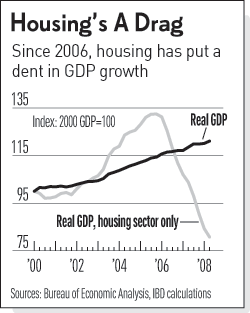
Fair enough. But we did our own calculations. The slowdown in the economy is mainly due to one thing: housing. We indexed overall GDP to housing GDP back to 2000.
issues082908.gif

As the chart shows, it's a very stark picture. We crunched even more numbers. Since 2006, the economy minus the ailing housing sector has grown at an average 3.3% rate. Add housing back in, and GDP growth has averaged just 2.4%. So housing's collapse has cost us roughly 1% of GDP.

Housing is still weak, with sales off 35% year over year and values depreciating at double-digit rates. Banks can't boost lending much, since they're writing off old loans and have to shrink capital. This will take time.

But listening to the media and the Democrats in Denver, you'd think the economy was in a depression. Well, it's not. In fact, we're modestly optimistic. By the end of this year, all the really bad year-to-year comparisons in growth will be over. Sales and prices will start to look more normal. And the panic will leave the market.

As noted, exports have supported the economy this year. To critics, a stronger dollar means export growth will slow. Maybe so. But falling oil prices mean our import tab will also drop.

Moreover, oil demand now is falling. The Energy Department recently reported a shocking statistic that got little attention: U.S. demand in June plummeted 1.17 million barrels a day from last year, and a spokesman said prices could fall below $100 a barrel due to rising output in the U.S., Brazil and Canada.

Other data also suggest grounds for optimism. Just this week, the Census Department reported median household income hit $50,233 in 2007, after inflation, a gain of 1.6% since 2001.

Despite the slowdown in growth, the number of people without health insurance fell one million last year, while the poverty rate was unchanged at 12.5% of the population. And believe it or not, the average unemployment and poverty rates under President Bush have been slightly lower than under President Clinton.

Sure, bad things can happen. But we don't have to will them into existence. As it stands, the much anticipated recession — thanks to Bush's tax cuts and timely Fed actions — might just be a no-show.

Posted by edelfenbein at 11:42 AM

August 28, 2008

My Boldest Prediction Yet

Write down this time and day, and note that I'm calling a bottom in Pakistan's stock market.

In other news, Pakistan has barred stocks from trading below yesterday's close.

One more prediction, this won't end well.

(Via: Birthday Boy Joseph Weisenthal).

Posted by edelfenbein at 10:22 AM

Latest Phony Concern: Delistings “Pinching” Exchanges

One of things I enjoy about the financial media is finding stories that are negative no matter what the outcome is. For example, you’re read a story about “red lining” and how banks are shutting out lower-income borrowers. Then a few years later, you’ll read a story about “predatory lending,” and how banks are taking advantage of lower-income borrowers. The completely contradict each other, but end results is always bad news. Or worse, it “raises concerns.” One day I hope to write a book, " How Media Alarmism is Killing Our Children."

If you want to be taken seriously as an economic analyst or policy maker, you need to spend much of your day being “worried” and/or “concerned.” You don’t have to do anything. Just say that this latest development “raises troubling questions.” (See Bernanke Warns.)

Probably the classic example is the worry of corporate consolidation and mega-mergers seamlessly turns into a worry about junk IPOs. I would think you can worry about one of these, but not both. Apparently the latest concern is a wave of stock delistings:

The combination of more delistings and fewer new listings has pinched the big U.S. exchange operators, as the financial meltdown topples some of their clients and spooks others.

Midway through this year, more companies than in previous years had been bumped from the Nasdaq Stock Market and, to a lesser extent, from the New York Stock Exchange because they failed to meet the minimum requirements.

Meanwhile, tumbling stock markets have brought the IPO market to a crawl, compounding the pain for Nasdaq OMX Group and NYSE Euronext, which derive up to 15 percent of their overall revenue from listing fees.

"It's a negative" for the exchanges, said Ed Ditmire, analyst at Fox-Pitt Kelton. "But it ebbs and flows with the economic cycle."

More Nasdaq-listed companies have been delisted for non-compliance so far this year than in either of the previous two years, according to Nasdaq data. Some 54 stocks were bumped as of Aug. 7, compared to 48 in all of last year and 52 in 2006.

At larger rival NYSE, data show 11 companies had been delisted due to non-compliance as of July 1. That compares to 21 delistings in all of last year and 14 in 2006.

Let me get this right: A growing wave of delistings is 11 for the first half of this year compared with 21 for all of last year?

Posted by edelfenbein at 10:08 AM

Q2 GDP Revised to 3.3%

The government just revised second-quarter GDP to 3.3% from the original 1.9%. That's a pretty hefty increase.

Record exports and the temporary stimulus from the tax rebates prevented the economy from stalling as housing slumped and companies cut expenditures. Consumer spending is now waning and slower growth abroad dims the outlook for foreign sales, signaling last quarter will be the year's highpoint.

"Outside of trade, the economy is considerably weaker," said Carl Riccadonna, an economist at Deutsche Bank Securities Inc. in New York. "When you look at the spending, it looks terrible for the second half of the year."

I'm not too interested in the debate of, "are we or are we not in a recession." Consider, however, a few facts.

Imports have now declined for three straight quarters, and four of the last five.

Fixed investment has declined for four straight quarters.

Residential investment has fallen for 10 straight quarters.
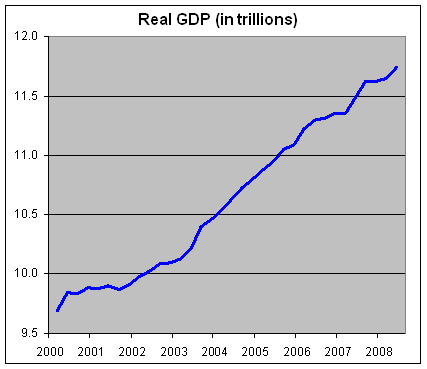
image708.png

Posted by edelfenbein at 9:30 AM

FDIC May Tap Treasury

The FDIC is designed to protect investors' deposits up to $100,000. The FDIC's fund currently has $45.2 billion which insures about $4.5 trillion.

Sooo...who protects the FDIC? If you said "the taxpayer," congratulations, you can move to the head of the class.

Federal Deposit Insurance Corp. Chairman Sheila Bair said Tuesday her agency might have to borrow money from the Treasury Department to see it through an expected wave of bank failures.

Ms. Bair said the borrowing could be needed to cover short-term cash-flow pressures caused by reimbursing depositors immediately after the failure of a bank. The borrowed money would be repaid once the assets of that failed bank are sold.

The last time the FDIC borrowed funds from Treasury came at the tail end of the savings-and-loan crisis in the early 1990s after thousands of banks were shuttered. That the agency is considering the option again, after the collapse of just nine banks this year, illustrates the concern among Washington regulators about the weakness of the U.S. banking system in the wake of the credit crisis.

"I would not rule out the possibility that at some point we may need to tap into [short-term] lines of credit with the Treasury for working capital, not to cover our losses, but just for short-term liquidity purposes," Ms. Bair said in an interview. Ms. Bair said such a scenario was unlikely in the "near term."

She said she did not expect the FDIC to take the more dramatic step of tapping a separate $30 billion credit line with Treasury, which has never been used.

The FDIC said Tuesday its "problem" list of banks at risk of failure had grown to 117 at the end of June, compared with 90 at the end of March.

The FDIC's deposit insurance fund reimburses depositors who lost money in a bank failure, typically up to $100,000. The fund's balance fell in the second quarter to $45.2 billion. That is just 1.01% of all insured deposits, low by historical standards.

Here's the key table in the FDIC's report.

Posted by edelfenbein at 8:37 AM

August 27, 2008

An Interest Rate What?

Posted by edelfenbein at 2:49 PM

Citigroup to Cut Costs

From Bloomberg:

Citigroup Inc., the biggest U.S. bank by assets, banned off-site meetings among investment- banking employees and cut back on color photocopying to reduce expenses as revenue declines.

Just to be clear, according to their most recent 10-Q, Citi has assets of $2.1 trillion.

Posted by edelfenbein at 1:20 PM

The Best Central Banker in the World Today

Imagine a country whose central bank responded to growing inflation by raising interest rates, strengthening the currency and trying to win investor confidence. This may be shocking to some U.S. investors, but proper monetary policy is still being practiced. Just not here in the United States. I’d give the award for Best Central Banker in the World Today to Mexico’s Guillermo Ortiz.

This is a story that truly ought to be better known. Mr. Ortiz has now been at the helm of the Mexican central bank for over ten years and despite many obstacles (consider that 70% of Mexicans don’t even use banks), he’s emerged as the anti-Greenspan. Mr. Ortiz previously served Finance Minister where he helped clean up the mess surrounding the peso devaluation in 1994.

What impresses me about Oritz, who earned has a Ph.D. from Stanford, is that he’s made it unequivocally clear that the Banco de Mexico (or Banxico) intends to fight inflation until its wins. In the last three months, the bank has raised rates three times. Interest rates now stand at 8.25%, an amazing 625 basis points higher than in the U.S. even though inflation rates are roughly similar.

Make no mistake; the Mexican economy has its share of problems. Growth is slowing and inflation is on the rise. Of course, much of this is understandable considering their raucous, hung-over neighbors to the north—nearly 80% of Mexico’s exports go to the U.S. Still, my money’s on Ortiz. He’s even had the chutzpah to criticize our monetary policy as being “very lax.” Don’t expect to hear anything like that from Senators McCain or Obama.

And what about that hopeless currency, the peso? Well, it’s on a roll this year. The peso is already up 7.5% for the year and earlier this month, it reached a six-year high. In my opinion, the rate gap between the U.S. and Mexico will only grow. The futures market seems certain that the Fed will hold steady for the rest of the year, but I think Banxico could very well raise rates again. Their next meeting is on September 19.

pseodollar.png

The most recent report for Mexican GDP showed that Q2 growth came in at 2.8%, which isn’t horrible but it was below expectations. The economy isn’t so fragile as to ward off monetary tightening. Retail sales are weak and the stock market is still hurting—the Bolsa is at a seven-month low. Of course, that comes on the heels of an enormous rally so some consolidation would be expected. Consider that shares of EWW, the Mexican ETF, more than quadrupled in five years.

image707.png

What’s really hurting the economy is that less money is being sent home from workers living abroad. And by abroad, you can probably guess what country I mean. Speaking of which, Ortiz also favors, sit down for this one, stricter immigration controls in the U.S. so Mexico can hold on to its workers. Ortiz said, “I think Mexico needs its people. It would be best to keep its people in Mexico, and it would give incentives for Mexico to create the jobs that are needed.” Increíble!

I’m guessing Ortiz has some sympathy for Hank Paulson. When the Mexican financial system imploded, Ortiz was called into to clean up the mess. Paulson certainly has a tough task, but look at what Ortiz was facing—inflation reached 52% and investment fell by one-fourth. Thing got so bad that the former president basically can’t show his face Mexico and he’s been exiled to Ireland. By contrast, Senor Greenspan now works at Pimco! Thanks to Ortiz, Mexico righted itself and paid back its bailout money to the United States. In fact, Uncle Sam made a half-billion dollar profit.

The thing about finance, public or private, is that it’s really an issue of establishing confidence. If investors think you’re serious, then they’ll invest with you. So far, Ortiz seems to winning the battle of establishing credibility. The yield on Mexico’s long-term benchmark bond recently fell to its lowest level since June 6.

Mexico is a country with many deep rooted economic problems, however, the country has taken many steps in the right direction. For example, the election of the pro-market government of Felipe Calderon (cue Larry Kudlow) is helping to bring long-overdue economic reforms like privatizing the oil industry. Unfortunately, Calderon supports some poorly considered ideas like price controls. Unlike the United States, the Mexican government seems to be serious about fiscal discipline. Their legislature...er, not so much. One issue in particular that Ortiz wants addressed is reducing the government’s fuel subsidies. Good luck with that one, but at least he’s trying. (Incidentally, Ortiz wants to reduce the subsidies even though he thinks that will increase inflation in the near-term.)

The government recently announced that its current account deficit widen to over $2 billion which came as a shock to economists who were expecting a shortfall of $750 million. The trade deficit declined but that was helped by the increase in oil prices. The Mexican economy faces several significant challenges ahead. Most importantly, inflation is simply too high. But I think Ortiz realizes the difficulties and his current policies will help Mexico be well-prepared for the future.

Posted by edelfenbein at 11:58 AM

August 26, 2008

Looking at China's Savings

John Hempton at Bronte Capital has a novel explanation for China’s stratospheric savings rate. He says it’s due to their one-child policy. In any pre-Industrial economy, you’re retirement savings plan was very simple, you had children. Now you can’t so to compensate, you save, save, save. Hempton’s reckons “that the average Chinese person is saving maybe 46 percent of their income”.

This is an issue for us in the West because, as the theory goes, all that savings needs to be invested somewhere. And there’s simply too much money lying around, sooner or later it will go into dumb areas. Today, we’re at the later part. Hempton writes:

My thesis - which will be expanded in future posts is that the brokers have become the intermediaries between this endless demand for products to save in (China, Petrodollars etc) and the endless willingness of the profligate in the West to spend. What they do is - through their trading, their securitisation and through other things they turn the complex financial instruments of the West (mostly but not entirely debt) into vanilla instruments that the Chinese and petrodollars want to buy.

In the Telegraph, Ambrose Evans-Pritchard notes a study by HSBC which claims that China is forcing its banks to buy dollars. In effect, the Chinese Fed is using its banking sector as a way to intervene in the currency markets.

Beijing has raised the reserve requirement for banks five times since March, quickening the pace with two half-point rises in late June.

This is having major spill-over effects into the currency markets because banks in China have been required over the last year to hold extra reserves in dollars rather than yuan. The latest moves have lifted the mandatory deposit from 15pc to 17.5pc of total lending since March.

"China has used the pretext of reserve requirement hikes to help slow yuan appreciation. We estimate that the PBOC [central bank] intervened by about $49.6bn in June," said Daniel Hui, the bank's Asia strategist.

Beijing has also slashed the amount of foreign debt banks operating in China can hold. The effect is to oblige the banks to become net buyers of dollars, halting the flow of foreign "hot money".

Posted by edelfenbein at 9:45 AM

How Investment Banks Can Cut Costs

From Andrew Ross Sorkin:

When Wall Street seeks to save money — “every dollar saved is a dollar made,” is the current catchphrase — it often turns to management consultants to help figure out which divisions should stay and which should go.

So McKinsey & Company published a helpful report last week on how investment banks can cut up to $2 billion in noncompensation costs. (We wouldn’t want to cut compensation, would we?)

“Initiatives to curb expenditures need not be extremely demoralizing to frontline employees,” McKinsey says, trying to find ways to save money without affecting the worker bees. So what does it recommend? Getting rid of the consultants. Yep, you read that correctly.

Interesting. When Google went public, it tried to cut cost by eliminating the investment banks.

Posted by edelfenbein at 9:13 AM

August 25, 2008

Tyler Cowen on the Economy

From Saturday's NYT:

Emerging from the current slowdown isn’t just a matter of political will or smart central banking. If the recipe for success requires smooth adjustment into new growth sectors, more savings from disposable income, cleaning up the housing mess, well-functioning energy markets, and more effective financial intermediation — all in the right combinations and in the right sequences — neither the government nor the Federal Reserve can control this process. The Fed can add regulatory and monetary clarity, but there isn’t any magic bullet. Beware of anyone who tells you there is.

The Japanese failed to break out of their recession quickly because they didn’t promptly close down or clean up their problem banks. So far, the Fed and other regulators show no signs of making this mistake; they have been vigilant in resolving crises as they occur. But that’s not enough to guarantee a successful transition. The American economy will be tested for its deftness — and the test will be difficult precisely because there isn’t a single enemy on which to focus.

HAVE you ever tried to undo a bunch of tangled wires or cords? If you don’t pull on the right wires in the right order, the mess becomes worse. If you pull too hard, the whole thing can break. But if your first pulls are good ones, the untangling becomes easier with each move.

That’s like our economy’s situation today. If we expect too much too quickly, we’ll make matters worse. But there is a way out of the mess, and it lies in our hands.

Be careful, and start pulling.

Posted by edelfenbein at 10:02 AM

Ben Stein Watch

Felix Salmon regularly skewers Ben Stein's incoherence in each week's New York Times. (For the record, Stein's the one who appears in the NYT, Felix writes on his blog). This week, Felix finds this sentence:

They walk in rows of three, each on a cellphone, not even talking to the people next to her.

You truly do not want to know the context. What caught Felix's eye is that, up until that point, no female had been referenced. The "next to her" just appeared out of nowhere, which leads Felix to conclude that no one at the Times bothers to read his columns.

My take is that there was a previous sentence that had been edited out which had referred to the female, and the following sentence hadn't been fixed. I have to think that the reason for the deletion and the female reference are related, but I could be wrong.

Posted by edelfenbein at 9:50 AM

Best Line of the Day

Paul Kedrosky finds this gem from a French banker in 1907:

The U.S. is a great financial nuisance.

The Panic of 1907 was pretty ugly for investors. Here's what I wrote last year on its 100th anniversary.

Posted by edelfenbein at 9:46 AM

August 22, 2008

The Weekend Is Here

Posted by edelfenbein at 5:27 PM

Gas Prices Around the World

Here's a cool map looking at gasoline prices around the world. I'm glad I don't live in Turkey ($11.17/gallon). On the other hand, I'm not about to move to Venezuela ($0.12 a gallon) either.

Posted by edelfenbein at 1:46 PM

Defending Shorts

Doug Kass has an excellent article in the FT defending shorts:

Yet short-sellers have served as financial watchdogs, as many of their warnings have been spot on. The delusional dotcom boom in the late 1990s brought Cassandra-like utterings from the short-selling cabal that proved insightful but were largely ignored. After the subsequent 75 per cent collapse of the Nasdaq, a bull market in corporate fraud emerged and short-sellers such as David Rocker, founder of Rocker Partners, highlighted accounting problems at companies such as Sunbeam, Tyco and Lernout & Hauspie. Kynikos’ Jim Chanos played a role in uncovering the largest fraud in history when his contrary-minded analysis warned of Enron’s accounting shenanigans – which were emulated (but ignored by investors) in the banks’ recent dalliance with structured investment vehicles.

Short sellers have done the work that governments won't and can't. It's absurd for governments to limit their opportunities. .

Posted by edelfenbein at 11:42 AM

Investors Pulling Out of Russia

In January 1980, the gold market peaked just a few days after the Soviets invaded Afghanistan. Now it looks like the commodities market has again peaked with a Russian incursion, this time into Georgia. In the short-term, it was a strategic victory for Putin, but the long-term might not be so kind. The BBC reports that investors are pulling out of Russia.

Russia has seen foreign reserves decline, a sign that the market is more nervous about investing in the region since the recent conflict in Georgia.

Central Bank figures show reserves were sharply down in the week ending 15 August, marking a fall of $16.4bn (£8.8bn) from $597.5bn a week earlier.

Tensions with the west have also been strained by Russia's objection to the US placing a missile defence in Poland. Georgia has urged the west to invest in the region as it seeks to rebuild.

According to the Financial Times, the latest drop in capital reserves is the largest "since comparable figures began" in 1998, though similar funds were taken out during the currency crisis.

Posted by edelfenbein at 10:10 AM

Quote of the Day

From Mr. Buffett:

"You always find out who's been swimming naked when the tide goes out. We found out that Wall Street has been kind of a nudist beach," said Buffett, who was called the world's richest person by Forbes magazine.

Posted by edelfenbein at 9:48 AM

August 19, 2008

Random Observation

Is it me or is everyday either a good day for commodities and commodity stocks and a rotten day for financials and value stocks, or an awful day for commodities and commodity stocks and a good day for financials and value stocks?

Posted by edelfenbein at 1:04 PM

Flashback from 1998: NYT: Commodities' Price Slide Victimizes Economies of Several Nations

On December 10, 1998, the price for oil reached a low of $10.72 a barrel. That was the lowest price since 1986, and it turns out, it was the beginning of a huge turnaround for the price of crude.

So the low prices were good news, right? Well, not exactly. The New York Times was able to find the downside: Market Place; Commodities' Price Slide Victimizes Economies of Several Nations:

Victimizes?

What worries analysts now is that the recent decline is a signal that prices will not turn around soon.

Matthew J. Sagers, the director of the energy service of Planecon, a consulting group specializing in the former Soviet Union and Eastern Europe, said the consensus on oil prices ''is that we are going to be here for several years.''

Mr. Brainard and other analysts argue that an extended period of lost economic growth and lower governmental revenues stemming from the drop in commodity prices will raise the pressure on many already troubled governments and economies. That could intensify investor concern and weaken currencies. To defend those currencies, central banks would have to raise their interest rates -- which would mean even slower growth.

The impact on Russia, for example, has been stark. The country's $87 billion in 1997 exports included $21.9 billion in oil, $16.4 billion in gas and $14 billion in metals -- about 60 percent of the total.

But the prices of every one of these commodities have fallen sharply and are still declining. The price of platinum, for which Russia is the second major supplier, has dropped almost 12 percent just since July. The price of oil plunged 36 percent -- from around $22 a barrel in October 1997 to around $14 in August -- and has fallen another 23 percent, to $10.72, since November.

At the time, Kofi Annan approved oil sales to Iraq for "humanitarian goods," which apparently including several palaces for Saddam. According to a CNN article from 1998:

But Benon Sevan, executive director of the program, turned down Iraq's request to improve its telecommunications system, saying Baghdad had not answered an October 30 letter requesting information on the subject.

Annan's endorsement also excluded $20 million to upgrade Iraq's banking system, a new item Baghdad had not previously discussed with the United Nations, according to a letter Sevan sent to Iraq's outgoing U.N. ambassador Nizar Hamdoon.

Mr. Sevan unfortunately couldn't be with us today. It turns out that according to the Volcker Report, he was taking cash bribes from Saddam.

Posted by edelfenbein at 11:39 AM

Medtronic Earns 72 Cents a Share

This morning, Medtronic (MDT) posted adjusted fiscal first-quarter earnings of 72 cents a share which topped Wall Street’s forecast of 69 cents a share. For last year’s Q1, the company earned an adjusted 62 cents a share, so that’s an impressive increase. Revenues rose 18.5% to $3.71 billion. Sales for its spinal biz rose 33%. Revenue outside the U.S. grew by 24% and accounted for nearly 40% of all revenue.

This is the latest is a string of good news for the company. A few weeks ago, the board increased the quarterly dividend by 50%. In May, the company said it expects earnings-per-share for 2009 to range between $2.94 and $3.02. After today’s report I wouldn’t be surprised to see that range revised higher. If Q2 earnings come in at 70 cents a share or better, than I think MDT should easily earn $3 this fiscal year.

Here's a look at MDT's sales and earnings for the past several quarters:

Quarter...........EPS.............Sales
Jul-01............$0.28...........$1,455.70
Oct-01...........$0.29...........$1,571.00
Jan-02...........$0.30...........$1,592.00
Apr-02...........$0.34...........$1,792.00
Jul-02............$0.32...........$1,713.90
Oct-02...........$0.34...........$1,891.00
Jan-03...........$0.35...........$1,912.50
Apr-03...........$0.40...........$2,148.00
Jul-03............$0.37...........$2,064.20
Oct-03...........$0.39...........$2,163.80
Jan-04...........$0.40...........$2,193.80
Apr-04...........$0.48...........$2,665.40
Jul-04............$0.43...........$2,346.10
Oct-04...........$0.44...........$2,399.80
Jan-05...........$0.46...........$2,530.70
Apr-05...........$0.53...........$2,778.00
Jul-05............$0.50...........$2,690.40
Oct-05...........$0.54...........$2,765.40
Jan-06...........$0.55...........$2,769.50
Apr-06...........$0.62...........$3,066.70
Jul-06............$0.55...........$2,897.00
Oct-06...........$0.59...........$3,075.00
Jan-07...........$0.61...........$3,048.00
Apr-07...........$0.66...........$3,280.00
Jul-07............$0.62...........$3.127.00
Oct-07...........$0.58...........$3,124.00
Jan-08...........$0.63...........$3,405.00
Apr-08...........$0.78...........$3,860.00
Jul-08............$0.72...........$3.706.00

Posted by edelfenbein at 9:54 AM

PPI Rises at Fastest Rate Since 1981

Ah, it seems like old times. Not only is the Cold War coming back, but today’s report on producer prices indicates that wholesale inflation is at its highest level in 27 years.

The PPI jumped 1.2% last month which is more than double what economists were expecting. Even if you strip out food and energy and just look at the “core rate” wholesale inflation still rose by 0.7% or more than three times the 0.2% expected by economists.

For July, wholesale energy prices jumped by 3.1 percent following a 6 percent gain in June. That increase reflected big jumps in the price of natural gas, home heating oil and liquefied petroleum gas, which offset a 0.2 percent dip in gasoline costs.

Food prices rose by 0.3 percent in July after a 1.5 percent surge in June. Beef prices jumped by 7.4 percent, the biggest increase in nearly four years. Milk prices shot up by 5 percent, the biggest gain in a year, while soft drink prices rose by 2.4 percent, the largest increase in four years.

Excluding energy and food, the 0.7 percent rise in core inflation reflected big gains in the prices of passenger cars and light trucks, pharmaceutical preparations and plastic products.

Naturally there’s a bit of a lag to these numbers and the dramatic sell-off in oil prices will most likely be seen in next month’s report.

Posted by edelfenbein at 9:29 AM

August 18, 2008

More Troubles on Wall Street

Part 1:

Part 2:

Part 3:

From Equity Private.

Posted by edelfenbein at 2:07 PM

From the Halls of Academia

Finally!

A New Value-Weighted Total Return Index for the Finnish Stock Market 1912-1969

Posted by edelfenbein at 1:50 PM

JNJ Hits New High

I really like the stock of Johnson & Johnson (JNJ). Few companies have been as stable long-term winners as JNJ. A few months ago, I said it was a good buy, especially under $60. Just recently, the shares finally took out their 2005 high. The company reported good earnings again last month. JNJ now sees 2008 EPS coming in at $4.45 to $4.50 which is almost certainly too low.

Here’s a look at JNJ’s stock (blue line, left scale) and earnings (gold line, right scale with EPS projection in red). The two lines are scaled at 16-to-1.

image706.png

Posted by edelfenbein at 1:11 PM

The Nasdaq Lauches for New Indexes

The Nasdaq has announced that it's launching four new indexes; biotech, coal, steel and precious metals.

If anyone needs me, I'll be shorting biotech, coal, steel and precious metals.

Posted by edelfenbein at 11:42 AM

The Plunge of Gold Continues

A few weeks ago, I wrote about the recent peak in gold prices and said that we're never quite sure if we're in a bubble until it's over. Perhaps one of the best signs that we're in a bubble is that people will refuse to acknowledge that we're in a bubble. If that's any indication, the commentors on my post at Seeking Alpha definitely should have clued us in that gold was headed for a big fall.

Bloomberg reports this morning:

Gold may fall for a sixth straight week, the longest slide in four years, as a strengthening dollar erodes the precious metal's appeal as an alternative investment.

Twelve of 21 traders, investors and analysts surveyed from Mumbai to Chicago on Aug. 14 and Aug. 15 advised selling gold, which last week fell to $792.10 an ounce in New York, capping an 8.4 percent drop for the week that was the biggest in 25 years. Eight respondents said to buy, and one was neutral.

Gold, priced in dollars, generally moves in the opposite direction of the U.S. currency. Gold is down as much as 25 percent from a record $1,033.90 reached on March 17. The last time the metal fell for six straight weeks was in May 2004.

If you have some time for a little cheap entertainment, this link will take you to the Yahoo Message board posts for Cisco’s stock on March 27, 2000. That was the highest day for the hottest stock of the era. These posters are so madly in love with their stock it’s almost funny. Absolutely no criticism is allowed. Just look at the posts. They have a religious intensity to them.

To scroll through the posts, just click on the > symbol right by the time stamp.

Posted by edelfenbein at 11:20 AM

A 400,000% Return

Floyd Norris asks, “Has a Penny Stock Become a Big Company?"

In my opinion, the short answer is no. If any company is serious about its business and its future, it has no business being listed on the pink sheets. Any real company has nothing to fear from full disclosure. Multimedia Kingpin Tim Sykes makes his living doing nothing but spotting phony pink sheet stocks that have no reason business outside of issuing daily press releases.

The longer answer, however, is that yes, a very smaller number of stocks that have fallen to less than $1 per share have gone on to become real companies.

In early 1985, Apco Argentina (APAGF) traded for as little as 12.5 cents (or an 1/8 back then). The stock has since split 4-for-1 (last November) so it was even less than that. It's now worth about $27 a share,

A better example is Mylan Labs (MYL). That stock was going for 75 cents a share in 1976. Since then it’s split 11 times (one 5-for-4, four 2-for-1 and six 3-for-2) for a total of 227.8125 for 1. Which means that adjusted for splits, the stock was going for less than one-third of a penny per share. Mylan is now going for $13.72 which is about half what it was five years ago. Still, that’s a nice 400,000% return from its low.

(H/T: Paul K.)

Posted by edelfenbein at 11:06 AM

August 14, 2008

Inflation at 17-Year High

Ugh.

Inflation reached a 17-year high last month, fueled by high gasoline and food prices, all but assuring that the Federal Reserve will keep interest rates at their current level for the time being.

Consumer prices were 5.6 percent higher last month than they were in July 2007, a brisker pace than economists had expected, the Labor Department said on Thursday.

That was the sharpest annual increase since January 1991, as Americans paid more for clothing, food, transportation and recreational products.

The news was distressing for investors and the stock markets initially fell on the report. The major exchanges recovered, however, and the Dow Jones industrials up more than 80 points in early afternoon trading. Investors returned to buying financial stocks, taking advantage of a sector that has fared poorly in recent sessions. The broader S.&P. 500-stock index was up 0.46 percent. Wal-Mart also reported a better-than-expected rise in quarterly profits, but the discount retail giant also issued a gloomy sales forecast for the rest of the year. In addition, crude oil prices continued to fall, dropping below $113 a barrel.

The overall Consumer Price Index, considered the benchmark gauge of domestic inflation, rose 0.8 percent in July. Economists had forecast a rise of half that rate. In June, prices rose 1.1 percent, the second highest monthly pace in 26 years.

image705.png

Posted by edelfenbein at 4:09 PM

August 13, 2008

Stat of the Day

From its peak in 1980, if the price of gold had kept pace with total return of the Wilshire 5000, today gold would be worth over $21,000 an ounce.

Posted by edelfenbein at 6:42 PM

August 12, 2008

When All the Small Things Includes Your Portfolio

He lost
It all
So screwed
he is
Oh no!
Must tour
A-gain
Ha Ha
Dumb Ass

Say it ain’t so
Where did it go
One Point Five Mil
See you in Court

Na, na, na, na…..

Posted by edelfenbein at 4:25 PM

A Very Short Post

I'd really like to buy T. Rowe Price (TROW) but I think it's about $10 too expensive here.

image704.png

Pretty sweet chart tho.

Posted by edelfenbein at 12:06 PM

Sysco's Earnings

In terms of relative performance, these have been great times for the Buy List. Yesterday, Sysco (SYY) added 4% on good earnings news. Typically, this is one of the most stable large-cap stocks on Wall Street. For Q2, Sysco earned 55 cents a share, three cents more than estimates. Last year, Sysco netted 49 cents a share so the company is growing well.

Posted by edelfenbein at 11:17 AM

Thank You NICK

I'm up 27% in three weeks since my last purchase of Nicholas Financial (NICK). It takes patience but the market is not efficient. The stock is still going for less than 80% of book.

Posted by edelfenbein at 10:43 AM

August 11, 2008

From the NYT Corrections

August 11, 2008

The Arts

A listing of credits on April 28, 1960, with a theater review of “West Side Story” on its return to the Winter Garden theater, misstated the surname of the actor who played Action. He is George Liker, not Johnson. (Mr. Liker, who hopes to audition for a role in a Broadway revival of the show planned for February, brought the error to The Times’s attention last month. )

Posted by edelfenbein at 10:54 AM

Gas Prices fall for 24 Straight Days

Supply and Demand continues to work its magic:

Retail gasoline prices have fallen for the 24th straight day, a AAA survey of gas station sales showed.

The national average price for a gallon of regular gas are down more than 7 percent from the record high of $4.114 on July 16, CNNMoney.com reported Sunday.

Even with gas prices falling, Friday's national average price is more than $1 higher than it was a year ago.

In Alaska, the state with the highest prices, drivers pay an average of $4.63 a gallon, the AAA study found. Oklahoma and Missouri have the lowest gas prices, at $3.58 a gallon.

Diesel, meanwhile, is up nearly 55 percent from last year's levels. The national average price for diesel fuel fell Sunday to $4.557 a gallon.

The AAA study is based on data from credit card swipes at 85,000 U.S. fuel stations.

Posted by edelfenbein at 10:45 AM

August 8, 2008

Citigroup Trader "Dooced"

Michael J. McCarthy aka "Large" has been fired from his job as a Citigroup trader for running his blog, Take A Report.

"This employee was terminated for behavior that violated the firm's code of conduct and policies," Citigroup spokeswoman Danielle Romero-Apsilos said. McCarthy, a vice president, declined to comment on his departure from the New York-based bank. Financial industry regulatory records show he's been at Citigroup for seven years, most recently trading shares of utility and power companies.

"It's a little over the top," said Barry Ritholtz, director of equity research for New York-based Fusion IQ, who has looked at the site and has his own financial blog at www.bigpicture.typepad.com. "I can see why a conservative bank is not going to be happy with it. It's funny as hell."

Posted by edelfenbein at 1:08 PM

August 7, 2008

My Buy List YTD

image703.png

Through today, the Buy List is down -10.39% while the S&P 500 is down -13.78%. Neither figure includes dividends. The daily volatility of the Buy List is 7.17% greater than the S&P 500.

Posted by edelfenbein at 10:47 PM

Analyst says Bed Bath & Beyond well positioned

From the AP:

An analyst said Thursday that Bed Bath & Beyond Inc. remains one of the "best operators" in its sector and will likely withstand the nation's economic downturn better than many of its competitors.

Oppenheimer & Co. analyst Vivian Ma told investors in a research note that the Union, N.J.-based specialty home retailer has no plans to cut back on reinvestments.

"We believe that (Bed Bath & Beyond) remains one of the best operators in the home goods space and should continue to navigate the challenging consumer environment better than the competition," Ma wrote.

The analyst added that the retailer remains "very focused on superior execution to drive share gains.

Posted by edelfenbein at 2:02 PM

August 6, 2008

Cramer on Jimmy Carter: "May He Rest in Peace"

Listen around the 4:25 mark.

For those of you who don't remember, Jimmy Carter is the guy who defeated Gerald Ford.

Via: WallBlog.)

Posted by edelfenbein at 7:15 PM

Feel Good News Story of the Day

Cancer survivor wins the CNBC Million Dollar Portfolio Challenge. Bonus points: He's a member of two tribute bands, one for Queen and another for Led Zeppelin.

About 10 weeks ago, a local man using the online name of CLASSICROCKER began e-mailing friends to update them on his participation in the CNBC.com Million Dollar Portfolio Challenge.

CLASSICROCKER, known in real life as Edward Burke, had positioned himself for a possible cash prize.

On Monday, CNBC made the official announcement -- Burke, 54, had won the $500,000 Grand Prize, edging out David Lesser, a mechanic from Kent, Wash., and approximately 254,000 other people.

"They kept us in the dark until the final announcement," said Burke, a 1974 graduate of Chambersburg Area Senior High School and current Shippensburg resident. "It was suspenseful, but it was easier to take because we both knew we were going to win a quarter of a million at the very least.

"My son, Chase, texted me and said he was crying tears of joy."

Posted by edelfenbein at 12:29 PM

Let's Play "Spot the Problem"

November 8, 2008

Morgan Stanley takes $3.7bn hit

December 20, 2007

$9.4 Billion Write-Down at Morgan Stanley

August 5, 2008

Treasury hires Morgan Stanley to analyze Fannie, Freddie

Posted by edelfenbein at 12:25 PM

Whole Foods Hits New Low

Whole Foods Market (WFMI) just reported a rotten quarter. The company's fiscal Q3 net dropped 31% to 24 cents a share. The Street was looking for 31 cents a share. The company also said that Q4 earnings will be 15 cents a share, which was far below the 27 cents Wall Street was expecting. The shares are down about 16% today and are now at a six-year low.

Nearly three years ago, I called out Whole Foods and its overpriced stock:

I’m a big fan of Whole Food Market (WFMI), but this stock is way, WAY over-priced. Last quarter, the company missed earnings by a penny a share. In the past few weeks, Wall Street has lowered this fiscal year’s consensus earnings estimate to $2.86 a share, and the stock is still trading at 53 times that. That’s almost as much as Google (GOOG)!

Look, I like organic kumquats as much as the next guy, but let’s be reasonable. Whole Foods’ earnings will probably grow by about 17%-20%. Not bad at all. The stock, however, is already up over 60% this year.

A stock can’t go up faster than its earnings indefinitely. At some point, something’s gotta give. That’s not finance, it’s physics. Right now, the stock is going up because it’s going up. The price and fundamentals have politely parted company. On Friday, shares of Whole Foods closed at another all-time high.

image702.png

Posted by edelfenbein at 12:00 PM

Oh Dear Lord

Icahn Hires Reporter to Write for His Blog

According to sources, Mr. Elfenbein described this as "wicked lame."

Posted by edelfenbein at 10:00 AM

Who Needs Diebold

Wonderful:

Yahoo has updated the results of recent voting by shareholders, revealing that support for the Internet firm's board is far weaker than it appeared.

Some 200 million votes were mistakenly cast in favor of the re-election of Yahoo chief executive Jerry Yang and board chairman Roy Bostock by an outside company used by a major stockholder.

A revised tally released on Tuesday shows Bostock got the least support, with 60.4 percent of votes in favor of his re-election instead of the 79.5 percent originally reported after the August 1 shareholders meeting.

Yang did not fare much better, winning 66.3 percent of the votes cast as opposed to the 85.6 percent figure in the miscount. Two other Yahoo board members were erroneously given the support of 100 million votes each.

Posted by edelfenbein at 9:57 AM

August 5, 2008

Inflation and the Markets

According to monthly data from Ibbotson Associates, all of the stock market’s inflation-adjusted gains have come when monthly inflation is below 3.5%.

From 1926 through 2007, there were 984 months. Of those 984 months, 436 months showed an annualized inflation increase of over 3.5%, while the other 548 came in less than 3.5%.

The combined increase of the 436 months with inflation greater than 3.5% is -1.25%. That’s over 36 years worth of data and it’s given investors an inflation-adjusted loss. However, the combined total of the 548 months with inflation under 3.5% is 27,957%. That’s quite a difference. Annualized, that works out to 13.14%.

Posted by edelfenbein at 2:24 PM

The Fed Chills

Still at 2% and still one dissent:

The Federal Open Market Committee decided today to keep its target for the federal funds rate at 2 percent.

Economic activity expanded in the second quarter, partly reflecting growth in consumer spending and exports. However, labor markets have softened further and financial markets remain under considerable stress. Tight credit conditions, the ongoing housing contraction, and elevated energy prices are likely to weigh on economic growth over the next few quarters. Over time, the substantial easing of monetary policy, combined with ongoing measures to foster market liquidity, should help to promote moderate economic growth.

Inflation has been high, spurred by the earlier increases in the prices of energy and some other commodities, and some indicators of inflation expectations have been elevated. The Committee expects inflation to moderate later this year and next year, but the inflation outlook remains highly uncertain.

Although downside risks to growth remain, the upside risks to inflation are also of significant concern to the Committee. The Committee will continue to monitor economic and financial developments and will act as needed to promote sustainable economic growth and price stability.

Voting for the FOMC monetary policy action were: Ben S. Bernanke, Chairman; Timothy F. Geithner, Vice Chairman; Elizabeth A. Duke; Donald L. Kohn; Randall S. Kroszner; Frederic S. Mishkin; Sandra Pianalto; Charles I. Plosser; Gary H. Stern; and Kevin M. Warsh. Voting against was Richard W. Fisher, who preferred an increase in the target for the federal funds rate at this meeting.

Posted by edelfenbein at 2:16 PM

Great Moments in Business: A Five-Act Play

November 14, 2006

Icahn Joins WCI Communities

March 13, 2007

Icahn to launch $22-per-share offer for WCI

April 6, 2007

WCI Board Rejects Icahn Bid

May 12, 2007

WCI Twists Icahn's Arm For More Cash

August 4, 2008

WCI files for Chapter 11

Posted by edelfenbein at 11:22 AM

The Law of Supply and Demand Finally Catches Up to Oil

It had to happen soon or later. The Law of Supply and Demand has finally caught up to the oil market. The price for a barrel of oil has plunged recently from over $147 to under $120. One of the major reasons for the decline is that consumers are changing their behavior. Irwin Kellner notes:

In March, the yearly decline was a bit over 3%. That was the biggest drop in miles driven since 1942. May's drop of nearly 4% over last year was the most ever, according to the Transportation Department

While significant, this drop in miles driven is only the beginning of what appears to be a prolonged reduction in gasoline consumption. Wait until the mix of vehicles on the road changes.

As you know, people are now shunning SUVs and pickup trucks in favor of small cars. The object, of course, is to improve fuel efficiency.

As these gas-guzzling behemoths are replaced by small cars, the average vehicle on the road will get better gas mileage, thus further reducing gasoline use even if miles driven levels off.
To this add a likely increase in the number of vehicles on the road that are hybrids, pure battery powered, use natural gas, hydrogen or solar power and you can see the potential for an even larger drop in gasoline consumption.

As for lifestyle changes, fewer people are traveling large distances on their vacations.

Restaurants report less dining out. And while it's not so easy to sell one's house these days to move closer to one's job, many are opting to work at home, while others are taking mass transit to work, bicycling, or even walking.

Posted by edelfenbein at 10:42 AM

Deconstructing the GDP Data

There’s an interesting debate going on regarding the latest GDP report. The government’s initial estimate for second-quarter GDP growth showed that the economy expanding by 1.9%. The part that has that pessimists laughing is that measly 1.1% number for inflation. Inflation, of course, as measured by the CPI is running at a much higher rate, and would most likely push GDP growth into negative territory.

The issue centers around imports prices. Brian Westbury writes:

If import prices are added back into inflation, then the total dollar volume of imports must be added back into nominal GDP as well. This is the only way to compare apples to apples. Adding back imports pushes nominal GDP growth to 5.5% at an annual rate in Q2. Then, using the 4% inflation data (that includes import prices) means real GDP growth was still positive by 1.5%, or so.

A second issue to think about is that unlike the Consumer Price Index (CPI) – which attempts to measure changes in the cost of the things we buy – GDP inflation is designed to measure changes in the prices of the things we produce, regardless of whether the purchasers are foreign or domestic. Due to oil, prices for the items Americans buy have been increasing much more rapidly than the items they produce. As a result, GDP inflation looks artificially low, when in reality it is not comparable to the CPI.

Posted by edelfenbein at 9:34 AM

August 4, 2008

Bail Out the Oil Companies

My fellow Americans, the time for action is at hand. In less than three months, we’ve witnessed horrendous losses for major oil stocks. This is deeply destabilizing for the entire economy. We need—no, we insist that the government step in and protect shareholders from these losses. Personally, I blame short-sellers and rumor mongers.

Just look at some of these losses.

Stock..............................May 20...................August 4.............Loss
ExxonMobil (XOM)............$94.56.................$76.60..............-19.0%
Occidental Pete (OXY)......$97.85.................$74.23..............-24.1%
ConocoPhillips (COP)........$93.55.................$79.45..............-15.1%
Chevron (CVX).................$103.09.................$82.80..............-19.7%

Hey, they did it for Bear Stearns plus Phonie and Fraudie, why not the oil stocks? Will someone please think of the children!

Posted by edelfenbein at 4:11 PM

Trade Debate

This link shows a trade “debate” CNBC just had between Jagdish Bhagwati and Naomi Klein.

Bhagwati is one of the most distinguished professor on trade in the entire world. He’s written about 38 billion books and articles, and has a roomful of awards and honors. (Although CNBC has a little trouble spelling his name.)

Naomi Klein, by contrast, is a complete moron.

For some background, here’s the NYT article they're discussing, and here’s Jonathan Chait eviscerating Klein.

Posted by edelfenbein at 3:34 PM

"Most Americans have not experienced any significant decline in the value of their homes -- nor are they likely to."

You know how the housing market is crushing everyone across the land? These guys say it’s really not that bad:

We conclude that declines in house prices are highly likely to remain small. Our analysis reveals, unsurprisingly, that foreclosures and home prices have negative effects on each other over time, but this does not imply a vicious cycle of collapsing prices. Our models predict that as foreclosures continue to climb in many states, house prices will remain flat or decline in those states -- but will not collapse.

One reason for this is that the effect of foreclosure shocks on house prices is small. Furthermore, other fundamental factors (such as employment growth and a slowing of the growth of the housing supply over the past year and a half) will cushion the impact of foreclosures.

We constructed several forecasting models. Even under an extreme worst-case scenario for foreclosures, our conclusion was that U.S. house prices just aren't going to fall by very much in the next two years. In our worst-case scenario, the average cumulative decline is about 5 percent, and only 12 states experience declines greater than 6 percent by the end of 2009.

They criticize the Case-Schiller data as being skewed toward poor-performing areas, and that it’s weighted by value which also gives greater say to overpriced homes.

Posted by edelfenbein at 11:42 AM

Sentence of the Day

From Bloomberg:

Standard & Poor's analysts questioned their own ratings of mortgage-related debt products and said they were overworked as the number of deals increased, the Wall Street Journal reported, citing a draft version of a U.S. Securities & Exchange Commission report.

In one e-mail, an unidentified S&P analytical staffer wrote that a mortgage or structured-finance deal was "ridiculous" and "we should not be rating it," the Journal said, citing the 38-page draft SEC report.

A colleague replied, "we rate every deal," the newspaper said, citing the report. "It could be structured by cows and we would rate it," the colleague wrote, the Journal said.

I'd really like to see an email from folks who structured a deal in reference to the rating agencies.

Posted by edelfenbein at 11:29 AM

How are those Stimulus Checks Doing?

Good news, thanks to those government stimulus checks, consumer spending increased by 0.6% in June!

Oh, the downside is that inflation increased by 0.8%.

The Federal Reserve meets again tomorrow, and no change in rates is expected, although I wouldn't mind seeing rates climb 50 points from here.

Posted by edelfenbein at 10:01 AM

Casinos and Luck

Every time I’m in a casino, I need to remind myself that some gaming stocks have been extraordinary performers over the long haul. There’s a reason why they’re so profitable. Thanks to the laws of probability, a game that’s even slightly in the house’s favor can be very lucrative. Still, I was shocked to run across this:

Casino Blames Income Drop On Gamblers' Luck

UNCASVILLE, Conn. -- Mohegan Sun officials said the casino's net income in the third quarter dropped 89 percent compared with the same period last year, and they're placing some of the blame on gamblers' extraordinary luck.

The Mohegan Tribal Gaming Authority reported net income of $5 million Thursday for the three months ending June 30.

Mitchell Etess, Mohegan Sun's president and chief executive officer, said the casino had an extremely long streak of bad luck.

Gamblers played about $611 million at table games during the quarter, a 6.4 percent increase. The casino kept about 11.6 percent of that gambling money, nearly 5 percent less than it did during last year's quarter.

Table game revenues dropped more than 25 percent to $75.3 million in the third quarter from the year-ago period.

Unless there’s more to this story, I don’t see how it’s possible that a casino can have a run of bad luck. The only explanation I can think of is that there have been several very large bets that have gone the wrong way. Outside that, with a sample size that large, the house should barely see any fluctuation in its take. If I were the casino, I’d be keeping a closer eye on its dealers.

Posted by edelfenbein at 9:47 AM

August 1, 2008

P/E Ratios and Inflation

One of the most basic rules for valuing the stock market is that the overall P/E Ratio should be equal to 20 minus the inflation rate. I was curious to see how good a measure of the market this is. Given how simple it is, it’s not too bad.

Here’s a look at where the rule would have valued the S&P 500 compared with its actual value.

image701.png


The trouble spots are when there’s serious deflation. Still, I wouldn’t recommend using this as a market timing device. The average error is about 10%.

According to the latest numbers, the S&P 500 should be at 1,092.

Posted by edelfenbein at 10:15 AM

spacer
bottom of page image