Crossing Wall Street: Your Guide to Financial Success, Hosted by Eddy Elfenbein
spacer About Buy List FAQ Contact Links Home
spacer

« August 2007 | Main | October 2007 »

September 28, 2007

West Side Story at 50

West Side Story opened 50 years ago this week.

Posted by edelfenbein at 7:36 PM

Bed Bath & Beyond's Earnings

I didn't have a chance to write about this before but Bed Bath & Beyond (BBBY) earned 55 cents a share for its fiscal second quarter.

Here are the earnings results going back a few years:

Quarter Sales Gross Profit Operating Profit Net Profit EPS
May-99$356,633$146,214$28,015$17,883$0.06
Aug-99$451,715$185,570$53,580$33,247$0.12
Nov-99$480,145$196,784$50,607$31,707$0.11
Feb-00$569,012$238,233$77,138$48,392$0.17
May-00$459,163$187,293$36,339$23,364$0.08
Aug-00$589,381$241,284$70,009$43,578$0.15
Nov-00$602,004$246,080$64,592$40,665$0.14
Feb-01$746,107$311,802$101,898$64,315$0.22
May-01$575,833$234,959$45,602$30,007$0.10
Aug-01$713,636$291,342$84,672$53,954$0.18
Nov-01$759,438$311,030$83,749$52,964$0.18
Feb-02$879,055$370,235$132,077$82,674$0.28
May-02$776,798$318,362$72,701$46,299$0.15
Aug-02$903,044$370,335$119,687$75,459$0.25
Nov-02$936,030$386,224$119,228$75,112$0.25
Feb-03$1,049,292$443,626$168,441$105,309$0.35
May-03$893,868$367,180$90,450$57,508$0.19
Aug-03$1,111,445$459,145$155,867$97,208$0.32
Nov-03$1,174,740$486,987$161,459$100,506$0.33
Feb-04$1,297,928$563,352$231,567$144,248$0.47
May-04$1,100,917$456,774$128,707$82,049$0.27
Aug-04$1,273,960$530,829$189,108$120,008$0.39
Nov-04$1,305,155$548,152$190,978$121,927$0.40
Feb-05$1,467,646$650,546$283,621$180,980$0.59
May-05$1,244,421$520,781$150,884$98,903$0.33
Aug-05$1,431,182$601,784$217,877$141,402$0.47
Nov-05$1,448,680$615,363$205,493$134,620$0.45
Feb-06$1,685,279$747,820$304,917$197,922$0.67
May-06$1,395,963$590,098$148,750$100,431$0.35
Aug-06$1,607,239$678,249$219,622$145,535$0.51
Nov-06$1,619,240$704,073$211,134$142,436$0.50
Feb-07$1,994,987$862,982$309,895$205,842$0.72
May-07$1,553,293$646,109$154,391$104,647 $0.38
Aug-07$1,767,716$732,158$211,037$147,008 $0.55

Posted by edelfenbein at 12:55 PM

Stocks and Bonds Unite

Here’s an unusual recent development.

From July 3 to September 19, the stock and bond markets moved in opposite directions 80% of the time (I’m using the SPX & TLT).

But in the six trading days since, they’ve moved in different directions just once.

Obviously, it’s too early to read any major significance into this, but it’s something worth watching. There’s also the question of what the consequences are.

If the stock and bond markets are indeed, converging, I’m inclined to think it’s a healthy sign for both markets.

Posted by edelfenbein at 10:29 AM

Paul Kedrosky on Wall Strip

Paul Kedrosky runs Infectious Greed, one of my favorite blogs. Here he is on Wall Strip.

Posted by edelfenbein at 9:23 AM

September 27, 2007

How to Make a lot of Money in Five Easy Steps

Step #1: Sell everything you own. Sell it all. Stocks, bonds, real estate. eBay your couch, you dog. Everything.

Step #2: Then convert it all into pre-1982 copper pennies.

Step #3: Meltdown the pennies.

Step #4: Sell the copper.

Step #5: Now use your proceeds to buy back all the stuff you sold. You’ll have more than enough left over.

The material in a pre-1982 penny is currently worth about 2-1/2 cents.

Update: It's not exactly legal.

Posted by edelfenbein at 7:04 AM

September 26, 2007

Integrity Boosts Returns

Hmmm.

People know that integrity will help them in the business world. It can also boost their investment results. That's the finding of a recent survey of advisers at Ameriprise Financial Services. The study sought to find out the impact of various adviser traits on their investment results.

It studied 12 emotional and moral competencies, such as client service and self-confidence.

The results showed that the adviser's level of integrity played the biggest part in posting strong investment returns.

"Most people we deal with are high performers," said Rick Aberman, a founding partner of consulting firm Lennick Aberman Group, which like Ameriprise is based in Minneapolis and assisted with the survey. "We wanted to look at what differentiated those who are successful from those who are really successful."

Ameriprise paid for the study. It sought to find out whether emotional competency and integrity led to better performance, says Kris Petersen, the firm's general manager of financial planning and advice.

"I assumed the results would be better (for those who had more integrity), but not by as much as it was," she said.

Integrity showed up in advisers' ability to act the way they believe and to do what they say they will, Aberman says.

During my career, I've worked for three different brokerage firms and there I met some of the most dishonest people I've ever met in my life.

Posted by edelfenbein at 10:28 AM

Biomet Trades No More

Biomet was taken off the market yesterday for $46 a share. Here's a look at the stock's amazing run. In 23 years, the stock went up by more than 200-fold.
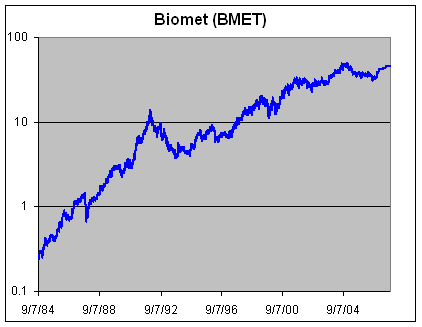
image530.png

I have to do a little housekeeping for my Buy List. This will be a dull post, but since we now know how important integrity is to our returns, I want to be as thorough as possible.

I’ll go over the rules again. At the start of each year, I pick 20 stocks for the Buy List. I’m not allowed to make any changes during the entire year. I assume a portfolio of $1 million, with $50,000 invested in each position.

For track record purposes, I’m going to take the Biomet proceeds and invest them equally in the 19 other stocks. I thought about keeping the proceeds in cash until the end of the year, but that doesn’t seem right.

At the start of the year, the Buy List had 1211.5338 shares of Biomet at $41.27. With the $46 buy-out price, that gives us a total of $55,730.5548. Divided 19 ways, that means we invest $2,933.1871 in each stock.

Here’s how I calculated the new number of shares:

Stock........9/25 Close........New Shares.......Starting Shares........New Total
AFL.............$55.94.............52.4345.............1086.9565.............1139.3910
APH............$39.22.............74.7880.............1610.8248.............1685.6128
BBBY...........$33.20.............88.3490.............1312.3360.............1400.6850
DCI.............$41.52.............70.6452.............1440.5071.............1511.1523
DHR............$83.82.............34.9939...............690.2264..............725.2203
FDS.............$66.10.............44.3750...............885.2691..............929.6441
FIC..............$36.11.............81.2292.............1230.0123.............1311.2415
FISV.............$50.46.............58.1290..............953.8344.............1011.9634
GGG.............$38.10.............76.9865............1261.9889.............1338.9754
HOG.............$46.51.............63.0657.............709.5218...............772.5875
JOSB.............$35.08.............83.6142...........1703.5775.............1787.1917
MDT..............$56.26.............52.1363.............934.4048...............986.5411
NICK.............$8.93.............328.4644............4237.2881.............4565.7525
RESP.............$48.74............60.1803.............1324.5033.............1384.6836
SEIC.............$25.92...........113.1631.............1678.9792.............1792.1423
SYY..............$34.70.............84.5299.............1360.1741.............1444.7040
UNH.............$49.48.............59.2803..............930.5788...............989.8591
VAR..............$39.09.............75.0368.............1051.0826.............1126.1194
BER..............$28.99............101.1793............1448.8554.............1550.0347

Posted by edelfenbein at 9:58 AM

The Dow By Each Day of the Week

Here's how the Dow Industrials have performed by each day of the week going back to 1896.
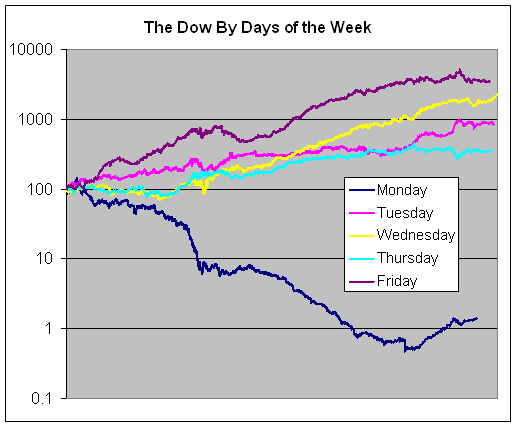
image532.png

Note that the lines aren't exactly lined up because there aren't the same number of trading days for each day.

Yuck, that Monday line is horrible. In fact, the Dow is down 58% for Monday, Tuesday and Thursday combined. So much Efficient Market Theory! To be fair, Monday has recovered a lot since 1987.

The big winner is Friday, but Wednesday has slowly closed the gap over the past few decades. And as I’ve written before, Wednesday has been the big winner of the past few years. In fact, all of the market’s gain has come on Wednesday.

Here are the average returns for each day:
Monday..............-0.0784%
Tuesday..............0.0379%
Wednesday.........0.0550%
Thursday.............0.0220%
Friday..................0.0634%

Here are the standard deviations:

Monday..............1.3849%
Tuesday..............1.0616%
Wednesday.........1.1106%
Thursday.............1.0350%
Friday..................1.0536%

Posted by edelfenbein at 9:31 AM

Wall Strip on United Industrial


Posted by edelfenbein at 9:07 AM

September 25, 2007

Smithtown Bancorp (SMTB)

Here's a small one. Check out these numbers for Smithtown Bancorp (SMTB).

Date EPS
1997 0.29
1998 0.31
1999 0.4
2000 0.47
2001 0.59
2002 0.79
2003 0.92
2004 1.02
2005 1.13
2006 1.43

The bank earned 73 cents a share for the first six months of this year.

Posted by edelfenbein at 3:04 PM

The Implied Electability Contract

One of the things I find fascinating about finance is how you can use markets for two items to create an “implied market” for a third. I've written about this before here, here and here. This idea is at the root of all the complex financial instruments that caused problems for so many hedge funds recently.

I’ll give you a good example I recently discovered. At InTrade.com, the site where you can trade futures on real world events, you can buy contracts on which candidate will win his or her party’s nomination next year. There’s a separate contract for which candidate will win the presidency.

So, if you divide the former by the latter, you get an “electability” contract. For example, according to recent prices, Rudy Giuliani has a 34.65% chance (I'm using the mid-point of the bid/ask spread) of getting the GOP nomination and a 15.95% of winning the presidency. So the market believes that if he gets the nomination, he has a 46.03% chance of winning (15.95% divided by 34.65%).

(The only minor flaw is that could include a candidate winning but not getting the nomination, however, I’m content with dismissing that possibility as beyond remote.)

What’s interesting is electability in the general election can have little impact on how well a candidate does in the primaries. Some people, myself included, think that Ronald Reagan would have had a better chance of beating Jimmy Carter in 1976 instead of Gerald Ford, even though Ford beat Reagan for the nomination.

I should add that I don’t place a great deal of faith in these real world futures markets. I simply see them as fun games to enjoy, but not to take too seriously. Also, the markets aren’t very liquid. In the following table I took the mid-point of each contract’s bid/ask spread. A minor change could have a big impact on the smaller-priced contracts.

Having said that, here’s a look at some candidate and the market’s take on their electability.

Candidate………To Get Nomination……To Win…......….Electability
Giuliani........................34.65...................15.95..................46.03
Romney.......................22.95...................8.85....................38.56
Thompson...................24.85....................9.60....................38.63
Paul..............................5.50....................1.95....................35.45
McCain.........................4.65.................... 2.35....................50.54
Hillary..........................67.05...................45.25..................67.49
Obama........................16.35....................8.25...................50.46
Edwards.......................6.95....................3.75....................53.96
Gore.............................8.05....................5.25....................65.21

Posted by edelfenbein at 10:59 AM

Shiller's Real Track Record

At Deal Breaker, Bess Levin highlights Alan Greenspan’s predictive abilities. In the linked NY Post article, I was left speechless by Terry Keenan’s touting of Robert Shiller’s track record.

No wonder the average homeowner is confused. That's why when I want to really know about the real state of the real estate market, I want to hear from someone who has been predicting this whole debacle for years now - a spot-on observer like Robert Shiller of Yale University.

Shiller is in no need of reputation repair. Not only did he warn of the housing mess, he also called the Internet bubble with remarkable precision in his book "Irrational Exuberance."

Sorry Terry, but Shiller hasn’t been spot on—he’s been way off the mark. Shiller is a perma-bear and investors who followed his advice lost out in a big way. In the last five years, the S&P 500 has doubled. Shiller missed that and every other rally. He was a bear long before the market nose-dived and he’s continued to be a bear ever since.

For some reason, there seems to be a strong bias to celebrate people who warn of market crashes. Perhaps it’s more dramatic. If you’re always warnings of a market crash, guess what? Sooner or later you’re going to be right! You're suddenly a wise market observer. No matter what you say after, your reputation can live off that forever. The people who make the undramatic prediction “no, don’t worry, everything’s ok” rarely get credit for being right.

Posted by edelfenbein at 10:09 AM

FactSet Follow-Up

About a month ago, I highlighted FactSet Research Systems (FDS) as a stock worth watching. The stock is up 13% since then.

I wanted to follow up as several readers asked if recent hedge fund explosions were curtailing FactSet’s business. Good question. Earnings are out today and the short answer is no. For the quarter, FactSet had EPS growth of 30% and revenue growth of 23%.

The CEO said: “Demand for FactSet’s services continued unabated. Users rose to 35,000, up from 33,300 at the beginning of the quarter. Client count was 1,953 as of August 31, a net increase of 39 clients during the quarter.”


Posted by edelfenbein at 9:40 AM

September 24, 2007

Earnings Preview: Bed Bath & Beyond

From the AP:

Home accessories retailer Bed Bath & Beyond Inc. reports earnings for the fiscal second quarter on Wednesday. The following is a summary of key developments and analyst opinion related to the period.

OVERVIEW: Home furnishings and accessories retailers are being pressured as the housing market sags, and consumers curb discretionary spending due to widening credit problems and high energy costs.

Bed Bath & Beyond Inc. is no exception. In June, the Union, N.J., company said its full-year profit would miss analyst expectations due to uncertain economic trends.

BY THE NUMBERS: Analysts polled by Thomson Financial expect a profit for the fiscal second quarter of 52 cents per share on revenue of $1.77 billion.

ANALYST TAKE: Bear Stearns analyst Christopher Horvers said in a note to investors on Monday that he remains cautious on the sector.

"Home furnishings remains one of the most challenging spaces in retail given the difficulties in housing, the fragmentation of the market, the discretionary nature of the products and the inventory build that has occurred across the retail landscape," he wrote.

He said he believes Bed Bath & Beyond will continue to "encounter near-term headwinds" and said he expects a few more quarters of difficult trends.

For the quarter, he expects its gross margin to fall less than 1 percent to 41.4 percent of sales, driven by an increase in inventory acquisitions costs, a shift in merchandise mix and a heightened promotional environment.

WHATS AHEAD: In a note to investors on Monday, Deutsche Bank North America analyst Mike Baker said he is "concerned" about analyst estimates for fiscal 2008 in the home furnishings sector overall, including Bed Bath & Beyond. Analysts polled by Thomson Financial expect, on average, a profit of $2.47 per share.

"The company will not give its 2008 guidance until December, but at that time, we would not be surprised if BBBY guides to a number below the current consensus," Baker wrote.

A profit of $2.47 per share in fiscal 2008 implies a same-store sales improvement of 3 percent and a slight increase in operating margins, Baker said.

"But, with our concerns regarding high inventories industry wide, demand environment would need to improve considerably over the next year to drive that kind of recovery," Baker wrote. "The recent Fed easing could help us get there, but that's not without risk, in our view."

The Federal Reserve approved a half-point reduction in interest rates on Thursday, in an effort to ease concern about the economy.

STOCK PERFORMANCE: Shares fell nearly 15 percent during the quarter.

Posted by edelfenbein at 4:30 PM

The Presidential Election Cycle

Out of boredom, this weekend I looked at all the Dow daily closings for the last 111 years (about 28,000 points of data) for a closer examination of the Presidential Election Cycle’s impact on stock prices. (What the hell was I thinking?) I did this before, but that only for the data from 1930 to mid-2006. This time, I looked at the every day from 1896 to last Friday.

I don’t put much faith in these types of trading rules, but there are some interesting results. Historically, the Dow has gained an average of 24.1% from September 30 of the mid-term election year to September 6 of the pre-election year, which we recently passed.
This means that nearly two-thirds of the Dow’s four-year gain (24.1% of 36.7%) comes in less than one-quarter of the time. That’s a pretty stunning stat.

After September 6 of the pre-election year, the Dow has historically pulled back 5.2% to May 29 of the election year. After that, it puts on a nice 23.2% climb to August 3 of the post election year. Then trouble starts. After September 3, the Dow then pulls back 5.6% and we’re back at our starting point, September 30 of the mid-term election year.

image529.png

Also, Leap Day is a positive day for the Dow, up an average of 0.1256%.

Posted by edelfenbein at 2:35 PM

Looking at Long-Term Credit Spreads

image528.png

If you’re confused by the credit crunch that happened last summer, here’s a good graph showing you some of the details. This chart shows the spread between Moody’s AAA Corporate yield index and the 10-year Treasury yield.

Since lending to the government is pretty low risk, they own the printing press after all, the lower the spread signifies greater confidence the free market has in corporations paying back their loans. When the difference widens, that signifies that investors have become much more afraid of loaning to corporations. In other words, they’ve become more afraid of taking risks.

In mid-July, the spread was around 70 basis points, which was close to some of the lowest levels in the past 15 years. Then, very suddenly, the spread exploded to over 120 basis points in less than one month.

While the spread is still wide compared with last summer, it’s still moderate compared with the long-term. Consider that after 9/11, it ballooned to over 260 basis points. Looking at last ten years, the current spread is within the lowest 37th percentile.

Posted by edelfenbein at 10:06 AM

Playmate of the Year Talks Investing

Posted by edelfenbein at 8:45 AM

A Lesson on Data Mining

Here’s a cute stat I saw over at Motley Fool. Cal Tech professor David Leinweber crunched the numbers and found that the singe-best predictor of stock prices is butter production in Bangladesh. “When butter production was up 1%, the S&P 500 was up 2% the next year. Conversely, if butter production was down 10%, you could predict the S&P 500 would be down 20%.”

Coincidence? Well, yes. But this isn’t too far from the kind of research that’s been driving many hedge funds.

Posted by edelfenbein at 8:42 AM

September 21, 2007

Beware the Emerging Hegemonic Canadian Superpower

For the first time in three decades, the loonie reaches parity.

Posted by edelfenbein at 3:14 PM

Civics Quiz

I pride myself on being a civics geek. I got 58 out of 60 on this quiz. (I missed #36 and #58.)

How did you do?

Posted by edelfenbein at 2:29 PM

The Fed's Irresponsible Move

Here's a dissenting view from Vitaliy N. Katsenelson:

I've seen this movie before, and it doesn't end pretty. That's what I thought on Sept. 18 when Federal Reserve Chairman Ben Bernanke took the road so often traveled by his predecessor, Alan Greenspan, and threw the financial markets a sop in the form of a big cut in interest rates. It was clearly what the markets wanted, as the immediate 336-point jump in the stock market confirmed. But popular decisions are not always the right decisions. (Just consider Greenspan's popular 2001 interest rate cuts, which actually caused the current housing bubble.)


Indeed, at the core of today's credit mess—whether in housing or the now battered markets for commercial paper—lies a glut of global liquidity. That has dramatically altered our perception of risk and fueled an unwillingness to accept traditional credit limits. If a homeowner couldn't qualify for a conventional mortgage, brokers were more than happy to offer an exotic loan the borrower could never realistically pay off. If a loan was too risky to be sold as investment-grade, investment banks could always concoct elaborate bundles of good and toxic credits that (supposedly) eliminated the risk.

Nowhere was this disregard of financial reality more apparent—or damaging—than in housing. The housing bubble was fueled by many years of low interest rates, which eventually priced many people out of their dream homes. But instead of settling for less or renting, people pursued their American dream (the house with a white picket fence, 2.7 kids, and 1.2 dogs) with a vengeance, taking out adjustable-rate, interest-only—or even worse, negative-amortization loans.

Posted by edelfenbein at 2:20 PM

Wall Street Turns 20

douglas_gordon_gekko.03.jpg

The iconic movie turns 20.

Since its release in December, 1987, "Wall Street" has been required viewing for anyone working in finance and a standard way of framing the go-go '80s of junk bonds and power ties - an era that some say has returned during the recent private equity-led mergers and acquisitions boom.

With a twentieth-anniversary DVD released on September 18 and a sequel currently in development, "Wall Street" is again a topic of conversation.

The film is best-known for its lasting character, Gordon Gekko, played by Michael Douglas, who netted an Academy Award for Best Actor for the role. And its most famous line -"Greed, for lack of a better word, is good," typically shortened to just "Greed is good" - is a favorite of headline writers and Wall Streeters alike.

Here’s an interesting tidbit about the famous “greed is good” line. The original source comes from a speech by Ivan Boesky, but it was hardly in the form of macho Nietzschean posturing. What Boesky said was “Greed is all right; by the way, I think greed is healthy. You can be greedy and still feel good about yourself.”

Feel good about yourself? It’s interesting that he framed it terms of self-image, as if that’s the most important standard. He’s being more Oprah than Michael Milken. The iconic statement from the 1980s is more closely related to the self-absorption of the 1990s.

Posted by edelfenbein at 12:54 PM

Questions for Greenspan

Caroline Baum has some questions for Alan Greenspan. Here are a few:

4. In that same vein, you write you were "struck by how relatively easy it was to bring inflation down." When you assumed the Fed chairmanship in August 1987, the consumer price index was rising at an annual rate of 4.3 percent. In January 2006, the month you left, the CPI was rising 4 percent.

You inherited a core CPI, which excludes food and energy, of 4.2 percent and cut it in half. That computes to a decline of 0.1 percentage point a year. If lowering inflation was such a chip shot, why don't you have more to show for your effort?

5. When you were Fed chairman, you wondered out loud about "irrational exuberance" in the stock market, even though Bob Rubin, whom you call one of your "foxhole buddies" (the other was Larry Summers), said such comments were inappropriate for a government official.

When Leslie Stahl asked you about your personal investments, you refused to comment on the stock market. Aren't you confusing your role as a public servant and private citizen?

6. You say it's improper for a president to comment on monetary policy, yet you actively tried to influence fiscal policy. You told Leslie Stahl you were an "economic consultant" to Bill Clinton, that you are "very knowledgeable about lots of different subjects." And no one else is?

You told Al Hunt you "give advice because they ask me." Your successor, Ben Bernanke, has made a point of not offering pronouncements on fiscal policy. What part of "no comment" don't you understand?

Posted by edelfenbein at 10:28 AM

September 20, 2007

Cyclical Divergence

Merrill Lynch tracks two cyclical indexes, one for Early Cyclicals (^XE) and one for Late Cyclicals (^XT). The Earlies are mostly big box retailers like Wal-Mart and Lowe’s while the Lates are your classic Johnny Lunch Bucket stocks like U.S. Steel.

For about four years now, the Lates have clobbered the Earlies. Yet here’s the interesting part: There’s an especially large divergence today. The Early Cyclicals are down about 2% while the Late Cyclicals are basically flat.

Posted by edelfenbein at 2:54 PM

A Tale of Two Banks

Profits at Goldman Sachs (GS) were up 79%. The company earned $6.13 a share, far more than the $4.35 Wall Street was expecting.

"They dominate the business in so many different ways," said Michael Vogelzang, who helps manage $2.3 billion, including Goldman shares, as president and chief investment officer at Boston Advisors LLC. "Goldman will tell us what the state of the industry is because they have their hands in most of this stuff."

Meanwhile at Bear Stearns (BSC), profits dropped 61%.

"Bear Stearns is in the worst shape on Wall Street because it has the most exposure to fixed income and least to international markets," said Matt Albrecht, a New York-based equity analyst at Standard & Poor's who recommends selling Bear Stearns shares. "Their reliance on the mortgage market isn't going to help as that market continues to roil."

Posted by edelfenbein at 10:39 AM

Connection?

$5 Bill to Have Splashes of Purple, Gray

Dollar Falls to Record Low

Posted by edelfenbein at 9:43 AM

September 19, 2007

A Turn for Large-Caps

This hasn’t been a pleasant decade for large-cap stocks. Consider General Electric (GE). The company’s earnings-per-share this year will be about 75% higher than in 2000, yet the stock is 30% below its 2000 high.

But the outlook for large-caps may be changing. During the July-August correction, the S&P 100 fell less then the S&P 500, and it’s risen more off the August 15 bottom.

Posted by edelfenbein at 1:01 PM

Greenspan on the Daily Show

Here's Alan Greenspan on the Daily Show last night. Jon Stewart basically gets him to admit that the Fed is not consistent with free market capitalism.

Posted by edelfenbein at 9:26 AM

Looking at the Fed’s Decision

I don’t quite understand the strong reactions to yesterday’s move by the Federal Reserve. To me, it seems perfectly reasonable for the Fed to cut rates by 50 points.

I’ll put the easiest way I can. The Fed last raised rates in June 2006. From June 2006 to August 2007, the year-over-year core CPI has fallen from 2.64% to 2.13% (the data just came out). That’s 51 basis points. In other words, the Fed is just keeping up with inflation. If you keep rates the same while inflation goes down, you’re really tightening.

You can skip all the mumbo-jumbo about commodities and gold and M2 and simply look at real interest rates (meaning after inflation). During a recession, the Fed Funds rate should exactly match the core CPI. During an expansion, it should be about 3% higher.

Here’s a look at recent history:

image526.png


Posted by edelfenbein at 8:53 AM

Missy Francis

Widdle%20Missy%20Francis.jpg

Jon Friedman sits down with CNBC's Melissa Francis:

Francis doesn't include her childhood TV fame anywhere in her official biography. "The only people who recognize me from ["Little House"] these days are CNBC viewers who are watching and suddenly make the connection," she mused. "Then they say it's nice to see a child actor who didn't end up in rehab or robbing their local dry cleaner."

Posted by edelfenbein at 7:53 AM

Chart of the Day

Leucadia National Corporation (LUK) compared with the S&P 500:

LUK.gif

Posted by edelfenbein at 7:37 AM

September 18, 2007

50 Points!

Wow!!

The Federal Open Market Committee decided today to lower its target for the federal funds rate 50 basis points to 4-3/4 percent.

Economic growth was moderate during the first half of the year, but the tightening of credit conditions has the potential to intensify the housing correction and to restrain economic growth more generally. Today’s action is intended to help forestall some of the adverse effects on the broader economy that might otherwise arise from the disruptions in financial markets and to promote moderate growth over time.

Readings on core inflation have improved modestly this year. However, the Committee judges that some inflation risks remain, and it will continue to monitor inflation developments carefully.

Developments in financial markets since the Committee’s last regular meeting have increased the uncertainty surrounding the economic outlook. The Committee will continue to assess the effects of these and other developments on economic prospects and will act as needed to foster price stability and sustainable economic growth.

Voting for the FOMC monetary policy action were: Ben S. Bernanke, Chairman; Timothy F. Geithner, Vice Chairman; Charles L. Evans; Thomas M. Hoenig; Donald L. Kohn; Randall S. Kroszner; Frederic S. Mishkin; William Poole; Eric Rosengren; and Kevin M. Warsh.

In a related action, the Board of Governors unanimously approved a 50-basis-point decrease in the discount rate to 5-1/4 percent. In taking this action, the Board approved the requests submitted by the Boards of Directors of the Federal Reserve Banks of Boston, New York, Cleveland, St. Louis, Minneapolis, Kansas City, and San Francisco.


Posted by edelfenbein at 2:16 PM

The Importance of Interest Rates

If you’re new to investing or if you’re simply curious as to why us bloggers jabber on incessantly about the Federal Reserve and interest rates, it’s because it’s hard to overemphasize the importance of interest rates on equity valuations.

Understanding this fact is one of the most important keys to investing. Simply put, interest rates call the shots for the stock market. Not only do lower rates make it cheaper to rent someone else’ money, but it also provide stiffer competition for stock prices so shares tend to adjust higher. When rates rise, the opposite happens.

I’ll give you an example. I looked at all the data going back to 1962. I separated out each day that short-term T-bill rates fell. I then squished all those days together and found that combined, the S&P 500 rose over 2,000%. On days when rates rose—a nearly identical time frame—the S&P lost nearly 60%.

As impressive as that it, for long-term rates, the effect is even more dramatic. On days when the 10-year T-bond yield fell, the S&P soared 90,000%. Wow! On days when the yield climbed, the S&P 500 dropped nearly 99%. If we try to annualize that, assuming 253 trading days year, that means the S&P gains 42.3% a year when long-term rates fall and it loses 20.4% when long-term rates rise.

We can put those two variables together and see how the stock market reacts to the spread between short-term and long-term rates. Not surprisingly, stocks like a positive yield curve (when short rates are less than long). When the yield curve is positive (about 87% of the time), the S&P 500 gained 2,500%. When the yield curve is negative, stocks are down about 25%.

Here’s the kicker: All of the S&P 500’s price gains have come when the yield curve is positive by 67 or more basis points. Anything less than that, stocks have flat. Zippo.

One more thing. The current spread is about 45 basis points.


Posted by edelfenbein at 1:24 PM

The New York Times Hits a 10-Year Low

image525.png

Posted by edelfenbein at 10:03 AM

Greenspan's Genius

Elizabeth Spiers looks at the Maestro:

Americans have a long history of confusing inscrutability with genius. The less you say, the conventional wisdom goes, the smarter people will think you are. Alan Greenspan, the most powerful Fed chairman in history, built his storied career on this simple, if shaky, premise. His memoir, The Age of Turbulence, will be published this month, and it will be interesting to see how he stretches this rhetorical formula across 640 pages. Greenspan's particular style has always been to offer a short restating of the facts that are obvious to most economic observers, peppered with a few original insights that can be interpreted as black, white, or a blackish-whitish shade of gray, depending on who's listening. In Greenspanish, two and two may equal four. But it may also equal two discrete sets of two that shall never become four. And that assumes we all agree on how four should be defined. (If you find that analogy impenetrable, just make like a Greenspan acolyte and assume that it's brilliant.)

Posted by edelfenbein at 9:29 AM

September 17, 2007

Economic Myths

This is a good time to repost this. In December, Nobel Prizer Edward Prescott listed five economic myths in the Wall Street Journal. Myth #1 is that monetary policy causes booms and busts:

One of the mysteries of the 1990s is how to explain the economic boom when the increase in capital investments -- as measured by the national accounts -- grew at a subdued pace. The numbers simply don't add up. However, it turns out that something special happened in the 1990s, and it wasn't monetary policy. In a recent paper, Minneapolis Fed senior economist Ellen McGrattan and I show that intangible capital investment -- including R&D, developing new markets, building new business organizations and clientele -- was above normal by 4% of GDP in the late 1990s.

This difference is key to understanding growth rates in the 1990s: Output, correctly measured, increased 8% relative to trend between 1991 and 1999, which is much bigger than the U.S. national accounts number of 4%. Associated with this boom in unmeasured investment is the huge amount of unmeasured savings that showed up in the wealth statistics as capital gains. This was the people's boom, the risk-takers' boom. We should hang gold medals around these entrepreneurs' necks. So indeed, it does seem that Mr. Greenspan was lucky in that a boom happened under his watch; but we can at least say that he did a pretty good job of keeping inflation in check. Here's hoping for the same performance from our current chairman.

What about busts? Let's begin with the assumption that tight monetary policy caused the recession of 1978-1982. This myth is so firmly entrenched that I could have called this downturn the "Volcker recession" and readers would have understood my reference. To accept the myth, you have to accept a consistent relationship between monetary policy and economic activity -- and as we've just seen, this relationship is simply not evident in the data.

Between 1975 and 1980, the inflation-corrected federal funds rate was low; at the same time, output trended upward until late 1978. So far, things look somewhat promising for the mythmakers. But looking closer at the data we see that output began its downward trend in late 1979 while monetary policy was still easy through most of 1980. Also, output continued its decline through 1982, when it began to climb at a time when monetary policy remained tight.

These facts do not square with conventional wisdom. Our obsession with monetary policy in the conduct of the real economy is misplaced.

One caveat: I am not saying that there are no real costs to inflation -- there certainly are. And if we get too much inflation we can exact high costs on an economy (witness Argentina as an example). However, I am talking here of the vast majority of industrialized countries who live in a low-inflation regime and who are in no danger of slipping into hyperinflation. It is simply impossible to make a grave mistake when we're talking about movements of 25 basis points.


Posted by edelfenbein at 12:21 PM

AOL Is Moving to New York

I was always amused that AOL referred to its headquarters as being in "Dulles, Virginia." Before it got that name, I tended to think of it as "that area way out by the airport."

Well, no more. Start spreading the news: AOL is packing its bags and heading to NYC:

AOL is moving its corporate headquarters from Dulles to New York, the company announced today, ending a saga that helped cement Washington's identity as a technology center but also gave rise to corporate scandal and ill-fated dealmaking.

The company employs 4,000 people in Northern Virginia, and company officials said most will remain here. Senior executives, however, will be transferred to the company's new headquarters at 770 Broadway in Manhattan.

The company, which abandoned its fee-for-service model as subscriptions declined and internet access was taken over by cable and telephone companies, said it is making the move to be closer to the center of the advertising industry that is now crucial to its survival.

Posted by edelfenbein at 10:34 AM

Northern Rock

For the past few days, depositors in Britain's Northern Rock have lined up to withdraw their money. Now the government says it will guarantee all deposits.

Here's how the stock has done:

nrk.l.png

Posted by edelfenbein at 10:28 AM

Greenspan Unplugged

Alan Greenspan is speaking this week at GW. I may go to see him, but I'm really not that interested. A few years ago, I would have jumped at the chance. Nowadays, I feel he's just trying to defend his record, which is an increasingly difficult job.

One of the aspects I didn't like of his tenure was how he made his views known on subjects not related to monetary policy. As I've said many times before, the Federal Reserve is far less important than most people realize. I think the fact that it's so secretive helps keep the illusion alive.

Last night I saw Greenspan on 60 Minutes describe how he purposely gave incomprehensible answers to Congress. He worked hard at doing so. He and Lesley Stahl were giggling as if it were the cutest thing. It's not.

Today's WSJ has more from Greenspan:

Mr. Greenspan was himself a behind-the-scenes advocate of overthrowing former Iraqi leader Saddam Hussein. He says he felt "getting Saddam out of there was very important," not because of weapons of mass destruction, but because he was convinced the Iraqi dictator wanted to control the Strait of Hormuz, through which a sizable portion of the world's oil passes. That would enable him to threaten the U.S. and its allies. He said he conveyed that view to both Mr. Cheney and then-Defense Secretary Donald Rumsfeld, another friend from the Ford administration, but doubts that played a part in the Bush administration's decision to invade Iraq.

He recalls one administration official telling him such an argument couldn't fly politically, which Mr. Greenspan assumed to mean because of Mr. Bush's and Mr. Cheney's background in the oil industry. Yesterday, Defense Secretary Robert Gates, appearing on ABC's "This Week," rejected the assertion in Mr. Greenspan's book that the Iraq war "is largely about oil." Mr. Gates said, "it's about stability in the Gulf. It's about rogue regimes trying to develop weapons of mass destruction."

Posted by edelfenbein at 9:31 AM

September 14, 2007

Barney Frank on the Subprime Crisis

From the Boston Globe:

Well-functioning financial markets depend on transparency and confidence that institutions are playing by clearly defined rules. Both were in short supply in the months leading up to the August meltdown and remain so today. Large pools of unregulated capital, often highly leveraged, especially in hedge and private equity funds remain opaque and have been joined by massive sovereign investment funds to transform the financial landscape in ways that are out of reach of regulators here at home and in other wealthy countries. We lack the information that we need to ensure safety and soundness as well as the confidence that comes from the requirements mandating governance and reporting standards that apply to publicly traded companies.

To an important extent these new pools of capital are structured in a fashion that allows them to avoid the scrutiny that is required of firms and financial institutions in the regulated sectors. We should not be surprised. It is a fact of life that investors and firms will seek to innovate their way around whatever regulatory strictures apply, whether they deal with health and safety, labor protections, or reporting obligations. This tendency has been exacerbated by a 30-year attack on the very notion of a regulatory role for governments and loud professions that the market not only knows best, but knows everything.

Our job is to understand the changes in the financial marketplace and consider what we must do to ensure that our regulatory system is able to keep up with those changes. Innovation is as important in financial markets as it is in product markets, but it would be foolish to act as if regulatory structures, designed for a different world, do not have to be as nimble and innovative as those they regulate.


Posted by edelfenbein at 12:25 PM

September 13, 2007

Dollar Sinks to Record Low Against Euro

The greenback continues to fall (and fall and fall):

The dollar briefly sank to a record low against the euro on Thursday for a second successive day amid speculation that the U.S. central bank will cut interest rates amid turbulence in financial markets.

The euro rose to $1.3927, topping the record $1.3914 reached the previous day. It then settled back to $1.3887 in early afternoon European trading and was below the $1.3908 it bought late Wednesday in New York.

A higher euro makes goods from the 13-nation euro zone more expensive for customers elsewhere, and cuts into manufacturers' profits if they try to keep the dollar price of products constant. While it makes U.S. exports cheaper, it cuts the spending power of Americans visiting Europe.

The euro has benefited from healthy economic news in the euro zone and the European Central Bank's campaign of gradual interest rate increases.

However, its current strength is widely seen primarily as a result of problems afflicting the dollar.

The subprime mortgage crisis in the U.S. and signs of economic frailty, particularly weak August jobs data, have prompted speculation that the Federal Reserve will cut interest rates by as much as half a percentage point next week from the current 5.25 percent.

Posted by edelfenbein at 11:11 AM

When Investor Activism Doesn't Pay

Shareholder activism has become quite a buzzword in recent years. But a recent study found that it’s not always such a good idea:

The study by a Harvard Business School assistant professor, Robin Greenwood, and Michael Schor, a former student, found that activist funds are like a boxer with one punch: They are most successful when they prod managers to put a company up for sale. Shares of the target company typically rise, and all shareholders benefit.

But the authors found that activist investors have much less impact when a targeted company isn't sold. In those cases, the study found there is little change in the next 18 months in the company's stock price or financial results. That is true even when the company takes steps recommended by the activists, such as firing the chief executive, buying back stock or adding new directors.

"The money is in getting the target acquired," Mr. Greenwood says. "The ones that don't end up getting acquired don't end up with much of anything."

That’s an interesting view and I’m not terribly surprised. Carl Icahn didn’t get much from Time Warner. I would also think that shareholder activism would have some effect on closely-hold companies, especially by families (like Dow Jones). That’s just my hunch but I think you would find greater complacency there.

Posted by edelfenbein at 9:48 AM

September 12, 2007

Oil Hits $80

Oil hit an all-time high today of $80.18. But adjusted for inflation, we still have more to go.

Prices rose from 1979 through 1981 after Iran cut oil exports. The average cost of oil used by U.S. refiners was $37.48 a barrel in March 1981, according to the Energy Department, or $84.73 in today's dollars.

Posted by edelfenbein at 3:26 PM

Jos A Bank's Earnings

Jos A Bank Clothiers (JOSB), the most erratic stock on our Buy List, just released very good second-quarter earnings. Sales rose 12% to $119 million and EPS came in at 44 cents a share which is a nice improvement over the 38 cents from last year. Wall Street was looking for 42 cents a share.

Actually, breaking down the numbers, JOSB earned 44.49 cents per share. If they earned just $2,000 more, the number would round up to 45 cents per share.

I’ve always noticed a tendency for EPS reports to come in at a number just about 0.5 so it can round higher. There’s probably some research report waiting to be written here (grad students take note). I’ll give JOSB credit for not trying to massage their earnings higher.

All in all, this seems be a good report. I’ll have to dig through the numbers later. I added the stock at the beginning of the year and for awhile it seemed like a brilliant move on my part. The stock had been at over $48 and I was adding it at the year-end price of $29.35. By June, the stock had climbed back to $45. Since then, the stock has fallen all the way back to where it was. Fortunately, JOSB is doing well today.

Posted by edelfenbein at 11:11 AM

September 11, 2007

What Should the Fed Funds Rate Be?

Harvard Econ Professor (and blogger) Greg Mankiw came up with a nifty equation of determining what the Fed Funds rate ought to be.

Federal funds rate = 8.5 + 1.4 (Core inflation - Unemployment)

In July, the unemployment rate was 4.647%. The core CPI was 2.210%. That translates to a Fed Funds rate of 5.088%, which is below where the Fed is now. Here’s a look at how the Mankiw Rate compares with the real Fed Funds rate over the past few years.

image523.png

One small problem with this method is lag. The latest month we have data for is July. The August CPI will be coming out next week. (I also had a minor technical criticism of Mankiw's equation.)

Posted by edelfenbein at 2:57 PM

Orphan Stocks

I’m a big fan of orphan stocks. These are companies with little or no analyst coverage.

Last year, I highlighted three of my favorite banks with zero analysts following them. Since then, all three banks were bought out.

It doesn’t take much to get a good idea of how well business is going. The filings have all the details.

DealBook highlights a study on why firms get little coverage. Surprise, it’s because they don’t provide the investment banking income.

Posted by edelfenbein at 2:11 PM

Automatic Data Processing (ADP)

ADP is starting to catch my eye as a good contrarian stock. (The first step, however, is to ignore their notoriously inaccurate monthly employment reports.)

The stock is down to $44 from $50 in early June. I’m not claiming any great insight on its business, but it’s simply a good stock at a good price. In the last three years, earnings are up 56%. Gross margins are around 50% and the company has a solid balance sheet.

The company also raised guidance for FY 08. ADP is now looking for 12% sales growth and profit growth of 18% to 21%. I like those numbers.
image522.png

Posted by edelfenbein at 11:38 AM

Looking at Spinoffs

Here’s an interesting look at spinoffs I saw in the WSJ from a few months ago:

Recent spinoffs have seen their shares drop more sharply than the historical trend: Spinoffs typically fall in the first month, recover by the third and start outperforming the market after six months. This happens as more analysts start covering the companies, and the spinoffs' management teams, no longer part of big empires where attention and capital are often spread thin -- are able to expand the businesses more aggressively.

A Thomson Financial study of 200 spinoffs going back to 1996 bears this out. The median stock sank 2.1% one month after its spinoff, but then inched up 1.6% after three months. In six months, the median rose 8.2%, and it climbed 12.7% within 12 months. In the smaller sample of 83 businesses spun off from S&P 500 companies, the average share price was 37.3% higher in 12 months, beating the index's 10-year average return of 6.7%.

I’m not surprised by the initial underperformance, but I doubt the rebound is due to the sudden realization that management can do whatever it wants. I think the initial drop is simply due to a high price set by the parent and a flood of selling by shareholders.

All things being equal, I look favorably at spin-offs. But there must be something worthy of spinning off before we can throw the usual hype about management no longer being constrained.

For example, Eaton Vance (EV) spun-off Investors Financial Services (IFIN) and both stocks have been remarkable performers. In fact, IFIN was recently bought out at a very rich premium. Don’t jump at every spin-off. I think DNA matters more than people realize.

Posted by edelfenbein at 10:34 AM

Wall Strip on Tim Hortons


Posted by edelfenbein at 10:03 AM

Crossing Wall Street Six Years Ago

9-11.jpg

Posted by edelfenbein at 8:48 AM

September 10, 2007

The Money Honey Turns 40

MARIA.jpg

Happy Birthday Maria from everyone at Crossing Wall Street!

Posted by edelfenbein at 3:44 PM

The Infantilization of Corporate America.

In the Weekly Standard, Matt Labash has a sharp take on how Corporate America forces the fun on its employees.

There is, of course, a consultant for everything these days. Professional consultant-basher Martin Kihn, who is himself a consultant, and who wrote House of Lies: How Management Consultants Steal Your Watch and Then Tell You the Time, writes of everything from flag consultants to compost consultants to Satanic consultants who don't actually worship Lucifer (consultants tend not to believe in anything). So it stands to reason that with the new core value of fun on the ascent, there would be fun consultants. They don't have a trade association yet, and they go by all sorts of different names, usually with "fun" as a prefix (funsultants, funcilitators, etc). But if you had to distill what they do in one word, "fun" would be your best bet.

A considerable corpus of literature on their discipline is amassing. I use the word "literature" loosely, to mean a series of often ungrammatical double-spaced sentences put on paper, slapped between festively colored covers, and sold to mouth-readers with too much discretionary income. While most business books, according to Kihn, are written on about a 7th-grade level (there are exceptions like Who Moved My Cheese? for Teens that are written on a 5th-grade level), the funsultant literature regresses all the way back to primary school. Since we all forget to play as adults, as funsultants repeatedly tell us, they seem intent on speaking to us as though we're children.

Their books are thick with instances of how successful businessmen keep things loosey-goosey at work. Forget industriousness, talent, and know-how--the wellspring of employees' satisfaction, creativity, and prosperity is fun. In Mike Veeck's Fun Is Good, the cofounder of Hooters Restaurants reveals, "I don't know if we could've survived without humor," whereas to the untrained eye it looked like Buffalo Chicken Strips served with large sides of waitress's breasts were the secret to his success. Whatever. "Fun" is the cure-all for anything that ails your company.

Posted by edelfenbein at 3:21 PM

Could We Be in a Recession Right Now?

In the wake of Friday’s dismal jobs report, Kevin Hassett explains the Hamilton model:

The Hamilton model is intuitively quite simple, but in practice it has had a revolutionary impact on the way economists view recessions.

The model works like this: Assume that God sits in a room with two urns (colored red and black) before him. Each urn is filled with little balls that have numbers written on them. In the black urn, the average number on the balls is about 2 1/2, but the numbers vary widely. In the red urn, the average number on the balls is about negative 1/2, though the numbers also vary.

Each quarter, God pulls a number out of one of the urns, and that number becomes U.S. gross domestic product growth for that three-month period. In addition, he tends to take a ball from the urn he drew from in the previous period.

In this setting, the problem for the econometrician is relatively simple. He must identify at any given time whether God is drawing from the red or the black urn. Say we observe a negative GDP number. It might be that the number is from the red urn, and that we have entered a recession. It may also be that the draw was from the black urn, and was just negative because of noise.

Next Report Crucial

How can you tell if the number was drawn from the red "recession urn"? Hamilton's model tells us that the key is what happens next. If God made a bad draw from the good urn, then the next draw will be back around 2 1/2. If he made a bad draw from the other urn, then the next draw will be negative as well. As the sequence of negative numbers builds up, our feeling that God is drawing from the bad urn grows.

So a crucial thing to watch will be the next report. If it, too, is negative, then we will have had two such employment reports in a row. Since 1960, we have never had two consecutive negative employment months, except for during or shortly after a recession. One could reasonably conclude that God has turned to the red urn. There will be lots of public opinion about a recession between now and then, yet we won't know until we see the number.

Basically, what he’s saying is that the economy operates on two distributions, one for expansions and another for contracts. Due to the deviations, one might be disguised as the other. We’ll know more with more data. Obviously, getting two lousy reports during an expansion is very rare. In fact, we might be in a recession right now.

For the last five quarters, the economy has grown by 2.54% which is nearly 0.5 standard deviations below the mean.

Posted by edelfenbein at 2:56 PM

Hard Times for Title Insurers

One of my favorite industries to watch is title insurance. Yes, it’s boring but it’s also a low-risk business with steady and consistent and variables. (Here's an earlier post on the sector.)

Right now, however, is a rotten time for the sector. Stocks like Fidelity National (FNF) and First American (FAF) are down a lot and going for very low valuations. FNF is going for less than 10 times trailing earnings and it pays a dividend of 7%. It looks like earnings aren’t going to get better soon.

Today, the WSJ took a closer look at the problems facing title insurers:

"In times of economic loss, title claims go up," says Theodore L. Chandler Jr., chief executive of LandAmerica Financial Group Inc., another big title insurer based in Richmond, Va. There was a severe spike in claims, for instance, during the recession in the early 1990s.

Moreover, some title insurers are reporting a drop in new business. While that might not sound particularly surprising, given the real-estate slowdown, it could be a glimpse of more trouble ahead: Title-search orders usually come at least several weeks before a buyer takes out a mortgage.

“If you want to know what's going on with mortgage activity, you look at title orders,” says Nik Fisken, an insurance-industry analyst at Stephens Inc.

First American says average daily title orders were down 6% in July from June and that preliminary results indicate another 9.3% drop from July to August. Fidelity National Financial, a major title insurer based in Jacksonville, Fla., says there was a nearly 8% decline between April and June.

Fidelity National hasn't disclosed additional data about more recent months. But Chief Financial Officer Anthony Park says, “It's slowed down considerably, particularly in the month of August.”

I can’t say when yet, but sometime soon will be a great buying opportunity.

Posted by edelfenbein at 9:44 AM

Worst. Credit Card. Ever.

Ladies and Gentlemen, put your hands together for the Continental Finance MasterCard. This one is truly awful. Here are the details:


* Account setup fee: $99

* Program participation fee: $89

* Annual fee: $49

* Account maintenance fee: $120 (charged @ $10/month)

* Purchase APR: 19.92%

* Authorized user fee: $30 (great! seems like $53 credit is a bit too much for a single person to handle)

* Credit limit increase fee: $25 (and you don’t even have to ask for it!) You need to call these people and ask them to stop; otherwise, they are automatically going to increase the limit by $100 each time and charge you the $25 fee.

* Internet payment fee: $4 for each authorized internet payment. I just don’t get this - why are people with bad credit charged for paying their bills online? .. probably to make sure that they don’t start paying their bills automatically or something?

Posted by edelfenbein at 9:25 AM

September 9, 2007

Greenspan Compares Current Market to 1837

I missed this one:

Mr Greenspan said: "The behaviour in what we are observing in the last seven weeks is identical in many respects to what we saw in 1998, what we saw in the stock-market crash of 1987, I suspect what we saw in the land-boom collapse of 1837 and certainly [the bank panic of] 1907.”

I'm skeptical of comparing markets against five years ago. At 170 years, I not only stop listening to the comparison, but also the guy doing the comparing.

Posted by edelfenbein at 9:39 PM

September 7, 2007

Harley Drops Its Forecast

This is not good news:

The Milwaukee-based manufacturer said it now expects 2007 earnings of $3.69 a share to $3.77 a share, well below the average forecast of $4.12 a share in a survey of analysts by Thomson Financial.

Moreover, Harley-Davidson reduced its estimate for third-quarter shipments to a range of 86,000 to 88,000 units, from 91,000 to 95,000 previously.

"Initial reports about our 2008 model-year motorcycles from our dealers and the media have been excellent, but this is a difficult time for the U.S. consumer," said CEO Jim Ziemer in a statement. "However, our U.S. dealers' retail sales have fallen sharply during August."

Against the current economic background, Harley-Davidson said it no longer expects worldwide dealer retail sales to increase during the second half of this year, with a "modest" revenue decline for 2007 and earnings per share falling 4% to 6%.

For 2008, management now expects the U.S. retail environment to continue to be challenging for motorcycle sales, with moderate revenue growth, narrower operating margins and earnings-per-share growth between 4% and 7%.

Analysts have been expecting 2008 earnings of $4.51 a share, on average.

Harley-Davidson also withdrew its financial forecast for 2009.

Posted by edelfenbein at 10:31 AM

Today's Jobs Report

This morning's jobs report was a bit of a surprise. The economy lost 4,000 jobs last month. This is the first job loss in four years. Of course, the initial jobs report gets revised again and again, but this is the first serious evidence that the economy is going into, or perhaps is already in a recession. The economy needs to produce about 150,000 new jobs each month just to absorb population growth.

Here's a look a monthly nonfarm payroll gains. And losses.

image521.png

The economy has created far fewer jobs in this expansion than in the previous one. Some observers have thought this signals underlying weakness in the economy. I wasn't so sure. Not all economies look the same, and this current one has been marked by strong growth in corporate profits but timid job growth. Instead of making grandiose political claims, I simply think that's the style of this recovery.

The unemployment rate stayed the same at 4.6%. I looked at the raw numbers and the unemployment actually had a teeny decline from 4.6472% in July to 4.6419 in August.

Let’s remember that we had nearly 24 straight years where the unemployment was never this low. A lot of that time was quite good for equity prices.

Posted by edelfenbein at 9:13 AM

September 6, 2007

Does This Look Like a Bubble to You?

Not to me but a lot of folks would say yes.

image520.png

Posted by edelfenbein at 7:48 PM

Radio Silence

Sorry for the lack of postings today. I was at the DC Money Show which is just a few blocks from Crossing Wall Street Global HQ.

I saw many of the famous names (Forbes, Battipaglia, Kudlow). I'm not sure what to make of this but I also saw a well-dressed woman in her golden years...well-dressed except for her lime green Crocs. I think that may be the sign of a top.

Posted by edelfenbein at 4:07 PM

September 5, 2007

Leading Negative Indicator: Robert Reich

Poor Robert Reich. Ronald Bailey at Reason has the goods:

Former Clinton labor secretary and perennial industrial policy hustler, Robert Reich, is a leading negative indicator. Whatever he predicts, the exact opposite occurs. In the 1980s, Reich declared that the U.S. economic growth rates were in a permanent slump and that we needed to adopt the economic model represented by the once famed Japanese Ministry of International Trade and Industry. In 1982, Reich co-authored Minding America's Business with Ira Magaziner which recommended that the federal government start directing the economy. A few excerpts below:

"U.S. companies and the government [should] develop a coherent and coordinated industrial policy whose aim is to raise the real income of our citizens by improving the pattern of our investments." According to the two the governments of Japan, France and West Germany "understand that the only real alternative to developing a rational industrial policy that seeks to improve the competitive performance of their economy in world markets is for the government to cede the formation of policy to the politically strongest or most active elements of industry. Industrial policies are necessary to ease society's adjustment to structural changes in a growing economy."

The United States was failing because it had "an irrational and uncoordinated industrial policy," resulting in a "process of economic policy formation [that] remains decentralized and chaotic." They added: "Perhaps the most striking feature of the U.S. industrial policy apparatus is the absence of a single agency or office with overall responsibility for monitoring changes in world markets or in the competitiveness of American industry, or for easing the adjustment of the domestic economy to these changes."

They concluded: "The failure of U.S. industrial policy is not simply a failure of organization, of course. It is a failure of substantive strategy. The industrial policies of Japan, West Germany and France have been more successful than U.S. policies because they have explicitly and consciously aimed at improving the international competitiveness of their businesses."

Total unmitigated flapdoodle.

Ouch. This reminds me of the old saying that economists have predicted 13 of the last five recessions.

My personal favorite goes to John Kenneth Galbraith writing in the New Yorker: "That the Soviet system has made great material progress in recent years is evident both from the statistics and from the general urban scene...One sees it in the appearance of solid well-being of the people on the streets...and the general aspect of restaurants, theaters, and shops...Partly, the Russian system succeeds because, in contrast with the Western industrial economies, it makes full use of its manpower."

Posted by edelfenbein at 3:20 PM

Biomet Shareholders Approve Merger

It's official. Over 91% of Biomet (BMET) shareholders approved the merger agreement with LVB Acquisition, Inc., which is the consortium of Blackstone, Goldman, KKR and TPG. The deal is for $46 a share in cash.

When the initial deal came out at $44 a share, the Internet went crazy. Actually, it was just me. But five months after my first post complaining that the offer was too low, Institutional Shareholder Services agreed. So the consortium raised the bid by $2 a share, and now, it's a done deal.

Posted by edelfenbein at 12:42 PM

Hedge-Fund Manager Invests Millions In Spouse's Appearance

The Onion Radio News is on the scene.

Posted by edelfenbein at 12:01 PM

September Is the Worst Month for the Dow

CNBC looks at the average monthly performance of the Dow from 1896 to 2007:

Month.........% Positive........% Negative........Avg % Return
Dec..................71.6..................28.4 ..................1.4
Jan..................64.9..................34.2...................1.1
Aug..................63.6..................36.4..................1.2
Nov..................61.5..................38.5..................1.1
Jul....................60.7..................39.3..................1.3
Mar..................60.4..................39.6..................0.7
Oct..................59.1..................40.9..................0.3
Apr..................55.9..................44.1..................1.1
May..................51.4..................48.7..................0.1
Feb..................50.5..................49.5..................-0.2
Jun..................50.0..................50.0..................0.4
Sep..................40.9..................59.1..................-1.2

Posted by edelfenbein at 11:15 AM

Scholars Link Success of Firms To Lives of CEOs

Give economists enough data and they'll try to find links everywhere:

Should shareholders in a company care if the chief executive's child dies? What if the mother-in-law passes away?

Such things don't normally figure in investment decisions. But maybe they should, according to a recent study by three finance professors. Mining a trove of Danish government data on thousands of businesses, they were able to track links between CEO-family deaths and the companies' profitability over a decade.

It slid by about one-fifth, on average, in the two years after the death of a CEO's child, and by about 15% after the death of a spouse. As for an executive's mother-in-law, the old jokes seem to hold: The researchers found that profitability, on average, rose slightly after her demise.

The study is part of an emerging -- and controversial -- area of financial research that delves into the lives and personalities of executives in search of links to stock prices and corporate performance. The trend is an outgrowth of the tendency to lionize CEOs as critical to the businesses they lead. If their performance is so vital, the researchers say, investors should want to know anything that could affect it.

Posted by edelfenbein at 11:06 AM

September 4, 2007

Donaldson Reports 18th Straight Record Year

Donaldson (DCI) just reported a great fiscal fourth quarter. Earnings came in at 53 cents a share, five cents more than estimates. This is the company's 18th straight record year. Donaldson expects a 19th straight record year with EPS between $1.92 and $2.01.

Here's the streak:

Year.............Sales.................EPS
1990............$422.9...............$0.19
1991............$457.7...............$0.21
1992............$482.1...............$0.23
1993............$533.3...............$0.26
1994............$593.5...............$0.30
1995............$704.0...............$0.37
1996............$758.6...............$0.42
1997............$833.3...............$0.50
1998............$940.4...............$0.57
1999............$944.1...............$0.66
2000............$1,092.3............$0.76
2001............$1,137.0............$0.83
2002............$1,126.0............$0.95
2003............$1,218.3............$1.05
2004............$1,415.0............$1.18
2005............$1,595.7............$1.27
2006............$1,694.3............$1.55
2007............$1,918.8............$1.83
2008............$2,100.0............$1.92 to $2.01 (est)

Posted by edelfenbein at 4:44 PM

A Demon of Our Own Design

51KKQhPbwnL.jpg

Barry Ritholtz was able to get Wiley’s permission to post the first chapter of Richard Bookstaber’s A Demon of Our Own Design: Markets, Hedge Funds, and the Perils of Financial Innovation.

It’s a fascinating account of one man’s experience in the convoluted world of high-stakes derivatives trading. Here are the opening two paragraphs:

While it is not strictly true that I caused the two great financial crises of the late twentieth century—the 1987 stock market crash and the Long-Term Capital Management (LTCM) hedge fund debacle 11 years later—let’s just say I was in the vicinity. If Wall Street is the economy’s powerhouse, I was definitely one of the guys fiddling with the controls. My actions seemed insignificant at the time, and certainly the consequences were unintended. You don’t deliberately obliterate hundreds of billions of dollars of investor money. And that is at the heart of this book—it is going to happen again. The financial markets that we have constructed are now so complex, and the speed of transactions so fast, that apparently isolated actions and even minor events can have catastrophic consequences.

My path to these disasters was more or less happenstance. Shortly after I completed my doctorate in economics at the Massachusetts Institute of Technology and quietly nestled into the academic world, my area of interest—option theory—became the center of a Wall Street revolution. The Street became enamored of quants, people who can build financial products and trading models by combining brainiac-level mathematics with -massive computing power. In 1984 I was persuaded to join what would turn out to be an unending stream of academics who headed to New York City to quench the thirst for quantitative talent. On Wall Street, too, my initial focus was research, but with the emergence of derivatives, a financial construct of infinite variations, I got my nose out of the data and started developing and trading these new products, which are designed to offset risk. Later, I managed firmwide risk at Morgan Stanley and then at Salomon Brothers. It was at Morgan that I participated in knocking the legs out from under the market in October 1987 and at Solly that I helped to start things rolling in the LTCM crisis in 1998.

You can read the entire first chapter at Barry’s site. Also, here’s the Amazon link.

Posted by edelfenbein at 3:27 PM

What to Name Your Tech Startup

It's harder than you think:

Even if you could say Abazab or Eefoof without snickering, would you want to do business with them?

Would you feel OK owning Wakoopa shares in your 401(k)? Telling potential in-laws you met on Frengo? Relying on Ooma to call Grandma?

Silicon Valley is in the midst of a great corporate baby boom. Venture capitalists have pumped $2.5 billion into 400 young Internet companies since the beginning of 2006, compared with $1.3 billion into 236 companies during the previous two years, according to research firm Dow Jones VentureOne.

These entrepreneurial brainchildren have short life expectancies, destined to fight for revenue with the likes of Google, Yahoo and eBay. But still they are being born — and they need names.

Naming a company is far more difficult than naming a child. The name needs to sound snappy, separate its young company from the pack and provide a unique Web address.

Having two Ethans and three Madisons in a kindergarten class can create confusion, even embarrassment, but giving your startup a name that's already taken guarantees a legal fight you can't win.

Blogs aren't any easier. I spent days trying to come up with this one. I was THIS close to going with Fiscal Graffiti, but I figured the Led Zep reference might not be a good idea.

Still, I snagged the URL. (See.)

Posted by edelfenbein at 10:04 AM

Feldstein Warns of Recession

I'm back! I hope everyone had a great Labor Day weekend. Since I'm labor too, I enjoyed my nice long three-day break.

Anyway, I wanted to share with you this article I noticed on Harvard economist Martin Feldstein's rather dire view of the economy. At the Fed's annual Jackson Hole shindig, Feldstein said the Fed should cut rates by a full 1%.

Lowering interest rates may result in a "stronger economy with higher inflation than the Fed desires," a situation that Feldstein described as the "lesser of two evils."

"If that happens, the Fed would have to engineer a longer period of slow growth to bring the inflation rate back to the desired level," said Feldstein, 67, president of the National Bureau of Economic Research. Some investors speculated that Feldstein was a candidate for Fed chairman before Bernanke was picked to succeed Alan Greenspan.

Bernanke wasn't in the room for Feldstein's speech, though most other Fed officials were, along with central bankers and economists from around the world who traveled to the annual mountainside conference hosted by the Kansas City Fed bank.

In other words, this isn't just Trump and Cramer talking about cutting rates.

Posted by edelfenbein at 9:50 AM

spacer
bottom of page image