-
CWS Market Review – August 18, 2017
Posted by Eddy Elfenbein on August 18th, 2017 at 7:08 am“Good investment advice is repetitive and boring. There is nothing exciting about it.”
– D. MuthukrishnanVolatility may slowly be creeping back into Wall Street. Last Thursday, the S&P 500 fell by 1.45%. As I explained in last week’s CWS Market Review, that’s not really that big a move in historical terms. But compared with how calm the market’s been this year, it was a jolt.
Some market watchers dismissed last week’s move as being due to jitters about North Korea. That’s right, but we got another downdraft this week, and again, it happened on Thursday. This time, the S&P 500 lost 1.54%. That’s the index’s biggest daily drop in three months. Not many other days have come close.
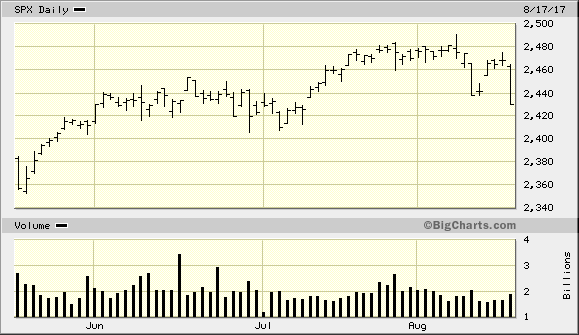
I’m not ready to say that this a major change for the market. It could be a false start, and the stock market may quickly return to its sleepy ways. But it’s something to notice. Trends can only last so long.
In this week’s CWS Market Review, I’ll highlight some of the market’s recent trends. Later on, I’ll discuss the very nice earnings report we got from Ross Stores. The deep-discounter is doing just fine against the great Amazon behemoth. Ross raised its full-year earnings guidance for the second time this year. I’ll also preview three more Buy List earnings reports coming our way next week. But first, let’s look at what’s shaking Wall Street.
The Slow-Moving Break-Up of the Baby-Step Rally
Three times in the last six trading sessions, the S&P 500 had a daily move of more than 1%. Normally, that’s no big deal, but in 2017, it’s enough to get your attention. Last year, the S&P 500 had 48 days in which it closed up or down by more than 1%. In 2015, there were 72. So far this year, there have been seven.
Here a remarkable stat: Not once since election day has there been a 3% drawdown for the market. In other words, from top to bottom, the S&P 500 has never been down by more than 3%. That’s the longest such streak on record. For more than nine months, it’s been a baby-step rally the whole way. However, there are a few disparate events that seem to be coming together all at once that could shake things up. Let me take them one at a time.
I was critical of the last Fed rate increase. Now it appears the market is starting to doubt the Fed’s commitment to more rate increases. The futures market had been expecting a third rate increase this year in December. Now the odds are slightly against it. Traders don’t give a 50% chance for another rate increase until March 2018. That’s actually more hawkish than a few days ago when the next hike was pegged for June 2018. Whatever the case, traders think the Fed will be on hold for several more months. By the way, I should add that Janet Yellen’s term ends in February. President Trump may reappoint her.
Speaking of the president, many of the investing themes that took hold of the market after the election have quietly melted away. A good example is small-cap stocks. Last November, the Russell 2000 soared. There was a great deal of optimism that the new administration would be a boon for smaller companies. (Please note: I’m not making a political statement. I’m merely reflecting what traders believed at the time.)
But the sector soon started to lag the baby-step rally. In the last month, the Russell 2000 has been drifting lower in absolute terms. On Thursday, the index dropped below its 200-day moving average, which is often a bad omen. The Russell hasn’t traded below its 200-DMA in more than a year.

Watching the small-cap sector is important because it could be an early warning sign that investors are pulling back on riskier names. In a bull market, you want to see stable blue chips rally alongside the up-and-comers. Whenever the score tilts heavily to one side, you know something’s up.
Along with small-caps, the energy sector is getting beaten up. Just like small-caps, energy stocks jumped last November on hopes of the incoming administration. But the Energy Sector ETF (XLE) has fallen for the last six days in a row, and 11 times in the last 13 days. There’s just no love for energy stocks at the moment.
Here’s what happening: On the surface, we’ve seen a baby-step rally. The S&P 500 is moving mostly upward, with very low volatility. But below the surface, investors have been quietly shunning riskier areas and fleeing to safety. Or rather, perceived safety. But this is unusual because it’s the opposite of what we normally see in the late stages of a bull run. Typically, when investors exit safety and chase madly after risk, that’s a sign of a frothy market.
On top of that, we’ve seen pronounced weakness in the U.S. dollar all year. Mind you, that’s not all bad. In fact, the weak dollar probably bailed out the market this earnings season. But are all these trends separate or are they different expressions of the same event?
One possible explanation is that the economy simply isn’t as strong as people thought. That’s why investors are shifting toward safety. Despite a low unemployment rate, GDP isn’t moving so fast, and that could require more assistance from the Fed. Lower rates, or a slower increase in rates, would also make the U.S. dollar less attractive.
Going forward, I encourage investors to remain focused on high-quality stocks. Two Buy List stocks that look particularly good at the moment are Danaher (DHR) and Alliance Data Systems (ADS). As always, make sure your portfolio is well diversified. Now let’s look at the good news from Ross Stores.
Ross Stores Beats and Raises Guidance (Again)
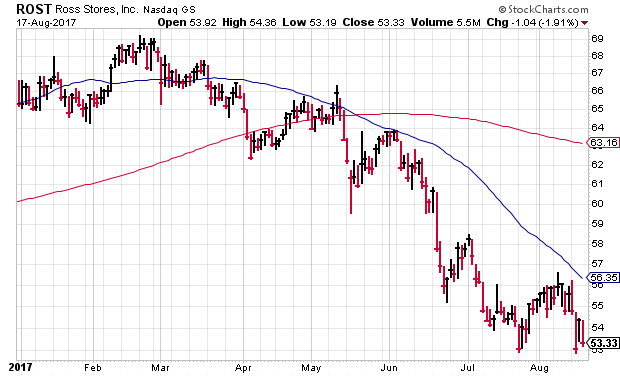
After the closing bell on Thursday, Ross Stores (ROST) reported very good earnings for their fiscal second quarter. This came as a huge relief for traders, as folks who keep an eye on retail had been expecting the worst. Shares of Ross had been drifting lower for much of this year.
I’m glad we’ve stuck by Ross because it’s an excellent firm. Ross is one of the few retailers that’s been able to withstand the great Amazon beast. For Q2, Ross earned 82 cents per share. That was well above the range of 73 to 76 cents per share that Ross had been expecting. Even as a Ross fan, this is more than I had anticipated.
Let’s dig into some of the numbers. Ross’s quarterly sales rose 8% to $3.432 billion. Their comp-store sales rose by 4%. That really impressed me. For Q2, Ross had been expecting an increase of 1% to 2%. A great number is that their quarterly operating margin came in at 14.9%, which is very good for a retailer. This tells us that Ross is holding up well within its sector.
Now for guidance. Ross sees Q3 earnings ranging between 64 and 67 cents per share. In last week’s issue, I said I was looking for something like 65 to 68 cents per share, so that’s pretty close. Ross also gave Q4 guidance of 88 to 92 cents per share. Q4 is November, December and January.
If you add those two ranges together, plus the $1.64 per share Ross has already made in the first half of this year, that translates to a full-year range of $3.16 to $3.23 per share. That’s an increase over the previous full-year range of $3.07 to $3.17 per share. This is actually the second time Ross has increased its full-year guidance. Things are obviously going well for them.
Ross has also been using its cash flow to buy back tons of its own stock. I’m not wild about this practice, but at least Ross actually reduces the share count. Through Thursday, Ross was our worst-performing stock this year. That may soon change. Thanks to the earnings report, shares of Ross were up more than 10% in the after-hours session. A word of caution: the after-hours market doesn’t always line up with what the stock will do once the real trading starts the next morning.
This time, we can congratulate ourselves. In last week’s newsletter, I told you Ross Stores was “a good value here.” We stuck by a good company when others got scared and ran away. This week, I’m raising my Buy Below on Ross Stores to $61 per share.
Three Buy List Earnings Reports Next Week
We have three more Buy List earnings reports next week. But I promise you, after that, we’re going into a long earnings lull period. We won’t see another Buy List earnings report until early October. Let’s look at who’s reporting next week.
HEICO (HEI) plans to release their fiscal Q3 earnings after the closing bell on Wednesday, August 23. The company had a very good earnings report last May, but the stock market was not impressed. That is, it wasn’t impressed until several weeks later, when HEICO started a furious rally. Sure that doesn’t make a whole lot of sense, but welcome to Planet Wall Street.
Wall Street expects earnings of 53 cents per share. The company said it expects sales to rise by 8% to 10% and net income to rise by 12% to 14%. Last year, HEICO made $1.86 per share. If we assume no change in shares outstanding, that implies 2017 EPS of $2.08 to $2.12.
One final note. Shares of HEICO took a 4% dip on Thursday after the stock was downgraded by Deutsche Bank. HEICO is up more than 32% for us this year.
Next Thursday, we’ll get earnings reports from Hormel Foods (HRL) and JM Smucker (SJM). Both companies will report results before the opening bell.
Unfortunately, Hormel has been one of our weaker stocks this year. Frankly, their last earnings report was kinda blah. The company faced a headwind of an oversupply of turkeys. The good news is that Hormel is standing by its full-year forecast of $1.65 to $1.71 per share. However, they now say they expect results to be at the low end of that range.
Hormel has missed the last three earnings reports—each time by one penny per share. This time, the consensus on Wall Street is for 37 cents per share. I think the losing streak will come to an end.
Next week’s report will be for Smucker’s fiscal Q1. For fiscal 2018, Smucker said they expect earnings to range between $7.85 and $8.05 per share. They beat earnings for Q4, but that was due to cost-cutting. I’m all for keeping costs down, but you need to grow the top line as well. Wall Street expects Q1 earnings of $1.63 per share.
That’s all for now. There’s not much on the calendar for next week except for the start of the Jackson Hole conference. This is the big Fed shindig every August out in Wyoming. Several times, the Fed has used the occasion for important policy announcements. I doubt we’ll see much this year. The conference begins on Thursday. On Friday, I’ll be keeping an eye out for the latest report on durable goods. Be sure to keep checking the blog for daily updates. I’ll have more market analysis for you in the next issue of CWS Market Review!
– Eddy
-
Morning News: August 18, 2017
Posted by Eddy Elfenbein on August 18th, 2017 at 7:03 amThanks To A Shopping Spree, Japan Is Looking Up. It May Not Last.
The World’s Biggest Tech Companies Are No Longer Just American
Bitcoin: Blockchain and Bitstamp Add Ethereum
Fracking Jobs Prove Elusive for Coal Miners Looking to Switch
Infosys Says Vishal Sikka Resigns as CEO, Becomes Vice Chairman
Walmart’s Online Sales Up 60% Giving Amazon A Good Run For The Money – Consumers To Benefit
How Walmart Is Bolstering Its Grocery Business Ahead of the Amazon-Whole Foods Marriage
For Uber, a Quiet Investor Becomes a Sudden Thorn
Wisconsin Bill Giving $3 Billion Incentives to Foxconn Advances
Rolls-Royce Is Pop Music’s Hottest Brand
Jack Ma-Backed Yunfeng Leads $1.7 Billion Purchase of MassMutual Asia Unit
What Happened Behind the Scenes as Trump’s Business Councils Fell Apart
The Internal Combustion Engine Is Not Dead Yet
Joshua Brown: Scott Galloway and Aswath Damodaran on Bitcoin vs Gold
Jeff Miller: Is The Bull Market Slowing?
Be sure to follow me on Twitter.
-
Morning News: August 17, 2017
Posted by Eddy Elfenbein on August 17th, 2017 at 7:12 amJapan Reports Trade Surplus in July as Exports Rise Again
Bank of England’s Caution Is Justified. What Happens When It Isn’t?
Fed Policymakers Grow More Worried About Weak Inflation
An Eclipse Is Just What the U.S. Power Sector’s Been Waiting For
Here’s How Trump’s Council of Business Titans Fell Apart
Trump’s Bruising Tweet Highlights Amazon’s Lingering Tax Fight
China’s Online Giants Back $12 Billion Deal to Shake Up State Firm
Hyundai Unveils New Fuel Cell SUV With Longer Travel Range
Cisco: Thrill-Seekers Need Not Apply
A Chinese Video Game Rakes in Cash – And Draws Young Rule Breakers
Alibaba’s Quarterly Revenue Beats Esimates
Cullen Roche: Robo Advisors Don’t Beat Traditional Index Funds
Roger Nusbaum: 8 Brutally Honest Truths You Need To Hear If You Want To Get Your Portfolio Together
Ben Carlson: The Canadian Housing Market is Bananas
Be sure to follow me on Twitter.
-
Morning News: August 16, 2017
Posted by Eddy Elfenbein on August 16th, 2017 at 7:06 amIMF Warns on China’s Credit Boom
Tech Companies Ramp Up NAFTA Lobbying on Eve of Trade Talks
Fed Minutes May Show Battle Lines Hardening Over Soft Inflation
CEOs Walk Trump Tightrope Into New Era of Corporate Politics
Junk Bonds Are Big Winner a Decade After Financial Crisis
The Real Losers in Air Berlin’s Demise
Cathay Struggles to Get Top Dollar From Fliers Amid Revamp
Amazon Enlists Bond Market in Its Quest for Grocery Dominance
Amazon Just Unveiled a Better Alternative to Vending Machines
Target’s Profit, Com Sales Beat on Higher Customer Visits
For Rajat Gupta, Returning Is a Hard Road
Roger Nusbaum: Dalio Likes Gold
Joshua Brown: My Middle Name Is Danger
Cullen Roche: Why I’m Not Worried About Household Debt
Be sure to follow me on Twitter.
-
Morning News: August 15, 2017
Posted by Eddy Elfenbein on August 15th, 2017 at 7:24 amWhy the U.S. Shouldn’t Start a Trade War With China
How Nafta Changed U.S. Trade With Canada and Mexico
Dudley Tells Skeptical Markets He Sees Fed Rate Hike
Tallying the C.E.O. Desertion of Trump
The Boom Is Booming and Home Depot Is Setting Records
Why Would Buffett’s Berkshire Bulk Up on Credit Cards?
3 Reasons Netflix Stock Isn’t Losing Half Its Value
Nvidia’s Stock Recovers As Analysts Urge Patience In The AI Business
How Elon Musk and Cheap Oil Doomed Push for Natural Gas Cars
New Pandora Media CEO Good Match For Struggling Music Service
Gates Makes Largest Donation Since 2000 With $4.6 Billion Pledge
Costco Made $3.7 Million Selling ‘Tiffany’ Rings. Now It Must Pay $19 Million To The Real Tiffany.
Michael Batnick: Only a Market of Stocks
Howard Lindzon: Momentum Monday…FFFFFINTECH
Be sure to follow me on Twitter.
-
North Korea and the Stock Market
Posted by Eddy Elfenbein on August 15th, 2017 at 12:06 amThe Aug. 10 market decline of almost 200 points on the Dow Jones Industrial Average seemed to confirm the dire view of the world and egged on the talk-show pundits. That’s understandable. Bleak warnings usually make for great TV ratings.
But the truth about the likelihood of imminent nuclear war is somewhat different, and it usually doesn’t get ratings.
“North Korea isn’t scaring people,” says Eddy Elfenbein, author of the Crossing Wall Street blog. “Rather, people who wanted to be scared (and exit their positions) have found an excuse in Pyongyang.”
In other words, some investors decided Aug. 10 was a reasonable time to ditch their stock holdings, and it had little to do with the potential start of another war on the Korean Peninsula.
Investors, such as Elfenbein, are telling the world the opposite of what talk-show guests are saying. We know this by looking at the level of the stock market, which in some ways is a crowd-sourced view of the future state of the world.
-
Morning News: August 14, 2017
Posted by Eddy Elfenbein on August 14th, 2017 at 7:05 amJapan at Top of the Growth Table Among G-7 Peers
Eurozone Industry Shows Signs of Slowing Amid Euro’s Rise
Commonwealth Bank Needs a Culture Shock
Bitcoin Surges Past $4,000 on Speed Breakthrough
U.S. Default? Unlikely, But Bond Traders Are Taking No Chances
Trump’s NAFTA Autos Goals to Collide With Industry as Talks Start
Why Discount Grocer Aldi Is Getting Into the Delivery Game
Robust China Economic Growth Shows Signs of Fading in July
China’s Fosun, Shanghai Pharma Say Bid for Stake in U.S. Drugmaker Arbor
The Messy, Confusing Future of TV? It’s Here
The Incredible Shrinking Sears
Piketty Zeroes In on Putin’s Pain Point
Jeff Miller: Will the North Korea Threat be the Catalyst for a Market Correction?
Roger Nusbaum: Big Gains (Five Basis Points At A Time)
Be sure to follow me on Twitter.
-
A Closer Look at the Tech Sector
Posted by Eddy Elfenbein on August 11th, 2017 at 6:43 pmJeff Reeves writes at U.S. News & World Report:
Surprising values and dividend potential. Many investors have been enamored with big names lately – Facebook (FB), Apple (AAPL), Amazon.com (AMZN), Netflix (NFLX) and Google parent Alphabet (GOOG, GOOGL). But “tech is a broad category” and the timing may be right to look beyond these fashionable names of the moment and think long-term, said Eddy Elfenbein, portfolio manager of the AdvisorShares Focused Equity ETF (CWS).
Elfenbein points to Microsoft Corp. (MSFT), a sleepier tech name that is currently a holding in his fund because of great management under CEO Satya Nadella, who has orchestrated “an impressive turnaround” from the Steve Ballmer era a few years back.
(…)
But it’s not unrealistic for tech to fall out of favor after a pretty long run for the sector. Elfenbein warns that it’s dangerous to assume every name in the sector has certain growth ahead of it and investors have to do their homework.
“We’re in the ninth year of a bull market, so many of the previous strategies have been played,” he says. “That leads to a premium being placed on growth.
Conversely, this is a punishing environment for companies that miss those growth expectations. He points to International Business Machines Corp. (IBM) and Qualcomm (QCOM) as examples of tech stocks that yield more than 4 percent but have actually declined year-to-date because of sluggish growth outlooks.
-
Inflation is Still Low
Posted by Eddy Elfenbein on August 11th, 2017 at 12:01 pmThis morning we got the CPI numbers for July, and they show that inflation is still quite low. Both the headline and core rate rose by 0.1% last month. In the last year, both headline and core are up 1.7%.
Here’s a look at the monthly seasonally-adjusted core rates going back a few years:

The decline during March was a clear outlier but the four following months haven’t seen much of an uptick.
Here’s the real Fed funds rate based off core inflation:

I think this chart says a lot. You can see that even when the Fed does nothing, it’s tightening because inflation is getting softer. In the last 11 months, real rates have gone from -2% to -0.6%.
-
CWS Market Review – August 11, 2017
Posted by Eddy Elfenbein on August 11th, 2017 at 7:08 am“The only perfect hedge is a Japanese garden.” – Eugene Rotberg
On Thursday, the S&P 500 dropped by 1.45% to close at 2,438.21. This was the index’s biggest drop in nearly three months. I should restate that—this was the biggest drop by far in the last three months. Put it this way: Since May 18, Thursday’s drop was five times greater than the damage of the sixth-largest loss.
The point is that in historical terms, Thursday’s loss really ain’t that big a deal. But in terms of 2017’s volatility, Thursday was an earthquake inside a hurricane next to shark attack.
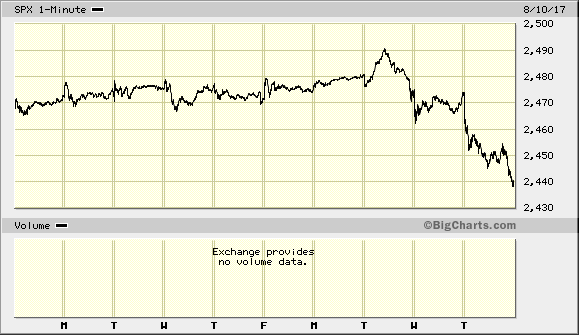
The reason behind Wall Street’s fearfulness isn’t hard to miss. Wall Street and the world are increasingly concerned by the behavior of North Korea. The United Nations Security Council voted unanimously to impose sanctions on North Korea. Bear in mind that the UNSC is rarely unified on anything. Despite Thursday’s bout of selling, defense stocks like Lockheed Martin, Northrop Grumman and Raytheon all made new 52-week highs.
In this week’s CWS Market Review, I’ll bring you up to speed on the latest happenings on Wall Street. I’ll also cover Cinemark’s reassuring earnings report. Plus, I’ll preview next week’s earnings report from Ross Stores. We also had some good news for the Buy List. Snap-on is spending $500 million to buy back shares. But first, let’s look at how Kim Jong Un has spooked the U.S. stock market.
Should We Worry About North Korea?
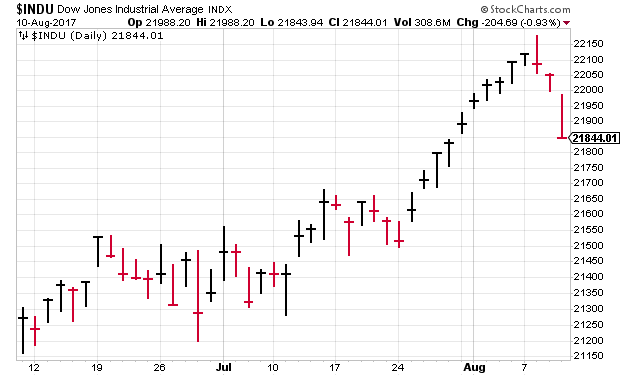
On Tuesday, the Dow snapped a 10-day winning streak. This streak got a lot of attention in the financial media, but I can’t say I was terribly impressed. For one thing, most of the increases were very small. In the history of the Dow, there have been 17 win streaks of 10 or more days. This last one has the smallest cumulative gain of all of them.
We also have to remember that the Dow is a price-weighted index. As a result, a company like Goldman Sachs has the second-highest weighting in the index even though it has the fifth-smallest market value. The S&P 500 is weighted by market value, and it barely budged during the Dow’s winning streak. In fact, the S&P 500 fell four times in those 10 days. It was precisely companies like Goldman Sachs and JP Morgan that helped power the Dow to its new highs.
With the recent war of words over North Korea, investors are starting to feel anxious. The South Korean economy punches above its weight in the world economy. There are several prominent Korean corporations like Samsung and Hyundai. But in the last two weeks, the South Korea ETF (EWY) has lost more than 7%.
Over the past several months, Wall Street has brought back its old habit of freaking out in the short-term over something that turned out to be nothing major. Remember the Brexit panic? The S&P 500 had its biggest daily drop in nearly a year. But shortly after that, cooler heads prevailed and doomsayers were yet again proven wrong.
Nearly the same thing happened after last year’s election. At one point on election night, the Dow futures were down more than 800 points. The end of the world never came, and the Dow is sitting on a nice 20% gain since the election.
My point isn’t to defend or criticize any of these political events. Rather, I’m encouraging you not be swept up by unreasonable fears. Stock prices are like a global blood-pressure machine. Historically, the U.S. stock market has been able to rally during highly-unsettling times for the country and the world. Any drop in U.S. equity prices is good for stock-pickers.
On our Buy List, there are a few stocks I like in particular. Ross Stores (ROST), which reports next week, is a good value here. I also like Danaher (DHR), which was has been quite weak lately. DHR looks particularly good below $80 per share. I also like Alliance Data Systems (ADS). The stock is currently going for a little more than 10 times the company’s estimate for next year’s earnings. ADS has also increased its buyback program by $500 million. That’s an impressive sign of confidence. Now let’s take a look at last Friday’s earnings report from Cinemark.
Cinemark Is a Buy up to $43 per Share
Last Friday, Cinemark (CNK) became our final Buy List stock to report earnings for the second-quarter earnings season. The movie-theater chain said they earned 44 cents per share last quarter. That was one penny below estimates.
What’s interesting is that shares of CNK dropped sharply going into Friday’s earnings report. That’s largely because a competitor, namely AMC, completely bombed its earnings report. Traders naturally think that whatever’s hurting one company in a sector must necessarily be hurting its competitors as well.
For Cinemark, that’s not the case. So even though they missed earnings by a penny per share, last Friday’s results relieved investors who feared the worst. Looking at the details, Cinemark´s quarterly sales rose by 0.9%. Concession revenue per person, which is the real moneymaker for CNK, rose by 8.9%.
“We continue to be pleased with the consistency of our financial performance, including our second quarter’s global revenue growth, record food and beverage per caps, and year-over-year box-office results that again exceeded the North American industry,” stated Mark Zoradi, Cinemark’s CEO. “We remain optimistic about film content for the remainder of the year, as well as the future growth potential that our strong foundation and strategic initiatives provide for our Company.”
Cinemark’s screen count is up to 5,926. I’m keeping CNK’s Buy Below at $43 per share.
Earnings Preview for Ross Stores
Ross Stores (ROST) will report its fiscal Q2 earnings after the closing bell on Thursday, August 17. Ross is one of my favorite retailers, but the shares have been struggling this year. It’s actually our single-worst performer YTD, with a loss of 14%. Part of the reason isn’t so much about Ross but the impact of online shopping on the entire retail sector. There have been countless stories this year about how Amazon is devouring the retail world. In fact, others retailers like Macy’s and Target have been hit worse than Ross.
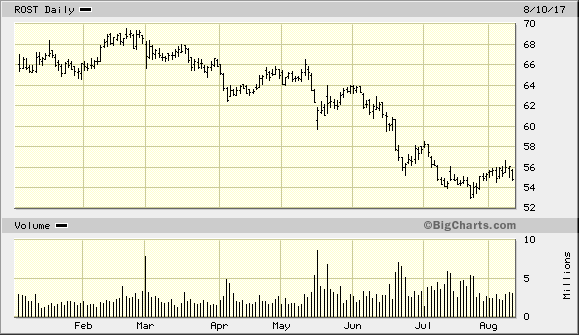
Still, I’m an optimist on Ross. If you understand Ross’s business model, you see that Amazon isn’t much of a direct competitor. For their Q2 report, which ended on July 29, Ross sees earnings ranging between 73 and 76 cents per share. That’s compared with 71 cents per share for last year’s Q2. That sounds about right. For comparable-store sales growth, Ross sees an increase of 1% to 2%.
I’ve been particularly impressed with Ross’s operating margins. Retail is all about keeping control of costs, especially for a deep discounter like Ross. In May, Ross raised its full-year earnings forecast. The company now projects 2017 earnings between $3.07 and $3.17 per share. The previous range was $3.02 to $3.15 per share. For context, Ross made $2.83 per share last year; however, this year will include an extra business week. Ross estimates that will add eight cents per share.
I’ll be paying close attention to Ross’s guidance for Q3. I’m expecting something around 65 to 68 cents per share. There’s a good chance I’ll raise my Buy Below on Ross, but I want to see their guidance first. Don’t give up on Ross!
I wanted to follow up on Continental Building Products (CBPX). Last week, the wallboard folks missed on their earnings report by three cents. The stock, however, reacted rather dramatically. Last Friday, CBPX jumped 8.4%. Then on Monday, it dropped by 5.4%. This is unusual but not unheard of. The stock seems have to calmed down lately. This week, I’m dropping my Buy Below on CBPX down to $23 per share.
A few weeks ago, Snap-on (SNA) beat earnings, yet the stock fell after the report. The earnings looked fine to me. Apparently, the company is trying to take advantage of the reduced share price. This week, Snap-on announced a new buyback plan worth $500 million. That’s worth about 5.6% of the SNA’s current market value.
Good news for CR Bard (BCR). This week, shareholders voted to approve Bard’s merger with Becton Dickinson (BDX). According to Bard, “approximately 99%” of the vote was in favor of the merger. There wasn’t much doubt about the outcome, but it’s nice to see such a strong vote.
As a reminder, the deal calls for BCR shareholders to get $222.93 per share in cash plus 0.5077 shares of BDX. That currently values BCR at $323.57 per share. The stock is currently going for a slight discount (about 1.4%) relative to the deal’s price. That’s common because there’s always a chance that the deal could fall apart. It’s highly unlikely but not impossible. The discount has gradually diminished since the deal was announced in April. Bard said the merger will officially take place sometime in Q4.
HEICO (HEI) has been very strong recently. Over the last six weeks, the shares are up 21%. If you recall, HEICO had a very good earnings report in May. The company has already raised guidance twice this year. I’m raising my Buy Below on HEICO to $90 per share.
That’s all for now. We’ll get some key economic reports next week. On Tuesday, the July retail-sales report comes out. The June report was not very good, so I’ll be curious to see if there’s been any improvement. On Wednesday, we’ll get the minutes from the last Federal Reserve meeting. Then on Thursday, the next industrial-production report comes out. This data series has been improving in recent months. Be sure to keep checking the blog for daily updates. I’ll have more market analysis for you in the next issue of CWS Market Review!
– Eddy
-
Archives
- October 2026
- September 2026
- August 2026
- July 2026
- June 2026
- May 2026
- April 2026
- March 2026
- February 2026
- January 2026
- December 2025
- November 2025
- October 2025
- September 2025
- August 2025
- July 2025
- June 2025
- May 2025
- April 2025
- March 2025
- February 2025
- January 2025
- December 2024
- November 2024
- October 2024
- September 2024
- August 2024
- July 2024
- June 2024
- May 2024
- April 2024
- March 2024
- February 2024
- January 2024
- December 2023
- November 2023
- October 2023
- September 2023
- August 2023
- July 2023
- June 2023
- May 2023
- April 2023
- March 2023
- February 2023
- January 2023
- December 2022
- November 2022
- October 2022
- September 2022
- August 2022
- July 2022
- June 2022
- May 2022
- April 2022
- March 2022
- February 2022
- January 2022
- December 2021
- November 2021
- October 2021
- September 2021
- August 2021
- July 2021
- June 2021
- May 2021
- April 2021
- March 2021
- February 2021
- January 2021
- December 2020
- November 2020
- October 2020
- September 2020
- August 2020
- July 2020
- June 2020
- May 2020
- April 2020
- March 2020
- February 2020
- January 2020
- December 2019
- November 2019
- October 2019
- September 2019
- August 2019
- July 2019
- June 2019
- May 2019
- April 2019
- March 2019
- February 2019
- January 2019
- December 2018
- November 2018
- October 2018
- September 2018
- August 2018
- July 2018
- June 2018
- May 2018
- April 2018
- March 2018
- February 2018
- January 2018
- December 2017
- November 2017
- October 2017
- September 2017
- August 2017
- July 2017
- June 2017
- May 2017
- April 2017
- March 2017
- February 2017
- January 2017
- December 2016
- November 2016
- October 2016
- September 2016
- August 2016
- July 2016
- June 2016
- May 2016
- April 2016
- March 2016
- February 2016
- January 2016
- December 2015
- November 2015
- October 2015
- September 2015
- August 2015
- July 2015
- June 2015
- May 2015
- April 2015
- March 2015
- February 2015
- January 2015
- December 2014
- November 2014
- October 2014
- September 2014
- August 2014
- July 2014
- June 2014
- May 2014
- April 2014
- March 2014
- February 2014
- January 2014
- December 2013
- November 2013
- October 2013
- September 2013
- August 2013
- July 2013
- June 2013
- May 2013
- April 2013
- March 2013
- February 2013
- January 2013
- December 2012
- November 2012
- October 2012
- September 2012
- August 2012
- July 2012
- June 2012
- May 2012
- April 2012
- March 2012
- February 2012
- January 2012
- December 2011
- November 2011
- October 2011
- September 2011
- August 2011
- July 2011
- June 2011
- May 2011
- April 2011
- March 2011
- February 2011
- January 2011
- December 2010
- November 2010
- October 2010
- September 2010
- August 2010
- July 2010
- June 2010
- May 2010
- April 2010
- March 2010
- February 2010
- January 2010
- December 2009
- November 2009
- October 2009
- September 2009
- August 2009
- July 2009
- June 2009
- May 2009
- April 2009
- March 2009
- February 2009
- January 2009
- December 2008
- November 2008
- October 2008
- September 2008
- August 2008
- July 2008
- June 2008
- May 2008
- April 2008
- March 2008
- February 2008
- January 2008
- December 2007
- November 2007
- October 2007
- September 2007
- August 2007
- July 2007
- June 2007
- May 2007
- April 2007
- March 2007
- February 2007
- January 2007
- December 2006
- November 2006
- October 2006
- September 2006
- August 2006
- July 2006
- June 2006
- May 2006
- April 2006
- March 2006
- February 2006
- January 2006
- December 2005
- November 2005
- October 2005
- September 2005
- August 2005
- July 2005
 Eddy Elfenbein is a Washington, DC-based speaker, portfolio manager and editor of the blog Crossing Wall Street. His