CWS Market Review – July 8, 2025
(This is the free version of CWS Market Review. If you like what you see, then please sign up for the premium newsletter for $20 per month or $200 for the whole year. If you sign up today, you can see our two reports, “Your Handy Guide to Stock Orders” and “How Not to Get Screwed on Your Mortgage.”)
If you like market anniversaries, then you’ll be happy to learn that today is the 93rd anniversary of the mega low. On July 8, 1932, the Dow closed at 41.22. In 1929, it peaked at 381.17. By March 6, 1937, the Dow rose 371%. That’s still the greatest rally in history. All you had to do was time it perfectly.
Fortunately, the world is a wealthier place than it was in the 1930s. Alas, we still have tariffs. After hitting a new all-time high last week, the stock market started this week a bit on the weak side. Once again, tariffs are the problem.
It’s not a coincidence that the stock market bottomed in April right as President Trump announced a 90-day pause to his tariffs. The stock market has rallied briskly ever since – not like 1932, but still pretty good.
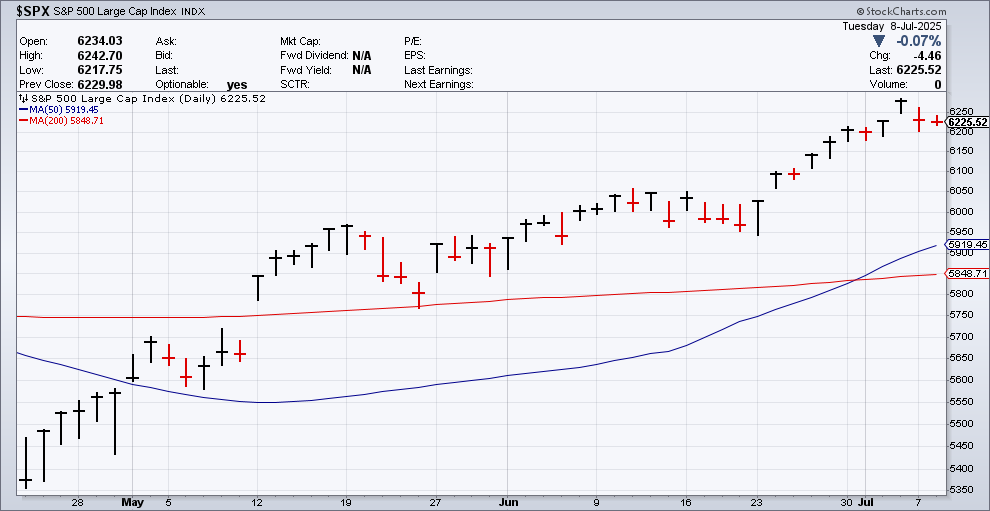
I think the message is loud and clear: Wall Street hates tariffs.
Yesterday, however, the president announced steep tariffs on 14 countries that are set to take effect on August 1. The market gods were less than pleased.
According to the president’s letters, goods that are imported to the United States from Japan, South Korea, Malaysia, Kazakhstan, Tunisia and several others will face a 25% tariff.
Goods from South Africa and Bosnia will face a 30% rate and Indonesia will have a 32% rate. The president allowed that the tariff rates are open to negotiation depending on each country’s relationship with the United States. The president wrote, “You will never be disappointed with The United States of America.”
In April, Trump imposed steep rates on several countries but the drop in the stock market caused him to announce his 90-day pause. As it turns out, the rates were in effect for only a few hours before Trump delayed them. I guess someone was disappointed. The delay period was about to end this week, but the president extended the pause for another three weeks.
This is where things get a little messy. President Trump has consistently pointed to trade deficits as proof of unfair trade practices, but that’s not necessarily the case. Trade deficits can happen for many reasons, and they can often be beneficial.
Trump’s reciprocal tariffs went as high as 125% on China, but the president was eagerly looking to strike some deals. The president said that the delay was because so many countries wanted to make deals with the U.S.
The issue got more complicated in May when the president’s reciprocal tariffs were struck down by a federal district court. The tariffs are in still effect while the federal courts are looking at the issue.
There are also targeted tariffs. For example, steel and aluminum are dinged at a 50% rate but the U.K. is exempt. Under U.S. law, the president can place tariffs if they’re related to national security.
I’m not sure what the outcome of these tariffs will be. The matter is far from settled and there are many exceptions. For example, Japan and South Korea export millions of cars to the U.S. and both countries will face 25% tariffs.
Then there’s the issue of China. According to the Wall Street Journal, “the Trump administration has for now settled on a tariff of 55% on Chinese imports.” That reflects a lowering of the initial rate to 30% which comes on top of a 25% tariff that existed before Trump took office.
The uncertainty of the tariff policy is having a major impact on issues like investment decisions. Of course, the Federal Reserve has been slow to lower interest rates, but the Fed is also looking out for higher prices from higher tariffs.
There are first-order effects of higher tariffs. For example, economists expect that tariffs will hold back the economy because it will dampen the demand for goods made outside the U.S., but there are other considerations which may not be fully expected.
The policy uncertainty could lead companies to hold off on expansion plans and that could curb the job market. We’re in a position where we don’t know what we don’t know.
The WSJ noted that Allianz, the German insurance company, slashed its growth estimate for the U.S. economy this year from 2.8% to 1.4%, and those forecasts were based on the current level of tariffs.
An Increasingly Narrow Market
This uncertainty is weighing on the market. One potentially troubling sign has been how narrow the stock market’s advance has become. In plain English, that means that fewer stocks are doing the heavy lifting.
On the NYSE, the number of stocks making a new high outpaced those making new lows by only 88 stocks. Historically, whenever that number drops below 100, the stock market hasn’t done very well over the coming months.
Large-cap tech stocks have resumed their leadership while most of the rest of the market has been fairly quiet. Since the market’s low in April, the Magnificent Seven stocks have outpaced the overall market. Research from Bloomberg shows that only 10% of the S&P 500 is driving the market. That’s down from 22% in previous years.
I also like to look at the S&P 500 equal weighted index. In that index, each stock weighs the same: 0.2% of the index. The regular S&P 500 is weighted by market cap. The S&P 500 equal weighted hasn’t made a new high in eight months.
Here’s a look at how the S&P 500 (in blue) has outpaced the Equal Weight (in red) over the last three months:
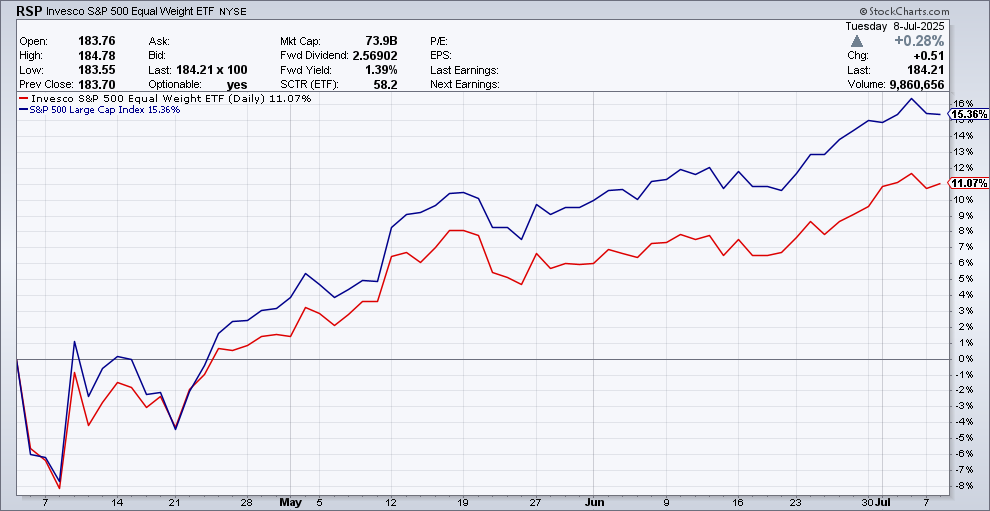
I suspect that the market will broaden out once the Fed starts to cut rates. Lower short-term rates are usually better for more conservative stocks along with dividend payers.
Speaking of dividends, there’s a fascinating ETF about to debut on the stock market. This week, Roundhill Investments will launch the S&P 500 No Dividend Target ETF. The ticker symbol will be XDIV.
The ETF aims to mimic the S&P 500 but pay no dividends. The benefit of not paying dividends is that it won’t have to pay taxes on dividends. How can it do that? The fund will sell holdings just before their dividend dates.
This is a great way to grow your wealth while avoiding the taxman. Of course, if you sell the ETF for a profit, you’ll still be liable for capital gains.
XDIV plans to invest in other S&P 500 Index funds but will sell positions just before the ex-dividend date. According to Bloomberg, the fund will then rotate from one such index fund into another that isn’t about to pay a distribution.
The goal of the fund is to skip the dividend while avoiding the price dip. It’s an ingenious idea. There are already funds that invest in non-dividend paying stocks of the S&P 500. I’ve often wondered if you could build a fund that reasonably mimicked the S&P 500 without using dividend-paying stocks. You probably could, but it would be complicated. XDIV aims to do it the smart and easy way.
This will probably be another quiet week on Wall Street, but next week might be busier. We’ll have our first Buy List earnings report. On Tuesday, we’ll get the inflation report for June. The retail sales report will be due out on Thursday. That’s all for now. I’ll have more for you in the next issue of CWS Market Review.
– Eddy
Posted by Eddy Elfenbein on July 8th, 2025 at 5:43 pm
The information in this blog post represents my own opinions and does not contain a recommendation for any particular security or investment. I or my affiliates may hold positions or other interests in securities mentioned in the Blog, please see my Disclaimer page for my full disclaimer.
-
Archives
- October 2026
- September 2026
- August 2026
- July 2026
- June 2026
- May 2026
- April 2026
- March 2026
- February 2026
- January 2026
- December 2025
- November 2025
- October 2025
- September 2025
- August 2025
- July 2025
- June 2025
- May 2025
- April 2025
- March 2025
- February 2025
- January 2025
- December 2024
- November 2024
- October 2024
- September 2024
- August 2024
- July 2024
- June 2024
- May 2024
- April 2024
- March 2024
- February 2024
- January 2024
- December 2023
- November 2023
- October 2023
- September 2023
- August 2023
- July 2023
- June 2023
- May 2023
- April 2023
- March 2023
- February 2023
- January 2023
- December 2022
- November 2022
- October 2022
- September 2022
- August 2022
- July 2022
- June 2022
- May 2022
- April 2022
- March 2022
- February 2022
- January 2022
- December 2021
- November 2021
- October 2021
- September 2021
- August 2021
- July 2021
- June 2021
- May 2021
- April 2021
- March 2021
- February 2021
- January 2021
- December 2020
- November 2020
- October 2020
- September 2020
- August 2020
- July 2020
- June 2020
- May 2020
- April 2020
- March 2020
- February 2020
- January 2020
- December 2019
- November 2019
- October 2019
- September 2019
- August 2019
- July 2019
- June 2019
- May 2019
- April 2019
- March 2019
- February 2019
- January 2019
- December 2018
- November 2018
- October 2018
- September 2018
- August 2018
- July 2018
- June 2018
- May 2018
- April 2018
- March 2018
- February 2018
- January 2018
- December 2017
- November 2017
- October 2017
- September 2017
- August 2017
- July 2017
- June 2017
- May 2017
- April 2017
- March 2017
- February 2017
- January 2017
- December 2016
- November 2016
- October 2016
- September 2016
- August 2016
- July 2016
- June 2016
- May 2016
- April 2016
- March 2016
- February 2016
- January 2016
- December 2015
- November 2015
- October 2015
- September 2015
- August 2015
- July 2015
- June 2015
- May 2015
- April 2015
- March 2015
- February 2015
- January 2015
- December 2014
- November 2014
- October 2014
- September 2014
- August 2014
- July 2014
- June 2014
- May 2014
- April 2014
- March 2014
- February 2014
- January 2014
- December 2013
- November 2013
- October 2013
- September 2013
- August 2013
- July 2013
- June 2013
- May 2013
- April 2013
- March 2013
- February 2013
- January 2013
- December 2012
- November 2012
- October 2012
- September 2012
- August 2012
- July 2012
- June 2012
- May 2012
- April 2012
- March 2012
- February 2012
- January 2012
- December 2011
- November 2011
- October 2011
- September 2011
- August 2011
- July 2011
- June 2011
- May 2011
- April 2011
- March 2011
- February 2011
- January 2011
- December 2010
- November 2010
- October 2010
- September 2010
- August 2010
- July 2010
- June 2010
- May 2010
- April 2010
- March 2010
- February 2010
- January 2010
- December 2009
- November 2009
- October 2009
- September 2009
- August 2009
- July 2009
- June 2009
- May 2009
- April 2009
- March 2009
- February 2009
- January 2009
- December 2008
- November 2008
- October 2008
- September 2008
- August 2008
- July 2008
- June 2008
- May 2008
- April 2008
- March 2008
- February 2008
- January 2008
- December 2007
- November 2007
- October 2007
- September 2007
- August 2007
- July 2007
- June 2007
- May 2007
- April 2007
- March 2007
- February 2007
- January 2007
- December 2006
- November 2006
- October 2006
- September 2006
- August 2006
- July 2006
- June 2006
- May 2006
- April 2006
- March 2006
- February 2006
- January 2006
- December 2005
- November 2005
- October 2005
- September 2005
- August 2005
- July 2005
 Eddy Elfenbein is a Washington, DC-based speaker, portfolio manager and editor of the blog Crossing Wall Street. His