CWS Market Review – July 22, 2025
(This is the free version of CWS Market Review. If you like what you see, then please sign up for the premium newsletter for $20 per month or $200 for the whole year. If you sign up today, you can see our two reports, “Your Handy Guide to Stock Orders” and “How Not to Get Screwed on Your Mortgage.”)
Q2 Earnings Seasons Is Looking Good So Far
The stock market closed at yet another all-time high on Tuesday. Today’s market was noteworthy because it was a “broader” rally. By that, I mean that more stocks are jumping in on the fun. It’s not just a “tech only” rally.
I like to look at the relationship between the S&P 500 High Beta ETF (SPHB) and the Low Volatility ETF (SPLV). This is an easy way to read the market’s mind.
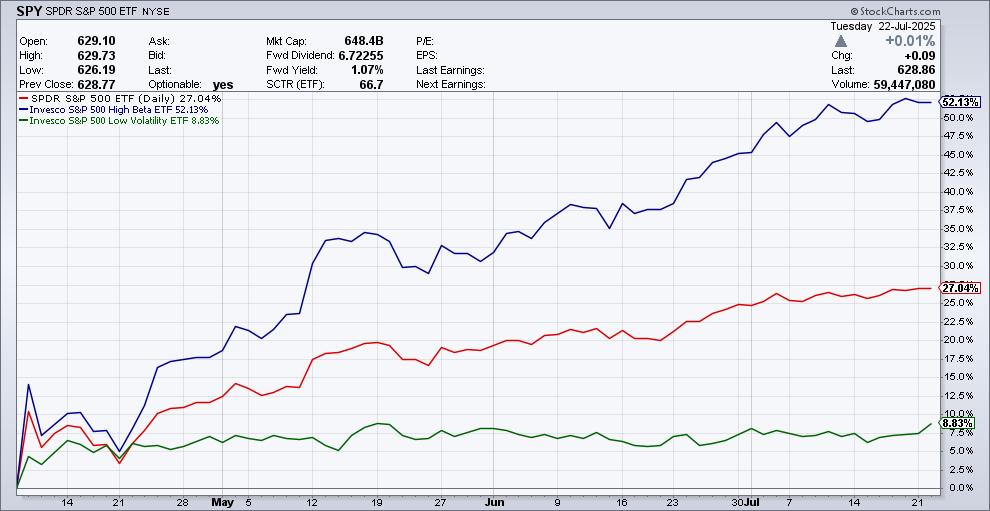
Since the market low in April, High Beta, meaning the riskier stocks, are up more than 52% while Low Volatility is just 9%. Today, High Beta was flat while Low Vol was up 1.4%. I’d like to see more of that kind of action.
We have some early numbers for this earnings season, and it’s looking quite good. So far, 12% of companies in the S&P 500 have reported Q2 earnings. Of those, 83% have beaten earnings. That’s higher than the 5- and 10-year averages.
The S&P 500 is on track to deliver Q2 earnings growth of 5.6%. That would be the slowest growth since Q4 2023. So far, 83% of companies that have reported have beaten on revenues. Bear in mind that on Wall Street, you’re expected to beat expectations.
The S&P 500 is currently trading at 22 times forward earnings. That’s high but not unreasonable. There are, however, signs of market excess. For example, the meme stock brigades are back. Thanks to a cheering section at Reddit, shares of Opendoor Technologies (OPEN) have taken center stage. Last Monday, OPEN was traded as low as 77 cents per share. Yesterday, OPEN peaked at $4.97 per share.
Trading volume for the stock has surged from 50,000 or so each day to over 500,000,000 per day. That’s an increase of 10,000-fold in just a few days. I think I have a feeling for how this will end.
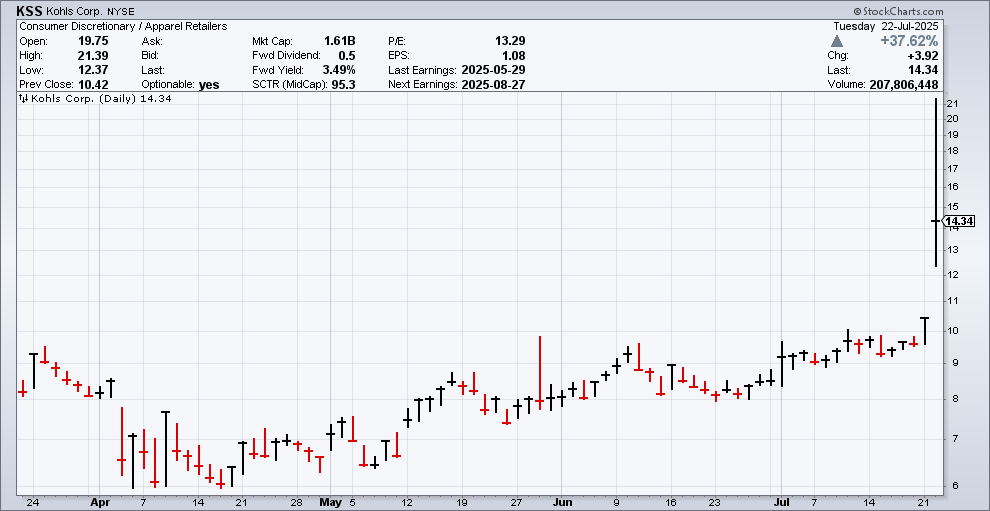
Now Kohl’s’s (KSS) has been picked up by the day-trading frenzy. I’m not sure how long this will last. About half of Kohl’s outstanding shares available for trading are shorted. At one point today, the stock was up more than 100%. By the closing bell, KSS settled for a gain of 37%. (It’s just a department store!)
Truthfully, these meme stocks are closer to gambling than true investing. They certainly can be fun games to play, but it really helps if you’re the first one out the door.
There were several prominent earnings reports today. GM (GM) beat earnings and reiterated its guidance but the stock fell 8% after the carmaker said that it’s concerned about tariffs hurting sales. GM’s core profit fell 31.6% to $3.04 billion.
Sherwin-Williams (SHW), a former Buy List stock, had a disappointing earnings report. For Q2, the paint people made $3.38 per share. That was 42 cents below expectations. The stock reversed its earlier losses and only closed down modestly.
Shares of Northrop Grumman (NOC) reached a new high. The stock was up over 9% today. The company raised its guidance.
Labcorp (LH) also got a nice 3.7% lift today. Philip Morris (PM) missed its revenue estimates and the shares got dinged 8.4% today. The stock yields close to 3%. Mettler-Toledo (MTD) also had a good day.
There are going to be a lot more earnings reports this week.
How the Market Behaves at a New High
The S&P 500 hit another all-time high yesterday. This week, I wanted to take a closer look at how the stock market has historically behaved when it’s at an all-time high. Perhaps counterintuitively, the stock market has done quite well off its all-time high. You might be inclined to think that the all-time high is the worst time, but the evidence says otherwise.
I took all the S&P 500 daily closes going back to 1960. Since then, there have been about 16,500 trading days. Of those, the index hit an all-time high on nearly 1,200 days or about 7.3% of the time.
The day following an all-time high close, the stock market has gained a total of 75%. Annualized, that works out to 12.8%. The rest of the time, when the market’s not at an all-time high, the annualized gain is just 7%. That’s quite a big difference.
From my experience, the worst market days don’t come off peaks. Instead, the market gradually crumbles off its peak, and then the big drop happens.
I also found that even if the S&P 500 closes within 10% of a new high, but not at a new high, then the market averages an annualized gain of 7.9%.
As well as the stock market has done when it’s at a new high, what’s also impressive is how stable the market has been at all-time highs. Since 1960, there have been only three times when the market has gained more than 2% in a single day off an all-time high. Interestingly, all three came in the 1990s.
Coming off an all-time high, the market has gained more than 1% only 5.4% of the time. Normally, 1% up days come more than 7.2% of the time. The lesson is that calm markets tend to be good markets, and markets that are rising tend to keep on rising.
Too often, investors feel that strong markets have given them unwarranted gains and that they have to sell out before the correction comes. The problem is that you never know when it will come. Just look at this year when we had a nasty drop followed by a pretty impressive rally.
Peter Lynch famously said, “Far more money has been lost by investors preparing for corrections, or trying to anticipate corrections, than has been lost in the corrections themselves.”
This is another example that good investing really comes down to patience.
Mueller Industries Delivers Solid Earnings
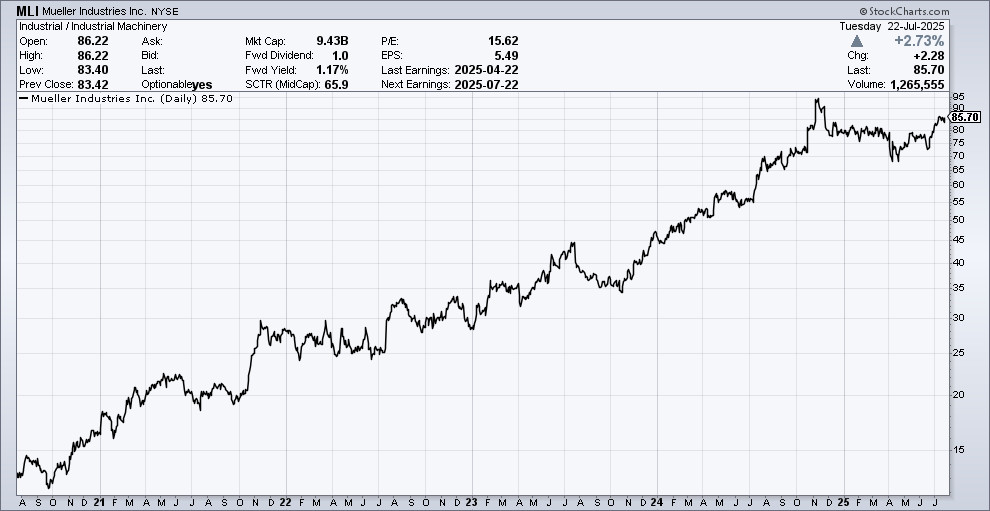
This morning, we got a nice earnings report from Mueller Industries (MLI), which is one of our Buy List stocks. I like Mueller a lot. It’s a well-run mid-cap that’s largely overlooked by Wall Street.
I’m always surprised at how Wall Street can completely ignore such good businesses. Only one analyst follows MLI despite it being a big winner for many years and having a market value of $10 billion. Since early 1992, the stock is up by 40,000%.
So what does Mueller do? The company makes and sells copper, brass, and aluminum products. The company operates through three segments: Piping Systems, Industrial Metals, and Climate. You may have noticed that copper prices are soaring and much of the reason is our tariff policy.
After some adjustments, MLI’s Q2 net income was $1.96 per share. That’s compared with $1.41 per share for the same quarter one year ago. The lone analyst had been expecting Q2 earnings of $1.62 per share. Mueller’s net cash generated from operations was $190.6 million. MLI’s cash balance net of debt was $1 billion at quarter end, and the current ratio is strong at 4.9 to 1.
CEO Greg Christopher, said, “Excluding the recovery reported thus far on our tornado related insurance claim, we delivered a record quarter. Tremendous credit goes to our manufacturing operations and commercial teams for their outstanding execution and focus amidst complex market conditions. We are particularly pleased to see the positive progress and contributions made by Nehring and EPC, our 2024 acquisitions, and look forward to their continued improvement.”
If business continues to go well at Mueller, then I think the company can earn $6 per share this year and perhaps $6.50 per share next year. If that’s correct, then the company is attractively valued. Over the last five weeks, the shares are up 18%.
The Federal Reserve meets again next week. Don’t expect any change to interest rates this time, but the odds of a rate cut before the end of the year are high. Also, the Q2 GDP report will be out on Wednesday which is the same as the Fed policy statement. That’s all for now. I’ll have more for you in the next issue of CWS Market Review.
– Eddy
P.S. I’m currently reading “The Wealth Ladder: Proven Strategies for Every Step of Your Financial Life” by Nick Maggiulli. In the book, Nick systematically breaks down how to build wealth. It’s one of those books where I find myself nodding along with each page. Check it out.
Posted by Eddy Elfenbein on July 22nd, 2025 at 8:02 pm
The information in this blog post represents my own opinions and does not contain a recommendation for any particular security or investment. I or my affiliates may hold positions or other interests in securities mentioned in the Blog, please see my Disclaimer page for my full disclaimer.
-
Archives
- October 2026
- September 2026
- August 2026
- July 2026
- June 2026
- May 2026
- April 2026
- March 2026
- February 2026
- January 2026
- December 2025
- November 2025
- October 2025
- September 2025
- August 2025
- July 2025
- June 2025
- May 2025
- April 2025
- March 2025
- February 2025
- January 2025
- December 2024
- November 2024
- October 2024
- September 2024
- August 2024
- July 2024
- June 2024
- May 2024
- April 2024
- March 2024
- February 2024
- January 2024
- December 2023
- November 2023
- October 2023
- September 2023
- August 2023
- July 2023
- June 2023
- May 2023
- April 2023
- March 2023
- February 2023
- January 2023
- December 2022
- November 2022
- October 2022
- September 2022
- August 2022
- July 2022
- June 2022
- May 2022
- April 2022
- March 2022
- February 2022
- January 2022
- December 2021
- November 2021
- October 2021
- September 2021
- August 2021
- July 2021
- June 2021
- May 2021
- April 2021
- March 2021
- February 2021
- January 2021
- December 2020
- November 2020
- October 2020
- September 2020
- August 2020
- July 2020
- June 2020
- May 2020
- April 2020
- March 2020
- February 2020
- January 2020
- December 2019
- November 2019
- October 2019
- September 2019
- August 2019
- July 2019
- June 2019
- May 2019
- April 2019
- March 2019
- February 2019
- January 2019
- December 2018
- November 2018
- October 2018
- September 2018
- August 2018
- July 2018
- June 2018
- May 2018
- April 2018
- March 2018
- February 2018
- January 2018
- December 2017
- November 2017
- October 2017
- September 2017
- August 2017
- July 2017
- June 2017
- May 2017
- April 2017
- March 2017
- February 2017
- January 2017
- December 2016
- November 2016
- October 2016
- September 2016
- August 2016
- July 2016
- June 2016
- May 2016
- April 2016
- March 2016
- February 2016
- January 2016
- December 2015
- November 2015
- October 2015
- September 2015
- August 2015
- July 2015
- June 2015
- May 2015
- April 2015
- March 2015
- February 2015
- January 2015
- December 2014
- November 2014
- October 2014
- September 2014
- August 2014
- July 2014
- June 2014
- May 2014
- April 2014
- March 2014
- February 2014
- January 2014
- December 2013
- November 2013
- October 2013
- September 2013
- August 2013
- July 2013
- June 2013
- May 2013
- April 2013
- March 2013
- February 2013
- January 2013
- December 2012
- November 2012
- October 2012
- September 2012
- August 2012
- July 2012
- June 2012
- May 2012
- April 2012
- March 2012
- February 2012
- January 2012
- December 2011
- November 2011
- October 2011
- September 2011
- August 2011
- July 2011
- June 2011
- May 2011
- April 2011
- March 2011
- February 2011
- January 2011
- December 2010
- November 2010
- October 2010
- September 2010
- August 2010
- July 2010
- June 2010
- May 2010
- April 2010
- March 2010
- February 2010
- January 2010
- December 2009
- November 2009
- October 2009
- September 2009
- August 2009
- July 2009
- June 2009
- May 2009
- April 2009
- March 2009
- February 2009
- January 2009
- December 2008
- November 2008
- October 2008
- September 2008
- August 2008
- July 2008
- June 2008
- May 2008
- April 2008
- March 2008
- February 2008
- January 2008
- December 2007
- November 2007
- October 2007
- September 2007
- August 2007
- July 2007
- June 2007
- May 2007
- April 2007
- March 2007
- February 2007
- January 2007
- December 2006
- November 2006
- October 2006
- September 2006
- August 2006
- July 2006
- June 2006
- May 2006
- April 2006
- March 2006
- February 2006
- January 2006
- December 2005
- November 2005
- October 2005
- September 2005
- August 2005
- July 2005
 Eddy Elfenbein is a Washington, DC-based speaker, portfolio manager and editor of the blog Crossing Wall Street. His