CWS Market Review – January 27, 2026
(This is the free version of CWS Market Review. If you like what you see, then please sign up for the premium newsletter for $20 per month or $200 for the whole year. If you sign up today, you can see our two reports, “Your Handy Guide to Stock Orders” and “How Not to Get Screwed on Your Mortgage.”)
Q4 Earnings Are Looking Good
On Tuesday, the stock market closed at another all-time high. The S&P 500 has climbed higher on the last five days in a row. The index finished Tuesday’s trading at 6,978.60. Ever since the Greenland ructions passed, Wall Street has been in a very good mood. The stock market is already up nearly 2% this year, and we’re still in January.
I always find it interesting how the stock market completely ignores news that we think is incredibly important. Yet at the same time, the market can easily be tripped up by a throwaway comment from some government official.
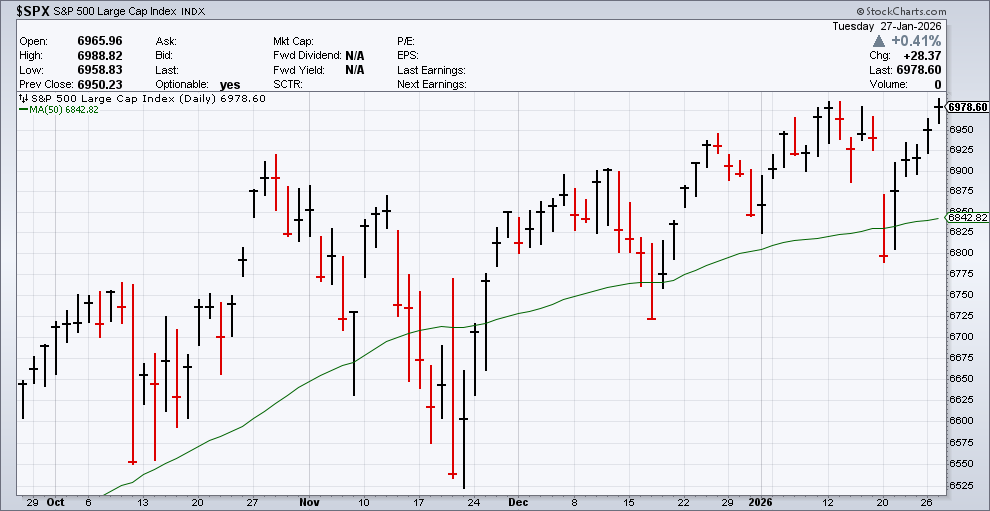
Wall Street is moving close to the heart of Q4 earnings season and we have some early numbers. So far, 13% of the companies in the S&P 500 have reported earnings. Of those, 75% have beaten expectations, and 69% have beaten on revenue. For Q4, the S&P 500 is on track to report earnings of 8.2%. If that’s right, then Q4 will be the 10th quarter in a row of earnings growth.
So far, six companies have issued positive guidance, and four have issued negative guidance. The index is currently going for 22.1 times forward earnings which is relatively high compared with the last 10 years.
The Magnificent 7 is expected to have Q4 earnings growth of 20.4%. If you exclude that from the S&P 500, then the other 493 companies are expected to show earnings growth of 4%.
For 2026, the Mag 7 are expected to have earnings growth of 22.8% while for the other 493 companies, it’s 12.1%. I should add that analysts have cut their estimates over the past few weeks. That’s a typical Wall Street tactic. Firms convince analysts to drop estimates far enough to where they can beat them, and then they claim victory while ignoring the previous estimate cuts.
On Tuesday, shares of United Health (UNH) plunged 20%. This is also important because UnitedHealth is a component in the Dow Jones Industrial Average. Since the Dow is price weighted, UNH’s fortunes have an outsized impact. Today’s drop dinged the Dow for more than 400 points.
The health insurer posted a modest earnings beat for Q4 ($2.11 vs. $2.10). Revenues were below expectations ($113.2 billion to $113.82 billion). Wall Street had been expecting $454.6 billion.
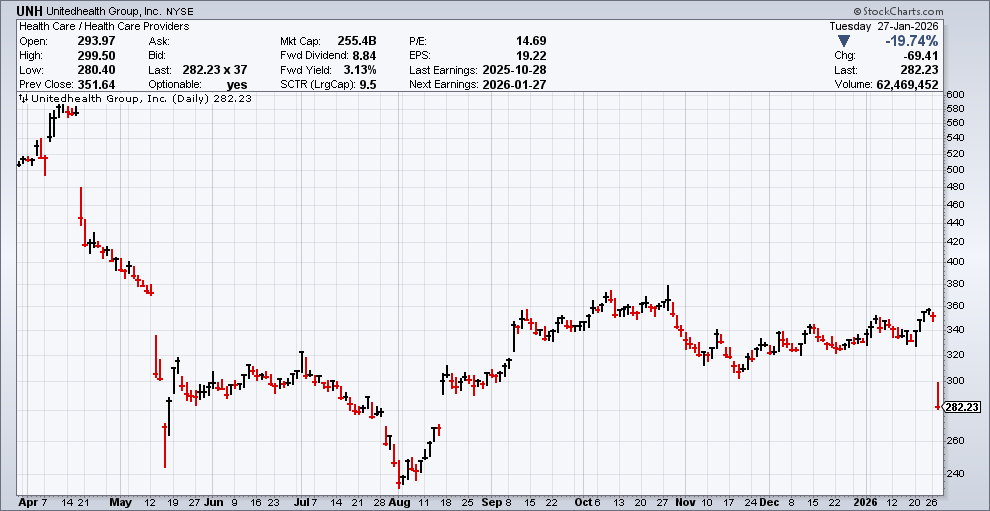
The problem was that UNH offered weak guidance for 2026. For this year, UNH expects revenues to fall by 2% to $430 billion. This is the first time in 10 years that United Health has had declining sales.
The WSJ reported on Tuesday that the Trump administration plans to keep the rates that it pays medical insurers steady. In 2027, payments would increase by an average of 0.09%. Wall Street had been expecting an increase of 4% to 6%. The increase for last year was 5%.
That news was enough to bring down several related stocks. For example, CVS (CVS) was down 14% on Tuesday.
Silver: The Poor Man’s Gold
In last week’s issue, I told you that the real action lately hasn’t been in the stock market. Instead, it’s been in the gold trading pits. In 18 months, the price for gold has doubled.
I actually understated that because even more intense action can be found in the silver trading pits. In two months, the price of solid silver has doubled.
Two years ago, you could have picked up an ounce of silver for just $22. Lately, silver has been going for $116 per ounce. Yesterday, Ag jumped by more than 14% before pulling back.
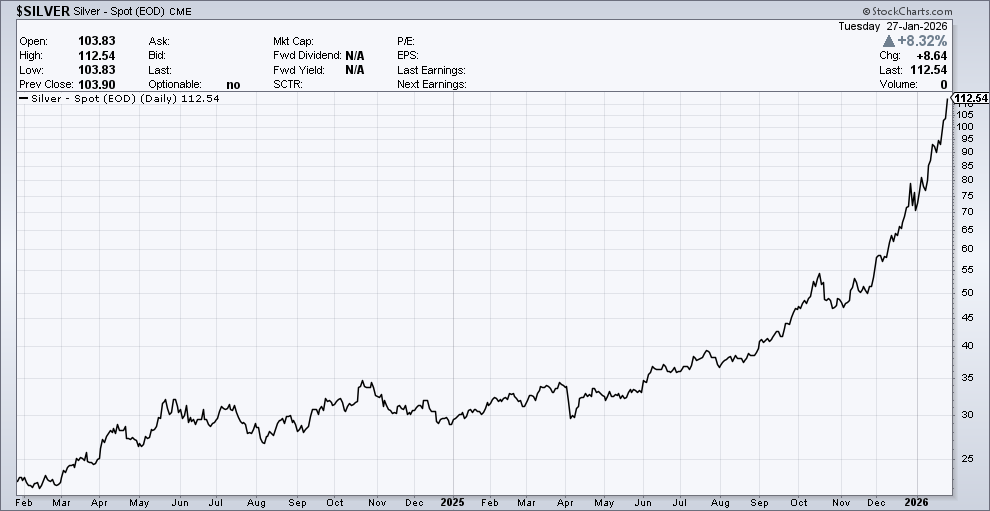
Gold broke $5,000 per ounce. This is all part of the “debasement trade.” The idea is that investors are shifting away from dollar-based assets. Other metals have also done well like copper, platinum and palladium.
Silver, which is often called “the poor man’s gold,” has a tendency to do whatever gold’s doing, just a lot more. If gold rallied by 10%, then silver is up by 20%. If gold drops by 10%, then silver is down by 20%.
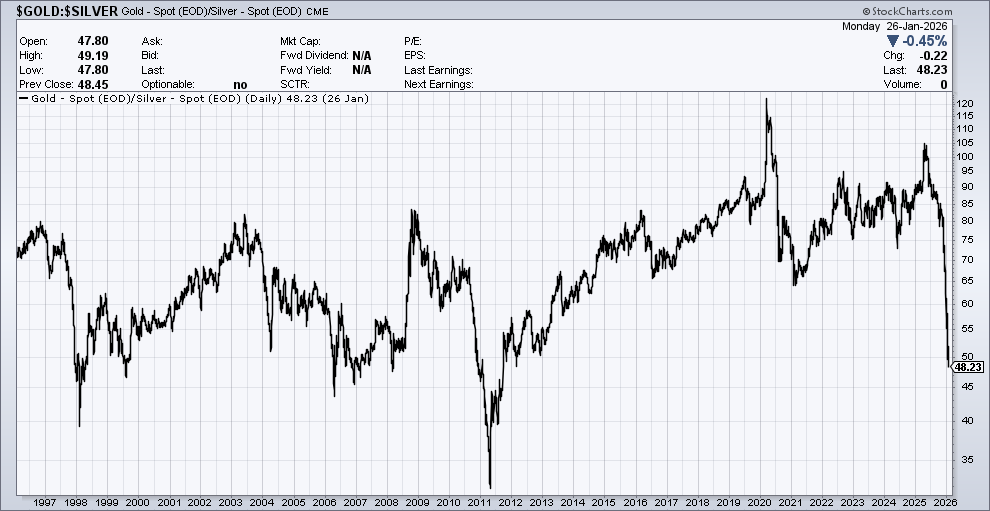
Gold now trades at less than 50 times silver. That’s the lowest gold/silver ratio in 15 years. During the early part of Covid, gold got to more than 130 times silver.
The Gold/Silver ratio has been an important ratio through history. In ancient Greece, the ratio fluctuated around 10:1 to 13:1. In King David’s time, it was 12:1. Julius Caesar had the ratio at 11.5:1.
In 1792, the U.S. Congress, at the advice of Alexander Hamilton, passed the Coinage Act of 1792. This was the government’s first attempt at price-fixing (and not the last). The act defined a U.S. dollar as 371.25 grams of silver or 24.75 grams of gold. In other words, Hamilton pegged the Gold/Silver ratio at 15. In 1834, Congress had to bump it up to 16.
In 1979-80, there was an absolutely crazy rally in silver when two Texas brothers tried to buy all the silver in the world. What’s even crazier is that if it hadn’t been for those meddling exchanges, they would have gotten away with it.
When Nelson Bunker Hunt and Herbert Hunt started their plan, silver was around $6 per ounce. By early 1980, it got to $50 per ounce. Time Magazine estimated they made between $2 billion and $4 billion in just nine months.
To pull this off, they had to borrow zillions of dollars. At one point, it was estimated that they held one-third of the world’s silver. Tiffany took out a full-page article to denounce them.
The Hunt brothers were the sons of the legendary oilman, Haroldson Lafayette “H.L” Hunt, Jr. Hunt the senior wrote a totally crazy novel based on his idea of a fascist utopia called “Alpaca.” I remember one person calling it “1984, but Big Brother is the good guy.”
Another brother was Lamar Hunt who was one of the most influential people in the development of modern football. He was the one who came up with the name “Super Bowl.” The winner of the AFC Championship Games gets the Lamar Hunt Trophy.
Anyway, back to silver. The Hunts were convinced that the Establishment was out to crush them and they were pretty much right. The exchange changed the margin requirement which forced the brothers to put up much more collateral.
(By the way, one of my first jobs in the industry was making margin calls. That’s not a metaphor. I had to actually call people to tell them they had to sell or put up more money.)
On March 27, 1980, the bottom fell out of the silver market. This is now known as “Silver Thursday.” The Hunts had to put up more money, but they couldn’t reach their margin requirement.
The government was worried (tell me if you’ve heard this one before) that Wall Street banks were so much in debt to the Hunts that if the Hunts went under, so would the banks. In fact, a silver panic could start a banking panic.
The Hunts had finally been broken. Silver didn’t make a new high for 45 years. The Hunts eventually become the models for brothers Randolph and Mortimer Duke in the movie Trading Places.
The Federal Reserve meets again this week. Don’t expect any change on interest rates. The futures market currently thinks there’s a 97% chance that the Fed will leave rates alone. The policy statement will come out tomorrow afternoon. I’ll be curious to see if Jerome Powell discusses the investigation by the DOJ.
Powell’s term ends in May, so he’ll be out in any event. The new frontrunner to be named Fed chair is Rick Rieder from BlackRock. He’s up to 47% at PolyMarket. Rieder has argued that productivity gains from AI have caused inflation to fall lower than we realize. This aligns with President Trump’s view. He appears to be a candidate who would both reassure Wall Street and be close to the president’s views.
Here’s an interesting exchange between Rieder and Barry Ritholtz in 2023:
RIEDER: It was. So Lehman paid a billion dollars for EF Hutton. And I was very lucky, there were 35 of us in the training program ad it looked like we all were going to get fired. And they took two of us, and I’m not sure how I made it through the strainer. But I found somebody who I really liked in the mortgage department and the mortgage agency, mortgage business, and took a liking to me and I went into the training program. You know, then by the way, it wasn’t like the crises ended between 1990 and the recession on the S&L dynamics.
And then in ‘94 and ‘98, you know, all had a different stream to 2002. By the way, it seemed like every four years —
RITHOLTZ: Right.
RIEDER: — there was — and then, you know, punctuating with obviously 2008. But boy, I mean, I went through — and I think I still have a scar tissue to this day of, you know, all of these — by the way, I think it’s an interesting cyclicality to markets, that every four years you need to recalibrate. You know, people are comfortable, leverage builds. And then all of a sudden, sometimes violently, it recalibrates. But I tell you, you know, going through it again in ’22, you know, you just know that the next couple of years are going to be pretty good because you just reprice things again. But I tell you going through those years, I’d love to skip those in my career.
RITHOLTZ: Mark your calendars for 2026.
That’s all for now. Earnings news to dominate the market this week along with the Fed meeting. I’ll have more for you in the next issue of CWS Market Review.
– Eddy
Posted by Eddy Elfenbein on January 27th, 2026 at 6:09 pm
The information in this blog post represents my own opinions and does not contain a recommendation for any particular security or investment. I or my affiliates may hold positions or other interests in securities mentioned in the Blog, please see my Disclaimer page for my full disclaimer.
-
Archives
- July 2026
- June 2026
- May 2026
- April 2026
- March 2026
- February 2026
- January 2026
- December 2025
- November 2025
- October 2025
- September 2025
- August 2025
- July 2025
- June 2025
- May 2025
- April 2025
- March 2025
- February 2025
- January 2025
- December 2024
- November 2024
- October 2024
- September 2024
- August 2024
- July 2024
- June 2024
- May 2024
- April 2024
- March 2024
- February 2024
- January 2024
- December 2023
- November 2023
- October 2023
- September 2023
- August 2023
- July 2023
- June 2023
- May 2023
- April 2023
- March 2023
- February 2023
- January 2023
- December 2022
- November 2022
- October 2022
- September 2022
- August 2022
- July 2022
- June 2022
- May 2022
- April 2022
- March 2022
- February 2022
- January 2022
- December 2021
- November 2021
- October 2021
- September 2021
- August 2021
- July 2021
- June 2021
- May 2021
- April 2021
- March 2021
- February 2021
- January 2021
- December 2020
- November 2020
- October 2020
- September 2020
- August 2020
- July 2020
- June 2020
- May 2020
- April 2020
- March 2020
- February 2020
- January 2020
- December 2019
- November 2019
- October 2019
- September 2019
- August 2019
- July 2019
- June 2019
- May 2019
- April 2019
- March 2019
- February 2019
- January 2019
- December 2018
- November 2018
- October 2018
- September 2018
- August 2018
- July 2018
- June 2018
- May 2018
- April 2018
- March 2018
- February 2018
- January 2018
- December 2017
- November 2017
- October 2017
- September 2017
- August 2017
- July 2017
- June 2017
- May 2017
- April 2017
- March 2017
- February 2017
- January 2017
- December 2016
- November 2016
- October 2016
- September 2016
- August 2016
- July 2016
- June 2016
- May 2016
- April 2016
- March 2016
- February 2016
- January 2016
- December 2015
- November 2015
- October 2015
- September 2015
- August 2015
- July 2015
- June 2015
- May 2015
- April 2015
- March 2015
- February 2015
- January 2015
- December 2014
- November 2014
- October 2014
- September 2014
- August 2014
- July 2014
- June 2014
- May 2014
- April 2014
- March 2014
- February 2014
- January 2014
- December 2013
- November 2013
- October 2013
- September 2013
- August 2013
- July 2013
- June 2013
- May 2013
- April 2013
- March 2013
- February 2013
- January 2013
- December 2012
- November 2012
- October 2012
- September 2012
- August 2012
- July 2012
- June 2012
- May 2012
- April 2012
- March 2012
- February 2012
- January 2012
- December 2011
- November 2011
- October 2011
- September 2011
- August 2011
- July 2011
- June 2011
- May 2011
- April 2011
- March 2011
- February 2011
- January 2011
- December 2010
- November 2010
- October 2010
- September 2010
- August 2010
- July 2010
- June 2010
- May 2010
- April 2010
- March 2010
- February 2010
- January 2010
- December 2009
- November 2009
- October 2009
- September 2009
- August 2009
- July 2009
- June 2009
- May 2009
- April 2009
- March 2009
- February 2009
- January 2009
- December 2008
- November 2008
- October 2008
- September 2008
- August 2008
- July 2008
- June 2008
- May 2008
- April 2008
- March 2008
- February 2008
- January 2008
- December 2007
- November 2007
- October 2007
- September 2007
- August 2007
- July 2007
- June 2007
- May 2007
- April 2007
- March 2007
- February 2007
- January 2007
- December 2006
- November 2006
- October 2006
- September 2006
- August 2006
- July 2006
- June 2006
- May 2006
- April 2006
- March 2006
- February 2006
- January 2006
- December 2005
- November 2005
- October 2005
- September 2005
- August 2005
- July 2005
 Eddy Elfenbein is a Washington, DC-based speaker, portfolio manager and editor of the blog Crossing Wall Street. His