CWS Market Review – March 17, 2026
(This is the free version of CWS Market Review. If you like what you see, then please sign up for the premium newsletter for $20 per month or $200 for the whole year. If you sign up today, you can see our two reports, “Your Handy Guide to Stock Orders” and “How Not to Get Screwed on Your Mortgage.”)
“Ship me Somewheres East of Hormuz”
The stock market posted a small gain today. It was the second daily gain in a row. Thanks to some bearish sentiment earlier this month, March could go down as the weakest month in a year. Frankly, the stock market has been rather boring over the last few days.
Don’t get me wrong, I like a boring market. The big question now is how much of an energy shock the U.S. economy can handle. This is no longer 1973, so I suspect we can absorb a lot. So far, the impact on the stock market has been modest. I don’t know how long that will last but I’m sure a lot will depend on the Strait of Hormuz.
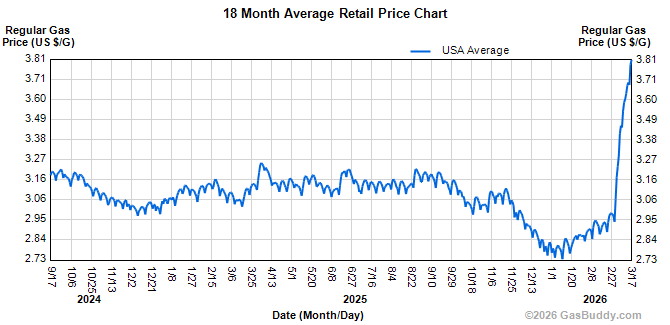
The oil shock has already been felt. Check out this chart from Gasbuddy for prices at the pump.
Last week, the government released a disappointing GDP growth report for Q4. I’ll go over the details in a bit, but first, I want to pay my respects to the late Paul Ehrlich.
RIP: Paul R. Ehrlich
Dr. Paul R. Ehrlich died on Friday at the age of 93. Ehrlich achieved a degree of fame in the 1960s and 70s with a string of pronouncements predicting that the planet was quickly headed towards mass starvation.
In 1968, he laid out his beliefs in the book The Population Bomb. He advocated that couples have no more than one or two children.
Ehrlich quickly became something of a celebrity apocalyptic. He appeared on Johnny Carson 20 times where he predicted famine and food riots. Ehrlich said 65 million Americans will starve to death.

The public loved it. The Population Bomb sold more than three million copies. In 1974, Ehrlich and his wife wrote The End of Affluence which held that “before 1985, mankind will enter a genuine age of scarcity.” Ehrlich later said, “If I were a gambler, I would take even money that England will not exist in the year 2000.”
You might say that he was a wee bit off. Or as the New York Times put it, “he faced criticism when his predictions proved premature.” Yes, premature.
There must be something deep down in the human psyche that refuses to believe that things are getting better and that Doomsday is coming next Tuesday.
I’ve been writing investment newsletters for 30 years and I certainly could have grabbed a bigger audience telling people that the world was done for.
In truth, being an investor means believing in a better tomorrow. Of course we have many problems that need urgent addressing, but we have to bear in mind the stunning progress that we’ve made.
A few years ago, Hans Rosling wrote a book called Factfulness which outlined how poorly people understood the trends of progress. Consider this question:
In the last 20 years, the proportion of the world population living in extreme poverty has…
A. Almost doubled.
B. Remained more or less the same.
C. Almost halved.
The answer is C. Only 5% of Americans got it right. In the last 20 years. Global poverty has fallen from 34% in 1993 to 10% in 2013. Longer-term, the global population living on an inflation-adjusted $2 a day or less is down from 50% in 1966 to 9% in 2017. An average of 100,000 people left extreme poverty every day for the last 35 years.
How about this question: How many of the world’s 1-year-old children today have been vaccinated against some disease?
A. 20%
B. 50%
C. 80%
Again, the answer is C: 80%, and now it’s closer to 90%. Only 17% of Americans got it right.
The end of the world was a big thing in the 1970s with movies like Soylent Green. In that movie, the world was dealing overpopulation, pollution and poverty. The movie takes place in 2022.
If you predict the Apocalypse and you’re wrong, you’re rarely held to account.
In 1980, the economist Julian Simon bet Ehrlich that the prices of five metals would go lower over the next 10 years, but Ehrlich thought they’d go higher. Simon allowed Ehrlich to pick the metals of his choice. Erlich chose copper, chromium, nickel, tin, and tungsten.
All five went down. Tin and tungsten fell by more than half. Ehrlich paid up. Over that decade, the world’s population increased by 800 million. Also in 1990, Ehrlich won a MacArthur prize.
In 1981, Simon wrote The Ultimate Resource which said that the world was not running out of resources. He said that the rise in price of a resource makes a greater incentive to extract it more efficiently. Simon said that adjusting for inflation and wages, the price for resources has been falling for decades. The ultimate resource is human ingenuity.
Academic studies have shown that over the long-term, stocks have beaten every other investment category. The key is that stocks are different from assets. Assets are things, like Ehrlich’s metals. They don’t do anything by themselves. Gold doesn’t do anything. It’s a metal (or element). Same for bitcoin, or a house. These assets only have economic relevance once they come in contact with people who can employ them.
It’s interesting that Ehrlich was completely unbothered by the fact that his predictions were wrong. This is something else you see a lot of in finance. For example, 65 million Americans didn’t starve to death, but Ehrlich kept right along. He even said, “My language would be even more apocalyptic today.”
So he got a few predictions wrong. It’s not the end of the world.
GDP Growth Revised Downward to 0.7%
On Friday, the Commerce Department said the U.S. economy grew by just 0.7% during the last quarter of 2025. That number is annualized and adjusted for inflation. Wall Street had been expecting growth of 1.5%. Last month, the initial report said the economy grew by 1.5% during Q4.
Here’s the quarterly growth rate of GDP for the last several quarters.
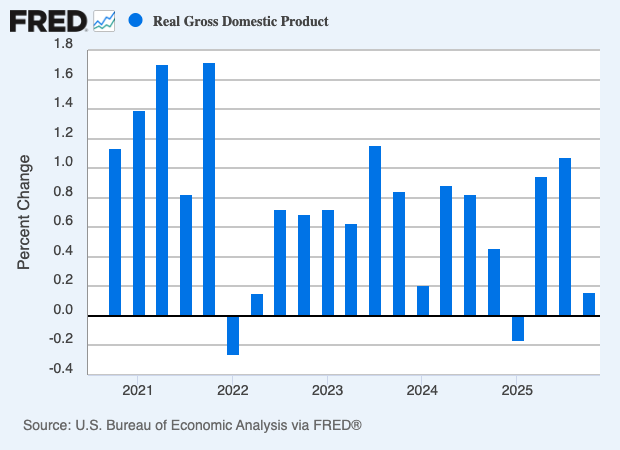
Thanks to the government shutdown, government spending fell by 16.7%. This was a big change from Q3 when the economy grew by 4.4%. For the whole year, the economy grew by 2.1%. Last year had the third-slowest growth of the last 14 years.
According to the BEA, the downward revision came due to adjustments in consumer and government spending and exports. A decline in imports, which technically subtract from GDP, also was less than the previous estimate.
Consumer spending rose 2% for the quarter, following a 0.4 percentage point downward revision that represented a decline from the 3.5% increase in the third quarter. The largest contribution for the downward revision from services, specifically health care spending, according to the release.
We also got the PCE numbers for January which is the Fed’s preferred measure of inflation. It showed that prices increased by 0.3% in January and by 2.8% over the last 12 months. Core PCE inflation rose by 0.4% in January, and by 3.1% over the last year.
The report also said that personal income and spending in January both increased by 0.4%, and the personal savings rate rose to 4.5%. Note that this data came before the start of military operations against Iran.
The Federal Reserve meets again tomorrow, and you can forget about any rate cut. The futures market currently has the Fed doing nothing at 99.1%. That’s about 0.89999% too low.
That threat of inflation, which was an issue before the war, is a bigger one now. Put it this way: baseball is currently in spring training, and traders don’t see the Fed cutting rates until three days after the regular season ends.
That’s all for now. The Federal Reserve’s policy statement will be out tomorrow afternoon. I’ll have more for you in the next issue of CWS Market Review.
– Eddy
Posted by Eddy Elfenbein on March 17th, 2026 at 6:27 pm
The information in this blog post represents my own opinions and does not contain a recommendation for any particular security or investment. I or my affiliates may hold positions or other interests in securities mentioned in the Blog, please see my Disclaimer page for my full disclaimer.
-
Archives
- October 2026
- September 2026
- August 2026
- July 2026
- June 2026
- May 2026
- April 2026
- March 2026
- February 2026
- January 2026
- December 2025
- November 2025
- October 2025
- September 2025
- August 2025
- July 2025
- June 2025
- May 2025
- April 2025
- March 2025
- February 2025
- January 2025
- December 2024
- November 2024
- October 2024
- September 2024
- August 2024
- July 2024
- June 2024
- May 2024
- April 2024
- March 2024
- February 2024
- January 2024
- December 2023
- November 2023
- October 2023
- September 2023
- August 2023
- July 2023
- June 2023
- May 2023
- April 2023
- March 2023
- February 2023
- January 2023
- December 2022
- November 2022
- October 2022
- September 2022
- August 2022
- July 2022
- June 2022
- May 2022
- April 2022
- March 2022
- February 2022
- January 2022
- December 2021
- November 2021
- October 2021
- September 2021
- August 2021
- July 2021
- June 2021
- May 2021
- April 2021
- March 2021
- February 2021
- January 2021
- December 2020
- November 2020
- October 2020
- September 2020
- August 2020
- July 2020
- June 2020
- May 2020
- April 2020
- March 2020
- February 2020
- January 2020
- December 2019
- November 2019
- October 2019
- September 2019
- August 2019
- July 2019
- June 2019
- May 2019
- April 2019
- March 2019
- February 2019
- January 2019
- December 2018
- November 2018
- October 2018
- September 2018
- August 2018
- July 2018
- June 2018
- May 2018
- April 2018
- March 2018
- February 2018
- January 2018
- December 2017
- November 2017
- October 2017
- September 2017
- August 2017
- July 2017
- June 2017
- May 2017
- April 2017
- March 2017
- February 2017
- January 2017
- December 2016
- November 2016
- October 2016
- September 2016
- August 2016
- July 2016
- June 2016
- May 2016
- April 2016
- March 2016
- February 2016
- January 2016
- December 2015
- November 2015
- October 2015
- September 2015
- August 2015
- July 2015
- June 2015
- May 2015
- April 2015
- March 2015
- February 2015
- January 2015
- December 2014
- November 2014
- October 2014
- September 2014
- August 2014
- July 2014
- June 2014
- May 2014
- April 2014
- March 2014
- February 2014
- January 2014
- December 2013
- November 2013
- October 2013
- September 2013
- August 2013
- July 2013
- June 2013
- May 2013
- April 2013
- March 2013
- February 2013
- January 2013
- December 2012
- November 2012
- October 2012
- September 2012
- August 2012
- July 2012
- June 2012
- May 2012
- April 2012
- March 2012
- February 2012
- January 2012
- December 2011
- November 2011
- October 2011
- September 2011
- August 2011
- July 2011
- June 2011
- May 2011
- April 2011
- March 2011
- February 2011
- January 2011
- December 2010
- November 2010
- October 2010
- September 2010
- August 2010
- July 2010
- June 2010
- May 2010
- April 2010
- March 2010
- February 2010
- January 2010
- December 2009
- November 2009
- October 2009
- September 2009
- August 2009
- July 2009
- June 2009
- May 2009
- April 2009
- March 2009
- February 2009
- January 2009
- December 2008
- November 2008
- October 2008
- September 2008
- August 2008
- July 2008
- June 2008
- May 2008
- April 2008
- March 2008
- February 2008
- January 2008
- December 2007
- November 2007
- October 2007
- September 2007
- August 2007
- July 2007
- June 2007
- May 2007
- April 2007
- March 2007
- February 2007
- January 2007
- December 2006
- November 2006
- October 2006
- September 2006
- August 2006
- July 2006
- June 2006
- May 2006
- April 2006
- March 2006
- February 2006
- January 2006
- December 2005
- November 2005
- October 2005
- September 2005
- August 2005
- July 2005
 Eddy Elfenbein is a Washington, DC-based speaker, portfolio manager and editor of the blog Crossing Wall Street. His