CWS Market Review – April 7, 2026
(This is the free version of CWS Market Review. If you like what you see, then please sign up for the premium newsletter for $20 per month or $200 for the whole year. If you sign up today, you can see our two reports, “Your Handy Guide to Stock Orders” and “How Not to Get Screwed on Your Mortgage.”)
On Tuesday, the stock market rose for its fifth day in a row. While that rally has been good to see, I tend to be skeptical of any stock market rally that comes in the midst of a larger selloff. Wall Street loves to throw head fakes and phony rallies our way.
A good sign of a true turnaround is when the S&P 500 crosses above its 50- and 200-day moving averages. We’re still a long way from that happening.
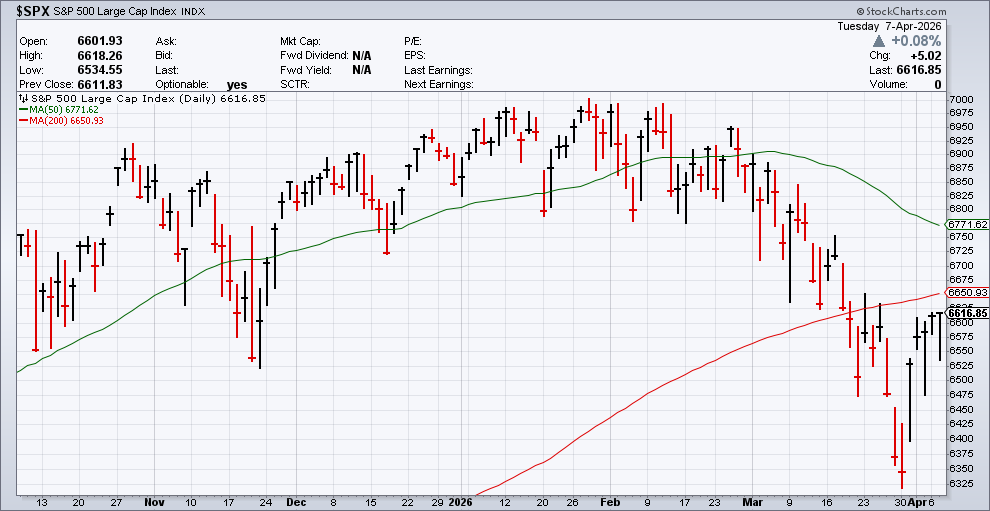
The stock market’s last all-time high was on January 27. Interestingly, the drawdown really didn’t start moving until February 25, but since then, the S&P 500 hasn’t been able to get much momentum against the bears.
Frankly, Tuesday was a rather blah day for the markets. At one point, shares of Apple were down by 5%. There was talk of engineering delays in its foldable iPhone. Shares of Home Depot, Trade Desk and Kimberly-Clark all made new 52-week lows today.
There are a few things coming soon that could alter Wall Street’s outlook. The first would be a quick resolution to military operations against Iran. I wouldn’t even try to guess what could happen, or when, but this is a major concern for investors. The price for oil has been rallying again. Oil has recently been as high as $115 per barrel, and it’s not far from its big jump at the start of this conflict.
Another big event coming our way will be Q1 earnings season. The unofficial kickoff of earnings season comes next Tuesday, April 14. That’s when JPMorgan, Citigroup, Wells Fargo, BlackRock and Johnson & Johnson are due to report. Not long after that, the earnings reports will come in a big flurry.
The big banks tend to report early in the earnings season. In fact, Goldman Sachs will report on Monday, but it may be the only major bank that will do that.
The other big event will come at the end of April when the Federal Reserve meets again. It’s very doubtful that the Fed will make any move on interest rates, but we may learn more what the Fed has planned for later this year.
At the moment, Wall Street seems unconvinced that the Fed will do much of anything over the next several months. In fact, traders don’t expect any move—up or down—from the Fed over the next 12 months.
Dissecting Nike’s Fall
In today’s issue. I want to take a closer look at Nike (NKE). The former all-star is stuck in the mud, and it can’t seem to do anything right.
As investors, we want to look at any lessons we can draw from Nike. It’s a good reminder that in a free enterprise system, no company is safe. Time and chance happeneth to us all.
Here’s a weekly chart of the last five years:
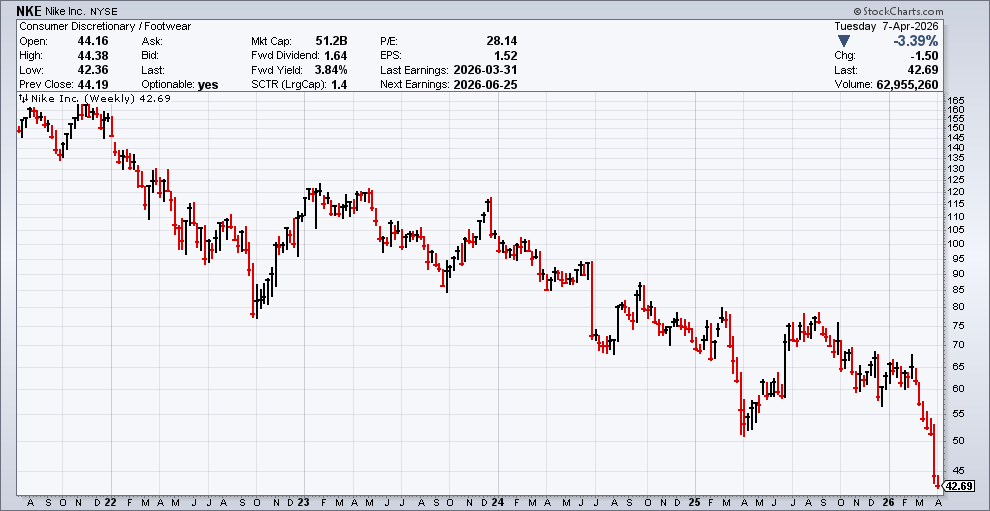
Last week, shares of Nike got taken to the woodshed. In one day, the sneaker company lost over 15% of its value, and it’s continued to slide from there. Nike had been falling going into last week’s big drop. In fact, Nike has been sliding for a few years.
As investors, it’s important for us to examine why and how good companies can go off the rails.
Since Nike’s all-time high in November 2021, the stock has fallen more than 75%. Remember that on Wall Street, one 75% drop is effectively two back-to-back 50% drops. This is a massive reversal of fortune. In the 37 years prior to Nike’s peak, the stock gained 18,000%, and that’s before dividends.
What went wrong? The short answer is—everything. The stock is back to where it was 12 years ago. Nike now has a market value of about $62 billion which makes it the smallest member of the Dow Jones Industrial Average. For some perspective, Nvidia is about 70 times more valuable than Nike.
It’s as if they looked at the competitive landscape and then decided to do everything wrong. There are a lot of lessons to be learned here.
Nike held an all-hands meeting this week. CEO Elliott Hill, who was called out of retirement to lead the sneaker outfit, said, “I’m so tired, and I know you are too, of talking about fixing this business.”
Nike beat earnings, but the details were not good. For the quarter, Nike made 35 cents per share on revenue of $11.28 billion. Wall Street had been expecting 28 cents per share, Still, there are many problems for Nike. For example, Nike’s margins continue to shrink, and sales in China fell by 7%.
Sales are basically flat in North America even though earnings are getting smaller. Nike said that sales will fall between 2% and 4% this quarter, and sales in China are expected to be down by 20% for the year.
Flat sales and lower margins mean they’re slashing prices just to tread water. That’s the thing about business: there’s no easy way out of a lousy product.
Here’s a chart that says a lot. This is NKE’s percentage gain over the last 40 years:
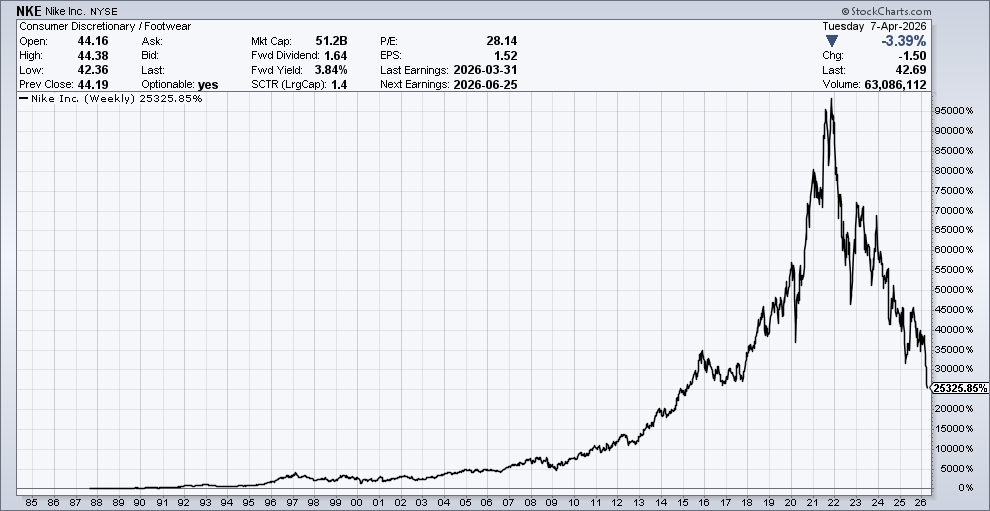
What’s particularly frustrating is that Nike has already been in turnaround mode, but it’s simply not showing results. The company said it needs more time, but at some point, they need to rethink their strategy. Shareholders have been very patient, and now they’re not. The benefit of telling shareholders that you’re in a turnaround strategy is that it grants you leeway to make major changes, but Nike hasn’t done that.
The company, especially previous management, made several missteps. For example, Nike placed too much emphasis on direct-to-consumer (DTC) sales. This came at the expense of their partners for wholesale business (think department stores).
This move completely backfired. This strategy alienated retailers, who then gave more shelf space to Nike’s competitors. The wholesale numbers have gotten a little better, but that took a lot of discounting, and that comes at the expense of margins.
Nike also tended to rest on its laurels. They assumed their old best-sellers would carry the load. With footwear, you have to be fresh. That means sports and athletes. Once your shoe becomes uncool, your competitors will eat you alive.
Nike’s other big problem is China. Nike had done well in China, but domestic competition and a bloated inventory of older shoes drove China’s business down. Sales in China are expected to be down by 20% this year.
Then there are tariffs. Oh boy, this a tough one. Nike’s shoes are made in the developing regions of Asia, particularly China and Vietnam. New U.S. tariffs are expected to add over $1 billion in costs. That will hit gross margins. Nike is working to diversify its supplies, but that will take time.
There are some reasons for (limited) optimism. Wholesale is looking a little better. Margins could stabilize soon. The brand is still strong, and it’s known all over the world. Of course, the stock price is low. Or it’s lower than where it was.
In FY 2024, Nike made close to $4 per share. This year, they’ll probably make $1.50 per share. Next year, maybe $1.85 per share. Is that worth $42 per share? Not to me. I won’t even consider Nike until the company has shown evidence that business has improved.
That’s all for now. The GDP report will be this Thursday, and the CPI report will be on Friday. Stay tuned! I’ll have more for you in the next issue of CWS Market Review.
– Eddy
Posted by Eddy Elfenbein on April 7th, 2026 at 7:39 pm
The information in this blog post represents my own opinions and does not contain a recommendation for any particular security or investment. I or my affiliates may hold positions or other interests in securities mentioned in the Blog, please see my Disclaimer page for my full disclaimer.
-
Archives
- October 2026
- September 2026
- August 2026
- July 2026
- June 2026
- May 2026
- April 2026
- March 2026
- February 2026
- January 2026
- December 2025
- November 2025
- October 2025
- September 2025
- August 2025
- July 2025
- June 2025
- May 2025
- April 2025
- March 2025
- February 2025
- January 2025
- December 2024
- November 2024
- October 2024
- September 2024
- August 2024
- July 2024
- June 2024
- May 2024
- April 2024
- March 2024
- February 2024
- January 2024
- December 2023
- November 2023
- October 2023
- September 2023
- August 2023
- July 2023
- June 2023
- May 2023
- April 2023
- March 2023
- February 2023
- January 2023
- December 2022
- November 2022
- October 2022
- September 2022
- August 2022
- July 2022
- June 2022
- May 2022
- April 2022
- March 2022
- February 2022
- January 2022
- December 2021
- November 2021
- October 2021
- September 2021
- August 2021
- July 2021
- June 2021
- May 2021
- April 2021
- March 2021
- February 2021
- January 2021
- December 2020
- November 2020
- October 2020
- September 2020
- August 2020
- July 2020
- June 2020
- May 2020
- April 2020
- March 2020
- February 2020
- January 2020
- December 2019
- November 2019
- October 2019
- September 2019
- August 2019
- July 2019
- June 2019
- May 2019
- April 2019
- March 2019
- February 2019
- January 2019
- December 2018
- November 2018
- October 2018
- September 2018
- August 2018
- July 2018
- June 2018
- May 2018
- April 2018
- March 2018
- February 2018
- January 2018
- December 2017
- November 2017
- October 2017
- September 2017
- August 2017
- July 2017
- June 2017
- May 2017
- April 2017
- March 2017
- February 2017
- January 2017
- December 2016
- November 2016
- October 2016
- September 2016
- August 2016
- July 2016
- June 2016
- May 2016
- April 2016
- March 2016
- February 2016
- January 2016
- December 2015
- November 2015
- October 2015
- September 2015
- August 2015
- July 2015
- June 2015
- May 2015
- April 2015
- March 2015
- February 2015
- January 2015
- December 2014
- November 2014
- October 2014
- September 2014
- August 2014
- July 2014
- June 2014
- May 2014
- April 2014
- March 2014
- February 2014
- January 2014
- December 2013
- November 2013
- October 2013
- September 2013
- August 2013
- July 2013
- June 2013
- May 2013
- April 2013
- March 2013
- February 2013
- January 2013
- December 2012
- November 2012
- October 2012
- September 2012
- August 2012
- July 2012
- June 2012
- May 2012
- April 2012
- March 2012
- February 2012
- January 2012
- December 2011
- November 2011
- October 2011
- September 2011
- August 2011
- July 2011
- June 2011
- May 2011
- April 2011
- March 2011
- February 2011
- January 2011
- December 2010
- November 2010
- October 2010
- September 2010
- August 2010
- July 2010
- June 2010
- May 2010
- April 2010
- March 2010
- February 2010
- January 2010
- December 2009
- November 2009
- October 2009
- September 2009
- August 2009
- July 2009
- June 2009
- May 2009
- April 2009
- March 2009
- February 2009
- January 2009
- December 2008
- November 2008
- October 2008
- September 2008
- August 2008
- July 2008
- June 2008
- May 2008
- April 2008
- March 2008
- February 2008
- January 2008
- December 2007
- November 2007
- October 2007
- September 2007
- August 2007
- July 2007
- June 2007
- May 2007
- April 2007
- March 2007
- February 2007
- January 2007
- December 2006
- November 2006
- October 2006
- September 2006
- August 2006
- July 2006
- June 2006
- May 2006
- April 2006
- March 2006
- February 2006
- January 2006
- December 2005
- November 2005
- October 2005
- September 2005
- August 2005
- July 2005
 Eddy Elfenbein is a Washington, DC-based speaker, portfolio manager and editor of the blog Crossing Wall Street. His