CWS Market Review – May 19, 2026
(This is the free version of CWS Market Review. If you like what you see, then please sign up for the premium newsletter for $20 per month or $200 for the whole year. If you sign up today, you can see our two reports, “Your Handy Guide to Stock Orders” and “How Not to Get Screwed on Your Mortgage.”)
For the third day in a row, the Nasdaq closed lower than where it had been the day before. Also, for the third day in a row, the Nasdaq trailed the overall market.
Normally, this is a fairly benign event. This time, however, it’s notable because the tech sector has been phenomenally strong for so long that any weakness, even minor stuff, gets my attention.
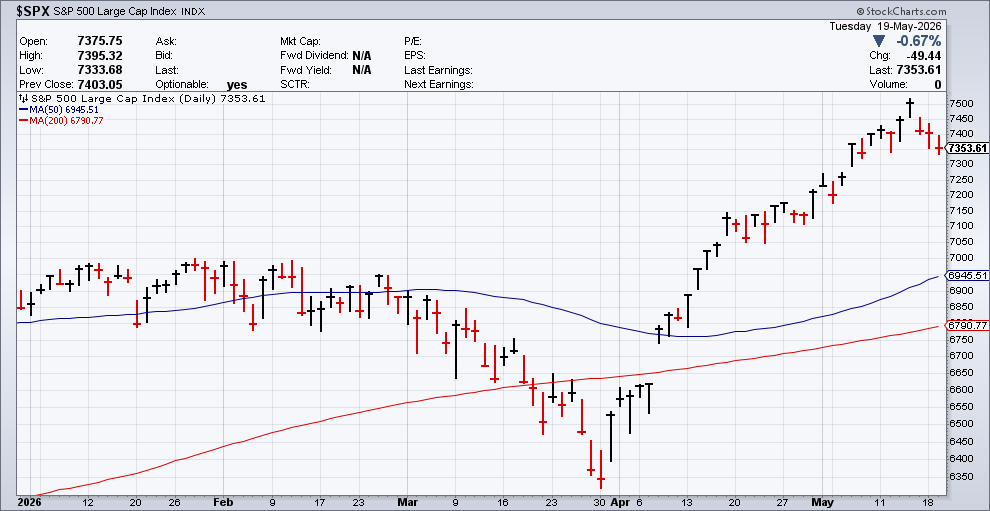
There’s a growing chorus on Wall Street that’s eager to declare this market a bubble. Maybe, but that’s a game I try to avoid. However, I will concede that if there were a bubble, this is pretty much how I’d expect it to begin.
What do I mean by that? Let’s start with the bond market. Historically, the bond market leads the stock market by a few months—usually around six months, sometimes more, sometimes less, but almost always, it’s first.
Lately, the bond market hasn’t looked so good. You can tell when investors run screaming from safe assets and plunge head-first into risky ones that everything might not be so kosher. That’s been the story of the last six weeks, and it may be unwinding.
Things are changing, albeit slowly. Indeed, yields on longer-dated Treasuries have been creeping higher. The yield on the 10-year Treasury is getting close to 4.7%. In February, it was under 4%. The yield on the 30-year Treasury is the highest it’s been since 2007.
At some point, investors will wonder if it’s easier to park their money in a safe Treasury and make a boring 4.7% versus riding a chaotic and overpriced stock market. The volatility doesn’t bother me much, but I know it bothers some investors, and it doesn’t take much to trigger a sector rotation.
Here’s a look at the Long-Term Treasury ETF (TLT):
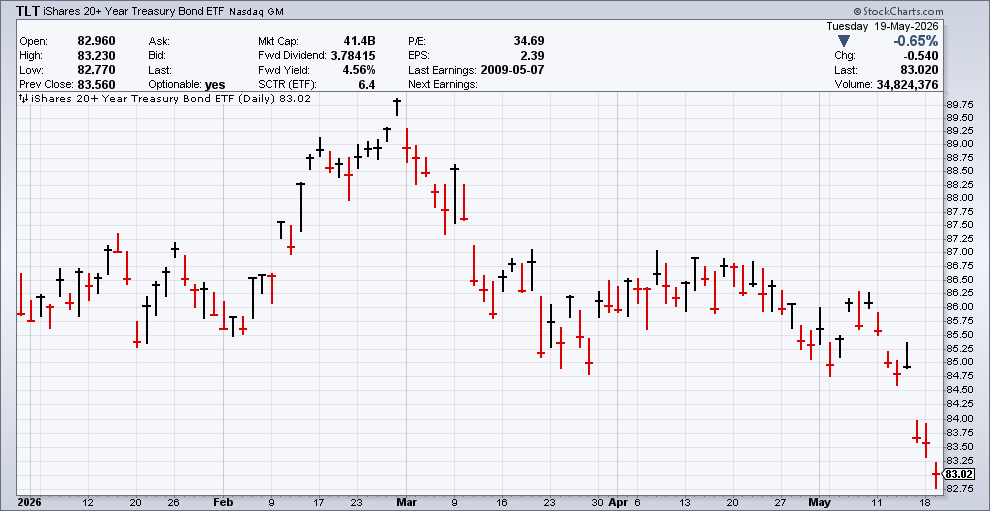
Strategists at Barclays and Citigroup both said that the 10-year yield could hit 5.5%. That would be a big deal. We haven’t seen these levels in over 20 years.
Think of the financial markets as an endless tug-of-war between safe and secure bonds versus riskier stocks. You know something’s up when one side completely creams the other, and that’s what’s happened this year. Stocks soared and bonds did nothing. Now the attractiveness of bonds is starting to show.
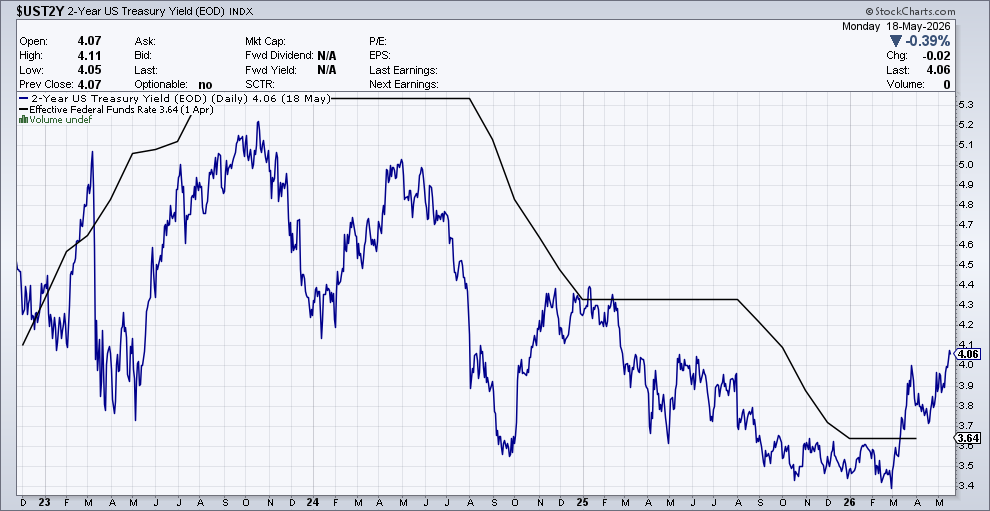
It doesn’t end there. Higher yields will also cause problems for the Federal Reserve. A good way of guessing what the Fed will do is to keep an eye on the two-year Treasury yield. The two-year yield has a habit of doing whatever the Fed does, just a little bit sooner.
The two-year yield has drifted up to 4.1%. Meanwhile, the Fed’s current range for interest rates is 3.5% to 3.75% (see below). This suggests that the market is putting pressure on the Fed to hike rates. Of course, it doesn’t mean that the Fed will follow, but the market doesn’t like being ignored.
As far as interest rates go, for now, the futures market is a doubter. The latest futures prices see the Fed hiking rates once before the end of the year. President Trump has said he wanted to see rates go down to 1%. I’m not so sure he’ll get his wish.
Tomorrow, the Fed will release the minutes from its most-recent meeting. The Fed minutes is normally the dullest report you can possibly imagine, but this new one might actually be a tiny bit interesting. That’s because there were four dissenting votes in the last policy statement.
I should explain that the Fed hates dissension. Even where there’s disagreement, the Fed will often defer to whatever the Fed chairman wants while making their objections known privately. One or two dissenting votes is rare but four is highly unusual. It’s the most dissenting votes in 34 years.
The other issue is that Jerome Powell is hanging around at the Fed, but not as chairman. Kevin Warsh has officially taken over that role. Could the Fed gradually have, in effect, competing Fed chairs? What happens if most members of the FOMC follow what Powell advocates instead of Warsh? It could happen. There’s no rule that says they can’t.
There’s also no rule that says that stocks and bonds can’t move in opposite directions, and that’s what we’ve seen. Not only do we see this risk divided between the markets, but we also see it within the markets. For example, value stocks have finally perked up after being trounced for so long by growth stocks.
Boring stocks are suddenly in. If you recall in last week’s issue, I told you about Sprouts Farmers Market. The stock gapped up 6.5% after the last earnings reports. Well, it didn’t stop there. The stock gained 3.5% yesterday, plus it was up over 7% today before it pulled back. SFM is now up 30% off last month’s low.
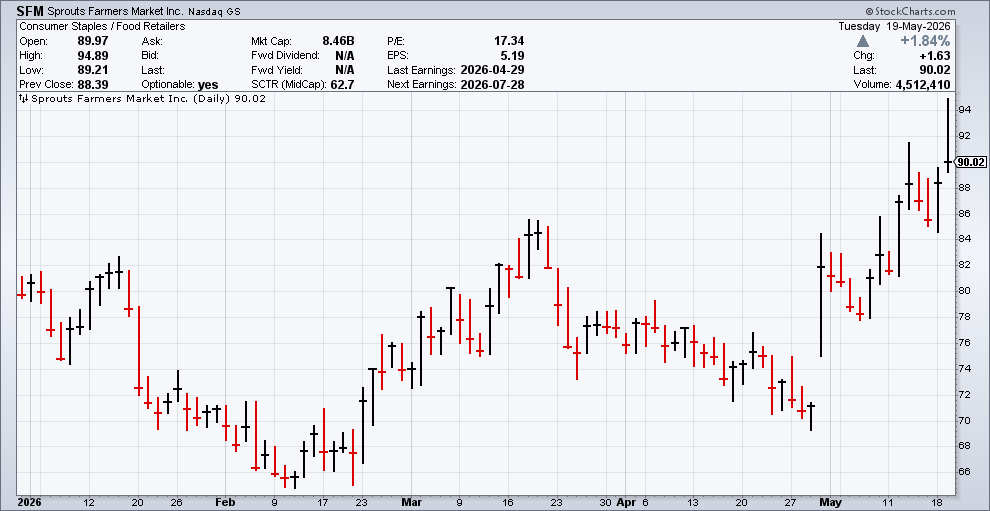
Beyond the optimistic earnings report, nothing has changed with SFM. It’s just that investors are finally more welcoming to stocks like Sprouts.
Weakness at the Big Boxes
This morning, we got a report that homebuilder confidence rose in May, but that’s coming off a steep low. The housing market is still soft, and many homebuilders are cutting prices to keep their sales going.
The report on pending home sales also increased by a bit, but here, too, there are some growing problems just under the surface. The major problem is affordability, and many potential buyers have been priced out of the market. Rising energy prices have also been a factor as that takes a big bite out of consumers’ finances.
Home Depot (HD) reported its earnings earlier today. In my mind, this is probably a better report on how the economy is really doing than most government reports.
For the three months ended on May 3, HD said that its same-store sales rose by just 0.6%. That’s not so hot. If more Americans are upgrading their homes, that’s a good signal of future growth. Home Depot’s CFO, Richard McPhail, said, “There’s no question that the average consumer is feeling pressure from rising fuel costs.”
On the plus side, HD maintained its full-year guidance, but I can assure you that higher rates will not help HD’s business. More earnings from the big box boys are to come. Target (TGT) reports tomorrow and Walmart (WMT) reports on Thursday.
Fly Me to the Moon…
At some point in the next few weeks, SpaceX will have its initial public offering. This has caused confusion for many on Wall Street.
On one hand, the company is obviously massively overpriced, but that calculation is based on conventional evaluation models and with Elon Musk, as usual, we’re dealing with something highly unconventional.
So the question is, how can you value SpaceX at all? One fact we’ve learned is that betting against Elon Musk has proved to be a risky proposition.
The company doesn’t have a ticker symbol yet, but SPCX seems to be the front runner. There’s also no IPO date yet, but rumors say it could be as early as June 12. Another possibility is June 28 which is Elon’s birthday. There’s also talk of the company having a five-for-one split ahead of the IPO.
We do know that after the IPO, Musk will own around 40% of the outstanding shares. Moreover, he has said that he has no plans to sell any stock. This means that if the company is given a value of say $1.5 to $2 trillion, that would make Musk the world’s first trillionaire. By trillionaire, we mean a person who is a millionaire one million times over.
For now, FOMO, the fear of missing out, seems to have overridden everything. No one wants to be left behind, especially when it involves Elon Musk.
Bank of America has already developed a basket of 35 stocks that are tied to the emerging space market. Of course, the connection that many of these companies have can be very faint. As long as it says “space” in their business models, investors will be interested.
I’m a fan of SpaceX, but I can’t say that I’m an eager investor. I’d love to be proven wrong.
That’s all for now. There will be no newsletter next week. I’m taking off in honor of Memorial Day. We’ll be back on June 2 with our next issue of CWS Market Review.
– Eddy
Posted by Eddy Elfenbein on May 19th, 2026 at 6:13 pm
The information in this blog post represents my own opinions and does not contain a recommendation for any particular security or investment. I or my affiliates may hold positions or other interests in securities mentioned in the Blog, please see my Disclaimer page for my full disclaimer.
-
Archives
- October 2026
- September 2026
- August 2026
- July 2026
- June 2026
- May 2026
- April 2026
- March 2026
- February 2026
- January 2026
- December 2025
- November 2025
- October 2025
- September 2025
- August 2025
- July 2025
- June 2025
- May 2025
- April 2025
- March 2025
- February 2025
- January 2025
- December 2024
- November 2024
- October 2024
- September 2024
- August 2024
- July 2024
- June 2024
- May 2024
- April 2024
- March 2024
- February 2024
- January 2024
- December 2023
- November 2023
- October 2023
- September 2023
- August 2023
- July 2023
- June 2023
- May 2023
- April 2023
- March 2023
- February 2023
- January 2023
- December 2022
- November 2022
- October 2022
- September 2022
- August 2022
- July 2022
- June 2022
- May 2022
- April 2022
- March 2022
- February 2022
- January 2022
- December 2021
- November 2021
- October 2021
- September 2021
- August 2021
- July 2021
- June 2021
- May 2021
- April 2021
- March 2021
- February 2021
- January 2021
- December 2020
- November 2020
- October 2020
- September 2020
- August 2020
- July 2020
- June 2020
- May 2020
- April 2020
- March 2020
- February 2020
- January 2020
- December 2019
- November 2019
- October 2019
- September 2019
- August 2019
- July 2019
- June 2019
- May 2019
- April 2019
- March 2019
- February 2019
- January 2019
- December 2018
- November 2018
- October 2018
- September 2018
- August 2018
- July 2018
- June 2018
- May 2018
- April 2018
- March 2018
- February 2018
- January 2018
- December 2017
- November 2017
- October 2017
- September 2017
- August 2017
- July 2017
- June 2017
- May 2017
- April 2017
- March 2017
- February 2017
- January 2017
- December 2016
- November 2016
- October 2016
- September 2016
- August 2016
- July 2016
- June 2016
- May 2016
- April 2016
- March 2016
- February 2016
- January 2016
- December 2015
- November 2015
- October 2015
- September 2015
- August 2015
- July 2015
- June 2015
- May 2015
- April 2015
- March 2015
- February 2015
- January 2015
- December 2014
- November 2014
- October 2014
- September 2014
- August 2014
- July 2014
- June 2014
- May 2014
- April 2014
- March 2014
- February 2014
- January 2014
- December 2013
- November 2013
- October 2013
- September 2013
- August 2013
- July 2013
- June 2013
- May 2013
- April 2013
- March 2013
- February 2013
- January 2013
- December 2012
- November 2012
- October 2012
- September 2012
- August 2012
- July 2012
- June 2012
- May 2012
- April 2012
- March 2012
- February 2012
- January 2012
- December 2011
- November 2011
- October 2011
- September 2011
- August 2011
- July 2011
- June 2011
- May 2011
- April 2011
- March 2011
- February 2011
- January 2011
- December 2010
- November 2010
- October 2010
- September 2010
- August 2010
- July 2010
- June 2010
- May 2010
- April 2010
- March 2010
- February 2010
- January 2010
- December 2009
- November 2009
- October 2009
- September 2009
- August 2009
- July 2009
- June 2009
- May 2009
- April 2009
- March 2009
- February 2009
- January 2009
- December 2008
- November 2008
- October 2008
- September 2008
- August 2008
- July 2008
- June 2008
- May 2008
- April 2008
- March 2008
- February 2008
- January 2008
- December 2007
- November 2007
- October 2007
- September 2007
- August 2007
- July 2007
- June 2007
- May 2007
- April 2007
- March 2007
- February 2007
- January 2007
- December 2006
- November 2006
- October 2006
- September 2006
- August 2006
- July 2006
- June 2006
- May 2006
- April 2006
- March 2006
- February 2006
- January 2006
- December 2005
- November 2005
- October 2005
- September 2005
- August 2005
- July 2005
 Eddy Elfenbein is a Washington, DC-based speaker, portfolio manager and editor of the blog Crossing Wall Street. His