CWS Market Review – August 18, 2026
(This is the free version of CWS Market Review. If you like what you see, then please sign up for the premium newsletter for $20 per month or $200 for the whole year. If you sign up today, you can see our two reports, “Your Handy Guide to Stock Orders” and “How Not to Get Screwed on Your Mortgage.”)
Is the Bond Market Reaching Its Breaking Point?
The stock markets got roughed up today. The S&P 500 closed below 7,700 for the first time in two weeks, and the Nasdaq was down nearly twice as much as the S&P 500.
But the drama wasn’t so much in the stock market as it was in the bond market. At one point today, the yield on the 30-year got to 5.3%. That’s the highest it’s been in 19 years. The 10-year yield is at its highest since 2025.
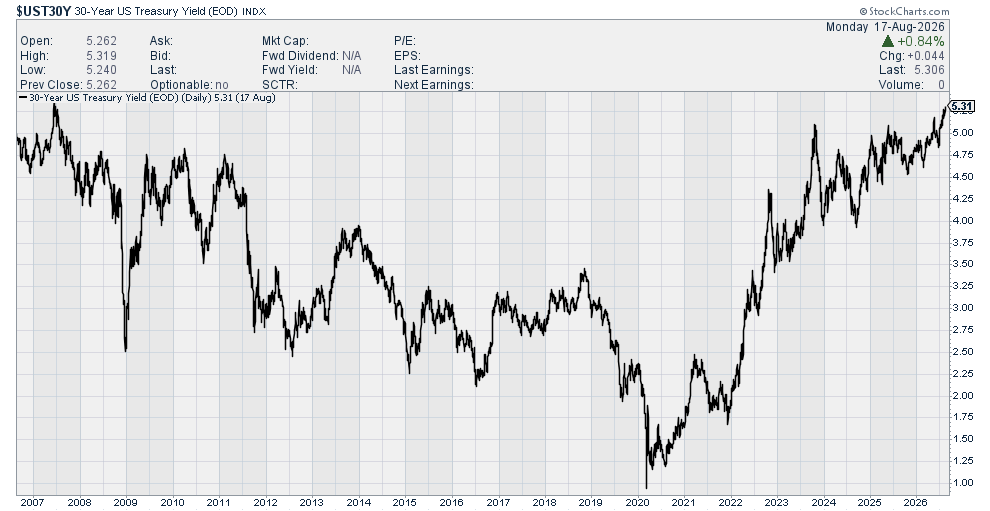
What appears to be happening is that bonds are falling so yields are rising, but the Fed is backing away from higher rates. There’s a disconnect, or maybe the market is challenging the Fed to reverse course.
It’s not just here – this appears to be a global bond market rout. Yields are higher in Europe and Japan. Germany floated some 30-year bonds today at the highest yield in 15 years.
Countries around the world are shifting their borrowing to the short end of the yield curve on hopes that rates will soon come down. One issue is that yields may not come down.
What’s driving all this? One key culprit is the tech sector. The AI companies have been turning to the bond market to raise tons of cash to finance their new projects. There’s a point in any bubble where a company has to wonder if it should work to build out new facilities or just write a check and buy out some emerging company.
As is often the case, most investment bubbles aren’t bubbles in the actual sector. Instead, they’re credit bubbles. How long will the bubble last? That’s easy. It will last as long as banks are willing to fund it. Right now, the AI sector borrowing has to compete with heavy government borrowing from … well, almost everywhere.
My friend Gary Alexander has some remarkable stats. Consider that in July 2026, Uncle Sam ran up a larger monthly deficit that any yearly deficit before 2008. Last month, the government took in $1,000 per person in tax revenue, but it spent $2,300 per person.
The day before the U.S. bombed Iran, the 10-year Treasury yield was at 3.95%. Now it’s at 4.75%. The Congressional Budget Office now projects that the deficit for this year will be $2.1 trillion. It would be rude of me to point out that 25 years ago, the CBO thought the entire debt would be wiped out by 2011. Now the CBO sees the debt reaching $40 trillion sometime next month.
A 60-day truce between the United States and Iran ended yesterday but we don’t seem to be any closer to a diplomatic resolution. President Trump posted an image of the Strait of Hormuz and called it a “New U.S. Territory.” There’s a saying in the field on national security that “the enemy gets a vote.” The same can be said for the bond market.
Today’s market drop is weighing heavily on many tech stocks, especially semiconductor stocks. For example, Micron (MU) and Intel (INTC) were both down over 7%.
This is a continuation of the trend that started nearly three months ago of conservative stocks outperforming more aggressive stocks. The Nasdaq was down more than 1% today, nearly twice the loss of the S&P 500.
I’m glad to see that many of our Buy List stocks are holding up well. In fact, we own the two top-performing stocks in the S&P 100 today, Adobe (ADBE) and Intuit (INTU). This is an interesting time for us because Intuit is scheduled to report its fiscal Q4 earnings on August 25. The stock has been rallying back over the last few weeks.
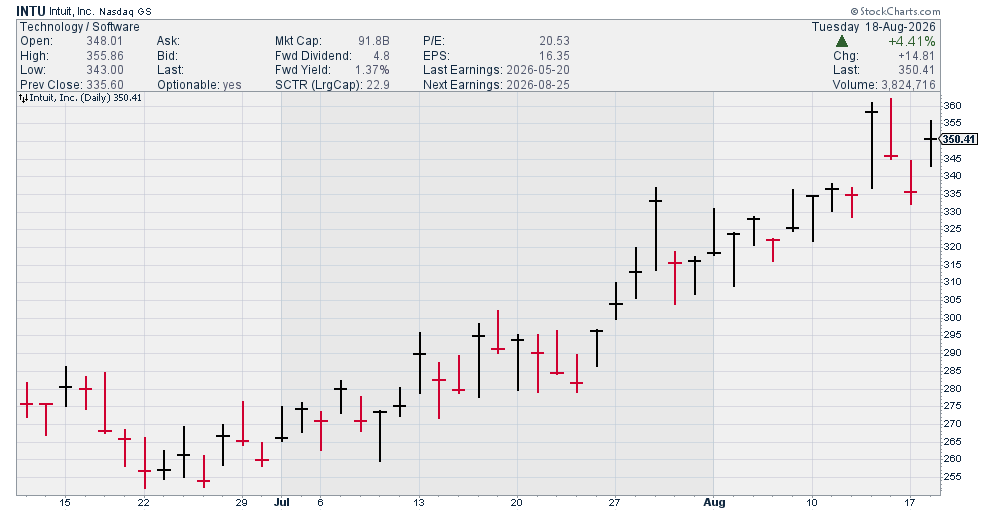
Intuit is the company behind TurboTax and QuickBooks and Credit Karma. In its last earnings report in May, Intuit said its global revenues rose 10% to $8.6 billion, and its earnings rose 10% to $12.80 per share. Wall Street had been expecting earnings of $12.57 per share. Inuit also increased its dividend by 15% to $1.20 per share.
For its Q4, which ended on July 31, Inuit expects earnings between $3.56 and $3.62 per share. They should easily beat that. For the full year, Intuit sees earnings coming in between $23.80 and $23.85 per share. That’s an increase from the previous range of $22.98 to $23.18 per share. I’m expecting a good report from Intuit.
The economy has had a run of sub-par news recently. This month’s jobs report wasn’t so hot. The inflation report came in low. Last Friday’s retail sales report was a big miss. Wall Street had been expecting a gain of 0.1%. Instead, it was a loss of 0.6%. If we look at the numbers excluding autos, then it’s still negative. The “core” retail sales number was expected to be up by 0.3%. Instead, it was down by 0.4%.
This morning, the Federal Reserve said that industrial production rose by 0.2% in July. That followed a 0.3% increase for June. For Q2, manufacturing rose at the fastest pace in five years.
I wouldn’t say that a Fed rate hike next month is off the table, but it’s getting there. Futures traders now place the odds of a September rate hike at 35%. As a reminder, in late July, the odds for a hike in September were close to 100%. Not anymore. For October, it’s at 47%. In fact, there’s a reasonable chance that the Fed won’t touch rates for the rest of this year.
Soon You’ll Be Able to Trade the Nasdaq 23 Hours a Day
Good news for investors. This week, the Nasdaq said that in December it will inaugurate overnight trading. Beginning on December 6, the Nasdaq will trade 23 hours a day.
This move still needs approval from the SEC, but if it works, that means that the market will be open almost nonstop from Sunday evening to Friday evening. The Nasdaq already has trading in after-hours markets but that’s limited to institutional investors. With the new proposal, everyone gets a chance.
I think the other exchanges will follow suit. The issue with market hours is that if some big event breaks out when markets are closed, that adds huge pressure on the markets once we reach the opening bell. Nonstop trading should hopefully reduce some of those fears.
The new schedule will look like this:
• Night Session: 9:00 pm – 4:00 am ET (Sunday – Thursday nights)
• Pre-Market & Regular Hours: Existing sessions from 4:00 am to 8:00 pm ET remain unchanged.
• Daily Maintenance Break: A one-hour pause from 8:00 p.m. to 9:00 p.m. ET for system upkeep and trade clearing.
• Weekly Span: From 9:00 p.m. ET Sunday to 8:00 p.m. ET Friday.
There will be other restrictions. For example, certain order types (like market orders and specific opening/closing instructions) will not be supported overnight. Also, any unexecuted overnight orders left over at 4:00 am will be canceled. Static price bands will reject orders submitted outside specified boundaries.
This is very good news for investors, and it probably should have come a long time ago.
That’s all for now. Tomorrow, the Fed will release the minutes from its last meeting. This could be interesting. I’ll have more for you in the next issue of CWS Market Review.
– Eddy
Posted by Eddy Elfenbein on August 18th, 2026 at 6:16 pm
The information in this blog post represents my own opinions and does not contain a recommendation for any particular security or investment. I or my affiliates may hold positions or other interests in securities mentioned in the Blog, please see my Disclaimer page for my full disclaimer.
-
Archives
- October 2026
- September 2026
- August 2026
- July 2026
- June 2026
- May 2026
- April 2026
- March 2026
- February 2026
- January 2026
- December 2025
- November 2025
- October 2025
- September 2025
- August 2025
- July 2025
- June 2025
- May 2025
- April 2025
- March 2025
- February 2025
- January 2025
- December 2024
- November 2024
- October 2024
- September 2024
- August 2024
- July 2024
- June 2024
- May 2024
- April 2024
- March 2024
- February 2024
- January 2024
- December 2023
- November 2023
- October 2023
- September 2023
- August 2023
- July 2023
- June 2023
- May 2023
- April 2023
- March 2023
- February 2023
- January 2023
- December 2022
- November 2022
- October 2022
- September 2022
- August 2022
- July 2022
- June 2022
- May 2022
- April 2022
- March 2022
- February 2022
- January 2022
- December 2021
- November 2021
- October 2021
- September 2021
- August 2021
- July 2021
- June 2021
- May 2021
- April 2021
- March 2021
- February 2021
- January 2021
- December 2020
- November 2020
- October 2020
- September 2020
- August 2020
- July 2020
- June 2020
- May 2020
- April 2020
- March 2020
- February 2020
- January 2020
- December 2019
- November 2019
- October 2019
- September 2019
- August 2019
- July 2019
- June 2019
- May 2019
- April 2019
- March 2019
- February 2019
- January 2019
- December 2018
- November 2018
- October 2018
- September 2018
- August 2018
- July 2018
- June 2018
- May 2018
- April 2018
- March 2018
- February 2018
- January 2018
- December 2017
- November 2017
- October 2017
- September 2017
- August 2017
- July 2017
- June 2017
- May 2017
- April 2017
- March 2017
- February 2017
- January 2017
- December 2016
- November 2016
- October 2016
- September 2016
- August 2016
- July 2016
- June 2016
- May 2016
- April 2016
- March 2016
- February 2016
- January 2016
- December 2015
- November 2015
- October 2015
- September 2015
- August 2015
- July 2015
- June 2015
- May 2015
- April 2015
- March 2015
- February 2015
- January 2015
- December 2014
- November 2014
- October 2014
- September 2014
- August 2014
- July 2014
- June 2014
- May 2014
- April 2014
- March 2014
- February 2014
- January 2014
- December 2013
- November 2013
- October 2013
- September 2013
- August 2013
- July 2013
- June 2013
- May 2013
- April 2013
- March 2013
- February 2013
- January 2013
- December 2012
- November 2012
- October 2012
- September 2012
- August 2012
- July 2012
- June 2012
- May 2012
- April 2012
- March 2012
- February 2012
- January 2012
- December 2011
- November 2011
- October 2011
- September 2011
- August 2011
- July 2011
- June 2011
- May 2011
- April 2011
- March 2011
- February 2011
- January 2011
- December 2010
- November 2010
- October 2010
- September 2010
- August 2010
- July 2010
- June 2010
- May 2010
- April 2010
- March 2010
- February 2010
- January 2010
- December 2009
- November 2009
- October 2009
- September 2009
- August 2009
- July 2009
- June 2009
- May 2009
- April 2009
- March 2009
- February 2009
- January 2009
- December 2008
- November 2008
- October 2008
- September 2008
- August 2008
- July 2008
- June 2008
- May 2008
- April 2008
- March 2008
- February 2008
- January 2008
- December 2007
- November 2007
- October 2007
- September 2007
- August 2007
- July 2007
- June 2007
- May 2007
- April 2007
- March 2007
- February 2007
- January 2007
- December 2006
- November 2006
- October 2006
- September 2006
- August 2006
- July 2006
- June 2006
- May 2006
- April 2006
- March 2006
- February 2006
- January 2006
- December 2005
- November 2005
- October 2005
- September 2005
- August 2005
- July 2005
 Eddy Elfenbein is a Washington, DC-based speaker, portfolio manager and editor of the blog Crossing Wall Street. His