CWS Market Review – September 29, 2026
(This is the free version of CWS Market Review. If you like what you see, then please sign up for the premium newsletter for $20 per month or $200 for the whole year. If you sign up today, you can see our two reports, “Your Handy Guide to Stock Orders” and “How Not to Get Screwed on Your Mortgage.”)
The third quarter of 2026 comes to an end with tomorrow’s closing bell. Overall, it was a middling quarter for the stock market. OK, but not great. For the quarter, the S&P 500 added about 2%. If we look at the total-return index (meaning, with dividends), then the S&P 500 was up by 2.4%. Mind you, these aren’t final numbers. There’s still a little more trading to go.
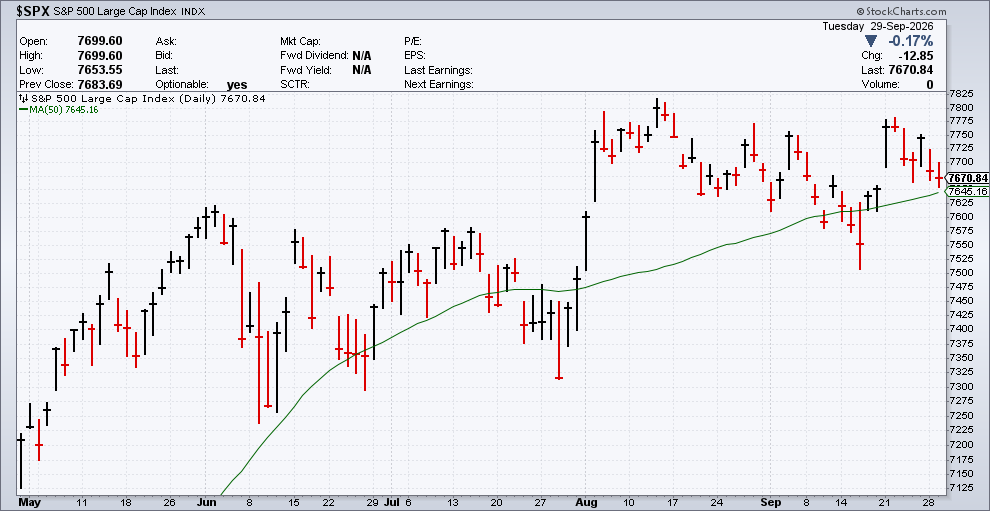
Q3 was very different from Q2. That’s when the S&P 500 rallied over 14% to notch its best quarter in six years. Q3 wasn’t nearly that exciting. Except for a quick bounce that added 5.75% in four days starting in late July, there wasn’t much drama in the market. Since May 6, the S&P 500 has largely stayed between 7,300 and 7,700.
Nvidia (NVDA) made news this week by adding $150 billion to its buyback. (Someone there thinks it’s a bargain!) Lately, the real action has been going on in the bond market. Since August 25, the yield on the 10-year Treasury bond has gained 60 basis points. That’s a big move for such a short period of time. The yield on the 30-year bond just got to a 24-year high.
What’s behind the bond selloff? There are a few reasons. I’ll cover that in greater detail in just a bit, but the important takeaway is that higher yields have a major impact on the economy. It’s no accident that higher long-term yields have often preceded bear markets. I’m not urging you to run for the hills, but investors ought to be prudent.
Higher yields have several effects. For one, it’s harder to borrow money. That makes buying a car or a new home more expensive. In turn, that can hold back the plethora of workers and businesses that are tied to housing (roofers, electricians, plumbers, etc.). It’s a good time to buy a house with all cash.
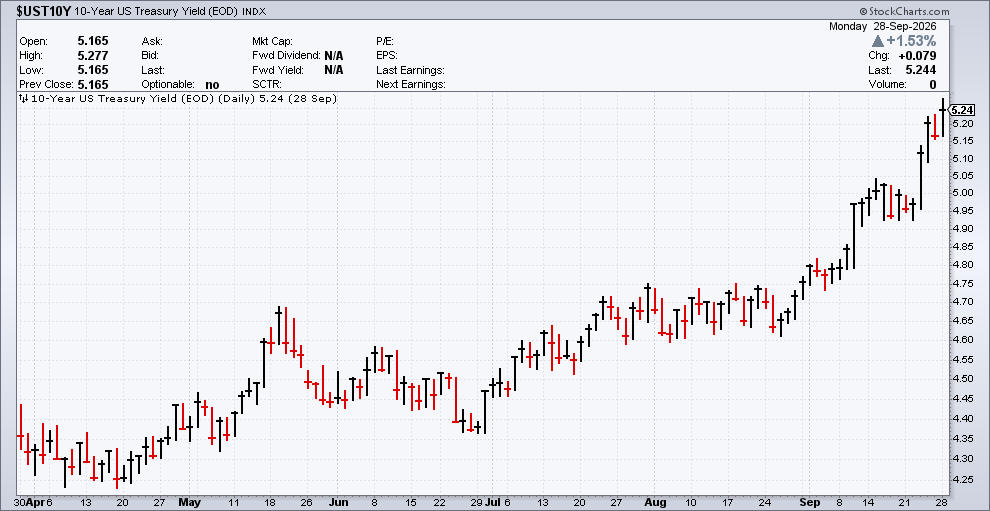
Higher yields also act as tough competition against stocks. There’s basically a never-ending battle on Wall Street between stocks and bonds. At yesterday’s close, the yield on the 20-year Treasury was going for 5.6%. That means an investor with $1.8 million can buy those bonds and make an average of $100,000 per year for 20 years. Personally, it’s not for me, but I understand why many investors would have little problem taking that deal.
Higher yields also make it more difficult for businesses to borrow money. That puts a damper on mergers and acquisitions, which is a very profitable area for investment banks. It’s no surprise that in recent days, financial stocks have badly lagged the overall market.
The U.S. continues to motor along. The economy is growing by more than a recession but by less than anything impressive. Kevin Warsh said, “the American economy appears to be strengthening,” which may be true, but I have my doubts. Today’s consumer confidence report fell to its lowest level since 2014. The Consumer Confidence Index fell 6.7 points to 81.9. Wall Street had been expecting 89.
On Wednesday, ADP will release its report on private payrolls. The company expects to see a gain of 68,00 new jobs. Of course, that’s the unofficial report. The big, official September jobs report is due out on Friday before the opening bell. Wall Street expects to see a gain of 84,000 net new jobs. That’s almost half the gain of what we saw for August.
Wall Street expects the unemployment rate to remain at 4.1% and for average hourly earnings to increase by 0.3%. The Federal Reserve doesn’t meet for another month, but it looks like we’ll get another rate increase just before Halloween. The bottom line is that rates are most likely to go higher and higher.
Now let’s look at what’s been roiling the bond market.
The Foiled Plan to Lower Inflation
As usual, I’ll steer clear of politics, but I will touch on some important public policy choices. For example, early in his second term, President Trump’s advisers give him a simple roadmap to cure inflation.
They assured him that fiscal restraint combined with deregulation would bring down prices. The best part of this plan is that he wouldn’t need to worry about a non-compliant Federal Reserve.
Well, that plan never happened. Instead, we got war, tariffs and an investment boom. Now, inflation is moving up and the yield on the 10-year Treasury is above 5%. That’s a 19-year high.
Fiscal restraint never arrived, and tariffs raised the cost of imports. On top of that, immigration restrictions shrank the labor force. The economy is still moving along, and energy prices are higher than ideal.
Earlier this year, mortgage rates were around 6%. Now they’re at 7%. That works out to $3,000 extra dollars on a $400,000 mortgage. That’s a big bite for a young family.
Consider this fact: Uncle Sam’s interest payments on our debt just reached $1 trillion for the fiscal year. That’s nothing we get. It’s just interest payments we’re making.
Of course, not all of this can be laid at President Trump’s doorstep. The massive AI boom is driving up the cost of several items like chips, components and power equipment. The problem now is that the mega-cap tech stocks are competing against the government to borrow money. If I know the bond market, it’s more than willing to lend to blue chip borrowers.
The economy really isn’t in a bad place, for now. Unemployment is still quite low, and the stock market is not far off its all-time high.
As has often happened with bold plans to restructure the government, reality intrudes. At first, Trump was serious in cutting the deficit. Remember DOGE, the Department of Government Efficiency? Elon Musk said he could find $2 trillion worth of waste. Trump also pushed for tariffs, but the Supreme Court said some of his moves went outside the president’s authority.
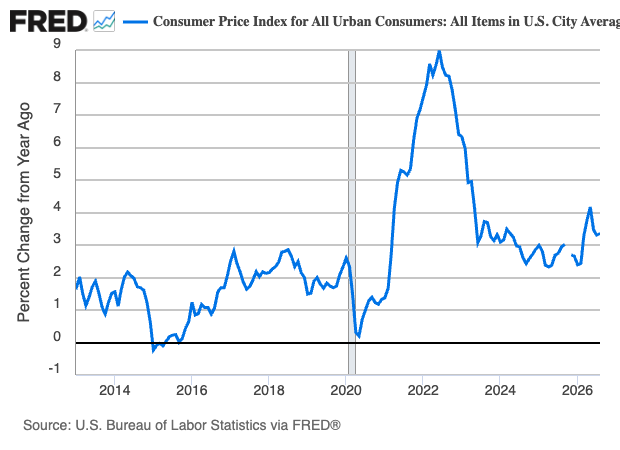
This summer, Treasury Secretary Scott Bessent said the Treasury Department will double its purchases of long-term bonds. The idea is that this would push down rates. Well, that worked for about day. Since then, yields have been climbing higher.
The government’s fiscal year ends tomorrow. It will probably turn out that the size of the deficit will be twice what Bessent had expected. Now, everyone wants to spend money. President Trump recently pledged $5,000 for every adult if Republicans keep control of the House and Senate.
We also have a new Fed chairman in Kevin Warsh who has taken a strong stand against inflation. The Fed has already raised rates once and looks to do so again before the end of the year.
The impact of the war isn’t just oil, but higher prices are being seen in other areas. For example, diesel prices are rising. That’s important because that impacts farm equipment and trucks.
The president said that oil prices would soon fall once the conflict with Iran was resolved. Here we are several months later, and the prices are still elevated.
The concern is that the impact of higher interest rates will have little impact on what’s really driving higher prices. I get what they’re saying. Will Nvidia really hold off going to the bond market due to a 0.25% rate hike? I doubt it.
Three Dark Horse Candidates for Next Year’s Buy List
Now that 2026 is three-quarters over, I want to share with you some “off-the-beaten-path” stocks that I’m considering for next year’s Buy List.
Let’s start with Credo Technology Group (CRDO). The company designs “zero-flap” active electrical cables that connect GPUs in massive clusters. This is a highly specialized niche essential for AI applications. Their connections are reportedly 1,000 times more reliable than standard competitors. This ensures that AI training processes don’t randomly drop signals and reset. Credo’s revenue has exploded (fiscal Q1: +114.7%), with expectations of major multi-billion-dollar growth over the coming years.
CECO Environmental (CECO) provides industrial air quality and fluid handling systems, which are increasingly vital for factories, data centers and energy infrastructure.
Wall Street analysts have taken notice of CECO’s massive $1 billion backlog and $7 billion pipeline. Thanks to heavy tailwinds from U.S. manufacturing reshoring and AI data center expansion, CECO is delivering stronger revenue and cash conversion growth than almost all its peers. CECO just completed a $2.2 billion cash-and-stock acquisition of Thermon Group Holdings, a process-heating company.
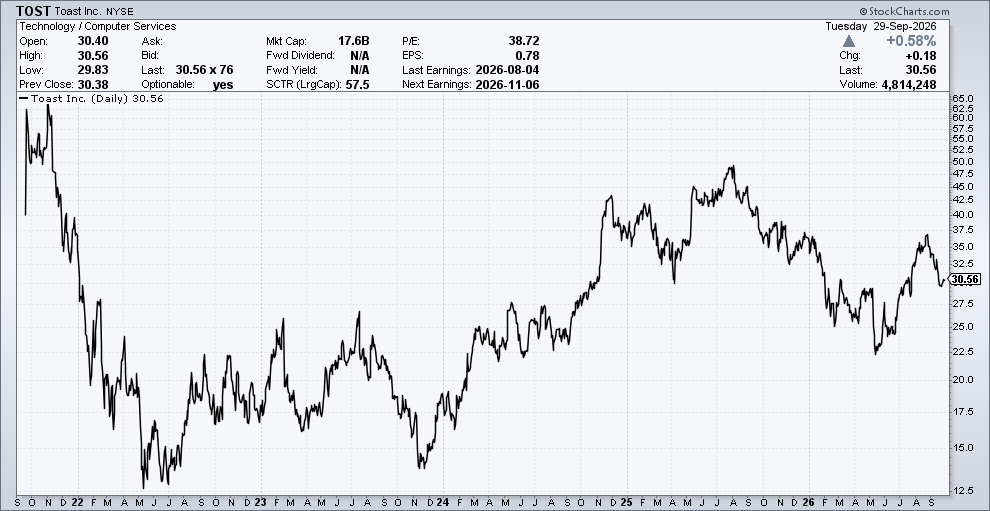
Toast Inc. (TOST) provides specialized point-of-sale (POS) and operational software that’s tailored for restaurants. Toast has a strong moat by helping restaurants manage everything from table orders to inventory and employee scheduling.
Toast’s recurring gross profits have surged over 30% recently, allowing them to sustain rapid annual growth even in a fluctuating consumer environment.
That’s all for now. The September jobs report is due out Friday morning. Wall Street expects to see a gain of 84,000 new jobs—that’s nearly half of August’s gain—and for the unemployment rate to be 4.2%. I’ll have more for you in the next issue of CWS Market Review.
– Eddy
Posted by Eddy Elfenbein on September 29th, 2026 at 7:03 pm
The information in this blog post represents my own opinions and does not contain a recommendation for any particular security or investment. I or my affiliates may hold positions or other interests in securities mentioned in the Blog, please see my Disclaimer page for my full disclaimer.
-
Archives
- September 2026
- August 2026
- July 2026
- June 2026
- May 2026
- April 2026
- March 2026
- February 2026
- January 2026
- December 2025
- November 2025
- October 2025
- September 2025
- August 2025
- July 2025
- June 2025
- May 2025
- April 2025
- March 2025
- February 2025
- January 2025
- December 2024
- November 2024
- October 2024
- September 2024
- August 2024
- July 2024
- June 2024
- May 2024
- April 2024
- March 2024
- February 2024
- January 2024
- December 2023
- November 2023
- October 2023
- September 2023
- August 2023
- July 2023
- June 2023
- May 2023
- April 2023
- March 2023
- February 2023
- January 2023
- December 2022
- November 2022
- October 2022
- September 2022
- August 2022
- July 2022
- June 2022
- May 2022
- April 2022
- March 2022
- February 2022
- January 2022
- December 2021
- November 2021
- October 2021
- September 2021
- August 2021
- July 2021
- June 2021
- May 2021
- April 2021
- March 2021
- February 2021
- January 2021
- December 2020
- November 2020
- October 2020
- September 2020
- August 2020
- July 2020
- June 2020
- May 2020
- April 2020
- March 2020
- February 2020
- January 2020
- December 2019
- November 2019
- October 2019
- September 2019
- August 2019
- July 2019
- June 2019
- May 2019
- April 2019
- March 2019
- February 2019
- January 2019
- December 2018
- November 2018
- October 2018
- September 2018
- August 2018
- July 2018
- June 2018
- May 2018
- April 2018
- March 2018
- February 2018
- January 2018
- December 2017
- November 2017
- October 2017
- September 2017
- August 2017
- July 2017
- June 2017
- May 2017
- April 2017
- March 2017
- February 2017
- January 2017
- December 2016
- November 2016
- October 2016
- September 2016
- August 2016
- July 2016
- June 2016
- May 2016
- April 2016
- March 2016
- February 2016
- January 2016
- December 2015
- November 2015
- October 2015
- September 2015
- August 2015
- July 2015
- June 2015
- May 2015
- April 2015
- March 2015
- February 2015
- January 2015
- December 2014
- November 2014
- October 2014
- September 2014
- August 2014
- July 2014
- June 2014
- May 2014
- April 2014
- March 2014
- February 2014
- January 2014
- December 2013
- November 2013
- October 2013
- September 2013
- August 2013
- July 2013
- June 2013
- May 2013
- April 2013
- March 2013
- February 2013
- January 2013
- December 2012
- November 2012
- October 2012
- September 2012
- August 2012
- July 2012
- June 2012
- May 2012
- April 2012
- March 2012
- February 2012
- January 2012
- December 2011
- November 2011
- October 2011
- September 2011
- August 2011
- July 2011
- June 2011
- May 2011
- April 2011
- March 2011
- February 2011
- January 2011
- December 2010
- November 2010
- October 2010
- September 2010
- August 2010
- July 2010
- June 2010
- May 2010
- April 2010
- March 2010
- February 2010
- January 2010
- December 2009
- November 2009
- October 2009
- September 2009
- August 2009
- July 2009
- June 2009
- May 2009
- April 2009
- March 2009
- February 2009
- January 2009
- December 2008
- November 2008
- October 2008
- September 2008
- August 2008
- July 2008
- June 2008
- May 2008
- April 2008
- March 2008
- February 2008
- January 2008
- December 2007
- November 2007
- October 2007
- September 2007
- August 2007
- July 2007
- June 2007
- May 2007
- April 2007
- March 2007
- February 2007
- January 2007
- December 2006
- November 2006
- October 2006
- September 2006
- August 2006
- July 2006
- June 2006
- May 2006
- April 2006
- March 2006
- February 2006
- January 2006
- December 2005
- November 2005
- October 2005
- September 2005
- August 2005
- July 2005
 Eddy Elfenbein is a Washington, DC-based speaker, portfolio manager and editor of the blog Crossing Wall Street. His