Archive for 2007
-
Novo Nordisk
Eddy Elfenbein, June 21st, 2007 at 11:47 amWhile American drug companies Merck (MRK) and Pfizer (PFE) aren’t doing well (or at least Merck has bounced off its deep lows rather nicely), check out the performance of Denmark’s Novo Nordisk (NVO):
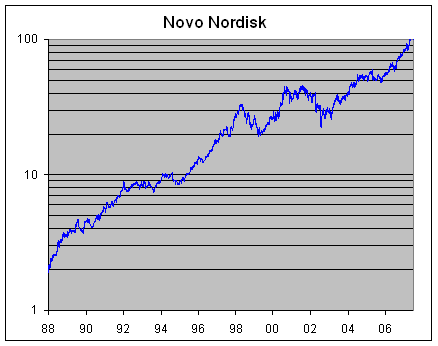
The stock is up about $5 a share today to $106. I had to cut off the top part of the chart because it’s a logarithmic scale, but you get the idea. -
Stephen Schwarzman’s Foolish Antics
Eddy Elfenbein, June 21st, 2007 at 9:12 amSlate’s Daniel Gross looks at the recent behavior of Blackstone’s Stephen Schwarzman:
First, he threw himself a (much-covered) 60th-birthday party at the Park Avenue Armory in February. It featured, among others, Martin Short, Rod Stewart, Marvin Hamlisch, and Patti LaBelle leading the Abyssinian Baptist Church choir singing, according to a great article in the Wall Street Journal, “a tune about Mr. Schwarzman.” (“He’s Got the Whole World in His Hands”?) The best bit: “A huge portrait of Mr. Schwarzman, which usually hangs in his living room, was shipped in for the occasion.” (I wasn’t invited, but my gift would have been a first edition of Christopher Lasch’s Culture of Narcissism.)
Next came a cover story in the March 5 Fortune declaring Schwarzman, who had just completed the gigantic acquisition of Equity Office Properties, “The New King of Wall Street.” Then, only a few months after saying that Sarbanes-Oxley was deterring companies from going public, he filed a huge IPO for the Blackstone Group. If it goes through as planned, according to the Wall Street Journal, Schwarzman’s sale will be worth $7.5 billion. This offering included several wrinkles that solidified Schwarzman’s smartest-guy-in-the-room reputation but also seemed designed to elicit scrutiny. As the Financial Times reported ($ required), the preliminary prospectus said the firm planned to “book profits from private equity at the time an asset is bought”—not when the assets are sold, as most businesses do. More significantly, the offering was structured as a “publicly traded partnership” to take advantage of an absurd wrinkle in the tax code. Under current rules, the asset-management fees that private-equity partnerships like Blackstone reap are taxed not at the 35 percent corporate income-tax rate, but at the 15 percent long-term capital-gains rate, allowing Blackstone to save tens of millions of dollars annually on its tax bill. Finally, in May, at a time when concerns about China’s role in the global economy and its influence on the United States were at a fever pitch, Schwarzman agreed to sell a 10 percent stake in Blackstone to an entity controlled by China’s government.The stock is expected to hit the world tomorrow. But now some people are wondering if the share price is too high.
If Blackstone goes public at $30, its price-earnings ratio (share price divided by earnings per share) would be about 14, based on the company’s 2006 results. By comparison, premier investment bank Goldman Sachs Group Inc., which has a large private equity operation, trades at about 11 times profit.
Shares of Fortress Investment Group had a price-earnings ratio of about 15 when the company went public in February at $18.50 a share. With the shares now at $26.52, the ratio has risen to about 22.Bloomberg reports that the Blackstone underwriting group is being forced to accept a lower in return for more business in the future:
Morgan Stanley, Citigroup Inc. and the 15 other investment banks that Blackstone hired to distribute shares in today’s IPO will get a 3.6 percent commission, or as much as $170 million, according to regulatory filings. That’s slightly more than half the 6.2 percent average rate banks charged U.S. companies to go public this year.
The securities firms are accepting the lower fee because they expect to make a lot more arranging and financing takeovers when New York-based Blackstone invests its $19.6 billion buyout fund, the second-biggest ever raised. Schwarzman’s firm paid $571.4 million for those services last year and $248.1 million in the first quarter of 2007 alone, according to estimates by industry consultants at New York-based Freeman & Co. -
This is NOT Happening
Eddy Elfenbein, June 20th, 2007 at 3:51 pmFrom the AP:
Rupert Murdoch’s News Corp. is discussing…
Me running in slow motion
…swapping social networking Web site…
waving my arms
…MySpace…
screaming
…for a 25 percent stake…
Nooooooo…
…in Yahoo.
…ooooooooooo!!!!
-
Paul Krugman Four Years Ago Today
Eddy Elfenbein, June 20th, 2007 at 1:24 pmThe big rise in the stock market is definitely telling us something. Bulls think it says the economy is about to take off. But I think it’s a sign that America is still blowing bubbles — that a three-year bear market and the biggest corporate scandals in history haven’t cured investors of irrational exuberance yet.
And.
In short, the current surge in stocks looks like another bubble, one that will eventually burst.
From a reader:
He lied! Krugman knew there was disagreement among investment consultants as to whether the market was a bubble or for real, and he intentionally massaged the indicators, and hyped the financial intelligence to make everyone believe there was a link between the current bull market and the bubble of 2000.
How many people sold their stocks on Krugman’s intentionally misleading misrepresentation and failed to realize the gain that came with the continuing bull market?
Krugman lied, profits died!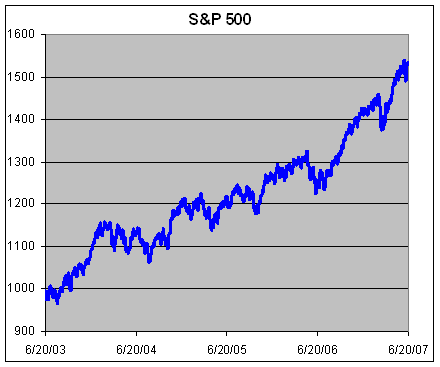
-
This Just In
Eddy Elfenbein, June 20th, 2007 at 9:57 am -
A Good Run Doesn’t Mean a Stock is Too Expensive
Eddy Elfenbein, June 20th, 2007 at 9:53 amA quick note on FactSet (FDS). This is a good reminder that just because a stock is up doesn’t mean it’s too expensive. FactSet was on last year’s Buy List and it rose 37.2% making it our second-best performer. I decided to keep it on this year’s Buy List and it’s up 20.6% so far, again our second-best performer.
Also, just because a stock is down doesn’t mean it’s cheap. I’ve often heard people say, “how much lower can it go?” The answer is, a lot. A whole lot. I remember my finance professor explaining how low zero is. A $100 stock can drop 90%, then another 90%, then another 90% and it’s still not at zero. In fact, it can drop 90% infinitely and still not be at zero. Zero is really, really, really, REALLY small, and that’s how low it can go. -
Oh Dear Lord
Eddy Elfenbein, June 19th, 2007 at 5:08 pm -
The Vietnam War Is Officially Over
Eddy Elfenbein, June 19th, 2007 at 4:04 pmMr. Carter added that he was looking forward to the day the first Vietnamese company lists on the NYSE.
Suck on that, hippies.
-
Guess the Stock
Eddy Elfenbein, June 19th, 2007 at 3:27 pmHere’s a 12-year chart:
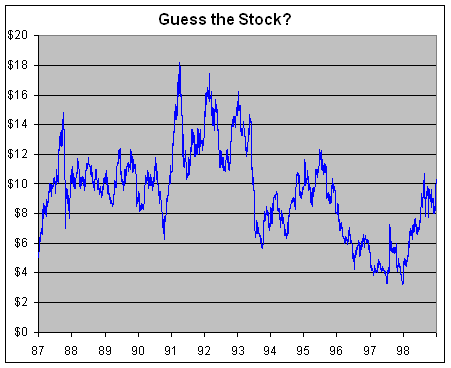
Give up? Answer is after the jump. -
When Wall Street Couples Cash Out
Eddy Elfenbein, June 19th, 2007 at 11:38 amFrom the LA Times:
The flood of cash into so-called hedge fund communities in New York, Connecticut and California has proved fatal to many marriages — and a windfall for lawyers, psychiatrists and forensic accountants who specialize in the superrich.
“There is no question that a huge infusion of wealth to relatively young people has a disastrous effect on the marriage’s stability,” says Bern Clare, a Manhattan divorce lawyer.
Divorce hedge fund-style often means the judges involved must cope with pre- and post-nuptial agreements, years of fights over access to hedge fund accounts and monetary demands well into eight and nine figures.
“When you are dealing with the uber-wealthy, you are dealing with the uber-lawyers,” says Kevin Tierney, the presiding judge of the family division in the Stamford-Norwalk district of Connecticut, where many hedge fund families live. “They have accountants and paralegals and dueling experts.”
Further complicating matters is that the value of the assets involved, unlike real estate or jewelry, is highly variable, depending on the gyrations of the stock market and other investments.
“You can have an asset change by $1 million while a witness is on the stand,” Tierney says.
-
Archives
- September 2026
- August 2026
- July 2026
- June 2026
- May 2026
- April 2026
- March 2026
- February 2026
- January 2026
- December 2025
- November 2025
- October 2025
- September 2025
- August 2025
- July 2025
- June 2025
- May 2025
- April 2025
- March 2025
- February 2025
- January 2025
- December 2024
- November 2024
- October 2024
- September 2024
- August 2024
- July 2024
- June 2024
- May 2024
- April 2024
- March 2024
- February 2024
- January 2024
- December 2023
- November 2023
- October 2023
- September 2023
- August 2023
- July 2023
- June 2023
- May 2023
- April 2023
- March 2023
- February 2023
- January 2023
- December 2022
- November 2022
- October 2022
- September 2022
- August 2022
- July 2022
- June 2022
- May 2022
- April 2022
- March 2022
- February 2022
- January 2022
- December 2021
- November 2021
- October 2021
- September 2021
- August 2021
- July 2021
- June 2021
- May 2021
- April 2021
- March 2021
- February 2021
- January 2021
- December 2020
- November 2020
- October 2020
- September 2020
- August 2020
- July 2020
- June 2020
- May 2020
- April 2020
- March 2020
- February 2020
- January 2020
- December 2019
- November 2019
- October 2019
- September 2019
- August 2019
- July 2019
- June 2019
- May 2019
- April 2019
- March 2019
- February 2019
- January 2019
- December 2018
- November 2018
- October 2018
- September 2018
- August 2018
- July 2018
- June 2018
- May 2018
- April 2018
- March 2018
- February 2018
- January 2018
- December 2017
- November 2017
- October 2017
- September 2017
- August 2017
- July 2017
- June 2017
- May 2017
- April 2017
- March 2017
- February 2017
- January 2017
- December 2016
- November 2016
- October 2016
- September 2016
- August 2016
- July 2016
- June 2016
- May 2016
- April 2016
- March 2016
- February 2016
- January 2016
- December 2015
- November 2015
- October 2015
- September 2015
- August 2015
- July 2015
- June 2015
- May 2015
- April 2015
- March 2015
- February 2015
- January 2015
- December 2014
- November 2014
- October 2014
- September 2014
- August 2014
- July 2014
- June 2014
- May 2014
- April 2014
- March 2014
- February 2014
- January 2014
- December 2013
- November 2013
- October 2013
- September 2013
- August 2013
- July 2013
- June 2013
- May 2013
- April 2013
- March 2013
- February 2013
- January 2013
- December 2012
- November 2012
- October 2012
- September 2012
- August 2012
- July 2012
- June 2012
- May 2012
- April 2012
- March 2012
- February 2012
- January 2012
- December 2011
- November 2011
- October 2011
- September 2011
- August 2011
- July 2011
- June 2011
- May 2011
- April 2011
- March 2011
- February 2011
- January 2011
- December 2010
- November 2010
- October 2010
- September 2010
- August 2010
- July 2010
- June 2010
- May 2010
- April 2010
- March 2010
- February 2010
- January 2010
- December 2009
- November 2009
- October 2009
- September 2009
- August 2009
- July 2009
- June 2009
- May 2009
- April 2009
- March 2009
- February 2009
- January 2009
- December 2008
- November 2008
- October 2008
- September 2008
- August 2008
- July 2008
- June 2008
- May 2008
- April 2008
- March 2008
- February 2008
- January 2008
- December 2007
- November 2007
- October 2007
- September 2007
- August 2007
- July 2007
- June 2007
- May 2007
- April 2007
- March 2007
- February 2007
- January 2007
- December 2006
- November 2006
- October 2006
- September 2006
- August 2006
- July 2006
- June 2006
- May 2006
- April 2006
- March 2006
- February 2006
- January 2006
- December 2005
- November 2005
- October 2005
- September 2005
- August 2005
- July 2005
 Eddy Elfenbein is a Washington, DC-based speaker, portfolio manager and editor of the blog Crossing Wall Street. His