Archive for 2008
-
Wallstrip Does CLARCOR
Eddy Elfenbein, April 1st, 2008 at 11:22 amJulie profiles CLARCOR (CLC), one of our Buy List stocks.
Here’s a spreadsheet of Clarcor’s results for the past few years. -
The End of the Gold Bubble
Eddy Elfenbein, April 1st, 2008 at 10:17 amA few weeks ago, I wrote a post criticizing the fear the something must be done to counteract investment bubbles. I said that one of the problems is, how do we even know if we’re in a bubble? I wrote:
How can we be sure it’s a bubble when an asset inflates? In the 1950s, stock prices soared and they never really came back down. The phrase “permanently high plateau” hasn’t had a good record since the 1920s, but I think that’s an accurate description of what happened in the 1950s.
Is gold a bubble right now? What about oil? Or the Euro? Or could it be that we’re simply adjusting to a new era of commodity prices? I don’t know and for now, I’m happy to consider these open questions. I will note, however, that adjusted for inflation, commodity prices have historically plunged.Some commenters wrote that I was crazy (as they often do) because it was perfectly obvious (in all caps) that we were in a credit bubble. But no one addressed my concerns that we could be in a gold bubble. In fact, come said that we’re certainly not because of…well, the standard bullish arguments for gold.
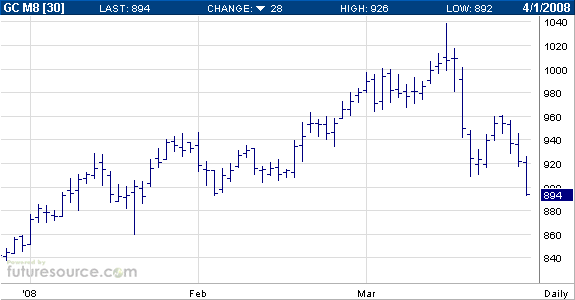
Now it looks like gold’s run may be coming to an end. Again, I’m not saying it is, but look at what’s happening. As I writing this, the contract for June gold is down to $892. That’s a huge drop just in the last two weeks.
-
W.R. Berkley to Change Ticker Symbol
Eddy Elfenbein, April 1st, 2008 at 9:54 amHere’s a heads-up to BER shareholders. In two weeks, W.R. Berkley Corp. will change its ticker symbol from “WRB” from “BER.” This is the second ticker symbol change for a stock on our Buy List. In 2006, Harley-Davidson switched from HDI to HOG.
I like HOG a lot better. Personally, I’m a big fan of the fun tickers. Here’s a list of my favorites:
1. (BUD) Anheuser-Busch
2. (WOOF) VCA Antech (veterinary services)
3. (BOOM) Dynamic Materials
4. (FIZ) National Beverage
5. (LVB) Steinway Musical Instruments (in honor of Ludwig Van Beethoven)
6. (ZEUS) Olympic Steel
7. (CHUX) O’Charley’s Inc.
8. (TAP) Molson Coors Brewing
9. (BID) Sotheby’s Holdings
10. (LENS) Concord Camera -
Jos. A. Bank Down on Barron’s Article
Eddy Elfenbein, March 31st, 2008 at 10:38 amThis week, Barron’s criticized the inventory levels at Jos. A. Bank (JOSB):
Chief Executive Robert N. Wildrick did a great job of shaking up the century-old retailer after he took charge in 1999. Annual sales have since tripled, to $604 million, while per-share earnings have risen eightfold. The company expects to report about $2.67 a share when it finishes accounting for the fiscal year ended January 2008 (called the 2007 fiscal year, by retailing convention). While adding 50 new stores a year, the chain grew revenues at existing stores. In all but 11 of the past 77 months, the retailer reported higher comparable-store sales — a measure that compares each store’s sales with its sales in the prior-year period. Frequent promotions drive the sales. These discounting binges make monthly comps erratic, varying by an average of seven percentage points around the median increase of 6%.
But comparable-store growth has been shrinking in the last two years. In fiscal 2005, comps grew more than 10%. In 2007, they grew less than 4%. The 2005 inflection in comps is intriguing, since that’s the year the company stopped using a controversial calculation method that had inflated its comps by not counting stores within 10 miles of a newly-opened store. Barron’s had previously criticized Bank’s comps approach (“Dressed for Success?“ Oct. 13, 2003). That may explain why the chain didn’t respond to our inquiries last week. More disturbing, Bank stopped reporting monthly comps after January of this year.
Along with softening comps, another sign of sputtering growth is Bank’s inventory accumulation. When we wrote about the company in 2003, it had about 350 days of inventory on hand (with a “day” of inventory equaling the quarter’s cost-of-goods-sold divided by 90 days). As of November 2007, Bank’s inventory had hit the 425-day mark while Men’s Wearhouse’s ending inventory was 292 days. The average of Bank’s starting and ending inventory for its November quarter was 397 days. Holiday sales probably reduced Bank’s number by the end of January, but the company hasn’t yet reported that balance sheet. -
Investors pull almost $100bn out of equity funds
Eddy Elfenbein, March 31st, 2008 at 10:29 amFrom the FT:
Investors worldwide pulled close to $100bn (€63.3bn) out of equity funds in the first three months of this year – a record shift that accelerates a longer-term trend away from US and western European stock markets.
Equity funds suffered outflows of $98bn in the quarter ending March 28, according to Emerging Portfolio Fund Research, which tracks retail and institutional flows. The funds had inflows of $19bn during the same period last year and inflows of $49bn in the same period for 2006.
EPFR said the outflows were because “the credit squeeze linked to the US subprime debt mess weighed on investor confidence and global growth”.
The outflows also accelerate a trend for investors to put their money either in ultra-safe cash options such as money market funds, or into riskier markets and high-fee products such as hedge funds. They are abandoning the middle ground of mainstream equity and fixed income funds, especially in the developed markets.
Investors pulled $70bn from US, Japan and Western Europe funds during the quarter, compared with inflows last year and in most previous years.
Funds enjoying inflows were nearly all focused on Taiwan, Russia, the Middle East and Africa. Emerging markets funds as a group had outflows of $20bn, compared with a small outflow of $1.6bn in the same period last year. -
Let’s Go Nats
Eddy Elfenbein, March 31st, 2008 at 6:42 amDad and I went down to the Nationals season opener last night at their brand-new ballpark. The park gets an A+ from me. They did a really good job, and the food is light years better than RFK.
Most importantly, the Nats won a thriller with a two-out bottom-of-the-ninth walk-off home run from Ryan Zimmerman. The place went absolutely bonkers. Hey, we’re in first!
Here’s a brief photo montage starting with Pop:

The scoreboard is roughly the size of Delaware. This picture below is taken during the opening ceremonies when they unfurled two huge flags. I snapped this right as an F-16 did a flyover, as you can tell from everyone looking up. I tried to take another picture of the plane, but F-16s are very, very fast. By the time I did, the pilot was probably back in the hangar drinking beers.

See that little tiny red dot stepping off the pitcher’s mound. That’s Bush.
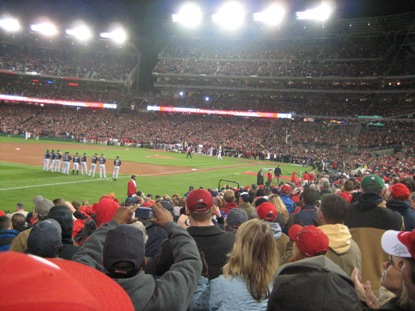
This is the view behind us.

-
Jimmy Cayne Cashes Out
Eddy Elfenbein, March 28th, 2008 at 9:39 amJimmy Cayne dumps all of his Bear Stearns (BSC) stock.
Only a year ago James E. Cayne’s stake in Bear Stearns was worth more than $1 billion. But on Thursday, Mr. Cayne, the chairman of Bear, disclosed that he had sold all of his shares in the troubled investment bank this week for just $61 million.
While the sale leaves Mr. Cayne a wealthy man, it nonetheless underscores the deep losses suffered by Bear’s shareholders after the company’s forced sale to JPMorgan Chase two weeks ago.
And for Mr. Cayne, the liquidation evokes a deep sense of loss. It represents a humiliating capitulation for a brash executive who, with his ever-present cigar, suspender-snapping ways and Friday golf outings in the summer, epitomized the classic, if outdated, picture of the Wall Street chieftain.
To the end, Mr. Cayne heeded the advice he often gave his colleagues at Bear: hold on to your stock. Whether the stock was flying high, as it was early last year, at $171, or plummeting, as it did in recent months, Mr. Cayne kept the vast bulk of his 5.6 million shares. -
Goodbye Moto
Eddy Elfenbein, March 26th, 2008 at 10:27 amInstead of one big sucky company, we’ll now have two!
Motorola said Wednesday that it would split itself into two publicly traded companies as it struggles to boost its stock price and faces pressure from activist investor Carl C. Icahn.
Motorola said in a statement that it would separate its flagging cellphone unit from its broadband and mobility operations, which encompasses the servicing of wireless networks and the building of television set-top boxes. Motorola shareholders would receive stock in both companies.
“Creating two industry-leading companies will provide improved flexibility, more tailored capital structures, and increased management focus – as well as more targeted investment opportunities for our shareholders,” Gregory Q. Brown, Motorola’s chief executive, said in a statement.
Motorola said in January that it was considering a break-up as its stock has plunged 45 percent over the past year. Despite the success of its Razr cellphone, Motorola has lost market share to rivals like Nokia, Samsung and Apple.
It has also faced increasing pressure from Mr. Icahn, its second-largest shareholder. The activist investor recently sued Motorola to gain access to documents related to its board’s discussions about its cellphone business.
Mr. Icahn, who holds about 6.3 percent of Motorola shares, is also seeking four seats on the company’s board.This makes some sense as the company’s stock has also split itself in two. I really don’t see the value of doing this. I’m always suspicious of the phrase “unlocking shareholder value.” The problem is, there has to be shareholder value in the first place that can be unlocked.
One of the reasons for the breakup, given by CEO Gregory Brown, was that the two separate units would benefit from increased focus from management. Why couldn’t they effectively manage both? -
Goldman: $460 Billion More in Credit Losses
Eddy Elfenbein, March 26th, 2008 at 9:34 amWall Street banks, brokerages, and hedge funds may report $460 billion in credit losses from the collapse of the subprime mortgage market, or almost four times the amount already disclosed, according to Goldman Sachs Group Inc. Profits will continue to wane, other analysts said.
“There is light at the end of the tunnel, but it is still rather dim,” Goldman analysts including New York-based Andrew Tilton said in a note to investors yesterday. They estimated that residential mortgage losses will account for half the total and commercial mortgages for as much as 20 percent.
Earnings and share prices at US financial institutions tumbled in the past year as fallout from the mortgage crisis spread to other markets. Demand for mortgage-backed securities evaporated, leading to the collapse of Bear Stearns Cos., once that market’s largest underwriter, and a Federal Reserve-led bailout by JPMorgan Chase & Co. this month. -
Federal Reserve Announces Emergency Release Of Butterflies
Eddy Elfenbein, March 26th, 2008 at 6:56 amThe Onion Radio News is on the scene.
-
Archives
- October 2026
- September 2026
- August 2026
- July 2026
- June 2026
- May 2026
- April 2026
- March 2026
- February 2026
- January 2026
- December 2025
- November 2025
- October 2025
- September 2025
- August 2025
- July 2025
- June 2025
- May 2025
- April 2025
- March 2025
- February 2025
- January 2025
- December 2024
- November 2024
- October 2024
- September 2024
- August 2024
- July 2024
- June 2024
- May 2024
- April 2024
- March 2024
- February 2024
- January 2024
- December 2023
- November 2023
- October 2023
- September 2023
- August 2023
- July 2023
- June 2023
- May 2023
- April 2023
- March 2023
- February 2023
- January 2023
- December 2022
- November 2022
- October 2022
- September 2022
- August 2022
- July 2022
- June 2022
- May 2022
- April 2022
- March 2022
- February 2022
- January 2022
- December 2021
- November 2021
- October 2021
- September 2021
- August 2021
- July 2021
- June 2021
- May 2021
- April 2021
- March 2021
- February 2021
- January 2021
- December 2020
- November 2020
- October 2020
- September 2020
- August 2020
- July 2020
- June 2020
- May 2020
- April 2020
- March 2020
- February 2020
- January 2020
- December 2019
- November 2019
- October 2019
- September 2019
- August 2019
- July 2019
- June 2019
- May 2019
- April 2019
- March 2019
- February 2019
- January 2019
- December 2018
- November 2018
- October 2018
- September 2018
- August 2018
- July 2018
- June 2018
- May 2018
- April 2018
- March 2018
- February 2018
- January 2018
- December 2017
- November 2017
- October 2017
- September 2017
- August 2017
- July 2017
- June 2017
- May 2017
- April 2017
- March 2017
- February 2017
- January 2017
- December 2016
- November 2016
- October 2016
- September 2016
- August 2016
- July 2016
- June 2016
- May 2016
- April 2016
- March 2016
- February 2016
- January 2016
- December 2015
- November 2015
- October 2015
- September 2015
- August 2015
- July 2015
- June 2015
- May 2015
- April 2015
- March 2015
- February 2015
- January 2015
- December 2014
- November 2014
- October 2014
- September 2014
- August 2014
- July 2014
- June 2014
- May 2014
- April 2014
- March 2014
- February 2014
- January 2014
- December 2013
- November 2013
- October 2013
- September 2013
- August 2013
- July 2013
- June 2013
- May 2013
- April 2013
- March 2013
- February 2013
- January 2013
- December 2012
- November 2012
- October 2012
- September 2012
- August 2012
- July 2012
- June 2012
- May 2012
- April 2012
- March 2012
- February 2012
- January 2012
- December 2011
- November 2011
- October 2011
- September 2011
- August 2011
- July 2011
- June 2011
- May 2011
- April 2011
- March 2011
- February 2011
- January 2011
- December 2010
- November 2010
- October 2010
- September 2010
- August 2010
- July 2010
- June 2010
- May 2010
- April 2010
- March 2010
- February 2010
- January 2010
- December 2009
- November 2009
- October 2009
- September 2009
- August 2009
- July 2009
- June 2009
- May 2009
- April 2009
- March 2009
- February 2009
- January 2009
- December 2008
- November 2008
- October 2008
- September 2008
- August 2008
- July 2008
- June 2008
- May 2008
- April 2008
- March 2008
- February 2008
- January 2008
- December 2007
- November 2007
- October 2007
- September 2007
- August 2007
- July 2007
- June 2007
- May 2007
- April 2007
- March 2007
- February 2007
- January 2007
- December 2006
- November 2006
- October 2006
- September 2006
- August 2006
- July 2006
- June 2006
- May 2006
- April 2006
- March 2006
- February 2006
- January 2006
- December 2005
- November 2005
- October 2005
- September 2005
- August 2005
- July 2005
 Eddy Elfenbein is a Washington, DC-based speaker, portfolio manager and editor of the blog Crossing Wall Street. His