Archive for 2008
-
Fire Sale at the Times?
Eddy Elfenbein, March 12th, 2008 at 7:18 amThe Wall Street Journal reports that the New York Times is considering selling some assets. Well…it’s about time. This move is clearly in response to pressure from hedge funds that are pushing for seats on the company’s board. The funds now own as much stock as the Sulzberger family.
In the media, pressure from hedge funds is often portrayed in a negative light, as if some slick-haired Gordon Gekko types are bullying a loveable family run enterprise. In the case of the New York Times, the funds are the only ones willing to hold the company accountable. The current management has run the company into the ground, and an asset sale should have happened a long time ago. Jack Welch, for example, wanted to buy the Boston Globe, but the Times shot him down. Now, I doubt the Times could sell the Globe even if they wanted to.
Here’s what sclerotic companies like the Times don’t get: Even if shareholders don’t control the board, they still have a vote. They can vote by selling and that’s exactly what has happened. Shares of NYT are basically where they were 12 years ago. How could anyone think that’s serving shareholders well?
There’s also an interesting wrinkle. One of the NYT’s non-core assets is a stake in the Boston Red Sox. You read that right. That’s like Sauron owning a stake in the Hobbit’s favorite pub. Given the Bosox recent World Series wins, I would think that the franchise could go for a nice sum. Speaking of Sauron, maybe Steinbrenner is interested?
The Times could also let go of the IHT and even About.com. Some analysts have floated ideas of the Times being bought out by fill-in-the-blank (Buffett, Google, Bloomberg). Interesting, but I doubt it. Even if a major deal came to pass, it doesn’t avoid the major issue that the Times can’t survive in its present form. It will exist, but I don’t think it will be a New York-focused general news publication. The future lies in smaller, niche pubs. -
Best Day Ever
Eddy Elfenbein, March 12th, 2008 at 7:17 amYesterday was the best day for the stock market in five years, but this week, we’re celebrating the 75th anniversary of the best day ever.
Well, technically it wasn’t a one-day gain. When FDR became president on March 4, 1933, there was a national bank holiday. The stock exchange shut down at didn’t reopen until March 15. When trading resumed, stocks soared. The Dow closed at 62.1 which was a 15.34% gain over the close from 12 days before.
The Dow has never done better. By contrast, yesterday’s move doesn’t rank in the top 150. The rally of March 1933 was so strong that the Dow doubled by July.
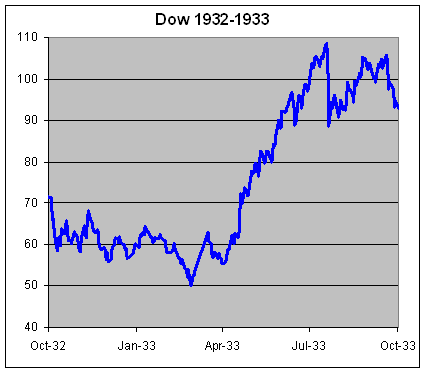
In March 1933, the U.S. effectively ended the gold standard. It’s interesting that yesterday’s rally was sparked, in part, by the Fed’s securities-lending program. -
Today’s S&P 500
Eddy Elfenbein, March 11th, 2008 at 9:26 pmHere’s how every stock in the S&P 500 did today.
-
Things that Sound Like Chewbacca
Eddy Elfenbein, March 11th, 2008 at 4:57 pmVacuum Cleaner
Nightstand
Dog
Cat
Boxer
Baby
Dude Getting Tasered
Hatchback
Trash Can
Hippie Chick -
The Best Day in Five Years
Eddy Elfenbein, March 11th, 2008 at 3:46 pmToday was the best day for the S&P 500 in five years.
Date……………Gain
11-Mar-08…….3.71%
17-Mar-03…….3.54%
13-Mar-03…….3.45%
18-Sep-07…….2.92%
13-Nov-07…….2.91%
28-Nov-07…….2.86%
2-Apr-03……….2.61%
17-Aug-07…….2.46%
6-Aug-07………2.42%
21-Mar-03…….2.30%
16-Jun-03……..2.24%
1-Oct-03……….2.23%
The last time the S&P 500 was up this much was October 15, 2002. -
UNH at Three-Year Low
Eddy Elfenbein, March 11th, 2008 at 11:29 amUnitedHealth Group (UNH) is plunging today on news that WellPoint (WLP) has cut its earnings forecast. If you recall, UNH is company that does nothing but make huge profits and awful headlines.
For the record, UnitedHealth has said that it expects 2008 EPS of $3.95 to $4 a share. The company has publicly made this estimate not once, but twice. That would be a yearly increased of 13% to 14% over 2007. Not bad.
But now the stock is down to $40 a share. Today, it reached its lowest point since 2004. In 2005, the company made $2.48 a share. So the stock is the same price, but profits are about 60% higher.
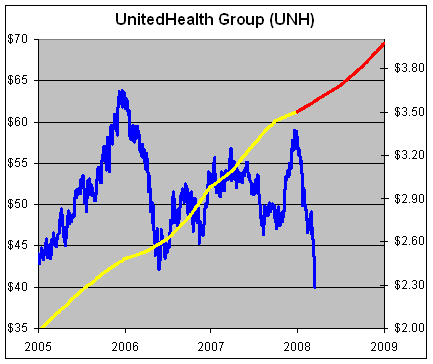
In the above chart, the blue line is the stock price and it follows the left scale. The yellow is the EPS and it follows the right. The red part is the estimate. When the lines cross, the P/E ratio is 17.5. -
The Fed Opens the Spigots
Eddy Elfenbein, March 11th, 2008 at 11:25 amLet’s throw money at them until they stop complaining!
The Federal Reserve, struggling to contain a crisis of confidence in credit markets, plans to lend up to $200 billion in exchange for mortgage-backed securities.
The Fed coordinated the effort with central banks in Europe and Canada, which plan to inject up to $45 billion into their banking systems. The Fed said in a statement it will hold auctions of Treasuries in exchange for debt including AAA rated mortgage securities sold by Fannie Mae, Freddie Mac and by banks.
Today’s steps indicate the Fed is increasingly concerned about the investor exodus from mortgage debt, which threatens to deepen the housing contraction and the economic slowdown. While they fall short of the calls by some analysts for the Fed to make outright purchases of mortgage debt, the central bank left the door open to expanding the effort.
“This is the most significant step the Fed has taken so far,” said David Resler, chief economist at Nomura Securities International Inc. in New York. “This relieves some of the pressure” in the credit markets, he said. -
The Credit Crisis Subtext of the Spitzer Story
Eddy Elfenbein, March 10th, 2008 at 6:01 pmI think this might be ironic, and not the Alanis kind either:
The members decided that even though Client 9 had a credit of $400 to $500 with the ring, they wouldn’t let him keep the appointment until his latest deposit arrived. Client 9 made the calls himself.
On Feb. 13, according to the affidavit, Client 9 made a hotel reservation in D.C. under his name and left a key for a woman named “Kristen.”
Client 9 was eventually told his deposit had arrived and “Kristen” was on her way from New York. Client 9 responded, “Great, OK, wonderful.”
Client 9 discussed with the prostitution ring a way for him to have credit stored up so that he wouldn’t have to worry about sending in a deposit in the future.
Then they discussed a way for “Kristen” to get his hotel room key once she arrived.
“Kristen” was sent to room 871, which Client 9 was leaving ajar; Client 9 wanted to be reminded of what she looked like and was told “American, petite, very pretty brunette, five feet five inches, and 105 pounds.”Was Spitzer done in by tougher credit standards? If only some banks were as prudent as whorehouses.
Check out their rates (conveniently listed in pounds, dollars and euros). You can pay with cash, credit card, wire transfer or money order. I wonder if the rates count as core or non-core inflation. -
L’Affaire Spitzer
Eddy Elfenbein, March 10th, 2008 at 3:58 pmI don’t have much to add about today’s big story, but I’ll simply say that I’ve never been a big fan of Eliot Spitzer. He’s a nasty guy and he ruthlessly pursued a baseless case against Dick Grasso. According to Charlie Gasparino’s book, “King of the Club,” Spitzer’s aides told reporters that Grasso had an affair with his secretary. Charming.
-
Little Tycoons
Eddy Elfenbein, March 10th, 2008 at 2:46 pmAt the Ariel Community Academy in Chicago, each incoming first-grade class gets $20,000. The children are eventually put in charge of managing it and picking the stocks.
The concept is simple: Ariel’s experts manage a $20,000 portfolio for each class until sixth grade, briefing them regularly along the way, and then begin turning over the decisions to the children. Upon graduation from eighth grade, each class returns the initial investment amount to the school for another first-grade class and donates, invests or pockets the profits.
After giving half the gains to community charity programs or school initiatives, each student can then take the rest in cash or invest it in a Section 529 college savings plan, in which case they are given an additional $1,000. Last year, 80 percent of graduates invested their $150 shares in a 529.Given the success of stocks like Crocs, Apple and Hansen Natural, I think it might be worth listening to what kids have to say.
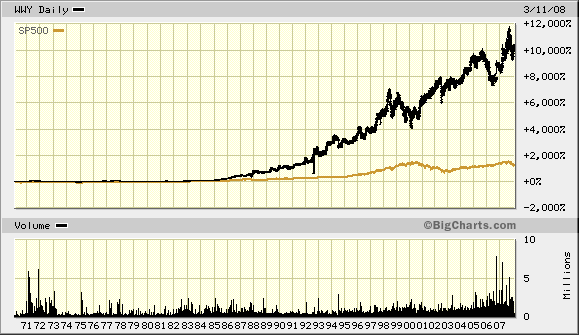
Here’s how Wrigley’s (WWY) has performed over the long haul:
-
Archives
- October 2026
- September 2026
- August 2026
- July 2026
- June 2026
- May 2026
- April 2026
- March 2026
- February 2026
- January 2026
- December 2025
- November 2025
- October 2025
- September 2025
- August 2025
- July 2025
- June 2025
- May 2025
- April 2025
- March 2025
- February 2025
- January 2025
- December 2024
- November 2024
- October 2024
- September 2024
- August 2024
- July 2024
- June 2024
- May 2024
- April 2024
- March 2024
- February 2024
- January 2024
- December 2023
- November 2023
- October 2023
- September 2023
- August 2023
- July 2023
- June 2023
- May 2023
- April 2023
- March 2023
- February 2023
- January 2023
- December 2022
- November 2022
- October 2022
- September 2022
- August 2022
- July 2022
- June 2022
- May 2022
- April 2022
- March 2022
- February 2022
- January 2022
- December 2021
- November 2021
- October 2021
- September 2021
- August 2021
- July 2021
- June 2021
- May 2021
- April 2021
- March 2021
- February 2021
- January 2021
- December 2020
- November 2020
- October 2020
- September 2020
- August 2020
- July 2020
- June 2020
- May 2020
- April 2020
- March 2020
- February 2020
- January 2020
- December 2019
- November 2019
- October 2019
- September 2019
- August 2019
- July 2019
- June 2019
- May 2019
- April 2019
- March 2019
- February 2019
- January 2019
- December 2018
- November 2018
- October 2018
- September 2018
- August 2018
- July 2018
- June 2018
- May 2018
- April 2018
- March 2018
- February 2018
- January 2018
- December 2017
- November 2017
- October 2017
- September 2017
- August 2017
- July 2017
- June 2017
- May 2017
- April 2017
- March 2017
- February 2017
- January 2017
- December 2016
- November 2016
- October 2016
- September 2016
- August 2016
- July 2016
- June 2016
- May 2016
- April 2016
- March 2016
- February 2016
- January 2016
- December 2015
- November 2015
- October 2015
- September 2015
- August 2015
- July 2015
- June 2015
- May 2015
- April 2015
- March 2015
- February 2015
- January 2015
- December 2014
- November 2014
- October 2014
- September 2014
- August 2014
- July 2014
- June 2014
- May 2014
- April 2014
- March 2014
- February 2014
- January 2014
- December 2013
- November 2013
- October 2013
- September 2013
- August 2013
- July 2013
- June 2013
- May 2013
- April 2013
- March 2013
- February 2013
- January 2013
- December 2012
- November 2012
- October 2012
- September 2012
- August 2012
- July 2012
- June 2012
- May 2012
- April 2012
- March 2012
- February 2012
- January 2012
- December 2011
- November 2011
- October 2011
- September 2011
- August 2011
- July 2011
- June 2011
- May 2011
- April 2011
- March 2011
- February 2011
- January 2011
- December 2010
- November 2010
- October 2010
- September 2010
- August 2010
- July 2010
- June 2010
- May 2010
- April 2010
- March 2010
- February 2010
- January 2010
- December 2009
- November 2009
- October 2009
- September 2009
- August 2009
- July 2009
- June 2009
- May 2009
- April 2009
- March 2009
- February 2009
- January 2009
- December 2008
- November 2008
- October 2008
- September 2008
- August 2008
- July 2008
- June 2008
- May 2008
- April 2008
- March 2008
- February 2008
- January 2008
- December 2007
- November 2007
- October 2007
- September 2007
- August 2007
- July 2007
- June 2007
- May 2007
- April 2007
- March 2007
- February 2007
- January 2007
- December 2006
- November 2006
- October 2006
- September 2006
- August 2006
- July 2006
- June 2006
- May 2006
- April 2006
- March 2006
- February 2006
- January 2006
- December 2005
- November 2005
- October 2005
- September 2005
- August 2005
- July 2005
 Eddy Elfenbein is a Washington, DC-based speaker, portfolio manager and editor of the blog Crossing Wall Street. His