Archive for 2009
-
Best Paragraph of the Day
Eddy Elfenbein, January 5th, 2009 at 11:16 amJames Surowiecki on Wall Street con games:
In David Mamet’s movie “House of Games,” the grifter played by Joe Mantegna explains to a former mark, “It’s called a confidence game. Why? Because you give me your confidence? No. Because I give you mine.” So the bankers gave us their confidence, in the form of mortgages and other forms of credit, and we gave them ours. This culture of credulity did plenty of damage to the economy, but now it has given way to something even more corrosive; namely, endemic mistrust. Because if there’s one thing worse than too much confidence it’s not enough. Fraud impoverishes a few; fear impoverishes the many. As long as mistrust prevails, people will keeping pulling money out of the system—sometimes even at gunpoint.
-
Renaissance Waives Fees
Eddy Elfenbein, January 5th, 2009 at 10:45 amJames Simons, the Grand Poobah of Renaissance Technologies, said he’s going to waive the fees on his futures fund which was down 12% last year, or as Simons called his performance, “less than stellar.”
The break in fees for this year adds up to $30 million for his $3 billion futures fund. In light of Simons move, I’d also like to announce that I’m waiving all user fees for this blog due to the Buy List‘s less-than-stellar performance.
Simons’ Medallion Fund, I should add, was up 80% last year. -
The Frank Pentangeli Defense
Eddy Elfenbein, January 5th, 2009 at 2:03 amHarry Markopolos won’t testify in front of Congress today due to illness. This is strangely similar to The Godfather Part 2.
(H/T: Naked Shorts). -
Down with Financial History
Eddy Elfenbein, January 5th, 2009 at 1:36 amPaul Kedrosky has a very good post on the uselessness of financial history. I think he’s exactly right. Finance people tend to be very loose with historical comparisons. I’ll often hear that some situation is “eerily similar” to some year. I don’t buy it—all these historical scenarios are incredibly different. That’s also why I don’t buy the “madness of crowds” explanations about speculative bubbles (there’s another overrated book).
Paul writes:I’m torn on the subject, but I’m also increasing skeptical of any and all comparisons to prior historical periods. I don’t buy trough P/E, or recession length, or relative valuation, or interest rate, or sectoral rotation arguments, or… you get the picture. I love data, but I’m increasingly close to being an outright nihilist when it comes to over-reliance on historical financial data without any truly coherent supporting rationale. We are in a grand experiment with no real history to draw on, and anyone who pretends otherwise is deluded or selling something, or both.
My view is all these models and comparisons are useful fictions. To put it succinctly: Some are more useful than others. The danger is thinking they’re overly determinant. All comparisons need to be put in context, and context changes constantly. The more I study investing, the more I admire a truly independent mind.
David Merkel has more. -
Dubai, Do Sell
Eddy Elfenbein, January 5th, 2009 at 1:14 am -
Lewis and Einhorn in the NYT
Eddy Elfenbein, January 5th, 2009 at 1:09 amThe must-read article from yesterday is Michael Lewis and David Einhorn’s two-parter (here and here) in the New York Times. For the most part, I think they describe the problems fairly well. My issue is that I’m not entirely satisfied when a highly complex issue is reduced to the long-term good being sacrificed for short-term gain. Whenever I hear problems put in a neat package like that, I’m suspicious. It’s like hearing that a problem is due to “a lack of communication.” Call me skeptical. The more I look at the credit mess, the more bewildering I find it.
For proposed solutions, Lewis and Einhorn have some good ideas and some not-so-good ideas. For example, when firms get into trouble, let them fail. However, they don’t go all they way and instead suggest nationalizing a failed firm. Well, that’s not letting it fail. When I think of letting a company fail, I mean the real thing. I think the supposed “chaos of bankruptcy” is overrated. Going into bankruptcy protection is a very well-defined area of our legal system. Airlines can exist for a long time in Chapter fill-in-the-blank.
The question I have is can the FDIC come up with a way to protect counter-party risk in a failed firm ala deposit insurance. Plus, an off-with-their-head strategy, as Lewis and Einhorn propose, could cause even more mischief from execs who have nothing left to lose.
Lewis and Einhorn also suggest regulating credit-default swaps but they’re a little thin on the details. More specifically, there are no details.
They also propose breaking up “any institution that becomes too big to fail.” Hmmm. Again, that’s a lot easier said than done. Particularly when you consider that firms often (though not always) become large through success. Therefore the government has to effectively punish success. I have some issues with that. -
Ed Reed
Eddy Elfenbein, January 4th, 2009 at 11:50 pmIn today’s playoff game, Raven’s safety Ed Reed had two interceptions, including one he returned for 64 yards and a touchdown.
What’s remarkable about Reed is his ability to return inceptions for big yardage. He has 43 career regular season inceptions, which ties him for 58th place all-time. For yardage, however, Reed has 1,144 yards which ranks him sixth all-time.
In week 12 of this season, Reed returned a pick 107 yards for a touchdown to set an all-time record for the longest interception return in the history of the NFL. The previous record was 106 yards.
Set by Ed Reed in four years ago.
-
Not Getting the Year Off on the Right Foot
Eddy Elfenbein, January 2nd, 2009 at 1:14 pm -
Madoff Statue Returned!
Eddy Elfenbein, January 2nd, 2009 at 12:04 pmThe thieves brought it back. And attached a note: “Bernie the Swindler, Lesson: Return Stolen Property to rightful owners. Signed by – The Educators.”
The copper statue was reported stolen from Madoff’s $9.2 million mansion on Dec. 22 – about a week after the Wall Street money man was accused of scamming investors in a $50 billion Ponzi scheme.
The statue does not appear to have any damage, and police are continuing to investigate the incident.
Frick said he was not aware of the 2004 German movie The Edukators, in which anti-capitalist activists break into the homes of rich people, move furniture around and leave notes that say “the days of plenty are over.”
The activists kidnap a rich businessman, have ideological discussions about money and politics, and then let him go, possibly teaching him a lesson on ethics and morality.
“Interesting,” Frick said when told of the film. -
What’s the Difference Between a Recession and a Depression?
Eddy Elfenbein, January 2nd, 2009 at 11:16 amHebert Hoover used the word “depression” instead of “panic” to describe the events of his administration. Since then, there’s been a battle to define what’s a recession and what’s a depression. Most seem to define a depression as a 10% drop in GDP. The Economist says that it’s “a decline in real GDP that exceeds 10%, or one that lasts more than three years.”
America’s Great Depression qualifies on both counts, with GDP falling by around 30% between 1929 and 1933. Output also fell by 13% during 1937 and 1938. The Great Depression was America’s deepest economic slump (excluding those related to wars), but at 43 months it was not the longest: that dubious honour goes to the one in 1873-79, which lasted 65 months.
Japan’s “lost decade” in the 1990s was not a depression, according to these criteria, because the largest peak-to-trough decline in real GDP was only 3.4%, over the two years to March 1999. Since the second world war, only one developed economy has suffered a drop in GDP of more than 10%: Finland’s contracted by 11% during the three years to 1993, mainly thanks to the collapse of the Soviet Union, then its biggest trading partner.
Emerging economies, however, have been much more depression-prone. Among the 25 emerging economies covered each week in the back pages of The Economist, there have been no fewer than 13 instances in the past 30 years of a decline in real GDP of more than 10%. Argentina and Poland were afflicted twice. Indonesia, Malaysia and Thailand all suffered double-digit drops in output during the Asian crisis of 1997-98, and Russia’s GDP shrank by a shocking 45% between 1990 and 1998.
The left-hand chart shows The Economist’s ranking of slumps in developed and emerging economies over the past century. It excludes those during wartime (both Germany and Japan, for example, saw output plunge by 50% or more after 1944). The depressions in Germany and France in the 1930s make it into the top 12, but not that in Britain, where GDP fell by a relatively modest 6%.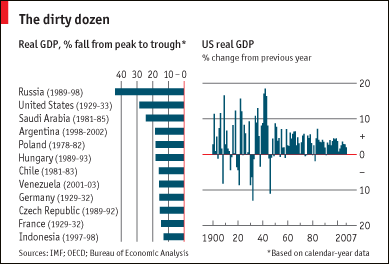
-
Archives
- October 2026
- September 2026
- August 2026
- July 2026
- June 2026
- May 2026
- April 2026
- March 2026
- February 2026
- January 2026
- December 2025
- November 2025
- October 2025
- September 2025
- August 2025
- July 2025
- June 2025
- May 2025
- April 2025
- March 2025
- February 2025
- January 2025
- December 2024
- November 2024
- October 2024
- September 2024
- August 2024
- July 2024
- June 2024
- May 2024
- April 2024
- March 2024
- February 2024
- January 2024
- December 2023
- November 2023
- October 2023
- September 2023
- August 2023
- July 2023
- June 2023
- May 2023
- April 2023
- March 2023
- February 2023
- January 2023
- December 2022
- November 2022
- October 2022
- September 2022
- August 2022
- July 2022
- June 2022
- May 2022
- April 2022
- March 2022
- February 2022
- January 2022
- December 2021
- November 2021
- October 2021
- September 2021
- August 2021
- July 2021
- June 2021
- May 2021
- April 2021
- March 2021
- February 2021
- January 2021
- December 2020
- November 2020
- October 2020
- September 2020
- August 2020
- July 2020
- June 2020
- May 2020
- April 2020
- March 2020
- February 2020
- January 2020
- December 2019
- November 2019
- October 2019
- September 2019
- August 2019
- July 2019
- June 2019
- May 2019
- April 2019
- March 2019
- February 2019
- January 2019
- December 2018
- November 2018
- October 2018
- September 2018
- August 2018
- July 2018
- June 2018
- May 2018
- April 2018
- March 2018
- February 2018
- January 2018
- December 2017
- November 2017
- October 2017
- September 2017
- August 2017
- July 2017
- June 2017
- May 2017
- April 2017
- March 2017
- February 2017
- January 2017
- December 2016
- November 2016
- October 2016
- September 2016
- August 2016
- July 2016
- June 2016
- May 2016
- April 2016
- March 2016
- February 2016
- January 2016
- December 2015
- November 2015
- October 2015
- September 2015
- August 2015
- July 2015
- June 2015
- May 2015
- April 2015
- March 2015
- February 2015
- January 2015
- December 2014
- November 2014
- October 2014
- September 2014
- August 2014
- July 2014
- June 2014
- May 2014
- April 2014
- March 2014
- February 2014
- January 2014
- December 2013
- November 2013
- October 2013
- September 2013
- August 2013
- July 2013
- June 2013
- May 2013
- April 2013
- March 2013
- February 2013
- January 2013
- December 2012
- November 2012
- October 2012
- September 2012
- August 2012
- July 2012
- June 2012
- May 2012
- April 2012
- March 2012
- February 2012
- January 2012
- December 2011
- November 2011
- October 2011
- September 2011
- August 2011
- July 2011
- June 2011
- May 2011
- April 2011
- March 2011
- February 2011
- January 2011
- December 2010
- November 2010
- October 2010
- September 2010
- August 2010
- July 2010
- June 2010
- May 2010
- April 2010
- March 2010
- February 2010
- January 2010
- December 2009
- November 2009
- October 2009
- September 2009
- August 2009
- July 2009
- June 2009
- May 2009
- April 2009
- March 2009
- February 2009
- January 2009
- December 2008
- November 2008
- October 2008
- September 2008
- August 2008
- July 2008
- June 2008
- May 2008
- April 2008
- March 2008
- February 2008
- January 2008
- December 2007
- November 2007
- October 2007
- September 2007
- August 2007
- July 2007
- June 2007
- May 2007
- April 2007
- March 2007
- February 2007
- January 2007
- December 2006
- November 2006
- October 2006
- September 2006
- August 2006
- July 2006
- June 2006
- May 2006
- April 2006
- March 2006
- February 2006
- January 2006
- December 2005
- November 2005
- October 2005
- September 2005
- August 2005
- July 2005
 Eddy Elfenbein is a Washington, DC-based speaker, portfolio manager and editor of the blog Crossing Wall Street. His