Archive for 2009
-
The Idea of Breaking Up Big Banks Is Nonsense According to the Chairman of a Big Bank
Eddy Elfenbein, June 30th, 2009 at 1:12 pmHSBC’s Chairman Stephen Green has some interesting thoughts on the futility of trying contain financial crises:
The global financial industry should not be revamped to try to ensure no bank was too big to fail, HSBC (HSBA.L) Chairman Stephen Green said on Tuesday.
“It is unrealistic to believe that the industry can be reconstructed such that individual institutions are not too big to fail. Quite small and simple banks are too big to fail in a strict sense,” said Green, chairman of Europe’s biggest bank, in a speech at the British Bankers’ Association annual conference.
“The notion that the failure of a bank can be contained by the conventional legal and administrative processes for handling business failures is nonsense.”
Green said “narrow banking” was not the answer to ensure stability. “When you look at the different things that commercial banks do you can’t segregate those out meaningfully in this day of integrated capital markets,” he told Reuters in an interview after.
Peter Sands, chief executive of Standard Chartered (STAN.L), agreed that breaking up the big banks was not the answer.
“There is a case for restricting proprietary risk-taking, but (a new Glass-Steagall Act) is not the way to do it,” Sands said. “It gives an illusion of comfort, it won’t work, and it will be great for regulatory arbitrage.” -
About Auditing the Fed
Eddy Elfenbein, June 30th, 2009 at 11:43 amThe Federal Reserve is one of those topics where otherwise normal people start getting a little weird. I think it knocks about 10 points off people’s IQ. Israel is another topic like that. In fact, to some people, it’s not a separate topic.
I mention this because there’s been a movement to support Congressman’s Ron Paul’s bill (HR 1207) which will require audits of the Federal Reserve. The bill already has enough cosponsors to pass the House easily. The Senate, however, could be a different matter.
So what could anyone have against auditing the Fed? The problem I have isn’t the audit, but it’s the bizarre paranoia of more than a few of the bill’s supporters. What exactly do they expect to find out?
There is a serious question as to what role the Federal Reserve ought to have. The issue before us is that the Fed has been taking on more and more job titles over the last year, not be design but by default. Congress’ prefer method seems to be outsourcing fiscal policy to the Fed and then blaming it for the consequences.
Letting Lehman Brothers may have been a mistake, though I’m not convinced it brought on the collapse. Nationalizing AIG was a bad move and the Fed wasn’t pleased with it. Unlike a lot of folks, I’m not so judgmental about Greenspan’s low-rate policies earlier this decade. Not that I think they were right but I’m not convinced how obvious the wrongness was at the time. Monetary policy in hindsight is an easy thing to do.
I consider these open questions but the fact is that these are decisions that the Federal Reserve has made and will have to make in the future. That’s a lot on their plate, plus they have their regulatory duties. Consider that over the past several months, the Fed’s balance sheet has more than doubled to over $2 trillion. One idea is to let the Fed issue its own bonds. The Fed wants to do that but Congress would never go for it. This brings me to my general rule about central banking, it should be as dull as possible.
Technically, the Fed is audited but HR 1207 will require a full audit which will include their open market operations. Edward Flaherty writes that there’s a good reason why the Fed’s open market operations haven’t been audited:In 1978, the Federal Reserve’s Office of Inspector General was given authority to conduct audits, operations reviews, and investigations of Board of Governors’ programs and operations. In addition, GAO was given authority to audit the Board of Governors and the regional Federal Reserve Banks, branches, and facilities, subject to the limitation that it could not examine the Fed’s foreign exchange and open market monetary policy actions.
One of the difficulties in understanding the audit issue is in the different types of audits. Most people think of audits as financial audits. These are principally concerned with whether an institution has spent the money and maintains the funds as it has claimed in its financial statements, and whether it is complying with procedures designed to safeguard it from misappropriation of funds. This is no doubt the kind of audit most people have in mind when expressing their concern over whether the Fed gets audited.
But audits are also designed to review management efficiency and to evaluate the policy of an institution. It is the latter kind of audits that are the reason for the restrictions on GAO’s audit authority over the Fed. The concern is that more extensive audits will become policy evaluations second-guessing the Fed’s monetary policy, and not examinations of Federal Reserve financial safeguards and procedures. Under current law, policy is reviewed twice annually by the Congress.In 1993 Wayne D. Angell, then a member of the Board of Governors, submitted testimony before a House subcommittee on the reasons for the restrictions on GAO access. He commented, By excluding these areas, the Act attempts to balance the need for public accountability of the Federal Reserve through GAO audits against the need to insulate the central bank’s monetary policy functions from short-term political pressures and to ensure that foreign central banks and governmental entities can transact business in the U.S. financial markets through the Federal Reserve on a confidential basis.
In reference to a bill that would lift the constraints placed on the GAO’s audit authority over the Federal Reserve, Angell stated, The benefits, if any, of broadening the GAO’s authority into the areas of monetary policy and transactions with foreign official entities would be small. With regard to purely financial audits, the Federal Reserve Act already requires that the Board conduct an annual financial examination of each Reserve Bank…The process of conducting financial audits is reviewed by a public accounting firm to confirm that the methods and techniques being employed are effective and that the program follows generally accepted auditing standards…Further, a private accounting firm audits the Board’s balance sheet…Finally, and more broadly, the Congress has, in effect, mandated its own review of monetary policy by requiring semiannual reports to Congress on monetary policy under the Full Employment and Balanced Growth Act of 1978…In addition, there is a vast and continuously updated body of literature and expert evaluation of U.S. monetary policy. In this environment, the contribution that a GAO audit would make to the active public discussion of the conduct of monetary policy is not likely to outweigh the disadvantages of expanding GAO audit authority in this area.Ultimately, I’m puzzled by the anger directed at the Fed. Go ahead and audit them, but you should really be angry at Congress.
-
2009’s Dumbest Business Moments
Eddy Elfenbein, June 30th, 2009 at 10:21 amFortune has a roundup of the Dumbest Business Moments of 2009.
My favorite is when the SEC banned Bernie Madoff from the securities industry. Exactly two weeks ago, nine years after they were first warned of him. -
Boring = Technical Analysis; Better = Technical Analysis Explained by Hot Aussie Chick
Eddy Elfenbein, June 30th, 2009 at 10:16 am
(HT: Timmay) -
Cramer’s Greatest Hits
Eddy Elfenbein, June 30th, 2009 at 10:12 amJoe Weisenthal notes that Jim Cramer said that today is the exact bottom of the housing market. He said that last September.
Check out Joe’s collection of Cramer’s greatest hits. -
Headline of the Day
Eddy Elfenbein, June 30th, 2009 at 10:01 amFirst Place goes to CNN:
My comment: I stopped reading after the comma.
Second Place goes to the LA Times:My comment: ???????
-
British Economy has Worst Quarter in 50 years
Eddy Elfenbein, June 30th, 2009 at 9:43 amThe U.K. economy shrank more than previously estimated in the first quarter in the biggest contraction since 1958 as the recession choked industries from construction to services.
Gross domestic product fell 2.4 percent from the final three months of 2008, compared with the prior measurement of a 1.9 percent drop, the Office for National Statistics said today in London. The median prediction in a Bloomberg survey of 28 economists was for a 2.1 percent decline. Construction activity plunged almost three times as much as originally estimated.
Bank of England Governor Mervyn King said last week that Britain’s recovery from recession may turn out to be “a long, hard slog.” While business surveys have indicated the economic slump is easing, unemployment may continue to increase and net mortgage lending is the weakest since records began in 1993.
“In big picture terms, it doesn’t really change the outlook,” said Nick Kounis, an economist at Fortis Bank Nederland Holding NV in Amsterdam and a former U.K. Treasury official. “The recovery is unlikely to be very strong any time soon. There’s more bad news for consumers ahead.”The lousy economy is apparently affecting everyone: Queen to run out of funds by 2012.
-
BarryTV
Eddy Elfenbein, June 29th, 2009 at 8:54 pmHere’s blogger and Carney-foil, Barry Ritholtz discussing Bailout Nation on C-Span’s BookTV.
Here’s my review of Bailout Nation. -
The Best of the Money Blogs
Eddy Elfenbein, June 29th, 2009 at 4:35 pmI’m honored to have been nominated by Howard Lindzon and David Berman as one of the best money blogs at the Globe and Mail.
You can vote here for Crossing Wall Street. Please vote early and often. You can see the gentleman at the Acorn office for additional assistance. -
Stocks Chillax
Eddy Elfenbein, June 29th, 2009 at 4:14 pmThe stock market’s volatility continues to subside. The VIX closed at its lowest level in nine months. At one point in October, the VIX came within inches of 90. Now it’s close to dipping below 25.
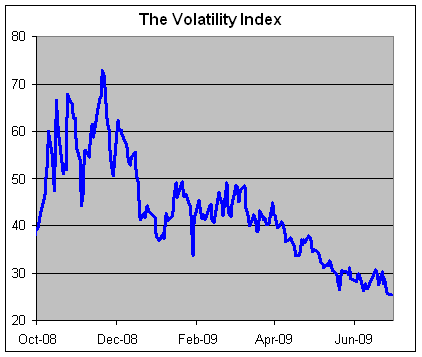
Except at very low points (like below 13), a low VIX is neither good nor bad for stocks. It simply means that there will be less volatility.
-
Archives
- October 2026
- September 2026
- August 2026
- July 2026
- June 2026
- May 2026
- April 2026
- March 2026
- February 2026
- January 2026
- December 2025
- November 2025
- October 2025
- September 2025
- August 2025
- July 2025
- June 2025
- May 2025
- April 2025
- March 2025
- February 2025
- January 2025
- December 2024
- November 2024
- October 2024
- September 2024
- August 2024
- July 2024
- June 2024
- May 2024
- April 2024
- March 2024
- February 2024
- January 2024
- December 2023
- November 2023
- October 2023
- September 2023
- August 2023
- July 2023
- June 2023
- May 2023
- April 2023
- March 2023
- February 2023
- January 2023
- December 2022
- November 2022
- October 2022
- September 2022
- August 2022
- July 2022
- June 2022
- May 2022
- April 2022
- March 2022
- February 2022
- January 2022
- December 2021
- November 2021
- October 2021
- September 2021
- August 2021
- July 2021
- June 2021
- May 2021
- April 2021
- March 2021
- February 2021
- January 2021
- December 2020
- November 2020
- October 2020
- September 2020
- August 2020
- July 2020
- June 2020
- May 2020
- April 2020
- March 2020
- February 2020
- January 2020
- December 2019
- November 2019
- October 2019
- September 2019
- August 2019
- July 2019
- June 2019
- May 2019
- April 2019
- March 2019
- February 2019
- January 2019
- December 2018
- November 2018
- October 2018
- September 2018
- August 2018
- July 2018
- June 2018
- May 2018
- April 2018
- March 2018
- February 2018
- January 2018
- December 2017
- November 2017
- October 2017
- September 2017
- August 2017
- July 2017
- June 2017
- May 2017
- April 2017
- March 2017
- February 2017
- January 2017
- December 2016
- November 2016
- October 2016
- September 2016
- August 2016
- July 2016
- June 2016
- May 2016
- April 2016
- March 2016
- February 2016
- January 2016
- December 2015
- November 2015
- October 2015
- September 2015
- August 2015
- July 2015
- June 2015
- May 2015
- April 2015
- March 2015
- February 2015
- January 2015
- December 2014
- November 2014
- October 2014
- September 2014
- August 2014
- July 2014
- June 2014
- May 2014
- April 2014
- March 2014
- February 2014
- January 2014
- December 2013
- November 2013
- October 2013
- September 2013
- August 2013
- July 2013
- June 2013
- May 2013
- April 2013
- March 2013
- February 2013
- January 2013
- December 2012
- November 2012
- October 2012
- September 2012
- August 2012
- July 2012
- June 2012
- May 2012
- April 2012
- March 2012
- February 2012
- January 2012
- December 2011
- November 2011
- October 2011
- September 2011
- August 2011
- July 2011
- June 2011
- May 2011
- April 2011
- March 2011
- February 2011
- January 2011
- December 2010
- November 2010
- October 2010
- September 2010
- August 2010
- July 2010
- June 2010
- May 2010
- April 2010
- March 2010
- February 2010
- January 2010
- December 2009
- November 2009
- October 2009
- September 2009
- August 2009
- July 2009
- June 2009
- May 2009
- April 2009
- March 2009
- February 2009
- January 2009
- December 2008
- November 2008
- October 2008
- September 2008
- August 2008
- July 2008
- June 2008
- May 2008
- April 2008
- March 2008
- February 2008
- January 2008
- December 2007
- November 2007
- October 2007
- September 2007
- August 2007
- July 2007
- June 2007
- May 2007
- April 2007
- March 2007
- February 2007
- January 2007
- December 2006
- November 2006
- October 2006
- September 2006
- August 2006
- July 2006
- June 2006
- May 2006
- April 2006
- March 2006
- February 2006
- January 2006
- December 2005
- November 2005
- October 2005
- September 2005
- August 2005
- July 2005
 Eddy Elfenbein is a Washington, DC-based speaker, portfolio manager and editor of the blog Crossing Wall Street. His