Archive for 2009
-
Academic Study: “Analysts’ revisions are typically information-free”
Eddy Elfenbein, June 2nd, 2009 at 9:16 amThe Irish Times notes that Wall Street analysts…you better sit down for this…often don’t know what they’re talking about:
The Citi research looked at analyst recommendations over the last 15 years. It found that analysts were at their most bullish at the end of 1999, despite the fact that price-earnings ratios suggested markets had never been so over-valued. The dotcom crash in early 2000 triggered a vicious three-year bear market during which analysts grew progressively bearish. This bearishness increased even as the market bottomed in the autumn of 2002. Bullishness took root as the market rose over the following five years, peaking just prior to the outbreak of the financial crisis. Since then, analyst bearishness has risen inexorably.
The report also looked at the difference in performance between the stocks most favoured by analysts and the stocks least favoured by analysts. It found that the furious global rally off the March bottom has caught analysts completely by surprise, with forecasters more off the mark than at any other time during the period under study.Later on.
The Financial Times reported this month on an academic study that looked at the effect of analyst recommendations on stock prices. It found that “buy” and “sell” tips have little appreciable effect on prices. “Analysts’ revisions are typically information-free,” the study concluded, adding that investors were aware of this.
One analyst who has been consistently critical of his fellow professionals is James Montier of Société Générale. The award-winning analyst said last year that it was “transparently obvious that analysts lag reality”. They “only change their minds when there is irrefutable proof they were wrong, and then only change their minds very slowly”, he said.
The latter study appears to confirm this – almost 80 per cent of analysts’ changes in recommendations came after major corporate events. Analysts are “like rabbits caught in the headlights”, Mr Montier said, and are “seemingly incapable of any form of independent thought”.Do rabbits stare at headlights?
Maybe analysts should start listening to this guy who has almost zero private sector experience:
The market is up 35% since then. -
Long Bond Hasn’t Suffered a Loss Like Since Since Another Century — And Not the 20th
Eddy Elfenbein, June 2nd, 2009 at 9:07 amMebane Faber writes that the long bond is suffering its worst draw down since at least 1900.
By the way, his new book is out. -
Dow Jones Admits It Paid Attention to Bloggers on Decision to Add Cisco to DJIA. Suck it S&P!
Eddy Elfenbein, June 1st, 2009 at 10:32 pmIn the WSJ, John Prestbo explains why they decided to replace GM and Citigroup with Cisco and Travelers today.Here are some highlights:
Did the fact that Travelers used to be part of Citigroup play a role in choosing that particular insurance company?
No. Citigroup spun off Travelers in 2002, so it has been operating independently for going on seven years. And it was independent prior to becoming part of Citigroup in 1998. We were committed to restoring the insurance sector to the Dow after ejecting American International Group, Inc. (AIG) last September after the government takeover. Travelers is a property and casualty insurer, as AIG is, and it is certainly a leader in that industry.
Why choose a tech company, Cisco, to replace an automaker?
We did not need another consumer goods company after adding Kraft Foods when we removed AIG. In looking around, we were struck by the fact that Cisco makes products that pave the Information Highway – computer networking equipment, things that enable high-speed data and video transmission, and so on. We saw Cisco helping the economy and culture adjust to the digital age, much as automobiles influenced economic and social changes in the 20th Century.
Well, why not Apple (AAPL) or Google (GOOG)?
Those companies certainly qualify as blue chips, but we chose Cisco this time.This part really caught my attention
Cisco has been on bloggers’ suggestion list for a long time. Do you pay any attention to these kibitzers?
Yes. They and many others take the Dow seriously enough to complain when they think we are doing something wrong and to offer their ideas. So, we take them seriously in return. However, most of these folks are looking at things from an investor’s point of view, as though the Dow was a portfolio they owned (and maybe some of them really do). But our goal is to maintain an index to accurately reflect the market as whole, and by extension the U.S. economy. That is a different purpose, which sometimes leads us in a different direction.Good for them! I’m glad they did two things. One, they listened to bloggers. Two, they said they listened to bloggers.
This is pretty big news for financial blogs. We’re talking about a 113-year-old index and one of the best brand names around.
Now…about Bing. -
S&P Makes New High
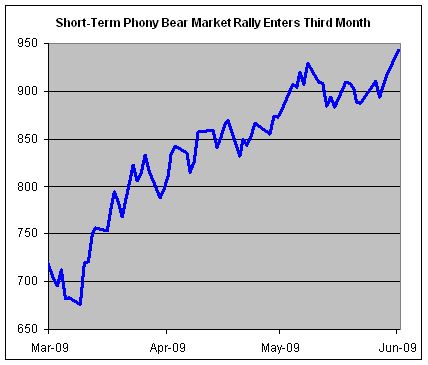
Eddy Elfenbein, June 1st, 2009 at 7:43 pmWe did it. The S&P closed at 942.87, the highest close since November 5.
The phony, fraudulent, manipulated, short-term bear market sucker’s rally is now up 39%.
-
No Comment
Eddy Elfenbein, June 1st, 2009 at 4:25 pmThe Telegraph reports:
In his first official visit to China since becoming Treasury Secretary, Mr Geithner told politicians and academics in Beijing that he still supports a strong US dollar, and insisted that the trillions of dollars of Chinese investments would not be unduly damaged by the economic crisis. Speaking at Peking University, Mr Geithner said: “Chinese assets are very safe.”
The comment provoked loud laughter from the audience of students.LOL has officially become a part of our economic policy, and not in a good way.
(HT: CS) -
Nominal GDP Growth
Eddy Elfenbein, June 1st, 2009 at 3:19 pmWhenever we look at GDP growth, we almost always look at “real growth,” meaning adjusted for inflation. But it’s interesting to look at nominal growth as well. Ideally, the Fed should target interest rates to nominal GDP growth. Of course, that’s a lot harder than it looks.
Here’s the four-quarter change in nominal GDP going back several years.
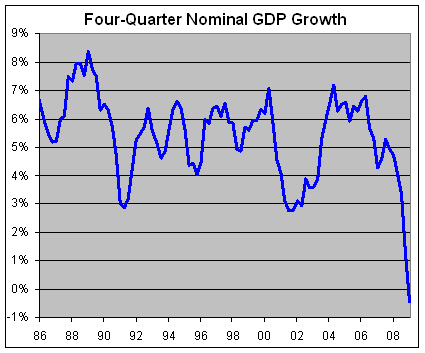
This is the first time it’s been negative in over 50 years. -
CWS Named One of Five Favorite Financial Blogs
Eddy Elfenbein, June 1st, 2009 at 2:49 pmDavid Berman at the Globe and Mail named Crossing Wall Street one of his favorite financial blogs.*
For four years, a long time in this business, Eddy Elfenbein has been treating readers with a mix of charts and sharp observation.
The others are Bespoke Investment Group, Stocks To Watch Today, Humble Student of the Markets and Footnoted.org.
* He actually wrote “favourite.” When are Canadians and Brits going to learn English? -
AMZN@$83
Eddy Elfenbein, June 1st, 2009 at 2:09 pmDid Amazon (AMZN) start trading in pesos today?
$83! Really?
This won’t end well. -
S&P Nears Seven-Month High
Eddy Elfenbein, June 1st, 2009 at 12:55 pmThe S&P 500 is currently over 945. If it holds up, this will be the highest close since November 5, the day after election day.
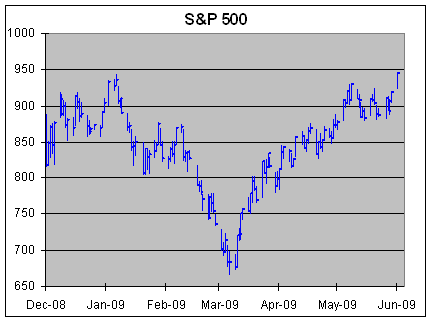
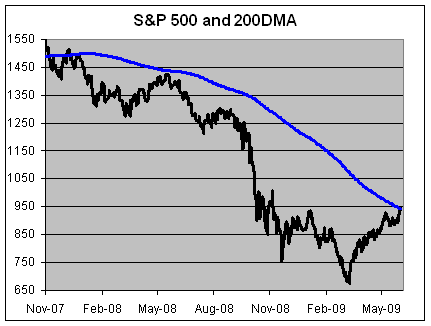
Also, if today’s gains hold up, the S&P 500 will be above its 200-day moving average for the first time in 18 months.
-
“What’s Good for General Motors Is Good for America”
Eddy Elfenbein, June 1st, 2009 at 11:02 amOne of great urban myths of American business history is that the head of GM once said “what’s good for General Motors is good for America.”
That line is once again getting a lot of press today. There’s one problem — it’s not true.
Here’s what happened. In 1953, President Eisenhower nominated GM’s CEO Charles “Engine Charlie” Wilson to be Secretary of Defense. I’ll turn it over to Wikipedia:During the hearings, when asked if as secretary of defense he could make a decision adverse to the interests of General Motors, Wilson answered affirmatively but added that he could not conceive of such a situation “because for years I thought what was good for the country was good for General Motors and vice versa.”
Gee, that’s kinda different. So what’s often portrayed as the ultimate in corporate arrogance that defined the atavistic nature of American capitalism was instead a humble statement of public spiritedness.
-
Archives
- October 2026
- September 2026
- August 2026
- July 2026
- June 2026
- May 2026
- April 2026
- March 2026
- February 2026
- January 2026
- December 2025
- November 2025
- October 2025
- September 2025
- August 2025
- July 2025
- June 2025
- May 2025
- April 2025
- March 2025
- February 2025
- January 2025
- December 2024
- November 2024
- October 2024
- September 2024
- August 2024
- July 2024
- June 2024
- May 2024
- April 2024
- March 2024
- February 2024
- January 2024
- December 2023
- November 2023
- October 2023
- September 2023
- August 2023
- July 2023
- June 2023
- May 2023
- April 2023
- March 2023
- February 2023
- January 2023
- December 2022
- November 2022
- October 2022
- September 2022
- August 2022
- July 2022
- June 2022
- May 2022
- April 2022
- March 2022
- February 2022
- January 2022
- December 2021
- November 2021
- October 2021
- September 2021
- August 2021
- July 2021
- June 2021
- May 2021
- April 2021
- March 2021
- February 2021
- January 2021
- December 2020
- November 2020
- October 2020
- September 2020
- August 2020
- July 2020
- June 2020
- May 2020
- April 2020
- March 2020
- February 2020
- January 2020
- December 2019
- November 2019
- October 2019
- September 2019
- August 2019
- July 2019
- June 2019
- May 2019
- April 2019
- March 2019
- February 2019
- January 2019
- December 2018
- November 2018
- October 2018
- September 2018
- August 2018
- July 2018
- June 2018
- May 2018
- April 2018
- March 2018
- February 2018
- January 2018
- December 2017
- November 2017
- October 2017
- September 2017
- August 2017
- July 2017
- June 2017
- May 2017
- April 2017
- March 2017
- February 2017
- January 2017
- December 2016
- November 2016
- October 2016
- September 2016
- August 2016
- July 2016
- June 2016
- May 2016
- April 2016
- March 2016
- February 2016
- January 2016
- December 2015
- November 2015
- October 2015
- September 2015
- August 2015
- July 2015
- June 2015
- May 2015
- April 2015
- March 2015
- February 2015
- January 2015
- December 2014
- November 2014
- October 2014
- September 2014
- August 2014
- July 2014
- June 2014
- May 2014
- April 2014
- March 2014
- February 2014
- January 2014
- December 2013
- November 2013
- October 2013
- September 2013
- August 2013
- July 2013
- June 2013
- May 2013
- April 2013
- March 2013
- February 2013
- January 2013
- December 2012
- November 2012
- October 2012
- September 2012
- August 2012
- July 2012
- June 2012
- May 2012
- April 2012
- March 2012
- February 2012
- January 2012
- December 2011
- November 2011
- October 2011
- September 2011
- August 2011
- July 2011
- June 2011
- May 2011
- April 2011
- March 2011
- February 2011
- January 2011
- December 2010
- November 2010
- October 2010
- September 2010
- August 2010
- July 2010
- June 2010
- May 2010
- April 2010
- March 2010
- February 2010
- January 2010
- December 2009
- November 2009
- October 2009
- September 2009
- August 2009
- July 2009
- June 2009
- May 2009
- April 2009
- March 2009
- February 2009
- January 2009
- December 2008
- November 2008
- October 2008
- September 2008
- August 2008
- July 2008
- June 2008
- May 2008
- April 2008
- March 2008
- February 2008
- January 2008
- December 2007
- November 2007
- October 2007
- September 2007
- August 2007
- July 2007
- June 2007
- May 2007
- April 2007
- March 2007
- February 2007
- January 2007
- December 2006
- November 2006
- October 2006
- September 2006
- August 2006
- July 2006
- June 2006
- May 2006
- April 2006
- March 2006
- February 2006
- January 2006
- December 2005
- November 2005
- October 2005
- September 2005
- August 2005
- July 2005
 Eddy Elfenbein is a Washington, DC-based speaker, portfolio manager and editor of the blog Crossing Wall Street. His