Archive for 2009
-
Lower Libor May Not Be a Good Sign
Eddy Elfenbein, May 26th, 2009 at 8:59 amBloomberg has an interesting article saying that the lower Libor may actually reflect growing worries in the credit markets instead of a thawing.
“The disparity and the difference is really a signal to the market of who really wants to make some loans and who’s got the ability to make those loans,” said Mark MacQueen, partner and money manager at Austin, Texas-based Sage Advisory Services Ltd., which oversees $7.5 billion. “A lot of banks are just trying to hold on to what they have and not really make loans.”
Rather than signaling that the world’s banks are more willing to lend to each other, some investors and strategists say the decline in Libor has more to do with deposits reducing demand for funds in the interbank market. Deposits at U.S. banks jumped by almost $400 billion in the past six months, according to Jim Vogel, head of bond research at Memphis, Tennessee-based FTN Financial.
“Libor’s decline is not necessarily a sign of improving bank credit or the willingness of banks to lend to each other,” said Vogel, whose firm is one of the 10 biggest underwriters of Fannie Mae, Freddie Mac and other U.S. government agency debt. “It’s a sign of improving bank liquidity as customer deposit growth replaces borrowing in the short-term money markets.” -
The Challenge for Economics
Eddy Elfenbein, May 25th, 2009 at 9:49 amIn the NYT, Greg Mankiw writes on how the credit crisis will affect economics. His answer: Not much. The basics of economics are still in place although some topics will deserve more attention. Here’s a sample:
THE LIMITS OF MONETARY POLICY
The textbook answer to recessions is simple: When the economy suffers from high unemployment and reduced capacity utilization, the central bank can cut interest rates and stimulate the demand for goods and services. When businesses see higher demand, they hire more workers to meet it.
Only rarely in the past did students ask what would happen if the central bank cut interest rates all the way to zero and it still wasn’t enough to get the economy going again. That is no surprise; after all, interest rates near zero weren’t something that they, or even their parents, had ever experienced. But now, with the Federal Reserve’s target interest rate at zero to 0.25 percent, that question is much more pressing.
The Fed is acting with the conviction that it has other tools to put the economy back on track. These include buying a much broader range of financial assets than it typically includes in its portfolio. Students will need to know about these other tools of monetary policy — and will also need to know that economists are far from certain how well these tools work. -
Thanks Vets
Eddy Elfenbein, May 25th, 2009 at 8:26 am
-
Weekend Poll
Eddy Elfenbein, May 22nd, 2009 at 10:09 am -
Have a Great Weekend!
Eddy Elfenbein, May 22nd, 2009 at 9:56 amThe weather is beautiful so don’t expect much posting here today. Also, I finally broke down and joined Twitter (EddyElfenbein) so you can follow me there in 140-character-or-less increments.
I hope everyone has a great weekend! -
The First Trading Day of the Month
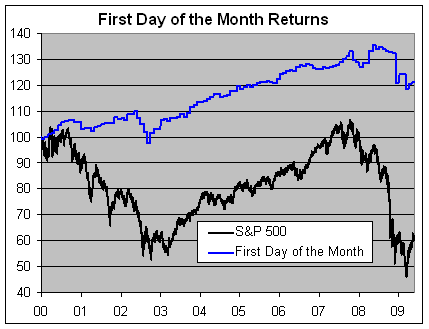
Eddy Elfenbein, May 22nd, 2009 at 9:39 amSo far this decade, the market hasn’t done very well except for one small phenomenon—the first trading day of the month. Through yesterday, the S&P 500 is down 39.5% for the decade. But the market has returned over 21% on the first day of the month (neither figure includes dividends).
What’s interesting is that first days of the month occur less than 5% of the time, so sitting out the rest of the time would have been a smart strategy. How’d you like a job that probably improved your performance if you took over 20 days a month?
-
“Mother of inflated hope/Mistress of despair”
Eddy Elfenbein, May 21st, 2009 at 2:06 pmThe Chronicle of Higher Education interviewed economist Stephen Ziliak.
In haiku.Q. How does writing verse
Help your students understand
A math-based science?
A: Thought transportation —
Newton’s laws might still abide,
Listen: Einstein’s train.
Q: A labor union
Protects workers from abuse —
But what does it cost?
A: Green Knights of Labor,
free Haymarket Anarchists,
cost less than Madoff.
Q: Debt plus recession —
Which is the better move:
saving or spending?
A: Treasury shoppers
choose plain broth over duck soup,
Nudge this paradox.
Q: Regarding Wall Street,
Do virtues of laissez-faire
Apply as elsewhere?
A: Traders are human,
swapping vices for virtues
and vice versa.
Q: Mom and Dad, I’m home!
The job market is nasty —
Where is my bedroom?
A: Invisible hand:
Mother of inflated hope,
Mistress of despair!
Q: Haiku might seem dumb
to bean counters and stuffed shirts —
Students disagree?
A: In this other world
wild orchids freely blossom —
haiku GDP. -
First They Came for My Natty Bo…
Eddy Elfenbein, May 21st, 2009 at 11:30 amUSA Today reports:
WASHINGTON (AP) — Consumers in the United States may have to hand over nearly $2 more for a case of beer to help provide health insurance for all.
Details of the proposed beer tax are described in a Senate Finance Committee document that will be used to brief lawmakers Wednesday at a closed-door meeting.
Taxes on wine and hard liquor would also go up. And there might be a new tax on soda and other sugary drinks blamed for contributing to obesity. No taxes on diet drinks, however.
Beer taxes would go up by 48 cents a six-pack, wine taxes would rise by 49 cents per bottle, and the tax on hard liquor would increase by 40 cents per fifth. Proceeds from the new taxes would help cover an estimated 50 million uninsured Americans.I bet Obama would never tax appletinis or mojitos.
-
Very Short Post on MO
Eddy Elfenbein, May 21st, 2009 at 11:13 amIf you’re looking for a nice yield, it’s hard to find something better than Altria Group (MO). The company just declared a quarterly dividend of 32 cents a share. That comes to 7.8% a year. The company has decent cash flow so I don’t see the dividend being cut to pieces.
-
Disturbing Segment on CNBC
Eddy Elfenbein, May 20th, 2009 at 2:12 pmOn CNBC, Jeff Macke starts acting weird, then very weird. You know it’s bad when Dennis Kneale is the sane one.
I’ve watched this clip a few times and I have no idea what Macke is talking about. It seems like he’s referring to some inside joke, but I don’t get where he’s going. Poor Dennis just backs away.
(Via: Clusterstock)
-
Archives
- October 2026
- September 2026
- August 2026
- July 2026
- June 2026
- May 2026
- April 2026
- March 2026
- February 2026
- January 2026
- December 2025
- November 2025
- October 2025
- September 2025
- August 2025
- July 2025
- June 2025
- May 2025
- April 2025
- March 2025
- February 2025
- January 2025
- December 2024
- November 2024
- October 2024
- September 2024
- August 2024
- July 2024
- June 2024
- May 2024
- April 2024
- March 2024
- February 2024
- January 2024
- December 2023
- November 2023
- October 2023
- September 2023
- August 2023
- July 2023
- June 2023
- May 2023
- April 2023
- March 2023
- February 2023
- January 2023
- December 2022
- November 2022
- October 2022
- September 2022
- August 2022
- July 2022
- June 2022
- May 2022
- April 2022
- March 2022
- February 2022
- January 2022
- December 2021
- November 2021
- October 2021
- September 2021
- August 2021
- July 2021
- June 2021
- May 2021
- April 2021
- March 2021
- February 2021
- January 2021
- December 2020
- November 2020
- October 2020
- September 2020
- August 2020
- July 2020
- June 2020
- May 2020
- April 2020
- March 2020
- February 2020
- January 2020
- December 2019
- November 2019
- October 2019
- September 2019
- August 2019
- July 2019
- June 2019
- May 2019
- April 2019
- March 2019
- February 2019
- January 2019
- December 2018
- November 2018
- October 2018
- September 2018
- August 2018
- July 2018
- June 2018
- May 2018
- April 2018
- March 2018
- February 2018
- January 2018
- December 2017
- November 2017
- October 2017
- September 2017
- August 2017
- July 2017
- June 2017
- May 2017
- April 2017
- March 2017
- February 2017
- January 2017
- December 2016
- November 2016
- October 2016
- September 2016
- August 2016
- July 2016
- June 2016
- May 2016
- April 2016
- March 2016
- February 2016
- January 2016
- December 2015
- November 2015
- October 2015
- September 2015
- August 2015
- July 2015
- June 2015
- May 2015
- April 2015
- March 2015
- February 2015
- January 2015
- December 2014
- November 2014
- October 2014
- September 2014
- August 2014
- July 2014
- June 2014
- May 2014
- April 2014
- March 2014
- February 2014
- January 2014
- December 2013
- November 2013
- October 2013
- September 2013
- August 2013
- July 2013
- June 2013
- May 2013
- April 2013
- March 2013
- February 2013
- January 2013
- December 2012
- November 2012
- October 2012
- September 2012
- August 2012
- July 2012
- June 2012
- May 2012
- April 2012
- March 2012
- February 2012
- January 2012
- December 2011
- November 2011
- October 2011
- September 2011
- August 2011
- July 2011
- June 2011
- May 2011
- April 2011
- March 2011
- February 2011
- January 2011
- December 2010
- November 2010
- October 2010
- September 2010
- August 2010
- July 2010
- June 2010
- May 2010
- April 2010
- March 2010
- February 2010
- January 2010
- December 2009
- November 2009
- October 2009
- September 2009
- August 2009
- July 2009
- June 2009
- May 2009
- April 2009
- March 2009
- February 2009
- January 2009
- December 2008
- November 2008
- October 2008
- September 2008
- August 2008
- July 2008
- June 2008
- May 2008
- April 2008
- March 2008
- February 2008
- January 2008
- December 2007
- November 2007
- October 2007
- September 2007
- August 2007
- July 2007
- June 2007
- May 2007
- April 2007
- March 2007
- February 2007
- January 2007
- December 2006
- November 2006
- October 2006
- September 2006
- August 2006
- July 2006
- June 2006
- May 2006
- April 2006
- March 2006
- February 2006
- January 2006
- December 2005
- November 2005
- October 2005
- September 2005
- August 2005
- July 2005
 Eddy Elfenbein is a Washington, DC-based speaker, portfolio manager and editor of the blog Crossing Wall Street. His