Archive for 2011
-
The Bull Turns Two
Eddy Elfenbein, March 9th, 2011 at 11:32 amTwo years ago today, the S&P 500 closed at 676.53. That was the market’s lowest close since September 12, 1996. The Dow was in even worse shape. Adjusting for inflation, the Dow was basically unchanged over the preceding 43 years.
As low as the market was, some folks were saying that it was headed still lower. In an article from exactly two years ago today, Bloomberg noted that David Rosenberg thought the S&P 500 “may bottom out at 600 in October.”
Bloomberg quoted Nouriel Roubini as saying “it’s highly likely it goes to 600 or below.” His reasoning was that the S&P 500 would earn $50 in 2009 and investors would pay 12 times that.
Sorry, professor. As it turned out, the S&P 500 earned $56.86 in 2009 but investors were willing to pay a lot more than 12 times earnings. In fact, the index broke 1,130 just before 2009 ended which was close to 20 times earnings.
Why were investors willing to pay so much? Because earnings continued to recover. Last year, the S&P 500 earned $83.78 and Wall Street currently expects $96.19 for this year. Even now, the S&P 500 is trading at 13.65 times this year’s expected earnings which is a fairly modest valuation by historical standards.
Did the perma-bears welcome the rally? Nope; they castigated it at every turn. This has been the most hated rally in Wall Street history:
Analysts Turning Bearish on S&P 500 After 14% Rally
Morgan Stanley Says S&P 500 to Drop 25%, Cuts Outlook
S&P 500 Overvalued by 40%, Set to Fall, Smithers Says
By Most Measures, Stocks No Longer Look CheapBut the numbers tell the truth. Since the end of February 2009, the market value of the Wilshire 5000 has increased by $6.6 trillion which is more than $20,000 per every American. The S&P 500 made its fastest double since the Great Depression and includes a 16% drop during the spring and summer of 2010.

-
The Analysts Come Up Short
Eddy Elfenbein, March 9th, 2011 at 9:42 amWhat factors work best when looking at stocks? Three academics (Kateryna Shapovalova, Alexander Subbotin and Thierry Chauveau) took a look. Here’s an excerpt from their paper, “Returns Premia on Company Fundamentals.”
Several accounting fundamentals do generate significant return premia, regardless of whether the sensitivities to the conventional systematic risk factors and price momentum are controlled for or not. Testing a large set of accounting fundamentals, we find that the book-to-price ratio, company size, past year sales growth and the amount of reinvested return on equity (“internal growth”) have the most pronounced impact on returns. Surprisingly, indicators related to earnings and their growth and analysts’ forecasts have relatively small impact. Besides, indicators computed over the past year contain more information than the long-term averages.
This isn’t very surprising. It really doesn’t matter which value factor you look at; they all basically measure the distress factor — how much the market is discounting the stock. Much of what the analysts have to say is already factored in.
With a study like this, I think the key is to see when a “price to something” variable is down but some other factor (like ROE) is still healthy.
I should add that I really wish they’d ditch all that three-factor model stuff.
-
Morning News: March 9, 2011
Eddy Elfenbein, March 9th, 2011 at 7:04 amOil Falls a Second Day on OPEC Supply Speculation, Rising U.S. Stockpiles
Brent Pushes to $114 as Libya Effect Persists
Bond Yields Soar in Portugal as Euro Drops; Stocks, U.S. Futures Fluctuate
Affordable Housing Highlighted in Curbing China’s Soaring Home Prices
Birinyi Buying as Biggest Bull Market Since ’55 Hits Third Year
Rising Gas Cost Finds the Nation Better Prepared
George Soros Says U.S. Spending Cuts to Brake Economy
Berkshire Takes $2.25 Billion in Dividends From Burlington
BofA Segregates Almost Half of its Mortgages Into ‘Bad Bank’
Daimler,Rolls-Royce EUR3.2 Billion Offer For Tognum Undervalues Co -Holder
European Aerospace/Defense Giant EADS Swings to Fourth-quarter Profit
Coffee Talk: Starbucks Chief on Prices, McDonald’s Rivalry
-
Some Numbers to Consider
Eddy Elfenbein, March 8th, 2011 at 9:10 pmFrom the WSJ:
New Chinese government figures show its national debt load remains low compared with other major economies. But including the debts of local governments and many parts of the state-owned banking sector, as many economists say is proper, shows the constraints facing Beijing in the fight against inflation, its top economic priority.
In a report issued during the annual session of the National People’s Congress, China’s legislature, the Ministry of Finance said central government debt at the end of 2010 was $1.03 trillion. That number is equal to about 17% of China’s gross domestic product, far below the levels of the U.S., Japan, and major European countries.
China’s government debt is mostly held domestically. In contrast, about half of the U.S. federal government’s debt is held by China and other foreigners, a source of anxiety among policy makers and the public who fear it makes the U.S. vulnerable to pressure from foreign creditors.
China, meanwhile, sits on foreign-exchange reserves that have grown to $2.85 trillion.
-
Buy List +1.53%
Eddy Elfenbein, March 8th, 2011 at 7:16 pmToday was a huge day for the Buy List. We were up 1.53% compared with just 0.89% for the S&P 500. For the year, the Buy List is up 6.50% compared with 5.10% for the S&P 500.
Here’s a look at how our stocks performed today:
Symbol Gain/Loss LUK 4.22% DLX 3.53% MOG-A 3.48% F 3.28% SYK 2.78% WXS 2.70% JPM 2.68% JOSB 2.12% ORCL 2.01% MDT 1.67% FISV 1.55% BDX 1.19% AFL 0.76% JNJ 0.51% GILD 0.46% ABT 0.41% RAI 0.32% SYY 0.14% BBBY -0.63% NICK -0.88% The S&P 500’s 50-DMA Streak Is In Jeopardy
Eddy Elfenbein, March 8th, 2011 at 10:13 amThe market is currently up today. If this rally holds up, today will be the 129th day in a row that the S&P 500 has closed above its 50-DMA.
However, the streak is starting to look a bit tired. Yesterday was the first time we closed within 1% of the 50-DMA since November.
Here’s another look at the longest 50-DMA streaks going back to 1932:
Begin End Days 4-Jan-95 10-Jan-96 257 10-Apr-58 25-Nov-58 159 14-Dec-42 21-Jun-43 156 24-Jul-06 27-Feb-07 149 4-Nov-60 12-Jun-61 148 5-Apr-35 20-Sep-35 140 2-Sep-10 08-Mar-11 129 29-Nov-63 1-Jun-64 126 31-Mar-89 25-Sep-89 123 23-Nov-70 17-May-71 120 25-Jan-83 12-Jul-83 116 Raven Industries — Up 210-Fold
Eddy Elfenbein, March 8th, 2011 at 8:39 amOne of the lessons I give investors is that little-known stocks or “boring” companies can be great investments. In fact, many of these types of investments have a distinct advantage over more glamorous sectors.
The problem with investing in an embryonic industry is that there are so many players and improvements occur so rapidly that it’s hard to know who will win out.
I’ll give you a good example. Check out the number of defunct car companies. Not many made it past about 1922 or so. Ever since I remember, we’ve always talked about the Detroit’s “Big Three.” So we went from many dozens to three, even though they’re not really three anymore.
So I tend to shy away from high-flying stocks in popular sectors. I like predictable businesses in industries I know will be around. The lesson for investors is to concentrate on how well a business is run and not so much on finding the next “Google.” It really is astonishing to see how little interest there is in well-run but dull businesses.
Recently, I gave you the example of Seaboard (SEB). Here’s another little-known gem, Raven Industries (RAVN).
For starters, they’re based in Sioux Falls, SD, so I like them already.
The company has a market cap of just under $1 billion. They’re not in any of the major indexes—and only a few analysts on the Street follow the stock. Raven has less than 1,000 employees and daily trading volume averages about 66,000 shares. In other words… Snoozesville.
Here’s a company description from Hoovers:
Quoth the Raven, “Reinforced plastic, electronics, flow control devices, and balloons!” Raven Industries’ engineered films division does make reinforced plastic sheeting for various applications, including hot air balloons! Its electronic systems division offers electronic manufacturing services, as well as design support, material procurement and management, and eco-stress testing. An applied technology leg manufactures high-tech agricultural aids, from global positioning system (GPS)-based chemical spray equipment to field computers and steering systems. Raven’s Aerostar subsidiary produces high altitude research balloons, parachutes, and protective wear used by US agencies. Goodrich is a major customer.
Steering systems!
Despite Raven’s low profile, the stock has been a massive performer over the last 30 years. Since March 1981, shares of RAVN are up 210-fold (that’s 20,900% for liberal arts majors). That’s an average of 19.5% per year. Raven has been slightly outperformed by Berkshire Hathaway (BRKA). Both stocks have beaten the S&P 500 so badly that the index looks like a girlie flat line in comparison.
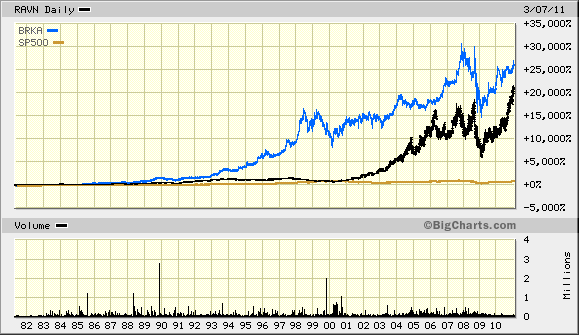
I’d bet Raven has done ever better than Buffett over the years since they pay out a dividend and Berkshire doesn’t. The company has sweetened its dividend for the last 24 years in a row. Expect #25 very soon.
Currently, RAVN pays out a quarterly dividend of 16 cents per share which works to a yield of 1.2%. On top of that, Raven has also paid out a special dividend every so often. I love when companies do that. They’re basically saying “Yeah, we’ve so profitable, here’s some extra cash we don’t know what to do with.” In 2008 and 2010, RAVN paid special dividends of $1.25 per share.
If you own Raven, the next time someone asks you where you’re investing, be sure to say, “Reinforced plastic, electronics, flow control devices, and balloons!”
It’ll be our inside joke.
Smith Barney Name May Go Away
Eddy Elfenbein, March 8th, 2011 at 7:06 amThe financial crisis has unquestionably altered the face of Wall Street. Today’s WSJ reports that Morgan Stanley (MS) is considering getting rid of the name Smith Barney.
If Smith Barney were to be dropped it would join a raft of Wall Street icons to disappear. Morgan Stanley itself killed off the Dean Witter name, and Citigroup offed Salomon Brothers. The financial crisis claimed the names Lehman Brothers and Bear Stearns.
Morgan Stanley now holds 51% of the joint venture, Wall Street’s biggest brokerage force, and has said it plans to buy the rest in the coming years. Morgan Stanley Chief Executive James Gorman has made the retail brokerage business a key part of his strategy for the firm.
A Morgan Stanley spokesman declined to comment specifically on a potential name change, but said “we regularly survey clients about a lot of things relevant to our brand, and I wouldn’t read a whole lot into this.”
Here’s one of John Houseman’s Smith Barney ads with the famous tagline, “They make money the old fashioned way. They URRHNN it.”
Morning News: March 8, 2011
Eddy Elfenbein, March 8th, 2011 at 6:47 amOil Slips as OPEC Discusses Output; Goldman, Merrill Raise Price Forecasts
German Factory Orders Rose in January on Surging Domestic Demand
Hong Kong Stocks Advance to One-Month High as Banks, Gold Gain
Greek, Spanish, Portuguese Bonds Drop as Debt Sales Test Investor Appetite
U.S. Home Sales Accelerate as Prices Decline Amid Rebound
Attorneys General Push for Loan Reductions, Seek Bank Deal Within 2 Months
Debit Card Fees Prompt a Push Near Deadline
Hitachi Rises on $4.3 Billion Sale of Hard-Drive Unit to Western Digital
Boeing Deals Show Rising Clout of Asian Airlines
Goldman’s Pariah Status Fades as Broadbent Joins BOE Monetary Policy Committee
Subway Runs Past McDonald’s Chain
Howard Lindzon: Discussing Disqus…The Case for Style, Instinct and Less Due Diligence
Paul Kedrosky: LICs Heart BRICs
Joshua Brown: TIME’s Embarrassingly Useless “Top 25 Financial Blogs” List
A Case of the Mondays
Eddy Elfenbein, March 7th, 2011 at 2:35 pmThis is just an ugly day of trading. The S&P 500 has been as low as 1,303. The index has to stay above 1,297 to remain above the 50-DMA.
Once again, the cyclicals are getting whacked hard. The Morgan Stanley Cyclical Index (^CYC) has been down as much as 1.82%. The CYC-to-S&P 500 ratio will likely close at its lowest level since November.
The Buy List is down with the overall market. Some cyclicals like Ford (F) and Moog (MOG-A) are getting dinged. I think Oracle (ORCL) looks very good below $32 per share.
Outside the Buy List, I see that Cisco (CSCO) is now at its lowest level in 20 months. I hate to think of all that money wasted on share buybacks.
-
Archives
- October 2026
- September 2026
- August 2026
- July 2026
- June 2026
- May 2026
- April 2026
- March 2026
- February 2026
- January 2026
- December 2025
- November 2025
- October 2025
- September 2025
- August 2025
- July 2025
- June 2025
- May 2025
- April 2025
- March 2025
- February 2025
- January 2025
- December 2024
- November 2024
- October 2024
- September 2024
- August 2024
- July 2024
- June 2024
- May 2024
- April 2024
- March 2024
- February 2024
- January 2024
- December 2023
- November 2023
- October 2023
- September 2023
- August 2023
- July 2023
- June 2023
- May 2023
- April 2023
- March 2023
- February 2023
- January 2023
- December 2022
- November 2022
- October 2022
- September 2022
- August 2022
- July 2022
- June 2022
- May 2022
- April 2022
- March 2022
- February 2022
- January 2022
- December 2021
- November 2021
- October 2021
- September 2021
- August 2021
- July 2021
- June 2021
- May 2021
- April 2021
- March 2021
- February 2021
- January 2021
- December 2020
- November 2020
- October 2020
- September 2020
- August 2020
- July 2020
- June 2020
- May 2020
- April 2020
- March 2020
- February 2020
- January 2020
- December 2019
- November 2019
- October 2019
- September 2019
- August 2019
- July 2019
- June 2019
- May 2019
- April 2019
- March 2019
- February 2019
- January 2019
- December 2018
- November 2018
- October 2018
- September 2018
- August 2018
- July 2018
- June 2018
- May 2018
- April 2018
- March 2018
- February 2018
- January 2018
- December 2017
- November 2017
- October 2017
- September 2017
- August 2017
- July 2017
- June 2017
- May 2017
- April 2017
- March 2017
- February 2017
- January 2017
- December 2016
- November 2016
- October 2016
- September 2016
- August 2016
- July 2016
- June 2016
- May 2016
- April 2016
- March 2016
- February 2016
- January 2016
- December 2015
- November 2015
- October 2015
- September 2015
- August 2015
- July 2015
- June 2015
- May 2015
- April 2015
- March 2015
- February 2015
- January 2015
- December 2014
- November 2014
- October 2014
- September 2014
- August 2014
- July 2014
- June 2014
- May 2014
- April 2014
- March 2014
- February 2014
- January 2014
- December 2013
- November 2013
- October 2013
- September 2013
- August 2013
- July 2013
- June 2013
- May 2013
- April 2013
- March 2013
- February 2013
- January 2013
- December 2012
- November 2012
- October 2012
- September 2012
- August 2012
- July 2012
- June 2012
- May 2012
- April 2012
- March 2012
- February 2012
- January 2012
- December 2011
- November 2011
- October 2011
- September 2011
- August 2011
- July 2011
- June 2011
- May 2011
- April 2011
- March 2011
- February 2011
- January 2011
- December 2010
- November 2010
- October 2010
- September 2010
- August 2010
- July 2010
- June 2010
- May 2010
- April 2010
- March 2010
- February 2010
- January 2010
- December 2009
- November 2009
- October 2009
- September 2009
- August 2009
- July 2009
- June 2009
- May 2009
- April 2009
- March 2009
- February 2009
- January 2009
- December 2008
- November 2008
- October 2008
- September 2008
- August 2008
- July 2008
- June 2008
- May 2008
- April 2008
- March 2008
- February 2008
- January 2008
- December 2007
- November 2007
- October 2007
- September 2007
- August 2007
- July 2007
- June 2007
- May 2007
- April 2007
- March 2007
- February 2007
- January 2007
- December 2006
- November 2006
- October 2006
- September 2006
- August 2006
- July 2006
- June 2006
- May 2006
- April 2006
- March 2006
- February 2006
- January 2006
- December 2005
- November 2005
- October 2005
- September 2005
- August 2005
- July 2005
 Eddy Elfenbein is a Washington, DC-based speaker, portfolio manager and editor of the blog Crossing Wall Street. His