Archive for 2011
-
Buffett Makes Some Moves
Eddy Elfenbein, February 14th, 2011 at 10:11 pmAccording to the latest filings, Warren Buffett has made some changes to his massive portfolio which included trimming two stocks on our Buy List (FISV and BDX).
Berkshire sold off 5 million shares of Bank of America Corp., 187,000 Comcast Corp. shares, 6.5 million Lowe’s Cos. shares and 3.6 million shares of Nike Inc.
Berkshire also unloaded 1.9 million shares of Becton, Dickinson & Co., 3.9 million shares of Fiserv Inc., 6.1 million shares of Nalco Holding Co. and 3.4 million shares of Nestle.
And Berkshire reduced its stake in Bank of New York Mellon Corp. just three months after it revealed a new investment of nearly 2 million shares in the bank. At year end, Berkshire held 1.79 million shares of BNY Mellon.
Besides investments, Berkshire owns more than 80 different subsidiaries, including clothing, insurance, furniture, utility, jewelry and corporate jet companies.
-
Looking at Netflix’s Valuation
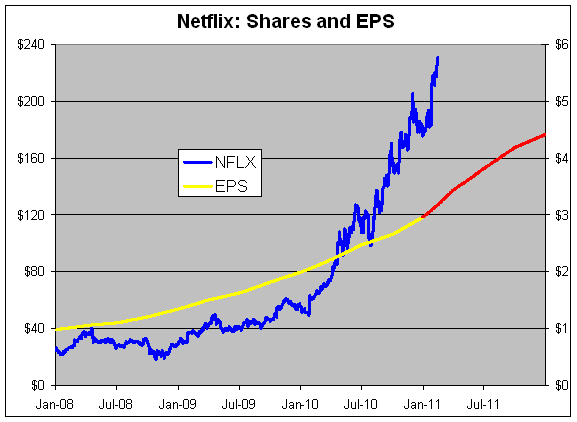
Eddy Elfenbein, February 14th, 2011 at 7:18 pmHere’s a look at Netflix’s stock along with its earnings-per-share. The stock is in blue and it follows the left scale. The earnings are in gold and follow the right scale. Wall Street’s projections are in red.
I’ve scaled the ratios at a ratio of 40-for-1 so whenever the lines cross, the P/E Ratio is exactly 40. That’s much higher than I normally use but the chart would be difficult to read at a ratio less than that. At this earlier post, I used a ratio of 20-for-1 and we’ve run so far past that.
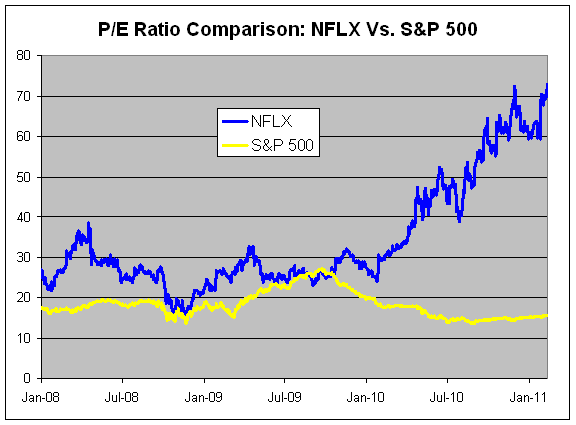
Here’s a comparison of the P/E Ratio of the S&P 500 and that of Netflix. It wasn’t too long ago that they were similar.
-
50-DMA Streaks
Eddy Elfenbein, February 14th, 2011 at 1:20 pmThe S&P 500 is very close to doubling from the March 2009 low. The intra-day low from March 6, 2009 was 666.79. To double that, we need to hit 1,333.58. We’ve been as high as 1,331.64 today.
The S&P 500 continues to hold above its 50-day moving average. We’ve been above it every day since September 2, 2010. This is the 11th longest streak since 1932.
Begin End Days 4-Jan-95 10-Jan-96 257 10-Apr-58 25-Nov-58 159 14-Dec-42 21-Jun-43 156 24-Jul-06 27-Feb-07 149 4-Nov-60 12-Jun-61 148 5-Apr-35 20-Sep-35 140 29-Nov-63 1-Jun-64 126 31-Mar-89 25-Sep-89 123 23-Nov-70 17-May-71 120 25-Jan-83 12-Jul-83 116 2-Sep-10 14-Feb-11 114 -
Federal Reserve’s Profits Projected to Fall
Eddy Elfenbein, February 14th, 2011 at 11:03 amBy law, the profits of the Federal Reserve are limited to 6%. Every dime over that goes right to the U.S. Treasury. Lately that’s been a big fat wad of cash, since — frankly — it’s just about impossible for a central bank to lose money.
Obama’s latest budget projects that the Fed’s payment to the Treasury will decline sharply over the next few years:
Fed deposits will reach a record estimated $79.5 billion in the fiscal year ending Sept. 30 before declining 53 percent through fiscal 2015 to $37.4 billion, according to the budget released today. The central bank’s annual remittances averaged $33.3 billion from fiscal 2007 through 2009.
The central bank’s increased payments reflect income from $2.3 trillion in mortgage and Treasury securities it’s purchasing as part of efforts to revive the economy after the worst financial meltdown in seven decades. Declining payments would reflect higher short-term interest rates in a “much stronger” economy that’s generating more tax revenue, Fed Chairman Ben S. Bernanke said last week.
The administration’s budget estimates Fed deposits of $65.8 billion on fiscal 2012; $47.4 billion in 2013; $38.2 billion in 2014; $37.4 billion in 2015; and $41 billion in 2016.
Less money from the Fed means that everyone would be doing better.
-
Netflix Is Still Way Too Expensive
Eddy Elfenbein, February 14th, 2011 at 9:26 amI regret that I must admit that I have a terrible track record with Netflix (NFLX). Last April, I called Netflix “the absolute worst stock to buy.” Not only was I wrong, but I was horribly wrong. The stock has soared dramatically ever since.
On top of that, I got an email from the CEO telling me I had misspelled the name of the company. (For the record, it’s Netflix, not NetFlix. Consider yourself warned.)
Let me clear up a point of confusion about investing. Stock analysis isn’t about predicting the future; it’s about making reasonable judgments about the future. Everyone is going to be wrong. If I could predict the future accurately, well…I wouldn’t be bothering myself with stocks.
Still, it’s important to learn from your mistakes. The judgments of the market can be very humbling. I’ve looked at the numbers and I still think Netflix is dramatically overpriced. Unfortunately, I don’t have the ability to say that it won’t become evermore overpriced.
Let’s look at some of the math. For 2010, Netflix had a net profit margin of 7.4%. The current market value is $12.2 billion. Assuming the margins stay constant, Netflix will need to generate revenues of $165 billion to earn its market value back. That works out to about $500 per every person in North America.
Now let’s add some context. Last year, Netflix generated revenues of $2.1 billion. This year, they’re projected to generate revenues of $3.1 billion. We’re at the point where people are only buying Netflix because they think they can dump the shares off at a higher price to someone else. This is also known as “the Greater Fool Theory.” The problem isn’t that it doesn’t work. It does work, just for everyone else.

-
Obama to Unveil $3.7 Trillion Budget
Eddy Elfenbein, February 14th, 2011 at 8:10 amToday is the day President Obama submits his budget to Congress. Of course, the actual budget that finally passes will look quite different from what we see today. This may be the first major confrontation between the White House and the new GOP-led House of Representatives. Within the fight, the Tea Party will most certainly be applying pressure to House Republicans.
Looking at the budget, the numbers aren’t pretty. The budget will total $3.7 trillion. This year’s deficit is projected to hit $1.6 trillion, which would be the largest ever. That comes to nearly 11% of the economy.
According to the President Obama’s projections, the deficit will fall to $607 billion by 2015 which is still 3.2% of the economy. If there’s ever a time we need to get several quarters of 6% or 7% GDP growth, this is it.
The problem is that borrowing costs are starting to rise. Bloomberg somehow got hold of a Treasury presentation to bond dealers saying that interest expense on the debt will rise from 1.3% of GDP in 2010 to 3.1% of GDP by 2016. Higher interest costs, of course, make the budget outlook even worse.
The long end of the yield curve has risen substantially over the past few months. On Friday, the 30-year yield closed at 4.71%. Last August 26, the yield stood at 3.53%. I think it’s very possible that the bond market may play a role in any budget confrontation. The bond and currency markets can serve as virtual parliaments so even if the budget flies through Congress, the budget can still be effectively vetoed by investors. This is exactly what happened in Greece and Ireland.
Stay tuned; we’re about to see if our leaders are serious or not.
-
Morning News: February 14, 2011
Eddy Elfenbein, February 14th, 2011 at 7:44 amNYSE-Deutsche Boerse Merger Is Free With Derivatives: Real M&A
China’s Trade Surplus Shrinks as Nation Imports More
France’s Lagarde Hopes To Deliver Indicative Guidelines at G-20 This Week
Merkel’s Permanent Euro-Rescue Plan Needs Opposition Backing
Obama to Submit $3.7 Trillion Budget, GOP Promises Fight
Housing Crash Is Hitting Cities Once Thought to Be Stable
Clothing Prices to Rise 10% Starting in Spring
Icahn Again Extends Dynegy Offer, but Shares Tendered Dwindle
GE to Buy U.K.’s John Wood Unit for $2.8 Billion
Hong Kong Stock Preview: China Southern, Golden Harvest, PICC
Credit Suisse Pads Capital with 6 Billion Swiss Francs in Coco Bonds
Chapter 11 for Borders, New Chapter for Books
EchoStar to Buy Hughes for $1.35 Billion
-
So Long Hosni!
Eddy Elfenbein, February 11th, 2011 at 2:55 pmI’ve been gripped by the dramatic scenes from Egypt. I won’t even pretend to say that this has any effect on U.S. financial markets.
Whatever the cause, the stock market is up today and the Buy List is at a new year-to-date high. The year is just six weeks old and the Buy List is already up over 6% for the year.
I’m pleased to see that Ford (F) is having a good day. I wasn’t pleased with Ford’s earnings miss but the company keeps making the right moves. Yesterday they announced that they’re going to cut down their debt by another $3 billion. Last year, they cut down their debt by $14.5 billion. Ford said this recent move will save them $180 million in annual interest payments.
JP Morgan Chase (JPM) and Reynolds American (RAI) are also having good days. Leucadia National (LUK), Moog (MOG-A), Stryker (SYK) and Wright Express (WXS) are all at fresh 52-week highs.
-
CWS Market Review – February 11, 2011
Eddy Elfenbein, February 11th, 2011 at 7:49 amEarnings season is just about over and the profit picture continues to look very good. According to the latest numbers, 352 of the stocks in the S&P 500 have reported earnings. Weighted by market cap, fourth quarter earnings are on track to rise 26.7% to $23.00 per share. Not including financials, earnings are up 30.1%.
On Thursday, we got more good earnings news for our Buy List. Last week I said that Wright Express ($WXS) was our best candidate for an earnings surprise and that’s exactly what happened. Wright reported adjusted Q4 earnings of 74 cents per share which is three cents more than expectations. What’s even better is that Wright sees Q1 earnings-per-share coming in between 63 cents and 69 cents.
For the full year, Wright forecasts earnings ranging between $3.17 and $3.37 per share. The Street had been expecting earnings of $3.18 per share so I’m sure we’ll see some analyst upgrades. The shares rallied 4.4% on Thursday and we’re now up over 13.5% for the year. Wright Express continues to be an excellent buy.
However, not all of our recent earnings news has been good. Becton Dickinson ($BDX), Fiserv ($FISV) and Reynolds American ($RAI) all missed estimates by a penny per share, and Sysco ($SYY) missed by three cents per share. Some of these stocks got knocked down pretty hard by the market.
Honestly, I’m not terribly concerned by these small earnings misses because they’re all high-quality companies. For lower-quality stocks, the game is often “live by earnings or die by earnings.” But with top-notch stocks, I pay far more attention to earnings guidance, and that’s been pretty good.
Mind you, not all companies provide full-year earnings guidance. In fact, most do not. I seek out those that not only give full-year guidance but also have proven track records of delivering on their guidance. I’m not a fan of having an antagonistic relationship with the stocks I own. Well-run companies don’t have anything to hide, so they’re open about their expectations. Not even the best analysts on Wall Street know what’s going on inside a firm better than the executives themselves.
Fiserv is a good example of a company I’m not worried about. Yes, Fiserv missed estimates by a penny per share, but the company said it expects full-year earnings between $4.42 per share and $4.54 per share. Let’s put that into some context. For 2010, Fiserv earned $4.05 per share so their guidance represents very strong growth. On top of that, I think the company should have little trouble earning $5 in 2012.
Yet after the earnings report came out, FISV dropped over 3%. Movements like this make me annoyed with nervous traders. Who cares about a miss of one little penny compared to such a bold growth forecast? Keep your eye on the picture! Fiserv continues to be a very strong buy.
Fiserv isn’t alone. BDX shares were hacked by over 5% after the company’s earnings report. But let’s look at what they said: Becton Dickinson expects full-year earnings somewhere between $5.45 and $5.55 per share. This isn’t Goldman Sachs or Citigroup making an estimate; this is BDX itself! If you don’t own it, this is a good time to take advantage of BDX’s lower price. The shares are going for less than 15 times the low end of the earnings range—and I wouldn’t be surprised to see higher guidance later this year.
Reynolds American said it sees full-year 2011 earnings-per-share coming in between $2.60 and $2.70. The growth rate implied is modest, between 4% and 8%, but it’s nothing to sneeze at. Looking at the valuation, RAI is going for around 12 times this year’s guidance, and don’t forget Reynolds’ hefty dividend which currently yields 6.1%. That’s around 240 basis points more than the 10-year Treasury.
I continue to be very optimistic for the equities for 2011, but we may be in for some short-term bumps. One reason is that the market has risen so impressively recently. The S&P 500 has rallied for seven of the last nine sessions. The Dow had rallied for eight-straight days before falling slightly on Thursday.
Mirroring this rise in equities has been a sell-off in long-term bonds. The yield on the 30-year Treasury has climbed for seven of the last nine sessions. My take is that this is the exact outcome of the Fed’s effort at Quantitative Easing. The Fed’s plan has forced investors out of low-risk assets and into higher-risk assets. Fortunately, this is why our Buy List has prospered.
It’s not so much that stocks were a great value a few months ago. Instead, it’s that stocks were a great value relative to very overpriced bonds. Recall that back in August, investors pushed the yield on the 30-year Treasury down to 3.53%. That’s just nuts especially when you could easily match that yield with many blue chip stocks. On Thursday, the 30-year T-bond yield closed at 4.77% which is the highest closing yield since last April.
Here’s what investors need to watch: The bond market often leads the stock market by a few weeks or months. When the spread between stocks and bonds gets too wide, there’s often a sharp reaction. As a result, I wouldn’t be surprised to see the stock rally cool off soon. Don’t get me wrong: I’m not expecting a major reversal, but the easy gains have already been made.
The key for investors is to focus on high-quality stocks. Some of the names on the Buy List that look especially good right now include Oracle ($ORCL), Abbott Labs ($ABT) and Gilead Sciences ($GILD). I also really like Ford ($F) below $16.
Next week, we’re going to get key reports on inflation plus the reports on industrial production, capacity utilization and retail sales. Except for Leucadia National ($LUK), this earnings season is over for us. LUK usually reports near the end of February. Coming before that will probably be Medtronic ($MDT) and that’s for the quarter that ended January 31st. Wall Street expects 84 cents per share and that sounds about right.
That’s all for now. Be sure to keep visiting the blog for daily updates. I’ll have more market analysis for you in the next issue of CWS Market Review!
Best – Eddy
-
Morning News: February 11, 2011
Eddy Elfenbein, February 11th, 2011 at 7:40 amAsian Shares Mixed; Inflation Concerns Weigh Seoul
In China, Tentative Steps Toward Global Currency
Portugal Funding Fears Return As EMU Periphery Debt Supply Mounts
U.S. Trade Gap Probably Widened in December on Oil Imports
Deutsche Boerse AG’s Francioni Wins NYSE After Losing With Niederauer CEO
White House to Uunveil Proposals for Mortgage Market Reform
Apple’s IPhone Dominance Leaves Operators With Utility Status
Nokia, Microsoft to Join Forces to Challenge Apple, Google
French Oil Giant Total’s Adjusted Profit Up 23%
Rio Tinto May Expand Buyback on Higher Prices, Analysts Say
Kinder Morgan Prices $2.9 Billion I.P.O.
Kraft Profit Squeezed by Cadbury Acquisition
Paul Kedrosky: China Growth in Context
Leigh Drogen: VYou to Answer Questions With Video
Joshua Brown: Guns n’ Roses: Welcome to Derek, Joey and Kristin
-
Archives
- October 2026
- September 2026
- August 2026
- July 2026
- June 2026
- May 2026
- April 2026
- March 2026
- February 2026
- January 2026
- December 2025
- November 2025
- October 2025
- September 2025
- August 2025
- July 2025
- June 2025
- May 2025
- April 2025
- March 2025
- February 2025
- January 2025
- December 2024
- November 2024
- October 2024
- September 2024
- August 2024
- July 2024
- June 2024
- May 2024
- April 2024
- March 2024
- February 2024
- January 2024
- December 2023
- November 2023
- October 2023
- September 2023
- August 2023
- July 2023
- June 2023
- May 2023
- April 2023
- March 2023
- February 2023
- January 2023
- December 2022
- November 2022
- October 2022
- September 2022
- August 2022
- July 2022
- June 2022
- May 2022
- April 2022
- March 2022
- February 2022
- January 2022
- December 2021
- November 2021
- October 2021
- September 2021
- August 2021
- July 2021
- June 2021
- May 2021
- April 2021
- March 2021
- February 2021
- January 2021
- December 2020
- November 2020
- October 2020
- September 2020
- August 2020
- July 2020
- June 2020
- May 2020
- April 2020
- March 2020
- February 2020
- January 2020
- December 2019
- November 2019
- October 2019
- September 2019
- August 2019
- July 2019
- June 2019
- May 2019
- April 2019
- March 2019
- February 2019
- January 2019
- December 2018
- November 2018
- October 2018
- September 2018
- August 2018
- July 2018
- June 2018
- May 2018
- April 2018
- March 2018
- February 2018
- January 2018
- December 2017
- November 2017
- October 2017
- September 2017
- August 2017
- July 2017
- June 2017
- May 2017
- April 2017
- March 2017
- February 2017
- January 2017
- December 2016
- November 2016
- October 2016
- September 2016
- August 2016
- July 2016
- June 2016
- May 2016
- April 2016
- March 2016
- February 2016
- January 2016
- December 2015
- November 2015
- October 2015
- September 2015
- August 2015
- July 2015
- June 2015
- May 2015
- April 2015
- March 2015
- February 2015
- January 2015
- December 2014
- November 2014
- October 2014
- September 2014
- August 2014
- July 2014
- June 2014
- May 2014
- April 2014
- March 2014
- February 2014
- January 2014
- December 2013
- November 2013
- October 2013
- September 2013
- August 2013
- July 2013
- June 2013
- May 2013
- April 2013
- March 2013
- February 2013
- January 2013
- December 2012
- November 2012
- October 2012
- September 2012
- August 2012
- July 2012
- June 2012
- May 2012
- April 2012
- March 2012
- February 2012
- January 2012
- December 2011
- November 2011
- October 2011
- September 2011
- August 2011
- July 2011
- June 2011
- May 2011
- April 2011
- March 2011
- February 2011
- January 2011
- December 2010
- November 2010
- October 2010
- September 2010
- August 2010
- July 2010
- June 2010
- May 2010
- April 2010
- March 2010
- February 2010
- January 2010
- December 2009
- November 2009
- October 2009
- September 2009
- August 2009
- July 2009
- June 2009
- May 2009
- April 2009
- March 2009
- February 2009
- January 2009
- December 2008
- November 2008
- October 2008
- September 2008
- August 2008
- July 2008
- June 2008
- May 2008
- April 2008
- March 2008
- February 2008
- January 2008
- December 2007
- November 2007
- October 2007
- September 2007
- August 2007
- July 2007
- June 2007
- May 2007
- April 2007
- March 2007
- February 2007
- January 2007
- December 2006
- November 2006
- October 2006
- September 2006
- August 2006
- July 2006
- June 2006
- May 2006
- April 2006
- March 2006
- February 2006
- January 2006
- December 2005
- November 2005
- October 2005
- September 2005
- August 2005
- July 2005
 Eddy Elfenbein is a Washington, DC-based speaker, portfolio manager and editor of the blog Crossing Wall Street. His