Archive for 2011
-
Danaher Buys Beckman Coulter
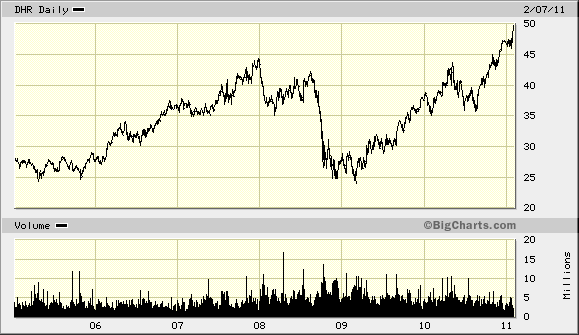
Eddy Elfenbein, February 7th, 2011 at 10:09 amI’m a big fan of Danaher (DHR) and the stock used to be a member of the Buy List. I decided to take the stock off the Buy List for 2010, which probably wasn’t a smart move since the stock rallied 25% last year.
The company just announced that it’s buying Beckman Coulter (BEC) for $5.8 billion in cash.
Under the terms of the deal, Danaher will pay $83.50 per share in a tender offer for Beckman’s shares. The price is 11 percent higher than Beckman’s closing price on Friday and 45 percent above the company’s stock price on Dec. 9, before reports of a potential deal emerged.
I’m surprised to see that DHR is up today. Usually, the acquiring firm drops when a buyout is announced. Danaher beat out two consortiums to buy BEC.
I was hoping that DHR would drop below $35 so I could add it to this year’s Buy List. As much as I like the stock, I think it’s fairly priced here.
-
Investing and Politics
Eddy Elfenbein, February 7th, 2011 at 9:49 amLast year, I listed several “deep truths” about the stock market and investing. More than a few were controversial, but one, “The market doesn’t care about politics,” caused a lot of arguments.
The market does care about policy, but it doesn’t much care for partisan politics. It’s also a gross misunderstanding of how America works to think that a change in public officeholders causes a large and immediate shift in the economy. I would estimate that no matter who is elected president, more than 95% of the budget will look the same — and the federal budget is still a small minority of the national economy.
In yesterday’s Washington Post, Barry Ritholtz carries the same argument. Here’s a sample:
To neurophysiologists, who research cognitive functions, the emotionally driven appear to suffer from cognitive deficits that mimic certain types of brain injuries. Not just partisan political junkies, but ardent sports fans, the devout, even hobbyists. Anyone with an intense emotional interest in a subject loses the ability to observe it objectively: You selectively perceive events. You ignore data and facts that disagree with your main philosophy. Even your memory works to fool you, as you selectively retain what you believe in, and subtly mask any memories that might conflict.
Studies have shown that we are actually biased in our visual perception – literally, how we see the world – because of our belief systems.
This cognitive bias is not an occasional problem – it is a systematic source of errors. It’s not you, it’s just how you are built. And it is the reason most people are terrible investors.
-
Morning News: February 7, 2011
Eddy Elfenbein, February 7th, 2011 at 8:01 amGerman Industry Orders Sink in December
Hong Kong Stocks Fall; Worst Start of Lunar New Year Since 2008
Egypt Pound Hits Six-year Low Despite State Bank Support
U.S. Treasuries Slide on Upbeat Economic Outlook
S&P 500 Beating Estimates for Sales by Most Since 2006
Breach Tied to Nasdaq May Have Wider Effect
Humana Net Falls 57% Amid Higher Expenses
AOL to Buy The Huffington Post for $315 Million
Danaher to Purchase Beckman Coulter for $6.8 Billion
Santander Offers $5.8 Billion for Polish Bank
Finish Line Nears for Sanofi-Genzyme Talks
Tibet Ad Not Likely to Help Groupon in China
Leigh Drogen: The Lion And The Gazelle
Howard Lindzon: Merger Monday is Awesome…Congrats Huffington Post and Steve Case is the New Grinch
-
Happy 40th Birthday, Nasdaq Composite
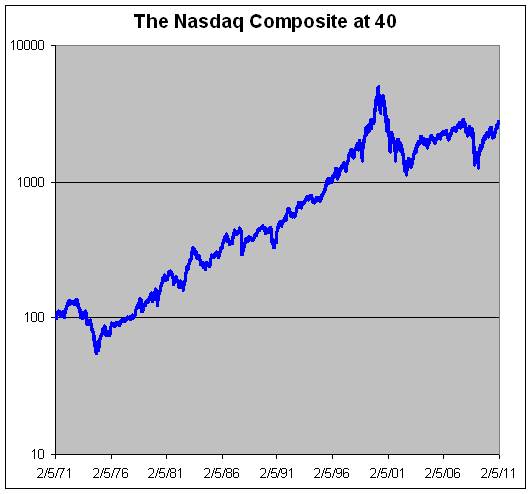
Eddy Elfenbein, February 5th, 2011 at 7:08 pmThe Nasdaq Composite Index debuted 40 years ago today. The index started at 100 on February 5, 1971.
The all-time low close came on October 3, 1974 when the index hit 54.87. The high came on March 10, 2000 at 5048.62. Nearly 11 years later we’re barely more than half that.
-
Reagan at 100
Eddy Elfenbein, February 5th, 2011 at 6:15 pmRonald Reagan was born 100 years tomorrow.
Here’s a fascinating video of Reagan speaking to Yale students in 1967. You almost expect Don Draper to come walking through.
I could have posted one of Reagan’s many famous speeches, but I think this clip really captures Reagan the man, It really is interesting that Reagan isn’t speaking down to the students or glad-handing them. There’s no Bill Clinton-style “great question.”
Regan defends himself with charm and grace, and most importantly, facts. The students should also be commended for asking serious questions. It’s a contentious but civil encounter.
-
Michael Lewis on Ireland
Eddy Elfenbein, February 4th, 2011 at 3:34 pmHere’s another great piece by Michael Lewis (warning: it clocks in at 13,000 words). This time, he looks at Ireland.
Here’s my favorite line:
Across Europe just now men who thought their title was “minister of finance” have woken up to the idea that their job is actually government bond salesman.
-
Unemployment Drops to 9% in January
Eddy Elfenbein, February 4th, 2011 at 9:05 amHere’s a rather strange-sounding jobs report: The jobless rate dropped from 9.4% in December to 9% in January, yet the economy only created 50,000 jobs last month. The private sector added 50,000 jobs and the public sector shed 14,000.
The reason for the big decline in the rate is that fewer people are looking for jobs. Economists are also blaming the snow which sounds like a pretty lame excuse. The construction sector lost 32,000 jobs in January.
If that’s not bad enough, the government did its benchmark revisions this past month, so the numbers for 2010 were even worse than we originally expected.
-
CWS Market Review – February 4, 2011
Eddy Elfenbein, February 4th, 2011 at 7:59 amLast week was a mixed week for our Buy List. Ford ($F) was hurt by its weak earnings last Friday, but Moog ($MOG-A) came out with a very strong report that beat expectations by 10 cents per share. AFLAC ($AFL), Fiserv ($FISV) and Reynolds American ($RAI) all fell just shy of expectations, but all three gave very good guidance for the year ahead. I still like all of these stocks and I fault Ford for not communicating its business outlook better with the public.
We’re heading to the back end of earnings season and this is when we often see smaller companies report since the “big boys” usually report at the beginning of the season.
The latest numbers show that 297 companies in the S&P 500 have reported so far. On the whole, the reports have been quite good. A total of 243 companies have seen higher earnings while 50 have seen lower earnings and four have remained unchanged. Earnings are tracked to hit $22.91 (that’s in terms relative to the S&P 500 index) which is a nice 36.37% increase over the fourth quarter of 2009. No matter how you slice it, that’s very strong growth.
Considering earnings compared with expectations, a total of 70.7% companies have beaten expectations, 21.8% have fallen short of expectations and 7.5% have gotten it right in the clown’s mouth.
Let’s break down the numbers some more. Wall Street currently expects full-year 2011 earnings of 95.84 for the S&P 500. Going by Thursday’s close, those figures translate to a forward P/E Ratio of 13.64. If you invert that, you get an earnings yield of 7.33% which easily beats just about any bond you’ll find.
For comparison, Moody’s index of bonds rated BAA is currently yielding 6.14% which is a good deal less than you can get in stocks. So stocks continue to be a good buy compared with bonds. In fact, “out of bonds and into stocks” has been the major trend over the past few months.
I expect to see Wall Street raise its full-year forecasts but not by much. The Street currently expects 2012 earnings of 106.17 but I should caution you that that is a very preliminary estimate.
There will certainly be bumps along the way, but I also expect to see more gains for the stock market. I think the S&P 500 can reasonably hit 1500 by the end of the year. (That’s a 14.8% gain in less than 11 months.)
The other reason why I like equities is that the yield curve continues to be very wide. The steepness of the yield curve is one of our best “secret predictors” of the stock market. The difference between the yield on the two-year Treasury and the 30-year Treasury just hit an all-time high of 400 basis points. This means that interest rates are expected to rise, but not for a good long time.
The lesson of history is very clear: Wall Street loves cheap money. The major downside is that Wall Street hates the inevitable consequences of cheap money. But using the yield curve as our guide, we can see that any trouble is still a way off.
A few years ago I ran the numbers on how the stock market reacts to the yield curve. I found that from 1962 to 2007, all the stock market’s gains have come when the spread between the 90-day T-bill and the 10-year T-bond is 65 or more basis points. Today that spread stands at 340 basis points.
For this earnings season, we have three more reports ahead of us. Don’t hold me to these dates, but I expect Sysco ($SYY) to report on Monday, Becton Dickinson ($BDX) on Tuesday and Wright Express ($WXS) on Thursday. I believe that WXS is the best candidate for an earnings beat. The other two stocks rarely beat or miss estimates by much so I’m not expecting any surprises there.
I still like all the stocks on the Buy List but I’ll give you a few names that are especially good buys right now. Nicholas Financial ($NICK) had a great earnings report. On Tuesday, NICK got as high as $12.98 per share. I wouldn’t be surprised if NICK earned as much as $1.50 this calendar year.
Ford ($F) got knocked around this past week but I fault the company for poor communication. The Ford story still holds and the stock is a little cheaper now. Frankly, the amount of selling surprised me. For now, Ford seems to have a floor of $15 per share. Any new position under $16 is a smart move.
I think Oracle ($ORCL) can be a $40 stock before the end of the year.
If you like dividends, Reynolds American ($RAI) is still as solid as ever. The stock now yields about 6.1%. The shares are off about $2 in the last month even though they missed earnings by one penny per share.
JPMorgan Chase ($JPM) hasn’t done much since it creamed Wall Street’s forecast. I think JPM can make a run at $50 very soon, and a big dividend hike should be coming by April.
In last week’s e-letter, I said that I wasn’t too worried if AFLAC ($AFL) were to miss earnings by a penny or two and that I was more concerned with their future earnings guidance. Well, maybe I was on to something. The company did indeed miss Wall Street’s EPS forecast by two cents ($1.33 versus $1.35) and they gave us decent full-year guidance. AFLAC now sees 2011 earnings coming in at the low end of their range of $5.97 to $6.19 per share. Despite the earnings miss, AFL is an excellent buy.
That’s all for now. Be sure to keep visiting the blog for daily updates. I’ll have more market analysis for you in the next issue of CWS Market Review!
Best – Eddy
-
Morning News: February 4, 2011
Eddy Elfenbein, February 4th, 2011 at 7:57 amOil Climbs, Heads for Second Week of Gains, on Economic Optimism
Asian Shares End Higher; Merger Talks Boost Japan Steel Plays
Merkel Turns Crisis into Opportunity to Reshape Euro Zone
In Asia, Hello to Faster Trades and Goodbye to Lunch Hour
Gold Falls as Recovering Economy Curbs Alternative-Asset Demand
Bernanke Takes Sides on Debt Limit Vote
Municipal Bond Yields Rise as Market Rally Stalls
Aetna Lifts Dividend as Profit Tops Views
Blackstone Posts 56% Rise in Quarterly Profit
Luxury Goods’ LVMH Falls After 2010 Operating Profit Trails Estimate
Joshua Brown: Brian Shannon: The Answer is Real Simple
Leigh Drogen: Rupert Murdoch Just Doesn’t Get It
Paul Kedrosky: Niall Ferguson on Systemic Risk in Egypt
Turkey Claimed by Ethel Kennedy Sought for Harassing Mail Trucks
-
Fiserv Misses by a Penny
Eddy Elfenbein, February 3rd, 2011 at 11:07 pmAfter the closing bell, Fiserv (FISV) reported Q4 earnings of $1.06 per share which was a penny below expectations. The market may not be pleased tomorrow by the earnings miss, but I’m not worried about one penny. My concern was a major miss and I thought that was a very remote possibility. In October, I wrote: “if they make less than $1 per share this quarter, we’ll know something went very wrong. In fact, if they made less than $1.04, it would be ugly.” So $1.06 is fine by me.
For all of 2010, the company earned $4.05 compared with $3.66 in 2009. Quarterly sales rose from $1.06 billion to $1.08 billion. In October, Fiserv’s full-year guidance was $3.96 to $4.07 per share. I had wanted them to at least raise the low end because it seemed very obvious that they would easily top that. As it turns out, they did.
The earnings miss is a disappointment, but not a major one. By far, the most important news is that Fiserv gave us full-year earnings guidance of $4.42 to $4.54 per share. Wall Street had been expecting $4.46.
I think we’ll see a lower open tomorrow but that’s just the Street being a drama queen. My view hasn’t changed at all. Even going by the low end, FISV is going for 14.1 times 2011’s estimate. That’s a good buy.

-
Archives
- October 2026
- September 2026
- August 2026
- July 2026
- June 2026
- May 2026
- April 2026
- March 2026
- February 2026
- January 2026
- December 2025
- November 2025
- October 2025
- September 2025
- August 2025
- July 2025
- June 2025
- May 2025
- April 2025
- March 2025
- February 2025
- January 2025
- December 2024
- November 2024
- October 2024
- September 2024
- August 2024
- July 2024
- June 2024
- May 2024
- April 2024
- March 2024
- February 2024
- January 2024
- December 2023
- November 2023
- October 2023
- September 2023
- August 2023
- July 2023
- June 2023
- May 2023
- April 2023
- March 2023
- February 2023
- January 2023
- December 2022
- November 2022
- October 2022
- September 2022
- August 2022
- July 2022
- June 2022
- May 2022
- April 2022
- March 2022
- February 2022
- January 2022
- December 2021
- November 2021
- October 2021
- September 2021
- August 2021
- July 2021
- June 2021
- May 2021
- April 2021
- March 2021
- February 2021
- January 2021
- December 2020
- November 2020
- October 2020
- September 2020
- August 2020
- July 2020
- June 2020
- May 2020
- April 2020
- March 2020
- February 2020
- January 2020
- December 2019
- November 2019
- October 2019
- September 2019
- August 2019
- July 2019
- June 2019
- May 2019
- April 2019
- March 2019
- February 2019
- January 2019
- December 2018
- November 2018
- October 2018
- September 2018
- August 2018
- July 2018
- June 2018
- May 2018
- April 2018
- March 2018
- February 2018
- January 2018
- December 2017
- November 2017
- October 2017
- September 2017
- August 2017
- July 2017
- June 2017
- May 2017
- April 2017
- March 2017
- February 2017
- January 2017
- December 2016
- November 2016
- October 2016
- September 2016
- August 2016
- July 2016
- June 2016
- May 2016
- April 2016
- March 2016
- February 2016
- January 2016
- December 2015
- November 2015
- October 2015
- September 2015
- August 2015
- July 2015
- June 2015
- May 2015
- April 2015
- March 2015
- February 2015
- January 2015
- December 2014
- November 2014
- October 2014
- September 2014
- August 2014
- July 2014
- June 2014
- May 2014
- April 2014
- March 2014
- February 2014
- January 2014
- December 2013
- November 2013
- October 2013
- September 2013
- August 2013
- July 2013
- June 2013
- May 2013
- April 2013
- March 2013
- February 2013
- January 2013
- December 2012
- November 2012
- October 2012
- September 2012
- August 2012
- July 2012
- June 2012
- May 2012
- April 2012
- March 2012
- February 2012
- January 2012
- December 2011
- November 2011
- October 2011
- September 2011
- August 2011
- July 2011
- June 2011
- May 2011
- April 2011
- March 2011
- February 2011
- January 2011
- December 2010
- November 2010
- October 2010
- September 2010
- August 2010
- July 2010
- June 2010
- May 2010
- April 2010
- March 2010
- February 2010
- January 2010
- December 2009
- November 2009
- October 2009
- September 2009
- August 2009
- July 2009
- June 2009
- May 2009
- April 2009
- March 2009
- February 2009
- January 2009
- December 2008
- November 2008
- October 2008
- September 2008
- August 2008
- July 2008
- June 2008
- May 2008
- April 2008
- March 2008
- February 2008
- January 2008
- December 2007
- November 2007
- October 2007
- September 2007
- August 2007
- July 2007
- June 2007
- May 2007
- April 2007
- March 2007
- February 2007
- January 2007
- December 2006
- November 2006
- October 2006
- September 2006
- August 2006
- July 2006
- June 2006
- May 2006
- April 2006
- March 2006
- February 2006
- January 2006
- December 2005
- November 2005
- October 2005
- September 2005
- August 2005
- July 2005
 Eddy Elfenbein is a Washington, DC-based speaker, portfolio manager and editor of the blog Crossing Wall Street. His