Archive for 2013
-
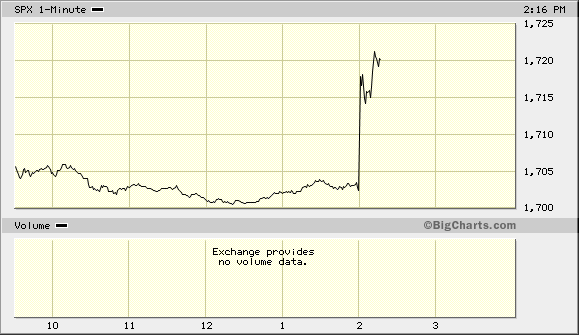
OMG! No Taper!!
Eddy Elfenbein, September 18th, 2013 at 2:03 pmThe Fed makes the right call and does nothing. The markets are rallying. Here’s today’s statement:
Information received since the Federal Open Market Committee met in July suggests that economic activity has been expanding at a moderate pace. Some indicators of labor market conditions have shown further improvement in recent months, but the unemployment rate remains elevated. Household spending and business fixed investment advanced, and the housing sector has been strengthening, but mortgage rates have risen further and fiscal policy is restraining economic growth. Apart from fluctuations due to changes in energy prices, inflation has been running below the Committee’s longer-run objective, but longer-term inflation expectations have remained stable.
Consistent with its statutory mandate, the Committee seeks to foster maximum employment and price stability. The Committee expects that, with appropriate policy accommodation, economic growth will pick up from its recent pace and the unemployment rate will gradually decline toward levels the Committee judges consistent with its dual mandate. The Committee sees the downside risks to the outlook for the economy and the labor market as having diminished, on net, since last fall, but the tightening of financial conditions observed in recent months, if sustained, could slow the pace of improvement in the economy and labor market. The Committee recognizes that inflation persistently below its 2 percent objective could pose risks to economic performance, but it anticipates that inflation will move back toward its objective over the medium term.
Taking into account the extent of federal fiscal retrenchment, the Committee sees the improvement in economic activity and labor market conditions since it began its asset purchase program a year ago as consistent with growing underlying strength in the broader economy. However, the Committee decided to await more evidence that progress will be sustained before adjusting the pace of its purchases. Accordingly, the Committee decided to continue purchasing additional agency mortgage-backed securities at a pace of $40 billion per month and longer-term Treasury securities at a pace of $45 billion per month. The Committee is maintaining its existing policy of reinvesting principal payments from its holdings of agency debt and agency mortgage-backed securities in agency mortgage-backed securities and of rolling over maturing Treasury securities at auction. Taken together, these actions should maintain downward pressure on longer-term interest rates, support mortgage markets, and help to make broader financial conditions more accommodative, which in turn should promote a stronger economic recovery and help to ensure that inflation, over time, is at the rate most consistent with the Committee’s dual mandate.
The Committee will closely monitor incoming information on economic and financial developments in coming months and will continue its purchases of Treasury and agency mortgage-backed securities, and employ its other policy tools as appropriate, until the outlook for the labor market has improved substantially in a context of price stability. In judging when to moderate the pace of asset purchases, the Committee will, at its coming meetings, assess whether incoming information continues to support the Committee’s expectation of ongoing improvement in labor market conditions and inflation moving back toward its longer-run objective. Asset purchases are not on a preset course, and the Committee’s decisions about their pace will remain contingent on the Committee’s economic outlook as well as its assessment of the likely efficacy and costs of such purchases.
To support continued progress toward maximum employment and price stability, the Committee today reaffirmed its view that a highly accommodative stance of monetary policy will remain appropriate for a considerable time after the asset purchase program ends and the economic recovery strengthens. In particular, the Committee decided to keep the target range for the federal funds rate at 0 to 1/4 percent and currently anticipates that this exceptionally low range for the federal funds rate will be appropriate at least as long as the unemployment rate remains above 6-1/2 percent, inflation between one and two years ahead is projected to be no more than a half percentage point above the Committee’s 2 percent longer-run goal, and longer-term inflation expectations continue to be well anchored. In determining how long to maintain a highly accommodative stance of monetary policy, the Committee will also consider other information, including additional measures of labor market conditions, indicators of inflation pressures and inflation expectations, and readings on financial developments. When the Committee decides to begin to remove policy accommodation, it will take a balanced approach consistent with its longer-run goals of maximum employment and inflation of 2 percent.
Voting for the FOMC monetary policy action were: Ben S. Bernanke, Chairman; William C. Dudley, Vice Chairman; James Bullard; Charles L. Evans; Jerome H. Powell; Eric S. Rosengren; Jeremy C. Stein; Daniel K. Tarullo; and Janet L. Yellen. Voting against the action was Esther L. George, who was concerned that the continued high level of monetary accommodation increased the risks of future economic and financial imbalances and, over time, could cause an increase in long-term inflation expectations.
-
Fed Day Is Here
Eddy Elfenbein, September 18th, 2013 at 11:13 amToday is Fed Day! We can expect an announcement from the central bank at 2 pm today. Despite all the anticipation, the markets are fairly quiet today. The indexes are down but not by much. Of the S&P 100 stocks, only a few are up or down by more than 1%.
The same goes for our Buy List. One exception is Cognizant Technology Solutions ($CTSH) which is up 1.86%. Barclays raised its rating on CTSH to Overweight from Equal Weight.
Also, Oracle ($ORCL) is set to report later today.
-
100 Years Ago Today – The Federal Reserve Act Passes the House
Eddy Elfenbein, September 18th, 2013 at 11:02 amExactly 100 years ago today, the House of Representatives passed the Federal Reserve Act by a vote of 287 to 85 with five voting present. It would take three more months for the Senate to pass it in a much tougher fight.
-
Morning News: September 18, 2013
Eddy Elfenbein, September 18th, 2013 at 6:53 amBOE Officials See No Case for More Stimulus
Banks Face Fines for Benchmark Safeguard Breaches in EU Plan
China Property Prices Surge in August
Less Tapering Becomes Tighter Credit No Matter What Fed Says
U.S. Poverty Rate Holds Steady Near a Generational High
IRS Enforcement at Risk as Collections Drop 9% Amid Cuts
S.&P. Bond Deals Are on the Rise Since It Relaxed Rating Criteria
Jamie Dimon Outlines JP Morgan’s Path Out of Legal Limbo
Microsoft Plans $40 Billion Buyback, Boosts Dividend
Google is On the Way to Quietly Becoming an Electric Utility
Redbox Sacrifices Margins to Drive DVD Rentals
Zara Owner Inditex Says Profit Edged Higher
Starbucks Asks U.S. Customers to Leave Guns at Home
Cullen Roche: The Lehman Collapse 5 Years Later – Who’s Been the Worst?
Joshua Brown: “as long as they spell your name right”
Be sure to follow me on Twitter.
-
The Fall of the House of Rusher
Eddy Elfenbein, September 17th, 2013 at 10:48 pmA quick non-financial post.
What happened to running the ball in the NFL? Since 1978, thanks to rule changes, the passing game has become more important every year. But this year…wow! The running game has run right off a cliff.
The season is still young so this trend may not last, but with two weeks on the books, the number of rushes-per-game is down 4.8% from last year.
But what’s really dramatic is that average yards-per-carry is down by 10.7% (from 4.262 to 3.805).
Combine the two effects, fewer runs going not as far, and the rushing-yards-per-game figure is down 15% from last year. That number has been fairly steady for the last 25 years.
On the passing side, attempts are up 7.8%, completions are up 10.0% and passing yards are up 10.5%. The league-wide passer rating now stands 87.3. In 1994, that would have qualified as fourth-best in the league.
-
Healthcare Inflation Perks Up
Eddy Elfenbein, September 17th, 2013 at 3:41 pmLast week, I posted “the most important economic chart in the U.S. right now” which shows that healthcare inflation is coming inline with all other inflation.
Not so fast.
Healthcare relative inflation ticked up last month. Check out the graph:
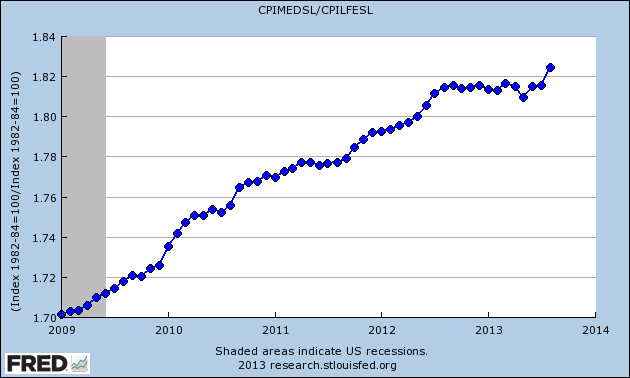
Please note that the chart above isn’t inflation — it’s the medical portion of the CPI divided by the core portion of the CPI. That’s the amount that medical inflation is exceeding core inflation.
As always, one point doesn’t make a trend, but this is interesting to note.
-
FactSet Research Systems Earns $1.20 per Share
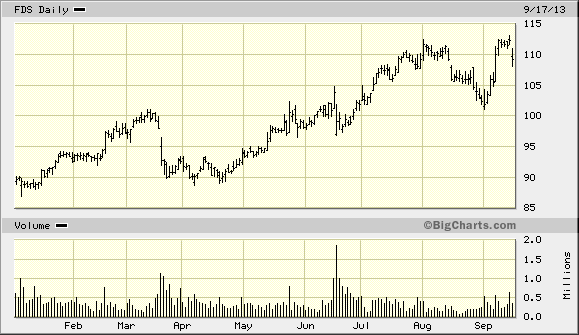
Eddy Elfenbein, September 17th, 2013 at 10:49 amThis morning, FactSet Research Systems ($FDS) reported fiscal fourth-quarter earnings of $1.20 per share. The stock is down today because technically, that counts as an “earnings miss.” The Street was at $1.21 per share but that’s just traders being traders. Three months ago, FactSet gave us a range of $1.18 to $1.21 per share so the company is hitting its own targets. FactSet’s revenues rose 6% to $219.3 million, and net income was $51 million.
The big metric for FactSet is ASV or annual subscription value. For the quarter, ASV rose by 6% to $888 million. That’s a good number and it points towards strong revenue over the next year.
For fiscal Q1, which ends in November, FactSet expects revenues between $222 and $225 million. They also see earnings coming in between $1.21 and $1.24 per share. Wall Street had been expecting $1.23 per share. The bottom line is that business continues to go well for FactSet. The company earned $1.11 per share in last year’s Q1.
From the earnings report, here are some financial highlights from Q4:
ASV from U.S. operations was $606 million and $282 million was related to international operations.
U.S. revenues were $149.9 million, up 6% from the year ago quarter.
Non-U.S. revenues rose 5% to $69.4 million as compared to the same period in fiscal 2012. Excluding the impact from foreign currency, the international growth rate was 6%.
GAAP operating margin was 32.2%. Adjusted operating margin was 33.4%, compared to 34.0% a year ago.
The effective tax rate for the fourth quarter was 28.1%, down from 31.7% a year ago. Excluding income tax benefits recorded during the second quarter of fiscal 2013 primarily from the reenactment of the U.S. Federal R&D credit, the annual effective tax rate was 28.9%.
Quarterly free cash flow was $71 million, up 38% over the year ago quarter. For the full fiscal 2013 year, FactSet generated $251 million in free cash flow which is 20% higher than a year ago.
Here are their expectations for Q1:
Revenues are expected to range between $222 million and $225 million.
Operating margin is expected to range between 33.0% and 34.0%, which includes a 30 basis point reduction from Revere.
The annual effective tax rate is expected to range between 28.5% and 29.5% and assumes the U.S. Federal R&D tax credit will be re-enacted by the end of the first quarter of fiscal 2014.
GAAP diluted EPS should range between $1.21 and $1.24, the midpoint of the range represents 10% growth over last year’s first quarter. GAAP diluted EPS assumes the U.S. Federal R&D tax credit will be re-enacted. If the U.S. Federal R&D tax credit is not re-enacted, first quarter’s GAAP diluted EPS will be reduced by $0.03.
Yesterday, the shares hit an all-time high of $113.05. Today they’re down to $108-$109.
-
Microsoft Ups Dividend by 22%
Eddy Elfenbein, September 17th, 2013 at 10:10 amThe stock market has rallied for nine of the ten days in September thus far, and we’re on track for another up day today. All eyes are on the Fed which begins its important two-day “tapering” meeting in Washington.
The best news this morning is that Microsoft ($MSFT) just announced a big dividend increase. I had projected that MSFT would raise their quarterly dividend by three cents — rising from 23 cents to 26 cents per share. I wasn’t optimistic enough. The software giant just raised their quarterly dividend by five cents per share to 28 cents. That’s a 22% increase. MSFT also announced a $40 billion buyback program.
The new repurchase program, which has no expiration date, replaces another $40 billion buyback plan that was due to lapse at the end of this month, Redmond, Washington-based Microsoft said today in a statement. The company’s quarterly dividend will rise 22 percent to 28 cents a share, payable to shareholders on Dec. 12.
“These actions reflect a continued commitment to returning cash to our shareholders,” Chief Financial Officer Amy Hood said in the statement.
For the year, the company will pay out $1.12 per share. Based on yesterday’s close, that translates to a yield of 3.41%.
-
Morning News: September 17, 2013
Eddy Elfenbein, September 17th, 2013 at 6:21 amThe Landesbanken: Inside Germany’s Trillion Euro banking Blind Spot
U.K. Inflation Slows to 2.7% on Transport, Clothing Prices
Europe August Car Sales Drop as Demand Lowest on Record
Poland Proves Best in Years Since Lehman: Riskless Return
A Bitter ‘Fertilzer War’ Gripping Belarus and Russia is Helping U.S. Farmers
Manufacturing Rebound Led by Autos Supports Growth
Two-Name Race Drops to One, but Guessing Continues
In Budget Faceoff, Obama Warns of ‘Economic Chaos’
Less Tapering Becomes Tightening Credit No Matter What Fed Says
Wall Street Exploits Ethanol Credits, and Prices Spike
Regulators to Charge JPMorgan Chase $750 Million in London Whale Cases
Anglo American Drops Alaska Investment
Packaging Corp. to Buy Boise for $1.28 Billion
Jeff Carter: Why Going Public Is Good For Twitter
Roger Nusbaum: A Doozy of Quote
Be sure to follow me on Twitter.
-
Looking at Starbucks
Eddy Elfenbein, September 16th, 2013 at 2:57 pmI don’t have much that is profound to say with this graph, but I spent some time making it and didn’t want it to go to waste. This is the share price of Starbucks ($SBUX) along with its earnings-per-share.
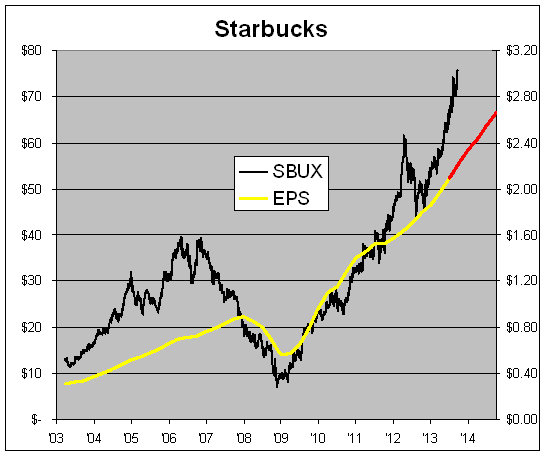
The share price is in black and it follows the left scale. The earnings are in yellow and follow the right scale. The red line is Wall Street’s consensus. The two lines are scaled at a ratio of 25 to 1 so whenever the lines cross, SBUX’s P/E Ratio is exactly 25.
The point I wanted to get across is how rapidly SBUX’s valuation has grown over the last year. It’s also interesting to see, despite some wild stock moves, how stable SBUX’s earnings growth appears to be.
I can’t say if 25 is the right P/E Ratio for Starbucks. I used 25 simply because I think it makes the chart look best. In 2006, SBUX traded at more than 56 times earnings.
I want to make it clear that looking at a stock’s P/E Ratio is just one way to analyze a stock. To get a full picture, there are many other metrics you must look at. I was struck by how dramatic the recent run-up is. The company is also benefiting from a steep drop in coffee prices. Personally, I don’t think Starbucks would be a bargain unless it dropped to $60 per share.
-
Archives
- July 2026
- June 2026
- May 2026
- April 2026
- March 2026
- February 2026
- January 2026
- December 2025
- November 2025
- October 2025
- September 2025
- August 2025
- July 2025
- June 2025
- May 2025
- April 2025
- March 2025
- February 2025
- January 2025
- December 2024
- November 2024
- October 2024
- September 2024
- August 2024
- July 2024
- June 2024
- May 2024
- April 2024
- March 2024
- February 2024
- January 2024
- December 2023
- November 2023
- October 2023
- September 2023
- August 2023
- July 2023
- June 2023
- May 2023
- April 2023
- March 2023
- February 2023
- January 2023
- December 2022
- November 2022
- October 2022
- September 2022
- August 2022
- July 2022
- June 2022
- May 2022
- April 2022
- March 2022
- February 2022
- January 2022
- December 2021
- November 2021
- October 2021
- September 2021
- August 2021
- July 2021
- June 2021
- May 2021
- April 2021
- March 2021
- February 2021
- January 2021
- December 2020
- November 2020
- October 2020
- September 2020
- August 2020
- July 2020
- June 2020
- May 2020
- April 2020
- March 2020
- February 2020
- January 2020
- December 2019
- November 2019
- October 2019
- September 2019
- August 2019
- July 2019
- June 2019
- May 2019
- April 2019
- March 2019
- February 2019
- January 2019
- December 2018
- November 2018
- October 2018
- September 2018
- August 2018
- July 2018
- June 2018
- May 2018
- April 2018
- March 2018
- February 2018
- January 2018
- December 2017
- November 2017
- October 2017
- September 2017
- August 2017
- July 2017
- June 2017
- May 2017
- April 2017
- March 2017
- February 2017
- January 2017
- December 2016
- November 2016
- October 2016
- September 2016
- August 2016
- July 2016
- June 2016
- May 2016
- April 2016
- March 2016
- February 2016
- January 2016
- December 2015
- November 2015
- October 2015
- September 2015
- August 2015
- July 2015
- June 2015
- May 2015
- April 2015
- March 2015
- February 2015
- January 2015
- December 2014
- November 2014
- October 2014
- September 2014
- August 2014
- July 2014
- June 2014
- May 2014
- April 2014
- March 2014
- February 2014
- January 2014
- December 2013
- November 2013
- October 2013
- September 2013
- August 2013
- July 2013
- June 2013
- May 2013
- April 2013
- March 2013
- February 2013
- January 2013
- December 2012
- November 2012
- October 2012
- September 2012
- August 2012
- July 2012
- June 2012
- May 2012
- April 2012
- March 2012
- February 2012
- January 2012
- December 2011
- November 2011
- October 2011
- September 2011
- August 2011
- July 2011
- June 2011
- May 2011
- April 2011
- March 2011
- February 2011
- January 2011
- December 2010
- November 2010
- October 2010
- September 2010
- August 2010
- July 2010
- June 2010
- May 2010
- April 2010
- March 2010
- February 2010
- January 2010
- December 2009
- November 2009
- October 2009
- September 2009
- August 2009
- July 2009
- June 2009
- May 2009
- April 2009
- March 2009
- February 2009
- January 2009
- December 2008
- November 2008
- October 2008
- September 2008
- August 2008
- July 2008
- June 2008
- May 2008
- April 2008
- March 2008
- February 2008
- January 2008
- December 2007
- November 2007
- October 2007
- September 2007
- August 2007
- July 2007
- June 2007
- May 2007
- April 2007
- March 2007
- February 2007
- January 2007
- December 2006
- November 2006
- October 2006
- September 2006
- August 2006
- July 2006
- June 2006
- May 2006
- April 2006
- March 2006
- February 2006
- January 2006
- December 2005
- November 2005
- October 2005
- September 2005
- August 2005
- July 2005
 Eddy Elfenbein is a Washington, DC-based speaker, portfolio manager and editor of the blog Crossing Wall Street. His