Archive for 2013
-
Buffett’s 2012 Shareholder Letter
Eddy Elfenbein, March 1st, 2013 at 4:16 pmWarren Buffett’s lastest shareholder letter is out. It usually contains a great deal of investing wisdom.
-
S&P 500 Divided By Gold
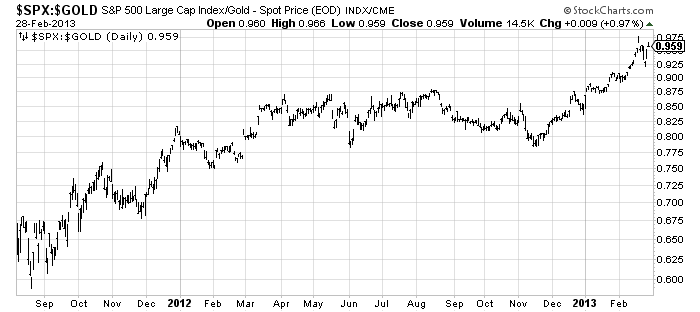
Eddy Elfenbein, March 1st, 2013 at 4:05 pmThe S&P 500 is nearing parity with gold. The index is now 96.3% of the price of gold. Eighteen months ago, the ratio was down below 60%.
-
AFLAC “Is One of the Cheapest Stocks in the S&P 500 Right Now”
Eddy Elfenbein, March 1st, 2013 at 11:23 amTeresa Rivas at Barron’s make the case for AFLAC ($AFL):
The Aflac duck endures many misfortunes in the insurance company’s goofy advertisements, from scorched feet to a broken bill. Now the stock is taking a beating as well, following a drop in Japan’s currency, and this has created an opportunity for investors.
(…)
“This is one of the cheapest stocks in the S&P 500 right now, especially among companies that are going to report earnings, not losses,” says Bill Smead, portfolio manager of the Smead Value Fund. “This is a premier financial services and insurance company—a storm doesn’t come in and turn a company upside down. If you look at the 2011 tsunami, even though 75% of Aflac’s revenue comes from Japan, [the disaster] didn’t really have any impact.”
(…)
“It has low price-to-earnings and price-to-book [ratios], and yet the company is going to be turning in a fairly healthy return on equity in 2013, so there’s a disconnect between the price today and the returns the company is providing.”
(…)
Still, the stock price doesn’t reflect Aflac’s long-term potential. Its premium brand name is an asset in Japan, where it has long enjoyed a stellar reputation, and, thanks to the duck, it is well known in the U.S.
“If you put 100 people in a room and give them the generic category of supplemental health insurance, I don’t think anyone would be able to say any name other than Aflac,” says Smead. “If savvy people can’t tell you who a company’s No. 2 competitor is, they’ve won the game before it starts.”
-
February ISM = 54.2
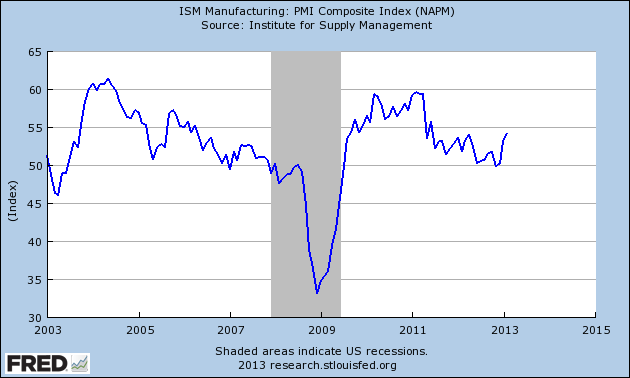
Eddy Elfenbein, March 1st, 2013 at 10:05 amVery good ISM report for February of 54.2. We saw a nice increase last month to 53.1 so it’s good to see some confirmation. Since 1948, the ISM has printed between 53.0 and 55.0 a total of 104 times. Only twice have been during recessions.
The other news today is that personal income plunged 3.6% in January although spending rose by 0.2%. The income number was impacted by some calendar effects. A number of companies paid dividends and bonuses late last year which increased December’s number, so the January number was moving back to correct for that.
We also learned that the University of Michigan consumer sentiment index rose last month to 77.6 from 73.8 in the month before. Economists were expecting an increase to 76.3.
-
CWS Market Review – March 1, 2013
Eddy Elfenbein, March 1st, 2013 at 6:52 am“Business, more than any other occupation, is a continual dealing with the future;
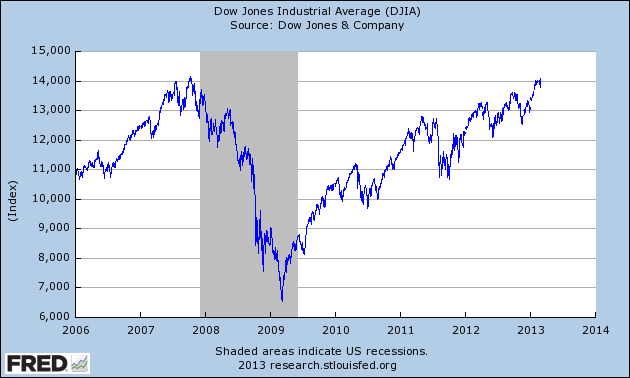
it is a continual calculation, an instinctive exercise in foresight.” – Henry R. LuceThe stock market had a rather raucous few days this week, which included our worst single-day plunge since November, thanks to, of all things, unexpected election results in Italy. But after some good earnings and positive economic reports, plus bullish comments from Mr. Bernanke, the stock market regained its legs; the Dow is now only steps away from an all-time high. You know, it’s a wonder what pumping in a few trillion dollars can do for a market’s spirits.
Here’s an interesting fact: The S&P 500 has risen in both January and February. Since 1945, the S&P 500 has been positive for the first two months of the year 26 times. Every single time that’s happened, the index has closed higher for the year. No exceptions. In fact, it’s usually closed a lot higher. The average total gain, including dividends, has been 24%. If the S&P 500 were to rack up a 24% total return this year, the index would have to be well over 1,700 by the end of the year.
Of course, I’m not predicting such a move. We’re too smart to play the price targets game around here, but I do think this market will continue to be tricky. Frankly, earnings estimates are too high, and I see a lot of lousy stocks gaining ground. That’s not a good sign. On the plus side, the economic recovery is starting to gain some momentum, and our Buy List continues to be an oasis in a troubling climate. As usual, our strategy is to ignore the noise and remain focused on high-quality stocks.
We didn’t have any earnings reports this week, so I’m going to discuss some broader themes impacting the market. First, let’s look at what had the market so grumpy earlier this week.
Reports of the Euro’s Death Are Greatly Exaggerated
The early news on Monday showed that it looked like Pier Luigi Bersani’s left-of-center party was going to win the election in Italy. But as the results came in, both Beppe Grillo and Silvio Berlusconi, who are, respectively, a former comedian and a former Prime Minister, did much better than expected. The better they did, the worse stocks did.
In other words, the ditch-the-euro-and-bury-austerity crowd is still pulling in a lot of votes. As it turns out, Italians prefer governing themselves and not having Germany tell them what to do. Who knew? In fact, Grillo and Berlusconi did so well that due to the rules of Italy’s legislature, probably no one will be able to cobble together a governing coalition. And that probably means it’s back to the polls we go.
So here we are in 2013, with our portfolios noticeably impacted by the decision of a former comedian not to join in the governing of the Italian nation. My friends, we live in interesting times.
Now you might think it’s odd that I’m discussing these election results in a service dedicated to investing, and I have to agree with you—it is odd. But like the proverbial flap of a butterfly’s wing that causes a tornado thousands of miles away, the election results have far-reaching consequences. For one, the S&P 500 dropped 27.75 points on Monday, and it was the worst daily loss since the day after President Obama’s reelection.
Now let me explain what’s really going on and what it means for us: The plan to save Europe was perfectly drawn up and perfectly executed. There was one teeny, tiny, minor, little flaw: no one bothered to ask the voters. Well, technically they did ask, but the pro-euro policies slid by in Greece and other places. Now in Italy, voters are pushing back. That’s why this isn’t just about one election. It’s really a much broader battle, and that’s why our market reacted so dramatically. Bear in mind that the establishment’s candidate wasn’t Bersani; it was the current Prime Minister Mario Monti, and he was totally blown out.
If the anti-euro and anti-austerity movement gains power, it could undermine all the work that’s been done to save the eurozone. Remember last summer when Mr. Draghi made his dramatic statement that he was prepared to do whatever it takes to save the euro? Just look at any chart from that period and you’ll see that’s precisely when the lines that had been going down started to rise and when the rising lines started to fall. More specifically, that’s when investors finally stepped away from crowding en masse into U.S. Treasuries and started buying dollar-denominated stocks. That’s also when cyclical stocks started to take the lead. We’ve come a long way, so the recent events in Italy are seen as a big threat.
Here’s my take: This latest round is really a political crisis, whereas the previous episodes were part of a financial crisis. The good news is that bond yields in Europe are down dramatically from where they had been last summer. I think this was another example of investors who had already been looking to exit some U.S. stocks jumping on this excuse to unload their positions. The fundamentals in Europe and the U.S. are much better. Panicky traders, however, will never change. There may be more euro flare-ups to come, but those whom the Bond Market Gods wish to destroy, they first make Greek or Spanish. Maybe Portuguese. But not Italian.
The Equation That’s Been Driving the Market
The other big news this week was the Congressional testimony from Ben Bernanke. The Fed Chairman’s semi-annual testimony used to be a big deal, but since Bernanke allowed at least a little more transparency into a hopelessly opaque institution, the thoughts of Mr. Bernanke aren’t wholly unexpected.
In short, Bernanke said that the economy hit a rough patch late last year but that things are looking better at the start of this year. The part of Bernanke’s remarks that caught my attention was his robust defense of the Fed’s asset purchases. Some folks on Wall Street thought the recent Fed minutes indicated that the central bank was ready to pull the plug on their bond-buying. That ain’t happening. Bernanke made it clear that they want to keep buying bonds until the labor market gets much better. The Bearded One said, “The FOMC has indicated that it will continue purchases until it observes a substantial improvement in the outlook for the labor market in a context of price stability.” Seems pretty clear to me.
Now let me circle back and explain why this is so important. I’ll give you the simple equation to understand the stock market for the last six months or so. The areas that have done exceptionally well are found wherever you see consumers intersecting finance. This is absolutely crucial.
What do I mean by this? It’s not just that consumers are buying more things; it’s that they also need to finance those purchases. That means housing, which has done extremely well. The Homebuilder ETF ($XHB) is up 41% in the last year.
That means cars. Ford Motor ($F) has rallied more than 36% in the last seven months. Nicholas Financial ($NICK) continues to thrive as well. It also means travel and airline stocks. And spillover industries. Home Depot ($HD) just reported very good earnings, plus they raised their dividend by 34%. People buying. People borrowing. Banks lending.
On the other side of the financing, the big banks have done well. This has been great for JPMorgan Chase ($JPM) and Wells Fargo ($WFC), both of whom made a conscious decision to focus on mortgages. Stocks like Visa ($V) and MasterCard ($MA) have also been big winners. All of these stocks have benefited from the same effect: Consumers buying things with money they don’t have at the moment but plan to get soon. This is why Bernanke’s defense of QE, and his dismissal of its risks, is so important. This trend isn’t nearly over, either. Mortgage rates are still very low, and housing inventory is getting pretty thin as well. Monetary policy does eventually work, though it may tarry.
Two Buy Below Adjustments
I want to make two small adjustments to our Buy Below prices. I’m going to bump up FactSet Research’s ($FDS) Buy Below to $96. Fiscal Q2 earnings are due out in mid-March, and I’m expecting good news. The Street’s looking for $1.11 per share. I also want to raise Stryker’s ($SYK) Buy Below to $64. Stryker is our #1 performer this year, with a YTD gain of 16.5%. Despite the recent rally, the shares are still quite reasonably priced.
That’s all for now. Next week, the government will revise its productivity report, plus we’ll get the Fed’s important Beige Book report. But the most important event will be next Friday’s jobs report. Remember what Bernanke said about “a substantial improvement.” Be sure to keep checking the blog for daily updates. I’ll have more market analysis for you in the next issue of CWS Market Review!
– Eddy
-
Morning News: March 1, 2013
Eddy Elfenbein, March 1st, 2013 at 6:45 amAsian Manufacturing Growth Slows, Data Show
Eurozone Unemployment Hits 11.9%
Spending Cuts Signal Austere Future for Domestic Programs
Consumers, Exports Nudge Up Economy
4 Possible Silver Linings In The Sequester
Buffett Outlining Dividend Plan May Ease Successor’s Path
Groupon Dismisses Chief After a Dismal Quarter
J.C. Penney Lowest Sales in Decades Show Johnson Stumbles
Banana Republic: Turning Khaki Into Gold
Lloyds Posts Loss on Loan Insurance, Swaps Compensation
Sears Holdings Q4 Loss Narrows
Ad Firm WPP Sees Business Confidence Improving
Barnes & Noble Rethinks Its Strategy for the Nook
Roger Nusbaum: You Maniacs, You Blew It Up
Stone Street: ZAGG:SKUL::Punxsutawney:Paris
Be sure to follow me on Twitter.
-
Remarkable Stat on Real GDP
Eddy Elfenbein, February 28th, 2013 at 10:42 amHere’s a stat that I find astonishing:
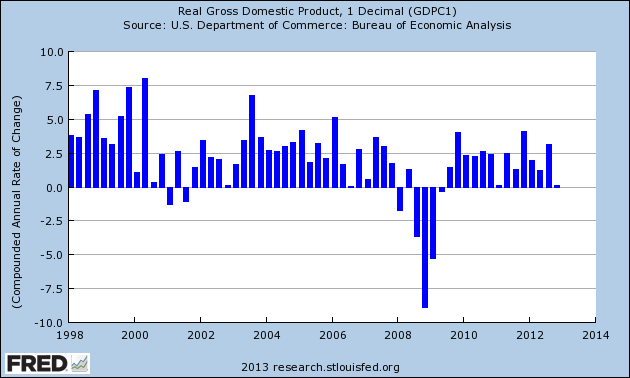
From 1947 to 1973, real GDP grew by 175.9603%.
From 1973 to 2012, real GDP grew by 175.9607%.In other words, the U.S. economy grew by the same amount over the last 39 years as it did in the 26 years before, despite the latter period being 50% longer. And when I say the same, I mean almost precisely exactly the same.
Here’s quarterly GDP growth for the last few years:
-
The Dow Closes in on All-Time High
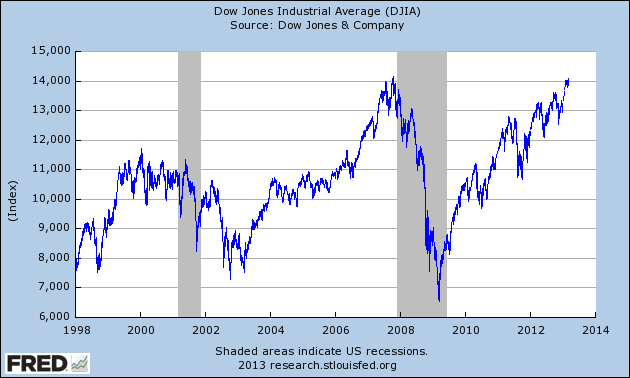
Eddy Elfenbein, February 28th, 2013 at 10:27 amThe Dow closed yesterday just 89.16 points from an all-time high close. This was the highest close for the index in 64 months. To give you an idea of how close we are to making a record, the 30 stocks in the Dow need to rise by a combined total of $11.61. The index has been up as much as 30 points today.
-
Morning News: February 28, 2013
Eddy Elfenbein, February 28th, 2013 at 7:13 amDraghi Says ECB in No Rush to Tighten as Inflation Slows
Monti Says European Crisis Management, Populism Led to Defeat
Banker Bonuses Face Curbs in EU Basel Law Deal
Osborne’s ‘Shrink The Bank’ Strategy Means A Smaller, Less Profitable RBS
Bankia Posts Record 21.2 Billion Euros After-Tax Loss
Wheat Rises as U.S. Export Demand May Increase After Price Drop
Businesses Show Resilience Despite Drop in Goods Orders
Senate, in a More Affable Mode, Backs Treasury Nominee
Groupon Drops 24% On Weak Results, Forecast
Chief Talks of Mistakes and Big Loss at J.C. Penney
Samsung Armors Android to Take On BlackBerry
Wal-Mart Struggles to Restock Store Shelves as U.S. Sales Slump
The Excessive Uproar Over Marissa Mayer’s Telecommuting Ban
Cullen Roche: Nasdaq Sentiment Remains Near its Highest Levels Since March 2000
Jeff Miller: Investors: How tO Profit by Understanding the Fed
Be sure to follow me on Twitter.
-
Update on My Watch List
Eddy Elfenbein, February 27th, 2013 at 1:16 pmI’m often asked how I go about picking stocks for my Buy List. The answer is really quite simple. I don’t have a magic formula and I hate stock screeners.
Instead, I have a Watch List of stocks that I try to follow. These are what I would call “really good companies.” They’re in the top tier of Corporate America. It’s taken me years to build up this list and I change it often.
The Watch List serves as the minor leagues for my Buy List. It’s from this list that almost all candidates for the Buy List come, and it’s where they return after they’ve been deleted.
Let me make it clear that I’m not recommending any of these stocks listed below. That’s what the Buy List is for. I just wanted to show you which stocks make the first cut in the process. Honestly, this list is too large and I should knock off around 30 names. If a stock is on this list, you can be pretty sure it’s a decent company (the price may not be).
My secret formula is nothing more than watching really good companies and making a move when the price looks good.
Company Symbol Aaron’s AAN Abbott Laboratories ABT Advance Auto Parts AAP Alliance Data Systems ADS AmerisourceBergen ABC Ametek AME Ansys ANSS AT&T T AutoZone AZO Balchem BCPC Ball BLL Baxter International BAX Becton, Dickinson BDX Biogen Idec BIIB Carter’s CRI Cerner CERN CH Robinson Worldwide CHRW Cheesecake Factory CAKE Church & Dwight CHD CLARCOR CLC Clorox CLX Coach COH Coca-Cola KO Colgate-Palmolive CL Community Health Systems CYH Concur Technologies CNQR Cooper COO Corrections of America CXW Costco COST Crane CR Cummins CMI CVS Caremark CVS Danaher DHR Darden Restaurants DRI DaVita HealthCare Partners DVA Deckers Outdoor DECK Deluxe DLX DENTSPLY International XRAY Dick’s Sporting Goods DKS Dolby Laboratories DLB Donaldson Company DCI Endo Health Solutions ENDP Esterline Technologies ESL Expeditors International of Washington EXPD Express Scripts ESRX Fair Isaac FICO Fastenal Company FAST FMC Technologies FTI Foot Locker FL Gardner Denver GDI Gartner IT General Dynamics GD Gentex GNTX Gilead Sciences GILD Global Payments GPN Graco GGG Hasbro HAS HEICO HEI Henry Schein HSIC HMS Holdings HMSY Hologic HOLX Hormel Foods HRL Hospira HSP HSN HSNI Hubbell HUB-B Humana HUM IBM IBM IDEX IEX IDEXX Laboratories IDXX Informatica INFA Infosys Ltd. INFY Ingram Micro IM Ingredion Incorporated INGR Intel INTC IntercontinentalExchange ICE International Flavors & Fragrances IFF Intuit INTU Intuitive Surgical ISRG Iron Mountain IRM Jack Henry & Associates JKHY Jarden JAH JB Hunt Transport Services JBHT John Wiley & Sons JW-A Johnson & Johnson JNJ Kansas City Southern KSU Life Time Fitness LTM McCormick MKC McDonald’s MCD MEDNAX MD Mettler-Toledo International MTD MICROS Systems MCRS Mylan MYL NeuStar NSR Nike NKE Nordson NDSN Panera Bread PNRA Pentair Ltd. PNR PetSmart PETM Polaris Industries PII Progressive PGR Prosperity Bancshares PB Quest Diagnostics DGX Rackspace Hosting RAX Raven Industries RAVN Regal Beloit RBC Reinsurance Group of America RGA Rent-A-Center RCII ResMed RMD Reynolds American RAI Riverbed Technology RVBD Rollins ROL Seaboard SEB SEI Investments SEIC Seneca Foods SENEA Sensient Technologies SXT Sigma-Aldrich SIAL Signature Bank SBNY Silgan Holdings SLGN Snap-on SNA SolarWinds SWI St. Jude Medical STJ Starbucks SBUX State Street STT Stericycle SRCL Sysco SYY Target TGT Tech Data TECD Teradata TDC Thermo Fisher Scientific TMO Thoratec THOR TIBCO Software TIBX Tiffany & TIF TJX Companies TJX Towers Watson & TW Tractor Supply TSCO Trimble Navigation Limited TRMB Triumph Group TGI Tupperware Brands TUP U.S. Bancorp USB Universal Health Services UHS URS URS V.F. VFC Varian Medical Systems VAR VeriFone Systems PAY Visa V W.W. Grainger GWW Wabtec WAB Walgreen WAG Waters WAT WellPoint WLP Wells Fargo WFC Western Union WU Weyco Group WEYS World Fuel Services INT Yum! Brands YUM Zimmer Holdings ZMH
-
Archives
- July 2026
- June 2026
- May 2026
- April 2026
- March 2026
- February 2026
- January 2026
- December 2025
- November 2025
- October 2025
- September 2025
- August 2025
- July 2025
- June 2025
- May 2025
- April 2025
- March 2025
- February 2025
- January 2025
- December 2024
- November 2024
- October 2024
- September 2024
- August 2024
- July 2024
- June 2024
- May 2024
- April 2024
- March 2024
- February 2024
- January 2024
- December 2023
- November 2023
- October 2023
- September 2023
- August 2023
- July 2023
- June 2023
- May 2023
- April 2023
- March 2023
- February 2023
- January 2023
- December 2022
- November 2022
- October 2022
- September 2022
- August 2022
- July 2022
- June 2022
- May 2022
- April 2022
- March 2022
- February 2022
- January 2022
- December 2021
- November 2021
- October 2021
- September 2021
- August 2021
- July 2021
- June 2021
- May 2021
- April 2021
- March 2021
- February 2021
- January 2021
- December 2020
- November 2020
- October 2020
- September 2020
- August 2020
- July 2020
- June 2020
- May 2020
- April 2020
- March 2020
- February 2020
- January 2020
- December 2019
- November 2019
- October 2019
- September 2019
- August 2019
- July 2019
- June 2019
- May 2019
- April 2019
- March 2019
- February 2019
- January 2019
- December 2018
- November 2018
- October 2018
- September 2018
- August 2018
- July 2018
- June 2018
- May 2018
- April 2018
- March 2018
- February 2018
- January 2018
- December 2017
- November 2017
- October 2017
- September 2017
- August 2017
- July 2017
- June 2017
- May 2017
- April 2017
- March 2017
- February 2017
- January 2017
- December 2016
- November 2016
- October 2016
- September 2016
- August 2016
- July 2016
- June 2016
- May 2016
- April 2016
- March 2016
- February 2016
- January 2016
- December 2015
- November 2015
- October 2015
- September 2015
- August 2015
- July 2015
- June 2015
- May 2015
- April 2015
- March 2015
- February 2015
- January 2015
- December 2014
- November 2014
- October 2014
- September 2014
- August 2014
- July 2014
- June 2014
- May 2014
- April 2014
- March 2014
- February 2014
- January 2014
- December 2013
- November 2013
- October 2013
- September 2013
- August 2013
- July 2013
- June 2013
- May 2013
- April 2013
- March 2013
- February 2013
- January 2013
- December 2012
- November 2012
- October 2012
- September 2012
- August 2012
- July 2012
- June 2012
- May 2012
- April 2012
- March 2012
- February 2012
- January 2012
- December 2011
- November 2011
- October 2011
- September 2011
- August 2011
- July 2011
- June 2011
- May 2011
- April 2011
- March 2011
- February 2011
- January 2011
- December 2010
- November 2010
- October 2010
- September 2010
- August 2010
- July 2010
- June 2010
- May 2010
- April 2010
- March 2010
- February 2010
- January 2010
- December 2009
- November 2009
- October 2009
- September 2009
- August 2009
- July 2009
- June 2009
- May 2009
- April 2009
- March 2009
- February 2009
- January 2009
- December 2008
- November 2008
- October 2008
- September 2008
- August 2008
- July 2008
- June 2008
- May 2008
- April 2008
- March 2008
- February 2008
- January 2008
- December 2007
- November 2007
- October 2007
- September 2007
- August 2007
- July 2007
- June 2007
- May 2007
- April 2007
- March 2007
- February 2007
- January 2007
- December 2006
- November 2006
- October 2006
- September 2006
- August 2006
- July 2006
- June 2006
- May 2006
- April 2006
- March 2006
- February 2006
- January 2006
- December 2005
- November 2005
- October 2005
- September 2005
- August 2005
- July 2005
 Eddy Elfenbein is a Washington, DC-based speaker, portfolio manager and editor of the blog Crossing Wall Street. His