CWS Market Review – January 20, 2026
(This is the free version of CWS Market Review. If you like what you see, then please sign up for the premium newsletter for $20 per month or $200 for the whole year. If you sign up today, you can see our two reports, “Your Handy Guide to Stock Orders” and “How Not to Get Screwed on Your Mortgage.”)
Markets Drop on Greenland News
The stock market opened sharply lower this morning due to rising tensions over Greenland. (Well, there’s a sentence I never saw myself typing.)
The stock market was not pleased over this weekend’s news. The Dow lost 870 points today and the S&P 500 dropped a little over 2%. The Nasdaq fell by 2.4%. The S&P 500 also fell below its 50-day moving average. This was the worst day for the index since October.
A lot of folks just seem baffled by President Trump’s actions. French President Emmanuel Macron emailed President Trump saying, “I do not understand what you are doing on Greenland.” He’s not alone.
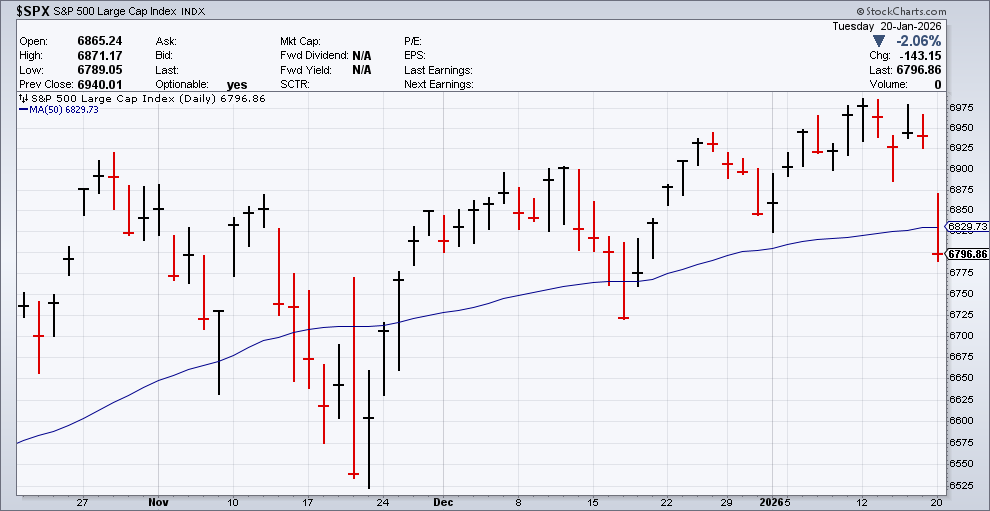
As usual, I’ll steer clear of any political angles – that’s not my specialty. I do know markets and markets do not like uncertainty, but that’s what we’re getting over Greenland.
My hunch is to ignore this as typical Trumpian bluster, but I can’t be positive. Some folks are taking this very seriously. Denmark has moved troops to Greenland. There appears to be a desire to deescalate tensions.
President Trump has threatened new tariffs on several European countries that aren’t siding with him over Greenland. This could impact $100 billion worth of U.S. exports. Countries such as Denmark, Norway, Sweden, France, Germany, the U.K., the Netherlands and Finland will be hit with 10% tariffs on February 1. Those will rise to 25% in June.
The “Sell America” trade dominated world markets on Tuesday. Before there’s warfare on the battlefields, there’s often warfare in the markets. On Tuesday, the dollar plunged, Treasuries fell, yields spiked and gold rallied. In fact, gold and silver hit record highs. In less than 18 months, gold has doubled.
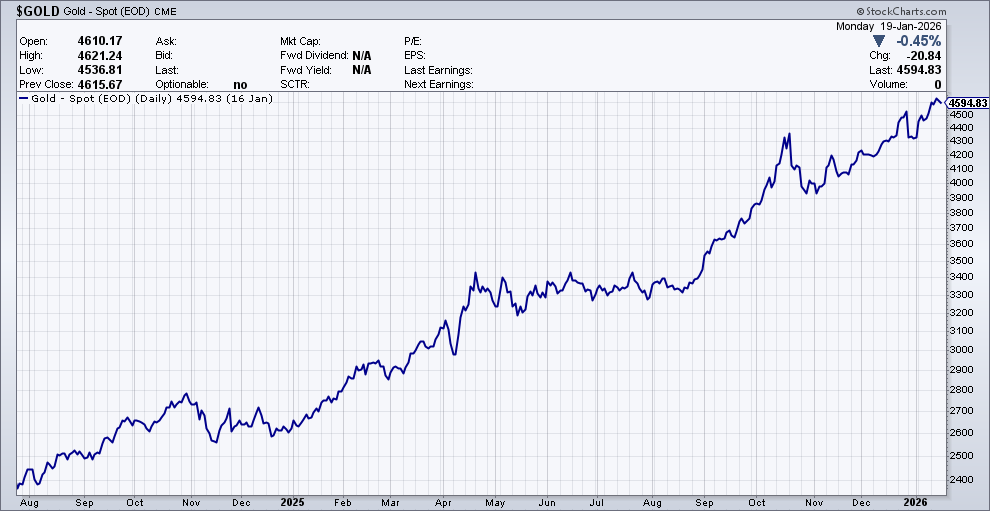
On Tuesday, the euro gained 0.7% against the dollar and gold was on pace for its best day since October. The bulls came in and tried to turn things around, but that effort flopped by noon.
What’s interesting about today’s market is that it largely continued the trend that’s been in place for several weeks. By that, I mean that Value outperformed Growth (meaning it fell by less). Low Vol beat High Beta. The Russell 2000 beat the large-cap indexes and the equal-weighted indexes held up very well.
I’m happy to report that our Buy List continues to do very well this year. On Tuesday, the Buy List outperformed the S&P 500 for the 11th time in 12 trading sessions. Rollins (ROL) was up a bit today and it reached a new 52-week high as did Casey’s (CASY) and Mueller (MLI). Comfort Systems USA (FIX) just became our first 20% winner this year.
So far, this earnings season is going mostly well for Wall Street but there have been some prominent disappointments. 3M (MMM) beat earnings by three cents but the stock got knocked for a 5% loss.
Fastenal (FAST) said its Q4 revenues were below Wall Street’s estimate. The problem is that higher tariffs inflated prices and cut demand. Fastenal is a good example of a cyclical stock. The company sells construction supplies such as fasteners, nuts, screws and bolts.
Bank stocks were nervous on Tuesday as the market was waiting on the decision by the Trump administration to impose a 10% cap on credit card interest rates. U.S. Bancorp (USB) rallied a bit after an encouraging earnings report.
For much of last year, I talked about how riskier stocks strongly outperformed more conservative investments. That gap between high-risk and low-risk performance grew exceedingly wide by late last year. So far, that trend has reversed itself and low-risk stocks are finally leading the market.
The reversal seems to have started in late October. Since then, defensive stocks have prospered. Here’s a look at the Consumer Staples (red), Healthcare (blue) and the S&P 500 (green) over the last several weeks:
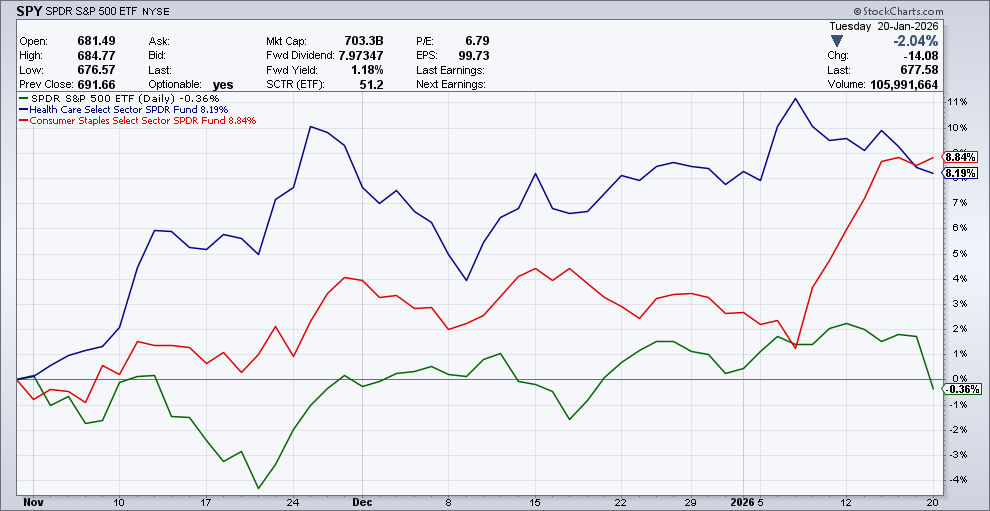
It’s not much yet but this is a major departure from what we saw last year. These are typically the kinds of stocks people buy when they’re nervous about the state of the economy.
On Thursday, the government will release its first estimate for Q4 GDP growth. It could be a strong number. Traders are very optimistic. The traders at Polymarket expect growth of more than 3.5%. For 2026, traders see a 78% chance that GDP growth surpasses 2.5%.
The Federal Reserve meets again next week, and I think we can completely rule out any changes to interest rates. The Fed’s pause may not last long. Traders still see two more rate cuts coming this year. If the employment news continues to be sluggish, then we’ll certainly see the Fed come to the market’s rescue, no matter who the Fed Chair is.
Stock Focus Guidewire Software (GWRE)
One of the stocks I strongly considered for this year’s Buy List was Guidewire Software (GWRE). Even though I didn’t chose Guidewire for inclusion on our Buy List, I thought it’s worth taking a closer look.
Guidewire is a leading provider of cloud-based software solutions specifically designed for the property and casualty (P&C) insurance industry (e.g., auto, home, commercial, and other non-life insurance).
The company helps insurance carriers modernize their operations, engage customers digitally, and grow more efficiently. Their platform is used by over 570 insurers in more than 40 countries. Guidewire is the go-to platform for many P&C insurers looking to replace outdated legacy systems with modern, flexible technology. The company is based San Mateo, CA.
Guidewire had several co-founders but the most prominent is Marcus Ryu. He served as the CEO for several years and led Guidewire through its IPO in 2012.
Guidewire’s AI analytics features are deeply integrated into its P&C insurance platform (primarily through Guidewire Analytics and Guidewire Cloud), enabling insurers to embed predictive and generative AI insights directly into core workflows like underwriting, claims, pricing, and operations.
What I like about Guidewire Software is that it has a strong moat, particularly in the property and casualty (P&C) insurance software market. This is because Guidewire has “high switching costs.”
This refers to the expense that a customer faces when trying to switch from one product to another. These costs make it difficult for customers to change, even if a competitor offers a better or cheaper alternative.
High switching costs help companies retain customers, reduce churn, maintain pricing power, and deter new competitors from easily gaining market share. This is important because companies with high switching costs can often charge higher prices without losing many customers.
Guidewire is a very profitable outfit. In December, Guidewire reported fiscal Q1 earnings of 66 cents per share. That’s up from 43 cents per share one year ago. It also beat Wall Street’s consensus of 61 cents per share.
Wall Street expects Guidewire to make $2.95 per share this year and $3.86 per share in 2027.
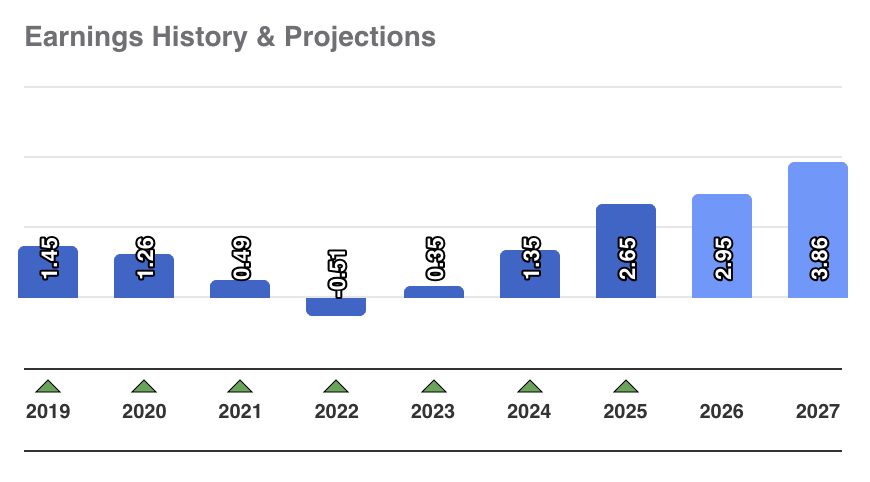
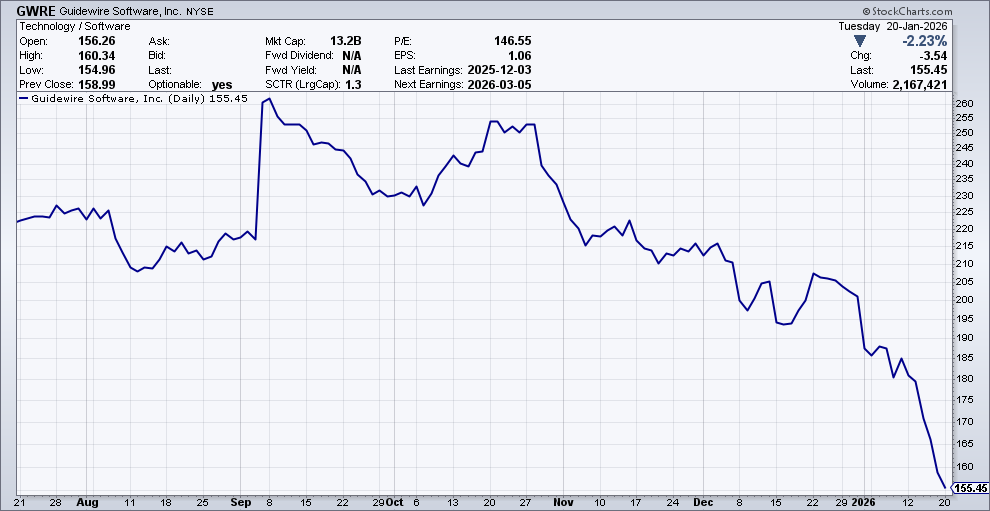
One problem with Guidewire is that it’s overpriced. Very overpriced. That fact probably explains why the stock has not done well recently. Since October, it’s been in a nosedive. At one point, GWRE got to $272.60 in October. It touched a new 52-week low today of $154.96. That’s still 40 times next year’s earnings estimate.
I expect Guidewire to trade at a premium, but I’d prefer to see a much smaller premium. Another concern I have is that Guidewire relies too heavily on a small number of customers. Still, if business remains good and the shares become a good deal less expensive, then I think Guidewire would be an attractive investment.
That’s all for now. Expect earnings news to dominate the market this week. I’ll have more for you in the next issue of CWS Market Review.
– Eddy
Posted by Eddy Elfenbein on January 20th, 2026 at 5:20 pm
The information in this blog post represents my own opinions and does not contain a recommendation for any particular security or investment. I or my affiliates may hold positions or other interests in securities mentioned in the Blog, please see my Disclaimer page for my full disclaimer.
-
Archives
- October 2026
- September 2026
- August 2026
- July 2026
- June 2026
- May 2026
- April 2026
- March 2026
- February 2026
- January 2026
- December 2025
- November 2025
- October 2025
- September 2025
- August 2025
- July 2025
- June 2025
- May 2025
- April 2025
- March 2025
- February 2025
- January 2025
- December 2024
- November 2024
- October 2024
- September 2024
- August 2024
- July 2024
- June 2024
- May 2024
- April 2024
- March 2024
- February 2024
- January 2024
- December 2023
- November 2023
- October 2023
- September 2023
- August 2023
- July 2023
- June 2023
- May 2023
- April 2023
- March 2023
- February 2023
- January 2023
- December 2022
- November 2022
- October 2022
- September 2022
- August 2022
- July 2022
- June 2022
- May 2022
- April 2022
- March 2022
- February 2022
- January 2022
- December 2021
- November 2021
- October 2021
- September 2021
- August 2021
- July 2021
- June 2021
- May 2021
- April 2021
- March 2021
- February 2021
- January 2021
- December 2020
- November 2020
- October 2020
- September 2020
- August 2020
- July 2020
- June 2020
- May 2020
- April 2020
- March 2020
- February 2020
- January 2020
- December 2019
- November 2019
- October 2019
- September 2019
- August 2019
- July 2019
- June 2019
- May 2019
- April 2019
- March 2019
- February 2019
- January 2019
- December 2018
- November 2018
- October 2018
- September 2018
- August 2018
- July 2018
- June 2018
- May 2018
- April 2018
- March 2018
- February 2018
- January 2018
- December 2017
- November 2017
- October 2017
- September 2017
- August 2017
- July 2017
- June 2017
- May 2017
- April 2017
- March 2017
- February 2017
- January 2017
- December 2016
- November 2016
- October 2016
- September 2016
- August 2016
- July 2016
- June 2016
- May 2016
- April 2016
- March 2016
- February 2016
- January 2016
- December 2015
- November 2015
- October 2015
- September 2015
- August 2015
- July 2015
- June 2015
- May 2015
- April 2015
- March 2015
- February 2015
- January 2015
- December 2014
- November 2014
- October 2014
- September 2014
- August 2014
- July 2014
- June 2014
- May 2014
- April 2014
- March 2014
- February 2014
- January 2014
- December 2013
- November 2013
- October 2013
- September 2013
- August 2013
- July 2013
- June 2013
- May 2013
- April 2013
- March 2013
- February 2013
- January 2013
- December 2012
- November 2012
- October 2012
- September 2012
- August 2012
- July 2012
- June 2012
- May 2012
- April 2012
- March 2012
- February 2012
- January 2012
- December 2011
- November 2011
- October 2011
- September 2011
- August 2011
- July 2011
- June 2011
- May 2011
- April 2011
- March 2011
- February 2011
- January 2011
- December 2010
- November 2010
- October 2010
- September 2010
- August 2010
- July 2010
- June 2010
- May 2010
- April 2010
- March 2010
- February 2010
- January 2010
- December 2009
- November 2009
- October 2009
- September 2009
- August 2009
- July 2009
- June 2009
- May 2009
- April 2009
- March 2009
- February 2009
- January 2009
- December 2008
- November 2008
- October 2008
- September 2008
- August 2008
- July 2008
- June 2008
- May 2008
- April 2008
- March 2008
- February 2008
- January 2008
- December 2007
- November 2007
- October 2007
- September 2007
- August 2007
- July 2007
- June 2007
- May 2007
- April 2007
- March 2007
- February 2007
- January 2007
- December 2006
- November 2006
- October 2006
- September 2006
- August 2006
- July 2006
- June 2006
- May 2006
- April 2006
- March 2006
- February 2006
- January 2006
- December 2005
- November 2005
- October 2005
- September 2005
- August 2005
- July 2005
 Eddy Elfenbein is a Washington, DC-based speaker, portfolio manager and editor of the blog Crossing Wall Street. His