CWS Market Review – April 28, 2026
(This is the free version of CWS Market Review. If you like what you see, then please sign up for the premium newsletter for $20 per month or $200 for the whole year. If you sign up today, you can see our two reports, “Your Handy Guide to Stock Orders” and “How Not to Get Screwed on Your Mortgage.”)
Beginning on March 30 and ending yesterday, the S&P 500 gained 13.1%, and the Nasdaq Composite gained 19.7%. I referenced similar numbers before, you’ll have to forgive me for any repetition, but this rally has been quite extraordinary.
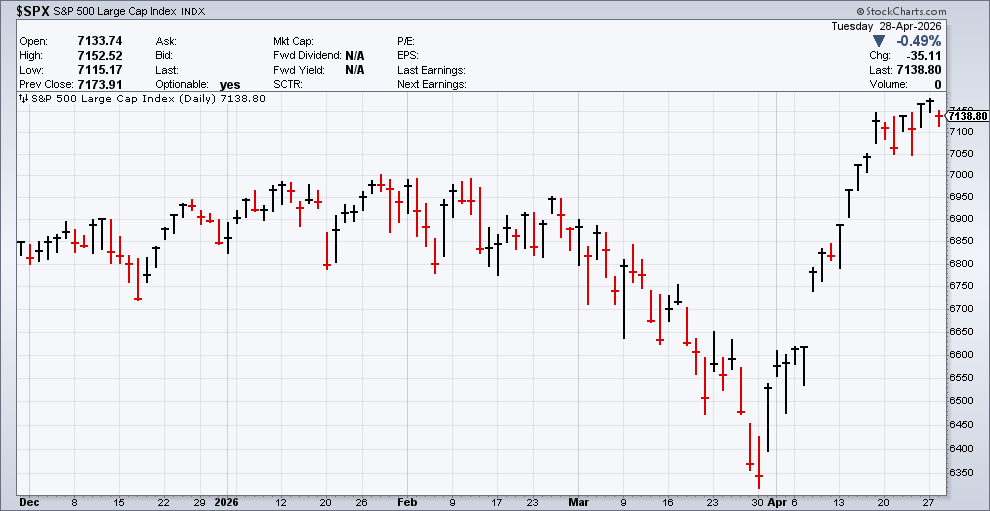
The stock market has vaulted forward despite uncertain geopolitical events and growing problems with certain parts of the economy.
Are investors being foolish or are there solid fundamental reasons that justify higher equity prices?
Some market watchers are calling this a bubble. I think that’s very premature, although it could be true regarding certain tech stocks. If we were to go back to the start of 2022 and adjust the market’s gains for inflation, then the market has done decently well, but nothing out of the ordinary.
On Tuesday, we finally got a reversal of the previous trend. By that, I mean that the Nasdaq fell close to 1% while the Dow 30 was nearly flat. Gold and silver also did poorly on Tuesday.
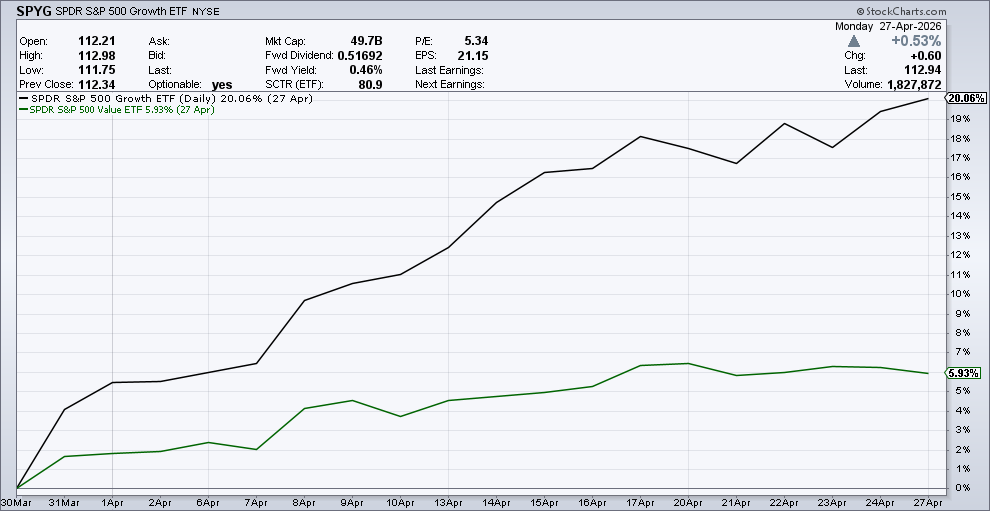
I have been surprised by how strong growth stocks have been in the recent rally compared with value. Normally growth stocks lead during up markets, but I’m impressed by how wide the gap has been. Also, prior to the recent rally, value stocks had been holding up well compared with growth. That all got washed away in less than one month.
Here’s a look at how the S&P 500 Growth ETF (in black) has performed versus the S&P 500 Value ETF (green):
The oil market was shocked today by the UAE saying it’s withdrawing from OPEC. The country has consistently pushed for higher production quotas. Iran is expected to submit a revised peace proposal. President Trump rejected an earlier proposal.
The Federal Reserve meets again this week. The policy statement will be released tomorrow afternoon. I’ll spoil the ending for you: the Fed won’t be making any changes to interest rates.
But the Fed still may generate some news. That’s because the central bank finds itself in a difficult spot. Thanks to higher energy prices, Americans are suffering from higher inflation. At the same time, the broader economy could be slowing down. To be very blunt, the U.S. economy may need higher and lower rates at the same time. Since the Fed can’t possibly deliver that, I expect rates to stay the same for some time. Futures traders don’t see the Fed touching interest until the end of the next year.
Bear in mind that the recent consumer confidence report was the lowest on record. The April jobs report won’t be out until Friday, May 8, and it may not be a good one. The jobs report for March was surprisingly good (+178,000). In fact, I wouldn’t be surprised to see that get revised lower.
What really caught my attention was the weak growth for average hourly earnings which rose only 0.2% for March. If problems show up in the economy, this is likely where we’ll see the pain first.
A Strong Earnings Season So far
Wall Street is currently digesting Q1 earnings. So far, it’s been a pretty good earnings season. The S&P 500 is currently on pace to report its sixth quarter in a row of double-digit earnings growth. (The following data is courtesy our friends at FactSet.)
This week, 180 stocks in the S&P 500 are due to report, along with 11 stocks in the Dow, and five of the Mag 7.
By the way, of the Mag 7 stocks, Wall Street desperately wants to hear how much they plan to invest in AI. In January, Microsoft, Google, Amazon and Meta said they’re aiming to spending $650 billion on AI this year. Wall Street wants to hear an update.
So far, 28% of companies in the S&P 500 have reported Q1 earnings. Of those, 84% have beaten Wall Street’s expectations. That’s well above the long-term average. (That’s right. On Wall Street, it’s expected that you beat expectations.)
Companies are also beating expectations by a larger-than-normal margin. Average earnings beats are coming in at 12.3% above consensus. That’s nearly twice the long-term average.
Earnings growth for Q1 is currently tracking at 15.1%. Actually, that number has steadily increased as we’ve seen better reports come out.
Quarterly revenue growth has been particularly strong. So far, 81% of companies have beaten their estimates for sales growth. The five-year average is at 70%. All told, companies are beating their sales consensus by 2%. For Q1, sales growth is currently tracking at 10.3%. Like earnings, that number has also trended higher. If that number holds, it will mark the best quarter for revenue growth since Q3 of 2022.
Wall Street expects very good earnings growth for this year. For 2026, expectations are currently running at 18.6%. For the remaining three quarters, the expectations are for Q2 at 20.6%, Q3 at 22.7% and Q4 at 20.4%. The forward P/E Ratio for the S&P 500 is currently at 20.9%. That’s high, but it’s not excessive.
As I look at these earnings reports, I’ve been especially impressed by the profit margin. Wide and rising operating margins are a quick and easy way to see if a company is doing well. For Q1, the market’s overall net profit margin is running at 13.4%. If that holds up, it will be highest one in FactSet’s record which goes back to 2009.
As impressive as these numbers are, Wall Street expects even better numbers this year. The current estimate for net margin is 14.1% for Q2, 14.6% for Q3 and 14.6% for Q4.
Looking at Church & Dwight
One of our former Buy List stocks, Church & Dwight (CHD) has not been performing well. I like to take notice when good companies have bad stocks. That’s often a good place to find a bargain.
Church & Dwight is your quintessential consumer staple. It tends to do well when the economy is suffering. A little more than a year ago, CHD got as high as $116 per share. Even though the market has rallied since then, shares of CHD are now trading around $96 per share. It even recently dipped below $92 per share.
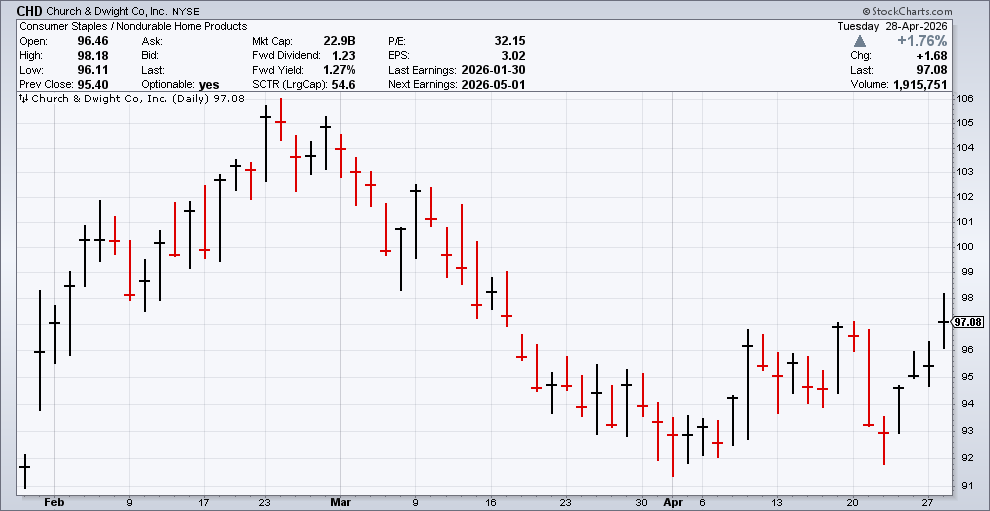
Despite this, Church & Dwight’s business has remained strong. Is it really a good idea to make a long-term bet against a company that makes Arm & Hammer baking soda and Trojan condoms? Church Dwight has about 5,000 employees and it generates about $5 billion to $6 billion in sales each year. The company also makes laundry detergent, cat litter, toothpaste, deodorant, and OxiClean.
The company has beaten Wall Street’s earnings estimates for the last 12 quarters in a row. For this year, Wall Street expects earnings of $3.75 per share, and $4 per share for 2027.
Church Dwight recently raised its dividend by 4.2%. This was it 30th yearly increase in a row. In January, the company said it expects to grow earnings this year by 5% to 8%, which works out to 2026 earnings of $3.70 to $3.81 per share.
I also like that CHD has gradually exited slower-growing lower-margin businesses. That caused sales to decline, but it’s in the interest of the company over the long term. CHD also faces tariff issues as some of its products are outsourced to China.
CHD’s Q1 earnings report is due out on Friday, May 1.
That’s all for now. Stayed tuned for tomorrow’s policy statement from the Federal Reserve. I’ll have more for you in the next issue of CWS Market Review.
– Eddy
Posted by Eddy Elfenbein on April 28th, 2026 at 6:02 pm
The information in this blog post represents my own opinions and does not contain a recommendation for any particular security or investment. I or my affiliates may hold positions or other interests in securities mentioned in the Blog, please see my Disclaimer page for my full disclaimer.
-
Archives
- October 2026
- September 2026
- August 2026
- July 2026
- June 2026
- May 2026
- April 2026
- March 2026
- February 2026
- January 2026
- December 2025
- November 2025
- October 2025
- September 2025
- August 2025
- July 2025
- June 2025
- May 2025
- April 2025
- March 2025
- February 2025
- January 2025
- December 2024
- November 2024
- October 2024
- September 2024
- August 2024
- July 2024
- June 2024
- May 2024
- April 2024
- March 2024
- February 2024
- January 2024
- December 2023
- November 2023
- October 2023
- September 2023
- August 2023
- July 2023
- June 2023
- May 2023
- April 2023
- March 2023
- February 2023
- January 2023
- December 2022
- November 2022
- October 2022
- September 2022
- August 2022
- July 2022
- June 2022
- May 2022
- April 2022
- March 2022
- February 2022
- January 2022
- December 2021
- November 2021
- October 2021
- September 2021
- August 2021
- July 2021
- June 2021
- May 2021
- April 2021
- March 2021
- February 2021
- January 2021
- December 2020
- November 2020
- October 2020
- September 2020
- August 2020
- July 2020
- June 2020
- May 2020
- April 2020
- March 2020
- February 2020
- January 2020
- December 2019
- November 2019
- October 2019
- September 2019
- August 2019
- July 2019
- June 2019
- May 2019
- April 2019
- March 2019
- February 2019
- January 2019
- December 2018
- November 2018
- October 2018
- September 2018
- August 2018
- July 2018
- June 2018
- May 2018
- April 2018
- March 2018
- February 2018
- January 2018
- December 2017
- November 2017
- October 2017
- September 2017
- August 2017
- July 2017
- June 2017
- May 2017
- April 2017
- March 2017
- February 2017
- January 2017
- December 2016
- November 2016
- October 2016
- September 2016
- August 2016
- July 2016
- June 2016
- May 2016
- April 2016
- March 2016
- February 2016
- January 2016
- December 2015
- November 2015
- October 2015
- September 2015
- August 2015
- July 2015
- June 2015
- May 2015
- April 2015
- March 2015
- February 2015
- January 2015
- December 2014
- November 2014
- October 2014
- September 2014
- August 2014
- July 2014
- June 2014
- May 2014
- April 2014
- March 2014
- February 2014
- January 2014
- December 2013
- November 2013
- October 2013
- September 2013
- August 2013
- July 2013
- June 2013
- May 2013
- April 2013
- March 2013
- February 2013
- January 2013
- December 2012
- November 2012
- October 2012
- September 2012
- August 2012
- July 2012
- June 2012
- May 2012
- April 2012
- March 2012
- February 2012
- January 2012
- December 2011
- November 2011
- October 2011
- September 2011
- August 2011
- July 2011
- June 2011
- May 2011
- April 2011
- March 2011
- February 2011
- January 2011
- December 2010
- November 2010
- October 2010
- September 2010
- August 2010
- July 2010
- June 2010
- May 2010
- April 2010
- March 2010
- February 2010
- January 2010
- December 2009
- November 2009
- October 2009
- September 2009
- August 2009
- July 2009
- June 2009
- May 2009
- April 2009
- March 2009
- February 2009
- January 2009
- December 2008
- November 2008
- October 2008
- September 2008
- August 2008
- July 2008
- June 2008
- May 2008
- April 2008
- March 2008
- February 2008
- January 2008
- December 2007
- November 2007
- October 2007
- September 2007
- August 2007
- July 2007
- June 2007
- May 2007
- April 2007
- March 2007
- February 2007
- January 2007
- December 2006
- November 2006
- October 2006
- September 2006
- August 2006
- July 2006
- June 2006
- May 2006
- April 2006
- March 2006
- February 2006
- January 2006
- December 2005
- November 2005
- October 2005
- September 2005
- August 2005
- July 2005
 Eddy Elfenbein is a Washington, DC-based speaker, portfolio manager and editor of the blog Crossing Wall Street. His