CWS Market Review – May 5, 2026
(This is the free version of CWS Market Review. If you like what you see, then please sign up for the premium newsletter for $20 per month or $200 for the whole year. If you sign up today, you can see our two reports, “Your Handy Guide to Stock Orders” and “How Not to Get Screwed on Your Mortgage.”)
The old Wall Street adage tells us to “sell in May, and go away, don’t come back till St. Leger Day.” There’s a bit of truth to this statement. Wall Street hasn’t performed well over the half of the year from May through October.
I crunched all the Dow’s data going back to 1896. From May 6 to October 29, the Dow has posted an average gain of 0.86%. For the rest of the time, the Dow has gained an average of 7.16%. That’s remarkable. Essentially, 90% of the stock market’s gain has only come during half the year.
Here’s what the average year looks like for the Dow:
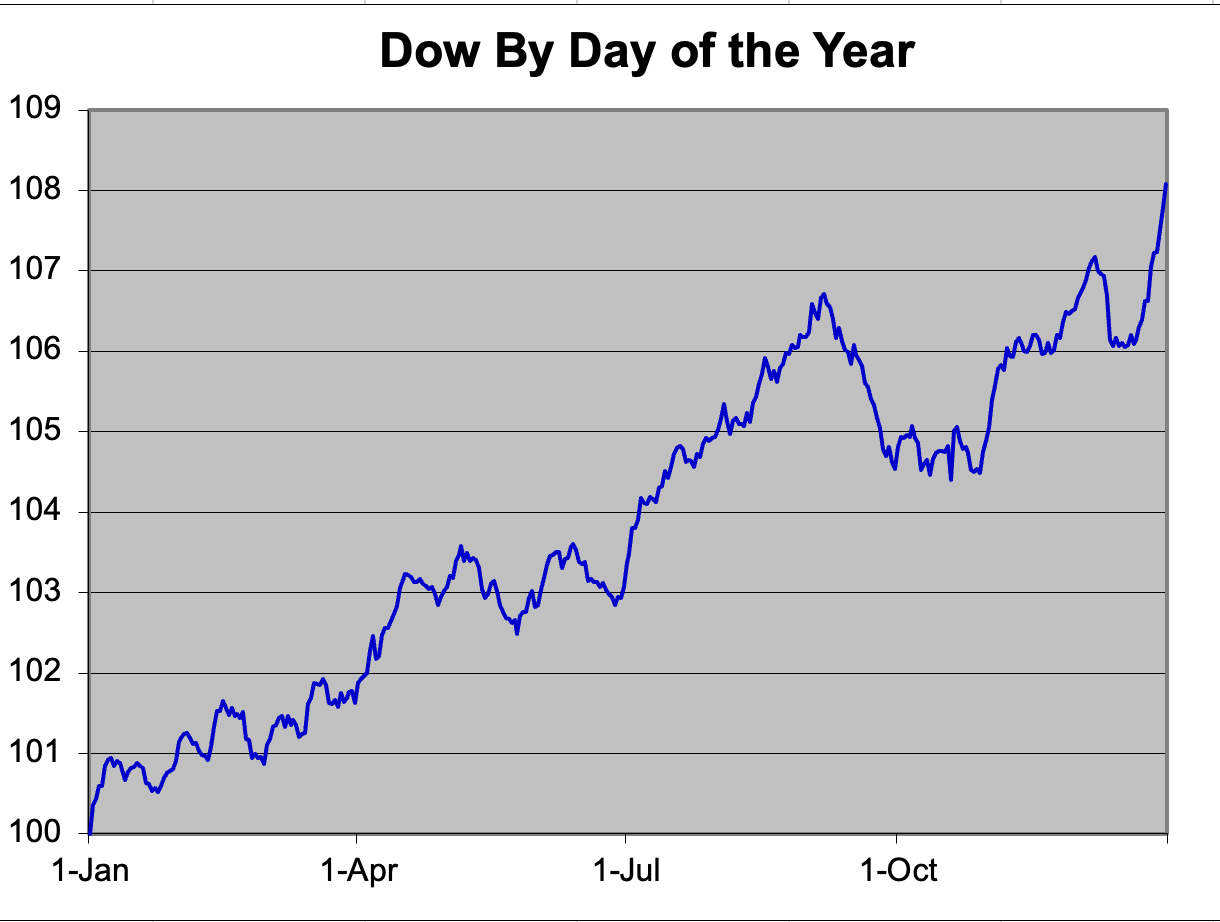
To be sure, I certainly don’t advocate for any trading strategy based on this data. It’s wholly impractical. I simply think it’s fascinating that over the long term, the market has showed some calendar biases. This shouldn’t be too surprising.
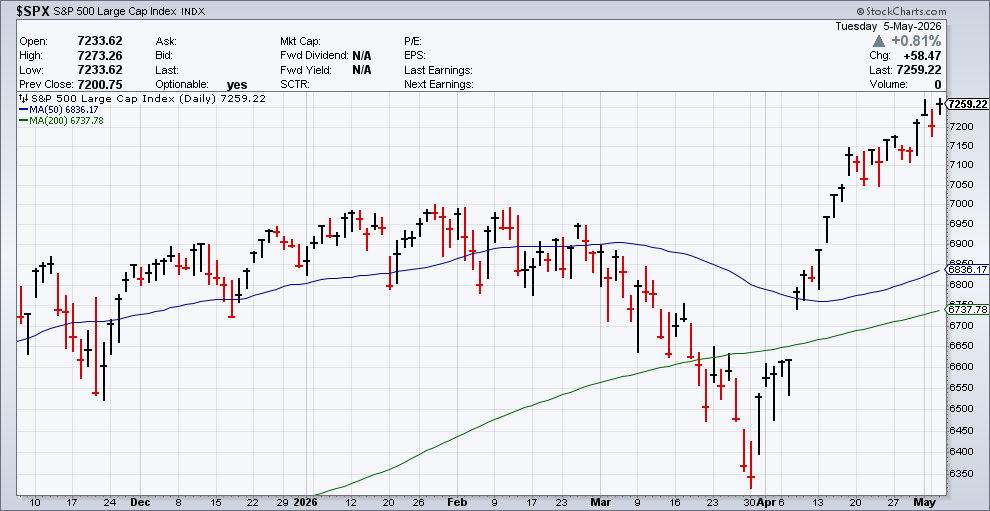
Wall Street just finished off a very successful April. This was the single best month for stocks in over five years. The S&P 500 gained more than 10%, and the Nasdaq Composite was up over 15%. The tech-heavy index has been on a very impressive run.
On Tuesday, the S&P 500 closed at yet another all-time high. It’s especially welcoming to see these gains come during earnings season.
Another Strong Earnings Season
We’re already nearly two-thirds of the way through earnings season, and Q1 is has turned out to be a very good time for Wall Street. Another 128 stocks are due to report earnings this week. So far, 63% of stocks in the S&P 500 have reported earnings, and of those, 84% have beaten estimates. If that holds up, it will be our best “beat rate” in five years.
Overall, 63% of the companies in the S&P 500 have reported actual results for Q1 2026 to date. Of these companies, 84% have reported actual EPS above estimates.
Not only are more companies beating expectations but they’re beating by larger margins as well. For this earnings season, companies have, on average, topped expectations by more than 20%. That’s nearly three times the five-year average.
Meta beat estimates by 56%. Amazon beat by 70% and Alphabet beat by 90%. Thanks to the Mag 7, earnings growth for Q1 is now running at 27%. To put that in perspective, at the end of Q1, Wall Street was expecting Q1 earnings growth of 13%. The S&P 500 is on pace for its sixth quarter in a row of double-digit earnings growth.
Looking at revenues, 81% of the companies in the S&P 500 have topped their revenue estimates. If that rate holds, then it will be the best quarter for sales beats in five years. The weak spot is that companies aren’t beating top-line growth by very much. Currently, companies have exceeded sales growth forecasts by only 1.9%. That’s roughly in line with long-term estimates.
I’m pleased to see that analysts have been increasing their earnings estimates for next quarter and for the rest of this year. During April, the estimates for Q2 were increased by 2.1%. We won’t get those numbers until the summer. During April, analysts increased their full-year 2026 estimates by 3.4%. They now see earnings for the S&P 500 of $331.23 per share.
For this calendar year, Wall Street currently expects earnings growth of 21.3%. That would give the index a forward P/E Ratio of 20.9, which is high but not crazy.
Looking Forward to Friday’s Jobs Report
This Friday, we’ll get the jobs report for April. This will be an interesting one because it will be the first jobs report to reflect the full impact of Operation Epic Fury. The last report was encouraging, but it came after a long string of disappointing reports. Was March an exception or is the jobs market still slowing down?
This morning, we got the Job Openings and Labor Turnover Survey, better known as the JOLTS report. It said there are currently 6.87 million job openings in March which was basically unchanged from February. The survey said that layoffs rose while hiring improved. Also, more Americans are quitting their jobs, which is a good sign for jobs. It signals confidence that there are better jobs out there.
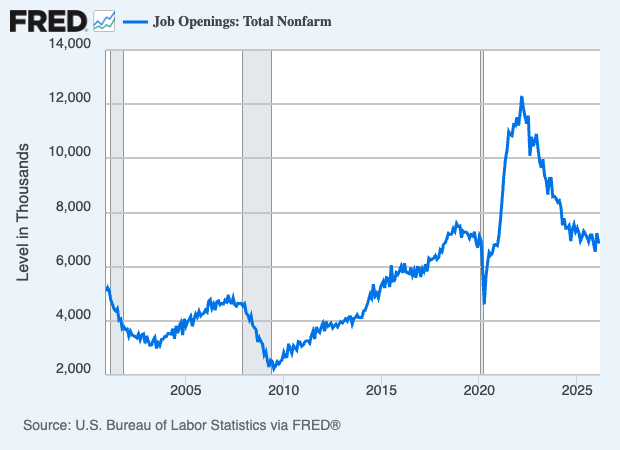
Job openings have come down more or less steadily since peaking at a record 12.3 million in March 2022 as the U.S. economy bounded back from COVID-19 lockdowns. High interest rates, a response to an outburst of inflation in 2021-2022, uncertainty over President Donald Trump’s policies, and, potentially, the disruptive impact of artificial intelligence have all discouraged robust hiring.
In March, the U.S. economy added 178,00 new jobs. For Friday, the consensus on Wall Street is that the economy added 57,000 and the unemployment rate stayed at 4.3%. For March, average hourly earnings increased by just 0.2%. That’s not so hot. This time, Wall Street is looking for an increase of 0.3%.
We’ll get a preview tomorrow when ADP releases its report on private payrolls. Wall Street expects a gain of 84,000 jobs.
Happy 130th Birthday to the DJIA
I mentioned earlier that I looked at all the Dow’s data going back to 1896. Later this month, the Dow Jones Industrial Average will celebrate its 130th birthday. The index first appeared on May 26, 1896. Its closing value that day was 40.94. To give you an idea of how long the Dow has been around, its birth is closer to the Declaration of Independence than it is to today.
The index was the brainchild of Charles Dow, who was the editor of the Wall Street Journal. When the index started, it only had 12 stocks. The list grew to 20 stocks in 1916, and it reached its present total of 30 stocks in 1928.
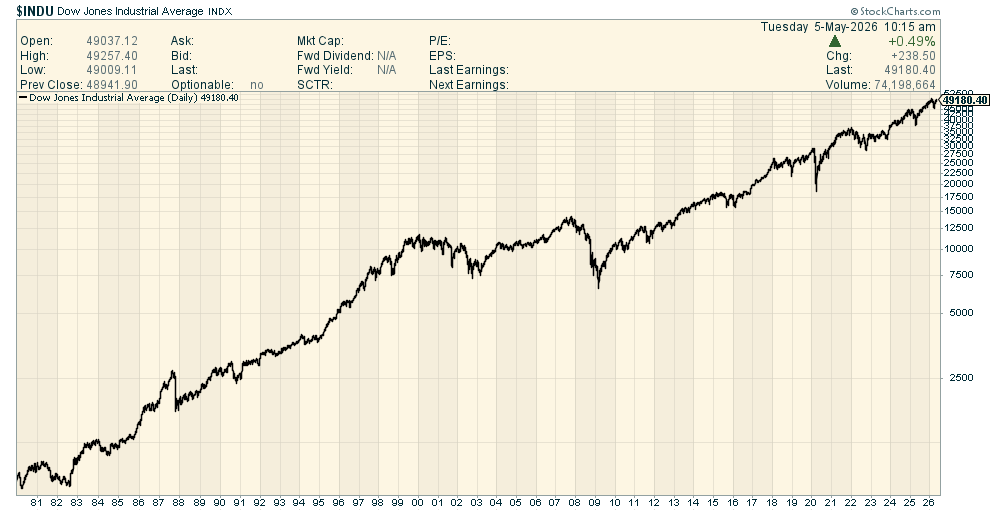
The index has only changed 59 times over the last 130 years. That’s an enviably low turnover rate. In fact, the Dow has had two separate streaks of going 17 years without a single change—once from 1939 to 1956, and again from 1959 to 1976.
Until a few years ago, General Electric was the only one of the original 12 from 1896 left in the index, but GE was removed eight years ago. Although it was on the first list, GE was added and a deleted a few times before it was added for a long time in 1907.
A few stocks have been long-time members.
ExxonMobil or Standard Oil of New Jersey (XOM) had been a member since 1928 before it was dropped in 2020. Procter & Gamble (PG) is still in after being added in 1932. Coca-Cola (KO) has been a member continuously since 1987. International Business Machines (IBM) has been in since 1979 after being given the boot in 1939.
The lesson for investors here is how quickly things change. Anyone remember Johns Manville? It was in the Dow for over 50 years.
The reason I bring up the Dow’s history is because therein lies a good investing lesson. The keepers of the index decided to kick out IBM in 1939, only to change their minds 40 years later and bring it back. Over those 40 years, shares of IBM soared 22,000%.
I can’t hide my feelings. I think the Dow is a lousy index. I rarely refer to it here. The reason is that it’s just 30 stocks, and the index is weighted by price instead of by market value. McDonald’s has a greater weighting in the index than Apple even though the latter has 20 times the market value. Perhaps that made sense 80 years ago, but it’s not needed today. The only reason the Dow is still in the news is because the index is owned by the Wall Street Journal.
Also, the Dow hasn’t been a continuous index since 1896. Wall Street shut it down in 1914 with the outbreak of World War I. In 1916, the Dow folks started a new index and later backdated it to 1914.
As a result, the new index is not continuous with the previous index. You’ll often see December 12, 1914, listed as one of the worst days in market history. It’s not. They’re comparing two different indexes.
Still, I have to give credit to Charles Dow for starting the index. In the last 100 years, the index is up 350-fold (not including inflation and dividends). Anything that’s still quoted 130 years later deserves a tip of my cap.
Here’s to 130 more!
That’s all for now. Stayed tuned for Friday’s jobs report. I’ll have more for you in the next issue of CWS Market Review.
– Eddy
Posted by Eddy Elfenbein on May 5th, 2026 at 6:05 pm
The information in this blog post represents my own opinions and does not contain a recommendation for any particular security or investment. I or my affiliates may hold positions or other interests in securities mentioned in the Blog, please see my Disclaimer page for my full disclaimer.
-
Archives
- October 2026
- September 2026
- August 2026
- July 2026
- June 2026
- May 2026
- April 2026
- March 2026
- February 2026
- January 2026
- December 2025
- November 2025
- October 2025
- September 2025
- August 2025
- July 2025
- June 2025
- May 2025
- April 2025
- March 2025
- February 2025
- January 2025
- December 2024
- November 2024
- October 2024
- September 2024
- August 2024
- July 2024
- June 2024
- May 2024
- April 2024
- March 2024
- February 2024
- January 2024
- December 2023
- November 2023
- October 2023
- September 2023
- August 2023
- July 2023
- June 2023
- May 2023
- April 2023
- March 2023
- February 2023
- January 2023
- December 2022
- November 2022
- October 2022
- September 2022
- August 2022
- July 2022
- June 2022
- May 2022
- April 2022
- March 2022
- February 2022
- January 2022
- December 2021
- November 2021
- October 2021
- September 2021
- August 2021
- July 2021
- June 2021
- May 2021
- April 2021
- March 2021
- February 2021
- January 2021
- December 2020
- November 2020
- October 2020
- September 2020
- August 2020
- July 2020
- June 2020
- May 2020
- April 2020
- March 2020
- February 2020
- January 2020
- December 2019
- November 2019
- October 2019
- September 2019
- August 2019
- July 2019
- June 2019
- May 2019
- April 2019
- March 2019
- February 2019
- January 2019
- December 2018
- November 2018
- October 2018
- September 2018
- August 2018
- July 2018
- June 2018
- May 2018
- April 2018
- March 2018
- February 2018
- January 2018
- December 2017
- November 2017
- October 2017
- September 2017
- August 2017
- July 2017
- June 2017
- May 2017
- April 2017
- March 2017
- February 2017
- January 2017
- December 2016
- November 2016
- October 2016
- September 2016
- August 2016
- July 2016
- June 2016
- May 2016
- April 2016
- March 2016
- February 2016
- January 2016
- December 2015
- November 2015
- October 2015
- September 2015
- August 2015
- July 2015
- June 2015
- May 2015
- April 2015
- March 2015
- February 2015
- January 2015
- December 2014
- November 2014
- October 2014
- September 2014
- August 2014
- July 2014
- June 2014
- May 2014
- April 2014
- March 2014
- February 2014
- January 2014
- December 2013
- November 2013
- October 2013
- September 2013
- August 2013
- July 2013
- June 2013
- May 2013
- April 2013
- March 2013
- February 2013
- January 2013
- December 2012
- November 2012
- October 2012
- September 2012
- August 2012
- July 2012
- June 2012
- May 2012
- April 2012
- March 2012
- February 2012
- January 2012
- December 2011
- November 2011
- October 2011
- September 2011
- August 2011
- July 2011
- June 2011
- May 2011
- April 2011
- March 2011
- February 2011
- January 2011
- December 2010
- November 2010
- October 2010
- September 2010
- August 2010
- July 2010
- June 2010
- May 2010
- April 2010
- March 2010
- February 2010
- January 2010
- December 2009
- November 2009
- October 2009
- September 2009
- August 2009
- July 2009
- June 2009
- May 2009
- April 2009
- March 2009
- February 2009
- January 2009
- December 2008
- November 2008
- October 2008
- September 2008
- August 2008
- July 2008
- June 2008
- May 2008
- April 2008
- March 2008
- February 2008
- January 2008
- December 2007
- November 2007
- October 2007
- September 2007
- August 2007
- July 2007
- June 2007
- May 2007
- April 2007
- March 2007
- February 2007
- January 2007
- December 2006
- November 2006
- October 2006
- September 2006
- August 2006
- July 2006
- June 2006
- May 2006
- April 2006
- March 2006
- February 2006
- January 2006
- December 2005
- November 2005
- October 2005
- September 2005
- August 2005
- July 2005
 Eddy Elfenbein is a Washington, DC-based speaker, portfolio manager and editor of the blog Crossing Wall Street. His