CWS Market Review – July 7, 2026
(This is the free version of CWS Market Review. If you like what you see, then please sign up for the premium newsletter for $20 per month or $200 for the whole year. If you sign up today, you can see our two reports, “Your Handy Guide to Stock Orders” and “How Not to Get Screwed on Your Mortgage.”)
We’re at an odd moment for the financial markets. Not much is going on right now, but soon, a lot will be going on. Last week, we got the June jobs report, and there’s still some fallout after it because the report was not very encouraging.
Apparently, the “no-hire, no fire” economy appears to be still at work. One of the odd aspects of this economy is that the unemployment rate is only at 4.2%. That’s quite low. In normal times, that would be celebrated. Not now.
Last month, the U.S. economy created half the number of jobs expected. The jobs report was probably enough for the Fed to delay, but not cancel, its plans for an interest-rate hike.
We’ll get the minutes of the last Fed meeting tomorrow. This was the first one under the stewardship of new Fed chairman Kevin Warsh. He’s already streamlined the Fed’s policy statements.
Where are we as far as the stock market goes? For the last six months, the stock market has been mostly flat except for two short and brief selloffs. There could be a third waiting in the wings. As we know, the market loves to “retest” levels of previous support. So far, the bulls have been willing to push back on any drop, but I wonder how long that can last. The headlines may soon change.
We won’t get the CPI report until next week, but I imagine that the falling price for oil will also help push back its plans for a rate hike. Not that long ago, the price for oil was creeping up to $120 per barrel. Lately, it’s been less than $75 per barrel.
The S&P 500 market pulled back again today but it’s still above its 50-day moving average, and it’s not far from another all-time high. Yesterday, the Dow closed at a new all-time high. The two indexes have diverged in recent weeks. Since the middle of May, the Dow is up 6.5% while the S&P 500 is up just 0.8%.
Since the start of June, the Nasdaq Composite had performed worse than both the Dow and the S&P 500. This is probably due to the market having taken a more defensive posture. Value stocks have also outperformed since the start of June. It’s been a long time since value stocks were hot.
Value had a nice run in 2022. Outside that, value has had a rough time of it over the last 20 years.
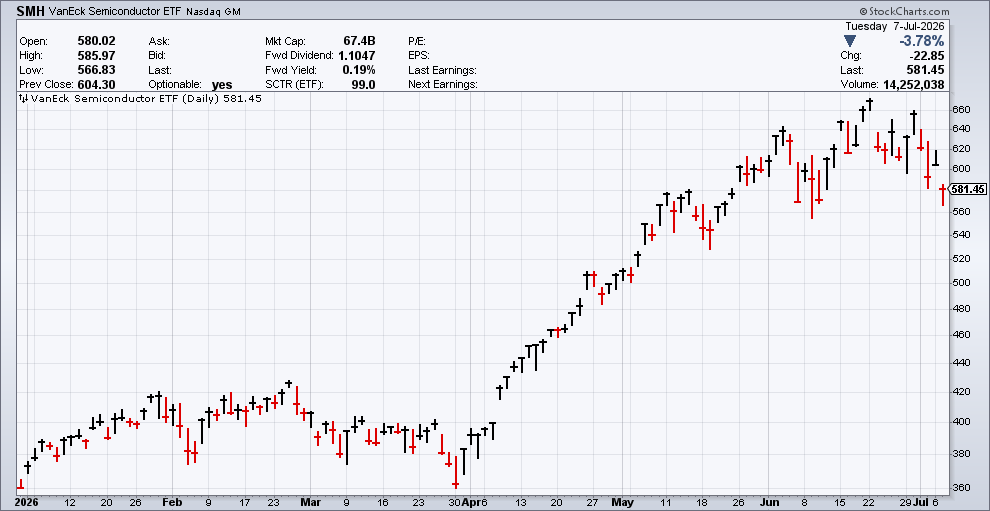
Chip stocks have performed especially poorly in the last few days. Intel (INTC) fell nearly 10% today. The ETF to follow for this sector is the aptly named VanEck Semiconductor ETF (SMH). Don’t feel too bad about the semiconductor stocks. In the last 15 months, SMH has more than tripled.
In today’s trading, utilities and REITs both did better than the overall market. The desire for higher yielding stocks dovetails with the Fed’s desire to hold off raising interest rates. It’s hard to make a case that we need to raise interest rates as jobs are growing and oil prices are falling. The futures market currently sees one rate hike coming by Halloween.
The Best-Performing Stock of All-Time
I recently got Meb Faber’s new book, Investing in America: The Rise of a 250-Year Bull Market. I love market history, so it’s no secret that I really enjoyed Meb’s book. I highly recommend it. Here’s a brief snippet I thought you might enjoy on the best-performing stock of all time.
What is the best-performing stock of all time?
Hank Bessembinder, who authored the famous academic paper, “Do stocks outperform treasury bills?” found the answer in his paper “Which US stocks generated the highest long-term returns?”
Eighty stocks had returns of over 500,000% in their lifetime, but only one had a total percentage gain of 265,528,901%. If you had invested $1,000 in the stock in 1925, it would be worth over $25 billion by the end of 2023. What was it?
Some may guess Berkshire Hathaway (BRK-B), but that was only a 792,053% return. Microsoft (MSFT) offered up a paltry 622,498%.
No, the actual winner was Altria (MO)!
Most people probably assume that the best performing stock returned something like 30% or 50% per year. Only six stocks out of the top 100 had returns of over 20% per year. In fact, most of the best performing stocks had returns in the mid-teens. That’s not shabby, of course, and it’s better than the broad index, but not like the eye-popping returns you seeing being advertised on Instagram.
The key is just that they did it for a very long time. The challenge with holding these winners is the path. If you held one of the best performing stocks over the past years, chances are it had a 70% or 80% or even 90% draw down. Could you sit through it?
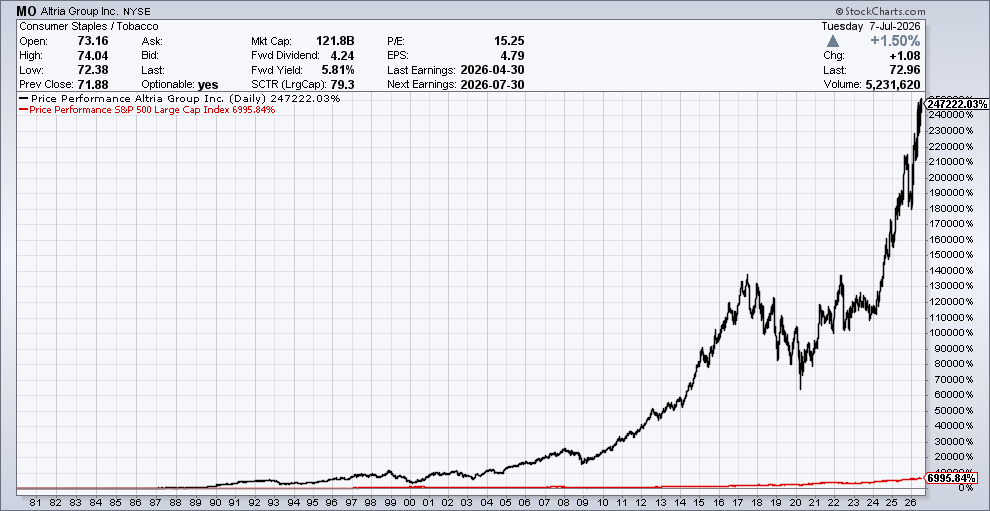
Here’s how Altria has done since 1980. See that flat red line? That’s actually a 7,000% gain for the S&P 500. Only compared with Altria does it look like nothing.
I remember reading once about a stock (I think it was EMC) that a man owned. He sold his position without realizing that the stock had split. As a result, he still had a few thousand shares left. The stock took off. It gained something like 75,000% in the 1990s. He was informed that he had acquired a nice fortune in EMC.
(Update: I found a link to the story. I wasn’t dreaming it.)
The obvious question is, was he better off not knowing? I think many people would have sold out their position long before. Investing is one of the few pursuits where not doing anything can be a big advantage.
That’s all for now. Short issue this week, but that won’t last. Next Tuesday, July 14, we’ll get the CPI report for June. It will also be the unofficial kick off for Q2 earnings season. I’ll have more for you in the next issue of CWS Market Review.
– Eddy
Posted by Eddy Elfenbein on July 7th, 2026 at 5:44 pm
The information in this blog post represents my own opinions and does not contain a recommendation for any particular security or investment. I or my affiliates may hold positions or other interests in securities mentioned in the Blog, please see my Disclaimer page for my full disclaimer.
-
Archives
- October 2026
- September 2026
- August 2026
- July 2026
- June 2026
- May 2026
- April 2026
- March 2026
- February 2026
- January 2026
- December 2025
- November 2025
- October 2025
- September 2025
- August 2025
- July 2025
- June 2025
- May 2025
- April 2025
- March 2025
- February 2025
- January 2025
- December 2024
- November 2024
- October 2024
- September 2024
- August 2024
- July 2024
- June 2024
- May 2024
- April 2024
- March 2024
- February 2024
- January 2024
- December 2023
- November 2023
- October 2023
- September 2023
- August 2023
- July 2023
- June 2023
- May 2023
- April 2023
- March 2023
- February 2023
- January 2023
- December 2022
- November 2022
- October 2022
- September 2022
- August 2022
- July 2022
- June 2022
- May 2022
- April 2022
- March 2022
- February 2022
- January 2022
- December 2021
- November 2021
- October 2021
- September 2021
- August 2021
- July 2021
- June 2021
- May 2021
- April 2021
- March 2021
- February 2021
- January 2021
- December 2020
- November 2020
- October 2020
- September 2020
- August 2020
- July 2020
- June 2020
- May 2020
- April 2020
- March 2020
- February 2020
- January 2020
- December 2019
- November 2019
- October 2019
- September 2019
- August 2019
- July 2019
- June 2019
- May 2019
- April 2019
- March 2019
- February 2019
- January 2019
- December 2018
- November 2018
- October 2018
- September 2018
- August 2018
- July 2018
- June 2018
- May 2018
- April 2018
- March 2018
- February 2018
- January 2018
- December 2017
- November 2017
- October 2017
- September 2017
- August 2017
- July 2017
- June 2017
- May 2017
- April 2017
- March 2017
- February 2017
- January 2017
- December 2016
- November 2016
- October 2016
- September 2016
- August 2016
- July 2016
- June 2016
- May 2016
- April 2016
- March 2016
- February 2016
- January 2016
- December 2015
- November 2015
- October 2015
- September 2015
- August 2015
- July 2015
- June 2015
- May 2015
- April 2015
- March 2015
- February 2015
- January 2015
- December 2014
- November 2014
- October 2014
- September 2014
- August 2014
- July 2014
- June 2014
- May 2014
- April 2014
- March 2014
- February 2014
- January 2014
- December 2013
- November 2013
- October 2013
- September 2013
- August 2013
- July 2013
- June 2013
- May 2013
- April 2013
- March 2013
- February 2013
- January 2013
- December 2012
- November 2012
- October 2012
- September 2012
- August 2012
- July 2012
- June 2012
- May 2012
- April 2012
- March 2012
- February 2012
- January 2012
- December 2011
- November 2011
- October 2011
- September 2011
- August 2011
- July 2011
- June 2011
- May 2011
- April 2011
- March 2011
- February 2011
- January 2011
- December 2010
- November 2010
- October 2010
- September 2010
- August 2010
- July 2010
- June 2010
- May 2010
- April 2010
- March 2010
- February 2010
- January 2010
- December 2009
- November 2009
- October 2009
- September 2009
- August 2009
- July 2009
- June 2009
- May 2009
- April 2009
- March 2009
- February 2009
- January 2009
- December 2008
- November 2008
- October 2008
- September 2008
- August 2008
- July 2008
- June 2008
- May 2008
- April 2008
- March 2008
- February 2008
- January 2008
- December 2007
- November 2007
- October 2007
- September 2007
- August 2007
- July 2007
- June 2007
- May 2007
- April 2007
- March 2007
- February 2007
- January 2007
- December 2006
- November 2006
- October 2006
- September 2006
- August 2006
- July 2006
- June 2006
- May 2006
- April 2006
- March 2006
- February 2006
- January 2006
- December 2005
- November 2005
- October 2005
- September 2005
- August 2005
- July 2005
 Eddy Elfenbein is a Washington, DC-based speaker, portfolio manager and editor of the blog Crossing Wall Street. His