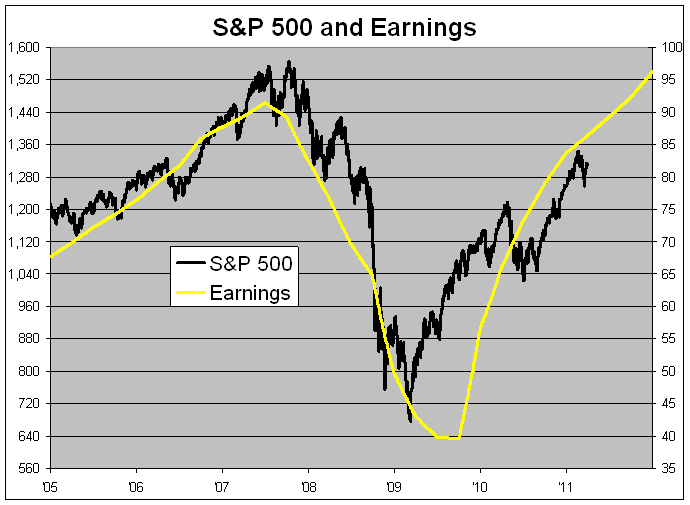
Thanks to the mini-pullback following the Japanese earthquake, the S&P 500 hit a closing low of 1,256.88 on March 16th, which is a P/E Ratio of 14.62.
In the chart below, the S&P 500 and its earnings are scaled at a ratio of 16-to-1 since 16 seems to be the best value for a long-term earnings multiple. We actually haven’t been as high as 16 since last May.
For 2010, the S&P 500’s earnings were $83.76 which was a 47% increase over 2009. For 2011, Wall Street’s current consensus is for earnings of $96.23. With a P/E Ratio of 16, that gives us a year-end possible target of 1,539.28. That’s a 17.5% rally from yesterday’s close.
Here’s a look at the yen’s impact on the stock market. More correctly, I should say this is a look at how the yen is correlated with the U.S. stock market.
I looked at all the daily market activity from 1989 through 2010 and then I annualized what the stock market did on days when the yen rose against the dollar and on days when it fell against the dollar. The results are below.
As you might expect, the movement of the currencies has the least impact on domestic-oriented sectors like staples and healthcare, but it has a big impact on areas like tech and finance.
The latest Case-Shiller numbers came out this morning. This is a home-price index. There’s a bit of a lag in these numbers, so today’s report covers January.
The bottom line is that home prices aren’t doing much of anything. In fact, they’re backsliding some. Below are the seasonally-adjusted numbers for the Case-Shiller’s 10 City Index and for their 20 City Index. The 10-City numbers go back to 1987. Both indexes have declined for the last seven months in a row.
The 10-City Index is currently just 2.2% above its recent low from May 2009. The 20-City Index is less than 1% above its level from that same month.
Both indexes peaked in April 2006 and both are currently down 31% since then.
It’s odd, but I remember when folks thought the home price decline of the early 90s was severe. The chart shows us that this decline was nothing compared to what was going to happen.
The stock market is up in early trading so far. It seems like a fairly quiet day on Wall Street. One of our Buy List stocks, Jos. A Bank Clothiers ($JOSB), is doing quite well and is at a new 52-week high. JOSB is a 20% winner for us on the year so far.
Reynolds American ($RAI) is also doing well; the stock came within three pennies of hitting a new 52-week high this morning. Even with the higher share price, RAI still yields 6.2%.
We had some decent economic news this morning. Consumer spending rose 0.7% last month which was an increase from 0.3% in January. Personal income rose by 0.3% so people are saving less.
It’s still early but the S&P 500 may close today at a three-week high.
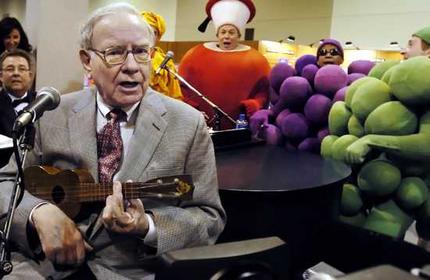
The investing guru is touring India and charming them with his folksy wisdom:
At one point, Mr. Buffett said Berkshire Hathaway kept about $10 billion in cash on hand just in case “Ben Bernanke runs off to South America with Lindsay Lohan,” a remark that of course drew laughter. “We have to be prepared for anything.”
In today’s Barron’s, Miriam Gottfried explains why Oracle ($ORCL) kicks ass:
Fourth-quarter guidance was strong with management forecasting above-consensus revenue, new software licenses and earnings for the seasonally strong close to the year. Analysts say margins could come in at peak levels of 51%—reached before the 2010 acquisition of Sun Microsystems—over the next several years as businesses continue to ramp up spending. That Sun acquisition appears to be paying off, much to the surprise of numerous skeptics, driving sales of hardware without damaging margins.
Oracle offers a squeaky clean balance sheet with $9.7 billion, or $1.87 a share, in cash. And to top it off, shares trade at a reasonable 14.5 times projected-forward earnings.
“Oracle’s engineered systems are resonating (50% sequential-Exadata growth), enterprise application spending is firmly back, and gross and operating margins continue to positively surprise,” wrote Ross MacMillan, an analyst with Jefferies & Co.
(…)
Oracle shares have historically outperformed in June as investors anticipate strong fourth-quarter results, according to Citigroup analyst Walter H. Pritchard.
“Shares trade at a 10% premium to the S&P versus a historical ceiling of 20%, leaving some room for multiple expansion,” he wrote in a note. “We’d continue to buy as we see trends as sustainable, seasonal strength on tap and headroom to valuation.”
We would follow that advice and snap up some Oracle shares on the promise of a profitable, growth-fueled future.
Eddy Elfenbein is a Washington, DC-based speaker, portfolio manager and editor of the blog Crossing Wall Street. His Buy List has beaten the S&P 500 over the last 20 years. (more)

 Eddy Elfenbein is a Washington, DC-based speaker, portfolio manager and editor of the blog Crossing Wall Street. His