Author Archive
-
The Beta Trade
Eddy Elfenbein, December 14th, 2010 at 3:27 pmWhat’s been happening continues to happen.
After today’s Fed announcement, Treasury yields spiked along the yield curve.
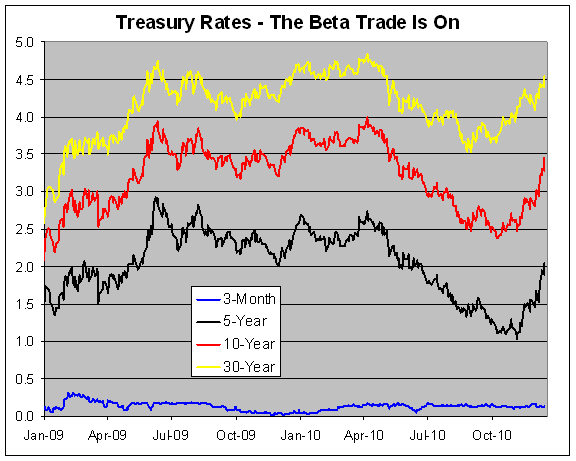
It’s almost like a wave hit the yield curve — the later maturities turned first and the process gradually moved to the shorter-term maturities.
The 30-year yield bottomed in late August at 3.53%. It’s now up more than one full percent.
Then the 10-year yield bottomed on October 8th at 2.38%. It’s up by 118 points since then.
Then the 5-year yield bottomed on November 4th at 1.03%. It’s up 102 points since then, meaning the yield has basically doubled.
This is the Beta Trade. Money is going out of bonds and into riskier assets like stocks, and cyclical stocks in particular.
Here’s a look at the three-month, five-year, ten-year and thirty-year yields over the past two years:
-
Today’s Fed Policy Statement
Eddy Elfenbein, December 14th, 2010 at 2:17 pmHere’s today’s Fed statement:
Information received since the Federal Open Market Committee met in November confirms that the economic recovery is continuing, though at a rate that has been insufficient to bring down unemployment. Household spending is increasing at a moderate pace, but remains constrained by high unemployment, modest income growth, lower housing wealth, and tight credit. Business spending on equipment and software is rising, though less rapidly than earlier in the year, while investment in nonresidential structures continues to be weak. Employers remain reluctant to add to payrolls. The housing sector continues to be depressed. Longer-term inflation expectations have remained stable, but measures of underlying inflation have continued to trend downward.
Consistent with its statutory mandate, the Committee seeks to foster maximum employment and price stability. Currently, the unemployment rate is elevated, and measures of underlying inflation are somewhat low, relative to levels that the Committee judges to be consistent, over the longer run, with its dual mandate. Although the Committee anticipates a gradual return to higher levels of resource utilization in a context of price stability, progress toward its objectives has been disappointingly slow.
To promote a stronger pace of economic recovery and to help ensure that inflation, over time, is at levels consistent with its mandate, the Committee decided today to continue expanding its holdings of securities as announced in November. The Committee will maintain its existing policy of reinvesting principal payments from its securities holdings. In addition, the Committee intends to purchase $600 billion of longer-term Treasury securities by the end of the second quarter of 2011, a pace of about $75 billion per month. The Committee will regularly review the pace of its securities purchases and the overall size of the asset-purchase program in light of incoming information and will adjust the program as needed to best foster maximum employment and price stability.
The Committee will maintain the target range for the federal funds rate at 0 to 1/4 percent and continues to anticipate that economic conditions, including low rates of resource utilization, subdued inflation trends, and stable inflation expectations, are likely to warrant exceptionally low levels for the federal funds rate for an extended period.
The Committee will continue to monitor the economic outlook and financial developments and will employ its policy tools as necessary to support the economic recovery and to help ensure that inflation, over time, is at levels consistent with its mandate.
Voting for the FOMC monetary policy action were: Ben S. Bernanke, Chairman; William C. Dudley, Vice Chairman; James Bullard; Elizabeth A. Duke; Sandra Pianalto; Sarah Bloom Raskin; Eric S. Rosengren; Daniel K. Tarullo; Kevin M. Warsh; and Janet L. Yellen.
Voting against the policy was Thomas M. Hoenig. In light of the improving economy, Mr. Hoenig was concerned that a continued high level of monetary accommodation would increase the risks of future economic and financial imbalances and, over time, would cause an increase in long-term inflation expectations that could destabilize the economy.
There’s not a single item in this statement that should be considered a surprise.
-
Bed Bath & Beyond Hits All-Time High
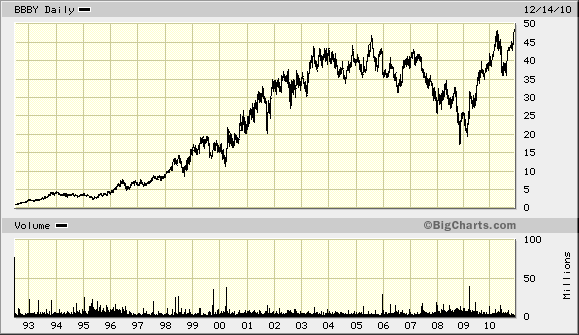
Eddy Elfenbein, December 14th, 2010 at 1:58 pmBed, Bath & Beyond (BBBY) just broke out to a new 52-week high. On April 26, the stock got as high as $48.52.
-
Noon Market Update
Eddy Elfenbein, December 14th, 2010 at 11:57 amThe market is up again today. This looks to be the ninth rally for the S&P 500 in the last ten sessions (granted, some of those “up days” were puny).
The Buy List is doing well. Both Fiserv (FISV) and Becton, Dickinson (BDX) are at new highs today.
Christopher Danely, an analyst at J.P. Morgan, has said that Intel (INTC) is in danger of missing Wall Street’s earnings estimate.
Danely writes that checks in Asia find orders from the PC food chain in November were stable with October levels, but didn’t increase. He notes that Intel had indicated it needed an uptick in November and December orders to meet its Q4 outlook; he thinks the chip maker is “tracking towards the low end of its Q4 revenue guidance.”
The analyst notes that notebook contract manufacturer shipments in November were seasonal, but below plan, with shipments flat with October, below expectations of a 2% rise. For Intel (and the notebook makers) to meet estimates, he says, the industry will need to see an above-seasonal December. Danely notes that the notebook manufacturers are forecasting a 1% sequential rise in shipments, above the seasonal average 10% decline.
Danely thinks Intel is likely to miss the $11.4 billion midpoint of guidance, and will come in flat sequentially at $11.1 billion.
-
Morning News: December 14, 2010
Eddy Elfenbein, December 14th, 2010 at 7:57 amWorld Stocks Rise, Dollar Falls Before Fed
Euro Hits 3-week High Vs. Dollar as U.S. Yields Ease
Oil Steadies Near $88.50, Eyes on U.S., China
China Says Regrets WTO Ruling on US Tire Tariff
Japanese Government to Extend Stock Tax Breaks for 2 Years
ECB’s Trichet Calls for `Maximum’ Flexibility of Region’s Rescue Fund
Bank Regulators to Tackle Capital Standards
Wellstream Brings GE Energy to $4.3 Billion in Deals
Dell Seeks More Data-storage Firms
-
Brett Favre Won’t Start
Eddy Elfenbein, December 13th, 2010 at 7:02 pmIt’s official: Brett Farve’s starting games streak will come to an end at 297.
The streak began on September 20, 1992.
To put this into context, the Friday before that game, the Dow was at 3,327.05. The 30-year Treasury was at 7.32%. The Nasdaq Composite was at 589.12. Gold was at $347.20.
Also, Jenn Sterger was eight years old.
-
The Fed’s “Mr. No”
Eddy Elfenbein, December 13th, 2010 at 6:41 pmThe New York Times profiles the Fed’s contrarian, Thomas Hoenig who is the president of the Kansas City Fed.
This is an odd time to profile Hoenig since he rotates off the FOMC at the end of the year. Tomorrow’s meeting will be his last.
This caught my eye:
By keeping interest rates too low for too long, in his view, the Fed contributed to the dot-com bubble that burst in 2001 and the even bigger housing bubble that popped in 2007.
The Nasdaq had its highest close on March 10, 2000 at 5,048.62. The index closed the year at 2,470.52, meaning the tech bubble had already popped by 51% before 2001 even began.
Tuesday’s Fed vote will be Mr. Hoenig’s last, because the presidents of the Fed’s regional banks, other than New York, share votes under a rotation system. Mr. Hoenig does not have a vote next year, and he must retire after he turns 65 in September.
As for his future, Mr. Hoenig is certain that he will not follow other Fed veterans who have gone to work on Wall Street. “I can tell you one thing,” he said. “I’ll never work for a too-big-to-fail bank.”
Um…you already do.
-
Baxter Approves Share Repurchase of $2.5 Billion
Eddy Elfenbein, December 13th, 2010 at 4:23 pmAnother Buy List stock, Baxter International (BAX), is buying back its stock:
Baxter International Inc. announced today that its Board of Directors has approved a share repurchase authorization of up to $2.5 billion of the company’s common stock.
Baxter has approximately $600 million of remaining authorization under a previous $2.0 billion share repurchase program approved in July 2009. Shares will be repurchased in the open market at times and amounts determined by the company based on its evaluation of market conditions and other factors.
“This approval is consistent with our disciplined capital allocation approach and reflects the confidence we have in our ongoing ability to generate strong cash flows and deliver increased value to our shareholders,” said Robert J. Hombach, chief financial officer.
Over the last five years, the company has returned more than $10 billion to shareholders in the form of dividends and share repurchases. Baxter has doubled its dividend rate during this period, and recently announced a 7 percent increase for 2011.
-
AFLAC Buying Dollar-Denominated Debt
Eddy Elfenbein, December 13th, 2010 at 1:17 pmBloomberg notes that AFLAC (AFL) is buying as much as $1 billion worth of corporate bonds through the end of this year:
Columbus, Georgia-based Aflac, the world’s biggest seller of supplemental health insurance, is shifting from Japanese government securities and focusing on dollar-denominated corporate debt rated A with a duration of about 10 years. Japanese government bonds due in 7 to 10 years yield about 0.99 percent, compared with 4.52 percent for A rated U.S. corporate debt.
“Given that interest rates are so low you have to look at your duration preferences,” Kriss Cloninger, president and chief financial officer of Aflac, said in an interview last week. “At the time we were placing the money, we felt the risk- reward advantage was with shorter-duration corporates as opposed to the longer-term Treasuries.”
-
The New S&P Dividend Aristocrats
Eddy Elfenbein, December 13th, 2010 at 12:01 pmHere’s the new list of the S&P 500 Dividend Aristocrats. These are stocks that have increased their dividends for 25-straight years. For the year, this index is up 17.57%.
Stocks Symbol 3M MMM AFLAC AFL Abbott Labs ABT Air Products & Chemicals APD Archer-Daniels-Midland ADM Automatic Data Processing ADP Bard, C.R. BCR Becton, Dickinson BDX Bemis BMS Brown-Forman BF/B CenturyLink CTL Chubb CB Cincinnati Financial CINF Cintas CTAS Clorox CLX Coca-Cola KO Consolidated Edison ED Dover DOV Ecolab Inc. ECL Emerson Electric EMR Exxon Mobil XOM Family Dollar Stores FDO Grainger, W.W. GWW Hormel Foods HRL Johnson & Johnson JNJ Kimberly-Clark KMB Leggett & Platt LEG Lowe’s LOW McCormick & Co. MKC McDonald’s MCD McGraw-Hill MHP PPG Industries PPG PepsiCo PEP Pitney Bowes PBI Procter & Gamble PG Sherwin-Williams SHW Sigma-Aldrich SIAL Stanley Black & Decker SWK Target TGT VF Corp VFC Wal-Mart Stores WMT Walgreen WAG
-
Archives
- July 2026
- June 2026
- May 2026
- April 2026
- March 2026
- February 2026
- January 2026
- December 2025
- November 2025
- October 2025
- September 2025
- August 2025
- July 2025
- June 2025
- May 2025
- April 2025
- March 2025
- February 2025
- January 2025
- December 2024
- November 2024
- October 2024
- September 2024
- August 2024
- July 2024
- June 2024
- May 2024
- April 2024
- March 2024
- February 2024
- January 2024
- December 2023
- November 2023
- October 2023
- September 2023
- August 2023
- July 2023
- June 2023
- May 2023
- April 2023
- March 2023
- February 2023
- January 2023
- December 2022
- November 2022
- October 2022
- September 2022
- August 2022
- July 2022
- June 2022
- May 2022
- April 2022
- March 2022
- February 2022
- January 2022
- December 2021
- November 2021
- October 2021
- September 2021
- August 2021
- July 2021
- June 2021
- May 2021
- April 2021
- March 2021
- February 2021
- January 2021
- December 2020
- November 2020
- October 2020
- September 2020
- August 2020
- July 2020
- June 2020
- May 2020
- April 2020
- March 2020
- February 2020
- January 2020
- December 2019
- November 2019
- October 2019
- September 2019
- August 2019
- July 2019
- June 2019
- May 2019
- April 2019
- March 2019
- February 2019
- January 2019
- December 2018
- November 2018
- October 2018
- September 2018
- August 2018
- July 2018
- June 2018
- May 2018
- April 2018
- March 2018
- February 2018
- January 2018
- December 2017
- November 2017
- October 2017
- September 2017
- August 2017
- July 2017
- June 2017
- May 2017
- April 2017
- March 2017
- February 2017
- January 2017
- December 2016
- November 2016
- October 2016
- September 2016
- August 2016
- July 2016
- June 2016
- May 2016
- April 2016
- March 2016
- February 2016
- January 2016
- December 2015
- November 2015
- October 2015
- September 2015
- August 2015
- July 2015
- June 2015
- May 2015
- April 2015
- March 2015
- February 2015
- January 2015
- December 2014
- November 2014
- October 2014
- September 2014
- August 2014
- July 2014
- June 2014
- May 2014
- April 2014
- March 2014
- February 2014
- January 2014
- December 2013
- November 2013
- October 2013
- September 2013
- August 2013
- July 2013
- June 2013
- May 2013
- April 2013
- March 2013
- February 2013
- January 2013
- December 2012
- November 2012
- October 2012
- September 2012
- August 2012
- July 2012
- June 2012
- May 2012
- April 2012
- March 2012
- February 2012
- January 2012
- December 2011
- November 2011
- October 2011
- September 2011
- August 2011
- July 2011
- June 2011
- May 2011
- April 2011
- March 2011
- February 2011
- January 2011
- December 2010
- November 2010
- October 2010
- September 2010
- August 2010
- July 2010
- June 2010
- May 2010
- April 2010
- March 2010
- February 2010
- January 2010
- December 2009
- November 2009
- October 2009
- September 2009
- August 2009
- July 2009
- June 2009
- May 2009
- April 2009
- March 2009
- February 2009
- January 2009
- December 2008
- November 2008
- October 2008
- September 2008
- August 2008
- July 2008
- June 2008
- May 2008
- April 2008
- March 2008
- February 2008
- January 2008
- December 2007
- November 2007
- October 2007
- September 2007
- August 2007
- July 2007
- June 2007
- May 2007
- April 2007
- March 2007
- February 2007
- January 2007
- December 2006
- November 2006
- October 2006
- September 2006
- August 2006
- July 2006
- June 2006
- May 2006
- April 2006
- March 2006
- February 2006
- January 2006
- December 2005
- November 2005
- October 2005
- September 2005
- August 2005
- July 2005
 Eddy Elfenbein is a Washington, DC-based speaker, portfolio manager and editor of the blog Crossing Wall Street. His