Author Archive
-
Morning News: June 2, 2022
Eddy Elfenbein, June 2nd, 2022 at 7:01 amTrillions at Stake in India as Women Disappear From Workforce
China Warns US Ban on Xinjiang Goods to ‘Severely Disrupt’ Ties
In Russia, No Air Bags, Costly Toilets and Old Hollywood Movies Are Sanctions Fallout
Europe’s Russian Oil Ban Could Mean a New World Order for Energy
Saudi, OPEC May Make Up for Russian Oil Output Loss as Biden Visit Looms
Economic Scorecard: Biggest Numbers May Not Be Best, for Now
Biden Says No Short-Term Fix to High Energy, Grocery Prices
Federal Reserve’s Portfolio Runoff Has Begun
SPACs Were All the Rage. Now, Not So Much.
Jamie Dimon Says U.S. Consumers Still Have Six to Nine Months of Spending Power
Gen Z Workers Want Mission-Driven Jobs. A Big Paycheck Would Be Nicer.
$5.8 Billion in Loans Will Be Forgiven for Corinthian Colleges Students
Sheryl Sandberg Is Stepping Down From Meta
Sheryl Sandberg’s Advertising Empire Leaves a Complicated Legacy
Winklevoss Twins’ Gemini Slashes Staff 10% on Crypto Slump
This Tesla-Supplying Battery Maker Has Lost Some of Its Power
When Elon Musk Dreams, His Employees Have Nightmares
Be sure to follow me on Twitter.
-
ISM Improves in May
Eddy Elfenbein, June 1st, 2022 at 11:59 amThe stock market is down again today. This could be our second down day in a row.
This morning’s ISM Manufacturing Index improved to 56.1. That’s up from 55.4 in April. Wall Street had been expecting 54.5.
Job openings fell by 455,000 in April. That’s still a huge number compared with the amount of unemployed.
The openings total declined by 455,000 from the upwardly revised March number to 11.4 million in April, about in line with the FactSet estimate, according to the bureau’s Job Openings and Labor Turnover Survey.
That left a gap of 5.46 million between openings and the available workers, still high by historical standards and reflective of a very tight labor market, but below the nearly 5.6 million difference from March. As a share of the labor force, the job openings rate fell 0.3 percentage point to 7%.
Two other news items to pass along. Janet Yellen admitted that she was wrong when she said that inflation was “transitory.”
Delta Air Lines said that business will return to pre-pandemic levels.
-
Morning News: June 1, 2022
Eddy Elfenbein, June 1st, 2022 at 7:08 amRussian Oil Producers Stay One Step Ahead of Sanctions
How the World Is Paying for Putin’s War in Ukraine
Russian Yachts and Money Are Going Where US Influence Has Waned
Seizing Russian Assets to Help Ukraine Sets Off White House Debate
The Bolsheviks to Putin: A History of Russian Defaults
President Biden, Fed Chairman Jerome Powell Meet With Inflation at Its Highest in 40 Years
Fed Starts Experiment of Letting $8.9 Trillion Portfolio Shrink
25% of Americans Are Delaying Retirement Due to Inflation, Survey Finds
Sizzling U.S. Energy Stock Rally Confronts Global Growth Worries
Americans Start Summer Travel Season Beset by Record Gas Prices
EV Sales Will Triple by 2025 and Still Need More Oomph to Reach Net Zero
Missed Payments, Rising Interest Rates Put ‘Buy Now, Pay Later’ to the Test
Forbes, Chronicler of Wealthy and Powerful, Will Scrap Plan to Go Public via SPAC
Animal-Testing Calls Threaten to Derail ‘Cruelty-Free’ Cosmetics
Movie Theaters Experiencing Popcorn, Candy Shortages Over Inflation
Be sure to follow me on Twitter.
-
CWS Market Review – May 31, 2022
Eddy Elfenbein, May 31st, 2022 at 10:37 pm(This is the free version of CWS Market Review. If you like what you see, then please sign up for the premium newsletter for $20 per month or $200 for the whole year. If you sign up today, you can see our two reports, “Your Handy Guide to Stock Orders” and “How Not to Get Screwed on Your Mortgage.”)
The Bear May Not Be Finished
Last week, the S&P 500 gained 6.6% for its best weekly gain in 18 months. That was welcome news, and it snapped a seven-week losing streak. Still, the odds are very high that this is yet another bear market rally.
Unfortunately, this recent bump comes amid a poor overall market. In fact, this year is the worst start to a year, through 100 trading days, in 52 years. It’s the second-worst start in over 82 years (the fall of France was apparently not good for stocks).
The truth is that bear market rallies are common. Investors will typically see several before the real rally begins. Is this latest rally just another head-fake? Probably, but there’s no way to be certain. In my experience, the stronger the bounce is, the less likely it is to last. As a rule, bear market rallies should be assumed to be phony until proven otherwise.
Here’s an updated look at the S&P 500 High Beta Index (black) versus the S&P 500 Low Vol Index (blue).
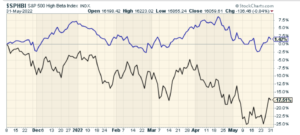
In plain English, the chart above is risky stocks against conservative stocks. As you can see, it’s been the risky stocks getting hammered while the conservative ones are barely scratched. This latest rally is focused almost exclusively among the risky stocks. That adds to my skepticism.
The simple reality is that it’s hard for me to believe that the market has suddenly changed its outlook when all the previous problems are still there. At the top of the list, the U.S. economy still faces high inflation, and there’s little evidence that things are improving.
Many Americans just celebrated the Memorial Day weekend while facing higher prices for food and gasoline. The highest inflation in four decades is leading the Federal Reserve to (finally) adopt an aggressive policy of raising interest rates. The recent minutes from the Fed made that clear.
Investors should understand that higher interest rates are like kryptonite to stocks. Nearly every market rally has eventually been done in by the Federal Reserve.
Here’s an example from the financial crisis:
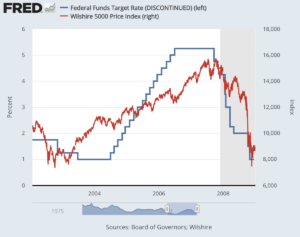
The Fed raised rates by 0.25% at 17 consecutive meetings. They overdid it and choked off first, the market and second, the economy.
The Fed meets again in two weeks, and it seems highly likely that we’ll see another 0.5% rate increase. On top of that, there will probably be another 0.5% hike in late July. How high will rates go? I don’t know but I wouldn’t be surprised to see rates rise by 2% before the end of the year.
Fed Governor Christopher Waller said yesterday that he expects to see the 0.5% rate hikes continue. Waller said he supports raising rates until they’re above the “neutral level.” This is the idea that there’s an ideal interest rate where all the parts of the economy come into perfect balance. The problem is that we don’t know exactly where this rate is. Recently, the Fed pinpointed the neutral rate at 2.5%. Still, that’s only a guess.
We’re at an odd crossroads with the economy. Many of the numbers continue to look good, but the outlook for the near future is very pessimistic. I’ve never seen a gap this wide between economic reports and the outlook. The housing market is booming. The jobs market is on fire. Summer businesses are having trouble finding employees. (Hey guys, offer more!) There are now two job openings for every unemployed person. Yet everyone on Wall Street thinks we’re headed back to the 1970s.
Another good example is the strength in corporate profits. In the S&P 500, 375 companies beat Wall Street’s earnings expectations for Q1. While many companies have reported trouble with supply-chain issues, they’re still experiencing strong demand.
Last year was a very good year for corporate profits, and a large part of that was driven by wider profit margins. The problem with margin expansion is that there’s only so far you can push that. Now we’re seeing the pushback, and that’s what has stock traders so antsy.
On Friday, the government said that consumer spending rose by 0.9% last month while after-tax income rose by 0.3%. Households set aside just 4.4% of their after-tax income. That’s the lowest rate since 2008.
The government also updated the Q1 GDP report last week. The Bureau of Economic Analysis now says that the U.S. economy contracted by 1.5% during the first three months of this year. That’s 0.1% lower than the initial report. Don’t let the negative number fool you. Consumer spending was pretty good during the first quarter.
With the income and spending report, the government also updates the personal consumption expenditure numbers. This is important to watch because it’s the Fed’s preferred measure for inflation. For the 12 months ending in April, core PCE rose by 4.9%. That’s down from the 12 months ending in March which was 5.2%. Headline PCE, which includes food and energy prices, rose by 6.3%. Over the last year, home prices were up more than 20%.
On Friday, we’re going to get the jobs report for May. I expect to see more good numbers. Wall Street expects to see a gain of 325,000 nonfarm payrolls, and it is looking for the unemployment rate to fall to 3.5%. That’s a bold forecast but it’s reasonable. The weekly jobless claims numbers are still holding up well. The Federal Reserve recently conducted a survey on consumer health. It found that 78% of respondents say that they’re doing “at least OK.” That’s the highest result in the survey’s history.
Stock Focus: Atrion
I want to revisit Atrion (ATRI), which is a stock I’ve profiled before. Atrion is a great example of a niche company with an amazing track record, and barely anyone knows about them. Atrion makes products for the healthcare field for applications such as fluid delivery, cardiovascular and ophthalmology.
These fluid delivery products include valves that hold and release precise amounts of fluids. This is crucial for areas like anesthesia and oncology. Do you wonder who makes valves for life vests? There’s a good chance it’s Atrion.
Even though Atrion is small (about $1.1 billion in market cap), several of their most successful products are dominant in their market niches. For example, Atrion is a leading U.S. manufacturer of soft contact lens disinfection cases, clamps for IV sets, cardiac surgery vacuum relief valves, minimally invasive surgical tapes, check valves and balloon catheters for the treatment of tear duct blockages.
The company currently has about 400,000 square feet of manufacturing and R&D capacity in three facilities in Alabama, Florida and Texas. Over the past five years, Atrion has steadily increased R&D funding by 5% per year. The firm has also invested $60 million in manufacturing and quality assurance equipment.
Over the last 20 years, Atrion has averaged 6% sales growth and 18% growth in operating income. Most impressively, this growth has been organic, meaning it hasn’t come from acquisitions. Over the last 20 years, earnings-per-share has grown by an average of 20% per year. I also like that Atrion doesn’t have any debt.
The stock has had an amazing run. Since 1990, shares of Atrion are up close to 300-fold. An investment of $10,000 would have grown to more than $2.9 million. Despite the amazing track record, shares of ATRI peaked at $948 in 2019. The stock is down about one-third since then.
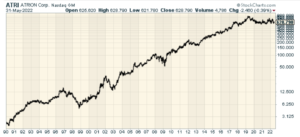
Best of all, not a single Wall Street analyst follows Atrion. I can’t say if the company has topped Wall Street’s expectations because there aren’t any expectations. Earlier this month, Atrion reported fiscal Q1 earnings of $4.71 per share. That’s an 18% increase over last year’s Q1.
About the earnings, David Battat, Atrion’s president and CEO, said, “The three primary drivers of performance in the quarter were medical devices used in minimally invasive surgical procedures, consoles utilized in open heart surgeries, and components used to safely deliver therapeutics.”
He added, “The substantial expansion of one of our manufacturing facilities remains on track for completion in the summer of 2023, which will support ongoing projects to increase the number of new product launches as well as the expansion of markets for existing ones.”
Last year, Atrion’s sales rose about 11% and its EPS increased from $17.44 to $18.18. Atrion also increased its quarterly dividend from $1.75 to $1.95 per share. I’m expecting another dividend hike in August. This is a company that has rewarded its shareholders. Not only has Atrion consistently increased its dividend for 20 years, but the company has also paid out several generous special dividends.
I can’t recommend Atrion just yet. I think the shares are still too expensive, but if Atrion dips another 20%, I would definitely be interested.
That’s all for now. I’ll have more for you in the next issue of CWS Market Review.
– Eddy
P.S. Don’t forget to sign up for a premium subscription: $20 per month or $200 for the whole year!
-
Morning News: May 31, 2022
Eddy Elfenbein, May 31st, 2022 at 7:08 amWhy China Is Miles Ahead in a Pacific Race for Influence
China’s Economic Downturn Shows Signs of Easing
As China’s Private Developers Retreat, State-Backed Rivals Gain Ground
Global Oil Refiners Falter in Efforts to Keep Up with Demand
Oil Surge Fans Inflation Fears, Dampens Stocks
Biden Pledges to Back Fed in Effort to Combat High Inflation
Treasury Market Faces Liquidity Risks as Fed Pares Balance Sheet
Wall Street’s Losing Streak Ends, but Uncertainty That Drove It Lingers
After a Bumper 2021, Companies Might Struggle to Increase Profits
States Help Business Owners Save Likely More Than $10 Billion in Federal Taxes
Summer Worker Shortage Means Things Will Be Closed. Again.
U.S. Wheat Crop Hit by Dry Winter then Soggy Spring, Adding to Global Tightness
US Meat Prices Surge — Beef, Chicken Hit Record Highs on Memorial Day
Unilever to Add Activist Investor Nelson Peltz to Board
Be sure to follow me on Twitter.
-
Morning News: May 30, 2022
Eddy Elfenbein, May 30th, 2022 at 8:09 amU.S. Retakes Top Spot in Supercomputer Race
The Luna Cryptocurrency Has Been Resurrected After Its $40 Billion Collapse. It’s Already Crashing
Treasury Releases Pandemic Funding for Small Businesses as They Face New Risks
17 States Where Unemployment Is at Record Lows
Safe As Houses? Rising Rates Test Foundations of Property Boom
Russia Comes Up With a New Bond-Payment Plan to Avoid Default
Europe’s Bid to Kick Russian Natural Gas Faces Opposition
Companies Rush to Cash In on EPA Rules for Capturing Methane Emissions
Hit Hard by High Energy Costs, Hawaii Looks to the Sun
EVs Proliferate, While Charging Stations Lag Behind
Bottleneck Fuels Record-High Gas Prices
Illegal Immigration Is Down, Changing the Face of California Farms
The Texas Law That Has Banks Saying They Don’t ‘Discriminate’ Against Guns
Activist Investing Has Come for Fossil Fuels. What About Guns?
Be sure to follow me on Twitter.
-
Morning News: May 27, 2022
Eddy Elfenbein, May 27th, 2022 at 7:02 amI Watched Russia Join The World’s Markets. Now It All Feels Like an Illusion
Digital Dollar Could Coexist With Stablecoins, Fed Vice Chairwoman Says
Dip Buyers Storm Back to Stocks After Selloff
A New Prediction Market Lets Investors Bet Big on Almost Anything
How Influencers Hype Crypto, Without Disclosing Their Financial Ties
ESG Haters Think Climate Investors Are Controlling Everything. If Only
Britain Will Tax Oil and Gas Profits as Cost-of-Living Crisis Swells
American Shoppers Boost Retailers With Spending on Work Clothes, Discount Staples
When the Best Available Home Is the One You Already Have
Apple Supplier Faces Worker Revolt in Locked Down China Factory
Broadcom to Acquire VMware in $61 Billion Enterprise Computing Deal
‘Top Gun: Maverick’ Loses Chinese Investor Due to Pro-U.S. Messaging
China Excels in Google Rankings on Xinjiang and Covid-19 Searches
‘Escalation of Secrecy’: Global Brands Seek Clarity on Xinjiang
Accounting Firm EY Considers Split of Audit, Advisory Businesses
Full House: American Casino Development Has Hit Its Saturation Point
Be sure to follow me on Twitter.
-
Morning News: May 26, 2022
Eddy Elfenbein, May 26th, 2022 at 7:08 amRussia’s Central Bank Cuts Key Interest Rate To 11%, Citing Decreased Stability Risks
Fed Minutes Show Urgency for Raising Rates to Tame High Inflation
CBO Projects Inflation, Economic Growth to Cool This Year and Next
SEC Proposes More Disclosure Requirements for ESG Funds
Sequoia Capital Warns Founders After ‘Crucible Moment’
The Tech Rout Isn’t Just Cyclical—It’s Well-Earned, and Overdue
Twitter’s Chief Tries Staying the Course as Elon Musk Upends Plans
Rescinded Twitter Job Offer Points to Turmoil at the Company
Twitter is Fined $150 Million in Privacy Settlement, as Elon Musk Commits More Equity to Fund Deal
Apple to Keep iPhone Production Flat as Market Grows Tougher
Apple Boosting Pay Budget for Workers Amid Tight Labor Market
South Korean Workers Turn the Tables on Their Bad Bosses
‘Quantum Internet’ Inches Closer With Advance in Data Teleportation
Gen Zers Are Buying Homes. Here’s Where They’re Looking
Macy’s Raises Annual Profit Outlook as Party-Wear Demand Rebounds
The Ice Cream Choice Is Endless, but We All Get the Same Cone
Be sure to follow me on Twitter.
-
The Latest Fed Minutes
Eddy Elfenbein, May 25th, 2022 at 3:18 pmThis afternoon, the Federal Reserve released the minutes from its meeting held earlier this month. The minutes showed that the Fed is looking at making three more rate hikes over the next few months. Some Fed members said they think inflation may be cooling off, but it’s too early to say that inflation has peaked.
From the minutes:
In their consideration of the appropriate stance of monetary policy, all participants concurred that the U.S. economy was very strong, the labor market was extremely tight, and inflation was very high and well above the Committee’s 2 percent inflation objective. Against this backdrop, all participants agreed that it was appropriate to raise the target range for the federal funds rate 50 basis points at this meeting. They further anticipated that ongoing increases in the target range for the federal funds rate would be warranted to achieve the Committee’s objectives.
I’ve been critical of the Fed because I believe it was slow to react to inflation, even as the evidence became clear. These minutes tell me that the Fed is starting to realize that inflation is a problem. Still, I want to see more action rather than rhetoric.
-
Median Rent Could Hit $2,000 Soon
Eddy Elfenbein, May 25th, 2022 at 12:03 pmThe stock market is up today. At noon, the S&P 500 is up by about 0.44%. That’s not bad. High Beta stocks are doing very well while the Low Beta sector is mostly flat.
Some travel stocks have been getting knocked around. Royal Caribbean (RCL), Norwegian Cruise Line (NCLH), MGM (MGM) and Expedia (EXPE) all hit new 52-week lows, and Carnival is very close.
I will cautiously point out that Ross Stores (ROST) has made back a lot of lost ground. Today’s high for Ross was 18% above Friday’s intra-day low.
This morning’s report on durable goods showed an increase of 0.4%. The figure for March was revised down to a gain of 0.6%. MarketWatch said that the national median rent could hit $2,000 very soon.
Stay tuned. At 2 pm, the Fed will release the minutes from its last meeting.
-
Archives
- July 2026
- June 2026
- May 2026
- April 2026
- March 2026
- February 2026
- January 2026
- December 2025
- November 2025
- October 2025
- September 2025
- August 2025
- July 2025
- June 2025
- May 2025
- April 2025
- March 2025
- February 2025
- January 2025
- December 2024
- November 2024
- October 2024
- September 2024
- August 2024
- July 2024
- June 2024
- May 2024
- April 2024
- March 2024
- February 2024
- January 2024
- December 2023
- November 2023
- October 2023
- September 2023
- August 2023
- July 2023
- June 2023
- May 2023
- April 2023
- March 2023
- February 2023
- January 2023
- December 2022
- November 2022
- October 2022
- September 2022
- August 2022
- July 2022
- June 2022
- May 2022
- April 2022
- March 2022
- February 2022
- January 2022
- December 2021
- November 2021
- October 2021
- September 2021
- August 2021
- July 2021
- June 2021
- May 2021
- April 2021
- March 2021
- February 2021
- January 2021
- December 2020
- November 2020
- October 2020
- September 2020
- August 2020
- July 2020
- June 2020
- May 2020
- April 2020
- March 2020
- February 2020
- January 2020
- December 2019
- November 2019
- October 2019
- September 2019
- August 2019
- July 2019
- June 2019
- May 2019
- April 2019
- March 2019
- February 2019
- January 2019
- December 2018
- November 2018
- October 2018
- September 2018
- August 2018
- July 2018
- June 2018
- May 2018
- April 2018
- March 2018
- February 2018
- January 2018
- December 2017
- November 2017
- October 2017
- September 2017
- August 2017
- July 2017
- June 2017
- May 2017
- April 2017
- March 2017
- February 2017
- January 2017
- December 2016
- November 2016
- October 2016
- September 2016
- August 2016
- July 2016
- June 2016
- May 2016
- April 2016
- March 2016
- February 2016
- January 2016
- December 2015
- November 2015
- October 2015
- September 2015
- August 2015
- July 2015
- June 2015
- May 2015
- April 2015
- March 2015
- February 2015
- January 2015
- December 2014
- November 2014
- October 2014
- September 2014
- August 2014
- July 2014
- June 2014
- May 2014
- April 2014
- March 2014
- February 2014
- January 2014
- December 2013
- November 2013
- October 2013
- September 2013
- August 2013
- July 2013
- June 2013
- May 2013
- April 2013
- March 2013
- February 2013
- January 2013
- December 2012
- November 2012
- October 2012
- September 2012
- August 2012
- July 2012
- June 2012
- May 2012
- April 2012
- March 2012
- February 2012
- January 2012
- December 2011
- November 2011
- October 2011
- September 2011
- August 2011
- July 2011
- June 2011
- May 2011
- April 2011
- March 2011
- February 2011
- January 2011
- December 2010
- November 2010
- October 2010
- September 2010
- August 2010
- July 2010
- June 2010
- May 2010
- April 2010
- March 2010
- February 2010
- January 2010
- December 2009
- November 2009
- October 2009
- September 2009
- August 2009
- July 2009
- June 2009
- May 2009
- April 2009
- March 2009
- February 2009
- January 2009
- December 2008
- November 2008
- October 2008
- September 2008
- August 2008
- July 2008
- June 2008
- May 2008
- April 2008
- March 2008
- February 2008
- January 2008
- December 2007
- November 2007
- October 2007
- September 2007
- August 2007
- July 2007
- June 2007
- May 2007
- April 2007
- March 2007
- February 2007
- January 2007
- December 2006
- November 2006
- October 2006
- September 2006
- August 2006
- July 2006
- June 2006
- May 2006
- April 2006
- March 2006
- February 2006
- January 2006
- December 2005
- November 2005
- October 2005
- September 2005
- August 2005
- July 2005
 Eddy Elfenbein is a Washington, DC-based speaker, portfolio manager and editor of the blog Crossing Wall Street. His