Author Archive
-
IBD on Fiserv
Eddy Elfenbein, March 2nd, 2016 at 5:39 pmInvestors Business Daily looks at Fiserv (FISV):
Financial Industry Still Craves Tech, Which Is Good For Fiserv
As banks farm out more tech services and try to keep up with customers managing more of their money via their phones, Fiserv (FISV), a company that provides back-end technology to the finance industry, seems to be expanding at a solid, measured pace.
Companies spilling over with triple-digit growth every quarter are drawing more adventurous investors, which is why many on Wall Street seem to like Fiserv’s steadiness. The company routinely generates single-digit sales gains and low-double-digit earnings growth, aided by share buybacks.
Following the Fed’s rate hike last year and forecasts for fatter industry tech budgets, more of the same could be in store despite worries over a downturn and consolidation, the company and analysts say. That’s due primarily to a steady income base.
“When you have 85% of revenue recurring, it gives them a very good visibility into their numbers,” helping enable more accurate guidance and minimizing surprises when earnings season rolls around, Monness Crespi Hardt analyst Alexander Veytsman told Investor’s Business Daily.
“They do increase pricing, but given the longevity of those contracts and given the fact that these clients have been with them for a number of years, I would say they’re growing it slowly and steadily,” Veytsman said.
The nature of the company’s contracts with clients helps Fiserv maintain its firm footing. Many deals are longer-term and retention is high, Morningstar notes in its research on the company. In addition, it’s costly and potentially hugely disruptive for financial companies to switch from one core-processing service to another, helping Fiserv keep customers in the fold.
And even amid Wall Street’s hand-wringing over a possible recession, Chief Executive Jeffrey Yabuki told IBD that he sees the trends in tech spending among Fiserv’s own clients continuing.
“Most of our revenue is based on non-discretionary, mission-critical technologies under longer term contracts and is not subject to dramatic fluctuation,” he said via email. “We are seeing stable and growing demand for newer technologies that enhance experiences in the increasingly digital world.”
13,000 Clients
Brookfield, Wis.-based Fiserv serves 13,000 banks, credit unions, retailers and other clients around the world. If you’ve withdrawn money from an automated teller or transferred a balance from one account to another, there’s a good chance it went smoothly in part because of Fiserv.
Created in 1984 through a merger, Fiserv handles everything from transaction processing to data analysis to person-to-person payment systems. With this year’s technology spending seen growing 4%-5% among banks and credit-union customers — Fiserv’s bread and butter — the company is set to follow, Argus Research says.
“We believe that Fiserv remains well positioned to benefit from technology infrastructure spending among its primary customers (banks and credit unions), many of whom are working to improve processing efficiency for online bill payment and debit card transactions,” Argus analyst Stephen Biggar said in a research note last month.
“This should help revenue to keep rising at a modest mid-single-digit pace,” Biggar said, adding that Argus sees 5.5% in sales growth this year.
Shares are up 25% over the past 12 months. The company has a Composite Rating of 93 out of a best-possible 99, boosted most recently by its strong fourth-quarter results that were marked by better-than-expected operating margins.
The company also has tried to stay relevant through acquisitions. In 2011, Fiserv snapped up mobile banking company M-Com and digital payments outfit CashEdge, which gave it Popmoney, a bank-based person-to-person payments system for participating institutions that has helped drive sales growth. The company in 2013 announced that it acquired Open Solutions, giving it real-time account-processing technology.
“You don’t need a new product every day,” Biggar said, “but you need something fairly significant every 2-3 years that would have its own sort of life cycle.”
Last month, Fiserv said the United Nations Federal Credit Union for U.N. employees, among the largest in the U.S. by assets, will begin using Fiserv’s core account-processing technology. Analysts say the Federal Reserve’s rate hike in December could help strengthen banks’ finances, potentially freeing up cash for their technology budgets.
“We view the Fed rate increase for the first time in a decade as good news for banks and a way to help fund needed increases in IT spend, as institutions look for ways to keep up with the broad changes across the technology landscape,” CEO Yabuki said on the company’s fourth-quarter earnings call last month.
Outsourcing Limits?
Some concern persists that Fiserv could make less money if consolidation continues within the banking industry, either due to tightening regulations or an event like the 2008 financial crisis. Mergers and acquisitions could reduce client count and give those bigger, combined companies more muscle in negotiating cheaper contract prices with companies like Fiserv.
However, the reduction in clients hasn’t materialized, Veytsman said, and the prospect of more banks bringing tech operations in-house seems unlikely. Fiserv counts Wells Fargo (WFC) among its big clients, potentially signaling a stronger shift to outsourcing among larger banks.
Monness Crespi’s Veytsman said consolidation could actually accelerate the trend of tech outsourcing.
“When they consolidate they also look to see what’s happening with the bottom line and what they’re doing around the costs,” he said. “And if someone was not considering using Fiserv as a client, maybe together, they will.”
Yabuki sees consolidation continuing, but stressed that the number of accounts and transactions has kept rising for the company.
Foreign exchange amid a stronger dollar could also hurt the company, although its international exposure is limited, Veytsman said. Jack Henry & Associates and FIS are among the company’s primary competitors. Concern also lingers about Fiserv’s debt, although Yabuki cites the company’s $1-billion-plus free cash flow last year.
Still, both Biggar and Veytsman say the company’s acquisitions have been relatively focused and restrained.
And one might be forgiven for wondering whether a person-to-person service like Popmoney can compete with PayPal’s (PYPL) Venmo, or payment-tech offerings from Facebook (FB), Alphabet (GOOGL) and, potentially, Apple (AAPL).
However, Yabuki said P2P was in the early innings. And Veytsman said Popmoney is intended more as a side dish in its offerings to midcap banks than a main course.
“It’s very hard to challenge PayPal,” he said.
-
Morning News: March 2, 2016
Eddy Elfenbein, March 2nd, 2016 at 7:10 amSouth Korea’s Output Drops More Than Estimates as Exports Slump
How Can Brazil Restore Its Growth Trajectory?
Molotovs and Death Threats: Russian Debt Collectors Go Medieval
Shale Oil Isn’t Saudi Arabia’s Only Nemesis
Shell Proves Test Case For Oil Majors’ Environmental Records
What Super Tuesday’s Victories Mean for Wall Street Now
Forbes Outs World’s Billionaires List
AB InBev Reaches Deal for Sale of SABMiller’s Chinese Beer Business
Sports Authority Files Bankruptcy After Missing Fitness Boom
Mark Pincus, Founder of Zynga, Is Replaced as C.E.O. Again
Honeywell Saved By United Technologies
Qualcomm Settles SEC Charges That It Repeatedly Bribed Chinese Officials To Gain An Edge
Former Chesapeake CEO McClendon Charged With Bid-Rigging of Land Leases
Jeff Carter: How Can the U.S. Win the Corporate Tax Battle?
Joshua Brown: Warren Buffett Said Everything on CNBC
Be sure to follow me on Twitter.
-
Ross Stores Earns 66 Cents per Share
Eddy Elfenbein, March 1st, 2016 at 4:10 pmRoss Stores (ROST) just released its fiscal Q4 earnings. For November, December and January, the discounter earned 66 cents per share. Sales rose 6% to $264 million, and same-store sales rose 4%.
Barbara Rentler, Chief Executive Officer, commented, “We are pleased with our sales and earnings results for the fourth quarter, which exceeded our expectations despite the highly promotional holiday selling environment and our most challenging sales comparisons from the prior year. These results were driven by the competitive values we offered on a wide assortment of name brand bargains and gifts throughout our stores.”
Ms. Rentler continued, “Fourth quarter operating margin was 12.7% compared to 13.1% in the prior year, as higher merchandise margin and tight expense control were more than offset by the timing of packaway-related costs. For the 2015 fiscal year however, operating margin rose 10 basis points to a record 13.6%.”
For the year, Ross earned $2.51 per share. Net sales rose 8%, and same-store sales rose 4%.
Ross is also raising its quarterly dividend by 15% to 13.5 cents per share. The previous dividend was 11.75 cents per share.
-
February ISM Rises to 49.5
Eddy Elfenbein, March 1st, 2016 at 10:20 amMore encouraging news. The February ISM Index rose to 49.5. This is the second straight monthly gain for an index that hasn’t done well over the last 18 months.
A reading above 50 means the manufacturing sector is expanding while below means it’s contracting. This is the fifth report in a row below 50, but it appears we may be in an upward trend.
Also, the Commerce Department said that construction spending rose by 1.5% in January. That’s the biggest increase since October 2007.
-
Ford Jumps on Strong February Sales
Eddy Elfenbein, March 1st, 2016 at 9:39 amIt’s still early but Ford Motor (F) is having a nice morning. The stock has been up as much as 4% today, and it broke above $13 per share.
The company just reported its best February sales in 11 years.
Ford Motor Company’s U.S. sales were up 20 percent in February versus a year ago with 217,192 vehicles sold. Retail sales grew 11 percent – the company’s best February since 2005.
Retail sales gains came across the product portfolio. Cars gained 6 percent, trucks increased 5 percent, and SUVs were up 22 percent.
Ford SUV sales last month – the best February in company history – totaled 65,016 vehicles, up 28 percent versus a year ago. Edge jumped 91 percent, Explorer was up 18 percent and Escape gained 14 percent.
F-Series sales were strong, too, with 60,697 vehicles sold – a 10-percent increase – marking Ford’s best February for F-Series in a decade.
“We saw a solid industry last month and a strong month for Ford, as customer demand for our newest vehicles – including new high-end series on Explorer and Edge – helped Ford increase its average transaction prices at almost double the industry average,” said Mark LaNeve, Ford vice president, U.S. Marketing, Sales and Service. “Offering more high-end options for truck and SUV customers and having the capability fleet buyers value as they are reinvesting in their fleets are strengthening our business.”
-
Morning News: March 1, 2016
Eddy Elfenbein, March 1st, 2016 at 7:35 amEuro-Area Unemployment Drops to 4-Year Low Amid Stimulus Debate
Supercore Inflation Guides ECB as Oil Muddies Price Outlook
ICE Confirms It May Bid for LSE as Shares Soar to Record
Why China’s Economy Will Be So Hard to Fix
Fed’s Dudley Sees Risks to U.S. Economic Outlook Tilting to Downside
Angry Americans: How the 2008 Crash Fueled a Political Rebellion
Apple Wins Ruling in New York iPhone Hacking Order
Discount Chain Dollar Tree’s Sales Rise Less Than Expected
Fiat Chrysler U.S. Auto Sales Jump 12%
Valeant Pharmaceuticals Is Under S.E.C. Investigation
Barclays, Reporting Loss, Plans to Cut Stake in African Business
Jamie Dimon on Finance: ‘Who Owns the Future?’
The Rise and Fall of Commodities Hedge Fund King Willem Kooyker
Cullen Roche: Three Things I Think I Think – Monday Funday Edition
Roger Nusbaum: Making the Most of a Messy Market
Be sure to follow me on Twitter.
-
The Correlation Continues
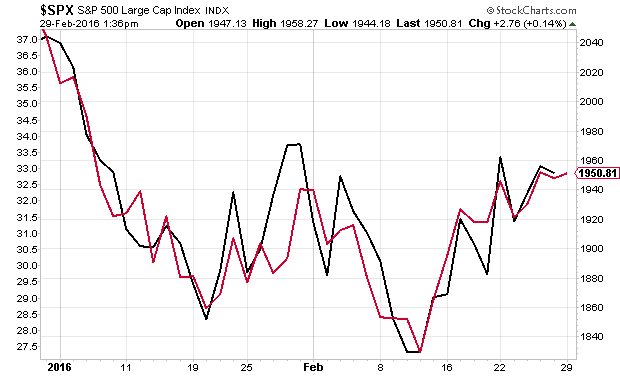
Eddy Elfenbein, February 29th, 2016 at 1:38 pmHere’s the year-to-date chart. The S&P 500 is in red and oil is in black.
-
China Cuts Reserve Requirement
Eddy Elfenbein, February 29th, 2016 at 12:03 pmThe stock market is up modestly today. The big news is that China cut its reserve requirement for its big banks. That’s how much money they have to keep in reserve and can’t lend out. The rate is now 17%. According to Bloomberg, the move will inject $105 billion to the Chinese economy.
The economy in China is weak and getting weaker. The authorities there have been trying everything to get it back on its feet, and the reserve requirement cut is their latest move. Of all the world’s stock markets, China’s is the single worst performer this year.
This is a change in China’s policy. Until now, the PBOC, China’s Fed, had used more modest policy tools to help the economy. Lowering the reserve requirement is seen as playing hardball. One concern is liquidity.
At noon, the U.S. market is up about 0.5%. It seems to be a fairly broad rally. Materials are leading while Healthcare is lagging.
-
Morning News: February 29, 2016
Eddy Elfenbein, February 29th, 2016 at 7:01 amChina Cuts Reserve Requirement Ratio for Fifth Time Since Feb. 2015
India Unveils Pro-Poor Budget, Keeps Deficit Target
ECB Window for Stimulus Message Closing as Inflation Stalls
Buffett: Politicians ‘Dead Wrong’ on Economy
Social Security Explains New Claiming Rules
Bullish Oil Bets Rise as Hedge Funds See Supply Tightening
Debt Swaps Become a Tough Sell for Cash-Strapped U.S. Energy Firms
Apple’s Cook Picks Up Where Snowden Left Off in Privacy Debate
Amazon Strikes Deal with U.K. Grocer Morrisons
With Humility, Starbucks to Enter Italian Market
Sharp Says Has Not Set a Deadline for Deal With Hon Hai
Lumber Liquidators Swings to Loss Amid Laminate Flooring Fallout
Gameloft Board Rejects Vivendi’s Takeover Offer
Jeff Miller: Can a Rebounding Economy Support Stock Prices?
Jeff Carter: Some Wrongheaded Policy on Minimum Wage
Be sure to follow me on Twitter.
-
Leap Day Returns
Eddy Elfenbein, February 27th, 2016 at 5:19 pmHere’s a look at all the Leap Day returns for the Dow. Twelve of the last 16 have been down days. Odd fact: There was no Leap Day in 1900.
 Eddy Elfenbein is a Washington, DC-based speaker, portfolio manager and editor of the blog Crossing Wall Street. His