Author Archive
-
Janet Yellen’s Testimony
Eddy Elfenbein, February 10th, 2016 at 9:32 amHere’s the text of what Janet Yellen will be saying later this morning on Capitol Hill:
Chairman Hensarling, Ranking Member Waters, and other members of the Committee, I am pleased to present the Federal Reserve’s semiannual Monetary Policy Report to the Congress. In my remarks today, I will discuss the current economic situation and outlook before turning to monetary policy.
Current Economic Situation and Outlook
Since my appearance before this Committee last July, the economy has made further progress toward the Federal Reserve’s objective of maximum employment. And while inflation is expected to remain low in the near term, in part because of the further declines in energy prices, the Federal Open Market Committee (FOMC) expects that inflation will rise to its 2 percent objective over the medium term.
In the labor market, the number of nonfarm payroll jobs rose 2.7 million in 2015, and posted a further gain of 150,000 in January of this year. The cumulative increase in employment since its trough in early 2010, is now more than 13 million jobs. Meanwhile, the unemployment rate fell to 4.9 percent in January, 0.8 percentage point below its level a year ago and in line with the median of FOMC participants’ most recent estimates of its longer-run normal level. Other measures of labor market conditions have also shown solid improvement, with noticeable declines over the past year in the number of individuals who want and are available to work but have not actively searched recently, and in the number of people who are working part time but would rather work full time. However, these measures remain above the levels seen prior to the recession, suggesting that some slack in labor markets remains. Thus, while labor market conditions have improved substantially, there is still room for further sustainable improvement.
The strong gains in the job market last year were accompanied by a continued moderate expansion in economic activity. U.S. real gross domestic product is estimated to have increased about 1-3/4 percent in 2015. Over the course of the year, subdued foreign growth and the appreciation of the dollar restrained net exports. In the fourth quarter of last year, growth in the gross domestic product is reported to have slowed more sharply, to an annual rate of just 3/4 percent; again, growth was held back by weak net exports as well as by a negative contribution from inventory investment. Although private domestic final demand appears to have slowed somewhat in the fourth quarter, it has continued to advance. Household spending has been supported by steady job gains and solid growth in real disposable income–aided in part by the declines in oil prices. One area of particular strength has been purchases of cars and light trucks; sales of these vehicles in 2015, reached their highest level ever. In the drilling and mining sector, lower oil prices have caused companies to slash jobs and sharply cut capital outlays, but in most other sectors, business investment rose over the second half of last year. And homebuilding activity has continued to move up, on balance, although the level of new construction remains well below the longer-run levels implied by demographic trends.
Financial conditions in the United States have recently become less supportive of growth, with declines in broad measures of equity prices, higher borrowing rates for riskier borrowers, and a further appreciation of the dollar. These developments, if they prove persistent, could weigh on the outlook for economic activity and the labor market, although declines in longer-term interest rates and oil prices provide some offset. Still, ongoing employment gains and faster wage growth should support the growth of real incomes and therefore consumer spending, and global economic growth should pick up over time, supported by highly accommodative monetary policies abroad. Against this backdrop, the Committee expects that with gradual adjustments in the stance of monetary policy, economic activity will expand at a moderate pace in coming years and that labor market indicators will continue to strengthen.
As is always the case, the economic outlook is uncertain. Foreign economic developments, in particular, pose risks to U.S. economic growth. Most notably, although recent economic indicators do not suggest a sharp slowdown in Chinese growth, declines in the foreign exchange value of the renminbi have intensified uncertainty about China’s exchange rate policy and the prospects for its economy. This uncertainty led to increased volatility in global financial markets and, against the background of persistent weakness abroad, exacerbated concerns about the outlook for global growth. These growth concerns, along with strong supply conditions and high inventories, contributed to the recent fall in the prices of oil and other commodities. In turn, low commodity prices could trigger financial stresses in commodity-exporting economies, particularly in vulnerable emerging market economies, and for commodity-producing firms in many countries. Should any of these downside risks materialize, foreign activity and demand for U.S. exports could weaken and financial market conditions could tighten further.
Of course, economic growth could also exceed our projections for a number of reasons, including the possibility that low oil prices will boost U.S. economic growth more than we expect. At present, the Committee is closely monitoring global economic and financial developments, as well as assessing their implications for the labor market and inflation and the balance of risks to the outlook.
As I noted earlier, inflation continues to run below the Committee’s 2 percent objective. Overall consumer prices, as measured by the price index for personal consumption expenditures, increased just 1/2 percent over the 12 months of 2015. To a large extent, the low average pace of inflation last year can be traced to the earlier steep declines in oil prices and in the prices of other imported goods. And, given the recent further declines in the prices of oil and other commodities, as well as the further appreciation of the dollar, the Committee expects inflation to remain low in the near term. However, once oil and import prices stop falling, the downward pressure on domestic inflation from those sources should wane, and as the labor market strengthens further, inflation is expected to rise gradually to 2 percent over the medium term. In light of the current shortfall of inflation from 2 percent, the Committee is carefully monitoring actual and expected progress toward its inflation goal.
Of course, inflation expectations play an important role in the inflation process, and the Committee’s confidence in the inflation outlook depends importantly on the degree to which longer-run inflation expectations remain well anchored. It is worth noting, in this regard, that market-based measures of inflation compensation have moved down to historically low levels; our analysis suggests that changes in risk and liquidity premiums over the past year and a half contributed significantly to these declines. Some survey measures of longer-run inflation expectations are also at the low end of their recent ranges; overall, however, they have been reasonably stable.
Monetary Policy
Turning to monetary policy, the FOMC conducts policy to promote maximum employment and price stability, as required by our statutory mandate from the Congress. Last March, the Committee stated that it would be appropriate to raise the target range for the federal funds rate when it had seen further improvement in the labor market and was reasonably confident that inflation would move back to its 2 percent objective over the medium term. In December, the Committee judged that these two criteria had been satisfied and decided to raise the target range for the federal funds rate 1/4 percentage point, to between 1/4 and 1/2 percent. This increase marked the end of a seven-year period during which the federal funds rate was held near zero. The Committee did not adjust the target range in January.
The decision in December to raise the federal funds rate reflected the Committee’s assessment that, even after a modest reduction in policy accommodation, economic activity would continue to expand at a moderate pace and labor market indicators would continue to strengthen. Although inflation was running below the Committee’s longer-run objective, the FOMC judged that much of the softness in inflation was attributable to transitory factors that are likely to abate over time, and that diminishing slack in labor and product markets would help move inflation toward 2 percent. In addition, the Committee recognized that it takes time for monetary policy actions to affect economic conditions. If the FOMC delayed the start of policy normalization for too long, it might have to tighten policy relatively abruptly in the future to keep the economy from overheating and inflation from significantly overshooting its objective. Such an abrupt tightening could increase the risk of pushing the economy into recession.
It is important to note that even after this increase, the stance of monetary policy remains accommodative. The FOMC anticipates that economic conditions will evolve in a manner that will warrant only gradual increases in the federal funds rate. In addition, the Committee expects that the federal funds rate is likely to remain, for some time, below the levels that are expected to prevail in the longer run. This expectation is consistent with the view that the neutral nominal federal funds rate–defined as the value of the federal funds rate that would be neither expansionary nor contractionary if the economy was operating near potential–is currently low by historical standards and is likely to rise only gradually over time. The low level of the neutral federal funds rate may be partially attributable to a range of persistent economic headwinds–such as limited access to credit for some borrowers, weak growth abroad, and a significant appreciation of the dollar–that have weighed on aggregate demand.
Of course, monetary policy is by no means on a preset course. The actual path of the federal funds rate will depend on what incoming data tell us about the economic outlook, and we will regularly reassess what level of the federal funds rate is consistent with achieving and maintaining maximum employment and 2 percent inflation. In doing so, we will take into account a wide range of information, including measures of labor market conditions, indicators of inflation pressures and inflation expectations, and readings on financial and international developments. In particular, stronger growth or a more rapid increase in inflation than the Committee currently anticipates would suggest that the neutral federal funds rate was rising more quickly than expected, making it appropriate to raise the federal funds rate more quickly as well. Conversely, if the economy were to disappoint, a lower path of the federal funds rate would be appropriate. We are committed to our dual objectives, and we will adjust policy as appropriate to foster financial conditions consistent with the attainment of our objectives over time.
Consistent with its previous communications, the Federal Reserve used interest on excess reserves (IOER) and overnight reverse repurchase (RRP) operations to move the federal funds rate into the new target range. The adjustment to the IOER rate has been particularly important in raising the federal funds rate and short-term interest rates more generally in an environment of abundant bank reserves. Meanwhile, overnight RRP operations complement the IOER rate by establishing a soft floor on money market interest rates. The IOER rate and the overnight RRP operations allowed the FOMC to control the federal funds rate effectively without having to first shrink its balance sheet by selling a large part of its holdings of longer-term securities. The Committee judged that removing monetary policy accommodation by the traditional approach of raising short-term interest rates is preferable to selling longer-term assets because such sales could be difficult to calibrate and could generate unexpected financial market reactions.
The Committee is continuing its policy of reinvesting proceeds from maturing Treasury securities and principal payments from agency debt and mortgage-backed securities. As highlighted in the December statement, the FOMC anticipates continuing this policy “until normalization of the level of the federal funds rate is well under way.” Maintaining our sizable holdings of longer-term securities should help maintain accommodative financial conditions and reduce the risk that we might need to return the federal funds rate target to the effective lower bound in response to future adverse shocks.
Thank you. I would be pleased to take your questions.
-
Morning News: February 10, 2016
Eddy Elfenbein, February 10th, 2016 at 7:10 amLagarde Says Ukraine Must Reform or Risk IMF Program Failing
Banks Lead European Stock Gains as Credit Risk Eases, Oil Rises
Iran to Purchase Sukhoi-30 Fighter Jets From Russia
U.S. Stocks Fight to a Draw, Look to Yellen Testimony
Deutsche Bank’s CoCo Payments Hinge on Obscure Accounting Metric
SoftBank Operating Profit Rises as Son Sees Sprint Revival
Chinese Group Bids $1.2 Billion for Company Behind Opera Web Browser
BP CEO `Very Bearish’ on Oil as Storage Tanks Are Filling Up
’Star Wars’ Sales Propel Disney Earnings, But ESPN Slips
Goodyear Reports 4Q on Hefty Charge
Asahi Is Bidding to Buy Peroni and Grolsch Beers From SABMiller
Taming Drug Prices by Pulling Back the Curtain Online
Monsanto to Pay $80 Million to Settle Charge of Improper Accounting
Cullen Roche: Fiscal Policy Has Failed the U.S. Economy
Roger Nusbaum: A Mostly Positive (?) Jobs Report Can’t Help Markets
Be sure to follow me on Twitter.
-
Sinking Small Caps
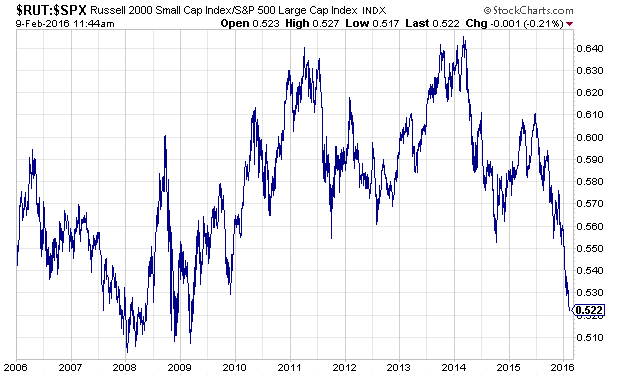
Eddy Elfenbein, February 9th, 2016 at 11:52 amHere’s a look at the relative strength of the small-cap sector. This is an interesting sector to watch for a few reasons.
For one, the sector is skewed toward domestic manufacturers. As a result, it’s a good way to see the impact of the U.S. dollar on equities.
Also, small-caps had a long 15-year run of outperforming the market (1999 to 2014). That’s quite impressive. Of course, you don’t know when the cycle is over until after the fact.
I’m sure many investors thought the relative strength line would make a run at its February 2014 high. It hasn’t yet. Instead, the line has gone down, down and down. It really started to crumble after last June. I think it’s safe to say that this is a new cycle of small-cap underperformance.
The little stocks just ain’t popular.
-
Spotting a Bear
Eddy Elfenbein, February 9th, 2016 at 11:17 amAt U.S. News and World Report, Simon Constable writes on how to spot a bear market:
If stocks are in a bear market, the last thing investors need is to hear about it after the fact. It’s as unhelpful as being told, “You should have been here yesterday.”
The pullback in the Standard & Poor’s 500 index hasn’t yet reached the classic definition of a bear market, which is a decline of 20 percent or more. But by that measure, the drop is nearly here.
Are we headed for a bear market, and what should investors do? The answers are tricky.
Watch the bond market. “They just don’t announce bear markets,” says Eddy Elfenbein, who writes the Crossing Wall Street financial blog. But there are methods of detection.
Elfenbein says it’s a harbinger of a bear market when interest rates on two-year government securities are higher than those on 10-year Treasuries. That differential in interest rates encourages investors to pull their money from long-term investments, such as 10-year Treasuries and stocks, and instead earn better yields for a short-term investment in the two-year bonds.
“We are nowhere near that now,” he says. Two-year treasuries yield around 0.74 percent, versus 10-year notes that yield 1.87 percent. Longer-term investments, like stocks, still make sense.
While he doesn’t see a bear market now, Elfenbein says he likes to keep a famous and sobering investing quote from ace stock picker Peter Lynch in mind: “Far more money has been lost by investors preparing for corrections, or trying to anticipate corrections, than has been lost in corrections themselves.”
-
Morning News: February 9, 2016
Eddy Elfenbein, February 9th, 2016 at 7:05 amBritain’s Global Banking Hub Is Mostly Leery of an E.U. Exit
Global Bond Rally Near `Panic’ Level With Japan Yield Below Zero
Bonds Follow Bank of Japan Into Negative Territory
Russian Companies Rush to Return to Post-Sanctions Iran
Oil Supply Seen Outpacing Demand, Capping Price
Gold Weekly: Should You Join The Party?
Amazon Is Building Global Delivery Business to Take On Alibaba
Google CEO Pichai Receives Record $199 Million Stock Grant
Viacom To Sell Snapchat Ads In Multiyear Deal
CVS Health Meets 4Q Profit Forecasts
Geithner Gets JPMorgan Credit Line to Invest With Warburg Pincus
Sears Hometown Indicates That Sears Brand Name Could Be Worthless
Zenefits CEO Parker Conrad Resigns Amid Scandal
Howard Lindzon: Cash is King…and What Were The Signs of the Top?
Joshua Brown: Now We Separate the Pros From the Pretenders
Be sure to follow me on Twitter.
-
The S&P 500 Drops 1.42%
Eddy Elfenbein, February 8th, 2016 at 9:49 pmToday was a rotten day for the stock market, and an afternoon rally saved it from being even more rotten. The S&P 500 lost 1.42% on the day although at its lowest, the index was off by 2.74%.
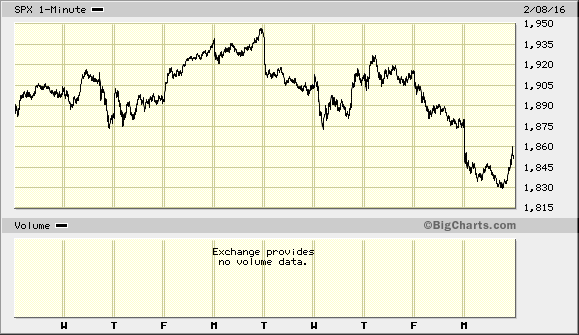
The Energy sector was the only sector to close in the green but that was by just 0.07%. Oil crossed above $30p per barrel. The big loser was the Materials sector which lost 2.71%. The Financials lost 2.64%. Many of the big banks did especially poorly today as a number of them hit their lowest point in more than two years. Citigroup and Bank of America were both off by more than 5%, and Morgan Stanley lost nearly 7%.
The pain in the big banks is being caused by an emerging banking mess in Europe. Several banks there have some bum energy loans so they need to ditch assets to raise capital. Deutsche Bank is going for about 30% of its book value.
The recent low for the S&P 500 came on January 20. Today’s low is still above that low, but the small-cap Russell 2000 did make a new two-and-a-half-year low.
The bond market did very well today. The 10-year yield dropped below 1.75%. The yield is near its low from almost exactly one year ago. The bond market has been creaming stocks over the last six weeks.
-
Cognizant Earned 80 Cents per Share for Q4
Eddy Elfenbein, February 8th, 2016 at 7:24 amThis morning, Cognizant Technology Solutions (CTSH) reported Q4 earnings of 80 cents per share which was two cents more than expectations. The company had previously said it expected earnings of at least 77 cents per share. Quarterly revenue rose 17.9% to $3.23 billion.
“We are pleased with our strong performance in 2015,” said Francisco D’Souza, CEO. “At a time when major technology shifts are disrupting all industries, clients are looking to a partner like Cognizant to work with them to create the winning business models of tomorrow at the intersection of the physical and digital worlds. Our investments in disruptive technologies, new business models and best-in-class delivery uniquely position us to enable clients to drive digital transformation at enterprise scale.”
For the year, Cognizant made $3.07 per share. Revenue rose 21.0% to $12.42 billion. A year ago, their initial guidance for 2015 was for earnings of at least $2.91 per share and revenue of at least $12.21 billion. Overall, 2015 was a very good year for CTSH.
Now for guidance. This is their first look at 2016. Cognizant sees Q1 earnings between 78 and 80 cents per share. For the year, CTSH expects earnings to range between $3.32 and $3.44 per share. That’s very light. In Friday’s newsletter, I said I was looking for something around $3.45 per share. Don’t worry. I think the company is lowballing expectations so they can raise them later on.
Cognizant expects Q1 revenue between $3.18 billion and $3.24 billion, and full-year revenue between $13.65 billion and $14.20 billion.
Update: CTSH is trading about 7% lower this morning.
-
Morning News: February 8, 2016
Eddy Elfenbein, February 8th, 2016 at 7:01 amOil Falls With Equities as Venezuela Tour Doesn’t Deliver Deal
China’s Foreign-Exchange Reserves Decline to $3.23 Trillion
National Bank Takes $119 Million Writedown on Maple Bank Inquiry
Yellen to Balance Confidence With Caution in Testimony
A Dying Breed: Currency Traders Are Left Out of New Wall Street
Net Neutrality Again Puts F.C.C. General Counsel at Center Stage
VW Plans to Make U.S. Diesel Owners an Offer They Can’t Refuse
LeapFrog to Be Acquired by VTech in Shake-Up for Toy Industry
EU Approves Schlumberger’s Cameron Takeover
U.N. Agency Seeks to End Rift on New Aircraft Emission Rules
Credit Suisse C.E.O. Asks for a Cut in His Bonus
Peyton Manning Just Gave Budweiser $3.2 Million in Free Ad Time
Bridgewater Executives Deny Report of Rift at the Hedge Fund
Jeff Miller: Is a Recession Looming?
Jeff Carter: Real Time Settlement, A Unique Piece of The BlockChain
Be sure to follow me on Twitter.
-
The Weakness in Semiconductors
Eddy Elfenbein, February 5th, 2016 at 8:44 pm -
January NFP +151K, Unemployment 4.9%
Eddy Elfenbein, February 5th, 2016 at 8:30 amThe February jobs report is out. Last month, the U.S. economy created 151,000 net new jobs. That’s not very strong. The unemployment rate dropped to 4.9%. That’s an eight-year low.
NFP growth has gradually decelerated for the last year.
-
Archives
- July 2026
- June 2026
- May 2026
- April 2026
- March 2026
- February 2026
- January 2026
- December 2025
- November 2025
- October 2025
- September 2025
- August 2025
- July 2025
- June 2025
- May 2025
- April 2025
- March 2025
- February 2025
- January 2025
- December 2024
- November 2024
- October 2024
- September 2024
- August 2024
- July 2024
- June 2024
- May 2024
- April 2024
- March 2024
- February 2024
- January 2024
- December 2023
- November 2023
- October 2023
- September 2023
- August 2023
- July 2023
- June 2023
- May 2023
- April 2023
- March 2023
- February 2023
- January 2023
- December 2022
- November 2022
- October 2022
- September 2022
- August 2022
- July 2022
- June 2022
- May 2022
- April 2022
- March 2022
- February 2022
- January 2022
- December 2021
- November 2021
- October 2021
- September 2021
- August 2021
- July 2021
- June 2021
- May 2021
- April 2021
- March 2021
- February 2021
- January 2021
- December 2020
- November 2020
- October 2020
- September 2020
- August 2020
- July 2020
- June 2020
- May 2020
- April 2020
- March 2020
- February 2020
- January 2020
- December 2019
- November 2019
- October 2019
- September 2019
- August 2019
- July 2019
- June 2019
- May 2019
- April 2019
- March 2019
- February 2019
- January 2019
- December 2018
- November 2018
- October 2018
- September 2018
- August 2018
- July 2018
- June 2018
- May 2018
- April 2018
- March 2018
- February 2018
- January 2018
- December 2017
- November 2017
- October 2017
- September 2017
- August 2017
- July 2017
- June 2017
- May 2017
- April 2017
- March 2017
- February 2017
- January 2017
- December 2016
- November 2016
- October 2016
- September 2016
- August 2016
- July 2016
- June 2016
- May 2016
- April 2016
- March 2016
- February 2016
- January 2016
- December 2015
- November 2015
- October 2015
- September 2015
- August 2015
- July 2015
- June 2015
- May 2015
- April 2015
- March 2015
- February 2015
- January 2015
- December 2014
- November 2014
- October 2014
- September 2014
- August 2014
- July 2014
- June 2014
- May 2014
- April 2014
- March 2014
- February 2014
- January 2014
- December 2013
- November 2013
- October 2013
- September 2013
- August 2013
- July 2013
- June 2013
- May 2013
- April 2013
- March 2013
- February 2013
- January 2013
- December 2012
- November 2012
- October 2012
- September 2012
- August 2012
- July 2012
- June 2012
- May 2012
- April 2012
- March 2012
- February 2012
- January 2012
- December 2011
- November 2011
- October 2011
- September 2011
- August 2011
- July 2011
- June 2011
- May 2011
- April 2011
- March 2011
- February 2011
- January 2011
- December 2010
- November 2010
- October 2010
- September 2010
- August 2010
- July 2010
- June 2010
- May 2010
- April 2010
- March 2010
- February 2010
- January 2010
- December 2009
- November 2009
- October 2009
- September 2009
- August 2009
- July 2009
- June 2009
- May 2009
- April 2009
- March 2009
- February 2009
- January 2009
- December 2008
- November 2008
- October 2008
- September 2008
- August 2008
- July 2008
- June 2008
- May 2008
- April 2008
- March 2008
- February 2008
- January 2008
- December 2007
- November 2007
- October 2007
- September 2007
- August 2007
- July 2007
- June 2007
- May 2007
- April 2007
- March 2007
- February 2007
- January 2007
- December 2006
- November 2006
- October 2006
- September 2006
- August 2006
- July 2006
- June 2006
- May 2006
- April 2006
- March 2006
- February 2006
- January 2006
- December 2005
- November 2005
- October 2005
- September 2005
- August 2005
- July 2005
 Eddy Elfenbein is a Washington, DC-based speaker, portfolio manager and editor of the blog Crossing Wall Street. His