Author Archive
-
Morning News: July 6, 2015
Eddy Elfenbein, July 6th, 2015 at 5:57 amGreece Debt Crisis: What Happens Now After Bailout Terms Rejected?
Greece Debt Crisis: Finance Minister Varoufakis Resigns
Dismay in European and Asian Markets After Greek Vote
Puerto Rico Shows Greece Needs €50 Billion A Year: And Would Still Fail Even Then
German Factory Orders Fell in May as Greece Damped Optimism
China’s Market Rout is a Double Threat
Can America’s Big Banks Get Less Complex?
U.S. Sided With Tax-Avoiding Companies Over Contracting Ban
Traders Recall the ‘Rush’ and ‘Roar’ as Famed Pits Close
Step Aside Black Friday – Meet Prime Day
With Merging of Insurers, Questions for Patients About Costs and Innovation
New Honda Chief Takahiro Hachigo Steers Away From Expansion
Philip Morris to Cut Stake in Indonesian Unit, Could Raise Over $1 Billion
Howard Lindzon: The Bombay Bubble? …Where the Hell is Bombay
Jeff Miller: Weighing the Week Ahead: Will FedSpeak Interrupt the Lazy, Hazy, Crazy Days of Summer?
Be sure to follow me on Twitter.
-
CWS Market Review – July 3, 2015
Eddy Elfenbein, July 3rd, 2015 at 7:08 am“Investors must keep in mind that there’s a difference between a good company and a good stock. After all, you can buy a good car but pay too much for it.” – Loren Fox
In last week’s CWS Market Review, I told you how calm and relaxed the market had become. It seemed like the market was taking it easy this summer. We hadn’t had a 2% drop all year.
Well, I guess I jinxed the market. Sure enough, on Monday, the S&P 500 not only dropped more than 2%, but the index had its worst daily fall in 17 months. Once again, investors were spooked by the unending mess in Greece. There’s a big yes-or-no national referendum scheduled for Sunday.
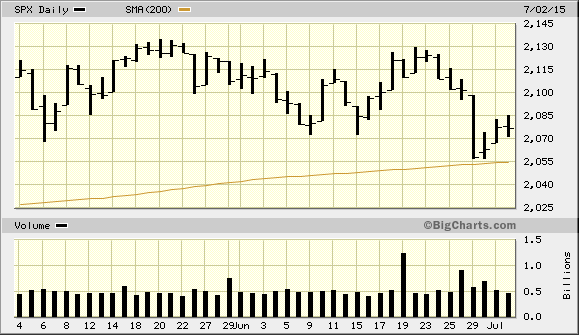
Once again, I’ll assure you not to worry about Greece. The simple version is that Wall Street doesn’t have much to focus on right now, so it’s giving outsized attention to Greece. Cullen Roche added some much-needed context by noting that Greece was defaulting on $1.6 billion. That’s equivalent to 30 hours’ worth of revenue for Walmart’s (WMT). The good news is that second-quarter earnings season starts next week, and we’ll finally have much more important news to digest.
In this week’s CWS Market Review, we’ll take a look at the upcoming earnings season and what it means for the market. I’ll also cover the latest news on the PayPal spinoff from eBay (EBAY). On July 20, PayPal will join our Buy List as a stand-alone company. I’ll also have the latest on Cognizant Technology (CTSH). The shares dropped on Thursday, but I don’t think it’s anything to worry about. Now let’s look at how well our Buy List did during the first half of 2015.
At the Halfway Marker, Our Buy List Is Beating the Market
I often tell investors not to stress out over short-term moves in the stock market. Viewed minute by minute, the market has a mind of its own. Investors need to understand that stocks fluctuate. Sometimes they go up for no good reason, and sometimes they go down for no good reason. To quote Hyman Roth, “this is the business we’ve chosen.” Only by taking the long view can you really take the measure of how well you’re doing.
On Tuesday, Wall Street closed the books on the first half of the year. In those six months, the S&P 500 gained a mere 0.20%. That’s the market’s worst first half since 2010. I’m please to report that our Buy List continues to outpace the rest of the market. The 20 stocks on our set-and-forget portfolio gained 3.02% for the first half of the year. Remember, that’s with making ZERO trades all year. (A mutual fund company would probably advertise our numbers as beating the market by 15 to 1.)
Once we include dividends, our Buy List gained 3.59% for the first half of the year. With dividends, the S&P 500 gained 1.22%. Roughly speaking, our Buy List yields about 1.1% annually, while the S&P 500 yields about 2%. (I can’t give an exact figure, since our dividends are probably growing faster than the rest of the market.)
Last year, our Buy List lost to the market (11.80% to 13.69%). That broke our streak of beating the S&P 500 for seven years in a row. I started the Buy List to show ordinary investors that with patience and a little discipline, you can consistently beat Wall Street over the long haul. So far, we’re on our way towards beating the market yet again. Patience and discipline are still the keys. Now let’s look at the upcoming earnings season.
Q2 Earnings Season Begins Next Week
On Wednesday, July 8, Alcoa (AA) will officially kick off Q2 earnings season when it reports. Over the next five weeks, 16 of our 20 Buy List stocks will report sales and earnings for the second three months of the year. A few will also update their guidance for the rest of the year. The first Buy List stock to report will be Wells Fargo (WFC) which is scheduled to report on Tuesday, July 14. I’ll preview more of our earnings reports in upcoming issues.
You’ll notice that many of our stocks offer sales and earnings guidance. Bear in mind that companies aren’t required to do this. It’s generally a sign of a better-run company that it tells investors what their goals are for the future.
Wall Street currently expects the S&P 500 to earn $28.42 per share for Q2. (That’s the index-adjusted number. Every one point in the S&P 500 is worth about $8.83 billion.) As with most quarters, analysts have been paring back their estimates. At the start of the year, Wall Street had expected Q2 earnings of $32.36 per share. But as investors realized the full scope of the damage caused by the surging dollar, Wall Street lowered its estimates. The continued impact of the dollar is one of the open questions for this earnings season. Wall Street had overestimated the damage done during Q1.
If Wall Street’s estimate for Q2 is accurate, then this will be the third quarter in a row of declining earnings. As this “earnings recession” began, there was a lot of fear that it would turn into a broader economic recession. Now that we have more data, it appears to be a minor blip within a favorable climate of rising sales and earnings. In fact, earnings are projected to increase slightly in Q3, and for Q4, Wall Street expects earnings growth of more than 17%.
I should also mention that dividends continue to grow very nicely. The S&P 500 saw dividend growth of nearly 10% during Q2. That means that despite many pronouncements of a stock-market bubble, dividends have actually been growing faster than stock prices, and the market’s dividend yield is rising, not falling.
We got more mildly positive news on Thursday, when the government said that the economy created 223,000 net new jobs in June. That was a bit below consensus, but basically it was what the market had been expecting, although the numbers for April and May were revised lower. The unemployment rate dipped to 5.3%, which is the lowest since April 2008. Part of the reason for the lower jobless rate is that more people are leaving the job market. The workforce participation is now at a 38-year low, but some of that is due to demographics (all those retiring Baby Boomers).
The bad news was that average hourly earnings were unchanged. Frankly, wage growth has been weak. What this means is that there’s less pressure on the Fed to raise rates soon. Bill Dudley, the Grand Poobah of the New York Fed, recently said the Fed could increase rates in September. Call me a doubter. The futures market currently thinks there’s a 50-50 chance the Fed will raise interest rates at their December meeting. That sounds about right.
The important takeaway from this jobs report is that there’s a lot of “slack” in the labor market. In previous recoveries, economists had assumed that inflation would start creeping up once unemployment hit 5.5% or so. That’s just not true anymore. In fact, I wouldn’t be surprised if the tipping point is now below 5%. That’s the thing about financial crises—the old rules no longer apply. The U.S. economy is nowhere close to full capacity. That’s good news for stock investors.
There was also mildly good news with the ISM Manufacturing report. The index came in at 53.8. That’s the second monthly increase in a row. It’s also the 30th month in a row that the ISM report topped 50, which indicates an expanding manufacturing sector. The Commerce Department also said that construction spending rose 0.8% in May. It’s now at a 6-1/2-year high. I hate to sound like a careless optimist, but I think Q2 GDP will be one of the best reports in years.
eBay to Spinoff PayPal On July 20
Mark your calendars for Monday, July 20. That’s when eBay (EBAY) will finally spin off PayPal. Technically, the shares will be “distributed” on Friday, July 17, but they won’t start trading until the following Monday.
If you’re an eBay shareholder, you’ll automatically get one share of PayPal for each share of eBay you own as of the close of business on July 8. The ticker symbol for PayPal will be PYPL.
Now there’s the issue of how much PayPal is worth. That’s a toughie. I won’t make a prediction on that, but most market watchers think PayPal will start trading around $35 per share. That would mean that eBay’s stock, without PayPal, will drop to around $26 per share. Remember, you’re not losing anything. You’re gaining a new stock.
To help make the adjustment smoother, “when-issued” shares of PayPal and eBay sans PayPal will start trading on Monday July 6. When-issued shares are for deals that have been announced but haven’t yet been consummated. They’re useful for gauging the market’s interest in the deal. But don’t worry about the when-issued shares. I just wanted you to be aware of what’s going on when you see them. You won’t get your PayPal shares for a few more days.
Overall, I think this is a very good deal for shareholders. I also think there’s a good chance that PayPal will be snapped up quickly by a large finance or tech company. I’m looking at you, Amazon (AMZN)!
Until then, PayPal will join our Buy List as the 21st stock. Just like the others, it’s locked and sealed for the rest of the year. I won’t have a Buy Below on PayPal until the deal is complete. I’ll also provide all the details on how we’ll account for the spinoff on our track record. eBay will report Q2 earnings, its last as a combined unit, on Thursday, July 16. Look for a good report.
Before I go, I want to highlight a few of our Buy List stocks that look especially attractive at the moment. I like Cognizant Technology (CTSH), especially below $62 per share. The shares got nicked on Thursday after Centene said it was buying Health Net, which is a partner with Cognizant. That deal would cost Cognizant $100 million in revenue, but the company was quick to reiterate its full-year guidance for earnings of at least $2.93 per share.
Microsoft (MSFT) also looks quite good if you can get it below $45 per share. The shares yield 2.8%, and I expect another dividend increase later this year.
Signature Bank (SBNY) looks good below $147 per share. Here’s a recent profile of the bank by Alyssa Oursler.
Wabtec (WAB) has pulled back recently, and I think it’s a solid value here. WAB is especially attractive below $95 per share. The company recently raised its dividend by 33%.
That’s all for now. The stock market is closed on Friday, July 3, so investors can enjoy a three-day holiday weekend. Expect some drama next week. I didn’t talk much about Greece in this issue, but the big referendum is scheduled for Monday. It’s a lot of sound and fury and doesn’t signify all that much. Still, traders will look for any excuse to buy or sell. The big news will be the start of earnings season on Wednesday. Also on Wednesday, the Fed will release the minutes of its last meeting. That may contain clues as to what the central bankers are thinking. Be sure to keep checking the blog for daily updates. I’ll have more market analysis for you in the next issue of CWS Market Review!
– Eddy
-
Morning News: July 3, 2015
Eddy Elfenbein, July 3rd, 2015 at 5:17 amGreeks Split Down Middle Before Bailout Referendum
Why A Troubled Greece Is A Boon For Germany and Euro
Euro-Area Economy Shakes Off Greek Shackles on Draghi Stimulus
China Tells Investors: Go Ahead, Bet the House on Stocks
U.S. Economy Adds 223,000 Jobs; Unemployment at 5.3%
Oil Oversupply Meets Rising Demand in Quietest Market Since 2013
BP’s $18.7 Billion Oil-Spill Deal Still Leaves Lesser Messes
Obamacare Cash Drives Healthcare Merger Mania
Aetna Agrees to Buy Humana for $37 Billion in Cash, Stock
Biogen to Pay Applied Genetic $124 Million to Develop Eye-Disease Treatments
Dollar Tree and Family Dollar Will Sell 330 Stores to Seal Merger Deal
Warren Buffett Will Celebrate July 4th With A New Stock: The Kraft Heinz Company
Employers Have Greater Leeway on Unpaid Internships, Court Rules
Roger Nusbaum: All That Crap About Not Panicking?
Cullen Roche: Should Money Earn Interest? (Very Nerdy)
Be sure to follow me on Twitter.
-
Cognizant Down on Health Net Acquisition
Eddy Elfenbein, July 2nd, 2015 at 9:58 amShares of Cognizant Technology (CTSH) are down about 5% after Centene said it’s going to buy Health Net for $6.3 billion. Health Net has been a key partner for Cognizant.
Cognizant released a statement:
Health Net Relationship
“Today’s announcement by Health Net and Centene is yet another example of how the healthcare landscape is rapidly changing, with increasing focus on medical costs, consumerization and a changing regulatory environment driving consolidation as well as an ongoing search for solutions that fundamentally change the business model and economics of healthcare management,” said Gordon Coburn, President, Cognizant. “As we congratulate Health Net and Centene today, we look forward to continuing to partner with them to support their technology and operations requirements.”
Key updates on the relationship include:
Cognizant remains a key strategic technology and operations partner to Health Net, with the existing relationship being extended through the end of 2020 with a total contract value of approximately $520 million. This will provide ongoing support of critical Health Net applications and processes.
The planned implementation of a seven-year master services agreement for end-to-end administrative services between Cognizant and Health Net, first announced in August 2014 and scheduled to begin in mid-2015, is being deferred while Health Net and Centene complete the merger review and approval process. Cognizant expects that if the merger of Health Net and Centene is completed, the existing master services agreement will not be implemented as there will likely be overlaps in services and capabilities planned to be provided by Cognizant.
Cognizant has negotiated the right to license certain Health Net intellectual property for incorporation into its healthcare management solutions and as-a-service platforms.
Coburn, added, “With our extensive healthcare expertise and 2014 acquisition of healthcare software leader TriZetto, Cognizant is well positioned to capitalize on the dynamic healthcare market and offer solutions that help payers and providers evolve as a digital enterprise and change their cost structures to address customer needs and meet regulatory requirements.”
Cognizant also reiterated their full-year guidance of revenue of at least $12.34 billion and adjusted EPS of at least $2.93.
“Despite the anticipated loss of approximately $100 million in incremental revenues during the second half of 2015, we are pleased to reaffirm our guidance for the year due to continued strong demand and projected over-performance in other parts of our business. Today’s announcement by Health Net will not impact our ability to achieve our goals for the year,” said Karen McLoughlin, Chief Financial Officer, Cognizant.
-
June NFP +223K
Eddy Elfenbein, July 2nd, 2015 at 9:00 amLast month, the U.S. economy created 223,000 net new jobs. The unemployment rate dropped to 5.3%. That’s the lowest since April 2008.
The reports for April and May were revised lower by 60,000.
The labor force participation rate fell to 62.6%. That’s the lowest in nearly 40 years.
-
Morning News: July 2, 2015
Eddy Elfenbein, July 2nd, 2015 at 7:18 amBattle for Greek Votes Under Way as Cash Shortages Bite
Defiant Varoufakis Says He’ll Quit If Greeks Endorse Austerity
China Relaxes Margin Rules as Share Prices Fall
R.B.S. to Reduce Cash Management Operations Outside Britain and Ireland
ADP Reports 237,000 Jobs Added by Businesses in June
Export-Import Bank’s Expiration a Victory For Billionaire Koch Brothers
Centene to Buy Health Net for $6.8 Billion in Shares, Cash
Spanish Language Network Univision Files For U.S. IPO
Tesla Beats Delivery Forecast With 52% Quarterly Surge
Can Xiaomi Reach Its Bold 2015 Sales Target?
Whole Foods Co-CEOs Admit To Overcharging Customers
Gerson Lehrman Seeks New Image as Investor Cashes Out
Credit Writedowns: Greek Default
Joshua Brown: Grantham: “People Respond To The Incentives They’re Given”
Be sure to follow me on Twitter.
-
June ISM = 53.5
Eddy Elfenbein, July 1st, 2015 at 11:17 amWelcome to the back half of the year. The S&P 500 rose just 0.2% during the first six months of the year. That’s the worst start since 2010. Let’s hope the rest of the year is better. Today’s ISM Manufacturing report came in at 53.5. That’s still well within the safe zone.
ADP said that the economy created 237,000 new private sector jobs last month. Not bad. The big June jobs report comes out tomorrow.
The Commerce Department said that construction spending rose 0.8% in May. It’s now at a 6-1/2 year high.
The S&P 500 bounced off Monday and Tuesday’s low, and is nicely higher today. The index bottomed out at 2,056.64 on Monday and 2,056.32 on Tuesday.
-
Morning News: July 1, 2015
Eddy Elfenbein, July 1st, 2015 at 7:08 amGreece Compromise Bid Faces Resistance as Trust Fades
Tsipras Signals Greece May Accept Bailout Terms
Sterling Dips After UK Manufacturing PMI Survey Misses Forecasts
Chinese Markets Fall Again, Ignoring Beijing’s Efforts to Soothe Them
Hedge Funds Fight to Save Puerto Rico Investments
Leon Black’s Sell-Everything Call Has Been Heard by His Rivals
Deutsche Bank’s Cryan Signals Cuts to Jain’s Trading Empire
ACE Agrees to Buy Chubb for $28.3 Billion
General Mills’s Revenue Growth Weaker Than Expected
MasterCard Stops Processing Purchases of Ads on Backpage.com
JPMorgan Builds Up Apartment-Loan Leader From WaMu Rubble
Jailed American Executive Resigns From Toyota
Jeff Carter: Greece: How Did We Get Here?
Cullen Roche: The USA Is Not Turning Into Greece
Be sure to follow me on Twitter.
-
The Halfway Point
Eddy Elfenbein, June 30th, 2015 at 5:02 pmThe first half of 2015 is officially on the books.
For the first six months of this year, our Buy List has crushed the S&P 500 by a ratio of 15 to 1!!
Well, technically.
Our Buy List is up 3.02% YTD while the S&P 500 has gained a meager 0.20%.
Including dividends, our Buy List was up 3.59% while the S&P 500 with dividends gained 1.22%.
Here’s how each of our stocks has performed. I’ve included the price gain and the dividend-adjusted gain.
Symbol Price Gain With Dividend FISV 16.71% 16.71% SNA 16.46% 17.29% SBNY 16.22% 16.22% CTSH 16.01% 16.01% WAB 8.46% 8.60% HRL 8.20% 9.20% EBAY 7.34% 7.34% ESRX 5.04% 5.04% ROST 3.14% 3.62% BLL 2.90% 3.28% WFC 2.59% 3.97% BCR 2.45% 2.71% AFL 1.82% 3.10% SYK 1.31% 2.06% F -3.16% -1.25% MOG-A -4.53% -4.53% MSFT -4.95% -3.64% BBBY -9.44% -9.44% ORCL -10.38% -9.82% QCOM -15.74% -14.66% Why Signature Bank Can’t Be Beat
Eddy Elfenbein, June 30th, 2015 at 11:20 amWhy Signature Bank Can’t Be Beat
by Alyssa Oursler
The financial sector has been slightly outperforming the market over the last 12 months and has been regaining strength dramatically since the financial crisis hit in 2008. Many of the biggest banks have bounced back from near death, posting improvements in earnings and asset quality recently. But some small banks have been regaining strength as well — and one small bank in particular barely took a beating even during the crisis, which sheds light on just how strong it is. Signature Bank (SBNY) is on the Crossing Wall Street buy list and has been blowing away rivals since going public in 2004.
For background, Signature is a full-service commercial bank with 27 private client offices located throughout the New York metropolitan area. That might not sound that impressive, but that niche has bred success for Signature, The key that sets the bank apart is the fact that it’s built on people, not on buzz.
As a Crain’s New York feature showcased, “Signature has secured a reputation in its field as a place where seasoned bankers want to work … Signature’s success stems from management recruiting groups of experienced business bankers, from rivals like Citibank and HSBC, who bring clients with them.” In fact, Signature’s CEO told Aaron Elstein at Crain’s: “It’s true we aren’t in the headlines much. I don’t mind.” He prefers to focus on hiring the best people as opposed to grabbing media attention.
That might sound fluffy as an investment thesis, but it trickles down to the tangible. See, the bank also offers these top-notch employees a large amount of freedom in how they work with clients, which has been a recipe for success. Of its $14 billion in loans, only 0.25% are more than 90 days delinquent. That’s 10% of the industry average. Signature also spends a mere 36 cents to generate each dollar in revenue — overhead that is 40% below the industry average. For the cherry on top, it boasts a 14% return on equity, which is 4 percentage points above the industry average.
Put another way, SNL Financial recently ran some numbers on the 100 largest banks in the U.S., looking at asset quality, capital adequacy and profitability to gauge the best and worst banks. And you guessed it — SBNY was top of the charts thanks to strong fundamentals on top of impressive growth potential for the NYC market. As Kurt Badenhausen noted for Forbes, “There are $1.4 trillion in deposits in New York banks, almost three times the next biggest metro of Philadelphia.”
Those qualities also make Signature Banks a textbook example of the Crossing Wall Street investing philosophy of buying and holding shares of outstanding companies. During the past decade, Signature Bank has posted 15 consecutive quarters of record diluted earnings per share, while shares of SBNY are up 17% year-to-date and 284% over the last five years. Since going public, Signature is the top-performing bank stock. Their return has more than lapped the second-best performing bank.
Of course, with such head-turning outperformance, it’s fair to be concerned about buying at a top. While the question remains whether Signature Bank can maintain this sizzling upwards trend, the analyst community is bullish, to say the least. Zack’s Investment Research just upgraded SBNY assigning it a $166 price target — good for 12% upside. Earlier this month, Guggenheim raised its price target from $155 to $165 and gave Signature a buy rating.
Plus, estimates for the current quarter and full year’s earnings have been moving in the right direction. Three months ago, analysts were expecting $1.65 per share for the current quarter, while they’ve tacked four pennies onto that number recently — good for double-digit year-over-year growth. Things are even sweeter for the full year; analysts have upped estimates from $6.80 to $6.95 per share, good for year-over-year growth of nearly 17%.
That growth is the reason why, despite the consistent upwards trend, Signature Bank shares aren’t extremely overpriced. The bank is slated for consistent earnings improvements, too, including 13% annual earning growth over the next five years. That’s better than the industry and nearly twice the expected growth for the broader market … which is especially impressive considering the growth it’s building upon.
Meanwhile, the stock just hit a new lifetime high yet is still trading for just 18 times forward earnings. While that’s a slight premium to the 13% growth on tap, it’s worth it considering the track record. Investors are shelling out a slight premium for a company that’s fundamentally sound and has proven itself as a long-term hold … but that also has impressive momentum. Put another way, SBNY is appealing to a wide variety of investors, which should provide further fuel to keep the stock moving higher.
All in all, Signature Bank is a signature buy. Between rock-solid fundamentals, a mouthwatering track record and a strong outlook, there’s no reason to think SBNY won’t continue to blow away both the financial sector and the broader market in years to come.
Alyssa Oursler is based in San Francisco and writes about technology, investing, gender and entrepreneurship. Her work has appeared on Business Insider, MSN Money, InvestorPlace and more. You can follow her on Twitter here or check out her personal site here. As of this writing, she did not hold a position in any of the aforementioned securities.
-
Archives
- June 2026
- May 2026
- April 2026
- March 2026
- February 2026
- January 2026
- December 2025
- November 2025
- October 2025
- September 2025
- August 2025
- July 2025
- June 2025
- May 2025
- April 2025
- March 2025
- February 2025
- January 2025
- December 2024
- November 2024
- October 2024
- September 2024
- August 2024
- July 2024
- June 2024
- May 2024
- April 2024
- March 2024
- February 2024
- January 2024
- December 2023
- November 2023
- October 2023
- September 2023
- August 2023
- July 2023
- June 2023
- May 2023
- April 2023
- March 2023
- February 2023
- January 2023
- December 2022
- November 2022
- October 2022
- September 2022
- August 2022
- July 2022
- June 2022
- May 2022
- April 2022
- March 2022
- February 2022
- January 2022
- December 2021
- November 2021
- October 2021
- September 2021
- August 2021
- July 2021
- June 2021
- May 2021
- April 2021
- March 2021
- February 2021
- January 2021
- December 2020
- November 2020
- October 2020
- September 2020
- August 2020
- July 2020
- June 2020
- May 2020
- April 2020
- March 2020
- February 2020
- January 2020
- December 2019
- November 2019
- October 2019
- September 2019
- August 2019
- July 2019
- June 2019
- May 2019
- April 2019
- March 2019
- February 2019
- January 2019
- December 2018
- November 2018
- October 2018
- September 2018
- August 2018
- July 2018
- June 2018
- May 2018
- April 2018
- March 2018
- February 2018
- January 2018
- December 2017
- November 2017
- October 2017
- September 2017
- August 2017
- July 2017
- June 2017
- May 2017
- April 2017
- March 2017
- February 2017
- January 2017
- December 2016
- November 2016
- October 2016
- September 2016
- August 2016
- July 2016
- June 2016
- May 2016
- April 2016
- March 2016
- February 2016
- January 2016
- December 2015
- November 2015
- October 2015
- September 2015
- August 2015
- July 2015
- June 2015
- May 2015
- April 2015
- March 2015
- February 2015
- January 2015
- December 2014
- November 2014
- October 2014
- September 2014
- August 2014
- July 2014
- June 2014
- May 2014
- April 2014
- March 2014
- February 2014
- January 2014
- December 2013
- November 2013
- October 2013
- September 2013
- August 2013
- July 2013
- June 2013
- May 2013
- April 2013
- March 2013
- February 2013
- January 2013
- December 2012
- November 2012
- October 2012
- September 2012
- August 2012
- July 2012
- June 2012
- May 2012
- April 2012
- March 2012
- February 2012
- January 2012
- December 2011
- November 2011
- October 2011
- September 2011
- August 2011
- July 2011
- June 2011
- May 2011
- April 2011
- March 2011
- February 2011
- January 2011
- December 2010
- November 2010
- October 2010
- September 2010
- August 2010
- July 2010
- June 2010
- May 2010
- April 2010
- March 2010
- February 2010
- January 2010
- December 2009
- November 2009
- October 2009
- September 2009
- August 2009
- July 2009
- June 2009
- May 2009
- April 2009
- March 2009
- February 2009
- January 2009
- December 2008
- November 2008
- October 2008
- September 2008
- August 2008
- July 2008
- June 2008
- May 2008
- April 2008
- March 2008
- February 2008
- January 2008
- December 2007
- November 2007
- October 2007
- September 2007
- August 2007
- July 2007
- June 2007
- May 2007
- April 2007
- March 2007
- February 2007
- January 2007
- December 2006
- November 2006
- October 2006
- September 2006
- August 2006
- July 2006
- June 2006
- May 2006
- April 2006
- March 2006
- February 2006
- January 2006
- December 2005
- November 2005
- October 2005
- September 2005
- August 2005
- July 2005
 Eddy Elfenbein is a Washington, DC-based speaker, portfolio manager and editor of the blog Crossing Wall Street. His