Author Archive
-
Top Hedge Fund Managers Did Well Even if Their Funds Did Not
Eddy Elfenbein, May 5th, 2015 at 3:10 pmThe New York Times noted that many leading hedge fund managers did very well last year, even though many of their funds did not.
The top 25 hedge fund managers reaped $11.62 billion in compensation in 2014, according to an annual ranking published on Tuesday by Institutional Investor’s Alpha magazine.
That collective payday came even as hedge funds, once high-octane money makers, returned on average low-single digits. In comparison, the benchmark Standard & Poor’s 500-stock index posted a gain of 13.68 percent last year when reinvested dividends were included.
(…)
Still, what makes such nine- and 10-figure paychecks remarkable for 2014 is that many of the top earners had mediocre performances at best. Only half of the top 10 earners recorded returns that exceeded that of the S.&.P 500.
For investors, 2014 was the sixth consecutive year that hedge funds have fallen short of stock market performance, returning only 3 percent on average, according to a composite index of 2,200 portfolios collected by HFR, a firm that tracks the industry. Hedge funds are lightly regulated private pools of capital open to institutional investors like pension funds, university endowments and wealthy investors.
The article contains the phrase “declined to comment” seven times.
-
The Flash Crash Five Years On
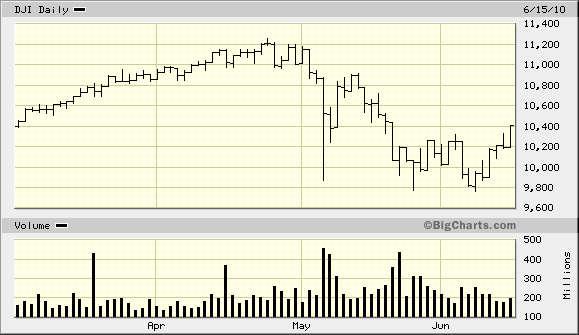
Eddy Elfenbein, May 5th, 2015 at 11:15 amFive years ago tomorrow, specifically at 2:42 pm, the stock market crashed and no one really knows why. Just as quickly as the market fell, it came back to mostly erase those gains.
Here’s what it looked like on CNBC:
The big drops stands out here:
But not so much in the long-term view:
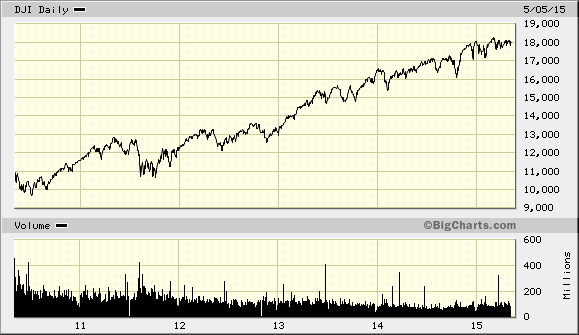
Measuring from the close the day before the Flash Crash to yesterday’s close, the S&P 500 has gained 81.4%. The S&P 500 Total Return Index is up 101.5%.
-
The Fancy Casual Rally
Eddy Elfenbein, May 5th, 2015 at 10:23 amShares in several “fancy” fast food stocks have done very well recently. There are more IPOs on the way including Fogo de Chao, a personal favorite. This Reuters article is worth quoting extensively:
Investors seem willing to pay just about anything for a better burger.
Half a dozen food chains have held piping-hot stock market debuts in the past year to meet a growing appetite for “fast-casual” restaurants catering to younger and more affluent diners willing to pay more for fresher, higher quality fare than they expect to find at traditional fast food places like McDonald’s.
Wall Street hopes the new crop of publicly traded eateries will replicate the success of Chipotle Mexican Grill Inc (CMG), which has grown to about 1,800 restaurants since its 2006 debut. With consumer spending showing signs of improvement and more diners keen on antibiotic-free meats and other healthy foods, now is a great time for restaurants in that niche, especially ones adept at building grass-roots buzz and loyalty, experts said.
But investors have pushed the shares of some of those restaurants – Shake Shack Inc (SHAK), Zoe’s Kitchen Inc (ZOES) and Habit Restaurants Inc (HABT) – to sky-high levels that imply growth expectations that may prove hard for the management to deliver.
Shake Shack – the big outperformer – is up 260 percent since it went public at the end of January. As a group, shares of established restaurant companies have outperformed the broader stock market exponentially, with the Dow Jones U.S. Restaurants & Bars Index .DJUSRU (which doesn’t include these newcomers) rising 11 percent this year, compared with the Standard & Poor’s 2 percent increase.
Based on the number of locations open at the end of 2014, Shake Shack’s current stock price values its restaurants at $40 million each, four times the stock market value of a Chipotle restaurant and 15 times the value investors assign to a McDonald’s Corp (MCD) restaurant.
Brad Lamensdorf, who co-manages the AdvisorShares Ranger Equity Bear ETF (HDGE), said he would short Shake Shack’s shares, except that his broker has none left after lending his last at a staggering 65 percent annual interest rate. At that rate, short sellers would have to pay out more than 5 percent of their investment every month while waiting for Shake Shack’s stock to fall, which may not happen.
“Just because a stock looks expensive doesn’t make it a great short. It’s way too expensive to borrow,” Lamensdorf said, adding it might become more feasible in July after insiders restricted following Shake Shack’s January IPO are allowed to sell their shares. Almost 40 percent of Shake Shack’s shares are currently short-sold.
Lamensdorf is also shorting Chipotle, betting that the company’s expansion is about to lose steam. Chipotle is down 7 percent so far in 2015. Another fast-casual chain, Buffalo Wild Wings, is down 13 percent, with investors concerned about slowing growth momentum at both chains.
And some may already have lost their luster: Shares of Chicago-based sandwich chain Potbelly Corp more than doubled in their first trading session after its IPO in 2013. But since then, the company’s growth has failed to impress investors and its stock sells now for about a dollar more than the $14 a share it fetched when it first went public.
More fast-casual restaurant IPOs are in the works. Nashville, Tennessee-based J. Alexander’s Holdings Inc and Fogo de Chao, a steakhouse chain offering 20 cuts of meat in Brazilian-style tableside barbecue service, have both filed with U.S. regulators for IPOs.
Habit, which opened in 1969 and is known in California for its charburgers, is up 120 percent since its November IPO. Zoe’s Kitchen, which serves Mediterranean cuisine with Southern hospitality, has doubled since its IPO in April 2014.
High prices for the newly listed stocks reflect a scarcity of high-growth restaurants to invest in as well as Wall Street’s confidence in companies’ management teams, said Piper Jaffray analyst Nicole Miller Regan, who has “overweight” ratings on Zoe’s and Habit and does not cover Shake Shack.
“Look at Chipotle. It’s not a burrito company, it’s an ATM,” Miller Regan said. “I don’t care what cuisine you put through there – it’s a phenomenal return.”
Shake Shack’s PEG ratio (price/earnings over its expected next year’s growth – a measure of a stock’s value that accounts for expected profit growth), is 156 compared to 1.6 for Chipotle. Lower PEGs suggest cheaper stocks. Zoe’s PEG is 2.5 and Habit stands at 4.6. By comparison, Internet giant Twitter Inc (TWTR.N) has a PEG of just 0.8, suggesting it is well priced for its expected growth.
(…)
To justify its recent stock price, Shake Shack would need to establish more than 400 company-run or franchised restaurants within about five years, estimated Georgetown University business professor James Angel.
With a new location in Austin, Texas, Shake Shack now has 68 restaurants in the United States and other countries; it has said it plans to open at least 10 domestic locations annually and expand abroad.
Shake Shack, which says its key to success is a culture of “enlightened hospitality,” is a master of word-of-mouth marketing. It has more than 1,800 Instagram followers for every $1 million spent across its locations, compared with 11 for McDonald’s Corp (MCD.N) and 60 for Taco Bell, a fact that Goldman Sachs has cited as helping build loyalty among millennials.
-
Morning News: May 5, 2015
Eddy Elfenbein, May 5th, 2015 at 7:06 amEU Commission Sharply Cuts Greek Surplus Forecasts
Forget Tanks. Russia’s Ruble Is Conquering Eastern Ukraine
The Bloom Is Off The Chinese Rose
Australia’s RBA Cuts Rates, Markets Wonder If That’s All
Venezuela’s Economy Suffers as Import Schemes Siphon Billions
Central Bankers Reconsider Inflation Targets They Can’t Hit
Why Elizabeth Warren Makes Bankers So Uneasy, and So Quiet
HSBC Profit Up Slightly on Market Uptick in First Quarter
Adidas’ Upswing Continues Thanks to New Focus on Urbanites
Lufthansa Says to Restart Plan For Hybrid Bond
GE Hooks Up With Qualcomm and Apple for Smart Lighting
Marcellus Shale Extraction Fluids Discovered in 3 Water Samples
Los Angeles Sues Wells Fargo, Alleges Unlawful Conduct
Jeff Carter: History Doesn’t Repeat Itself, But Echoes
Roger Nusbaum: Poland Has Negative Yields?
Be sure to follow me on Twitter.
-
Ndamukong Suh Arm Wrestles Warren Buffett
Eddy Elfenbein, May 4th, 2015 at 3:46 pm -
Cognizant Earns 71 Cents per Share
Eddy Elfenbein, May 4th, 2015 at 8:02 amGood news this morning from Cognizant Technology Solutions (CTSH). The company earned 71 cents per share last quarter, one penny more than estimates. Their guidance was for EPS of at least 69 cents per share. (CTSH is a fan of using “at least” in their forecasts.) Revenue rose 20.2% to $2.91 billion. Guidance was for at least $2.88 billion.
“The clients we serve are experiencing tremendous change in their businesses and are increasingly turning to Cognizant to navigate that change,” said Francisco D’Souza, Chief Executive Officer of Cognizant. “The investments we have made in digital, automation, utility-based delivery models, consulting and industry-specific expertise are clearly paying off. Given how fast the landscape is changing, clients typically don’t have the skillsets to manage this transformation in-house and are turning to Cognizant to help them re-architect their core business and organizational models. As a result, we’re building deeper relationships with CEOs and boards, CIOs, and business and functional leaders to help them transform their businesses into digital enterprises.”
“The Cognizant approach of helping clients from setting strategy, to implementing and maintaining technology, to transforming and running business operations is enabling us to establish greater mindshare and market leadership,” said Gordon Coburn, President. “It’s evident across all geographies and industries that businesses are being forced to manage growth, innovation and scale while simultaneously managing costs. The shift to a digital enterprise is driving greater demand for our traditional services and solutions as clients find the need to keep pace with the speed and scale of innovation and maintain their competitive advantage.”
For Q2, the company sees earnings of at least 72 cents per share on revenue of at least $3.01 billion.
For the whole year, they see earnings of at least $2.93 per share. That’s an increase of two cents per share from their earlier guidance. They increased their revenue guidance from at least $12.21 billion to at least $12.24 billion.
Overall, this was a very good earnings report.
-
Morning News: May 4, 2015
Eddy Elfenbein, May 4th, 2015 at 7:08 amDraghi Starting Euro Bond Buying Turns Out Not to Be One-
Greek Jobless Legacy Adds to Danger for Tsipras as Funds Dwindle
Long Before British Vote, Financiers Weigh In
China April HSBC PMI Shows Biggest Drop in Factory Activity In A Year
Oil Prices Rise, Hovering Just Below Multiyear Highs
Takeover Fuel Begins to Flow as S&P 500 Bull Run Makes History
Comcast Profit Beats Estimates on Internet, Enterprise Growth
Cognizant Profit Rises on Double-Digit Gains in Health Care
McDonald’s Puts Its Plan on Display
Tesla Is Facing Stiff Competition In Its Plan To Generate New Revenue Through Batteries
GM Cuts Price On Next-Gen 2016 Chevrolet Volt: Will It Move The Needle?
The Truth About ‘Sell in May and Go Away’
Buffett Celebrates 50th Year at Berkshire, Faces Tough Crowds
Cullen Roche: How Warren Buffett’s Misunderstanding of QE Left Billions on the Table
Jeff Miller: Can Employment News Change the Fed’s Course?
Be sure to follow me on Twitter.
-
Wabtec Jumps on New Rules
Eddy Elfenbein, May 1st, 2015 at 11:42 amWabtec (WAB) is up strongly today. WSJ reports.
U.S. transportation regulators Friday will issue tough new rules for railroads hauling crude oil and ethanol that will require trains be equipped with expensive new brake systems, according to a person familiar with the rules.
The regulations will also require that sturdier tank cars be built for hauling oil, ethanol and other flammable liquids and prescribes upgrades for an estimated 154,500 tank cars already carrying flammables.
The person familiar with the new tank car rules said that trains carrying large volumes of crude oil will be restricted to 30 mile an hour speeds if they don’t have new electronic brakes installed by 2021. Other flammable liquids, including ethanol in high volumes would be speed-restricted after 2023.
The rules, which will be unveiled Friday in a joint announcement by U.S. and Canadian regulators, were tougher than expected. The electronically controlled pneumatic brakes deploy faster than the air brakes now used on freight trains.
Freight railroads maintain that installing them on existing railcars and locomotives would be prohibitively expensive and take years of work fully implement. The cost of installing ECP brakes on an existing railcar is estimated at $8,000 to $10,000, according to rail industry consultants. It wasn’t immediately clear whether Canadian regulators will also require electronic brakes.
The decadelong phase-in requirement for upgrading tank cars already in service is double the time originally suggested by U.S. transportation regulators for completing retrofits. Transportation safety advocates and railcar builder Greenbrier Cos. have said that 10 years is too long and have urged that older cars be upgraded or removed from service sooner.
Several fiery crashes of crude-oil trains, including four this year alone, have ratcheted up pressure on government officials to reduce the risks posed by dozens of crude-oil trains a day traveling through metropolitan areas on their way to refineries.
-
April ISM = 51.5
Eddy Elfenbein, May 1st, 2015 at 11:06 amThe good news is that ISM did not fall for the sixth month in a row. The bad news is that it stayed the same at 51.5.
-
Moog Earned 96 Cents per Share
Eddy Elfenbein, May 1st, 2015 at 10:16 amFor their fiscal Q2, Moog (MOG-A) brought in 96 cents per share. That was five cents more than estimates.
Moog Inc. today announced second quarter net earnings of $32 million and earnings per share of $.80, a 2% decrease from last year. Adjusted EPS of $.96 was up 17%. Total sales of $637 million were also down 2% from a year ago.
The results for the quarter included a non-cash charge of $8 million related to an accounting correction in the Space and Defense segment and a non-cash charge of $1 million on the sale of two small operations in the Medical Devices segment.
Aircraft segment sales in the quarter were $274 million, unchanged from a year ago. Commercial Aircraft sales were 5% higher, at $140 million, with commercial OEM sales, up 12% to $111 million. Sales to Boeing were $64 million and Airbus sales were $22 million. Commercial aftermarket sales of $29 million were off 16% on last year’s strong initial provisioning spares for the 787 program.
Military aircraft sales were down $7 million, to $134 million. OEM sales were down $2 million, to $80 million, with lower revenues on F-18 production and the KC-46 tanker development program offsetting higher F-35 Joint Strike Fighter and V-22 tilt rotor sales. Military aftermarket sales were down 8%, to $54 million.
Space and Defense segment sales were $93 million, down 2% from a year ago. Defense sales were up 2% on strong sales of missile and naval controls that were offset by weak security sales. Space sales were down 6%.
The Company’s Industrial Systems segment had sales of $129 million, down 15%, with the decline primarily tied to negative foreign currency effects. A general weakness across global industrial markets resulted in lower sales for industrial automation applications, down 15%. Sales of energy controls were off 16% and sales of simulation and test products, including motion bases for flight training simulators, were 12% lower.
Sales for the Components segment were 7% higher, at $109 million. Sales of aerospace and defense products were $46 million, up 11%. Industrial product sales were up 9%, energy sales were 6% higher and medical sales were mostly unchanged.
The Medical Devices segment had sales of $32 million, a 16% increase, with improvements in sales for pumps and administration sets.
The Company’s twelve month backlog is $1.3 billion.
The Company updated its projections for 2015 to include sales for the year at $2.54 billion, net earnings of $142 million and earnings per share of $3.55. The moderated guidance includes $.24 of negative special adjustments.
“We had some unusual charges this quarter,” said John Scannell, Chairman and CEO. “Excluding these charges, our underlying business performed well in the face of an adverse shift in our aircraft sales, and on-going macroeconomic headwinds. As we navigate through these challenges, we continue to focus on operational improvements, strong cash flow and allocating capital to create value for our shareholders.”
-
Archives
- June 2026
- May 2026
- April 2026
- March 2026
- February 2026
- January 2026
- December 2025
- November 2025
- October 2025
- September 2025
- August 2025
- July 2025
- June 2025
- May 2025
- April 2025
- March 2025
- February 2025
- January 2025
- December 2024
- November 2024
- October 2024
- September 2024
- August 2024
- July 2024
- June 2024
- May 2024
- April 2024
- March 2024
- February 2024
- January 2024
- December 2023
- November 2023
- October 2023
- September 2023
- August 2023
- July 2023
- June 2023
- May 2023
- April 2023
- March 2023
- February 2023
- January 2023
- December 2022
- November 2022
- October 2022
- September 2022
- August 2022
- July 2022
- June 2022
- May 2022
- April 2022
- March 2022
- February 2022
- January 2022
- December 2021
- November 2021
- October 2021
- September 2021
- August 2021
- July 2021
- June 2021
- May 2021
- April 2021
- March 2021
- February 2021
- January 2021
- December 2020
- November 2020
- October 2020
- September 2020
- August 2020
- July 2020
- June 2020
- May 2020
- April 2020
- March 2020
- February 2020
- January 2020
- December 2019
- November 2019
- October 2019
- September 2019
- August 2019
- July 2019
- June 2019
- May 2019
- April 2019
- March 2019
- February 2019
- January 2019
- December 2018
- November 2018
- October 2018
- September 2018
- August 2018
- July 2018
- June 2018
- May 2018
- April 2018
- March 2018
- February 2018
- January 2018
- December 2017
- November 2017
- October 2017
- September 2017
- August 2017
- July 2017
- June 2017
- May 2017
- April 2017
- March 2017
- February 2017
- January 2017
- December 2016
- November 2016
- October 2016
- September 2016
- August 2016
- July 2016
- June 2016
- May 2016
- April 2016
- March 2016
- February 2016
- January 2016
- December 2015
- November 2015
- October 2015
- September 2015
- August 2015
- July 2015
- June 2015
- May 2015
- April 2015
- March 2015
- February 2015
- January 2015
- December 2014
- November 2014
- October 2014
- September 2014
- August 2014
- July 2014
- June 2014
- May 2014
- April 2014
- March 2014
- February 2014
- January 2014
- December 2013
- November 2013
- October 2013
- September 2013
- August 2013
- July 2013
- June 2013
- May 2013
- April 2013
- March 2013
- February 2013
- January 2013
- December 2012
- November 2012
- October 2012
- September 2012
- August 2012
- July 2012
- June 2012
- May 2012
- April 2012
- March 2012
- February 2012
- January 2012
- December 2011
- November 2011
- October 2011
- September 2011
- August 2011
- July 2011
- June 2011
- May 2011
- April 2011
- March 2011
- February 2011
- January 2011
- December 2010
- November 2010
- October 2010
- September 2010
- August 2010
- July 2010
- June 2010
- May 2010
- April 2010
- March 2010
- February 2010
- January 2010
- December 2009
- November 2009
- October 2009
- September 2009
- August 2009
- July 2009
- June 2009
- May 2009
- April 2009
- March 2009
- February 2009
- January 2009
- December 2008
- November 2008
- October 2008
- September 2008
- August 2008
- July 2008
- June 2008
- May 2008
- April 2008
- March 2008
- February 2008
- January 2008
- December 2007
- November 2007
- October 2007
- September 2007
- August 2007
- July 2007
- June 2007
- May 2007
- April 2007
- March 2007
- February 2007
- January 2007
- December 2006
- November 2006
- October 2006
- September 2006
- August 2006
- July 2006
- June 2006
- May 2006
- April 2006
- March 2006
- February 2006
- January 2006
- December 2005
- November 2005
- October 2005
- September 2005
- August 2005
- July 2005
 Eddy Elfenbein is a Washington, DC-based speaker, portfolio manager and editor of the blog Crossing Wall Street. His