Author Archive
-
Morning News: February 13, 2014
Eddy Elfenbein, February 13th, 2014 at 6:46 amBOE’s Dale Says Bets for 2015 Rate Increase Are ‘Reasonable’
Italian Leadership Squabble Weighs as Shares Halt Hot Run
Putin Sochi Bill Seen Rising $7 Billion After Flame Dies
China January Vehicle Sales Up 6%: Industry Group
Conflict in Oil Industry, Awash in Crude
BNP Paribas Net Falls After $1.1 Billion U.S. Legal Charge
Comcast Said to Agree to $44 Billion Time Warner Cable Deal
Lenovo Aims For Third Position in Global Smartphone Market
Nestlé Hurt by Emerging Markets
Cisco’s Third-Quarter Revenue May Miss Some Analysts’ Estimates
Apple Says Suppliers Forgo a Disputed Metal
Renault 2013 Profit Advances 59% on Dacia Brand Gains
Whole Foods Says Competition Cooling Sales, Shares Tumble
Howard Lindzon: Cable and TV are Dead…Give or Take $1 Trillion… and Price is All That Matters
Credit Writedowns: BoE Shatters Quiet Session
Be sure to follow me on Twitter.
-
Comcast Is Buying Time Warner Cable
Eddy Elfenbein, February 12th, 2014 at 10:14 pmThe deal was just announced. Comcast ($CMCSK) is buying Time Warner Cable ($TWC). It’s an all-cash deal and it will be for $159 per share. David Faber is reporting (tweeting) that the ratio will be 2.875.
I’m agnostic on the deal, but it doesn’t seem to be a bad price. I think Comcast had to do something, so this makes sense. However, I’m always a bit skeptical of mega-deals.
Interestingly, check out the trading in TWC today.
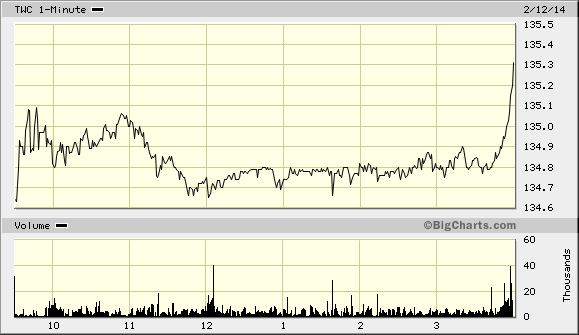
Markets are efficient, right?
-
Morning News: February 12, 2014
Eddy Elfenbein, February 12th, 2014 at 6:47 amCarney Renews BOE Low-Rate Pledge to Fight Slack in U.K. Economy
China Strength in Trade Growth Defies Signs of Slowdown
Spot Gold Comes Off A Bit, But Holds Most Of Yellen Gains
How Coca-Cola’s Deal With Green Mountain Shakes Up the Nonalcoholic Beverage Industry
CVS Profit Up After Fourth Quarter Prescription Volume Increases
Marissa Mayer: Yahoo Isn’t Done With Search
Irish company to buy Cadence Pharmaceuticals of San Diego
AOL’s Armstrong Joins Parade of CEOs Apologizing
Everybody Wins When Icahn Gives Up on Apple
SocGen Raises Dividend Payout After Swing to Fourth-Quarter Profit
A World Unprepared, Again, for Rising Interest Rates
U.S. Targets Buyers of China-Bound Luxury Cars
GM Had To Say It: We Didn’t Promote Barra To Pay Her Less
Jeff Carter: The Bitcoin FlashCrash
Cullen Roche: About That 1929 Chart…The Details Matter
Be sure to follow me on Twitter.
-
Thanks, Janet
Eddy Elfenbein, February 11th, 2014 at 4:43 pmOn the heels of Janet Yellen’s Congressional testimony, the S&P 500 rallied for the fourth day in a row — three of those days were more than 1%.
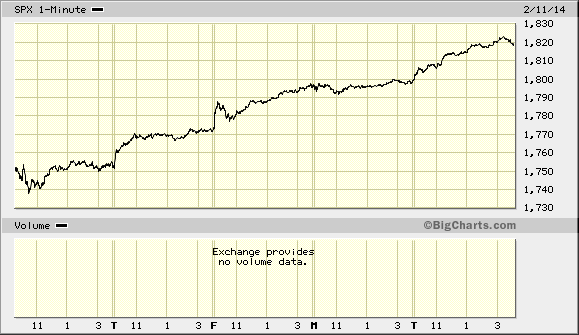
Going by daily closes, the S&P 500 dropped 5.76% from January 15th to February 3rd — and we’ve gained 4.47% in the six trading says since then.
-
Reynolds American Yields 5.55%
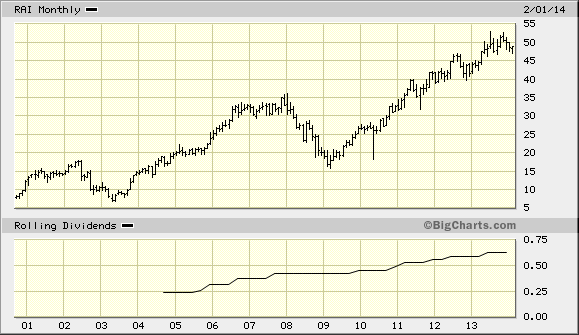
Eddy Elfenbein, February 11th, 2014 at 1:56 pmA tobacco stock I like a lot is Reynolds American ($RAI). In fact, it used to be a member of our Buy List. Reynolds is a very good company and I like to check in every so often to see how they’re doing.
Today the company reported Q4 earnings below estimates (77 cents vs 81 cent est.) and the shares are taking a hit. The good news is that Reynolds sees 2014 EPS ranging between $3.30 and $3.45. That’s especially good to get that kind of guidance so early in the year. Wall Street had been expecting $3.44 per share. They earned 3.19 per share for all of 2013.
The other good news is that Reynolds raised their quarterly dividend from 63 cents to 67 cents per share. That comes to $2.68 per share for the year. Notice also how RAI pays out about 80% of their earnings as dividends.
With the lower share price and higher dividends, Reynolds now yields 5.55% which is the equivalent of 890 Dow points.
-
Yellen’s Testimony
Eddy Elfenbein, February 11th, 2014 at 10:36 amTwice a year, the Chairman of the Federal Reserve heads up to Capitol Hill to take questions from Congress. This is part of the Humphrey Hawkins law. Each session is a two-day affair, one in front of each finance committee. Today is new Fed Chair Janet Yellen’s first Humphrey Hawkins testimony.
This is an interesting time for the Fed as they’ve started tapering but the last two job reports were rather mushy. While the Fed has consistently said they’re not on a pre-set course, they don’t appear to be wavering. At least, not yet.
Here are the key parts from Yellen’s testimony:
Our current program of asset purchases began in September 2012 amid signs that the recovery was weakening and progress in the labor market had slowed. The Committee said that it would continue the program until there was a substantial improvement in the outlook for the labor market in a context of price stability. In mid-2013, the Committee indicated that if progress toward its objectives continued as expected, a moderation in the monthly pace of purchases would likely become appropriate later in the year. In December, the Committee judged that the cumulative progress toward maximum employment and the improvement in the outlook for labor market conditions warranted a modest reduction in the pace of purchases, from $45 billion to $40 billion per month of longer-term Treasury securities and from $40 billion to $35 billion per month of agency mortgage-backed securities. At its January meeting, the Committee decided to make additional reductions of the same magnitude. If incoming information broadly supports the Committee’s expectation of ongoing improvement in labor market conditions and inflation moving back toward its longer-run objective, the Committee will likely reduce the pace of asset purchases in further measured steps at future meetings. That said, purchases are not on a preset course, and the Committee’s decisions about their pace will remain contingent on its outlook for the labor market and inflation as well as its assessment of the likely efficacy and costs of such purchases.
The Committee has emphasized that a highly accommodative policy will remain appropriate for a considerable time after asset purchases end. In addition, the Committee has said since December 2012 that it expects the current low target range for the federal funds rate to be appropriate at least as long as the unemployment rate remains above 6-1/2 percent, inflation is projected to be no more than a half percentage point above our 2 percent longer-run goal, and longer-term inflation expectations remain well anchored. Crossing one of these thresholds will not automatically prompt an increase in the federal funds rate, but will instead indicate only that it had become appropriate for the Committee to consider whether the broader economic outlook would justify such an increase. In December of last year and again this January, the Committee said that its current expectation–based on its assessment of a broad range of measures of labor market conditions, indicators of inflation pressures and inflation expectations, and readings on financial developments–is that it likely will be appropriate to maintain the current target range for the federal funds rate well past the time that the unemployment rate declines below 6-1/2 percent, especially if projected inflation continues to run below the 2 percent goal. I am committed to achieving both parts of our dual mandate: helping the economy return to full employment and returning inflation to 2 percent while ensuring that it does not run persistently above or below that level.
-
The Single-Best Metric: EV/EBITDA
Eddy Elfenbein, February 11th, 2014 at 9:50 amHere’s a post for new investors—and perhaps a refresher for more experienced ones.
I often tell readers not to rely on one metric or ratio. There’s simply no magic formula for stock success. Instead, investors should consult a broad spectrum of numbers to get a clear view of a company’s worth. Having said that, one of the best ratios out there is EV/EBITDA. In fact, some academic research has shown that it’s the single-best valuation measure there is.
So what do all these letters mean? I’ll break it down for you in plain English. EV/EBITDA stands for Enterprise Value divided by Earnings Before Interest, Taxes, Depreciation and Amortization.
Let’s start with the numerator, Enterprise Value (sometimes called total enterprise value), which is basically a fancier version of a company’s market value.
To calculate EV, you start with a company’s market value (the number of shares times the market price). You then add the amount of debt they hold, both short-term and long-term, and at current market value. Then you subtract the amount of cash they have.
This makes sense, because if you’re going to buy out a company, you’re acquiring their debt too, and you can pocket the cash.
Those are the most important differences between EV and market cap, but Enterprise Value also includes things like minority ownership in other companies. There are lots of public companies that own small stakes in other public companies. These may be spin-offs in which they’ve held onto some shares. Perhaps they were considering a merger. The problem is that when an asset you own soars in price, it inflates your equity and therefore tends to lower your ROE, even though you didn’t do anything.
Now let’s turn to the denominator, EBITDA, which stands for Earnings Before Interest, Taxes, Depreciation and Amortization. When we look at a business, we want to know about the dollars coming in compared with the dollars going out. Ideally, we want to isolate the numbers that are closest to showing us the firm’s pure business efficiency. In that regard, EBITDA is beneficial because it tries to be neutral about the company’s capital structure (that’s why we don’t include interest).
Think of it as taking all the revenue and subtracting the costs that solely go into running the business. It’s the business end of the business separated from the financing end of the business. When you look at net income, you’re also factoring in what the CFO has been up to, and of course, Uncle Sam’s cut. While those are important, these variables are a step removed from business operations. The downside of EBITDA is that it can be abused by companies declaring as “one-off” costs things that should really be considered normal costs.
Let me add another important generalization. Strong companies aren’t normally done in by too much debt. It’s certainly possible, and has happened many times. But the more common path is that weak companies acquire too much debt because they’re weak, in an attempt to cure their weakness.
You can find the EV/EBITDA for a stock on Yahoo Finance. Click on the Key Stats page, and it’s the ninth one down. As a rule of thumb, any EV/EBITDA below 10 is the sign of a good value.
-
Morning News: February 11, 2014
Eddy Elfenbein, February 11th, 2014 at 6:35 amSpot Gold Hits 3-Month High With Eyes on Yellen
Five Ways China’s Slowdown Will Ripple Across Globe
Blankfein Says Emerging Markets in Better State Than in ’98
Justice Department Sued Over $13 Billion JPMorgan Pact
Revelations by AOL Boss Raise Fears Over Privacy
Icahn Retreats From Apple Battle on Stock Buybacks
Casino Owners Battle Over Online Gambling
Branson Escalates War of Words With Qantas
L’Oreal to Buy Part of Nestle Stake After 40 Years of Ownership
McDonald’s US Sales Chilled by January Weather
Facebook’s Mark Zuckerberg is 2013’s Top Philanthropist. Youngest, Too.
Mary Barra’s GM Pay Could Top $14 Million, Putting Her in the Big Three
Where Alpha Chasers Dare to Venture
Epicurean Dealmaker: Gedankenexperiment
Joshua Brown: 41% of the S&P 500 Beating on Earnings and Revenue
Be sure to follow me on Twitter.
-
So Then This Happened
Eddy Elfenbein, February 10th, 2014 at 6:04 pmCNBC, First in Business Worldwide
-
The Market’s Two Speeds
Eddy Elfenbein, February 10th, 2014 at 9:18 am“How did you go bankrupt?” “Two ways. Gradually, then suddenly.”
― Ernest Hemingway, The Sun Also RisesOne of the important truths about investing is that the stock market tends to move at two speeds. Bull markets are long, slow, upwards crawls, while bear markets are sudden, precipitous and painful. These, of course, are generalizations, but they’re sufficiently accurate to merit further discussion.
The reason for this dichotomy is, in my opinion, the market’s fixation on disaster. You can create a small market with 1,000 happy, well-balanced investors; yet when they come together, the collective whole will be a sputtering, neurotic mess. That’s just how markets are. They always hold the suspicion, to a greater or lesser degree, that everything’s a fraud and utter ruin is just around the corner.
I can show this to you in concrete terms. Recently I looked at the S&P 500’s daily performance since 1957. I divided all the days into two groups: those with daily changes greater than 1.25%, and those with changes of less than 1.25%. The direction of the change, up or down, didn’t matter. I only looked at daily volatility.
The results were eye-opening. In terms of market performance, low volatility demolished high volatility. It wasn’t even close. The low-vol group, taken together, accounted for the market’s entire gain spread over 56 years. But the high-volatility days, coming an average of once every seven days, were net losers. Annualized, low volatility returned an average of 8.9% per year, while the high-volatility group lost 5.9% per year.
In simple terms, scared markets are bad markets.
Market gurus enjoy discussing tail risk and the importance of fat tails, but they neglect the other part—the tall peaks. Yet we can see that it’s in these numerous small changes that the difference is truly made.
Investors need to understand that freak-outs happen. They just do. They’re painful because they temporarily confirm and amplify the market’s worst fears.
Fortunately for us, these periodic panics are what give us the value premium. After all, you’re more likely to jump ship from the leakiest vessel. This is why the value premium shows up again and again and again. It’s not some transient anomaly, but rather the direct result of human nature.
-
Archives
- June 2026
- May 2026
- April 2026
- March 2026
- February 2026
- January 2026
- December 2025
- November 2025
- October 2025
- September 2025
- August 2025
- July 2025
- June 2025
- May 2025
- April 2025
- March 2025
- February 2025
- January 2025
- December 2024
- November 2024
- October 2024
- September 2024
- August 2024
- July 2024
- June 2024
- May 2024
- April 2024
- March 2024
- February 2024
- January 2024
- December 2023
- November 2023
- October 2023
- September 2023
- August 2023
- July 2023
- June 2023
- May 2023
- April 2023
- March 2023
- February 2023
- January 2023
- December 2022
- November 2022
- October 2022
- September 2022
- August 2022
- July 2022
- June 2022
- May 2022
- April 2022
- March 2022
- February 2022
- January 2022
- December 2021
- November 2021
- October 2021
- September 2021
- August 2021
- July 2021
- June 2021
- May 2021
- April 2021
- March 2021
- February 2021
- January 2021
- December 2020
- November 2020
- October 2020
- September 2020
- August 2020
- July 2020
- June 2020
- May 2020
- April 2020
- March 2020
- February 2020
- January 2020
- December 2019
- November 2019
- October 2019
- September 2019
- August 2019
- July 2019
- June 2019
- May 2019
- April 2019
- March 2019
- February 2019
- January 2019
- December 2018
- November 2018
- October 2018
- September 2018
- August 2018
- July 2018
- June 2018
- May 2018
- April 2018
- March 2018
- February 2018
- January 2018
- December 2017
- November 2017
- October 2017
- September 2017
- August 2017
- July 2017
- June 2017
- May 2017
- April 2017
- March 2017
- February 2017
- January 2017
- December 2016
- November 2016
- October 2016
- September 2016
- August 2016
- July 2016
- June 2016
- May 2016
- April 2016
- March 2016
- February 2016
- January 2016
- December 2015
- November 2015
- October 2015
- September 2015
- August 2015
- July 2015
- June 2015
- May 2015
- April 2015
- March 2015
- February 2015
- January 2015
- December 2014
- November 2014
- October 2014
- September 2014
- August 2014
- July 2014
- June 2014
- May 2014
- April 2014
- March 2014
- February 2014
- January 2014
- December 2013
- November 2013
- October 2013
- September 2013
- August 2013
- July 2013
- June 2013
- May 2013
- April 2013
- March 2013
- February 2013
- January 2013
- December 2012
- November 2012
- October 2012
- September 2012
- August 2012
- July 2012
- June 2012
- May 2012
- April 2012
- March 2012
- February 2012
- January 2012
- December 2011
- November 2011
- October 2011
- September 2011
- August 2011
- July 2011
- June 2011
- May 2011
- April 2011
- March 2011
- February 2011
- January 2011
- December 2010
- November 2010
- October 2010
- September 2010
- August 2010
- July 2010
- June 2010
- May 2010
- April 2010
- March 2010
- February 2010
- January 2010
- December 2009
- November 2009
- October 2009
- September 2009
- August 2009
- July 2009
- June 2009
- May 2009
- April 2009
- March 2009
- February 2009
- January 2009
- December 2008
- November 2008
- October 2008
- September 2008
- August 2008
- July 2008
- June 2008
- May 2008
- April 2008
- March 2008
- February 2008
- January 2008
- December 2007
- November 2007
- October 2007
- September 2007
- August 2007
- July 2007
- June 2007
- May 2007
- April 2007
- March 2007
- February 2007
- January 2007
- December 2006
- November 2006
- October 2006
- September 2006
- August 2006
- July 2006
- June 2006
- May 2006
- April 2006
- March 2006
- February 2006
- January 2006
- December 2005
- November 2005
- October 2005
- September 2005
- August 2005
- July 2005
 Eddy Elfenbein is a Washington, DC-based speaker, portfolio manager and editor of the blog Crossing Wall Street. His